REVIEW 4 major objections 4 minor 14 references
A CFD model for heat and mass transfer leading to plume formation within Wet Cooling Towers
T0 review · 4 major / 4 minor · reviewed 2026-08-04 · deepseek-v4-flash
Pith's one-line read This paper proposes a CFD model in the code_saturne solver for heat and mass transfer in wet cooling towers and validates it against the MISTRAL experimental loop, claiming exit temperatures within 10% error and evaporation rates within 15%
desk verdict Modest engineering validation of a standard wet-cooling-tower CFD model in code_saturne; the 10%/15% agreement is believable but the 2D-vs-3D gap is the load-bearing weakness. read the letter →
The pith
A machine-rendered reading of the paper's core claim, the machinery that carries it, and where it could break.
The reading
What carries the argument
The load-bearing machinery is the closure-law stack: Poppe's evaporation flux in the fill packing with adjusted coefficients A ≈ 0.8 and n ≈ 0.6; the Bosnjakovic Lewis-factor relation tying convective heat transfer to evaporation; the Ranz-Marshall Nusselt correlation for rain-zone interfacial heat transfer; and Dreyer's interfacial friction model between air and rain. These closures turn a two-phase CFD calculation into a locally computable heat-and-mass-transfer model, rather than prescribing a global tower characteristic. The drift-velocity transport of injected liquid water is also central because it lets the model track water through the packing and rainfall.
What would settle it
Run the same 55 MISTRAL cases in a 3D simulation of the square-section loop with identical closure laws and check whether exit temperatures and evaporated masses stay within the claimed 10% and 15% margins; if they do not, the 2D representation is carrying the agreement.
Extended reading notes
Core claim
The paper's central claim is that a CFD model built in code_saturne, combining humid-air Navier-Stokes equations with scalar transport of water vapour and injected liquid water, reproduces the MISTRAL cooling-tower experiment well enough to be useful. The model computes evaporation and convection locally: Poppe's evaporation formulation is used in the fill packing, the Bosnjakovic Lewis factor couples convective and evaporative heat transfer, Ranz-Marshall correlation handles rain-zone heat transfer, and Dreyer's approach models air-rain friction. The validation shows a satisfying agreement on exit temperatures, evaporated mass flow, and total exchanged thermal power, with a stable underesti
Load-bearing premise
The claimed agreement rests on the untested premise that a 2D representation of a 3D square-section experimental loop with a side air inlet captures the heat and mass transfer that governs the measured exit quantities.
Editorial extensions
If this is right
- For the 55 MISTRAL cases, the model reproduces exit water and air temperatures to within 10% and evaporated water mass flow to within 15%.
- The model provides a CFD-based route to estimating cooling-tower water consumption, since the evaporated mass flow is a computed output rather than a prescribed global value.
- Because exhaust air temperature and humidity are solved fields, the same simulation yields inlet conditions for modelling plume dispersion in the atmosphere.
- The systematic underprediction of evaporation, linked to the missing pre-packing rain injection zone, identifies a concrete next modelling step rather than a fundamental flaw.
- The separation of fill-pack and rain-zone closures allows each zone to be refined independently with new experimental data.
Reading between the lines
- If the reported accuracy transfers to full-scale natural-draft towers, cooling-tower water consumption could be estimated from CFD rather than calibrated one-dimensional correlations, altering how plant water balance and plume impact are assessed.
- Because the packing coefficients are adjusted rather than derived, a useful test is to replace them with geometry-resolved fill-pack hydrodynamics; the MISTRAL dataset would then serve as a benchmark for whether resolved packings outperform calibrated ones.
- The 2D representation is a specific assumption tied to this facility's geometry; a 3D simulation under crosswind conditions is a natural next validation before relying on the model for real-world plume dispersion.
- The identified missing rain-injection zone implies a testable prediction: adding that zone should simultaneously reduce the evaporation error and the temperature bias.
Signed reviews
Editorial analysis
A structured set of objections, weighed in public.
Referee Report
Summary. The paper presents a CFD model in code_saturne for heat and mass transfer in wet cooling towers, with focus on evaporation in the fill-pack and rain zones. The model closes the two-phase exchanges through Poppe evaporation, Bosnjakovic Lewis-factor convection, Ranz-Marshall rain-zone Nusselt correlation, and Dreyer rain-air friction. The authors validate the model against the MISTRAL reduced-scale experimental loop at Bugey (55 cases) and report temperature predictions within a 10% error margin and evaporation within 15%. They conclude that the modeling is a first step for predicting water consumption and humid-air plume dispersion.
Significance. If the reported agreement holds, the model would provide a useful, open-source-based CFD capability for wet-cooling-tower design and plume-impact studies. The paper is honest about several limitations: it explicitly states that no optimization of the packing evaporation correlation was performed, that the rain injection zone is not yet simulated, and that the simulations are currently 2D. The strength of the work is the comparison against an independent experimental dataset. However, the validation evidence is currently insufficient to support the central quantitative claim: the 2D-vs-3D gap, the lack of a defined error metric, missing mesh-convergence and uncertainty information, and the unstated provenance of the adjusted coefficients A and n all leave room for the reported 10%/15% agreement to be partly an artifact. The paper has value as a progress report, but the validation needs to be made robust before it can support the claimed predictive capability.
major comments (4)
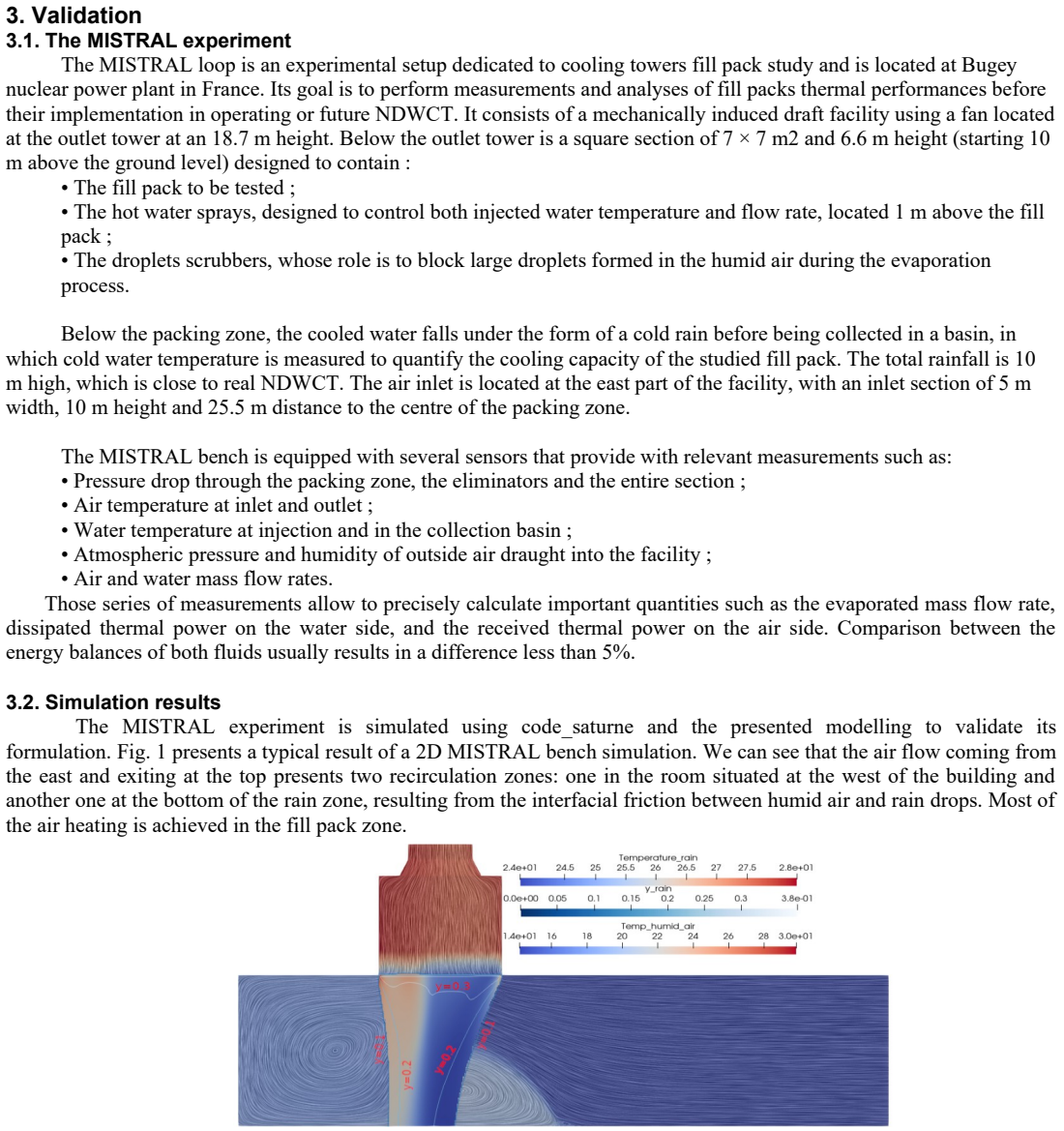
- [§3.2, Fig. 1] The MISTRAL bench is described in §3.1 as a 7×7 m square-section loop with a side air inlet (5 m wide, 10 m high, 25.5 m from the packing center), which is inherently three-dimensional. The only simulation shown is a 'typical result of a 2D MISTRAL bench simulation' (Fig. 1). No symmetry justification, no 2D-vs-3D comparison, and no quantified spanwise variation are provided. The two recirculation zones in Fig. 1 are plane vortices; their 3D counterparts need not have the same location or intensity. Because the claimed 10%/15% agreement is the core validation evidence, the possibility that 2D channeling artificially changes heat/mass transfer is load-bearing and must be addressed by a 3D run or a convincing reduced-dimensionality argument.
- [§2.2, Eq. (4)] Equation (4) uses the packing evaporation coefficients A≈0.8 and n≈0.6. The text calls them 'adjusted coefficients' but does not state whether these values were taken from the literature, chosen from prior calibration, or fitted to the same MISTRAL dataset used in §3.2. If they were fitted to these 55 cases, the validation is partly circular. The statement in §3.2 that 'we did not conduct an optimization of the packing evaporation correlation' mitigates, but does not resolve, the ambiguity. Please state the provenance of A and n and whether any parameters were adjusted after comparison with the experimental data.
- [§3.2] The reported '10% error margin and 15% for the evaporation rate' is not defined. Is it a mean relative error, a maximum per-case error, or a band enclosing most points? No experimental uncertainties are given, and no mesh-convergence study is reported. Without these, the reader cannot assess whether the agreement is within the noise of the measurements or the discretization. Add a precise error metric, report measurement uncertainties, and include at least one mesh-convergence test for the MISTRAL configuration.
- [§3.2, §4] The authors state that the rain injection zone (the spray zone above the packing) is not simulated, and that this omission likely explains the stable underestimation of evaporation and the corresponding systematic bias in outlet temperatures. Since this zone is an integral part of a real cooling tower and contributes to evaporation and plume formation, the validation does not yet cover the full configuration relevant to the paper's stated goals. This limitation is acknowledged in good faith, but the conclusions should be reframed as partial validation: the model captures the fill-pack and cold-rain-zone behavior, but the missing spray zone could affect water-consumption and plume predictions. Please quantify the expected contribution of the spray zone or explicitly limit the scope to the modeled zones.
minor comments (4)
- [§2.2, Eq. (4)] The sentence 'A 0.8 and n 0.6 are adjusted coefficients that ≈ ≈ represent the evaporative capacity' has garbled typography; it should read 'A≈0.8 and n≈0.6 are adjusted coefficients that represent...'.
- [§2.1, Eqs. (1)–(3)] In the version provided, Equations (1)–(4) are referenced but not displayed. Please ensure all equations appear in the final manuscript, with definitions of every symbol.
- [Fig. 2] Figure 2 does not specify what quantity is shown on each axis beyond the text, nor whether points represent individual cases, means, or ranges. Add axis labels, units, and a legend, and indicate whether the comparison is per-case or averaged.
- [§3.2] The phrase 'typical result of a 2D MISTRAL bench simulation' should be clarified: is the 2D slice aligned with the east-west inlet direction? What is its thickness/span? Adding a schematic of the computational domain would help.
Circularity Check
No significant circularity: model validation rests on an independent experimental loop, external closure laws, and an explicit non-optimization statement.
full rationale
The paper's central validation claim compares code_saturne simulations against the MISTRAL experimental loop, an independent external dataset. The closure laws used (Poppe evaporation, Bosnjakovic Lewis factor, Ranz-Marshall rain-zone Nusselt number, Dreyer rain friction) are established literature correlations, not results derived from the present paper's own outputs or from self-citations. No load-bearing step is justified by a self-citation: the references to code_saturne and previous cooling-tower CFD work are background references, not author self-citations used to force the conclusion. The coefficients A and n are described as 'adjusted coefficients' representing fill-pack evaporative capacity, which could in principle raise a fitted-input concern; however, the paper explicitly states 'we did not conduct an optimization of the packing evaporation correlation as in other studies', which directly disclaims fitting to the validation data. Without evidence that A and n were tuned to the MISTRAL measurements, the validation is not circular by construction. The paper's admitted limitation that the rain injection zone is not simulated is a modelling deficiency, not a circularity. The 2D-versus-3D geometry mismatch is a plausible correctness risk for the validation claim, but it is not a form of circular reasoning: the comparison still uses independent measurements. Therefore no circular step can be exhibited with the required specificity, and the appropriate finding is no significant circularity.
Assumptions & free parameters
free parameters (2)
- A (evaporation coefficient) =
≈0.8
- n (evaporation exponent) =
≈0.6
assumptions (5)
- domain assumption Poppe evaporation formulation (Eq. 4) correctly models the mass flux in the fill pack
- domain assumption Bosnjakovic Lewis factor relates convective heat transfer to mass transfer
- domain assumption Ranz-Marshall correlation gives the rain-zone Nusselt number
- domain assumption Dreyer approach models air-rain friction
- domain assumption k-epsilon turbulence model with linear production
Cite this review
Pith. "Pith review of A CFD model for heat and mass transfer leading to plume formation within Wet Cooling Towers." pith.science (2026). https://pith.science/paper/5XVPHUAC
@misc{pith2026250908394,
  author       = {Pith},
  title        = {Pith review of: A CFD model for heat and mass transfer leading to plume formation within Wet Cooling Towers},
  year         = {2026},
  howpublished = {\url{https://pith.science/paper/5XVPHUAC}},
  note         = {Machine review of arXiv:2509.08394}
}
read the original abstract
The crucial role played by Wet Cooling Towers (WCT) in many electricity production plants (e.g. nuclear power plants) make them a key parameter in the industrial design of such facilities. Their impact over the cooling water consumption and surrounding atmosphere through the formation and dispersion of a humid air plume has pushed the need to obtain proper models and simulations in order to anticipate those effects. In this work, we tackle this issue through a dedicated modelling in the CFD solver code_saturne. Specific modeling includes heat and mass transfer (convection and evaporation) between the injected water and the air flow that are validated against experimental results obtained in a reduced scale WCT experimental loop. Satisfying agreement is obtained for several parameters such as air and water exit temperatures, evaporation mass flow rate and total exchanged thermal power. This constitutes an important first step for detailed CFD predictions of WCT water consumption and humid air plume atmospheric dispersion.
Figures

Reference graph
Works this paper leans on
-
[1]
The performance of natural draft dry cooling towers under crosswind: Cfd study
Rafat Al-Waked and Masud Behnia. “The performance of natural draft dry cooling towers under crosswind: Cfd study”. International journal of energy research, 28(2):147–161, 2004
work page 2004
-
[2]
Cfd simulation of wet cooling towers
Rafat Al-Waked and Masud Behnia. “Cfd simulation of wet cooling towers”. Applied thermal engineering, 26(4):382– 395, 2006
work page 2006
-
[3]
Nicolas Blain, Antoine Belaud, and Matthieu Miolane. “Development and validation of a cfd model for numerical simulation of a large natural draft wet cooling tower”. Applied Thermal Engineering, 105: 953–960, 2016
work page 2016
-
[4]
A Chahine, P Matharan, D Wendum, L Musson-Genon, R Bresson, and B Carissimo. “Modelling atmo- spheric effects on performance and plume dispersal from natural draft wet cooling towers”. Journal of Wind Engineering and Industrial Aerodynamics, 136:151–164, 2015
work page 2015
-
[5]
N Williamson, S Armfield, and M Behnia. “Numerical simulation of flow in a natural draft wet cooling Tower–the effect of radial thermofluid fields”. Applied Thermal Engineering, 28(2-3):178–189, 2008
work page 2008
-
[6]
Experimental characterization Of liquid flows in cooling tower packing
Nicolas Jourdan, Mohamed Kanniche, Thibaut Neveux, and Olivier Potier. “Experimental characterization Of liquid flows in cooling tower packing”. Industrial & Engineering Chemistry Research, 61(7):2926–2936, 2022. HTFF 209-4
work page 2022
-
[7]
Numerical simulation of Hydrodynamics in wet cooling tower packings
Nicolas Jourdan, Mohamed Kanniche, Thibaut Neveux, and Olivier Potier. “Numerical simulation of Hydrodynamics in wet cooling tower packings”. International Journal of Refrigeration, 2023
work page 2023
-
[8]
Code_Saturne: a Finite Volume Code for the Computation of Turbulent Incompressible Flows
F Archambeau, N Méchitoua and M Sakiz, “Code_Saturne: a Finite Volume Code for the Computation of Turbulent Incompressible Flows”. International Journal on Finite Volumes, 2004
work page 2004
Show all 14 references
-
[9]
A linearised turbulent production in the k-ε model for engineering applications
V Guimet and D Laurence. “A linearised turbulent production in the k-ε model for engineering applications”. In Engineering Turbulence Modelling and Experiments 5, pages 157–166. Elsevier, 2002
2002
-
[10]
A diffusion-inertia model for predicting dis- Persion of low-inertia particles in turbulent flows
LI Zaichik, SL Soloviev, AP Skibin, and VM Alipchenkov. “A diffusion-inertia model for predicting dis- Persion of low-inertia particles in turbulent flows”. In 5th International Conference on Multiphase Flow, Yokohama, paper, number 220, 2004
2004
-
[11]
Berechnung von rückkühlwerken
M Poppe and H Rögener. “Berechnung von rückkühlwerken”. VDI-Wärmeatlas, 111:1–15, 1991
1991
-
[12]
Technische thermodynamik
Fr Bosnjakovic. Technische thermodynamik. 1965
1965
-
[13]
Evaporation from drops
WE Ranz and WR Marshall. “Evaporation from drops”. Chemical Engineering Progress, 48:41–146, 1952
1952
-
[14]
Modelling of cooling tower splash pack
Andre Alexis Dreyer and PJ Erens. “Modelling of cooling tower splash pack”. International journal of heat And mass transfer, 39(1):109–123, 1996. HTFF 209-5
1996
Reviewed August 4, 2026 · model on record in the stance chip above.
Discussion (0). Continue with ORCID to comment.