REVIEW 4 major objections 5 minor 25 references
AutoVeriFix: Automatically Correcting Errors and Enhancing Functional Correctness in LLM-Generated Verilog Code
T0 review · 4 major / 5 minor · reviewed 2026-08-04 · deepseek-v4-flash
Pith's one-line read AutoVeriFix claims that a two-stage Python-oracle loop raises functional correctness of LLM-generated Verilog to 84.6-90.2 percent on standard benchmarks.
desk verdict AutoVeriFix is a solid, genuinely new fix-loop for Verilog; the oracle ceiling is real but the numbers are internally consistent. read the letter →
The pith
A machine-rendered reading of the paper's core claim, the machinery that carries it, and where it could break.
The reading
What carries the argument
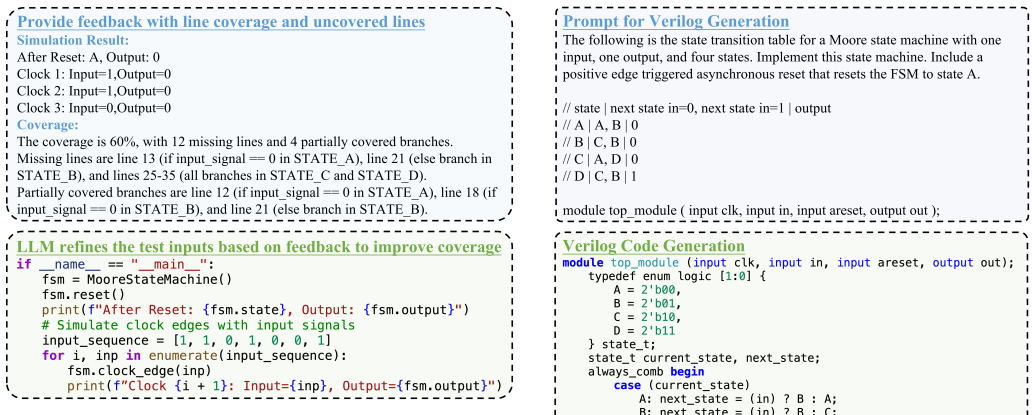
The central object is the Python reference model: a high-level, LLM-generated behavioral description of the circuit that serves as a functional oracle for the entire pipeline. It carries the argument by providing expected input-output pairs for any test input, which are used to generate a hardware testbench and to detect discrepancies in the Verilog simulation. The second key mechanism is the coverage-feedback loop, where line coverage of the Python model is measured, uncovered branches are reported to the LLM, and new test inputs are generated until coverage passes a threshold. This testbench is then the standard against which the Verilog generator iteratively debugs its output.
What would settle it
Take a benchmark problem where the LLM-generated Python reference model is known to be functionally wrong (one of the 1.4-6.0% cases in Table I), run AutoVeriFix end-to-end, and show that the resulting Verilog passes its self-generated testbench but fails the ground-truth functional evaluation. A high false-positive rate on such a set, or an independent human-annotated test suite, would directly quantify the oracle-mismatch failure mode.
Extended reading notes
Core claim
The paper's central claim is that the functional correctness of LLM-generated Verilog can be substantially improved by using an LLM-generated Python model as a functional oracle. In Stage 1, the LLM produces Python code from the hardware description; this code is over 94% functionally correct across benchmarks, even though the same LLM generates Verilog that is less than 50% correct. A testbench is built from the Python model and iteratively expanded using line-coverage feedback until at least 85% coverage is reached, typically exceeding 90%. In Stage 2, a fresh LLM generates Verilog, which is syntax-checked and then simulated against the testbench; any input-output mismatches are fed back t
Load-bearing premise
The Python reference model generated by the LLM is treated as the true specification, so if that model is wrong for a design—which Table I shows happens for 1.4 to 6.0 percent of problems—the testbench encodes wrong expected outputs and the Verilog is corrected to match a wrong spec.
Editorial extensions
If this is right
- LLM-generated Verilog can approach the functional correctness of LLM-generated Python, effectively transferring software-code reliability to hardware design.
- Coverage-guided testbench generation reduces the false-positive rate of automated verification from roughly 22-30% down to below 9%, making LLM-generated RTL more trustworthy for direct use.
- The method raises the practical ceiling for open and closed commercial LLMs, with AutoVeriFix on GPT-3.5 already beating several Verilog-specific models.
- Functional correctness, not syntax, becomes the bottleneck that automated feedback loops can target, potentially reducing manual verification effort in hardware design flows.
- The framework is model-agnostic: any LLM strong enough to generate correct Python can serve as the oracle, so improvements in base LLMs should directly improve RTL generation.
Reading between the lines
- Because the oracle is itself LLM-generated, a wrong Python model can silently encode wrong behavior into the testbench; for safety-critical hardware, a human or formal check on the reference model would still be needed, even though the paper's FPR numbers suggest this is rare.
- The same two-stage structure could be transferred to other hardware description languages such as SystemVerilog or Chisel, where the Python oracle would be identical and only the synthesis/debug prompts change.
- The coverage-feedback mechanism suggests a deeper principle: using a high-level language model to generate a reference implementation, then using coverage to build a testbench, is a general strategy that might also apply to firmware, drivers, or protocol implementations where a golden model is expensive to write by hand.
- If combined with formal equivalence checking between the Python model and the Verilog, the approach could in principle close the remaining correctness gap, since the oracle is already in executable form.
Editorial analysis
A structured set of objections, weighed in public.
Referee Report
Summary. The paper proposes AutoVeriFix, a two-stage framework for improving the functional correctness of LLM-generated Verilog. In Stage 1, an LLM (GPT-3.5 or GPT-4) generates a Python reference model from a hardware description, plus a set of input stimuli; line coverage of the Python model is measured, and the LLM iteratively refines the stimuli until coverage exceeds 85%. In Stage 2, a separate LLM generates Verilog from the same description, undergoes syntax debugging with compiler feedback, and then functional debugging using the testbench produced in Stage 1: simulation mismatches between Verilog and the Python reference model are fed back to the LLM until simulation matches the testbench. The paper evaluates the resulting designs on VerilogEval-human, VerilogEval-machine, RTLLM v1.1, and RTLLM v2.0 using pass@k. It reports that AutoVeriFix with GPT-4 achieves pass@10 of 84.6 and 90.2 on the two VerilogEval subsets and pass@5 of 86.2 and 83.5 on the two RTLLM subsets, substantially outperforming the listed commercial and domain-specific baselines. It also reports that coverage feedback reduces the false positive rate of testbench validation from roughly 22-30% to below 12% for GPT-3.5 and below 9% for GPT-4.
Significance. If the reported results hold, this is a practically important contribution: it offers a fully LLM-based way to use the relative strength of LLMs in Python code generation to guide the functional correction of RTL code, and it evaluates on widely used external benchmarks with the standard pass@k metric. The improvements over GPT-4, Claude3, OriGen, and RTLCoder are large, and the FPR ablation is a useful first step toward understanding testbench quality. The paper also makes the falsifiable prediction that Python reference models with >90% correctness can be used to substantially raise Verilog correctness, which is worth testing. However, the manuscript in its current form does not yet establish the central claim at the advertised strength: the Python-oracle ceiling is one of 94.0-98.6%, no statistical uncertainty or multiple-seed variance is reported, no code or artifact is released, and the comparison does not control for the additional LLM inference budget consumed by the iterative correction loops. The idea is promising, but the empirical evidence needs substantial strengthening.
major comments (4)
- [Section III-B, Table I, Section IV-D (Fig. 6)] The Python reference model is the functional oracle of the entire pipeline. Table I reports that this oracle is functionally incorrect on 1.4-6.0% of problems across the four benchmarks (94.00-98.60% correctness). Since Section III-D3 corrects Verilog until it matches the Python model, any problem whose Python model is wrong has a hard ceiling that cannot be recovered, and the feedback loop can actively deflect a correct Verilog design toward the wrong oracle. The paper never separates final pass@k failures into oracle-miss problems versus other problems, nor does it report performance after excluding or revealing oracle-miss cases. Fig. 6 makes the issue concrete: with GPT-4, 7-9% of designs that pass the self-generated testbench are incorrect on the official benchmark, so the testbench/oracle mismatch is not hypothetical. Please report pass@k conditioned on oracle correctness, and anal
- [Section IV-A and IV-C] The headline claims ('significantly outperforms all other models') rest on single point estimates of pass@k with no confidence intervals, no bootstrap, and no multiple-seed variance. LLM sampling is stochastic, and the paper does not state how many independent runs or which random seeds were used. Given that the margins over the strongest baselines are sometimes moderate (e.g., pass@10 90.2 vs. OriGen 85.7 on VerilogEval-machine), statistical uncertainty could change the ranking. Please report bootstrap confidence intervals over problems, or multiple independent runs, and specify the sampling temperature/seed protocol.
- [Section III-D, IV-C, Table II] AutoVeriFix uses an unbounded iterative loop of syntax and functional feedback: each corrected sample consumes multiple LLM calls. The baselines in Table II, especially one-shot commercial models and even self-correcting models, do not appear to be matched for compute or number of LLM calls. The reported gains may partly reflect additional inference budget rather than the Python-oracle mechanism. Please report the average number of LLM calls and tokens per problem for AutoVeriFix, and include a comparable baseline that spends a similar number of corrective iterations (or uses the same self-reflection loop without the Python oracle). Without this, the improvement is not an apples-to-apples comparison.
- [Section III-C and IV-D, Eq. (2)] Line coverage of the Python model is used as the proxy for functional coverage of the hardware design, but no evidence is provided that this proxy correlates with the actual fault-detection capability of the testbench. The 85% threshold is presented as a free parameter with no sensitivity analysis. Moreover, the false positive rate in Eq. (2) measures only 'passes testbench but fails official eval'; it does not measure false negatives, i.e., Verilog designs that fail the self-generated testbench but would pass official evaluation. If the Python oracle is wrong on some problems, correct Verilog can be rejected or corrected to the wrong behavior, and FPR alone cannot detect this. Please add mutation/fault-injection experiments or at least a sensitivity study over coverage thresholds, and report the false negative rate of the testbench.
minor comments (5)
- [Section IV-B] The text says 'Since the results for GPT-3.5 are similar, we have chosen to omit them' but no GPT-3.5 version of Table I is available anywhere. Please include the complete table in the appendix or state the exact ranges.
- [Section IV-A] The footnote 'We will open source our code after the paper is accepted' is not a substitute for an artifact. For a reproducibility-focused empirical paper, please provide at least the evaluation code and prompts in an anonymous repository or supplement.
- [Section IV-C, Eq. (1)] Please clarify the sample-count convention: for pass@10 and pass@5, is n always 10, and are the 10 samples for each problem generated independently with the same temperature? This affects the variance of the estimator and the comparability with the cited baselines.
- [Section II-A, References] Reference [9] (Chen et al., 'Evaluating Large Language Models Trained on Code') appears to support the claim about scarcity of high-quality RTL data, but it is a general code-generation paper, not an RTL-data-scarcity source. Please use a more appropriate citation for hardware data scarcity.
- [Section IV-D, Fig. 6] The baseline described as 'without coverage feedback' is underspecified: does it use the initial LLM-generated testbench only, or does it also perform syntax and functional debugging? Please state the exact baseline protocol so the ablation isolates coverage feedback.
Circularity Check
No significant circularity: the headline pass@k results are judged by external benchmark testbenches, not by the framework's self-generated Python oracle.
full rationale
AutoVeriFix's Stage-1 Python model is used only as an internal correction oracle; the reported pass@k numbers (Eq. 1) are evaluated against the official VerilogEval and RTLLM testbenches, not against the generated Python model or its derived testbench. The paper explicitly acknowledges the oracle can be wrong (Table I: functional correctness 94.0-98.6%) and quantifies the resulting gap through FPR analysis (Eq. 2, Fig. 6), stating that passing its generated testbench does not guarantee correctness. This is an oracle-accuracy limitation, not circular reasoning. There are no load-bearing self-citations, no fitted parameters renamed as predictions, and no uniqueness/ansatz claims imported from the authors' prior work. The central claim is an empirical comparison on external benchmarks and is self-contained in that sense.
Assumptions & free parameters
free parameters (1)
- line coverage threshold =
85%
assumptions (3)
- domain assumption LLMs generate Python reference models that are functionally more correct than their Verilog outputs.
- ad hoc to paper Line coverage of the Python model is a meaningful proxy for functional coverage of the hardware design.
- domain assumption Official benchmark testbenches (VerilogEval, RTLLM) are the ground truth for functional correctness, and generated testbenches approximate them well enough to improve pass@k.
Cite this review
Pith. "Pith review of AutoVeriFix: Automatically Correcting Errors and Enhancing Functional Correctness in LLM-Generated Verilog Code." pith.science (2026). https://pith.science/paper/Y36JUS3G
@misc{pith2026250908416,
  author       = {Pith},
  title        = {Pith review of: AutoVeriFix: Automatically Correcting Errors and Enhancing Functional Correctness in LLM-Generated Verilog Code},
  year         = {2026},
  howpublished = {\url{https://pith.science/paper/Y36JUS3G}},
  note         = {Machine review of arXiv:2509.08416}
}
read the original abstract
Large language models (LLMs) have demonstrated impressive capabilities in generating software code for high-level programming languages such as Python and C++. However, their application to hardware description languages, such as Verilog, is challenging due to the scarcity of high-quality training data. Current approaches to Verilog code generation using LLMs often focus on syntactic correctness, resulting in code with functional errors. To address these challenges, we present AutoVeriFix, a novel Python-assisted two-stage framework designed to enhance the functional correctness of LLM-generated Verilog code. In the first stage, LLMs are employed to generate high-level Python reference models that define the intended circuit behavior. In the second stage, these Python models facilitate the creation of automated tests that guide the generation of Verilog RTL implementations. Simulation discrepancies between the reference model and the Verilog code are iteratively used to identify and correct errors, thereby improving the functional accuracy and reliability of the LLM-generated Verilog code. Experimental results demonstrate that our approach significantly outperforms existing state-of-the-art methods in improving the functional correctness of generated Verilog code.
Figures


Figures from the paper (3 more)


Reference graph
Works this paper leans on
-
[1]
On the robustness of code generation techniques: An empirical study on github copilot,
A. Mastropaolo, L. Pascarella, E. Guglielmi, M. Ciniselli, S. Scalabrino, R. Oliveto, and G. Bavota, “On the robustness of code generation techniques: An empirical study on github copilot,” in2023 IEEE/ACM 45th International Conference on Software Engineering (ICSE). IEEE, 2023, pp. 2149–2160
2023
-
[2]
Codegen2: Lessons for training llms on programming and natural languages,
E. Nijkamp, H. Hayashi, C. Xiong, S. Savarese, and Y . Zhou, “Codegen2: Lessons for training llms on programming and natural languages,”arXiv preprint arXiv:2305.02309, 2023
arXiv 2023
-
[3]
Benchmarking large language models for automated verilog rtl code generation,
S. Thakur, B. Ahmad, Z. Fan, H. Pearce, B. Tan, R. Karri, B. Dolan- Gavitt, and S. Garg, “Benchmarking large language models for automated verilog rtl code generation,” in2023 Design, Automation & Test in Europe Conference & Exhibition (DATE). IEEE, 2023, pp. 1–6
work page 2023
-
[4]
A deep learning framework for verilog autocompletion towards design and verification automation,
E. Dehaerne, B. Dey, S. Halder, and S. De Gendt, “A deep learning framework for verilog autocompletion towards design and verification automation,”arXiv preprint arXiv:2304.13840, 2023
arXiv 2023
-
[5]
Openllm-rtl: Open dataset and benchmark for llm-aided design rtl generation(invited),
S. Liu, Y . Lu, W. Fang, M. Li, and Z. Xie, “Openllm-rtl: Open dataset and benchmark for llm-aided design rtl generation(invited),” in2024 IEEE/ACM International Conference on Computer-Aided Design (IC- CAD). ACM, 2024
work page 2024
-
[6]
Verilogeval: Evaluating large language models for verilog code generation,
M. Liu, N. Pinckney, B. Khailany, and H. Ren, “Verilogeval: Evaluating large language models for verilog code generation,” in2023 IEEE/ACM International Conference on Computer Aided Design (ICCAD). IEEE, 2023, pp. 1–8
2023
-
[7]
S. Liu, W. Fang, Y . Lu, Q. Zhang, H. Zhang, and Z. Xie, “Rtlcoder: Outperforming gpt-3.5 in design rtl generation with our open-source dataset and lightweight solution,” in2024 IEEE LLM Aided Design Workshop (LAD). IEEE, 2024, pp. 1–5
work page 2024
-
[8]
Origen: Enhancing rtl code generation with code-to- code augmentation and self-reflection,
F. Cui, C. Yin, K. Zhou, Y . Xiao, G. Sun, Q. Xu, Q. Guo, D. Song, D. Lin, X. Zhanget al., “Origen: Enhancing rtl code generation with code-to- code augmentation and self-reflection,”arXiv preprint arXiv:2407.16237, 2024
arXiv 2024
Show all 25 references
-
[9]
Evaluating large language models trained on code,
M. Chen, J. Tworek, H. Jun, Q. Yuan, H. P. D. O. Pinto, J. Kaplan, H. Edwards, Y . Burda, N. Joseph, G. Brockmanet al., “Evaluating large language models trained on code,”arXiv preprint arXiv:2107.03374, 2021
2021 arXiv
-
[10]
Autochip: Automating hdl generation using llm feedback,
S. Thakur, J. Blocklove, H. Pearce, B. Tan, S. Garg, and R. Karri, “Autochip: Automating hdl generation using llm feedback,”arXiv preprint arXiv:2311.04887, 2023
2023 arXiv
-
[11]
Rtlfixer: Automatically fixing rtl syntax errors with large language model,
Y . Tsai, M. Liu, and H. Ren, “Rtlfixer: Automatically fixing rtl syntax errors with large language model,” inProceedings of the 61st ACM/IEEE Design Automation Conference, 2024, pp. 1–6
2024
-
[12]
Verilogcoder: Autonomous verilog coding agents with graph-based planning and abstract syntax tree (ast)- based waveform tracing tool,
C.-T. Ho, H. Ren, and B. Khailany, “Verilogcoder: Autonomous verilog coding agents with graph-based planning and abstract syntax tree (ast)- based waveform tracing tool,”arXiv preprint arXiv:2408.08927, 2024
2024 arXiv
-
[13]
Myhdl: A python-based hardware description language,
J. Decaluwe, “Myhdl: A python-based hardware description language,” http://www.myhdl.org, 2003, accessed: July 2025
2003
-
[14]
Exploiting computation reuse for stencil acceler- ators,
Y . Chi and J. Cong, “Exploiting computation reuse for stencil acceler- ators,” in2020 57th ACM/IEEE Design Automation Conference (DAC). IEEE, 2020, pp. 1–6
2020
-
[15]
Betterv: Con- trolled verilog generation with discriminative guidance,
Z. Pei, H.-L. Zhen, M. Yuan, Y . Huang, and B. Yu, “Betterv: Con- trolled verilog generation with discriminative guidance,”arXiv preprint arXiv:2402.03375, 2024
2024 arXiv
-
[16]
Verigen: A large language model for verilog code generation,
S. Thakur, B. Ahmad, H. Pearce, B. Tan, B. Dolan-Gavitt, R. Karri, and S. Garg, “Verigen: A large language model for verilog code generation,” ACM Transactions on Design Automation of Electronic Systems, vol. 29, no. 3, pp. 1–31, 2024
2024
-
[17]
Codegen: An open large language model for code with multi-turn program synthesis,
E. Nijkamp, B. Pang, H. Hayashi, L. Tu, H. Wang, Y . Zhou, S. Savarese, and C. Xiong, “Codegen: An open large language model for code with multi-turn program synthesis,”arXiv preprint arXiv:2203.13474, 2022
2022 arXiv
-
[18]
Gpt-3.5-turbo,
OpenAI, “Gpt-3.5-turbo,” 2023, accessed: 2024. [Online]. Available: https://platform.openai.com/docs/models/gpt-3-5
2023
-
[19]
Gpt-4 technical report,
——, “Gpt-4 technical report,” 2023, accessed: 2024. [Online]. Available: https://openai.com/research/gpt-4
2023
-
[20]
Rtllm: An open-source benchmark for design rtl generation with large language model,
Y . Lu, S. Liu, Q. Zhang, and Z. Xie, “Rtllm: An open-source benchmark for design rtl generation with large language model,” in2024 29th Asia and South Pacific Design Automation Conference (ASP-DAC). IEEE, 2024, pp. 722–727
2024
-
[21]
A multi-expert large language model archi- tecture for verilog code generation,
B. Nadimi and H. Zheng, “A multi-expert large language model archi- tecture for verilog code generation,” in2024 IEEE LLM Aided Design Workshop (LAD). IEEE, 2024, pp. 1–5
2024
-
[22]
Code llama: Open foundation models for code,
B. Roziere, J. Gehring, F. Gloeckle, S. Sootla, I. Gat, X. E. Tan, Y . Adi, J. Liu, R. Sauvestre, T. Remezet al., “Code llama: Open foundation models for code,”arXiv preprint arXiv:2308.12950, 2023
2023 arXiv
-
[23]
Qwen technical report,
J. Bai, S. Bai, Y . Chu, Z. Cui, K. Dang, X. Deng, Y . Fan, W. Ge, Y . Han, F. Huanget al., “Qwen technical report,”arXiv preprint arXiv:2309.16609, 2023
2023 arXiv
-
[24]
Deepseek-coder: When the large language model meets programming–the rise of code intelligence,
D. Guo, Q. Zhu, D. Yang, Z. Xie, K. Dong, W. Zhang, G. Chen, X. Bi, Y . Wu, Y . Liet al., “Deepseek-coder: When the large language model meets programming–the rise of code intelligence,”arXiv preprint arXiv:2401.14196, 2024
2024 arXiv
-
[25]
Introducing the next generation of claude,
Anthropic, “Introducing the next generation of claude,” https://www. anthropic.com/, 2024
2024
Reviewed August 4, 2026 · model on record in the stance chip above.
Discussion (0). Sign in to comment.