REVIEW 3 major objections 5 minor 159 references
Phishing Webpage Detection: Unveiling the Threat Landscape and Investigating Detection Techniques
T0 review · 3 major / 5 minor · reviewed 2026-08-04 · deepseek-v4-flash
Pith's one-line read A survey maps phishing webpage detection into URL, content, and visual approaches, and catalogs the open problems that keep them from stopping zero-day attacks.
desk verdict A decent descriptive survey of phishing detection, but its headline claims that RF is best and hybrids outperform are unsupported because they pool numbers from non-comparable studies. read the letter →
The pith
A machine-rendered reading of the paper's core claim, the machinery that carries it, and where it could break.
The reading
What carries the argument
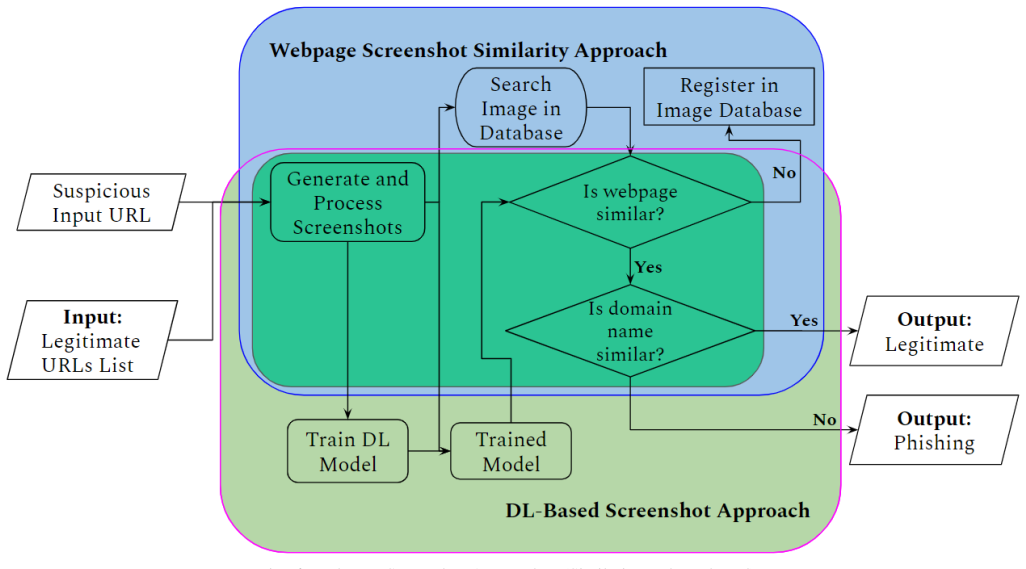
The survey's organizing device is a three-branch taxonomy of detection methodologies: URL-based approaches (list-based, certificate-based, heuristic, ML, DL), webpage-based approaches (content similarity, ML on content, screenshot similarity, DL on screenshots), and hybrid approaches that concatenate URL and content feature vectors before classification. The taxonomy carries the argument by turning a scattered literature into a map, and that map is what the authors use to identify which gaps appear in every branch.
What would settle it
Run the surveyed classifiers (RF, hybrid, etc.) on one common benchmark corpus with a fixed train/test split, balanced classes, and a single evaluation protocol; if RF's edge and the hybrid advantage shrink or reverse, those comparative conclusions fail.
Extended reading notes
Core claim
The paper claims that phishing webpage detection research can be organized by the input it inspects—the URL string, the page's content and code, or its visual appearance (screenshots, logos, favicons)—and that this organization exposes where current defenses fall short. On the evidence it surveys, it further claims that the Random Forest classifier is the most frequently favored machine-learning choice and that hybrid approaches combining URL and content features give the best zero-day detection performance. It then lists open problems and offers remedies: balanced dataset generation, feature-selection algorithms, stacked classifiers, brand prediction for proactive defense, and user-educatio
Load-bearing premise
The survey's comparative conclusions—that Random Forest is predominantly favored and hybrid approaches outperform others—assume that accuracy, precision, recall, and F1 values reported by different papers on different datasets with different evaluation protocols can be compared directly.
Editorial extensions
If this is right
- If the taxonomy is accurate, newcomers can locate any detection method by its input and immediately see which techniques already exist for that branch.
- If Random Forest is indeed the consistently favored classifier, new work can reasonably start with RF as a baseline before trying more complex models.
- If hybrid detection outperforms single-input approaches, combining URL and content features is a promising design direction for zero-day phishing detection.
- If the listed open problems are real, detection research should prioritize diverse balanced datasets, tiny-URL handling, compromised-domain detection, adversarial robustness, and LLM-generated-page detection.
- If the proposed phishing-page generator (synthesizing phishing pages from legitimate URLs plus random phishing attributes) is adopted, it could supply the balanced, diverse data the field currently lacks.
Reading between the lines
- The survey's comparative claims rest on cross-paper metric comparisons that its own tables show involve different datasets, class balances, and evaluation protocols; a shared benchmark would be the natural next step to verify whether RF and hybrid superiority actually holds.
- The proposed phishing-page generator could double as an adversarial robustness testbed: generated pages with varied phishing attributes can probe how classifiers generalize beyond a fixed repository.
- Brand prediction via NLP on business rankings is a proactive angle that could let defenses anticipate which domains attackers will impersonate next, rather than reacting after phishing pages appear.
- Stacking classifiers, suggested as a performance booster, is not itself evaluated in the survey; testing it on a balanced dataset would be a direct, low-cost follow-up experiment.
Editorial analysis
A structured set of objections, weighed in public.
Referee Report
Summary. This paper is a survey of phishing webpage detection. It categorizes detection approaches into URL-based, webpage content-based, and visual/hybrid methods; reviews inputs, dataset repositories, feature sets, feature selection algorithms, ML/DL classifiers, and performance metrics; discusses evasion tactics such as compromised domains, URL shortening, adversarial attacks, and LLM-based phishing; and lists open issues with proposed solutions. The contribution is a structured literature synthesis and a research-gap list rather than a new detector.
Significance. If read as a descriptive overview, the paper is useful: it organizes a large body of recent work, covers evolving threats (LLM-generated phishing, adversarial attacks), and provides tables of datasets and features that practitioners will find convenient. The survey does not ship reproducible code, machine-checked proofs, or parameter-free derivations; its value is as a synthesis. However, the paper's headline comparative conclusions are not supported by the evidence it presents. The claims that 'RF classifier is predominantly favored' and that 'hybrid-based approach outperforms other approaches' (Sections IV.D and VIII, Table V) rest on pooled accuracy/precision/recall/F1 numbers obtained on different datasets, class ratios, and evaluation protocols. These conclusions need to be reframed or removed before the survey can be accepted.
major comments (3)
- [§IV.D, Table V, §VIII] The statement that 'the RF classifier is predominantly favored' and 'outperforms other ML classifiers' is a load-bearing conclusion, but Table V pools metrics from papers using different repositories (Alexa, PhishTank, Common Crawl, DMOZ, UCI, OpenPhish), different class proportions (e.g., [73] uses 14,000 phishing vs 1,000 legitimate; [57] uses 2,119 vs 1,407), and different train/test splits. No common baseline or statistical test is provided. Direct inspection of Table V contradicts the superiority claim: in [111], LSTM achieves 98.76% accuracy vs RF 93.47%; in [11], LR achieves 98.42% vs RF 97.37%; in [57], PCA-RF achieves 99.55% vs RF 99.31%; in [77], multiple classifiers outperform RF on some metrics. At most, RF's frequency of use could be reported as a descriptive count, but that requires an explicit count and should be separated from any performance ranking.
- [§III.C, §VIII] The claim that 'the hybrid-based approach outperforms other approaches' is based only on [57] and [58]. Neither paper compares its hybrid feature combination against URL-only or content-only variants on the same data, so the conclusion 'the research works have proven' (Section III.C) is unsupported. The related survey [145] reaches a similar conclusion, but citing another survey's opinion does not provide the controlled comparison needed. This conclusion should be removed or rephrased as an observation about the two cited papers, not a general performance ordering.
- [§VII, Table VI] The paper positions itself as systematic and claims to make a substantial contribution by contrasting prior surveys in Table VI. However, the symbols used in the table legend (discussed, highlighted, not mentioned) are not rendered in the text, making the comparison impossible to verify. In addition, the selection of surveys is justified only by 'publication records, citation counts' with no explicit inclusion/exclusion criteria or search protocol. Adding a short methodology paragraph and fixing the table symbols is necessary to support the 'systematic' claim.
minor comments (5)
- [§II.B.1] Typo: 'Tanco' should be 'Tranco'.
- [Table II] Typo in the listed suspicious word: 'siginin' should be 'signin'.
- [§V.D] 'FR rate' appears to be a typo for 'FP rate'.
- [Table V] The many '-' entries make it unclear which metric a value refers to. The table would be much clearer if each metric column were explicitly labeled and every cell had a value or a footnote.
- [§II.F] DBN is discussed as a DL algorithm, but the same algorithm family is partly listed under neural networks in §II.E. This duplication could be consolidated to avoid confusion.
Circularity Check
No circularity: the paper is a survey that synthesizes external results; its comparative claims raise comparability concerns, not circular reasoning.
full rationale
This is a literature survey, not a derivation. It does not fit parameters, define quantities in terms of targets, or make predictions from its own inputs. The paper reports and categorizes results from external papers and compares metrics in Table V. The skeptical concern about cross-study comparability of accuracy/precision/recall/F1 (different datasets, class balances, and evaluation protocols) is an evidence-quality or correctness issue, not a circularity issue, because no quoted result is being reduced to the paper's own assumptions or fitted values. There is no equation in the paper that defines an output in terms of the quantity it is supposed to predict, and the authors do not invoke a self-citation chain as the justification for a central claim. The closest possible point—the reliance on prior surveys and shared observations such as dataset imbalance skewing decision trees—is a general machine-learning observation, not load-bearing circular reasoning. Therefore the appropriate circularity score is 0.
Assumptions & free parameters
assumptions (3)
- domain assumption Reported performance metrics across surveyed papers are comparable even when datasets and evaluation protocols differ.
- domain assumption The selected set of surveys and primary papers is representative of the field.
- domain assumption The feature taxonomy (URL, content, visual, third-party) cleanly partitions all phishing detection approaches.
Cite this review
Pith. "Pith review of Phishing Webpage Detection: Unveiling the Threat Landscape and Investigating Detection Techniques." pith.science (2026). https://pith.science/paper/DTJCUAW3
@misc{pith2026250908424,
  author       = {Pith},
  title        = {Pith review of: Phishing Webpage Detection: Unveiling the Threat Landscape and Investigating Detection Techniques},
  year         = {2026},
  howpublished = {\url{https://pith.science/paper/DTJCUAW3}},
  note         = {Machine review of arXiv:2509.08424}
}
read the original abstract
In the realm of cybersecurity, phishing stands as a prevalent cyber attack, where attackers employ various tactics to deceive users into gathering their sensitive information, potentially leading to identity theft or financial gain. Researchers have been actively working on advancing phishing webpage detection approaches to detect new phishing URLs, bolstering user protection. Nonetheless, the ever-evolving strategies employed by attackers, aimed at circumventing existing detection approaches and tools, present an ongoing challenge to the research community. This survey presents a systematic categorization of diverse phishing webpage detection approaches, encompassing URL-based, webpage content-based, and visual techniques. Through a comprehensive review of these approaches and an in-depth analysis of existing literature, our study underscores current research gaps in phishing webpage detection. Furthermore, we suggest potential solutions to address some of these gaps, contributing valuable insights to the ongoing efforts to combat phishing attacks.
Figures


Figures from the paper (3 more)


Reference graph
Works this paper leans on
-
[111]
Classifying phishing URLs using recurrent neural net- works,
A. C. Bahnsen, E. C. Bohorquez, S. Villegas, J. Vargas, and F. A. Gonz´alez, “Classifying phishing URLs using recurrent neural net- works,” inAPWG symposium on electronic crime research (eCrime), IEEE, 2017
work page 2017
-
[11]
A machine learning based approach for phishing detection using hyperlinks information,
A. K. Jain and B. B. Gupta, “A machine learning based approach for phishing detection using hyperlinks information,”Journal of Ambient Intelligence and Humanized Computing, Springer, vol. 10, no. 5, pp. 2015–2028, 2019
2015
-
[57]
Detection of phishing websites using an ef- ficient feature-based machine learning framework,
R. S. Rao and A. R. Pais, “Detection of phishing websites using an ef- ficient feature-based machine learning framework,”Neural Computing and Applications, Springer, vol. 31, no. 8, pp. 3851–3873, 2019
2019
-
[58]
Efficient deep learning techniques for the detection of phishing websites,
M. Somesha, A. R. Pais, R. S. Rao, and V . S. Rathour, “Efficient deep learning techniques for the detection of phishing websites,”S ¯adhan¯a, Springer, vol. 45, no. 1, pp. 1–18, 2020
2020
-
[73]
PHISH-SAFE: URL features-based phishing detection system using machine learning,
A. K. Jain and B. Gupta, “PHISH-SAFE: URL features-based phishing detection system using machine learning,” inCyber Security. Springer, 2018, pp. 467–474
2018
-
[77]
CatchPhish: detection of phishing websites by inspecting URLs,
R. S. Rao, T. Vaishnavi, and A. R. Pais, “CatchPhish: detection of phishing websites by inspecting URLs,”Journal of Ambient Intelli- gence and Humanized Computing, Springer, vol. 11, no. 2, pp. 813– 825, 2020
2020
-
[145]
Deep Learning for Phishing Detection: Taxonomy, Current Challenges and Future Directions,
N. Q. Do, A. Selamat, O. Krejcar, E. Herrera-Viedma, and H. Fujita, “Deep Learning for Phishing Detection: Taxonomy, Current Challenges and Future Directions,”IEEE Access, 2022
work page 2022
-
[1]
Statistics, ITU,
“Statistics, ITU,” 2023, https://www.itu.int/en/ITU-/Statistics/Pages/ stat/default.aspx [Accessed: October 14th, 2023]
2023
Show all 159 references
-
[2]
The 5 Biggest Phishing Scams of All Time - IT Governance Blog En, IT Governance European Blog,
L. Irwin, “The 5 Biggest Phishing Scams of All Time - IT Governance Blog En, IT Governance European Blog,” 2022, https://www. itgovernance.eu/blog/en/the-5-biggest-phishing-scams-of-all-time [Accessed: October 14th, 2023]
2022
-
[3]
What is Cybersecurity?
C. . I. S. A. (CISA), “What is Cybersecurity?” 2021, https://www.cisa. gov/uscert/ncas/tips/ST04-001 [Accessed: October 14th, 2023]
2021
-
[4]
Susceptibility to phishing on social network sites: A personality information processing model,
E. D. Frauenstein and S. Flowerday, “Susceptibility to phishing on social network sites: A personality information processing model,” Computers & security, Elsevier, vol. 94, p. 101862, 2020
2020
-
[5]
APWG Report,
APWG, “APWG Report,” 2018, https://docs.apwg.org//reports/apwg trends report q1 2018.pdf [Accessed: October 14th, 2023]
2018
-
[6]
Phishing Activity Trends Report,
——, “Phishing Activity Trends Report,” 2022, https://docs.apwg.org/ reports/apwg trends report q4 2022.pdf [Accessed: May 13th, 2023]
2022
-
[7]
Anti-phishing based on automated individual white-list,
Y . Cao, W. Han, and Y . Le, “Anti-phishing based on automated individual white-list,” inProceedings of the 4th ACM workshop on Digital identity management, 2008
2008
-
[8]
Beyond blacklists: learning to detect malicious web sites from suspicious URLs,
J. Ma, L. K. Saul, S. Savage, and G. M. V oelker, “Beyond blacklists: learning to detect malicious web sites from suspicious URLs,” in Proceedings of the 15th ACM SIGKDD international conference on Knowledge discovery and data mining, 2009
2009
-
[9]
Phishing-Alarm: Robust and Efficient Phishing Detection via Page Component Similarity,
J. Mao, W. Tian, P. Li, T. Wei, and Z. Liang, “Phishing-Alarm: Robust and Efficient Phishing Detection via Page Component Similarity,”IEEE Access, vol. 5, pp. 17 020–17 030, 2017
2017
-
[10]
Phishing attacks detection using machine learning approach,
M. N. Alam, D. Sarma, F. F. Lima, I. Saha, S. Hossainet al., “Phishing attacks detection using machine learning approach,” in3rd International Conference on Smart Systems and Inventive Technology (ICSSIT), IEEE, 2020
2020
-
[12]
Visualphishnet: Zero- day phishing website detection by visual similarity,
S. Abdelnabi, K. Krombholz, and M. Fritz, “Visualphishnet: Zero- day phishing website detection by visual similarity,” inProceedings of the 2020 ACM SIGSAC conference on computer and communications security, 2020
2020
-
[13]
PhishTank,
C. T. I. Group, “PhishTank,” 2006, http://www.phishtank.com/ developer [Accessed: October 14th, 2023]
2006
-
[14]
Phishing Websites, UC Irvine Machine Learning Repository,
L. M. Rami Mohammad, “Phishing Websites, UC Irvine Machine Learning Repository,” 2015, https://archive.ics.uci.edu/ml/datasets/ phishing+websites [Accessed: October 14th, 2023]
2015
-
[15]
Mendeley Data, Phishing Websites Dataset,
S. Ariyadasa, S. Fernando, and S. Fernando, “Mendeley Data, Phishing Websites Dataset,” 2021, https://data.mendeley.com/datasets/ n96ncsr5g4 [Accessed: October 14th, 2023]
2021
-
[16]
Alexa Top Sites,
Amazon, “Alexa Top Sites,” http://www.alexa.com/topsites
-
[17]
Common Crawl,
E. Gil, S. Rich, and L. Greg, “Common Crawl,” https://commoncrawl. org/ [Accessed: October 14th, 2023]
2023
-
[18]
Top Sites Ranking,
L. P. Victor, V . G. Tom, T. Samaneh, K. Maciej, and J. Wouter, “Top Sites Ranking,” https://tranco-list.eu/ [Accessed: October 14th, 2023]
2023
-
[19]
Open Directory Project (ODP), DMOZ,
S. Rick and T. Bob, “Open Directory Project (ODP), DMOZ,” 1998, https://dmoz-odp.org/Computers/Artificial Intelligence/Machine Learning/Datasets/ [Accessed: October 14th, 2023]
1998
-
[20]
“Curlie,” 2017, https://curlie.org/ [Accessed: October 14th, 2023]
2017
-
[21]
OpenPhish,
“OpenPhish,” 2014, https://openphish.com/ [Accessed: October 14th, 2023]
2014
-
[22]
MillerSmiles,
M. Bright, “MillerSmiles,” 2003, http://www.millersmiles.co.uk/ [Ac- cessed: October 14th, 2023]
2003
-
[23]
Phishing Dataset,
Ebub, “Phishing Dataset,” 2017, https://github.com/ebubekirbbr/pdd/ tree/master/input [Accessed: October 14th, 2023]
2017
-
[24]
Mendeley Data, phishrepo-dataset,
S. Ariyadasa, S. Fernando, and S. Fernando, “Mendeley Data, phishrepo-dataset,” 2022, https://data.mendeley.com/datasets/ ttmmtsgbs8/4 [Accessed: October 14th, 2023]
2022
-
[25]
Python-whois,
R. Penman, “Python-whois,” https://pypi.org/project/python-whois/, 2022, [Accessed: October 14th, 2023]
2022
-
[26]
Registration Data Access Protocol,
I. E. T. Force, “Registration Data Access Protocol,” https:// en.wikipedia.org/wiki/Registration Data Access Protocol, 2015, [Ac- cessed: October 14th, 2023]
2015
-
[27]
Liu and H
H. Liu and H. Motoda,Feature extraction, construction and selection: A data mining perspective. Springer Science & Business Media, 1998, vol. 453
1998
-
[28]
Context pre-modeling: an empirical analysis for classification based user-centric context-aware predictive modeling,
I. H. Sarker, H. Alqahtani, F. Alsolami, A. I. Khan, Y . B. Abushark, and M. K. Siddiqui, “Context pre-modeling: an empirical analysis for classification based user-centric context-aware predictive modeling,” Journal Of Big Data, SpringerOpen, vol. 7, no. 1, pp. 1–23, 2020
2020
-
[29]
Scikit-learn: Machine learning in Python,
F. Pedregosa, G. Varoquaux, A. Gramfort, V . Michel, B. Thirion, O. Grisel, M. Blondel, P. Prettenhofer, R. Weiss, V . Dubourget al., “Scikit-learn: Machine learning in Python,”the Journal of machine Learning research, JMLR. org, vol. 12, pp. 2825–2830, 2011
2011
-
[30]
Correlation-based feature selection strategy in classification problems,
K. Michalak and H. Kwa ´snicka, “Correlation-based feature selection strategy in classification problems,”International Journal of Applied Mathematics and Computer Science, Uniwersytet Zielonog ´orski. Ofi- cyna Wydawnicza, vol. 16, no. 4, pp. 503–511, 2006
2006
-
[31]
Rough fuzzy sets and fuzzy rough sets,
D. Dubois and H. Prade, “Rough fuzzy sets and fuzzy rough sets,” International Journal of General System, Taylor & Francis, vol. 17, no. 2-3, pp. 191–209, 1990
1990
-
[32]
Semantic sensitive TF-IDF to determine word relevance in documents,
A. Jalilifard, V . F. Carid ´a, A. F. Mansano, R. S. Cristo, and F. P. C. da Fonseca, “Semantic sensitive TF-IDF to determine word relevance in documents,” inAdvances in Computing and Network Communications: Proceedings of CoCoNet, Springer, 2021, vol. 2, pp. 327–337
2021
-
[33]
Principal Component Analysis,
H. Abdi and L. J. Williams, “Principal Component Analysis,”Wiley in- terdisciplinary reviews: computational statistics, Wiley Online Library, vol. 2, no. 4, pp. 433–459, 2010
2010
-
[34]
Random forests,
L. Breiman, “Random forests,”Machine learning, Springer, vol. 45, pp. 5–32, 2001
2001
-
[35]
J. R. Quinlan,C4. 5: programs for machine learning. Elsevier, 2014
2014
-
[36]
Classification and Regression Trees
A. Gordon, L. Breiman, J. Friedman, R. Olshen, and C. J. Stone, “Classification and Regression Trees.”Biometrics, JSTOR, vol. 40, no. 3, p. 874, 1984
1984
-
[37]
A Review of Bayesian Machine Learning Principles, Methods, and Applications,
J. P. Bharadiya, “A Review of Bayesian Machine Learning Principles, Methods, and Applications,”International Journal of Innovative Sci- ence and Research Technology, vol. 8, no. 5, pp. 2033–2038, 2023
-
[38]
Goodfellow, Y
I. Goodfellow, Y . Bengio, and A. Courville,Deep learning. MIT press, 2016
2016
-
[39]
Era of deep neural networks: A review,
P. Sharma and A. Singh, “Era of deep neural networks: A review,” in8th International Conference on Computing, Communication and Networking Technologies (ICCCNT), IEEE, 2017, pp. 1–5
2017
-
[40]
Gradient-based learning applied to document recognition,
Y . LeCun, L. Bottou, Y . Bengio, and P. Haffner, “Gradient-based learning applied to document recognition,”Proceedings of the IEEE, vol. 86, no. 11, pp. 2278–2324, 1998
1998
-
[41]
A semi-automatic approach to the segmentation of liver parenchyma from 3D CT images with Extreme Learning Machine,
W. Huang, Z. M. Tan, Z. Lin, G.-B. Huang, J. Zhou, C.-K. Chui, Y . Su, and S. Chang, “A semi-automatic approach to the segmentation of liver parenchyma from 3D CT images with Extreme Learning Machine,” in Annual international conference of the IEEE engineering in medicine and ...
2012
-
[42]
Improvements to Platt’s SMO algorithm for SVM classifier design,
S. S. Keerthi, S. K. Shevade, C. Bhattacharyya, and K. R. K. Murthy, “Improvements to Platt’s SMO algorithm for SVM classifier design,” Neural computation, MIT Press One Rogers Street, Cambridge, MA 02142-1209, USA journals-info, vol. 13, no. 3, pp. 637–649, 2001
2001
-
[43]
Sequential minimal optimization for SVM with pinball loss,
X. Huang, L. Shi, and J. A. Suykens, “Sequential minimal optimization for SVM with pinball loss,”Neurocomputing, vol. 149, pp. 1596–1603, 2015
2015
-
[44]
PCA-RF: an efficient Parkinson’s disease prediction model based on random forest classifi- cation,
I. Gupta, V . Sharma, S. Kaur, and A. K. Singh, “PCA-RF: an efficient Parkinson’s disease prediction model based on random forest classifi- cation,”arXiv preprint arXiv:2203.11287, 2022
2022 arXiv
-
[45]
Data mining: practical machine learning tools and techniques with Java implementations,
I. H. Witten and E. Frank, “Data mining: practical machine learning tools and techniques with Java implementations,”ACM Sigmod Record, New York, NY, USA, vol. 31, no. 1, pp. 76–77, 2002
2002
-
[46]
Very simple classification rules perform well on most commonly used datasets,
R. C. Holte, “Very simple classification rules perform well on most commonly used datasets,”Machine learning, Springer, vol. 11, pp. 63–90, 1993
1993
-
[47]
A comprehensive investigation and comparison of ma- chine learning techniques in the domain of heart disease,
S. Pouriyeh, S. Vahid, G. Sannino, G. De Pietro, H. Arabnia, and J. Gutierrez, “A comprehensive investigation and comparison of ma- chine learning techniques in the domain of heart disease,” inIEEE symposium on computers and communications (ISCC), 2017, pp. 204– 207
2017
-
[48]
Ridge estimators in logistic regression,
S. l. Cessie and J. V . Houwelingen, “Ridge estimators in logistic regression,”Journal of the Royal Statistical Society Series C: Applied Statistics, Oxford University Press, vol. 41, no. 1, pp. 191–201, 1992
1992
-
[49]
Estimating continuous distributions in Bayesian classifiers,
G. H. John and P. Langley, “Estimating continuous distributions in Bayesian classifiers,”arXiv preprint arXiv:1302.4964, 2013
2013 arXiv
-
[50]
Instance-based learning algorithms,
D. W. Aha, D. Kibler, and M. K. Albert, “Instance-based learning algorithms,”Machine learning, Springer, vol. 6, pp. 37–66, 1991
1991
-
[51]
A. A. Freitas,Data mining and knowledge discovery with evolutionary algorithms. Springer Science & Business Media, 2002
2002
-
[52]
Catching the Phish: De- tecting Phishing Attacks using Recurrent Neural Networks (RNNs),
L. Halga ˇs, I. Agrafiotis, and J. R. Nurse, “Catching the Phish: De- tecting Phishing Attacks using Recurrent Neural Networks (RNNs),” inInformation Security Applications: 20th International Conference, WISA 2019, Jeju Island, South Korea, August 21–24, Revised Selected Paper...
2019
-
[53]
An Introduction to Convolutional Neural Networks,
K. O’Shea and R. Nash, “An Introduction to Convolutional Neural Networks,”arXiv preprint arXiv:1511.08458, 2015
2015 arXiv
-
[54]
A review on the long short-term memory model,
G. Van Houdt, C. Mosquera, and G. N ´apoles, “A review on the long short-term memory model,”Artificial Intelligence Review, Springer, vol. 53, pp. 5929–5955, 2020
2020
-
[55]
A fast learning algorithm for deep belief nets,
G. E. Hinton, S. Osindero, and Y .-W. Teh, “A fast learning algorithm for deep belief nets,”Neural computation, vol. 18, no. 7, pp. 1527– 1554, 2006
2006
-
[56]
Deep belief networks and deep learning,
Y . Hua, J. Guo, and H. Zhao, “Deep belief networks and deep learning,” inProceedings of International Conference on Intelligent Computing and Internet of Things, IEEE, 2015
2015
-
[59]
Web phishing detection using a deep learning framework,
P. Yi, Y . Guan, F. Zou, Y . Yao, W. Wang, and T. Zhu, “Web phishing detection using a deep learning framework,”Wireless Communications and Mobile Computing, Hindawi, vol. 2018, 2018
2018
-
[60]
Visual-similarity-based phishing detection,
E. Medvet, E. Kirda, and C. Kruegel, “Visual-similarity-based phishing detection,” inProceedings of the 4th international conference on Security and privacy in communication networks, ACM, 2008
2008
-
[61]
Detecting phishing web pages with visual similarity assessment based on earth mover’s distance (EMD),
A. Y . Fu, L. Wenyin, and X. Deng, “Detecting phishing web pages with visual similarity assessment based on earth mover’s distance (EMD),” IEEE transactions on dependable and secure computing, vol. 3, no. 4, pp. 301–311, 2006
2006
-
[62]
PhishZoo: Detecting Phishing Websites by Looking at Them,
S. Afroz and R. Greenstadt, “PhishZoo: Detecting Phishing Websites by Looking at Them,” inIEEE fifth international conference on semantic computing, 2011
2011
-
[63]
Phishpedia: A Hybrid Deep Learning Based Approach to Visually Identify Phishing Webpages,
Y . Lin, R. Liu, D. M. Divakaran, J. Y . Ng, Q. Z. Chan, Y . Lu, Y . Si, F. Zhang, and J. S. Dong, “Phishpedia: A Hybrid Deep Learning Based Approach to Visually Identify Phishing Webpages,” inUSENIX Security Symposium, 2021
2021
-
[64]
Anomaly based web phishing page detection,
Y . Pan and X. Ding, “Anomaly based web phishing page detection,” in2006 22nd Annual Computer Security Applications Conference (ACSAC’06), IEEE, 2006, pp. 381–392
2006
-
[65]
A framework for detection and measurement of phishing attacks,
S. Garera, N. Provos, M. Chew, and A. D. Rubin, “A framework for detection and measurement of phishing attacks,” inProceedings of the 2007 ACM workshop on Recurring malcode, 2007
2007
-
[66]
Two-stage ELM for phishing Web pages detection using hybrid features,
W. Zhang, Q. Jiang, L. Chen, and C. Li, “Two-stage ELM for phishing Web pages detection using hybrid features,”World Wide Web, Springer, vol. 20, no. 4, pp. 797–813, 2017
2017
-
[67]
Cantina: a content-based approach to detecting phishing web sites,
Y . Zhang, J. I. Hong, and L. F. Cranor, “Cantina: a content-based approach to detecting phishing web sites,” inProceedings of the 16th international conference on World Wide Web, ACM, 2007
2007
-
[68]
Cantina+ a feature-rich machine learning framework for detecting phishing web sites,
G. Xiang, J. Hong, C. P. Rose, and L. Cranor, “Cantina+ a feature-rich machine learning framework for detecting phishing web sites,”ACM Transactions on Information and System Security (TISSEC), vol. 14, no. 2, pp. 1–28, 2011
2011
-
[69]
Visual similarity-based phishing detection without victim site information,
M. Hara, A. Yamada, and Y . Miyake, “Visual similarity-based phishing detection without victim site information,” inIEEE Symposium on Computational Intelligence in Cyber Security, 2009
2009
-
[70]
URLNet: Learning a URL representation with deep learning for malicious URL detection,
H. Le, Q. Pham, D. Sahoo, and S. C. Hoi, “URLNet: Learning a URL representation with deep learning for malicious URL detection,”arXiv preprint arXiv:1802.03162, 2018
2018 arXiv
-
[71]
Phishing website classification and detection using machine learning,
J. Kumar, A. Santhanavijayan, B. Janet, B. Rajendran, and B. Bindhu- madhava, “Phishing website classification and detection using machine learning,” inInternational Conference on Computer Communication and Informatics (ICCCI), IEEE, 2020
2020
-
[72]
PhishAlert: An Efficient Phishing URL De- tection via Hybrid Methodology,
B. Sharma and P. Singh, “PhishAlert: An Efficient Phishing URL De- tection via Hybrid Methodology,”International Journal of Innovative Technology and Exploring Engineering (IJITEE), vol. 8, 2019
2019
-
[74]
Phishing detection: A recent intelligent machine learning comparison based on models content and features,
N. Abdelhamid, F. Thabtah, and H. Abdel-jaber, “Phishing detection: A recent intelligent machine learning comparison based on models content and features,” inInternational conference on Intelligence and Security Informatics (ISI), IEEE, 2017, pp. 72–77
2017
-
[75]
Phishing web sites features classification based on extreme learning machine,
Y . S ¨onmez, T. Tuncer, H. G ¨okal, and E. Avcı, “Phishing web sites features classification based on extreme learning machine,” in6th International Symposium on Digital Forensic and Security (ISDFS), IEEE, 2018, pp. 1–5
2018
-
[76]
On the character of phishing URLs: Accurate and robust statistical learning classifiers,
R. Verma and K. Dyer, “On the character of phishing URLs: Accurate and robust statistical learning classifiers,” inProceedings of the 5th ACM Conference on Data and Application Security and Privacy, 2015
2015
-
[78]
“Kn0w Thy Doma1n Name
H. Shirazi, B. Bezawada, and I. Ray, ““Kn0w Thy Doma1n Name” Unbiased Phishing Detection Using Domain Name Based Features,” in Proceedings of the 23nd ACM on symposium on access control models and technologies, 2018
2018
-
[79]
Machine learning based phishing detection from URLs,
O. K. Sahingoz, E. Buber, O. Demir, and B. Diri, “Machine learning based phishing detection from URLs,”Expert Systems with Applica- tions, Elsevier, vol. 117, pp. 345–357, 2019
2019
-
[80]
Intelligent phishing url detection using association rule mining,
S. C. Jeeva and E. B. Rajsingh, “Intelligent phishing url detection using association rule mining,”Human-centric Computing and Information Sciences, Springer, vol. 6, no. 1, pp. 1–19, 2016
2016
-
[81]
Lexical feature based phishing URL detection using online learning,
A. Blum, B. Wardman, T. Solorio, and G. Warner, “Lexical feature based phishing URL detection using online learning,” inProceedings of the 3rd ACM Workshop on Artificial Intelligence and Security, 2010
2010
-
[82]
Hunting malicious TLS certificates with deep neural networks,
I. Torroledo, L. D. Camacho, and A. C. Bahnsen, “Hunting malicious TLS certificates with deep neural networks,” inProceedings of the 11th ACM workshop on Artificial Intelligence and Security, 2018
2018
-
[83]
Light weight anti-phishing with user whitelisting in a web browser,
Y . Wang, R. Agrawal, and B.-Y . Choi, “Light weight anti-phishing with user whitelisting in a web browser,” inIEEE region 5 conference, 2008
2008
-
[84]
Client-side defense against web-based identity theft,
N. Teraguchi and J. C. Mitchell, “Client-side defense against web-based identity theft,”Computer Science Department, Stanford University, 2004
2004
-
[85]
Making the world’s information safely accessible,
G. S. Browsing, “Making the world’s information safely accessible,” https://safebrowsing.google.com/ [Accessed: October 14th, 2023]
2023
-
[86]
Globally trusted defense against cybercrime, Netcraft,
R. Woodley, “Globally trusted defense against cybercrime, Netcraft,” 2022, https://www.netcraft.com/ [Accessed: October 14th, 2023]
2022
-
[87]
The Essential Guide to Phishing: How it Works and How to Defend Against it,
I. Belcic, “The Essential Guide to Phishing: How it Works and How to Defend Against it,” https://www.avast.com/c-phishing [Accessed: October 14th, 2023]
2023
-
[88]
Phishing Protection – Product Documentation,
Q. H. T. Security, “Phishing Protection – Product Documentation,” https://docs.quickheal.com/docs/qhts/protection/phishing-protection/ [Accessed: October 14th, 2023]
2023
-
[89]
Next-level confidence for identity, privacy, and device pro- tection,
L. McAfee, “Next-level confidence for identity, privacy, and device pro- tection,” https://www.mcafee.com/en-in/antivirus/mcafee-livesafe.html [Accessed: October 14th, 2023]
2023
-
[90]
Anti-Phishing Tools and Information: IsItPhishing Threat Detection,
V . Secure, “Anti-Phishing Tools and Information: IsItPhishing Threat Detection,” https://isitphishing.org/ [Accessed: October 14th, 2023]
2023
-
[91]
SSL Blacklist,
Abuse, “SSL Blacklist,” https://sslbl.abuse.ch/ [Accessed: October 14th, 2023]
2023
-
[92]
“Censys,” https://censys.io/[Accessed: October 14th, 2023]
2023
-
[93]
Detecting Malicious URL Machine Learning,
J. Lilo, “Detecting Malicious URL Machine Learning,” 2018, https: //github.com/rlilojr/Detecting-Malicious-URL-Machine-Learning/ blob/master/dataset.csv[Accessed: October 14th, 2023]
2018
-
[94]
The Majestic Million,
“The Majestic Million,” 2004, https://majestic.com/reports/ majestic-million [Accessed: October 14th, 2023]
2004
-
[95]
Yadex, Protection from Internet Fraud,
“Yadex, Protection from Internet Fraud,” 1997, https://yandex.com/ dev/safebrowsing/doc/quickstart/concepts/about.html [Accessed: Octo- ber 14th, 2023]
1997
-
[96]
PhishStorm: Detecting phishing with streaming analytics,
S. Marchal, J. Franc ¸ois, R. State, and T. Engel, “PhishStorm: Detecting phishing with streaming analytics,”IEEE Transactions on Network and Service Management, vol. 11, no. 4, pp. 458–471, 2014
2014
-
[97]
Stuff Gate Website Outlook,
“Stuff Gate Website Outlook,” 2012, https://stuffgate.com. websiteoutlook.com/ [Accessed: October 14th, 2023]
2012
-
[98]
List of online payment service providers,
“List of online payment service providers,” 2018, https: //research.omicsgroup.org/index.php/List of online payment service providers[Accessed: October 14th, 2023]
2018
-
[99]
Intelligent phishing detection system for e-banking using fuzzy data mining,
M. Aburrous, M. A. Hossain, K. Dahal, and F. Thabtah, “Intelligent phishing detection system for e-banking using fuzzy data mining,” Expert systems with applications, Elsevier, vol. 37, no. 12, pp. 7913– 7921, 2010
2010
-
[100]
Large-scale automatic classi- fication of phishing pages,
C. Whittaker, B. Ryner, and M. Nazif, “Large-scale automatic classi- fication of phishing pages,”Google Research, 2010
2010
-
[101]
An efficient phishing webpage detector,
M. He, S.-J. Horng, P. Fan, M. K. Khan, R.-S. Run, J.-L. Lai, R.-J. Chen, and A. Sutanto, “An efficient phishing webpage detector,”Expert systems with applications, Elsevier, vol. 38, no. 10, pp. 12 018–12 027, 2011
2011
-
[102]
Detection of phishing websites based on probabilis- tic neural networks and K-medoids clustering,
E.-S. M. El-Alfy, “Detection of phishing websites based on probabilis- tic neural networks and K-medoids clustering,”The Computer Journal, Oxford University Press, vol. 60, no. 12, pp. 1745–1759, 2017
2017
-
[103]
Detection of phishing attacks in Iranian e-banking using a fuzzy–rough hybrid system,
G. A. Montazer and S. ArabYarmohammadi, “Detection of phishing attacks in Iranian e-banking using a fuzzy–rough hybrid system,” Applied Soft Computing, Elsevier, vol. 35, pp. 482–492, 2015
2015
-
[104]
Fast multiresolution image querying,
C. E. Jacobs, A. Finkelstein, and D. H. Salesin, “Fast multiresolution image querying,” inSIGGRAPH’95: Proceedings of the 22nd annual conference on Computer graphics and interactive techniques, ACM, 1995
1995
-
[105]
Eyes of a human, eyes of a program: Leveraging different views of the web for analysis and detection,
J. Corbetta, L. Invernizzi, C. Kruegel, and G. Vigna, “Eyes of a human, eyes of a program: Leveraging different views of the web for analysis and detection,” inInternational Workshop on Recent Advances in Intrusion Detection, Springer, 2014, pp. 130–149
2014
-
[106]
The earth mover’s distance as a metric for image retrieval,
Y . Rubner, C. Tomasi, and L. J. Guibas, “The earth mover’s distance as a metric for image retrieval,”International journal of computer vision, Springer, vol. 40, pp. 99–121, 2000
2000
-
[107]
Scale-invariant feature transform (SIFT),
W. Burger and M. J. Burge, “Scale-invariant feature transform (SIFT),” inDigital Image Processing: An Algorithmic Introduction, Springer, 2022
2022
-
[108]
Siamese neural networks: An overview,
D. Chicco, “Siamese neural networks: An overview,”Artificial neural networks, Springer, pp. 73–94, 2021
2021
-
[109]
On oblique random forests,
B. H. Menze, B. M. Kelm, D. N. Splitthoff, U. Koethe, and F. A. Hamprecht, “On oblique random forests,” inMachine Learning and Knowledge Discovery in Databases: European Conference, ECML PKDD 2011, Athens, Greece, Proceedings, Part II 22, Springer, 2011
2011
-
[110]
I. S. Amiri, O. A. Akanbi, and E. Fazeldehkordi,A machine-learning approach to phishing detection and defense. Syngress, Elsevier, 2014
2014
-
[112]
Jail-Phish: An improved search engine based phishing detection system,
R. S. Rao and A. R. Pais, “Jail-Phish: An improved search engine based phishing detection system,”Computers & Security, Elsevier, vol. 83, pp. 246–267, 2019
2019
-
[113]
A Com- prehensive Survey on Identification and Analysis of Phishing Website based on Machine Learning Methods,
M. H. Alkawaz, S. J. Steven, A. I. Hajamydeen, and R. Ramli, “A Com- prehensive Survey on Identification and Analysis of Phishing Website based on Machine Learning Methods,” in11th IEEE Symposium on Computer Applications & Industrial Electronics (ISCAIE), 2021
2021
-
[114]
A comparison of machine learning techniques for phishing detection,
S. Abu-Nimeh, D. Nappa, X. Wang, and S. Nair, “A comparison of machine learning techniques for phishing detection,” inProceedings of the anti-phishing working groups 2nd annual eCrime researchers summit, ACM, 2007
2007
-
[115]
Fuzzy rough set feature selection to enhance phishing attack detection,
M. Zabihimayvan and D. Doran, “Fuzzy rough set feature selection to enhance phishing attack detection,” inInternational Conference on Fuzzy Systems, IEEE, 2019
2019
-
[116]
Two-level authentication approach to protect from phishing attacks in real time,
A. K. Jain and B. B. Gupta, “Two-level authentication approach to protect from phishing attacks in real time,”Journal of Ambient Intelligence and Humanized Computing, Springer, vol. 9, pp. 1783– 1796, 2018
2018
-
[117]
Deltaphish: Detecting Phishing Webpages in Compromised Websites,
I. Corona, B. Biggio, M. Contini, L. Piras, R. Corda, M. Mereu, G. Mureddu, D. Ariu, and F. Roli, “Deltaphish: Detecting Phishing Webpages in Compromised Websites,” in22nd European Symposium on Research in Computer Security, Oslo, Norway, Proceedings, Part I 22, Computer Secur...
2017
-
[118]
Phi. sh/$ ocial: the phishing landscape through short urls,
S. Chhabra, A. Aggarwal, F. Benevenuto, and P. Kumaraguru, “Phi. sh/$ ocial: the phishing landscape through short urls,” inProceedings of the 8th Annual Collaboration, Electronic messaging, Anti-Abuse and Spam Conference (CEAS), ACM, 2011
2011
-
[119]
A survey of machine learning-based solutions for phishing website detection,
L. Tang and Q. H. Mahmoud, “A survey of machine learning-based solutions for phishing website detection,”Machine Learning and Knowledge Extraction, MDPI, vol. 3, no. 3, pp. 672–694, 2021
2021
-
[120]
Learning to detect phishing URLs,
R. B. Basnet, A. H. Sung, and Q. Liu, “Learning to detect phishing URLs,”International Journal of Research in Engineering and Tech- nology (IJRET), vol. 3, no. 6, pp. 11–24, 2014
2014
-
[121]
PyLongURL - Python library for longurl.org,
R. B. Basnet, “PyLongURL - Python library for longurl.org,” https://storage.googleapis.com/google-code-archive-downloads/v2/ code.google.com/pylongurl/PyLongURL.py, 2010, [Accessed: October 14th, 2023]
2010
-
[122]
PhishHaven—An efficient real-time AI phishing URLs detection system,
M. Sameen, K. Han, and S. O. Hwang, “PhishHaven—An efficient real-time AI phishing URLs detection system,”IEEE Access, vol. 8, pp. 83 425–83 443, 2020
2020
-
[123]
Attacking machine learning with adversarial examples: OpenAI,
G. Ian, P. Nicolas, H. Sandy, D. Yan, A. Pieter, and C. Jack, “Attacking machine learning with adversarial examples: OpenAI,” https://openai. com/research/attacking-machine-learning-with-adversarial-examples, 2017, [Accessed: October 14th, 2023]
2017
-
[124]
SoK: a comprehensive reexamination of phishing research from the security perspective,
A. Das, S. Baki, A. El Aassal, R. Verma, and A. Dunbar, “SoK: a comprehensive reexamination of phishing research from the security perspective,”IEEE Communications Surveys & Tutorials, vol. 22, no. 1, pp. 671–708, 2019
2019
-
[125]
Ad- versarial classification,
N. Dalvi, P. Domingos, Mausam, S. Sanghai, and D. Verma, “Ad- versarial classification,” inProceedings of the tenth ACM SIGKDD international conference on Knowledge discovery and data mining, 2004
2004
-
[126]
Adversarial sampling attacks against phishing detection,
H. Shirazi, B. Bezawada, I. Ray, and C. Anderson, “Adversarial sampling attacks against phishing detection,” inData and Applications Security and Privacy XXXIII: 33rd Annual IFIP WG 11.3 Conference, DBSec 2019, Charleston, SC, USA, July 15–17, 2019, Proceedings 33, Springer, 2019
2019
-
[127]
Introducing ChatGPT,
OpenAI, “Introducing ChatGPT,” https://openai.com/blog/chatgpt, 2022, [Accessed: October 14th, 2023]
2022
-
[128]
ChatGPT, This Content May Violate Our Content Policy,
M. Linda, “ChatGPT, This Content May Violate Our Content Policy,” https://www.minitool.com/news/ chatgpt-this-content-may-violate-our-content-policy.html, 2023, [Accessed: October 14th, 2023]
2023
-
[129]
Generating Phishing Attacks using ChatGPT,
S. S. Roy, K. V . Naragam, and S. Nilizadeh, “Generating Phishing Attacks using ChatGPT,”arXiv preprint arXiv:2305.05133, 2023
2023 arXiv
-
[130]
Phishing attacks survey: Types, vectors, and technical approaches,
R. Alabdan, “Phishing attacks survey: Types, vectors, and technical approaches,”Future internet, MDPI, vol. 12, no. 10, p. 168, 2020
2020
-
[131]
CAPTCHA phishing: A practical attack on human interaction proofing,
L. Kang and J. Xiang, “CAPTCHA phishing: A practical attack on human interaction proofing,” inInformation Security and Cryptology: 5th International Conference, Inscrypt 2009, Beijing, China, Springer, 2010
2009
-
[132]
TrustQR: A new technique for the detection of phishing attacks on QR code,
A. Y . Alnajjar, S. Manickam, M. Anbar, S. Al-Saleem, and O. Elejla, “TrustQR: A new technique for the detection of phishing attacks on QR code,”Advanced Science Letters, American Scientific Publishers, vol. 22, no. 10, pp. 2905–2909, 2016
2016
-
[133]
Cracking classifiers for evasion: A case study on the google’s phishing pages filter,
B. Liang, M. Su, W. You, W. Shi, and G. Yang, “Cracking classifiers for evasion: A case study on the google’s phishing pages filter,” in Proceedings of the 25th International Conference on World Wide Web, ACM, 2016
2016
-
[134]
Knowing your enemies: Leveraging data analysis to expose phishing patterns against a major US financial institution,
J. Vargas, A. C. Bahnsen, S. Villegas, and D. Ingevaldson, “Knowing your enemies: Leveraging data analysis to expose phishing patterns against a major US financial institution,” inAPWG Symposium on Electronic Crime Research (eCrime), IEEE, 2016
2016
-
[135]
Deep- Phish: Simulating Malicious AI,
A. C. Bahnsen, I. Torroledo, L. D. Camacho, and S. Villegas, “Deep- Phish: Simulating Malicious AI,” inAPWG symposium on electronic crime research (eCrime), 2018
2018
-
[136]
Detecting Phishing Sites Using ChatGPT,
T. Koide, N. Fukushi, H. Nakano, and D. Chiba, “Detecting Phishing Sites Using ChatGPT,”arXiv preprint arXiv:2306.05816, 2023
2023 arXiv
-
[137]
Forbes Insights, Analytics: Don’t Forget The Human Element,
T. F. Sunny Chu, Scott Filiault, “Forbes Insights, Analytics: Don’t Forget The Human Element,” https://images.forbes.com/forbesinsights/ StudyPDFs/EY-DataandAnalyticsImpactIndex-REPORT.pdf [Accessed: October 14th, 2023]
2023
-
[138]
Interbrand: Best Global Brands 2022,
E. Walkom, “Interbrand: Best Global Brands 2022,” https://interbrand. com/newsroom/interbrand-launches-best-global-brands-2022/ [Accessed: October 14th, 2023]
2022
-
[139]
FORTUNE 500 List Of Companies 2022 And Their Domain Name Choices,
M. Stankova, “FORTUNE 500 List Of Companies 2022 And Their Domain Name Choices,” https://smartbranding.com/ fortune-500-list-of-companies-2022-and-their-domain-name-choices/ [Accessed: October 14th, 2023]
2022
-
[140]
Bloomberg, Top Headlines: Google Seeks Top-Level Domains,
E. Chang, “Bloomberg, Top Headlines: Google Seeks Top-Level Domains,” https://www.bloomberg.com/news/articles/2012-05-31/ top-headlines-google-seeks-top-level-domains [Accessed: October 14th, 2023]
2012
-
[141]
BrandZ Top 100 Most Valuable Global Brands,
Kantar, “BrandZ Top 100 Most Valuable Global Brands,” https: //www.rankingthebrands.com/The-Brand-Rankings.aspx?rankingID=6 [Accessed: October 14th, 2023]
2023
-
[142]
Teaching Johnny not to fall for phish,
P. Kumaraguru, S. Sheng, A. Acquisti, L. F. Cranor, and J. Hong, “Teaching Johnny not to fall for phish,”ACM Transactions on Internet Technology (TOIT), vol. 10, no. 2, pp. 1–31, 2010
2010
-
[143]
Web phishing detection techniques: a survey on the state-of-the-art, taxonomy and future directions,
M. Vijayalakshmi, S. Mercy Shalinie, M. H. Yang, and R. M. U, “Web phishing detection techniques: a survey on the state-of-the-art, taxonomy and future directions,”Iet Networks, Wiley Online Library, vol. 9, no. 5, pp. 235–246, 2020
2020
-
[144]
A methodical overview on phishing detection along with an organized way to construct an anti-phishing framework,
S. Patil and S. Dhage, “A methodical overview on phishing detection along with an organized way to construct an anti-phishing framework,” in5th International Conference on Advanced Computing & Commu- nication Systems (ICACCS), IEEE, 2019
2019
-
[146]
Towards benchmark datasets for machine learning based website phishing detection: An experimental study,
A. Hannousse and S. Yahiouche, “Towards benchmark datasets for machine learning based website phishing detection: An experimental study,”Engineering Applications of Artificial Intelligence, Elsevier, vol. 104, p. 104347, 2021
2021
-
[147]
Phishing or not phishing? A survey on the detection of phishing websites,
R. Zieni, L. Massari, and M. C. Calzarossa, “Phishing or not phishing? A survey on the detection of phishing websites,”IEEE Access, vol. 11, pp. 18 499–18 519, 2023
2023
-
[148]
Appli- cations of deep learning for phishing detection: a systematic literature review,
C. Catal, G. Giray, B. Tekinerdogan, S. Kumar, and S. Shukla, “Appli- cations of deep learning for phishing detection: a systematic literature review,”Knowledge and Information Systems, Springer, vol. 64, no. 6, pp. 1457–1500, 2022
2022
-
[149]
Malicious URL detection using machine learning: A survey,
D. Sahoo, C. Liu, and S. C. Hoi, “Malicious URL detection using machine learning: A survey,”arXiv preprint arXiv:1701.07179, 2017
2017 arXiv
-
[150]
A survey of phishing attack techniques, defence mechanisms and open research challenges,
A. K. Jain and B. Gupta, “A survey of phishing attack techniques, defence mechanisms and open research challenges,”Enterprise Infor- mation Systems, Taylor & Francis, vol. 16, no. 4, pp. 527–565, 2022
2022
-
[151]
Phishing website detection based on machine learn- ing: A survey,
C. Singhet al., “Phishing website detection based on machine learn- ing: A survey,” in2020 6th International Conference on Advanced Computing and Communication Systems (ICACCS), IEEE, 2020
2020
-
[152]
A comprehensive survey of AI-enabled phishing attacks detection techniques,
A. Basit, M. Zafar, X. Liu, A. R. Javed, Z. Jalil, and K. Kifayat, “A comprehensive survey of AI-enabled phishing attacks detection techniques,”Telecommunication Systems, Springer, vol. 76, no. 1, pp. 139–154, 2021
2021
-
[153]
A Survey of Phishing Website Detection Systems,
R. Prachit, V . Harshal, and R. Shete, “A Survey of Phishing Website Detection Systems,”International Research Journal of Engineering and Technology (IRJET), vol. 7, pp. 1145–1148, 2020
2020
-
[154]
Phishing classification techniques: A systematic literature review,
R. Abdillah, Z. Shukur, M. Mohd, and T. M. Z. Murah, “Phishing classification techniques: A systematic literature review,”IEEE Access, vol. 10, pp. 41 574–41 591, 2022
2022
-
[155]
A systematic literature review on phishing web- site detection techniques,
A. Safi and S. Singh, “A systematic literature review on phishing web- site detection techniques,”Journal of King Saud University-Computer and Information Sciences, Elsevier, 2023
2023
-
[156]
Survey on detection and prevention of phishing websites using machine learning,
M. Rastogi, A. Chhetri, D. K. Singhet al., “Survey on detection and prevention of phishing websites using machine learning,” inInterna- tional Conference on Advance Computing and Innovative Technologies in Engineering (ICACITE), IEEE, 2021
2021
-
[157]
A survey of URL-based phishing detection,
E. S. Aung, C. T. Zan, and H. Yamana, “A survey of URL-based phishing detection,” inDEIM Forum, 2019
2019
-
[158]
Phishing detection: a literature survey,
M. Khonji, Y . Iraqi, and A. Jones, “Phishing detection: a literature survey,”IEEE Communications Surveys & Tutorials, vol. 15, no. 4, pp. 2091–2121, 2013
-
[159]
Feature selection for phishing detection: a review of research,
H. Zuhair, A. Selamat, and M. Salleh, “Feature selection for phishing detection: a review of research,”International Journal of Intelligent Systems Technologies and Applications, Inderscience Publishers (IEL), vol. 15, no. 2, pp. 147–162, 2016
2016
Reviewed August 4, 2026 · model on record in the stance chip above.
Discussion (0). Sign in to comment.