Motion-Based User Identification across XR and Metaverse Applications by Deep Classification and Similarity Learning
Pith reviewed 2026-05-18 18:02 UTC · model grok-4.3
The pith
Motion data identifies users accurately within one XR app but shows limited success across different applications.
A machine-rendered reading of the paper's core claim, the machinery that carries it, and where it could break.
Core claim
While the models can accurately identify individuals within the same application, their ability to identify users across different XR applications remains limited. This result holds for both classification and similarity learning models evaluated on a dataset of motion data from 49 users in five distinct XR applications.
What carries the argument
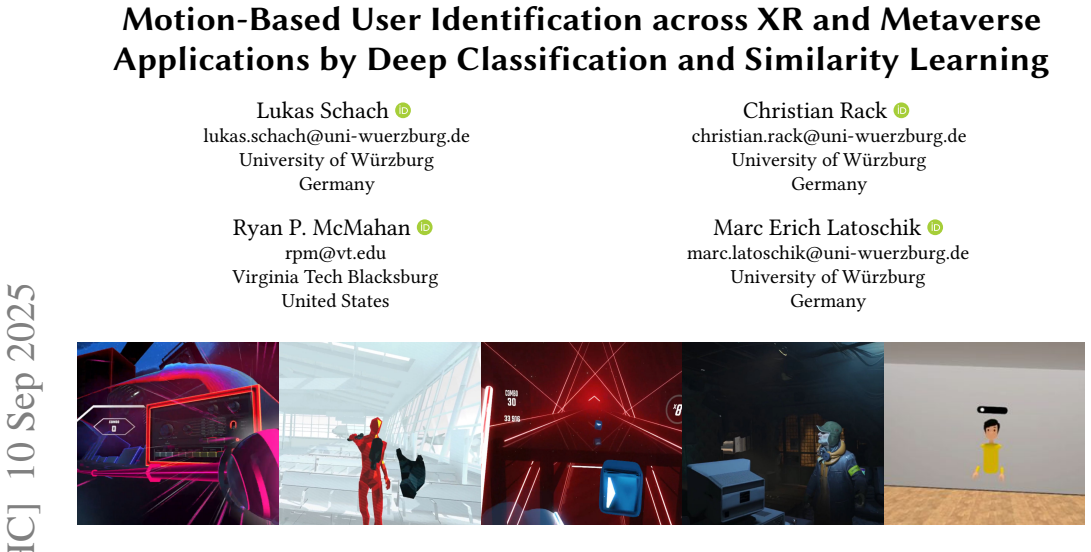
A new dataset of motion data collected from 49 users across five XR applications (four games plus one social app) that serves as the testbed for measuring within-application versus cross-application accuracy of classification and similarity learning models.
If this is right
- User identification via motion works reliably inside any single XR application.
- Seamless biometric identification across the full Metaverse remains difficult with current models.
- The results supply a concrete risk assessment for unwanted tracking in multi-app XR environments.
- Releasing the dataset publicly allows others to benchmark improvements in cross-application performance.
Where Pith is reading between the lines
- Privacy risks from motion tracking may be lower when users freely switch between Metaverse apps than when they stay inside one app.
- Practical systems may need app-specific training data or extra signals to achieve reliable cross-app identification.
- App designers could deliberately vary motion patterns to increase user anonymity when users move between virtual spaces.
Load-bearing premise
The five selected XR applications are diverse enough to represent typical Metaverse usage patterns when testing cross-application generalization.
What would settle it
Training a model on motion data from one XR application and then observing high identification accuracy when testing it on motion data from a different XR application would challenge the limited cross-application generalization claim.
Figures


read the original abstract
This paper examines the generalization capacity of two state-of-the-art classification and similarity learning models in reliably identifying users based on their motions in various Extended Reality (XR) applications. We developed a novel dataset containing a wide range of motion data from 49 users in five different XR applications: four XR games with distinct tasks and action patterns, and an additional social XR application with no predefined task sets. The dataset is used to evaluate the performance and, in particular, the generalization capacity of the two models across applications. Our results indicate that while the models can accurately identify individuals within the same application, their ability to identify users across different XR applications remains limited. Overall, our results provide insight into current models generalization capabilities and suitability as biometric methods for user verification and identification. The results also serve as a much-needed risk assessment of hazardous and unwanted user identification in XR and Metaverse applications. Our cross-application XR motion dataset and code are made available to the public to encourage similar research on the generalization of motion-based user identification in typical Metaverse application use cases.
Editorial analysis
A structured set of objections, weighed in public.
Referee Report
Summary. The manuscript introduces a novel dataset of motion data from 49 users across five XR applications (four games with distinct tasks and one untasked social app). It evaluates two deep models (classification and similarity learning) for user identification, reporting high accuracy within individual applications but limited performance when generalizing across applications. The work frames these results as a risk assessment for motion-based biometrics in XR/Metaverse settings and publicly releases the dataset and code.
Significance. If the empirical results hold, the paper supplies concrete evidence that current motion-based identification techniques do not generalize reliably across typical XR use cases, informing privacy and security considerations in the Metaverse. The public dataset release is a clear strength that supports reproducibility and follow-on work on cross-application generalization.
major comments (2)
- [Results section] The interpretation that limited cross-application accuracy reflects a fundamental biometric limitation (rather than task or hardware overlap) requires supporting evidence that the five applications induce distinct motion distributions. No inter-app feature divergence statistics, pairwise distance metrics, or cross-application confusion matrices are reported in the results to substantiate this premise.
- [§3] §3 (Dataset and Methods): Participant instructions, precise motion feature extraction pipeline, normalization across hardware, and exact train/test split details are insufficiently specified. These omissions directly affect the ability to assess whether the reported within-app vs. cross-app performance gap is robust.
minor comments (2)
- [Results] Add explicit per-application-pair performance tables or heatmaps to allow readers to see which application pairs drive the cross-app drop.
- [Methods] Clarify the exact architecture and loss functions used for the similarity-learning model in the methods description.
Simulated Author's Rebuttal
We thank the referee for their constructive feedback, which helps clarify the presentation of our results and improves the reproducibility of the work. We address each major comment below and indicate the revisions we will make.
read point-by-point responses
-
Referee: [Results section] The interpretation that limited cross-application accuracy reflects a fundamental biometric limitation (rather than task or hardware overlap) requires supporting evidence that the five applications induce distinct motion distributions. No inter-app feature divergence statistics, pairwise distance metrics, or cross-application confusion matrices are reported in the results to substantiate this premise.
Authors: We agree that additional quantitative support would strengthen the claim that the cross-application performance drop reflects a biometric limitation. In the revised manuscript we will add inter-application feature divergence statistics (e.g., mean pairwise Euclidean distances between per-user feature centroids across applications), a summary of cross-application confusion matrices, and, where space permits, a brief t-SNE visualization of motion features colored by application. These additions will help demonstrate that the five applications produce measurably distinct motion distributions beyond simple task or hardware differences. revision: yes
-
Referee: [§3] §3 (Dataset and Methods): Participant instructions, precise motion feature extraction pipeline, normalization across hardware, and exact train/test split details are insufficiently specified. These omissions directly affect the ability to assess whether the reported within-app vs. cross-app performance gap is robust.
Authors: We acknowledge that the current description of §3 is too concise. We will expand this section to provide (1) the exact wording of participant instructions, (2) the full motion-feature extraction pipeline with all parameters, (3) the normalization procedure applied to account for differences in tracking hardware, and (4) the precise train/test split strategy (including how users and sessions were partitioned). These details will be added without altering the reported numbers, thereby allowing readers to verify the robustness of the within- versus cross-application gap. revision: yes
Circularity Check
No circularity: empirical performance metrics on held-out data
full rationale
The paper reports an empirical machine-learning study: a new dataset of motion recordings from 49 users across five XR applications is collected, two standard deep models (classification and similarity learning) are trained, and identification accuracy is measured on within-app and cross-app held-out splits. All reported numbers are direct experimental outcomes; no equations, predictions, or first-principles claims are derived that reduce by construction to fitted parameters, self-definitions, or self-citation chains. The methodology follows ordinary supervised-learning practice with independent test partitions, rendering the central results self-contained.
Axiom & Free-Parameter Ledger
Lean theorems connected to this paper
-
IndisputableMonolith/Cost/FunctionalEquation.leanwashburn_uniqueness_aczel unclear?
unclearRelation between the paper passage and the cited Recognition theorem.
We developed a novel dataset containing a wide range of motion data from 49 users in five different XR applications... evaluate the performance and, in particular, the generalization capacity of the two models across applications.
What do these tags mean?
- matches
- The paper's claim is directly supported by a theorem in the formal canon.
- supports
- The theorem supports part of the paper's argument, but the paper may add assumptions or extra steps.
- extends
- The paper goes beyond the formal theorem; the theorem is a base layer rather than the whole result.
- uses
- The paper appears to rely on the theorem as machinery.
- contradicts
- The paper's claim conflicts with a theorem or certificate in the canon.
- unclear
- Pith found a possible connection, but the passage is too broad, indirect, or ambiguous to say the theorem truly supports the claim.
Forward citations
Cited by 1 Pith paper
-
Deep Learning for Virtual Reality User Identification: A Benchmark
A benchmark study evaluates standard and emerging deep learning architectures on motion data from 71 VR users, establishing performance baselines for user identification.
Reference graph
Works this paper leans on
- [1]
-
[2]
Sara Baldoni, Salim Benhamadi, Federico Chiariotti, Michele Zorzi, and Federica Battisti. 2025. Movement- and Traffic-based User Identification in Commercial Virtual Reality Applications: Threats and Opportunities. In 2025 IEEE Conference Virtual Reality and 3D User Interfaces (VR) . 72–81. doi:10.1109/VR59515.2025. 00032 arXiv:2501.16326 [cs]
-
[3]
Christopher Bruns. 2025. Pyopenvr. https://github.com/cmbruns/pyopenvr original-date: 2016-05-07T14:10:42Z
work page 2025
-
[4]
Anil K. Jain, Arun A. Ross, and Karthik Nandakumar. 2011. Introduction to Bio- metrics. Springer US, Boston, MA. doi:10.1007/978-0-387-77326-1
-
[5]
Adam Kendon. 2004. Gesture: Visible Action as Utterance. (01 2004). doi:10. 1017/CBO9780511807572
work page 2004
-
[6]
Sugang Li, Ashwin Ashok, Yanyong Zhang, Chenren Xu, Janne Lindqvist, and Macro Gruteser. 2016. Whose move is it anyway? Authenticating smart wear- able devices using unique head movement patterns. In 2016 IEEE International Conference on Pervasive Computing and Communications (PerCom) . IEEE, Syd- ney, Australia, 1–9. doi:10.1109/PERCOM.2016.7456514
-
[7]
Jonathan Liebers, Mark Abdelaziz, Lukas Mecke, Alia Saad, Jonas Auda, Uwe Gruenefeld, Florian Alt, and Stefan Schneegass. 2021. Understanding User Identi- fication in Virtual Reality Through Behavioral Biometrics and the Effect of Body Normalization. In Proceedings of the 2021 CHI Conference on Human Factors in Computing Systems. ACM, Yokohama Japan, 1–11...
-
[8]
Jonathan Liebers, Sascha Brockel, Uwe Gruenefeld, and Stefan Schneegass. 2024. Identifying Users by Their Hand Tracking Data in Augmented and Virtual Re- ality. International Journal of Human–Computer Interaction 40, 2 (Jan. 2024), 409–424. doi:10.1080/10447318.2022.2120845
-
[9]
Jonathan Liebers, Christian Burschik, Uwe Gruenefeld, and Stefan Schneegass
-
[10]
In 29th ACM Symposium on Virtual Reality Software and Tech- nology
Exploring the Stability of Behavioral Biometrics in Virtual Reality in a Re- mote Field Study: Towards Implicit and Continuous User Identification through Body Movements: Towards Implicit and Continuous User Identification through Body Movements. In 29th ACM Symposium on Virtual Reality Software and Tech- nology. ACM, Christchurch New Zealand, 1–12. doi:1...
-
[11]
David McNeill. 1992. Hand and Mind: What Gestures Reveal about Thought Univ
work page 1992
-
[12]
Mark Roman Miller, Fernanda Herrera, Hanseul Jun, James A. Landay, and Jeremy N. Bailenson. 2020. Personal identifiability of user tracking data dur- ing observation of 360-degree VR video. Sci Rep 10, 1 (Oct. 2020), 17404. doi:10.1038/s41598-020-74486-y
-
[13]
Robert Miller, Natasha Kholgade Banerjee, and Sean Banerjee. 2020. Within- System and Cross-System Behavior-Based Biometric Authentication in Virtual Reality. In 2020 IEEE Conference on Virtual Reality and 3D User Interfaces Ab- stracts and Workshops (VRW) . IEEE, Atlanta, GA, USA, 311–316. doi:10.1109/ VRW50115.2020.00070
-
[14]
Robert Miller, Natasha Kholgade Banerjee, and Sean Banerjee. 2021. Using Siamese Neural Networks to Perform Cross-System Behavioral Authentication in Virtual Reality. In 2021 IEEE Virtual Reality and 3D User Interfaces (VR) . IEEE, Lisboa, Portugal, 140–149. doi:10.1109/VR50410.2021.00035
-
[15]
Alec G. Moore, Tiffany D. Do, Nayan N. Chawla, Antonia Jimenez Iriarte, and Ryan P. McMahan. 2024. The Full-scale Assembly Simulation Testbed (FAST) Dataset. arXiv: 2403.08969 [cs.HC] doi:10.48550/arXiv.2403.08969
-
[16]
Alec G. Moore, Tiffany D. Do, Nicholas Ruozzi, and Ryan P. McMahan. 2023. Identifying Virtual Reality Users Across Domain-Specific Tasks: A Systematic Investigation of Tracked Features for Assembly. In 2023 IEEE International Sym- posium on Mixed and Augmented Reality (ISMAR) . IEEE, Sydney, Australia, 396–
work page 2023
-
[17]
doi:10.1109/ISMAR59233.2023.00054
-
[18]
Kevin Musgrave. 2025. PyTorch Metric Learning. https://github.com/ KevinMusgrave/pytorch-metric-learning original-date: 2019-10-23T17:20:35Z
work page 2025
-
[19]
O’Brien, Louis Rosenberg, and Dawn Song
Vivek Nair, Wenbo Guo, Justus Mattern, Rui Wang, James F. O’Brien, Louis Rosenberg, and Dawn Song. 2023. Unique Identification of 50,000+ Virtual Re- ality Users from Head & Hand Motion Data. 895–910. https://www.usenix.org/ conference/usenixsecurity23/presentation/nair-identification
work page 2023
-
[20]
O’Brien, Louis Rosenberg, and Dawn Song
Vivek Nair, Wenbo Guo, Rui Wang, James F. O’Brien, Louis Rosenberg, and Dawn Song. 2023. Berkeley Open Extended Reality Recordings 2023 (BOXRR- 23): 4.7 Million Motion Capture Recordings from 105,852 Extended Reality De- vice Users. doi:10.1109/TVCG.2024.3372087 arXiv:2310.00430 [cs]
-
[21]
Vivek Nair, Mark Roman Miller, Rui Wang, Brandon Huang, Christian Rack, Marc Erich Latoschik, and James F. O’Brien. 2024. Effect of Data Degradation on Motion Re-Identification. In 2024 IEEE 25th International Symposium on a World of Wireless, Mobile and Multimedia Networks (WoWMoM). IEEE, Perth, Australia, 85–90. doi:10.1109/WoWMoM60985.2024.00026
-
[22]
Vivek Nair, Louis Rosenberg, James F. O’Brien, and Dawn Song. 2024. Truth in Motion: The Unprecedented Risks and Opportunities of Extended Reality Mo- tion Data. IEEE Secur. Privacy 22, 1 (Jan. 2024), 24–32. doi:10.1109/MSEC.2023. 3330392 arXiv:2306.06459 [cs]
-
[23]
Christian Rack, Tamara Fernando, Murat Yalcin, Andreas Hotho, and Marc Erich Latoschik. 2023. Who is Alyx? A new behavioral biometric dataset for user identification in XR. Front. Virtual Real. 4 (Nov. 2023). doi:10.3389/frvir.2023. 1272234 Publisher: Frontiers
-
[24]
Christian Rack, Andreas Hotho, and Marc Erich Latoschik. 2022. Compar- ison of Data Encodings and Machine Learning Architectures for User Iden- tification on Arbitrary Motion Sequences. In 2022 IEEE International Confer- ence on Artificial Intelligence and Virtual Reality (AIVR) . IEEE, CA, USA, 11–19. doi:10.1109/AIVR56993.2022.00010
- [25]
-
[26]
Christian Rack, Vivek Nair, Lukas Schach, Felix Foschum, Marcel Roth, and Marc Erich Latoschik. 2024. Navigating the Kinematic Maze: Analyzing, Stan- dardizing and Unifying XR Motion Datasets. In 2024 IEEE Conference on Virtual Reality and 3D User Interfaces Abstracts and Workshops (VRW) . IEEE, Orlando, FL, USA, 507–514. doi:10.1109/VRW62533.2024.00098
-
[27]
Christian Rack, Lukas Schach, Felix Achter, Yousof Shehada, Jinghuai Lin, and Marc Erich Latoschik. 2024. Motion Passwords. 11 pages. doi:10.1145/3641825. 3687711
-
[28]
Cynthia E. Rogers, Alexander W. Witt, Alexander D. Solomon, and Krishna K. Venkatasubramanian. 2015. An approach for user identification for head- mounted displays. In Proceedings of the 2015 ACM International Symposium on Wearable Computers - ISWC ’15. ACM Press, Osaka, Japan, 143–146. doi:10.1145/ 2802083.2808391
-
[29]
Felix J. Thiel and Anthony Steed. 2022. Developing an Accessibility Metric for VR Games Based on Motion Data Captured Under Game Conditions. Front. Virtual Real. 3 (July 2022), 909357. doi:10.3389/frvir.2022.909357
-
[30]
Elliott Wen, Chitralekha Gupta, Prasanth Sasikumar, Mark Billinghurst, James Wilmott, Emily Skow, Arindam Dey, and Suranga Nanayakkara. 2024. VR.net: A Real-world Dataset for Virtual Reality Motion Sickness Research. IEEE Trans. Visual. Comput. Graphics 30, 5 (May 2024), 2330–2336. doi:10.1109/TVCG.2024. 3372044 10
discussion (0)
Sign in with ORCID, Apple, or X to comment. Anyone can read and Pith papers without signing in.