REVIEW 5 major objections 5 minor 42 references
CNN-ViT Hybrid for Pneumonia Detection: Theory and Empiric on Limited Data without Pretraining
T0 review · 5 major / 5 minor · reviewed 2026-08-04 · deepseek-v4-flash
Pith's one-line read A CNN-ViT hybrid, trained from scratch on limited and imbalanced chest X-ray images, outperforms standalone CNN and ViT models in recall and F1, reaching 0.9443 recall at 50% of the full training data.
desk verdict A modest empirical comparison with a shaky theoretical wrapper; the hybrid's advantage is plausible but not yet demonstrated because the evaluation has unaddressed validity gaps. read the letter →
The pith
A machine-rendered reading of the paper's core claim, the machinery that carries it, and where it could break.
The reading
What carries the argument
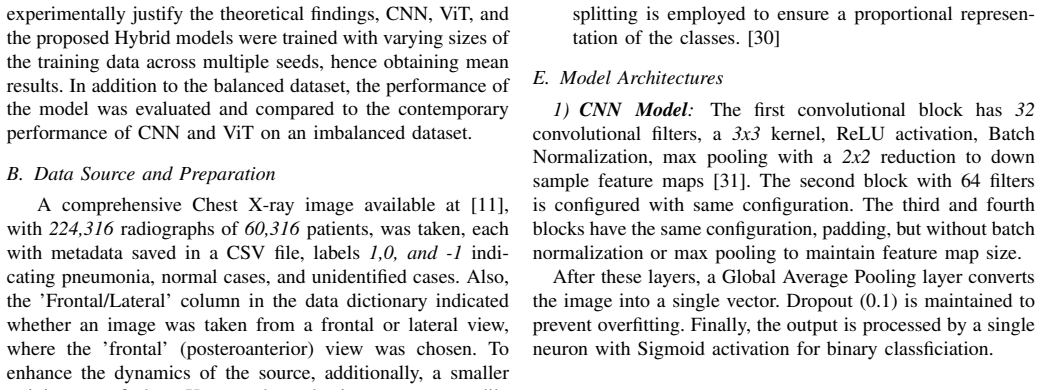
The load-bearing mechanism is the CNN-as-downsampler: a convolutional stack maps the 128×128×3 X-ray into a 32×32×256 feature map, which is cut into 16×16 non-overlapping patches arranged as a 2×2 grid, yielding a transformer sequence of length N=4 instead of N=64. Attention complexity is O(N²d), so this reduces the per-layer attention matrix operation count from 4,096 to 16 relative units, a 256-fold drop; the paper then uses the VC-dimension generalization bound (Eq. 7) to claim the smaller sequence also improves generalization on limited data. Multi-head self-attention, positional embeddings, and feedforward regularization follow the standard ViT formulation.
What would settle it
Compute a VC-dimension or Rademacher-complexity bound for the 4-patch hybrid and the 64-patch ViT on matched input features; if the 4-patch model does not show strictly lower complexity, the generalization argument fails. Alternatively, hold the CNN backbone fixed and run the hybrid with 1, 4, 9, and 16 patches: the claimed mechanism predicts recall and F1 should rise monotonically as the patch count falls, and a non-monotonic result would falsify the sequence-length explanation.
Extended reading notes
Core claim
The central claim is that combining CNN and ViT yields better generalization than either alone when data is scarce, because the CNN acts as a learned downsampler that reduces the transformer's input sequence from 64 patches (for a 128×128 image) to 4 patches (from a 32×32×256 feature map). The paper writes the generalization bound ϵ ≤ √(VC(H)·log(1/δ)/N) and asserts that the reduced patch count lowers the VC dimension, tightening the bound and preventing the transformer from memorizing noise. The experiments back this: the hybrid had the highest recall (0.9355, 0.9328, 0.9443 across 100%, 70%, 50% balanced fractions) and F1 near 0.85, while ViT's performance dropped sharply at 50%; in both i
Load-bearing premise
The paper assumes that reducing the number of patches from 64 to 4 lowers the VC dimension of the model and therefore tightens the generalization bound, but it never computes the VC dimension of either model; if fewer patches do not monotonically imply lower complexity, the theoretical advantage of the hybrid is not established.
Editorial extensions
If this is right
- The hybrid keeps accuracy near 0.83 and F1 near 0.85 even when only 50% of the training data is used, while ViT's F1 falls to 0.7576; the gap is the empirical payoff of the downsampling design.
- On imbalanced data, the hybrid reaches F1 0.9436 and 0.9728 in the two settings, surpassing ViT (0.9056, 0.9212) and CNN (0.1244, 0.7535); the plain CNN collapses to majority-class prediction when pneumonia cases dominate.
- Training-time scaling suggests the hybrid inherits flat or sub-linear time growth on small-to-medium data (power-law exponent 0.47 from 50% to 70% of the data), consistent with the reduced attention cost.
- The architecture demonstrates that a transformer component can be useful in medical imaging without any pretrained weights, which is exactly the setting where transfer learning is not available.
Reading between the lines
- A controlled ablation that varies the number of transformer patches while holding the CNN feature extractor fixed could isolate whether the gain comes from shorter sequence length (capacity reduction) or from the CNN's feature representation itself; the paper does not perform this isolation.
- The VC-dimension argument could be tested directly by computing or bounding the VC dimension, or a PAC-Bayes bound, for the 4-patch versus 64-patch models; if the complexity measures do not separate, the theoretical story needs revision even if the empirical ranking holds.
- If the mechanism generalizes, the same CNN-downsampler-then-ViT design should transfer to other small-sample medical imaging problems, such as retinal scans or ultrasound, and to edge-device settings where short transformer sequences reduce memory pressure.
Signed reviews
Editorial analysis
A structured set of objections, weighed in public.
Referee Report
Summary. The paper proposes a CNN-ViT hybrid for pneumonia detection from chest X-rays, trained from scratch on a limited dataset. It provides an architectural description, a theoretical complexity/VC-dimension argument, and experiments on balanced and imbalanced settings comparing the hybrid against standalone CNN and ViT. The main empirical claim is that the hybrid achieves the best recall and F1 across data fractions, with the highest recall of 0.9443 at the 50% balanced fraction and the best accuracy/F1 on both imbalanced datasets.
Significance. If the empirical comparison were valid, the paper would address a useful gap: most CNN-ViT hybrids for medical imaging rely on pretrained models, whereas this work targets training from scratch under data constraints. The study design—three seeds, balanced and imbalanced protocols, and a fixed test set for metric comparison—is appropriate for the stated goal, and the central claim is falsifiable. However, the evidence as presented is not yet sufficient. The split is not shown to be patient-disjoint, dataset counts are inconsistent, per-seed variance is absent, and the theoretical generalization argument is not a derivation. These issues directly affect the credibility of the claimed empirical superiority, so the manuscript requires substantive revision before the central claim can be accepted.
major comments (5)
- [II-B/II-D, Table V] The evaluation protocol is not shown to be patient-disjoint. The data source includes CheXpert with 224,316 radiographs from 60,316 patients, so multiple images per patient are almost certain. Section II-D.5 describes only an 'almost 90%/10% stratified split' without specifying whether the split is at the patient or image level. If images from the same patient appear in both training and test, the reported recall/F1 margins (e.g., Hybrid 0.9443 vs CNN 0.9240 at 50%) can be inflated by patient-level leakage. This is central to the paper's main claim; please report distinct patient counts per split and repeat the comparison with a patient-exclusive split.
- [VI and Table V] The dataset counts are mutually inconsistent. Section VI lists '8874 Pneumonia, 4984 Normal' for Dataset I, while Table V's caption reads '8729 Pneumonia, 4884 Normal'; Dataset II is '2908 Pneumonia, 4984 Normal' but Table V says '4884 Normal.' Section II-B states the total prepared data are 4984 pneumonia and 4913 normal. These inconsistencies prevent the reader from knowing the actual training/test distributions and whether the same test set was used across experiments. Please provide exact per-class counts by source and split.
- [Table II, IV-A.3] Table II reports only means over three seeds. No standard deviations, confidence intervals, or per-seed values are given. Many of the claimed advantages are small (e.g., F1 0.8498 vs 0.8372 at 50%; accuracy 0.8267 vs 0.8139). Without measures of variance or paired tests, the empirical superiority of the hybrid is not established. Report per-seed results and include error bars or significance tests.
- [III-B, Eq. (7)] The displayed bound is the standard VC generalization bound with N the sample size. The text immediately equates N with the number of patches and uses it to compare pure ViT (N=64) and hybrid (N=4). The VC dimension of none of the three models is computed or bounded. Therefore the statement that fewer patches 'reduces VC value' and 'generalization gets better' is an unproved assumption. The theoretical section should be rewritten as a heuristic complexity comparison or supplied with actual VC-dimension estimates.
- [III-A vs II-E.2 and Table I] The sequence-length definition is inconsistent. Section III-A says each image is split into 16x16 patches, hence N=256 and 256^2 attention operations; Section II-E.2 and Table I use N=64 for the pure ViT on 128x128 images. The complexity argument and Table I depend on this number. Reconcile the definitions of patch size and patch count.
minor comments (5)
- [I, II-E.1] Typos and wording: 'noble hybrid approach' should be 'novel hybrid approach'; 'classficiation' should be 'classification'; 'it the availability' in Section I should be 'the availability'.
- [Table IV, Eq. (8)] Equation (8) defines T(N)=a·N^b, where the scaling exponent is b, not a. The table and text attribute super-linear scaling to a>1. Clarify which parameter is reported and how it was estimated from only two intervals.
- [II-B vs II-D.5] Section II-B says 8% of images were segregated as test data, while Section II-D.5 says 'almost 90% for training and close to 10% for testing.' Reconcile the stated holdout fraction.
- [References] References [21] and [22] contain 'Author(s)' placeholders and incomplete bibliographic information. The citation list should be cleaned before resubmission.
- [General] No code or data availability statement is provided. Given the dataset-count inconsistencies, a precise description of the split, source composition, and preprocessing code would materially improve reproducibility.
Circularity Check
No significant circularity: the empirical comparison is self-contained, and the complexity reduction follows by construction from the architecture definitions.
full rationale
The paper's central claim is empirical: CNN, ViT, and the proposed hybrid are trained from scratch on the same chest X-ray data with the same preprocessing and repeated across seeds, and their measured recall/F1 values are reported directly. No parameter is fitted to a subset of the data and then renamed as a prediction; no constant is chosen to force the hybrid's superiority. The theoretical analysis in Section III derives the quadratic attention complexity O(N^2 d) from Eq. (6) and compares the pure ViT (64 patches) with the hybrid (4 patches) based on the architectures defined in Section II-E. That complexity reduction is a direct consequence of the architectural definitions—the hybrid downsamples the feature map with CNN layers, so the number of patches is indeed 4 rather than 64. The further step 'generalization gets better' (Section III-B) is not actually derived from Eq. (7); that equation is a VC bound in which N is the sample size, not the sequence length, and the paper never computes the VC dimension of either model. This is a correctness/validity flaw in the theoretical justification, but it is not circularity: the performance results are not used to infer the theory, and the theory is not used to produce the measured numbers. There are no self-citations to the authors' prior work, and no load-bearing argument reduces to an unverified self-citation. The dataset count inconsistencies and the lack of an explicit patient-disjoint split are experimental-validity concerns, not cases where the prediction is equivalent to the input by construction. Therefore, under the circularity criteria specified, the appropriate finding is no significant circularity (score 0).
Assumptions & free parameters
free parameters (5)
- Hybrid transformer embedding dimension =
256
- Number of transformer blocks in hybrid =
4
- Attention heads and head dimension =
2 heads x 16 dim (ViT), hybrid unspecified
- Dropout rates =
0.1 CNN, 0.3 ViT, 0.5 hybrid FF
- Staged learning rates =
3e-4, 6e-4, 1.2e-4
assumptions (5)
- standard math VC dimension generalization bound (Eq. 7) is applicable and tight enough to compare models
- ad hoc to paper Reducing the number of patches N from 64 to 4 reduces model complexity and thus generalization error
- domain assumption Complexity formulas O(k^2 H W Cin Cout) and O(N^2 d) dominate actual training time
- domain assumption The combined CheXpert and Kaggle pneumonia datasets, with frontal view selection and 8% holdout, form a valid benchmark
- domain assumption Normal class augmentation by 30% in the balanced experiment does not distort the comparison
Cite this review
Pith. "Pith review of CNN-ViT Hybrid for Pneumonia Detection: Theory and Empiric on Limited Data without Pretraining." pith.science (2026). https://pith.science/paper/PP3C6UZU
@misc{pith2026250908586,
  author       = {Pith},
  title        = {Pith review of: CNN-ViT Hybrid for Pneumonia Detection: Theory and Empiric on Limited Data without Pretraining},
  year         = {2026},
  howpublished = {\url{https://pith.science/paper/PP3C6UZU}},
  note         = {Machine review of arXiv:2509.08586}
}
read the original abstract
This research explored the hybridization of CNN and ViT within a training dataset of limited size, and introduced a distinct class imbalance. The training was made from scratch with a mere focus on theoretically and experimentally exploring the architectural strengths of the proposed hybrid model. Experiments were conducted across varied data fractions with balanced and imbalanced training datasets. Comparatively, the hybrid model, complementing the strengths of CNN and ViT, achieved the highest recall of 0.9443 (50% data fraction in balanced) and consistency in F1 score around 0.85, suggesting reliability in diagnosis. Additionally, the model was successful in outperforming CNN and ViT in imbalanced datasets. Despite its complex architecture, it required comparable training time to the transformers in all data fractions.
Figures


Figures from the paper (2 more)


Reference graph
Works this paper leans on
-
[1]
Pneumonia,
American Lung Association, “Pneumonia,” 2022, available at: https: //www.lung.org/lung-health-diseases/lung-disease-lookup/pneumonia (Accessed: 12 January 2025)
2022
-
[2]
Go- ing deeper with Image Transformers ,
H. Touvron, M. Cord, A. Sablayrolles, G. Synnaeve, and H. Jegou, “ Go- ing deeper with Image Transformers ,” in2021 IEEE/CVF International Conference on Computer Vision (ICCV). Los Alamitos, CA, USA: IEEE Computer Society, Oct. 2021, pp. 32–42. [Online]. Available: https://doi.ieeecomputersociety.org/10.1109/ICCV48922.2021.00010
arXiv 2021
-
[3]
An image is worth 16x16 words: Transformers for image recognition at scale,
A. Dosovitskiy, L. Beyer, A. Kolesnikov, D. Weissenborn, X. Zhai, T. Unterthiner, M. Dehghani, M. Minderer, G. Heigold, S. Gelly, J. Uszoreit, and N. Houlsby, “An image is worth 16x16 words: Transformers for image recognition at scale,” inInternational Conference on Learning Representations (ICLR), 2021. [Online]. Available: https://arxiv.org/abs/2010.11929
arXiv 2021
-
[4]
Comparing vision trans- formers and convolutional neural networks for image classification: A literature review,
J. Maurcio, I. Domingues, and J. Bernardino, “Comparing vision trans- formers and convolutional neural networks for image classification: A literature review,”Applied Sciences (Switzerland), 2023
2023
-
[5]
Prediction of the gain in classification performance from combining multiple imaging modalities,
R. Denkin, “Prediction of the gain in classification performance from combining multiple imaging modalities,” 2023
2023
-
[6]
Medical data visualiza- tion analysis and processing based on machine learning,
T. Wang, L. Zhao, Y . Cao, Z. Qu, and P. Li, “Medical data visualiza- tion analysis and processing based on machine learning,”Journal of Computer and Communications, vol. 6, no. 11, pp. 299–310, 2018
2018
-
[7]
Image processing using pearsons correlation coefficient: Applications on autonomous robotics,
A. Neto, A. Victorino, I. Fantoni, D. Zampieri, J. Ferreira, and D. Lima, “Image processing using pearsons correlation coefficient: Applications on autonomous robotics,” in2013 13th International Conference on Autonomous Robot Systems. IEEE, 2013, pp. 1–6
2013
-
[8]
The relationship between depth of vocabulary knowledge and reading comprehension of iranian efl learners,
D. Abedi, “The relationship between depth of vocabulary knowledge and reading comprehension of iranian efl learners,”Journal of Applied Linguistics and Language Research, vol. 4, pp. 224–229, 06 2017
2017
Show all 42 references
-
[9]
Mutual-information-based reg- istration of medical images: a survey,
J. Pluim, J. Maintz, and M. Viergever, “Mutual-information-based reg- istration of medical images: a survey,”IEEE Transactions on Medical Imaging, vol. 22, no. 8, pp. 986–1004, 2003
2003
-
[10]
Support-vector networks,
C. Cortes, “Support-vector networks,” 1995
1995
-
[11]
Chexpert: A large chest radiograph dataset with uncertainty labels and expert comparison,
J. Irvin, P. Rajpurkar, M. Ko, Y . Yu, S. Ciurea-Ilcus, C. Chute, H. Mark- lund, B. Haghgoo, R. Ball, K. Shpanskaya, J. Seekins, D. A. Mong, S. S. Halabi, J. K. Sandberg, R. Jones, D. B. Larson, C. P. Langlotz, B. N. Patel, M. P. Lungren, and A. Y . Ng, “Chexpert: A large ches...
2019 doi
-
[12]
Support vector machine for content-based image retrieval: A comprehensive overview,
D. Tian, “Support vector machine for content-based image retrieval: A comprehensive overview,”Journal of Information Hiding and Multime- dia Signal Processing, 2018, c
2018
-
[13]
Libsvm: A library for support vector machines,
C.-C. Chang and C.-J. Lin, “Libsvm: A library for support vector machines,” 2022, available at: www.csie.ntu.edu.tw/
2022
-
[14]
Comparison of medical image classi- fication accuracy among three machine learning methods,
T. Maruyama, N. Hayashi, Y . Sato, S. Hyuga, Y . Wakayama, H. Watan- abe, A. Ogura, and T. Ogura, “Comparison of medical image classi- fication accuracy among three machine learning methods,”Journal of X-Ray Science and Technology, vol. 26, no. 6, pp. 885–893, 2018
2018
-
[15]
Visualizing and understanding convolu- tional networks,
M. D. Zeiler and R. Fergus, “Visualizing and understanding convolu- tional networks,” inComputer Vision – ECCV 2014, D. Fleet, T. Pajdla, B. Schiele, and T. Tuytelaars, Eds. Cham: Springer International Publishing, 2014, pp. 818–833
2014
-
[16]
Image copy-move forgery detection via an end-to-end deep neural network,
Y . Wu, W. Abd-Almageed, and P. Natarajan, “Image copy-move forgery detection via an end-to-end deep neural network,” in2018 IEEE Winter Conference on Applications of Computer Vision, WACV 2018. IEEE, 2018, pp. 1907–1915
2018
-
[17]
Imagenet classification with deep convolutional neural networks,
A. Krizhevsky, I. Sutskever, and G. E. Hinton, “Imagenet classification with deep convolutional neural networks,”Commun. ACM, vol. 60, no. 6, p. 8490, May 2017. [Online]. Available: https://doi.org/10.1145/3065386
2017 doi
-
[18]
Do vision transformers see like convolutional neural networks?
M. Raghu, T. Unterthiner, S. Kornblith, C. Zhang, and A. Dosovitskiy, “Do vision transformers see like convolutional neural networks?” 08 2021
2021
-
[19]
Lightweight parallel cnn to classify covid- 19 associated pneumonia from chest x-ray,
H. Kibria and M. Hossain, “Lightweight parallel cnn to classify covid- 19 associated pneumonia from chest x-ray,” in2023 20th International Conference on Electrical Engineering, Computing Science and Auto- matic Control (CCE). IEEE, 2023, pp. 1–6
2023
-
[20]
Are pre-trained convolutions better than pre-trained trans- formers?
Y . Tay, M. Dehghani, J. Gupta, V . Aribandi, D. Bahri, Z. Qin, and D. Metzler, “Are pre-trained convolutions better than pre-trained trans- formers?” no date
-
[21]
A two-step hybrid cnn-vit model for chest disease classification,
Author(s), “A two-step hybrid cnn-vit model for chest disease classification,”PMC, 2024, available at: https://www.ncbi.nlm.nih.gov/pmc/articles/PMC
2024
-
[22]
Exploring the synergies of hybrid cnns and vits architectures for computer vision,
——, “Exploring the synergies of hybrid cnns and vits architectures for computer vision,”arXiv preprint, 2024
2024
-
[23]
Explainable hybrid transformer for multi-classification of lung disease using chest x-rays,
X. Fu, R. Lin, W. Du, A. Tavares, and Y . Liang, “Explainable hybrid transformer for multi-classification of lung disease using chest x-rays,” Scientific Reports, vol. 15, no. 1, p. 6650, Feb. 2025, 2025. The Author(s)
2025
-
[24]
Mobilevit: Light-weight, general-purpose, and mobile-friendly vision transformer,
S. Mehta and M. Rastegari, “Mobilevit: Light-weight, general-purpose, and mobile-friendly vision transformer,”arXiv preprint, 2021, also published in Apple Machine Learning Research and OpenReview
2021
-
[25]
Swin transformer: Hierarchical vision transformer using shifted windows,
Z. Liu, Y . Lin, Y . Caoet al., “Swin transformer: Hierarchical vision transformer using shifted windows,”Proceedings of the IEEE/CVF International Conference on Computer Vision (ICCV), pp. 10 012– 10 022, 2021, reviewed in Medium article on CVPR 2023 and PMC study on Swin-Unet, 2024
2021
-
[26]
Chest x-ray images (pneumonia),
P. Mooney, “Chest x-ray images (pneumonia),” 2018. [On- line]. Available: https://www.kaggle.com/datasets/paultimothymooney/ chest-xray-pneumonia
2018
-
[27]
The harm of class imbalance corrections for risk prediction models: illustration and simulation using logistic regression,
R. van den Goorbergh, M. van Smeden, D. Timmerman, and B. Van Cal- ster, “The harm of class imbalance corrections for risk prediction models: illustration and simulation using logistic regression,”Journal of the American Medical Informatics Association, vol. 29, no. 9, pp. 152...
2022
-
[28]
Handling imbalanced data: A survey,
N. Rout, D. Mishra, and M. K. Mallick, “Handling imbalanced data: A survey,” inInternational Proceedings on Advances in Soft Computing, Intelligent Systems and Applications, M. S. Reddy, K. Viswanath, and S. P. K.M., Eds. Singapore: Springer Singapore, 2018, pp. 431–443
2018
-
[29]
Impact of training set batch size on the performance of convolutional neural networks for diverse datasets,
P. Radiuk, “Impact of training set batch size on the performance of convolutional neural networks for diverse datasets,”Information Technology and Management Science, vol. 20, no. 1, 2017
2017
-
[30]
Stratified sampling,
C. Song and R. Kawai, “Stratified sampling,” 2023, probabilistic Engi- neering Mechanics [Preprint]
2023
-
[31]
Deep residual learning for image recognition,
K. He, X. Zhang, S. Ren, and J. Sun, “Deep residual learning for image recognition,”Proceedings of the IEEE Conference on Computer Vision and Pattern Recognition (CVPR), pp. 770–778, 2016. [Online]. Available: https://arxiv.org/abs/1512.03385
2016 arXiv
-
[32]
Vision transformer (vit)-based applications in image classification,
Y . Huo, K. Jin, J. Cai, H. Xiong, and J. Pang, “Vision transformer (vit)-based applications in image classification,” in2023 IEEE 9th Intl Conference on Big Data Security on Cloud (BigDataSecurity), IEEE Intl Conference on High Performance and Smart Computing (HPSC) and IEEE ...
2023
-
[33]
Deep convolutional neural networks for image classification: A comprehensive review,
W. Rawat and Z. Wang, “Deep convolutional neural networks for image classification: A comprehensive review,”Neural Computation, pp. 2352– 2449, 2017
2017
-
[34]
A review of convolutional neural networks in computer vision,
X. Zhao, L. Wang, Y . Zhang, X. Han, M. Deveci, and M. Parmar, “A review of convolutional neural networks in computer vision,”Artificial Intelligence Review, vol. 57, no. 4, p. 99, 2024
2024
-
[35]
Goodfellow, Y
I. Goodfellow, Y . Bengio, and A. Courville,Deep Learning. MIT Press, 2016. [Online]. Available: https://www.deeplearningbook.org/
2016
-
[36]
An introduction to convolutional neural networks,
K. O’Shea and R. Nash, “An introduction to convolutional neural networks,”arXiv preprint arXiv:1511.08458, 2015. [Online]. Available: https://arxiv.org/abs/1511.08458
2015 arXiv
-
[37]
Attention is all you need,
A. Vaswani, G. Brain, N. Shazeer, N. Parmar, J. Uszkoreit, L. Jones, A. Gomez, . Kaiser, and I. Polosukhin, “Attention is all you need,” no date
-
[38]
An introduction to transformers,
R. E. Turner, “An introduction to transformers,” 2024. [Online]. Available: https://arxiv.org/abs/2304.10557
2024
-
[39]
Global weighted average pooling bridges pixel-level localization and image-level classification,
S. Qiu, “Global weighted average pooling bridges pixel-level localization and image-level classification,” 2018, cornell University [Preprint]
2018
-
[40]
Nearly-tight vc-dimension and pseudodimension bounds for piecewise linear neural networks,
P. L. Bartlett, N. Harvey, C. Liaw, and A. Mehrabian, “Nearly-tight vc-dimension and pseudodimension bounds for piecewise linear neural networks,”arXiv preprint arXiv:1703.02930, 2017. [Online]. Available: https://arxiv.org/abs/1703.02930
2017 arXiv
-
[41]
Performance analysis and comparison of machine and deep learning algorithms for iot data classification,
M. Vakili, M. Ghamsari, and M. Rezaei, “Performance analysis and comparison of machine and deep learning algorithms for iot data classification,”arXiv preprint arXiv:2001.09636, 2020, arXiv:2001.09636 [cs.LG]. [Online]. Available: https://arxiv.org/abs/ 2001.09636
2001 arXiv
-
[42]
Power laws, pareto distributions and zipf’s law,
M. Newman, “Power laws, pareto distributions and zipf’s law,”Contem- porary Physics - CONTEMP PHYS, vol. 46, 12 2004
2004
Reviewed August 4, 2026 · model on record in the stance chip above.
Discussion (0). Continue with ORCID to comment.