REVIEW 3 major objections 5 minor 16 references
A 410GFLOP/s, 64 RISC-V Cores, 204.8GBps Shared-Memory Cluster in 12nm FinFET with Systolic Execution Support for Efficient B5G/6G AI-Enhanced O-RAN
T0 review · 3 major / 5 minor · reviewed 2026-08-15 · deepseek-v4-flash
Pith's one-line read A 64-core RISC-V cluster with systolic queues meets the 4 ms 5G/6G uplink budget while sustaining 243 GFLOP/s on complex baseband kernels.
desk verdict A credible silicon measurement of a programmable RISC-V cluster for O-RAN baseband, but the headline 4 ms end-to-end latency claim overstates what was actually measured. read the letter →
The pith
A machine-rendered reading of the paper's core claim, the machinery that carries it, and where it could break.
The reading
What carries the argument
The load-bearing mechanism is the Queue-Linked Register (QLR) systolic execution: each core's registers are linked into hardware-managed FIFO queues so that, after a one-time topology configuration, operands for matrix multiplication or FFT butterflies are automatically pushed and popped over direct tile-local connections or the routed crossbar. This turns inter-core data movement from explicit load, store, address, and control instructions into implicit register transfers, eliminating much of the memory and synchronization overhead. The second piece is the hierarchical shared-L1-memory fabric (256 KiB in 256 banks, 32-bit interleaved across 16 tiles) that gives all 64 cores low-latency access to the same baseband buffers. The third is the per-core instruction-set support for complex 16-bit MAC, division and square root, SIMD, and widening dot products, which keeps complex arithmetic precise during matrix inversion.
What would settle it
Run the complete PUSCH uplink on HeartStream at the 0.65 V corner including forward error correction decoding, rate matching, and control-plane processing; if the total exceeds 4 ms, the end-to-end claim is false. A simpler check is to measure an error-correction decoder such as LDPC on the cluster and add its runtime to the reported 3.2 ms.
Extended reading notes
Core claim
The central discovery is that shared-L1-memory manycore clusters, extended with complex 16-bit real/imaginary arithmetic instructions and programmable systolic queues in each core, can cover both the signal-processing and the AI-inference sides of an O-RAN baseband chain on a single chip. Complex FFT and matrix-multiplication kernels achieve instructions-per-cycle of 0.52-0.88, and the systolic extension improves energy efficiency by up to 1.89x. For a $32\times8$ MIMO, 1024-subcarrier PUSCH scenario with 14 symbols, all three measured stages complete in 3.2 ms at 0.65 V, with MIMO-MMSE dominating the runtime, and the chip delivers 8.99 Gbps of in-phase/quadrature PUSCH computing at 0.8 V. The mixed-precision 16/32-bit floating-point datapath matches a 64-bit golden model in bit-error rate for $16\times16$ MIMO-MMSE, yielding 16.5 dB SNR at a bit-error rate of $10^{-3}$.
Load-bearing premise
The 4 ms end-to-end latency claim assumes the measured stages (OFDM+beamforming, channel estimation, and MIMO-MMSE equalization) are the only binding parts of the uplink budget; if omitted stages such as forward error correction decoding, rate matching, or control-plane processing add more than the roughly 0.8 ms of unmodeled time, the end-to-end claim fails.
Editorial extensions
If this is right
- For the measured OFDM/beamforming, channel-estimation, and MIMO-MMSE stages, the 4 ms end-to-end budget is met at 0.65 V with roughly 0.8 ms of slack.
- The same 64 cores run integer deep-learning operators such as convolution and dot products at 37-89 GOP/s at 1 V with sub-32-microsecond latencies, so AI-enhanced reception can be co-located with baseband processing without a separate accelerator.
- Systolic execution is not limited to matrix multiplication: the paper demonstrates a complex FFT mapped onto systolic queues, and the mechanism generalizes to other data-flow kernels within the cluster.
- At 0.8 V, the cluster's 8.99 Gbps PUSCH computing and 410 GFLOP/s peak put a fully programmable RISC-V design on the same throughput/efficiency plane as non-programmable MIMO ASIPs and accelerators, while retaining software flexibility.
- At the low-voltage corner, PUSCH energy efficiency reaches 49.6 GFLOP/s/W, a 1.88x improvement over the high-performance corner, while staying inside the latency budget.
Reading between the lines
- A direct test of the headline 4 ms number would be to run the full uplink chain, including forward error correction, rate matching, and control-plane tasks, on the same cluster; the paper leaves that composition unmeasured.
- The QLR mechanism should also fit other streaming kernels with one-way data flow, such as interleaving, soft-metric exchange in channel decoders, or sequential beamforming updates, since it removes explicit loads, stores, and synchronization.
- The efficiency figure is tied to the 8x8 MIMO, 15 MHz scenario at 0.65 V; at 20 Gbps-class uplink targets or with larger antenna arrays, the operating point would shift to higher voltage, so energy efficiency at maximum workload remains an open question.
- Because the design is open-source, the systolic-queue core and shared-L1 fabric can be reused for other latency-critical edge workloads that mix streaming signal processing with AI inference.
Signed reviews
Editorial analysis
A structured set of objections, weighed in public.
Referee Report
Summary. The paper presents HeartStream, a 64-core RISC-V shared-L1-memory cluster fabricated in 12nm FinFET, and evaluates it for B5G/6G O-RAN baseband processing. The cluster supports complex 16-bit instructions, SIMD, division/sqrt, and hardware-managed systolic queues. Measured results include 243 GFLOP/s on complex baseband kernels at 800MHz@0.8V, up to 72 GOP/s on integer deep-learning kernels, and a PUSCH processing chain (OFDM&beamforming, channel estimation, MIMO-MMSE) completing in 3.2 ms at 0.65V with 49.6 GFLOP/s/W efficiency. The authors compare HeartStream to prior ASIC/ASIP baseband designs and claim compatibility with the 4 ms end-to-end uplink latency constraint.
Significance. If the silicon results are reproducible, HeartStream is a valuable open-source, programmable manycore platform for O-RAN baseband and AI workloads. The paper's strengths include direct measurements, a same-chip non-systolic baseline for quantifying systolic gains, and BER validation of the mixed-precision arithmetic against a 64-bit golden model. The hardware mechanisms (systolic queues, complex-arithmetic instructions) are clearly identified, and the design builds on the open-source MemPool cluster, supporting reproducibility. However, the headline latency and 'full uplink' claims exceed what the measurements cover, so the paper's central message needs revision before the significance can be fully credited.
major comments (3)
- [Abstract, §III (Fig. 8)] The claim that HeartStream is 'fully compatible with base station power and processing latency limits' and 'within the 4 ms end-to-end constraint for B5G/6G uplink' is not supported by the measurements. The 3.2 ms runtime at 0.65 V (Fig. 8) covers only the OFDM&beamforming, channel estimation, and MIMO-MMSE stages. The remaining NR uplink receiver chain (CP removal, resource demapping, descrambling, QAM demapping, rate dematching, LDPC decoding, CRC, and control-plane tasks) is not implemented, measured, or budgeted. With only 0.8 ms slack in the energy-efficient corner, the paper provides no evidence that these omitted stages fit; a software LDPC decoder for the 8-user/15 MHz PUSCH payload alone would likely exceed this slack. The authors should either implement and measure the full chain or temper the claim to 'the three measured PUSCH stages complete within 3.2 ms, leaving 0.8 ms unaccounted for' and provide a quantitative budget for the remaining stages.
- [Table I, footnote f] The comparison to prior work uses 'technology normalized to 12nm and 0.8V core supply' but the normalization methodology is not described. No scaling factors for frequency, voltage, capacitance, or power are given, and no reference to a standard scaling model is provided. As a result, the PUSCH Gbps/W comparisons in Table I are not reproducible, and the claim of 'competitive' energy efficiency relative to fixed-function accelerators cannot be independently assessed. Please add a detailed description of the normalization procedure (e.g., constant-field scaling assumptions, how voltage and frequency are mapped, and how both dynamic and static power are handled) or report unnormalized measured values alongside the normalized ones.
- [§III, Table I 'Baseband Processing' row] The table lists HeartStream as providing 'Full B5G/6G SW-Defined O-RAN' and the text states it supports 'a full B5G/6G uplink'. However, the only baseband processing demonstrated in the paper is the three PUSCH stages shown in Fig. 8. No transmit chain, no control channel, no FEC decoding, and no complete L1/L2 processing is described. This overstates the scope of the validation. Please restrict the claim to 'the measured PUSCH receive-chain stages' or add evidence that the omitted stages are implemented and benchmarked.
minor comments (5)
- [§II] The text refers to the 'Cooley-Turkey' algorithm; this should be 'Cooley-Tukey'.
- [Fig. 8 caption] The caption contains 'GFLOPS/s/W', which should be 'GFLOP/s/W'.
- [§III] The phrase 'BER@ 10−3dB' incorrectly attaches the unit 'dB' to the BER value; it should read 'a BER of 10−3'.
- [Footnote on page 1] The open-source footnote points to the MemPool repository rather than a HeartStream-specific release; please clarify whether the extended cluster (including systolic queues and complex instructions) is available at that URL or at a separate location.
- [Fig. 3] The die micrograph text reads '12nmTech n ology'; this should be formatted as '12nm Technology'.
Circularity Check
No circularity: HeartStream's headline numbers are direct silicon measurements, not fitted or self-derived predictions.
full rationale
The paper's central claims—410 GFLOP/s peak, 243 GFLOP/s on complex workloads, 49.6 GFLOP/s/W PUSCH efficiency, 0.68 W at 645 MHz@0.65V, and the 3.2 ms runtime for the measured PUSCH stages—are presented as direct measurements from the fabricated 12 nm chip, not as predictions derived from a model. The systolic speedup (up to 1.89×) is computed on-chip by comparing systolic kernels against a non-systolic kernel baseline executing on the same hardware, so it is not an imported or fitted result. The citations to prior work ([8] MemPool, [9] miniFloat ISA, [10] hybrid systolic computation) describe the architectural lineage of the implemented components, but the performance and efficiency numbers do not reduce to those citations; they are empirical results of the present chip. The only significant concern is a correctness/scope issue, not circularity: the abstract's 'within the 4 ms end-to-end constraint' is supported by Fig. 8, which covers only OFDM&beamforming, channel estimation, and MIMO-MMSE for an 8x8 MIMO, 15 MHz-FR1 scenario, while FEC, rate matching, and control-plane processing are not measured or budgeted. That is an unsupported generalization, but no equation or fitted parameter is being renamed as a prediction, and no derivation is equivalent to its own input. Accordingly, the circularity score is 0.
Assumptions & free parameters
assumptions (3)
- domain assumption The measured PUSCH steps (OFDM&beamforming, channel estimation, MIMO-MMSE) compose the full baseband uplink within the 4 ms end-to-end budget.
- domain assumption 16-bit smallfloat arithmetic is sufficient for MIMO-MMSE equalization in all target deployments.
- ad hoc to paper Across-technology normalization of prior chips to 12nm and 0.8V is valid and accurate.
Cite this review
Pith. "Pith review of A 410GFLOP/s, 64 RISC-V Cores, 204.8GBps Shared-Memory Cluster in 12nm FinFET with Systolic Execution Support for Efficient B5G/6G AI-Enhanced O-RAN." pith.science (2026). https://pith.science/paper/BRL5AXWN
@misc{pith2026250908608,
  author       = {Pith},
  title        = {Pith review of: A 410GFLOP/s, 64 RISC-V Cores, 204.8GBps Shared-Memory Cluster in 12nm FinFET with Systolic Execution Support for Efficient B5G/6G AI-Enhanced O-RAN},
  year         = {2026},
  howpublished = {\url{https://pith.science/paper/BRL5AXWN}},
  note         = {Machine review of arXiv:2509.08608}
}
read the original abstract
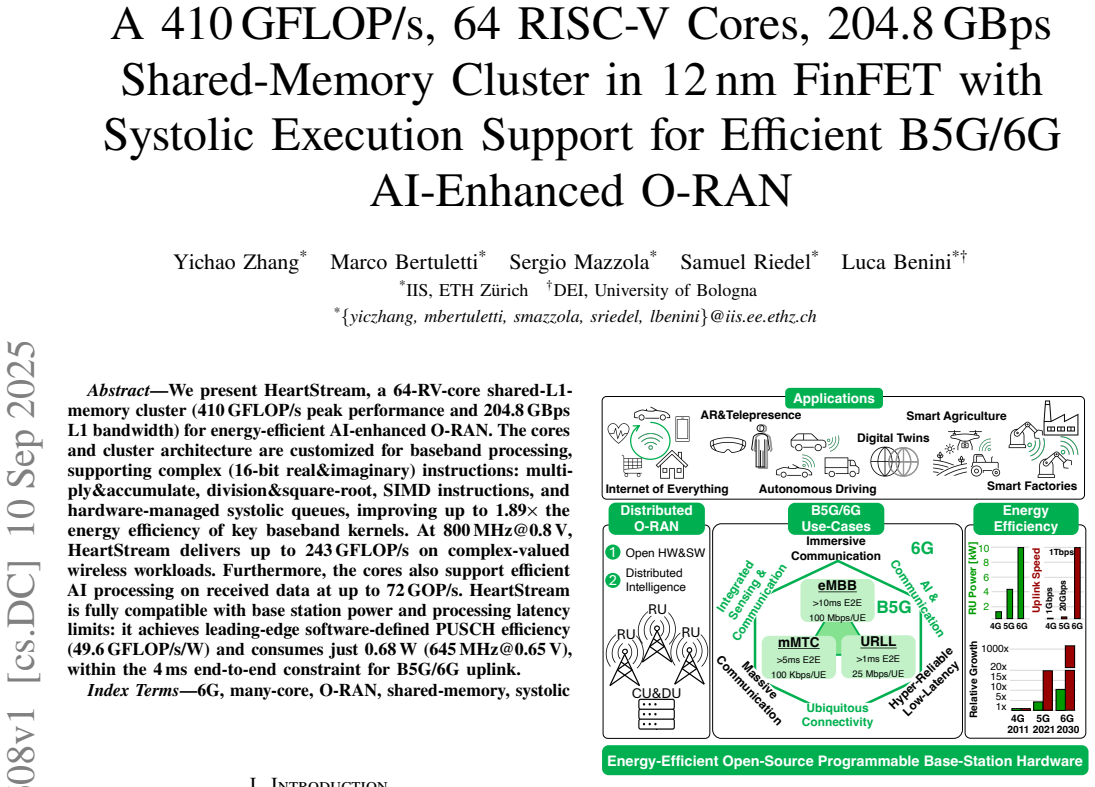
We present HeartStream, a 64-RV-core shared-L1-memory cluster (410 GFLOP/s peak performance and 204.8 GBps L1 bandwidth) for energy-efficient AI-enhanced O-RAN. The cores and cluster architecture are customized for baseband processing, supporting complex (16-bit real&imaginary) instructions: multiply&accumulate, division&square-root, SIMD instructions, and hardware-managed systolic queues, improving up to 1.89x the energy efficiency of key baseband kernels. At 800MHz@0.8V, HeartStream delivers up to 243GFLOP/s on complex-valued wireless workloads. Furthermore, the cores also support efficient AI processing on received data at up to 72 GOP/s. HeartStream is fully compatible with base station power and processing latency limits: it achieves leading-edge software-defined PUSCH efficiency (49.6GFLOP/s/W) and consumes just 0.68W (645MHz@0.65V), within the 4 ms end-to-end constraint for B5G/6G uplink.
Figures


Figures from the paper (5 more)


Reference graph
Works this paper leans on
-
[1]
L. Gavrilovska, V. Rakovic, and D. Denkovski, “From Cloud RAN to Open RAN,”Wirel. Pers. Commun., vol. 113, no. 3, pp. 1523–1539, Aug. 2020
work page 2020
-
[2]
Intelligent O-RAN Beyond 5G: Architecture, Use Cases, Challenges, and Opportunities,
S. Marinova and A. Leon-Garcia, “Intelligent O-RAN Beyond 5G: Architecture, Use Cases, Challenges, and Opportunities,”IEEE Access, vol. 12, pp. 27 088–27 114, Feb. 2024
work page 2024
-
[3]
R. Kumar, D. Sinwar, and V. Singh, “QoS aware resource allocation for coexistence mechanisms between eMBB and URLLC: Issues, challenges, and future directions in 5G,”Comp. Commu., vol. 213, pp. 208–235, Jan. 2024
work page 2024
-
[4]
ITU, “Recommendation ITU-R M.2160-0: Framework and overall objectives of the future development of IMT for 2030 and beyond,” International Telecommunication Union, Tech. Rep. M.2160-0, Nov. 2023
work page 2023
-
[5]
End-to-end learning for OFDM: From neural receivers to pilotless communication,
F. A. Aoudia and J. Hoydis, “End-to-end learning for OFDM: From neural receivers to pilotless communication,”IEEE TWC, vol. 21, no. 2, pp. 1049–1063, 2021
work page 2021
-
[6]
Energy-efficient 5G for a Greener Future,
C.-L. I, S. Han, and S. Bian, “Energy-efficient 5G for a Greener Future,” Nat. Electron., vol. 3, pp. 182–184, April 2020
work page 2020
-
[7]
Ericsson, “Ericsson Mobility Report,” Tech. Rep., 2021 & 2024
work page 2021
-
[8]
MemPool: A Scalable Manycore Architecture With a Low-Latency Shared L1 Memory,
S. Riedel, M. Cavalcante, R. Andri, and L. Benini, “MemPool: A Scalable Manycore Architecture With a Low-Latency Shared L1 Memory,”IEEE TCOMP, vol. 72, no. 12, pp. 3561–3575, Aug. 2023
work page 2023
Show all 16 references
-
[9]
MiniFloats on RISC-V Cores: ISA Extensions With Mixed-Precision Short Dot Products,
L. Bertacciniet al., “MiniFloats on RISC-V Cores: ISA Extensions With Mixed-Precision Short Dot Products,”IEEE TETC, vol. 12, no. 4, pp. 1040–1055, Feb. 2024
2024
-
[10]
Enabling Efficient Hybrid Systolic Computation in Shared-L1-Memory Manycore Clusters,
S. Mazzola, S. Riedel, and L. Benini, “Enabling Efficient Hybrid Systolic Computation in Shared-L1-Memory Manycore Clusters,”IEEE TVLSI, vol. 32, no. 9, pp. 1602–1615, Sept. 2024
2024
-
[11]
A 1095 pJ/b 219 Mb/s Application-specific Instruction-set Processor for Distributed Massive MIMO in 22FDX,
M. Attari, J. R. S ´anchez, O. Edfors, and L. Liu, “A 1095 pJ/b 219 Mb/s Application-specific Instruction-set Processor for Distributed Massive MIMO in 22FDX,” in2024 IEEE ESSERC, Sept. 2024, pp. 257–260
2024
-
[12]
DXT501:An SDR-Based Baseband MP-SoC for Multi-Protocol Industrial Wireless Communication,
Y. Chen, L. Liu, X. Feng, and J. Shi, “DXT501:An SDR-Based Baseband MP-SoC for Multi-Protocol Industrial Wireless Communication,” in2022 IEEE COOl CHIPS. Los Alamitos, CA, USA: IEEE Computer Society, April 2022, pp. 1–6
2022
-
[13]
A 105GOPS 36mm2 heterogeneous SDR MPSoC with energy-aware dynamic scheduling and iterative detection-decoding for 4G in 65nm CMOS,
B. Noethenet al., “A 105GOPS 36mm2 heterogeneous SDR MPSoC with energy-aware dynamic scheduling and iterative detection-decoding for 4G in 65nm CMOS,” in2014 IEEE ISSCC, Feb. 2014, pp. 188–189
2014
-
[14]
A 283 pJ/b 240 Mb/s Floating- Point Baseband Accelerator for Massive MU-MIMO in 22FDX,
O. Casta ˜neda, L. Benini, and C. Studer, “A 283 pJ/b 240 Mb/s Floating- Point Baseband Accelerator for Massive MU-MIMO in 22FDX,” in2022 IEEE ESSCIRC, Sept. 2022, pp. 357–360
2022
-
[15]
BayesBB: A 9.6Gbps 1.61ms Configurable All-Message Passing Baseband-Accelerator for B5G/6G Cell-Free Massive-MIMO in 40nm CMOS,
Y. Zhanget al., “BayesBB: A 9.6Gbps 1.61ms Configurable All-Message Passing Baseband-Accelerator for B5G/6G Cell-Free Massive-MIMO in 40nm CMOS,” in2024 IEEE ISSCC, vol. 67, Feb. 2024, pp. 48–50
2024
-
[16]
A 1.96 Gb/s Massive MU-MIMO Detector for Next- Generation Cellular Systems,
C.-C. Wenet al., “A 1.96 Gb/s Massive MU-MIMO Detector for Next- Generation Cellular Systems,” in2020 IEEE Symp. VLSI, June 2020, pp. 1–2
2020
Reviewed August 15, 2026 · model on record in the stance chip above.
Discussion (0). Continue with ORCID to comment.