REVIEW 3 major objections 4 minor 48 references
Implementing a Universal Set of Geometric Quantum Gates through Dressed-State assisted STA
T0 review · 3 major / 4 minor · reviewed 2026-08-15 · deepseek-v4-flash
Pith's one-line read A dressed-state shortcut protocol with a specially chosen auxiliary term cancels the dynamical phase exactly, producing fast purely geometric single-qubit gates with fidelities above 99.9% under errors and above 99.4% under decoherence.
desk verdict Plausible SATD geometric-gate idea undermined by discontinuities in the pulse schedules and an inconsistent two-qubit gate expression; worth a serious referee but needs major revision. read the letter →
The pith
A machine-rendered reading of the paper's core claim, the machinery that carries it, and where it could break.
The reading
What carries the argument
The load-bearing mechanism is the auxiliary Hamiltonian component $g_z(t)$ in the dressed-state frame of the SATD protocol. The protocol makes two successive unitary transformations—into the adiabatic frame and then into a dressed-state frame—and allows a control Hamiltonian with two free components, $g_x$ and $g_z$; $g_x$ drives the transitionless evolution, while $g_z$ does not alter the intended adiabatic path but can be used to engineer phases. The paper chooses $g_z(t)=\alpha\,\dot\theta^2/\Omega$ with $\alpha=\sin^2(\varphi_2)/4$ and $\varphi_1=0$, which makes the integrands $f_1(t)$ and $f_2(t)$ in the two energy integrals equal pointwise. Their difference—the dynamical phase—therefore vanishes, while the geometric phase $\gamma_g=\pi-(\varphi_2-\varphi_1)$ is set purely by the open area enclosed by the orange-slice trajectory on the qubit's state sphere.
What would settle it
Measure the rotation angle of the gate produced by the same orange-slice path executed at two very different speeds (e.g., $\tau=2/\Omega_0$ and $\tau=8/\Omega_0$ with $\Omega_0/2\pi=3$ MHz) using quantum process tomography on an NV center qubit. If the rotation angle shifts with $\tau$, a residual dynamical phase exists and the claimed cancellation is falsified; if it remains fixed at $\gamma_g=\pi-(\varphi_2-\varphi_1)$ in both cases, the gate is confirmed to be purely geometric.
Extended reading notes
Core claim
The central discovery is a closed-form pulse-shaping rule that restores geometric purity to shortcut-driven gates. For a two-level system driven along an orange-slice path with azimuthal phases $\varphi_1=0$ and $\varphi_2$, choosing $g_z(t)=\alpha\,\dot\theta(t)^2/\Omega(t)$ with $\alpha=\sin^2(\varphi_2)/4$ makes the dressed-state energy integrals on the two halves of the path equal, so the dynamical phase $\gamma_d$ vanishes identically and the evolution operator reduces to the purely geometric form $U(\chi,\gamma_g)$ of Eq. (3). This yields the single-qubit rotations $U_z(\gamma_g)$ and $U_x(\gamma_g)$, which form a universal set. The paper also shows that for experimentally relevant parameters the correction is mild: the peak value of $|g_z/\Omega|$ scales as $1/(\tau\Omega_0)^2$ and is minimized at $\eta=\Delta_0/\Omega_0=2$, and the fidelity stays above 99.9% under systematic errors and above 99.4% under decoherence modeled by a master equation. The same construction, applied to an NV electron spin coupled to a $^{13}$C nuclear spin with hyperfine splitting $A_{\rm hf}$, yields controlled versions of the single-qubit gates with fidelities around 99.8%.
Load-bearing premise
The cancellation of the dynamical phase rests on the pointwise equality of the two energy integrands, which requires the microwave phase to switch abruptly from $\varphi_1=0$ to $\varphi_2$ at $t=T/2$ and the pulse shapes of Eqs. (4)–(5) to be reproduced exactly; any waveform distortion that breaks the symmetry between the two halves of the evolution—other than the specific smooth phase ramp tested in Appendix A—reintroduces a dynamical phase and the gate is no longer purely geometric.
Editorial extensions
If this is right
- The gates $U_z(\gamma_g)$ and $U_x(\gamma_g)$ produced by the SATD protocol with $g_z$ from Eq. (19) are purely geometric and form a universal single-qubit set.
- The required correction stays experimentally mild for suitable parameters: $|g_z/\Omega|$ decays as $1/(\tau\Omega_0)^2$ and has a minimum at $\eta=2$, so shorter gates need not demand larger driving amplitudes.
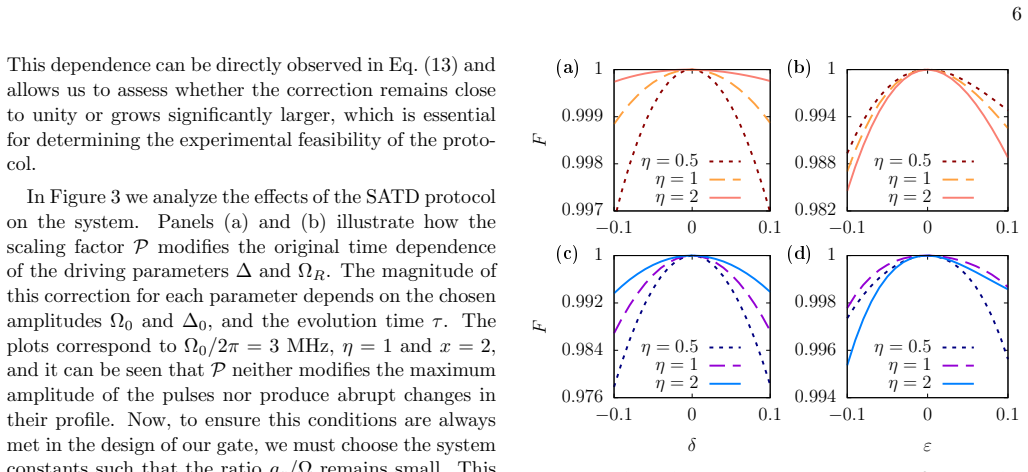
- For NV-center parameters, the single-qubit gates retain fidelities above 99.9% for systematic detuning and Rabi errors up to a few percent and above 99.4% for dephasing rates up to $10^{-2}\,\mu\mathrm{s}^{-1}$.
- The same protocol applied to an NV electron spin hyperfine-coupled to a $^{13}$C nucleus realizes controlled two-qubit gates (CS and CNOT) with fidelities around 99.8% for $A_{\rm hf}/2\pi=130$ MHz.
- Smoothing the abrupt microwave phase jump with a tanh ramp (Appendix A) does not significantly degrade fidelity for $\eta\ge1$ and $\sigma\le10$ ns, indicating compatibility with finite-bandwidth control electronics.
Reading between the lines
- Because the dynamical-phase cancellation is enforced pointwise ($f_1=f_2$) rather than only through averaged integrals, the gate should remain purely geometric at any speed along the same path; a clean experimental test would vary $\tau$ and check that the measured rotation angle stays $\gamma_g=\pi-(\varphi_2-\varphi_1)$ independent of duration.
- The symmetrization strategy—using $g_z$ to balance the energy integrals of the two halves of the trajectory—is not tied to the orange-slice path; any closed path whose two halves share the same $\theta(t)$ shape could in principle be protected by an analogous correction, offering a general design rule for nonadiabatic geometric gates.
- The robustness numbers assume static amplitude errors and a specific dephasing model; time-correlated pulse noise or asymmetric phase transients that break the $\varphi_1=0$, $\varphi_2$ symmetry would reintroduce a dynamical phase, so experimental characterisation of the gate phase versus speed would sharpen confidence in the geometric claim.
Signed reviews
Editorial analysis
A structured set of objections, weighed in public.
Referee Report
Summary. The manuscript proposes a dressed-state superadiabatic transitionless driving (SATD) protocol for implementing fast geometric single-qubit gates on a two-level system, with the nitrogen-vacancy center in diamond as the target platform. The authors design an orange-slice path on the Bloch sphere and add a correction function g_z(t) chosen to enforce equality of the dressed-state energy integrals, claiming that this cancels the dynamical phase and yields purely geometric U_z and U_x rotations. They report numerical fidelities under systematic pulse errors and Lindblad-type decoherence, and they extend the scheme to a two-qubit controlled gate via the hyperfine interaction with a nearby 13C nuclear spin, obtaining a controlled gate of the form |0><0|⊗U_sq + |1><1|⊗I.
Significance. If the construction is correct, the paper would provide a concrete, experimentally oriented route to combine the robustness of geometric quantum gates with the speed of shortcuts to adiabaticity, including explicit pulse shapes and a realistic decoherence analysis for NV centers. The g_z cancellation condition is derived analytically rather than fitted, and the robustness simulations are forward predictions from the model with no free parameters adjusted to experimental data. However, the central derivation depends on pulse schedules that are discontinuous in the instantaneous eigenbasis, and the two-qubit gate is based on an approximate identity that is not justified. These load-bearing gaps must be resolved before the claims can be accepted.
major comments (3)
- [II, Eqs. (4a) and (5a)] The detuning schedules in Eqs. (4a) and (5a) are discontinuous at the midpoints of the evolution. For the U_z gate, the left limit of Δ(t) at t=2τ is -2Δ0 while the right limit is +2Δ0, with Ω_R=0 on both sides; consequently the instantaneous eigenstate |ψ_+> jumps from |1> to |0>, an orthogonal jump. The same type of discontinuity occurs for U_x at t=3τ. The orange-slice path and the Berry-phase calculation in Eqs. (15)-(17) presuppose a continuous closed trajectory in parameter space, so as printed the geometric-phase derivation does not apply to the Hamiltonian defined by Eqs. (4)-(12). The smooth phase modulation in Appendix A regularizes only the φ discontinuity, not these Δ jumps. The pulse definitions need to be corrected, or the discontinuity explicitly justified, and the numerical results should be rechecked with the corrected schedules.
- [III.A, Eqs. (17)-(19)] The cancellation condition f1=f2 with φ1=0 and φ2=π/2 requires g_z to have opposite signs on the two halves of the trajectory, because f1 = sqrt((Ω+g_A)^2 + θdot^2) and f2 = sqrt((Ω+g_B)^2), with g_A=-g_z and g_B=+g_z. Equation (19) as printed defines g_z as a single positive function, g_z = α θdot^2/Ω; if this function is used unchanged in both segments, the equality f1=f2 cannot hold. If g_z is instead intended to switch sign at t=T/2, the corrected pulses in Eqs. (12) inherit a second discontinuity at the midpoint that is not analyzed or smoothed. The authors should state the piecewise definition of g_z explicitly and verify that the pulses used in the numerical simulations correspond to that definition.
- [III.C, Eq. (27)] The two-qubit gate in Eq. (27) is justified by the statement that for A_hf ≫ Ω_R the lower block h2 of Eq. (26) becomes trivial. However, h2 contains the time-dependent diagonal entries ±Δ_tq plus the constant 2A_hf; even in the absence of population transfer, the states |0↑> and |1↑> acquire a relative dynamical phase, so the evolution of h2 is not the identity. The residual infidelity at δ=ε=0 visible in Fig. 5 is attributed to the fixed hyperfine coupling, but the mechanism is not derived. An explicit computation of the h2 evolution, or a demonstration that the conditional phase cancels over the pulse, is needed to support the claim that Eq. (27) is the implemented controlled gate.
minor comments (4)
- [III.A] The text refers to 'Fig. 2(c)' and 'Fig. 2(e)' when discussing panels that actually appear in Fig. 3; please correct the cross-references.
- [II, Eq. (5a)] For the U_x pulses, Eq. (5a) gives Δ(4τ)=0 and Ω_R(4τ)=0, so θ=atan(0,0) is undefined at the final time; please specify the limiting values used in the simulations.
- [III.C, Eq. (26)] The hyperfine term 2A_hf in the lower block of Eq. (26) should be derived from Eq. (25) using the stated basis convention; as printed, the sign and magnitude of this term appear without derivation.
- [I and Conclusions] There are several typos: 'Tansitionless' in the Introduction, 'Basik' versus 'Baksic' in the Introduction and reference [16], and 'the this framework' in the Conclusions.
Circularity Check
No significant circularity: the g_z corrective pulse is derived from the stated dynamical-phase cancellation condition, and the fidelity results are forward numerical simulations.
full rationale
The derivation chain is self-contained. Equation (16) defines the total phase as γ_t = γ_g + γ_d with γ_d = I_φ1 − I_φ2, and Section III.A then constructs g_z(t) = α θ̇²/Ω by imposing the pointwise equality f1 = f2 (Eqs. (17)–(19)) so that the two energy integrals are equal and γ_d vanishes. This is an explicit control-design condition, not a fitted parameter renamed as a prediction; the resulting gates are then simulated forward via the Schrödinger and Lindblad equations (Figs. 4–7, Appendix A) with literature-based decoherence parameters. The SATD/dressed-state framework is imported from Baksic et al. (Ref. [16]), whose authors do not overlap with the present paper, and no uniqueness theorem or self-citation chain is invoked to force the choice of g_z. Appendix B openly states that the SATD-modified pulses produce an open trajectory and hence a dynamical phase, which is precisely the quantity later canceled by g_z; this is an acknowledged design step rather than a hidden input. The discontinuity of Δ(t) at the interval boundaries noted by a skeptic is a physical correctness concern about whether the assumed orange-slice path is realized, not a circularity in the derivation.
Assumptions & free parameters
assumptions (8)
- domain assumption Rotating-wave approximation for the microwave-driven two-level system
- domain assumption Two-level reduction of the NV spin-1 ground state under a strong static field B_z
- domain assumption Dressed-state construction of Baksic et al. (Ref [16]) gives the diagonal H_DS and the relations in Eqs. (10)-(13)
- standard math The geometric phase for the orange-slice cyclic path is gamma_g = pi - (phi_2 - phi_1)
- ad hoc to paper Pointwise cancellation f1=f2 with g_z=alpha theta-dot-squared/Omega requires exact pulse waveforms from Eqs. (4)-(5) and phi_1=0
- domain assumption Lindblad master equation with rates kappa_1=1/T_1 and kappa_2=1/T_phi models the decoherence of the NV spin
- domain assumption The lower block h_2 in Eq. (26) is trivial when A_hf >> Omega_R
- domain assumption Secular approximation for the NV-13C hyperfine Hamiltonian in Eq. (25)
Cite this review
Pith. "Pith review of Implementing a Universal Set of Geometric Quantum Gates through Dressed-State assisted STA." pith.science (2026). https://pith.science/paper/HM35AP37
@misc{pith2026250908723,
  author       = {Pith},
  title        = {Pith review of: Implementing a Universal Set of Geometric Quantum Gates through Dressed-State assisted STA},
  year         = {2026},
  howpublished = {\url{https://pith.science/paper/HM35AP37}},
  note         = {Machine review of arXiv:2509.08723}
}
read the original abstract
Geometric quantum computation relies on the geometric phase that arises in adiabatic cyclic evolutions of non-degenerate quantum systems, enabling the design of robust quantum gates. However, the adiabatic condition requires long evolution times, making the system vulnerable to decoherence. In this work, we propose a scheme to realize fast and high-fidelity geometric quantum gates by applying the Superadiabatic Transitionless Driving (SATD) protocol within the dressed-state framework. We analyze the implementation of single-qubit gates in a two-level system driven by a microwave field, focusing in particular on the NV center in diamond. We show how the dynamical phase can be canceled to obtain purely geometric operations. The robustness of the gates is assessed under systematic errors and environmental decoherence, demonstrating high fidelities even in regimes with strong fluctuations. Finally, we extend the protocol to construct nontrivial two-qubit gates, highlighting its feasibility for scalable quantum information processing.
Figures


Figures from the paper (4 more)


Reference graph
Works this paper leans on
-
[1]
M. A. Neilsen and I. L. Chuang, Quantum Computation and Quantum Information (Cambridge University Press, 2000)
work page 2000
-
[2]
M. V. Berry. Quantal phase factors accompanying adia- batic changes. Proc. R. Soc. A 392, 45–57 (1984)
work page 1984
-
[3]
Zanardi, P. and Rasetti, M. Holonomic quantum compu- tation. Phys. Lett. A 264, 94–99 (1999)
work page 1999
- [4]
- [5]
-
[6]
S. L. Zhu and Z. D Wang. Implementation of universal 10 0 10 20 0 τ 2τ 3τ 4τ 0 10 20 0 τ 2τ 3τ 4τ Energy (MHz) t ˜ΩR(t) ΩR(t) Energy (MHz) ˜∆(t) ∆(t) FIG. A2:Comparison between the original (dashed lines) and SATD-modified (solid lines) pulses for the S- gate. The parameters Ω 0,ηandτare the same from Figs. 3(a) and (b) of the main text. The lower panel s...
work page 2002
-
[7]
H. Wu, E. M. Gauger, R. E. George, M. M¨ ott¨ onen, H. Riemann, N. V. Abrosimov, P. Becker, H.-J. Pohl, K. M. Itoh, M. L. W. Thewalt, and J. J. L. Morton, Geomet- ric phase gates with adiabatic control in electron spin resonance, Phys. Rev. A 87, 032326 (2013)
work page 2013
-
[8]
Lupo, C., Aniello, P., Napolitano, M. and Florio, G. Ro- bustness against parametric noise of nonideal holonomic gates. Physical Review A, 76(1), 012309 (2007)
work page 2007
Show all 48 references
-
[9]
and Xue, Z.-Y
Chen, T. and Xue, Z.-Y. High-fidelity and robust geo- metric quantum gates that outperform dynamical ones. Physical Review Applied, 14(6), 064009 (2020)
2020
-
[10]
Gu´ ery-Odelin, A
D. Gu´ ery-Odelin, A. Ruschhaupt, A. Kiely, E. Tor- rontegui, S. Mart´ ınez-Garaot, and J. G. Muga, Shortcuts to adiabaticity: Concepts, methods, and applications. Rev. Mod. Phys. 91, 045001 (2019)
2019
-
[11]
Berry M. V. Transitioless quantum driving. J. Phys. A, 42 (2009) 365303
2009
-
[12]
Ruschhaupt, Xi Chen, D
A. Ruschhaupt, Xi Chen, D. Alonso and J. G. Muga. Op- timally robust shortcuts to population inversion in two- level quantum systems. New J. Phys. 14 093040 (2012)
2012
-
[13]
Pro- posal for implementing universal superadiabatic geomet- ric quantum gates in nitrogen-vacancy centers
Zhen-Tao Liang, Xianxian Yue, Qingxian Lv, Yan-Xiong Du, Wei Huang, Hui Yan, and Shi-Liang Zhu. Pro- posal for implementing universal superadiabatic geomet- ric quantum gates in nitrogen-vacancy centers. Phys. Rev. A 93, 040305(R) (2016)
2016
-
[14]
Noncyclic Geometric Quantum Gates with Smooth Paths via Invariant-based Shortcuts
Li-Na Ji, Cheng-Yun Ding, Tao Chen, and Zheng-Yuan Xue. Noncyclic Geometric Quantum Gates with Smooth Paths via Invariant-based Shortcuts. Adv. Quantum Technol., 4: 2100019 (2021)
2021
-
[15]
and Du, Y.-X
Lv, Q.-X., Liang, Z.-T., Liu, H.-Z., Liang, J.-H., Liao, K.-Y. and Du, Y.-X. Noncyclic geometric quantum com- putation with shortcut to adiabaticity. Physical Review A, 101(2), 022330 (2020)
2020
-
[16]
Baksic, H
A. Baksic, H. Ribeiro, and A. A. Clerk. Speeding up Adi- abatic Quantum State Transfer by Using Dressed States, Phys. Rev. Lett. 116, 230503 (2016)
2016
-
[17]
and Clerk, A
Ribeiro, H. and Clerk, A. A. Accelerated adiabatic quan- tum gates: Optimizing speed versus robustness. Physical Review A, 100(3), 032323 (2019)
2019
-
[18]
R. Coto, V. Jacques, G. H´ etet, and J. R. Maze. Stimu- lated Raman adiabatic control of a nuclear spin in dia- mond. Phys. Rev. B 96, 085420 (2017)
2017
-
[19]
Quantum state conversion in opto- electro-mechanical systems via shortcut to adiabaticity
Xiao Zhou, Bao-Jie Liu, L-B Shao, Xin-Ding Zhang and Zheng-Yuan Xue. Quantum state conversion in opto- electro-mechanical systems via shortcut to adiabaticity. Laser Phys. Lett. 14, 095202 (2017)
2017
-
[20]
Superadiabatic holonomic quantum computation in cavity QED
Bao-Jie Liu, Zhen-Hua Huang, Zheng-Yuan Xue, and Xin-Ding Zhang. Superadiabatic holonomic quantum computation in cavity QED. Physical Review A, vol. 95 (2017)
2017
-
[21]
Zhang, S
J. Zhang, S. S. Hegde, and D. Suter, Efficient imple- mentation of a quantum algorithm in a single nitrogen- vacancy center of diamond, Phys. Rev. Lett. 125, 030501 (2020)
2020
-
[22]
S. Li, J. Xue, T. Chen, Z. Xue. High-Fidelity Geo- metric Quantum Gates with Short Paths on Supercon- ducting Circuits. Advanced Quantum Technologies, 4(3), 2000140 (2021)
2021
-
[23]
Experimental implementation of short- path nonadiabatic geometric gates in a superconducting circuit
Yang, X.-X., Guo, L.-L., Zhang, H.-F., Du, L., Zhang, C., Tao, H.-R., Chen, Y., Duan, P., Jia, Z.-L., Kong, W.-C., and Guo, G.-P. Experimental implementation of short- path nonadiabatic geometric gates in a superconducting circuit. Physical Review Applied, 19(4), 044076 (2023)
2023
-
[24]
T. Wang, Z. Zhang, L. Xiang, Z. Jia, P. Duan, W. Cai, Z. Gong, Z. Zong, M. Wu, J. Wu, L. Sun, Y. Yin, and G. Guo. The experimental realization of high-fidelity ‘shortcut-to-adiabaticity’ quantum gates in a supercon- ducting Xmon qubit, New J. Phys. 20, 065003 (2018)
2018
-
[25]
Nonadiabatic geometric quan- tum gates with on-demand trajectories
Liang, Y., and Xue, Z.-Y. Nonadiabatic geometric quan- tum gates with on-demand trajectories. Physical Review Applied, 21(6), 064048 (2024)
2024
-
[26]
Single-spin-qubit geometric gate in a silicon quantum dot
Ma, R.-L., Li, A.-R., Wang, C., Kong, Z.-Z., Liao, W.-Z., Ni, M., Zhu, S.-K., Chu, N., Zhang, C., Liu, D., Cao, G., Wang, G.-L., Li, H.-O., and Guo, G.-P. Single-spin-qubit geometric gate in a silicon quantum dot. Physical Review Applied, 21(1), 014044 (2024)
2024
-
[27]
P. Z. Zhao, X.-D. Cui, G. F. Xu, E. Sjoqvist, and D. M. Tong. Rydberg-atom-based scheme of nonadiabatic geo- metric quantum computation. Phys. Rev. A 96, 052316 (2017)
2017
-
[28]
Geometric quantum gates via dark paths in Rydberg atoms
Jin, Z.-Y., and Jing, J. Geometric quantum gates via dark paths in Rydberg atoms. Phys. Rev. A, 109(1), 012619 (2024)
2024
-
[29]
and Zhang, L
Cheng, J.-J. and Zhang, L. Implementing conventional and unconventional nonadiabatic geometric quantum gates via SU(2) transformations. Physical Review A, 103(3), 032616 (2021)
2021
-
[30]
and Lu, H
Chen, S.-Q., Duan, Q.-T., Zhang, C. and Lu, H. Multiple-noise-resilient nonadiabatic geometric quantum control of solid-state spins in diamond (2025). arXiv preprint arXiv:2508.12221
2025 arXiv
-
[31]
W., Manson, N
Doherty, M. W., Manson, N. B., Delaney, P., Jelezko, F., Wrachtrup, J., and Hollenberg, L. C. L. (2013). The nitrogen-vacancy colour centre in diamond. Physics Re- ports, 528(1) (2013)
2013
-
[32]
Arroyo-Camejo, S., Lazariev, A., Hell, S. et al. Room temperature high-fidelity holonomic single-qubit gate on a solid-state spin. Nat Commun 5, 4870 (2014)
2014
-
[33]
Sekiguchi, Y., Niikura, N., Kuroiwa, R. et al. Optical 11 holonomic single quantum gates with a geometric spin under a zero field. Nature Photon 11, 309–314 (2017)
2017
-
[34]
P., Yun, J., Schymik, K
Bartling, H. P., Yun, J., Schymik, K. N., van Rigge- len, M., Enthoven, L. A., van Ommen, H. B., Babaie, M., Sebastiano, F., Markham, M., Twitchen, D. J. and Taminiau, T. H. Universal high-fidelity quantum gates for spin qubits in diamond. Physical Review Applied, 23(3), 034052 (2025)
2025
-
[35]
and Arroyo-Camejo, S
Kleißler, F., Lazariev, A. and Arroyo-Camejo, S. Univer- sal, high-fidelity quantum gates based on superadiabatic, geometric phases on a solid-state spin-qubit at room tem- perature. Quantum Inf 4, 49 (2018)
2018
-
[36]
Noncyclic nona- diabatic geometric quantum gates in a superconducting circuit
Ma, Z., Xu, J., Chen, T., Zhang, Y., Zheng, W., Li, S., Lan, D., Xue, Z.-Y., Tan, X., and Yu, Y. Noncyclic nona- diabatic geometric quantum gates in a superconducting circuit. Physical Review Applied, 20(5), 054047 (2023)
2023
-
[37]
Zu, C., Wang, WB., He, L. et al. Experimental real- ization of universal geometric quantum gates with solid- state spins. Nature 514, 72–75 (2014)
2014
-
[38]
On the generators of quantum dynamical semigroups
Lindblad, G. On the generators of quantum dynamical semigroups. Commun.Math. Phys. 48, 119–130 (1976)
1976
-
[39]
M., Jarmola, A., Budker, D
Bar-Gill, N., Pham, L. M., Jarmola, A., Budker, D. and Walsworth, R. L. Solid-state electronic spin coherence time approaching one second. Nature Communications, 4(1), 1743 (2013)
2013
-
[40]
E., Randall, J., Abobeih, M
Bradley, C. E., Randall, J., Abobeih, M. H., Berrevoets, R. C., Degen, M. J., Bakker, M. A., Markham, M., Twitchen, D. J. and Taminiau, T. H. A ten-qubit solid- state spin register with quantum memory up to one minute. Physical Review X, 9(3), 031045 (2019)
2019
-
[41]
L., Pham, L
Stanwix, P. L., Pham, L. M., Maze, J. R., Le Sage, D., Yeung, T. K., Cappellaro, P., Hemmer, P. R., Yacoby, A., Lukin, M. D.,and Walsworth, R. L. Coherence of nitrogen-vacancy electronic spin ensembles in diamond. Physical Review B, 82(20), 201201 (2010)
2010
-
[42]
K. D. Jahnke, B. Naydenov, T. Teraji, S. Koizumi, T. Umeda, J. Isoya, F. Jelezko; Long coherence time of spin qubits in 12C enriched polycrystalline chemical vapor de- position diamond. Appl. Phys. Lett. 2; 101 (1) 012405 (2012)
2012
-
[43]
and Clerk, A
Setiawan, F., Groszkowski, P. and Clerk, A. A. Fast and robust geometric two-qubit gates for superconduct- ing qubits and beyond. Physical Review Applied, 19(3), 034071 (2023)
2023
-
[44]
and Burkard, G
Finsterh¨ olzl, R., Hannes, W.-R. and Burkard, G. High- Fidelity Entangling Gates for Electron and Nuclear Spin Qubits in Diamond. Physical Review B, 111(21), 214104 (2025)
2025
-
[45]
M., Newton, M
Felton, S., Edmonds, A. M., Newton, M. E., Martineau, P. M., Fisher, D., Twitchen, D. J. and Baker, J. M. Hy- perfine interaction in the ground state of the negatively charged nitrogen vacancy center in diamond. Physical Review B, 79(7), 075203 (2009)
2009
-
[46]
Rao, K. R. K. and Suter, D. Characterization of hyperfine interaction between an NV electron spin and a first-shell 13Cnuclear spin in diamond. Physical Review B, 94(6), 060101 (2016)
2016
-
[47]
Herb, K., V¨ olker, L.A., Abendroth, J.M. et al. Quantum magnetometry of transient signals with a time resolution of 1.1 nanoseconds. Nat Commun 16, 822 (2025)
2025
-
[48]
and Du, J
Han, S., Ye, X., Zhou, X., Liu, Z., Guo, Y., Wang, M., Ji, W., Wang, Y. and Du, J. Solid-state spin coherence time approaching the physical limit. Science Advances, 11(9) (2025)
2025
Reviewed August 15, 2026 · model on record in the stance chip above.
Discussion (0). Continue with ORCID to comment.