REVIEW 5 major objections 5 minor 47 references
GeneVA: A Dataset of Human Annotations for Generative Text to Video Artifacts
T0 review · 5 major / 5 minor · reviewed 2026-08-04 · deepseek-v4-flash
Pith's one-line read This paper introduces GeneVA, a large-scale human-annotated dataset that localizes spatio-temporal artifacts in text-to-video generation with bounding boxes and free-text descriptions, and demonstrates its use as a benchmark and training si
desk verdict GeneVA fills a real gap in text-to-video benchmarks with localized, described artifacts, but its value as a benchmark is currently unverified because label reliability is unmeasured and the data aren't released. read the letter →
The pith
A machine-rendered reading of the paper's core claim, the machinery that carries it, and where it could break.
The reading
What carries the argument
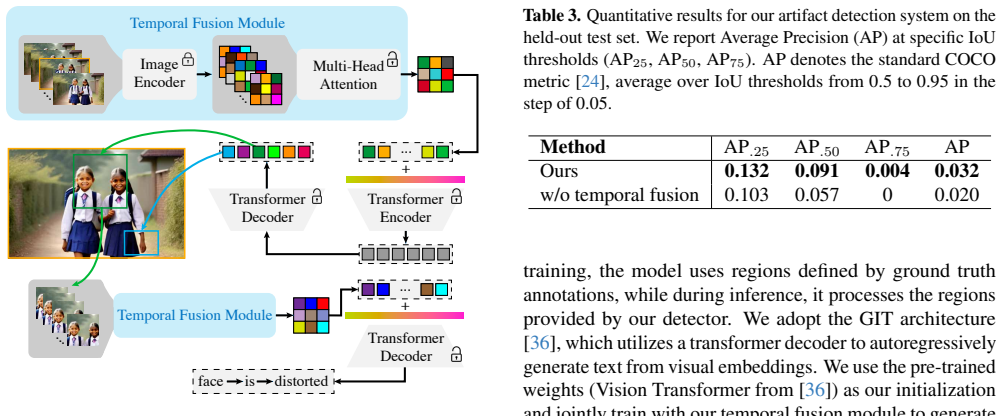
The load-bearing object is the annotation protocol itself. A web-based tool plays each video alongside its text prompt; annotators choose one of five artifact categories, write a free-text description, and draw a bounding box, with boxes for a single artifact interpolated between keyframes and capped at five artifacts per video to favor salient failures. The same session records 7-point ratings for visual quality and prompt alignment. This protocol converts 'looks wrong' into spatially and temporally localized, language-attached evidence that can be pooled across models and prompts. The paper's detection pipeline—an image encoder, a temporal self-attention fusion module, a transformer detect
What would settle it
Re-annotate a random subset of the same videos with independent annotators using the same protocol; if agreement on artifact category and bounding-box location is near chance, the benchmark and the detector training signal collapse. A cheaper check: run the released detector on several unseen models and see whether its average precision stays above random.
Extended reading notes
Core claim
On its own terms, GeneVA's central discovery is that spatio-temporal artifacts in generated video can be systematically captured as labeled, localized events: each annotation combines one of five artifact categories (shape/form/geometry, motion, physics, visual artifacts, other), a free-text description, a bounding box interpolated across frames, and a 7-point video-quality and prompt-alignment rating. The resulting resource contains 16,451 such annotations across 52,326 seconds of video. The paper further reports that a proof-of-concept detector trained on a 1,000-video subset achieves 13% average precision at a 25% overlap threshold on held-out videos, that adding temporal fusion improves
Load-bearing premise
The dataset's value rests on the untested assumption that the crowd-supplied artifact labels are consistent enough across annotators to be treated as ground truth, yet each video was annotated only once and inter-observer agreement was never measured.
Editorial extensions
If this is right
- GeneVA gives researchers a benchmark where video quality is decomposed into localized, describable artifacts rather than a single score.
- The dataset can train artifact detectors that output both a bounding box and a human-readable explanation, enabling explainable quality analysis.
- Because the dataset spans three generation models, models trained on it can be evaluated zero-shot on new generators, as demonstrated qualitatively in the paper.
- The observed negative correlation between quality ratings and bounding-box coverage suggests that artifact frequency is one component of perceived quality, but the weak strength of the correlation implies quality scores and artifact localization measure different things.
- The temporal-fusion ablation indicates that multi-frame context is needed to catch spatio-temporal artifacts, informing future detection architectures.
Reading between the lines
- If the annotations prove reliable, a natural next step is artifact inpainting: using the bounding-box descriptions as targets for automated repair, an application the paper mentions as future potential but does not develop.
- The free-text descriptions could be clustered into a fine-grained taxonomy of artifact types across models, which the paper only begins to sketch through category counts and word clouds.
- Single annotations per video leave inter-observer variability unmeasured; adding repeated annotations in a follow-up could transform artifact salience into a probabilistic quantity rather than a binary label.
- Because prompts were sampled to cover the semantic space of real-world usage, the dataset could double as a probe for where certain prompt topics, such as human bodies or animals, consistently trigger artifacts.
Editorial analysis
A structured set of objections, weighed in public.
Referee Report
Summary. GeneVA is presented as a large-scale human-annotated dataset for spatio-temporal artifacts in text-to-video generation. It is built from 5,452 VidProM prompts and 16,356 videos produced by Pika, VideoCrafter2, and Sora. The annotations total 16,451 and consist of artifact category, free-text description, optional per-keyframe bounding boxes with interpolation, plus 7-point video-quality and prompt-alignment ratings. The paper reports descriptive statistics (rating distributions, per-cluster analysis, bounding-box coverage correlations) and a proof-of-concept artifact detection/captioning pipeline (RT-DETR + temporal fusion + GIT captioner) that reaches 13% AP.25 on a held-out split versus an approximately 1% random baseline, with qualitative zero-shot results on Veo. The authors position GeneVA as the first benchmark that localizes and describes text-to-video artifacts, to be released upon acceptance.
Significance. If the dataset is reliable, it fills a genuine gap: existing text-video evaluation datasets provide scalar or aspect-level ratings but no localized artifact boxes or free-form artifact descriptions. The paper also offers a reasonable proof-of-concept detector and an ablation showing that temporal context helps (13% vs. 10% AP.25). The detector evaluation on a held-out split is standard benchmark practice and not circular; the Veo examples are appropriate as external evidence even though they are only qualitative. However, the central benchmark value depends on annotation reliability, which is not measured: the paper explicitly states there are no repeated annotations, and nearly every video has a single annotation. The dataset itself is also not available for inspection at review time. These are load-bearing issues for a dataset contribution, and they need to be addressed before the claims can be fully accepted.
major comments (5)
- [§3.2 and §6] Label reliability is the load-bearing premise of a benchmark, yet the paper explicitly states in the Limitations section that 'the current dataset does not include multiple repeated annotations for the same video.' With 16,451 annotations across 16,356 videos, almost every video has a single worker annotation, and the protocol description in §3.2 does not mention attention checks, screening, or post-hoc quality filtering. Annotator idiosyncrasy, especially for subtle spatio-temporal artifacts, is therefore unmeasured. This concern lands as stated in the stress-test note. I request a reliability study on a random subset (e.g., 100–200 videos) with at least three independent workers, reporting per-category agreement (e.g., Cohen's or Fleiss' kappa) and box IoU agreement, and a discussion of how single annotations support the benchmark or detector-training claims.
- [§3.2 and §4] The dataset is incompletely characterized because the paper never reports how many videos received zero artifact annotations, the histogram of annotation counts per video, or the fraction of annotations that include bounding boxes versus category-only. This is not a technicality: if a large share of videos is 'clean,' the detector evaluation is biased toward easy negatives, and if many annotations lack boxes, the localization statistics in Table 2 and Figure 6 are computed on a non-representative subset. Please report these distributions and rerun any coverage analyses on the fully localized subset.
- [Table 2] The variable 'Semantic Match' is not defined and does not appear in the annotation protocol described in §3.2; Figure 4 shows category, description, bounding box, quality rating, and prompt rating, but no explicit semantic-match question. Table 2's conclusion that semantic mismatches receive more artifact reports and lower ratings depends on how this binary was constructed. If it is derived from the prompt-alignment rating, state that; if from a separate question, describe it. As written, the table is uninterpretable.
- [§5.1.2 and §5.2] The quantitative detector claim is based on a 1,000-video subset with an 80/10/10 split, i.e., roughly 100 test videos, yet no confidence intervals are reported and the 'random baseline ≈1%' is not fully specified. The 'strong zero-shot generalization' claim rests solely on two qualitative Veo examples shown in Figure 9. Both points are load-bearing for the abstract's claim that GeneVA can 'enable and assist critical applications, such as benchmarking model performance and improving generative video quality.' Please provide quantitative zero-shot results on a small externally labeled sample and interval estimates for AP; otherwise, temper the abstract's phrasing.
- [Availability] The central contribution is a dataset, but no data, code, annotation instructions, or hosting link is provided at review time ('We will release the GeneVA dataset and the trained detector to the public upon acceptance'). Reviewers cannot verify even basic claims, such as the reported counts, the interpolation protocol, or the box statistics. For a dataset paper, the authors should either make the dataset available in anonymized form for review or provide a supplement with a sample of annotations and the exact interface.
minor comments (5)
- [Abstract and Table 1] The abstract reports 16,451 annotations, while Table 1 lists 'Total Human Rating Count' as 16,356 for GeneVA. Align these numbers or clarify that one row counts videos rather than annotations.
- [§1] Typo: 'artifacts no present in still images' should read 'artifacts not present in still images.'
- [§5.1.1] Typo: 'objectness' is misspelled as 'objecness.'
- [Figure 6] The caption says whiskers represent 95% confidence intervals, but standard box-and-whisker plots use Tukey whiskers. Clarify which convention is used.
- [Figure 3] The caption states '(a)/(b) visualize the embedded feature space before and after our cleaning procedure. We note that the two plots look very similar.' If the cleaning had no visible effect, either explain what changed or remove the comparison to avoid confusion.
Circularity Check
No significant circularity: the dataset is self-contained and the detector is evaluated on held-out data and external Veo videos.
full rationale
The paper's central claim is the construction of a new crowdsourced dataset, not a derived prediction. Prompt sampling uses kernel herding over VidProM embeddings with external models (Sora, Pika, VideoCrafter2) generating the videos, and annotations are collected independently from Prolific workers. The artifact detector is trained on an 80/10/10 split of 1,000 GeneVA videos and evaluated on the held-out test set, which is standard empirical practice rather than circular reasoning; the random-baseline comparison and temporal-fusion ablation further support the evaluation. The claimed cross-model generalization applies the trained detector to videos from Veo, a model unseen during training, providing external evidence. No fitted parameter is relabeled as a prediction, no load-bearing self-citation appears in the bibliography, and no uniqueness/ansatz is imported from prior work by the same authors. The limitation that repeated annotations are absent concerns annotation reliability and data quality, not circularity, and the interpolated bounding boxes are a methodological detail rather than a definitional equivalence. Therefore no circular step is present.
Assumptions & free parameters
free parameters (3)
- Artifact taxonomy =
5 categories: Shape/Form/Geometry, Motion, Physics, Visual Artifacts, Other
- Maximum of five artifact annotations per video =
5
- Temporal context window T=5 frames at 10 FPS =
T=5, 10 FPS
assumptions (4)
- domain assumption VidProM's 1.67M prompts are representative of real-world text-to-video user inputs
- domain assumption Human annotations are accurate ground truth for artifacts
- domain assumption Kernel herding on 3,072-dim text embeddings preserves semantic diversity
- standard math Pre-trained backbones (ResNet18, GIT, RT-DETR) provide valid initializations
Cite this review
Pith. "Pith review of GeneVA: A Dataset of Human Annotations for Generative Text to Video Artifacts." pith.science (2026). https://pith.science/paper/OHB7MEEJ
@misc{pith2026250908818,
  author       = {Pith},
  title        = {Pith review of: GeneVA: A Dataset of Human Annotations for Generative Text to Video Artifacts},
  year         = {2026},
  howpublished = {\url{https://pith.science/paper/OHB7MEEJ}},
  note         = {Machine review of arXiv:2509.08818}
}
read the original abstract
Recent advances in probabilistic generative models have extended capabilities from static image synthesis to text-driven video generation. However, the inherent randomness of their generation process can lead to unpredictable artifacts, such as impossible physics and temporal inconsistency. Progress in addressing these challenges requires systematic benchmarks, yet existing datasets primarily focus on generative images due to the unique spatio-temporal complexities of videos. To bridge this gap, we introduce GeneVA, a large-scale artifact dataset with rich human annotations that focuses on spatio-temporal artifacts in videos generated from natural text prompts. We hope GeneVA can enable and assist critical applications, such as benchmarking model performance and improving generative video quality.
Figures


Figures from the paper (6 more)



Reference graph
Works this paper leans on
-
[1]
text-embedding-3-large. 3
-
[2]
Accessed: July 10, 2025
Pika art. Accessed: July 10, 2025. 2, 3
2025
-
[3]
Video generation models as world simulators
OpenAI. Video generation models as world simulators. Ac- cessed: July 10, 2025. 2, 3 8
2025
-
[4]
Bin Cao, Jianhao Yuan, Yexin Liu, Jian Li, Shuyang Sun, Jing Liu, and Bo Zhao. Synartifact: Classifying and alleviating artifacts in synthetic images via vision-language model.arXiv preprint arXiv:2402.18068, 2024. 3
arXiv 2024
-
[5]
Watching the big artifacts: Exposing deepfake videos via bi-granularity artifacts
Han Chen, Yuezun Li, Dongdong Lin, Bin Li, and Junqiang Wu. Watching the big artifacts: Exposing deepfake videos via bi-granularity artifacts. Pattern Recognition, 135:109179,
-
[6]
Videocrafter2: Overcoming data limitations for high-quality video diffusion models, 2024
Haoxin Chen, Yong Zhang, Xiaodong Cun, Menghan Xia, Xintao Wang, Chao Weng, and Ying Shan. Videocrafter2: Overcoming data limitations for high-quality video diffusion models, 2024. 2, 3
2024
-
[7]
Yutian Chen, Max Welling, and Alexander J. Smola. Super- samples from kernel herding. CoRR, abs/1203.3472, 2012. 3
arXiv 2012
-
[8]
Exploring the naturalness of ai- generated images
Zijian Chen, Wei Sun, Haoning Wu, Zicheng Zhang, Jun Jia, Zhongpeng Ji, Fengyu Sun, Shangling Jui, Xiongkuo Min, Guangtao Zhai, et al. Exploring the naturalness of ai- generated images. arXiv preprint arXiv:2312.05476, 2023. 3
arXiv 2023
Show all 47 references
-
[9]
Gaia: Rethinking action quality assessment for ai-generated videos
Zijian Chen, Wei Sun, Yuan Tian, Jun Jia, Zicheng Zhang, Jiarui Wang, Ru Huang, Xiongkuo Min, Guangtao Zhai, and Wenjun Zhang. Gaia: Rethinking action quality assessment for ai-generated videos. In Advances in Neural Information Processing Systems, pages 40111–40144. Curran As...
2024
-
[10]
Measuring the quality of text-to-video model out- puts: Metrics and dataset
Iya Chivileva, Philip Lynch, Tomas E Ward, and Alan F Smeaton. Measuring the quality of text-to-video model out- puts: Metrics and dataset. arXiv preprint arXiv:2309.08009,
-
[11]
Human- refiner: Benchmarking abnormal human generation and refin- ing with coarse-to-fine pose-reversible guidance
Guian Fang, Wenbiao Yan, Yuanfan Guo, Jianhua Han, Zutao Jiang, Hang Xu, Shengcai Liao, and Xiaodan Liang. Human- refiner: Benchmarking abnormal human generation and refin- ing with coarse-to-fine pose-reversible guidance. InEuropean Conference on Computer Vision, pages 201–21...
-
[12]
On the content bias in fréchet video distance
Songwei Ge, Aniruddha Mahapatra, Gaurav Parmar, Jun-Yan Zhu, and Jia-Bin Huang. On the content bias in fréchet video distance. In Proceedings of the IEEE/CVF Conference on Computer Vision and Pattern Recognition, pages 7277–7288,
-
[13]
Yolox: Exceeding yolo series in 2021
Zheng Ge, Songtao Liu, Feng Wang, Zeming Li, and Jian Sun. Yolox: Exceeding yolo series in 2021. arXiv preprint arXiv:2107.08430, 2021. 7
2021 arXiv
-
[14]
Animatediff: Animate your personalized text-to-image diffusion models without specific tuning
Yuwei Guo, Ceyuan Yang, Anyi Rao, Zhengyang Liang, Yao- hui Wang, Yu Qiao, Maneesh Agrawala, Dahua Lin, and Bo Dai. Animatediff: Animate your personalized text-to-image diffusion models without specific tuning. In The Twelfth International Conference on Learning Representations. 1
-
[15]
Deep Residual Learning for Image Recognition
Kaiming He, Xiangyu Zhang, Shaoqing Ren, and Jian Sun. Deep Residual Learning for Image Recognition. In Pro- ceedings of 2016 IEEE Conference on Computer Vision and Pattern Recognition, pages 770–778. IEEE, 2016. 7
2016
-
[16]
Videoscore: Building auto- matic metrics to simulate fine-grained human feedback for video generation
Xuan He, Dongfu Jiang, Ge Zhang, Max Ku, Achint Soni, Sherman Siu, Haonan Chen, Abhranil Chandra, Ziyan Jiang, Aaran Arulraj, Kai Wang, Quy Duc Do, Yuansheng Ni, Bo- han Lyu, Yaswanth Narsupalli, Rongqi Fan, Zhiheng Lyu, Yuchen Lin, and Wenhu Chen. Videoscore: Building auto- m...
2024 arXiv
-
[17]
Gans trained by a two time-scale update rule converge to a local nash equilibrium
Martin Heusel, Hubert Ramsauer, Thomas Unterthiner, Bern- hard Nessler, and Sepp Hochreiter. Gans trained by a two time-scale update rule converge to a local nash equilibrium. Advances in neural information processing systems, 30, 2017. 1
2017
-
[18]
Video diffusion models
Jonathan Ho, Tim Salimans, Alexey Gritsenko, William Chan, Mohammad Norouzi, and David J Fleet. Video diffusion models. Advances in neural information processing systems, 35:8633–8646, 2022. 1
2022
-
[19]
Exddv: A new dataset for explainable deepfake detection in video
Vlad Hondru, Eduard Hogea, Darian Onchis, and Radu Tudor Ionescu. Exddv: A new dataset for explainable deepfake detection in video. arXiv preprint arXiv:2503.14421, 2025. 3
2025
-
[20]
Vbench: Comprehensive benchmark suite for video generative models
Ziqi Huang, Yinan He, Jiashuo Yu, Fan Zhang, Chenyang Si, Yuming Jiang, Yuanhan Zhang, Tianxing Wu, Qingyang Jin, Nattapol Chanpaisit, et al. Vbench: Comprehensive benchmark suite for video generative models. In Proceedings of the IEEE/CVF Conference on Computer Vision and Pat...
2024
-
[21]
Text2video-zero: Text- to-image diffusion models are zero-shot video generators
Levon Khachatryan, Andranik Movsisyan, Vahram Tade- vosyan, Roberto Henschel, Zhangyang Wang, Shant Navasardyan, and Humphrey Shi. Text2video-zero: Text- to-image diffusion models are zero-shot video generators. In Proceedings of the IEEE/CVF International Conference on Comput...
2023
-
[22]
Yolov11: An overview of the key architectural enhancements, 2024
Rahima Khanam and Muhammad Hussain. Yolov11: An overview of the key architectural enhancements, 2024. 7
2024
-
[23]
Pick-a-pic: An open dataset of user preferences for text-to-image generation
Yuval Kirstain, Adam Polyak, Uriel Singer, Shahbuland Ma- tiana, Joe Penna, and Omer Levy. Pick-a-pic: An open dataset of user preferences for text-to-image generation. Advances in neural information processing systems, 36:36652–36663,
-
[24]
Lawrence Zitnick
Tsung-Yi Lin, Michael Maire, Serge Belongie, James Hays, Pietro Perona, Deva Ramanan, Piotr Dollár, and C. Lawrence Zitnick. Microsoft coco: Common objects in context. In Computer Vision – ECCV 2014, pages 740–755, Cham, 2014. Springer International Publishing. 7
2014
-
[25]
Improving video generation with human feedback
Jie Liu, Gongye Liu, Jiajun Liang, Ziyang Yuan, Xiaokun Liu, Mingwu Zheng, Xiele Wu, Qiulin Wang, Wenyu Qin, Menghan Xia, et al. Improving video generation with human feedback. arXiv preprint arXiv:2501.13918, 2025. 3
2025 arXiv
-
[26]
Ntire 2024 quality assessment of ai-generated content challenge
Xiaohong Liu, Xiongkuo Min, Guangtao Zhai, Chunyi Li, Tengchuan Kou, Wei Sun, Haoning Wu, Yixuan Gao, Yuqin Cao, Zicheng Zhang, et al. Ntire 2024 quality assessment of ai-generated content challenge. In Proceedings of the IEEE/CVF Conference on Computer Vision and Pattern Reco...
2024
-
[27]
Evalcrafter: Benchmarking and evalu- ating large video generation models
Yaofang Liu, Xiaodong Cun, Xuebo Liu, Xintao Wang, Yong Zhang, Haoxin Chen, Yang Liu, Tieyong Zeng, Raymond Chan, and Ying Shan. Evalcrafter: Benchmarking and evalu- ating large video generation models. 2023. 3
2023
-
[28]
Fetv: A benchmark for fine-grained evaluation of open-domain text-to-video gen- eration
Yuanxin Liu, Lei Li, Shuhuai Ren, Rundong Gao, Shicheng Li, Sishuo Chen, Xu Sun, and Lu Hou. Fetv: A benchmark for fine-grained evaluation of open-domain text-to-video gen- eration. Advances in Neural Information Processing Systems, 36:62352–62387, 2023. 3 9
2023
-
[29]
Rt-detrv2: Improved baseline with bag-of-freebies for real-time detection transformer, 2024
Wenyu Lv, Yian Zhao, Qinyao Chang, Kui Huang, Guanzhong Wang, and Yi Liu. Rt-detrv2: Improved baseline with bag-of-freebies for real-time detection transformer, 2024. 7
2024
-
[30]
Gener- alizable deepfake detection with phase-based motion analysis
Ekta Prashnani, Michael Goebel, and BS Manjunath. Gener- alizable deepfake detection with phase-based motion analysis. IEEE Transactions on Image Processing, 2024. 3
2024
-
[31]
Deepfake detection: A systematic literature review
Md Shohel Rana, Mohammad Nur Nobi, Beddhu Murali, and Andrew H Sung. Deepfake detection: A systematic literature review. IEEE access, 10:25494–25513, 2022. 3
2022
-
[32]
You only look once: Unified, real-time object de- tection
Joseph Redmon, Santosh Divvala, Ross Girshick, and Ali Farhadi. You only look once: Unified, real-time object de- tection. In 2016 IEEE Conference on Computer Vision and Pattern Recognition (CVPR), pages 779–788, 2016. 7
2016
-
[33]
Faster r-cnn: Towards real-time object detection with region proposal networks
Shaoqing Ren, Kaiming He, Ross Girshick, and Jian Sun. Faster r-cnn: Towards real-time object detection with region proposal networks. Advances in neural information process- ing systems, 28, 2015. 7
2015
-
[34]
Fvd: A new metric for video generation
Thomas Unterthiner, Sjoerd Van Steenkiste, Karol Kurach, Raphaël Marinier, Marcin Michalski, and Sylvain Gelly. Fvd: A new metric for video generation. 1
-
[35]
To- wards accurate generative models of video: A new metric & challenges
Thomas Unterthiner, Sjoerd Van Steenkiste, Karol Kurach, Raphael Marinier, Marcin Michalski, and Sylvain Gelly. To- wards accurate generative models of video: A new metric & challenges. arXiv preprint arXiv:1812.01717, 2018. 1
2018 arXiv
-
[36]
Git: A generative image-to-text transformer for vision and language
Jianfeng Wang, Zhengyuan Yang, Xiaowei Hu, Linjie Li, Kevin Lin, Zhe Gan, Zicheng Liu, Ce Liu, and Lijuan Wang. Git: A generative image-to-text transformer for vision and language. arXiv preprint arXiv:2205.14100, 2022. 7
2022 arXiv
-
[37]
De- tecting human artifacts from text-to-image models
Kaihong Wang, Lingzhi Zhang, and Jianming Zhang. De- tecting human artifacts from text-to-image models. arXiv preprint arXiv:2411.13842, 2024. 3
2024 arXiv
-
[38]
Vidprom: A million-scale real prompt-gallery dataset for text-to-video diffusion models
Wenhao Wang and Yi Yang. Vidprom: A million-scale real prompt-gallery dataset for text-to-video diffusion models
-
[39]
Image quality assessment: from error visibility to structural similarity
Zhou Wang, Alan C Bovik, Hamid R Sheikh, and Eero P Simoncelli. Image quality assessment: from error visibility to structural similarity. IEEE transactions on image processing, 13(4):600–612, 2004. 1
2004
-
[40]
Is this generated person existed in real-world? fine-grained detecting and calibrating abnormal human-body
Zeqing Wang, Qingyang Ma, Wentao Wan, Haojie Li, Keze Wang, and Yonghong Tian. Is this generated person existed in real-world? fine-grained detecting and calibrating abnormal human-body. In Proceedings of the Computer Vision and Pattern Recognition Conference, pages 21226–2123...
2025
-
[41]
Wang, Fred Hohman, and Duen Horng Chau
Zijie J. Wang, Fred Hohman, and Duen Horng Chau. Wizmap: Scalable interactive visualization for exploring large machine learning embeddings. Association for Computational Linguis- tics, 3:516–523, 2023. 4
2023
-
[42]
Human preference score: Better aligning text-to- image models with human preference
Xiaoshi Wu, Keqiang Sun, Feng Zhu, Rui Zhao, and Hong- sheng Li. Human preference score: Better aligning text-to- image models with human preference. In Proceedings of the IEEE/CVF International Conference on Computer Vision, pages 2096–2105, 2023. 3
-
[43]
A survey on video diffusion models
Zhen Xing, Qijun Feng, Haoran Chen, Qi Dai, Han Hu, Hang Xu, Zuxuan Wu, and Yu-Gang Jiang. A survey on video diffusion models. ACM Computing Surveys, 57(2):1–42, 2024. 1
2024
-
[44]
Imagereward: Learning and evaluating human preferences for text-to-image generation
Jiazheng Xu, Xiao Liu, Yuchen Wu, Yuxuan Tong, Qinkai Li, Ming Ding, Jie Tang, and Yuxiao Dong. Imagereward: Learning and evaluating human preferences for text-to-image generation. Advances in Neural Information Processing Sys- tems, 36:15903–15935, 2023. 3
2023
-
[45]
Ipo: Iterative prefer- ence optimization for text-to-video generation
Xiaomeng Yang, Zhiyu Tan, and Hao Li. Ipo: Iterative prefer- ence optimization for text-to-video generation. arXiv preprint arXiv:2502.02088, 2025. 3
2025
-
[46]
The unreasonable effectiveness of deep features as a perceptual metric
Richard Zhang, Phillip Isola, Alexei A Efros, Eli Shechtman, and Oliver Wang. The unreasonable effectiveness of deep features as a perceptual metric. In Proceedings of the IEEE conference on computer vision and pattern recognition, pages 586–595, 2018. 1
2018
-
[47]
Detrs beat yolos on real-time object detection, 2023
Yian Zhao, Wenyu Lv, Shangliang Xu, Jinman Wei, Guanzhong Wang, Qingqing Dang, Yi Liu, and Jie Chen. Detrs beat yolos on real-time object detection, 2023. 7 10
2023
Reviewed August 4, 2026 · model on record in the stance chip above.
Discussion (0). Sign in to comment.