Systematic errors in fast relativistic waveforms for Extreme Mass Ratio Inspirals
Pith reviewed 2026-05-18 17:20 UTC · model grok-4.3
The pith
For circular orbits in Kerr spacetime, setting the global relative error in interpolated radiation-reaction fluxes equal to the small mass ratio produces negligible biases in EMRI parameter estimation.
A machine-rendered reading of the paper's core claim, the machinery that carries it, and where it could break.
Core claim
The paper claims that for circular orbits in Kerr spacetimes, interpolating the flux to a maximum global relative error equal to the small mass ratio is sufficient for parameter estimation purposes. For 4-year long quasi-circular EMRI signals with SNRs of order 100 and mass ratios between 10^{-4} and 10^{-6}, a global relative error of 10^{-6} yields mismatches less than 10^{-3} and negligible parameter estimation biases. The work also finds that ell_max greater than or equal to 30 is required for spins a greater than or equal to 0.9 and develops an efficient Chebyshev interpolation scheme that achieves the desired accuracy with significantly fewer grid points than spline-based methods.
What carries the argument
Radiation-reaction fluxes from black hole perturbation theory, interpolated via a Chebyshev scheme in the offline-online waveform architecture.
If this is right
- For spins a greater than or equal to 0.9, the multipolar mode sum must reach at least ell_max of 30 to keep flux errors acceptable.
- The Chebyshev interpolation scheme meets the target accuracy using far fewer grid points than spline interpolation.
- A global relative flux error of 10^{-6} produces waveform mismatches below 10^{-3} for 4-year quasi-circular signals at SNR of order 100.
- Parameter estimation biases remain negligible when the flux interpolation error is set equal to the small mass ratio for mass ratios from 10^{-4} to 10^{-6}.
Where Pith is reading between the lines
- The same error tolerance may be tested on eccentric or inclined orbits to determine whether it remains sufficient outside the circular case.
- Chebyshev grids could allow denser coverage of the full EMRI parameter space without increasing offline computational cost.
- The error budgeting approach points toward systematic studies that include higher-order self-force contributions to see whether they interact with interpolation inaccuracies.
Load-bearing premise
That truncation of the multipolar mode sum and interpolation error are the two dominant sources of systematic bias in the radiation-reaction fluxes.
What would settle it
A Bayesian parameter estimation run on simulated four-year EMRI signals that compares posterior distributions obtained with fluxes at the stated global relative error level against those obtained with substantially higher-accuracy reference fluxes, checking whether any bias exceeds statistical uncertainties.
Figures





read the original abstract
Accurate modeling of \gls{EMRIs} is essential for extracting reliable information from future space-based gravitational wave observatories. Fast waveform generation frameworks adopt an offline/online architecture, where expensive relativistic computations (e.g. self-force and black hole perturbation theory) are performed offline, and waveforms are generated rapidly online via interpolation across a multidimensional parameter space. In this work, we investigate potential sources of error that result in systematic bias in these relativistic waveform models, focusing on radiation-reaction fluxes. Two key sources of systematics are identified: (i) the intrinsic inaccuracy of the flux data, for which we focus on the truncation of the multipolar mode sum, and (ii) interpolation errors from transitioning to the online stage. We quantify the impact of mode-sum truncation and analyze interpolation errors by using various grid structures and interpolation schemes. For circular orbits in Kerr spacetime with spins larger than $a \geq 0.9$, we find that $\ell_{\text{max}} \geq 30$ is required for the necessary accuracy. We also develop an efficient Chebyshev interpolation scheme, achieving the desired accuracy level with significantly fewer grid points compared to spline-based methods. For circular orbits in Kerr spacetimes, we demonstrate via Bayesian studies that interpolating the flux to a maximum global relative error that is equal to the small mass ratio is sufficient for parameter estimation purposes. For 4-year long quasi-circular EMRI signals with SNRs $= \mathcal{O}(100)$ and mass-ratios $10^{-4}-10^{-6}$, a global relative error of $10^{-6}$ yields mismatches $<10^{-3}$ and negligible parameter estimation biases.
Editorial analysis
A structured set of objections, weighed in public.
Referee Report
Summary. The manuscript examines systematic errors in fast EMRI waveform models arising from radiation-reaction flux computations in an offline/online framework. It identifies multipolar mode-sum truncation and interpolation errors as the two primary sources, determines that ℓ_max ≥ 30 is required for spins a ≥ 0.9, develops an efficient Chebyshev interpolation scheme that uses fewer grid points than splines, and performs Bayesian injection studies to argue that a maximum global relative flux error equal to the mass ratio (e.g., 10^{-6}) is sufficient for parameter estimation. For 4-year quasi-circular signals with SNR = O(100) and mass ratios 10^{-4}–10^{-6}, this tolerance yields mismatches < 10^{-3} and negligible biases.
Significance. If the central result holds, the work supplies concrete, quantitative guidance on flux accuracy requirements that can reduce the computational burden of EMRI template banks for LISA while preserving parameter-estimation fidelity. The direct linkage, via Bayesian injections, between a stated flux-error level and observable mismatches/biases is a clear strength, as is the demonstration that the Chebyshev scheme achieves the target tolerance with substantially fewer points than spline baselines. These elements provide falsifiable thresholds rather than heuristic estimates.
major comments (2)
- [Bayesian studies / results on parameter biases] The Bayesian studies (implicitly the section presenting the injection results and mismatch calculations) treat multipolar truncation and interpolation error as the two dominant flux systematics while assuming higher-order self-force contributions, residual eccentricity, and spin-orbit phasing effects remain sub-dominant. No quantitative bound or auxiliary calculation is supplied on the coherent phase error these neglected terms would accumulate over a 4-year integration; if any produces a mismatch comparable to or larger than 10^{-3}, the claimed sufficiency of a global relative flux error of 10^{-6} would not hold.
- [Abstract and methods description of Bayesian setup] The abstract and the description of the numerical setup supply only high-level information on the precise grid structures, the exact Bayesian likelihood construction, and the manner in which truncation error is propagated into the posterior. This omission is load-bearing for reproducibility of the reported mismatch thresholds and bias levels.
minor comments (2)
- [Notation and error definition] The definition of 'global relative error' (the quantity set equal to the mass ratio) should be stated explicitly in the main text at the first appearance, together with the precise norm used to compute it across the (r, a) domain.
- [Interpolation results figures] Figure(s) comparing Chebyshev and spline interpolation errors versus number of grid points would benefit from an inset or table entry that directly quantifies the reduction in grid points at fixed tolerance.
Simulated Author's Rebuttal
We thank the referee for their detailed and constructive report. We are pleased that the referee recognizes the significance of our quantitative results on flux error tolerances and the advantages of the Chebyshev interpolation scheme. We address the major comments below and have revised the manuscript accordingly to enhance clarity and completeness.
read point-by-point responses
-
Referee: [Bayesian studies / results on parameter biases] The Bayesian studies (implicitly the section presenting the injection results and mismatch calculations) treat multipolar truncation and interpolation error as the two dominant flux systematics while assuming higher-order self-force contributions, residual eccentricity, and spin-orbit phasing effects remain sub-dominant. No quantitative bound or auxiliary calculation is supplied on the coherent phase error these neglected terms would accumulate over a 4-year integration; if any produces a mismatch comparable to or larger than 10^{-3}, the claimed sufficiency of a global relative flux error of 10^{-6} would not hold.
Authors: We agree that a full error budget including all possible sources would be ideal. However, the primary goal of this work is to isolate and quantify the systematic errors arising specifically from the radiation-reaction flux computations in the offline/online framework, namely multipolar truncation and interpolation. In the manuscript, we focus on quasi-circular orbits and argue that for the high-SNR, long-duration signals considered, these flux-related errors are the leading controllable systematics in such models. We have added a paragraph in the discussion section acknowledging the assumptions regarding other effects and noting that a comprehensive study of their phase accumulation would be a valuable extension but is outside the scope of the present analysis. This does not invalidate the reported thresholds for the flux errors themselves. revision: partial
-
Referee: [Abstract and methods description of Bayesian setup] The abstract and the description of the numerical setup supply only high-level information on the precise grid structures, the exact Bayesian likelihood construction, and the manner in which truncation error is propagated into the posterior. This omission is load-bearing for reproducibility of the reported mismatch thresholds and bias levels.
Authors: We thank the referee for pointing this out. To improve reproducibility, we have expanded the abstract to provide more details on the Bayesian injection studies, including the signal duration, SNR range, and mass ratios considered. Additionally, we have added a new subsection in the Methods section that describes the grid structures used for interpolation, the construction of the Bayesian likelihood (based on the standard matched-filtering inner product with Gaussian noise assumption), and how the truncation and interpolation errors are incorporated into the waveform model for the injection studies. These revisions should allow readers to better understand and reproduce the mismatch and bias results. revision: yes
Circularity Check
No significant circularity; derivation is self-contained against external benchmarks
full rationale
The paper's central claim is established through direct numerical experiments: mode-sum truncation is quantified by computing fluxes at increasing ell_max, interpolation error is measured by comparing Chebyshev grids to spline baselines on independent test points, and sufficiency is demonstrated by injecting controlled relative flux errors equal to q into 4-year waveforms and running Bayesian PE to measure mismatches and parameter biases. These tolerances are anchored to external scales (q in 10^{-4}–10^{-6}, SNR=O(100), target mismatch <10^{-3}) rather than being fitted or redefined from the validation data itself. No equation reduces to its input by construction, no prediction is statistically forced by a prior fit, and no load-bearing uniqueness theorem is imported via self-citation. The assumption that other systematics (higher-order self-force, eccentricity, noise modeling) are sub-dominant is stated explicitly but does not create a circular reduction; the reported result remains independently testable against those external benchmarks.
Axiom & Free-Parameter Ledger
free parameters (2)
- l_max =
30
- global_relative_error_threshold =
10^{-6}
axioms (2)
- domain assumption Kerr geometry for the central supermassive black hole
- domain assumption Quasi-circular orbits for the small body
Lean theorems connected to this paper
-
IndisputableMonolith/Foundation/RealityFromDistinction.leanreality_from_one_distinction unclear?
unclearRelation between the paper passage and the cited Recognition theorem.
We quantify the impact of mode-sum truncation and analyze interpolation errors by using various grid structures and interpolation schemes... interpolating the flux to a maximum global relative error that is equal to the small mass ratio
What do these tags mean?
- matches
- The paper's claim is directly supported by a theorem in the formal canon.
- supports
- The theorem supports part of the paper's argument, but the paper may add assumptions or extra steps.
- extends
- The paper goes beyond the formal theorem; the theorem is a base layer rather than the whole result.
- uses
- The paper appears to rely on the theorem as machinery.
- contradicts
- The paper's claim conflicts with a theorem or certificate in the canon.
- unclear
- Pith found a possible connection, but the passage is too broad, indirect, or ambiguous to say the theorem truly supports the claim.
Forward citations
Cited by 2 Pith papers
-
First-time assessment of glitch-induced bias and uncertainty in inference of extreme mass ratio inspirals
Moderately mitigated glitch streams induce negligible to minor biases (0.04–0.6σ) in EMRI parameters while weakly mitigated streams with higher-SNR events can reach ~1σ biases, making EMRI inference more robust than f...
-
Probing Kerr Symmetry Breaking with LISA Extreme-Mass-Ratio Inspirals
LISA EMRIs can constrain deviations from Kerr equatorial symmetry to 10^{-2} and axial symmetry to 10^{-3} using Analytic Kludge waveforms and Fisher analysis.
Reference graph
Works this paper leans on
-
[1]
Neglecting a coefficientcij contributes at most an absolute error of orderRij ≲ (nx + ny)|c ij|
We first examine the magnitudes of the coeffi- cients |cij|. Neglecting a coefficientcij contributes at most an absolute error of orderRij ≲ (nx + ny)|c ij|
-
[2]
To ensure the overall truncation error remains be- low δ, we compare this bound against the target error thresholdδ×max(|c ij|)
-
[3]
This defines the maximum required degree in the y-direction for that row, which we denote byn y,i(δ)
Starting from the highest indices(i = nx − 1, j = ny − 1)and moving backwards, we identify the largest index j for each fixedi such that |cij|> δmax(|c ij |) nx+ny . This defines the maximum required degree in the y-direction for that row, which we denote byn y,i(δ)
-
[4]
Finally, the effective truncation in the x-direction is set by the largest indexifor whichny,i(δ)̸= 0. With this scheme, the inner Chebyshev sum(17) only needs to be evaluated up tony,i(δ), and the outer sum (19) only up to the reduced x-limit. This structured pruning can dramatically reduce the number of terms required while guaranteeing a global accurac...
-
[5]
Flux errors We evaluate the accuracy of our flux data by computing the fractional error relative to a reference flux data. For each model, we quantify the discrepancy as Error= log 10 Fmodel − Fref Fref ,(21) where Fmodel is the flux values for the corresponding model and Fref is the reference flux at each section. The results are presented as contour plo...
-
[6]
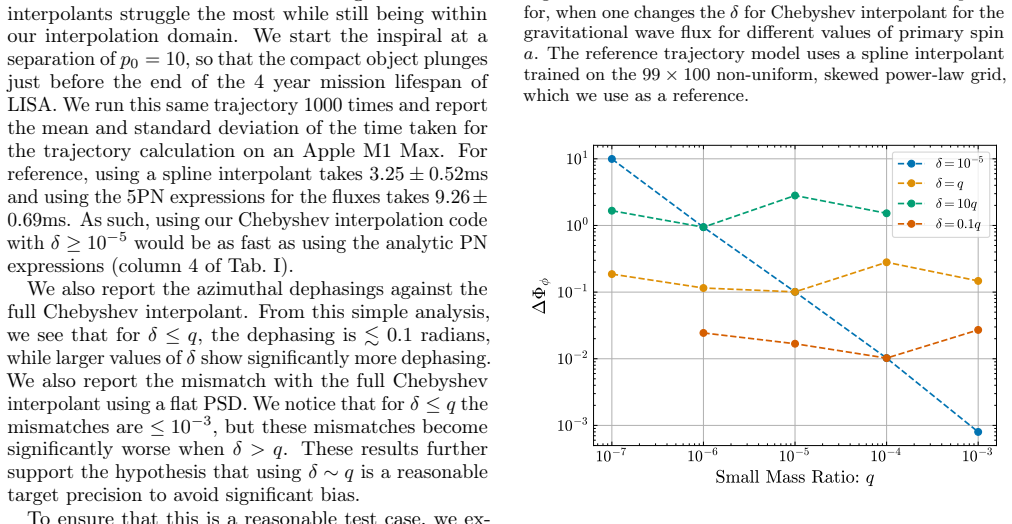
Phase differences To assess the effect of the flux error on the inspiral trajectory, we compare orbital phase evolution between each model and a reference trajectory which we specify at each section. We initialize all trajectories at an orbital separation p0 such that the reference model takes 4 years to reach the plunge limit (ps). We then compute the de...
-
[7]
Mismatches To assess the difference between models(h1, h2)at the waveform level, we will use the following metrics, M(h1, h2) = 1− O(h 1, h2),(23) O(h1, h2) = (h1|h2)p (h1|h1)(h2|h2) ,(24) (h1|h2) = 4Re Z ∞ 0 df h⋆ 1(f)h 2(f) Sn(f) ,(25) where M is the mismatch,O is the overlap, and(h1|h2) is the inner product. Eq.(23) quantifies orthogonality between two...
-
[8]
Bayesian statistics A gold standard technique to assess the suitability of model waveforms for parameter estimation is to use Bayesian inference. Bayes’ theorem states up to a nor- malization constantp(d) = R p(d|θ)p(θ)dθthat p(θ|d)∝p(d|θ)p(θ),(27) for p(d|θ)the likelihood function,p(θ)the prior probabil- ity distribution andp(θ|d)the sought for posterior...
-
[9]
Error in the Spline interpolants In this part we track how flux errors arising from cubic-spline interpolation accumulate into an inspiral phase shift. We start with examining a uniform grid spacing of ∆u = 0.025and∆ a = 0.01(where here only prograde spins of a∈ [0, 0.99]are covered), for a total ofnu = 99 by na = 100points, as used in our earlier work [1...
-
[10]
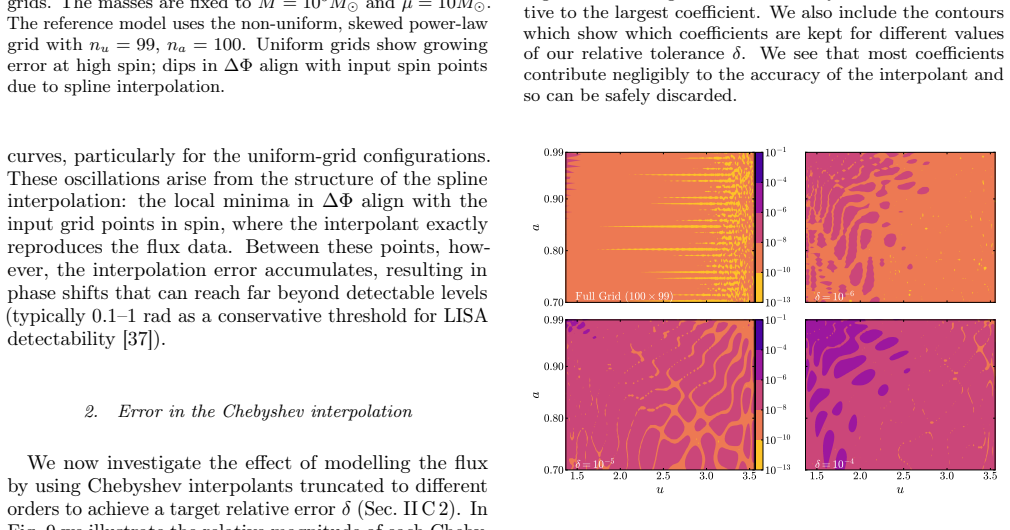
Error in the Chebyshev interpolation We now investigate the effect of modelling the flux by using Chebyshev interpolants truncated to different orders to achieve a target relative errorδ (Sec. IIC2). In Fig. 9 we illustrate the relative magnitude of each Cheby- shev coefficient compared to the largest coefficient. We see that most of the power is concentr...
-
[11]
Waveform fidelity and Bayesian Inference Building on the results from the flux error and phase shift analyses from Sec. IIIB and Sec.IIIB2, we now eval- uate the impact of interpolation-driven inspiral errors on waveform fidelity. To do this, as the first step we com- pute waveform mismatches relative to a high-accuracy reference model, using a selected s...
-
[12]
for further discussion). For precisely this reason, we will neglect additive noise in our likelihood calcula- tions but retain the PSD in(25) and (28) to properly account for uncertainty in parameter measurements due to the presence of noise. Recovered parameters that deviate from the true parameters areonlya result of waveform mismodelling errors. From h...
-
[13]
Physical Review Letters , archivePrefix = "arXiv", eprint =
B. Abbott, R. Abbott, T. Abbott, M. Abernathy, F. Acernese, K. Ackley, C. Adams, T. Adams et al., “Observation of gravitational waves from a binary black hole merger,”Physical Review Letters, vol. 116, no. 6, Feb. 2016. [Online]. Available: http://dx.doi.org/10.1103/PhysRevLett.116.061102
-
[14]
M. Colpiet al., “LISA Definition Study Report,”ArXiv e-prints, 2 2024
work page 2024
-
[15]
F. D. Ryan, “Accuracy of estimating the multipole moments of a massive body from the gravitational waves of a binary inspiral,”Phys. Rev. D, vol. 56, pp. 1845–1855, Aug 1997. [Online]. Available: https: //link.aps.org/doi/10.1103/PhysRevD.56.1845
-
[16]
L. Barack and C. Cutler, “Using lisa extreme-mass- ratio inspiral sources to test off-kerr deviations in the geometry of massive black holes,”Physical Review D, vol. 75, no. 4, p. 042003, 2007
work page 2007
-
[17]
Mapping spacetimes with lisa: inspiral of a test body in a ‘quasi-kerr’field,
K. Glampedakis and S. Babak, “Mapping spacetimes with lisa: inspiral of a test body in a ‘quasi-kerr’field,” Classical and Quantum Gravity, vol. 23, no. 12, p. 4167, 2006
work page 2006
-
[18]
Systematics errors in adiabatic relativistic waveforms for extreme mass ratio inspirals,
H. Khalvati, P. Lynchet al., “Systematics errors in adiabatic relativistic waveforms for extreme mass ratio inspirals,” 2025, manuscript in preparation
work page 2025
-
[19]
Gravitational wave snap- shotsofgenericextrememassratioinspirals,
S. Drasco and S. A. Hughes, “Gravitational wave snap- shotsofgenericextrememassratioinspirals,”Phys. Rev. D,vol.73, no.2, p.024027, 2006, [Erratum: Phys.Rev.D 88, 109905 (2013), Erratum: Phys.Rev.D 90, 109905 (2014)]
work page 2006
-
[20]
S. A. Hughes, N. Warburton, G. Khanna, A. J. K. Chua, andM.L.Katz, “Adiabaticwaveformsforextrememass- ratio inspirals via multivoice decomposition in time and frequency,”Phys. Rev. D, vol. 103, no. 10, p. 104014, 2021, [Erratum: Phys.Rev.D 107, 089901 (2023)]
work page 2021
-
[21]
Science with the space-based interferometer LISA. V: Extreme mass-ratio inspirals,
S. Babak, J. Gair, A. Sesana, E. Barausse, C. F. Sop- uerta, C. P. L. Berry, E. Berti, P. Amaro-Seoane, A. Pe- titeau, and A. Klein, “Science with the space-based interferometer LISA. V: Extreme mass-ratio inspirals,” Phys. Rev. D, vol. 95, no. 10, p. 103012, 2017
work page 2017
-
[22]
Impact of relativistic waveforms in LISA’s science objectives with extreme-mass-ratio inspirals,
H. Khalvati, A. Santini, F. Duque, L. Speri, J. Gair, H. Yang, and R. Brito, “Impact of relativistic waveforms in LISA’s science objectives with extreme-mass-ratio inspirals,”Phys. Rev. D, vol. 111, no. 8, p. 082010, 2025
work page 2025
-
[23]
Testing general relativity with low-frequency, space- based gravitational-wave detectors,
J. R. Gair, M. Vallisneri, S. L. Larson, and J. G. Baker, “Testing general relativity with low-frequency, space- based gravitational-wave detectors,”Living Reviews in Relativity, vol. 16, pp. 1–109, 2013
work page 2013
-
[24]
(sort of) testing relativity with extreme mass ratio inspirals,
S. A. Hughes, “(sort of) testing relativity with extreme mass ratio inspirals,” inAIP Conference Proceedings, vol. 873. American Institute of Physics, 2006, pp. 233–240
work page 2006
-
[25]
The Influence of the hydrodynamic drag from an accretion torus on extreme mass-ratio inspirals,
E. Barausse and L. Rezzolla, “The Influence of the hydrodynamic drag from an accretion torus on extreme mass-ratio inspirals,”Phys. Rev. D, vol. 77, p. 104027, 2008
work page 2008
-
[26]
Probing Accretion Physics with Gravitational Waves,
L. Speri, A. Antonelli, L. Sberna, S. Babak, E. Barausse, J. R. Gair, and M. L. Katz, “Probing Accretion Physics with Gravitational Waves,”Phys. Rev. X, vol. 13, no. 2, p. 021035, 2023
work page 2023
-
[27]
Observable Sig- natures of EMRI Black Hole Binaries Embedded in Thin Accretion Disks,
B. Kocsis, N. Yunes, and A. Loeb, “Observable Sig- natures of EMRI Black Hole Binaries Embedded in Thin Accretion Disks,”Phys. Rev. D, vol. 84, p. 024032, 2011
work page 2011
-
[28]
N. Yunes, B. Kocsis, A. Loeb, and Z. Haiman, “Imprint of Accretion Disk-Induced Migration on Gravitational Waves from Extreme Mass Ratio Inspirals,”Phys. Rev. Lett., vol. 107, p. 171103, 2011
work page 2011
-
[29]
Constrainingaccretionphysicswithgravitationalwaves from eccentric extreme-mass-ratio inspirals,
F. Duque, S. Kejriwal, L. Sberna, L. Speri, and J. Gair, “Constrainingaccretionphysicswithgravitationalwaves from eccentric extreme-mass-ratio inspirals,”Phys. Rev. D, vol. 111, no. 8, p. 084006, 2025
work page 2025
-
[30]
Implications of stochastic gas torques for asymmetric binaries in the LISA band,
L. Copparoni, E. Barausse, L. Speri, L. Sberna, and A. Derdzinski, “Implications of stochastic gas torques for asymmetric binaries in the LISA band,”Phys. Rev. D, vol. 111, no. 10, p. 104079, 2025
work page 2025
-
[31]
A fully relativistic treatment of EMRIs in collisionless environ- ments,
R. Vicente, T. K. Karydas, and G. Bertone, “A fully relativistic treatment of EMRIs in collisionless environ- ments,” 5 2025
work page 2025
-
[32]
F. Duque, C. F. B. Macedo, R. Vicente, and V. Cardoso, “Extreme-mass-ratio inspirals in ultralight dark matter,”Phys. Rev. Lett., vol. 133, p. 121404, Sep 2024. [Online]. Available: https: //link.aps.org/doi/10.1103/PhysRevLett.133.121404
-
[33]
N. Speeney, A. Antonelli, V. Baibhav, and E. Berti, “Impact of relativistic corrections on the detectability of dark-matter spikes with gravitational waves,”Physical Review D, vol. 106, no. 4, Aug. 2022. [Online]. Available: http://dx.doi.org/10.1103/PhysRevD.106.044027
-
[34]
Extreme mass ratio inspirals in rotating dark matter spikes,
S. Mitra, N. Speeney, S. Chakraborty, and E. Berti, “Extreme mass ratio inspirals in rotating dark matter spikes,” 5 2025
work page 2025
-
[35]
Dynamic signatures of black hole binaries with superradiant clouds,
J. Zhang and H. Yang, “Dynamic signatures of black hole binaries with superradiant clouds,”Phys. Rev. D, vol. 101, p. 043020, Feb 2020. [Online]. Available: https: //link.aps.org/doi/10.1103/PhysRevD.101.043020
-
[36]
Science potential for stellar-mass black holes as neighbors of Sgr A*,
S. Tahura, Z. Pan, and H. Yang, “Science potential for stellar-mass black holes as neighbors of Sgr A*,”Phys. Rev. D, vol. 105, no. 12, p. 123018, 2022
work page 2022
-
[37]
R. Brito and S. Shah, “Erratum: Extreme mass-ratio inspirals into black holes surrounded by scalar clouds [phys. rev. d 108, 084019 (2023)],”Phys. Rev. D, vol. 110, p. 109902, Nov 2024. [Online]. Available: https: //link.aps.org/doi/10.1103/PhysRevD.110.109902
-
[38]
C. Dyson, T. F. M. Spieksma, R. Brito, M. van de Meent, and S. Dolan, “Environmental Effects in Extreme-Mass-Ratio Inspirals: Perturbations to the Environment in Kerr Spacetimes,”Phys. Rev. Lett., vol. 134, no. 21, p. 211403, 2025
work page 2025
-
[39]
Detecting scalar fields with Extreme Mass Ratio In- spirals,
A.Maselli, N.Franchini, L.Gualtieri, andT.P.Sotiriou, “Detecting scalar fields with Extreme Mass Ratio In- spirals,”Phys. Rev. Lett., vol. 125, no. 14, p. 141101, 2020
work page 2020
-
[40]
S. Barsanti, N. Franchini, L. Gualtieri, A. Maselli, and T. P. Sotiriou, “Extreme mass-ratio inspirals as probes of scalar fields: Eccentric equatorial orbits around Kerr 23 black holes,”Phys. Rev. D, vol. 106, no. 4, p. 044029, 2022
work page 2022
-
[41]
Detecting Massive Scalar Fields with Extreme Mass- Ratio Inspirals,
S. Barsanti, A. Maselli, T. P. Sotiriou, and L. Gualtieri, “Detecting Massive Scalar Fields with Extreme Mass- Ratio Inspirals,”Phys. Rev. Lett., vol. 131, no. 5, p. 051401, 2023
work page 2023
-
[42]
L. Speri, S. Barsanti, A. Maselli, T. P. Sotiriou, N. War- burton, M. van de Meent, A. J. K. Chua, O. Burke, and J. Gair, “Probing fundamental physics with Ex- treme Mass Ratio Inspirals: a full Bayesian inference for scalar charge,”ArXiv e-prints, 6 2024
work page 2024
-
[43]
New horizons for psi: Extreme-mass- ratio inspirals in fundamental fields,
F. Duque, “New horizons for psi: Extreme-mass- ratio inspirals in fundamental fields,” 2024. [Online]. Available: https://arxiv.org/abs/2412.08711
-
[44]
Searching for extreme mass ratio inspirals in LISA: from identification to parameter estimation,
S. H. Strub, L. Speri, and D. Giardini, “Searching for extreme mass ratio inspirals in LISA: from identification to parameter estimation,”ArXiv e-prints, 5 2025
work page 2025
-
[45]
A. J. K. Chua and C. J. Cutler, “Nonlocal parameter degeneracy in the intrinsic space of gravitational-wave signals from extreme-mass-ratio inspirals,”Phys. Rev. D, vol. 106, no. 12, p. 124046, 2022
work page 2022
-
[46]
A constrained metropolis–hastings search for emris in the mock lisa data challenge 1b,
J. R. Gair, E. Porter, S. Babak, and L. Barack, “A constrained metropolis–hastings search for emris in the mock lisa data challenge 1b,”Classical and Quantum Gravity, vol. 25, no. 18, p. 184030, 2008
work page 2008
-
[47]
The Mock LISA Data Challenges: From Challenge 3 to Challenge 4,
S. Babaket al., “The Mock LISA Data Challenges: From Challenge 3 to Challenge 4,”Class. Quant. Grav., vol. 27, p. 084009, 2010
work page 2010
-
[48]
WaveformModellingfortheLaserIn- terferometer Space Antenna,
N.Afshordiet al., “WaveformModellingfortheLaserIn- terferometer Space Antenna,”ArXiv e-prints, 11 2023
work page 2023
-
[49]
Assessing the importance of first postadiabatic terms for small-mass-ratio binaries,
O. Burke, G. A. Piovano, N. Warburton, P. Lynch, L. Speri, C. Kavanagh, B. Wardell, A. Pound, L. Durkan, and J. Miller, “Assessing the importance of first postadiabatic terms for small-mass-ratio binaries,” Phys. Rev. D, vol. 109, no. 12, p. 124048, 2024
work page 2024
-
[50]
Self-force and radiation re- action in general relativity,
L. Barack and A. Pound, “Self-force and radiation re- action in general relativity,”Rept. Prog. Phys., vol. 82, no. 1, p. 016904, 2019
work page 2019
-
[51]
Black hole perturbation theory and gravitational self-force,
A. Pound and B. Wardell, “Black hole perturbation theory and gravitational self-force,”Handbook of Grav- itational Wave Astronomy, pp. 1–119, 2022
work page 2022
-
[52]
Two timescale analy- sis of extreme mass ratio inspirals in Kerr. I. Orbital Motion,
T. Hinderer and E. E. Flanagan, “Two timescale analy- sis of extreme mass ratio inspirals in Kerr. I. Orbital Motion,”Phys. Rev. D, vol. 78, p. 064028, 2008
work page 2008
-
[53]
J. Miller and A. Pound, “Two-timescale evolution of extreme-mass-ratio inspirals: waveform generation scheme for quasicircular orbits in Schwarzschild space- time,”Phys. Rev. D, vol. 103, no. 6, p. 064048, 2021
work page 2021
-
[54]
S. A. Hughes, “Evolution of circular, nonequatorial orbits of Kerr black holes due to gravitational wave emission. II. Inspiral trajectories and gravitational wave forms,”Phys. Rev. D,vol.64, p.064004, 2001, [Erratum: Phys.Rev.D 88, 109902 (2013)]
work page 2001
-
[55]
Gravitational radiation reaction and inspi- ral waveforms in the adiabatic limit,
S. A. Hughes, S. Drasco, E. E. Flanagan, and J. Franklin, “Gravitational radiation reaction and inspi- ral waveforms in the adiabatic limit,”Phys. Rev. Lett., vol. 94, p. 221101, 2005
work page 2005
-
[56]
Gravita- tional radiation reaction for bound motion around a Schwarzschild black hole,
C. Cutler, D. Kennefick, and E. Poisson, “Gravita- tional radiation reaction for bound motion around a Schwarzschild black hole,”Phys. Rev. D, vol. 50, pp. 3816–3835, 1994
work page 1994
-
[57]
Radiation reaction induced evolution of circular orbits of particles around Kerr black holes,
D. Kennefick and A. Ori, “Radiation reaction induced evolution of circular orbits of particles around Kerr black holes,”Phys. Rev. D, vol. 53, pp. 4319–4326, 1996
work page 1996
-
[58]
S. A. Hughes, “The Evolution of circular, nonequatorial orbits of Kerr black holes due to gravitational wave emission,”Phys. Rev. D, vol. 61, no. 8, p. 084004, 2000, [Erratum: Phys.Rev.D 63, 049902 (2001), Erratum: Phys.Rev.D 65, 069902 (2002), Erratum: Phys.Rev.D 67, 089901 (2003), Erratum: Phys.Rev.D 78, 109902 (2008), Erratum: Phys.Rev.D 90, 109904 (2014)]
work page 2000
-
[59]
K. Glampedakis and D. Kennefick, “Zoom and whirl: Eccentric equatorial orbits around spinning black holes and their evolution under gravitational radiation reac- tion,”Phys. Rev. D, vol. 66, p. 044002, 2002
work page 2002
-
[60]
Gravitational self force on a particle in circular orbit around a Schwarzschild black hole,
L. Barack and N. Sago, “Gravitational self force on a particle in circular orbit around a Schwarzschild black hole,”Phys. Rev. D, vol. 75, p. 064021, 2007
work page 2007
-
[61]
Gravitational self-force on a particle in eccentric orbit around a Schwarzschild black hole,
——, “Gravitational self-force on a particle in eccentric orbit around a Schwarzschild black hole,”Phys. Rev. D, vol. 81, p. 084021, 2010
work page 2010
-
[62]
Gravitational self-force on eccentric equatorial orbits around a Kerr black hole,
M. van de Meent, “Gravitational self-force on eccentric equatorial orbits around a Kerr black hole,”Phys. Rev. D, vol. 94, no. 4, p. 044034, 2016
work page 2016
-
[63]
Gravitational self-force on generic bound geodesics in Kerr spacetime,
——, “Gravitational self-force on generic bound geodesics in Kerr spacetime,”Phys. Rev. D, vol. 97, no. 10, p. 104033, 2018
work page 2018
-
[64]
Evolution of inspiral orbits around a Schwarzschild black hole,
N. Warburton, S. Akcay, L. Barack, J. R. Gair, and N. Sago, “Evolution of inspiral orbits around a Schwarzschild black hole,”Phys. Rev. D, vol. 85, p. 061501, 2012
work page 2012
-
[65]
Highly eccentric inspirals into a black hole,
T. Osburn, N. Warburton, and C. R. Evans, “Highly eccentric inspirals into a black hole,”Phys. Rev. D, vol. 93, no. 6, p. 064024, 2016
work page 2016
-
[66]
Evolution of small-mass-ratio binaries with a spinning secondary,
N. Warburton, T. Osburn, and C. R. Evans, “Evolution of small-mass-ratio binaries with a spinning secondary,” Phys. Rev. D, vol. 96, no. 8, p. 084057, 2017
work page 2017
-
[67]
Eccentric self-forced inspirals into a rotat- ing black hole,
Lynch, Philip and van de Meent, Maarten and Warbur- ton, Niels, “Eccentric self-forced inspirals into a rotat- ing black hole,”Class. Quant. Grav., vol. 39, no. 14, p. 145004, 2022
work page 2022
-
[68]
Self- forced inspirals with spin-orbit precession,
P. Lynch, M. van de Meent, and N. Warburton, “Self- forced inspirals with spin-orbit precession,”Phys. Rev. D, vol. 109, no. 8, p. 084072, 2024
work page 2024
-
[69]
L. V. Drummond, A. G. Hanselman, D. R. Becker, and S. A. Hughes, “Extreme mass-ratio inspiral of a spinning body into a Kerr black hole I: Evolution along generic trajectories,”ArXiv e-prints, 5 2023
work page 2023
-
[70]
L. V. Drummond, P. Lynch, A. G. Hanselman, D. R. Becker, and S. A. Hughes, “Extreme mass-ratio inspiral and waveforms for a spinning body into a Kerr black hole via osculating geodesics and near-identity trans- formations,”Phys. Rev. D, vol. 109, no. 6, p. 064030, 2024
work page 2024
-
[71]
Fast inspirals and the treatment of orbital resonances,
P. Lynch, V. Witzany, M. van de Meent, and N. War- burton, “Fast inspirals and the treatment of orbital resonances,”Class. Quant. Grav., vol. 41, no. 22, p. 225002, 2024
work page 2024
-
[72]
Z. Nasipak, “Adiabatic gravitational waveform model for compact objects undergoing quasicircular inspirals into rotating massive black holes,”Phys. Rev. D, vol. 24 109, no. 4, p. 044020, 2024
work page 2024
-
[74]
M. L. Katz, A. J. K. Chua, L. Speri, N. Warburton, and S. A. Hughes, “Fast extreme-mass-ratio-inspiral waveforms: New tools for millihertz gravitational-wave data analysis,”Phys. Rev. D, vol. 104, no. 6, p. 064047, 2021
work page 2021
-
[75]
Fast and Fourier: Extreme Mass Ratio Inspiral Waveforms in the Frequency Domain,
L. Speri, M. L. Katz, A. J. K. Chua, S. A. Hughes, N. Warburton, J. E. Thompson, C. E. A. Chapman- Bird, and J. R. Gair, “Fast and Fourier: Extreme Mass Ratio Inspiral Waveforms in the Frequency Domain,” Front. Appl. Math. Stat., vol. 9, 2024
work page 2024
-
[76]
C. E. Chapman-Bird, L. Speri, Z. Nasipak, O. Burke, M. L. Katz, A. Santini, S. Kejriwal, P. Lynch, J. Math- ews, H. Khalvatiet al., “The fast and the frame- dragging: Efficient waveforms for asymmetric-mass ec- centric equatorial inspirals into rapidly-spinning black holes,”arXiv preprint arXiv:2506.09470, 2025
work page internal anchor Pith review Pith/arXiv arXiv 2025
-
[77]
Second-Order Self-Force Calculation of Gravitational Binding Energy in Compact Binaries,
A. Pound, B. Wardell, N. Warburton, and J. Miller, “Second-Order Self-Force Calculation of Gravitational Binding Energy in Compact Binaries,”Phys. Rev. Lett., vol. 124, no. 2, p. 021101, 2020
work page 2020
-
[78]
Gravitational-Wave Energy Flux for Com- pact Binaries through Second Order in the Mass Ratio,
N. Warburton, A. Pound, B. Wardell, J. Miller, and L. Durkan, “Gravitational-Wave Energy Flux for Com- pact Binaries through Second Order in the Mass Ratio,” Phys. Rev. Lett., vol. 127, no. 15, p. 151102, 2021
work page 2021
-
[79]
L. Durkan and N. Warburton, “Slow evolution of the metric perturbation due to a quasicircular inspiral into a Schwarzschild black hole,”Phys. Rev. D, vol. 106, no. 8, p. 084023, 2022
work page 2022
-
[80]
Gravitational memory: new results from post-Newtonian and self-force theory,
K. Cunningham, C. Kavanagh, A. Pound, D. Trestini, N. Warburton, and J. Neef, “Gravitational memory: new results from post-Newtonian and self-force theory,” Class. Quant. Grav., vol. 42, no. 13, p. 135009, 2025
work page 2025
-
[81]
J. Lewis, T. Kakehi, A. Pound, and T. Tanaka, “Post- adiabatic dynamics and waveform generation in self- force theory: an invariant pseudo-Hamiltonian frame- work,” 7 2025
work page 2025
discussion (0)
Sign in with ORCID, Apple, or X to comment. Anyone can read and Pith papers without signing in.