REVIEW 4 major objections 4 minor 40 references
Resonant magnetic X-ray speckle autocorrelations directly measure fluctuations of the Edwards-Anderson spin-glass order parameter, and the measured relaxation time diverges as the Vogel-Fulcher law as Tg is approached.
Reviewed by Pith at T0; open to challenge. T0 means a machine referee read the full paper against a public rubric. the ladder, T0–T4 →
T0 review · deepseek-v4-flash
2026-08-04 19:55 UTC pith:R4LHYRWG
load-bearing objection A genuinely new experimental probe of spin-glass dynamics, but the central mapping from speckle contrast to the Edwards-Anderson susceptibility rests on an uncontrolled factorization that needs much more support before the headline claim can be accepted. the 4 major comments →
Time-dependent correlations of the Edwards-Anderson order parameter above the spin-glass transition
The pith
A machine-rendered reading of the paper's core claim, the machinery that carries it, and where it could break.
Core claim
The central claim is that the Edwards-Anderson order parameter has an observable time-dependent fluctuation spectrum above Tg, and that it appears as a four-spin correlation in the intensity of resonantly scattered coherent X-rays. Specifically, for forward scattering and with the usual decoupling of distinct spin pairs, the time-averaged magnetic intensity autocorrelation is C^2 chi_SG(tau) plus the square of the mean magnetic intensity, where chi_SG(tau) = (1/N^2) <q(t,tau)^2>_t and q(t,tau) is the overlap of thermally averaged spin orientations at times t and t+tau. The experimentally normalized function g2(q,tau)-1 is therefore proportional to chi_SG(tau). The paper reports that in Cu0.8
What carries the argument
The load-bearing object is the time-dependent Edwards-Anderson overlap q(t,tau) = (1/N) sum_i <S_i(t)> · <S_i(t+tau)> averaged over the random spin orientations, whose infinite-time limit is the Edwards-Anderson order parameter. The argument works through the relation between the speckle intensity autocorrelation and this overlap: in the forward-scattering limit the magnetic scattering amplitude is a sum of thermally averaged spin components, and after decoupling distinct spin pairs the intensity autocorrelation becomes C^2 chi_SG(tau) + <I_m>^2, with chi_SG(tau) proportional to <q(t,tau)^2>_t. This identity converts g2(q,tau)-1, normalized by the total intensity, into a direct measure of th
Load-bearing premise
The central claim collapses if the decoupling approximation in Eqs. (8)-(10) fails—namely, if contributions from distinct spin pairs do not factor into <I_m>^2, or if the 2-second thermal average and forward-scattering limit cannot be taken, then the measured g2 is not a faithful reading of chi_SG(tau) and the extracted tau0(T) is not the Edwards-Anderson order-parameter relaxation time.
What would settle it
A numerical simulation of a CuMn-like spin glass that computes both <q(t,tau)^2> and the full four-spin X-ray intensity autocorrelation at small q would settle the identification: if the two disagree in shape or in tau0(T), the decoupling step in Eq. (8) is invalid; equivalently, measuring g2(q,tau) at two strongly different Mn concentrations and finding different reduced tau0(T-Tg) scaling would signal that the order-parameter identification fails.
If this is right
- RM-XPCS provides a direct, real-time route to the time-dependent Edwards-Anderson susceptibility, covering time scales from seconds to tens of thousands of seconds that neutron scattering cannot reach.
- In Cu0.88Mn0.12, the correlation time diverges as the temperature approaches Tg according to the Vogel-Fulcher law, with T0 ≈ 36.5 K, so the spin-glass memory time scale behaves like the viscous relaxation time of structural glasses.
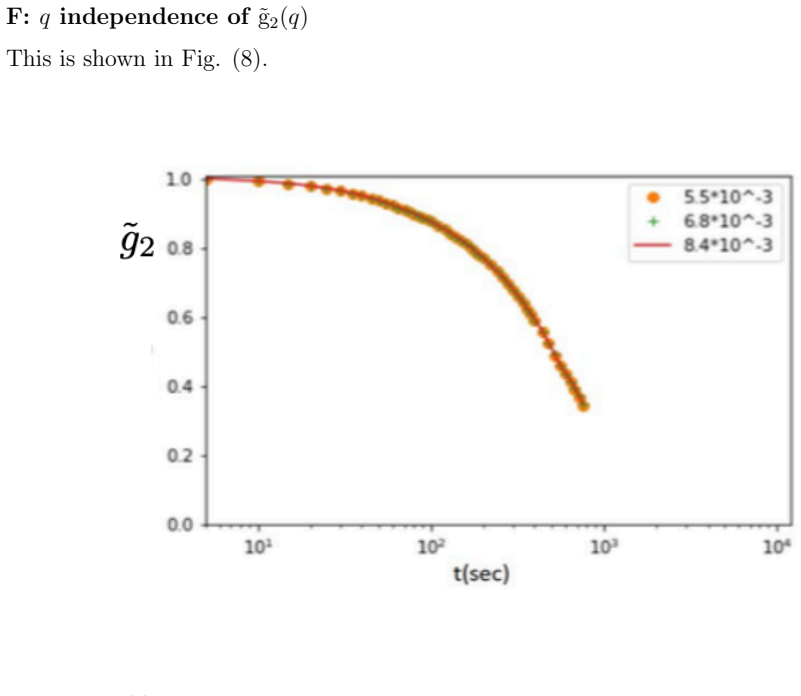
- The magnetic contribution to g2(q,tau) is nearly q-independent at small q, consistent with an order-parameter fluctuation that carries spatial randomness but no periodic spatial correlations.
- The same four-spin intensity-correlation method is applicable to other systems with quenched or entangled spin fluctuations, including spin ices, quantum spin liquids, and possibly the structural glass transition.
- If the power-law fit is used instead, the extracted dynamic exponent B ≈ 2.7 is appreciably smaller than the value ~7 from simulations of the cubic Ising spin glass, highlighting a discrepancy between the measured dynamics and standard spin-glass critical scaling.
Where Pith is reading between the lines
- If the identification of g2 - 1 with chi_SG(tau) survives closer scrutiny, the same normalized autocorrelation could serve as a model-free order-parameter-fluctuation thermometer for any spin glass, and its temperature dependence could be compared directly with the magnetization cusp to locate Tg uniquely.
- A natural test of the decoupling assumption is to run a numerical simulation of the same CuMn-like spin Hamiltonian with X-ray scattering weights and check whether the intensity autocorrelation's shape matches <q(t,tau)^2>; a mismatch would mean the extracted tau0(T) is not the EA susceptibility time.
- The near-q independence found here suggests that analogous speckle-correlation measurements in spin ices or quantum spin liquids would see a similar flat q dependence only if the fluctuations are genuine local-order-parameter fluctuations, offering a way to classify slow dynamics in those systems.
- The paper's two-pulse XPCS remark implies a broader inference: the same four-spin-correlation quantity measured at nanosecond delays with X-ray free-electron lasers could bridge the gap between macroscopic memory and microscopic spin dynamics, connecting to neutron spin-echo results.
Editorial analysis
A structured set of objections, weighed in public.
Referee Report
Summary. The paper presents RM-XPCS measurements on Cu_0.88Mn_0.12 above the spin-glass transition and argues that the normalized intensity autocorrelation g2(q,tau) is directly proportional to the time-dependent spin-glass susceptibility chi_SG(tau), i.e., to the autocorrelation of the squared Edwards-Anderson overlap q(t,tau)^2. From the measured decay they extract a relaxation time tau0(T) that grows as T approaches Tg from above and claim it follows the Vogel-Fulcher law with T0=36.5 K, while acknowledging a power-law fit with Tg=44 K and B=2.7 is equally good. The paper concludes this is the first direct measurement of the temperature dependence of the time-dependent susceptibility related to SG(EA) order parameter fluctuations.
Significance. If the central mapping is valid, the manuscript is a significant experimental advance: it introduces a way to probe four-spin correlations associated with the EA order parameter on time scales inaccessible to neutron scattering, and the q-independence and off-resonance controls (Supp. C-E) are sensible checks. The potential extension to spin ices, spin liquids, and structural glasses is plausible. However, the paper provides no code or data availability statement and, more importantly, the mapping itself rests on an uncontrolled factorization for which the necessary validation is not supplied; until that is fixed, the quantitative claims (tau0(T), VF/power-law divergence) remain conditional.
major comments (4)
- [Eqs. (8)-(10)] The central identity g2-1 = beta chi_SG(tau)/<I_t>^2 depends on Eq. (8), but Eq. (8) invokes 'By Eq. (7)' for <I_m(q,t)>^2 while Eq. (7) is missing from the manuscript. More substantively, Eq. (8) factorizes the four-spin product into the same-pair term and a product of separated pair averages with only the assertion that different spin pairs are 'spatially uncorrelated.' This is a Gaussian/Siegert-type factorization, and no estimate is given for the neglected connected four-spin cumulant, which is precisely the quantity expected to grow near the spin-glass transition. Without a bound on this term, or an independent numerical/experimental test, the identification with chi_SG(tau) is not established.
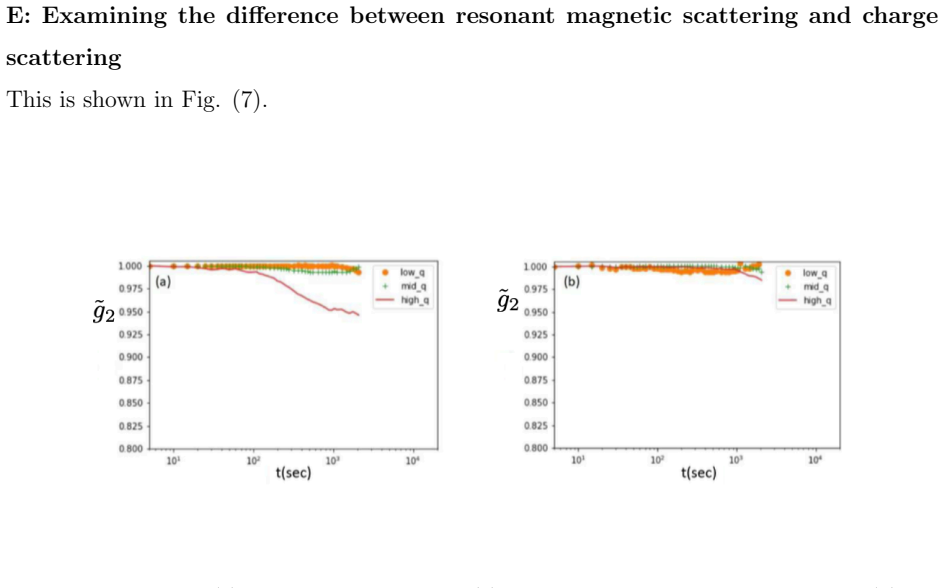
- [Eqs. (1), (5)-(6); Supp. C] Eq. (1) defines q(t,tau) with a true thermal average <S_i(t)>_T, but the experiment replaces it with a block average over 2 sec (main text after Eq. (5)), while Supp. C says the time frame for collecting data was 5 sec. No demonstration is provided that this block is long enough to define a quasi-static spin configuration and short compared with the slow fluctuations of interest. If the 2-sec/5-sec block average is not a faithful ergodic average, q(t,tau) is not the Edwards-Anderson overlap and the subsequent chi_SG(tau) interpretation falls.
- [Fig. (3) and Supp. f] The paper's abstract and conclusion emphasize the Vogel-Fulcher law, but Supp. f states the power-law Eq. (15) 'is as good as' the VF fit. Since the two forms are degenerate for this dataset, the claim 'consistent with the Vogel-Fulcher law' overstates what is demonstrated. The authors should provide quantitative model comparison (e.g., residuals, reduced chi^2, parameter uncertainties) and discuss what measurement range would distinguish VF from power law. The fitted power-law exponent B=2.7 also conflicts with earlier zv~7 estimates; this discrepancy is not resolved.
- [Eq. (14)] The relaxation time tau0(T) is extracted by fitting g2 to a single exponential plus constant. No justification is given for this functional form; if the true decay is stretched-exponential or has multiple steps, tau0(T) will be systematically biased, and this could affect the VF/power-law comparison. I request fits with alternative forms (e.g., exp[-(tau/tau0)^beta]) and a plot of residuals, or at least a statement that the conclusions are robust to the choice.
minor comments (4)
- [Abstract] 'Vogel-Vulcher' should be 'Vogel-Fulcher' (twice).
- [Supp. f / main text] The power-law fit is said to be shown in 'Fig. (5)' in the main text but appears as Fig. (9) in the supplementary file; also Eq. (15) is referenced before it is displayed.
- [Fig. 3] The axis label uses omega (log10[omega/omega0]) whereas the text uses tau (log10(tau/tau0)); please make the notation consistent.
- [References] Ref. [2] has a typo: 'Krikpatrick' should be 'Kirkpatrick'; check journal/volume formatting in Refs. [30] and [33].
Circularity Check
No significant circularity: the central g2-to-chi_SG mapping is a derived scattering relation with an openly stated factorization, and the Vogel-Fulcher/power-law forms are explicitly fitted, not predicted; one non-load-bearing self-citation appears in the discussion.
full rationale
The central identity g2(q,tau)-1 = beta*chi_SG(tau)/<I_t>^2 (Eq. 12) is derived from the resonant magnetic scattering cross-section of Eqs. (5)-(6), which cites the external theory of Hannon/Blume [17,18], together with the explicit decoupling approximation in Eq. (8): 'we have decoupled the time averages over different pairs of spins because they are assumed spatially uncorrelated.' Given the definition of q(t,tau) in Eq. (1) and the definitional relation chi_SG(tau) = (1/N^2)<q(t,tau)^2>_t in Eq. (10), the surviving first term of Eq. (8) is algebraically the same four-spin product summed in <q^2>_t, so the mapping is a derived identity, not an equivalence imposed by construction. The normalized observable is calibrated by Eq. (13), g2-tilde = (g2-1)/(g2(0)-1), which merely rescales chi_SG(tau) by its value at tau=0; no parameter is fitted to create the connection to EA-order-parameter fluctuations. The Vogel-Fulcher form (Eq. 16) and the power law (Eq. 15) are both fitted to the extracted tau0(T), and the paper openly acknowledges the degeneracy in Supplementary section f: 'The fit is as good as to the Vogel-Fulcher law.' Thus the 'remarkable' VF claim in the abstract is a curve-fit report, not a prediction manufactured from a fitted input. The only self-referential element is the citation of [29] (Varma 2023, co-authored by C.M. Varma) in the sentence 'This form has been derived from the shear correlations of the structural glass [29]'; this is used to note a conceptual analogy with structural glasses and is not load-bearing for the spin-glass measurement, which rests on the displayed fits and consistency checks (off-resonance null, q-independence, stationarity). The principal vulnerability is the factorization assumption in Eq. (8) -- a modeling approximation with no estimate of the neglected four-spin cumulant -- but that is a correctness/robustness concern, not a circular reduction. The derivation chain is self-contained and does not reduce to its own inputs.
Axiom & Free-Parameter Ledger
free parameters (6)
- Vogel-Fulcher T0 =
36.5 K
- Vogel-Fulcher activation energy E0 =
not quoted
- Vogel-Fulcher prefactor tau0 =
not quoted
- Power-law Tg and exponent B =
Tg = 44.12 K, B = 2.68
- Exponential form parameters C1 and C2 in Eq (14) =
not quoted
- Time bin for thermal average =
2 s
axioms (5)
- standard math Siegert-like relation for partially coherent scattered light: g2 = 1 + beta(<I(t)I(t+tau)> - <I>^2)/<I>^2
- domain assumption Charge and magnetic scattering do not interfere because their polarizations are perpendicular
- domain assumption Small-angle limit: (e_in x e_out) dot S_i is approximately S_i^z and e^{-iq dot (R_i-R_j)} is approximately 1
- ad hoc to paper Above the spin-glass transition, different spins are spatially uncorrelated, so time averages over different spin pairs factorize
- ad hoc to paper The 2-second time window is long enough to define a thermal average <S_i(t)> but short compared to the slow dynamics of interest
read the original abstract
In 1975 Edwards and Anderson introduced a new paradigm that interacting quenched systems, such as a spin-glass, have a phase transition in which long time memory of spatial patterns is realized without spatial correlations. We show here that the information about the time-dependent correlations above the spin-glass transition are embedded in the four spin correlations of the intensity of speckle pattern. This encodes the spin-orientation memory and can be measured by the technique of resonant magnetic x-ray photon correlation spectroscopy (RM- XPCS). We have implemented this method to observe and accurately characterize the critical slowing down of the spin orientation fluctuations in the classic metallic spin glass alloy $Cu_{1-x}{Mn}_x$ over time scales of ${2}$ sec. to $2 \times 10^{\mathbf{4}}$ secs. Remarkably the divergence of the correlation time as a function of temperature is consistent with the Vogel-Vulcher law, universally used to characterize the viscous relaxation time in structural glasses. Our method also opens the way for studying phase transitions in systems such as spin ices, quantum spin liquids, the structural glass transition, as well as possibly provide new perspectives on the multifarious problems in which spin-glass concepts have found applications.
Figures



Reference graph
Works this paper leans on
-
[1]
Edwards S. F. & Anderson, P. W. Theory of spin glasses. Journal of Physics F: Metal Physics 5, 965-974 (1975)
1975
-
[2]
For a compendium of references to early theoretical directions pursued, see D. Sherring- ton and S. Krikpatrick, 50 years of spin glass theory, arXiv.org/2505.24432
-
[3]
Mydosh, J. A. Spin glasses: redux: an updated experimental/materials survey. Rep. Prog. Phys. 78052501 (2015)
2015
-
[4]
Mydosh, J. A. Spin glasses - recent experiments and systems. Journal of Magnetism and Magnetic Materials 7 237-248 (1978)
1978
-
[5]
Huang, C. Y. Some experimental aspects of spin glasses: A review. Journal of Magnetism and Magnetic Materials 51 1-74 (1985)
1985
-
[6]
Young, A. P. Spin Glasses and Random Fields, (Ed., Series on Directions in Condensed Matter Physics, Vol. 12, World Scientific Singapore, 1998)
1998
-
[7]
Bryngelson, J. D. & Wolynes, P. G. Spin glasses and the statistical mechanics of protein folding. Proc. Nat. Acad. Sci. 84, 7524-7528 (1987)
1987
-
[8]
Parisi, G
Mezard, M. Parisi, G. & Virasoro, M. A. Spin Glass Theory and Beyond (World Scientific Lecture Notes in Physics, Vol. 9, World Scientific Press, Singapore 1986)
1986
-
[9]
An Introduction to the Theory of Spin Glasses and Neural Networks (World Scientific Lecture Notes in Physics, Vol
Dotsenko, V. An Introduction to the Theory of Spin Glasses and Neural Networks (World Scientific Lecture Notes in Physics, Vol. 54, World Scientific Press, Singapore 1995)
1995
-
[10]
Exact solutions for diluted spin glasses and optimization problems
Franz, S. Exact solutions for diluted spin glasses and optimization problems. Phys. Rev. Lett. 87, 127209 (2001)
2001
-
[11]
Optimization problems and replica symmetry breaking in finite connec- tivity spin glasses
Monasson, R. Optimization problems and replica symmetry breaking in finite connec- tivity spin glasses. J. Phys. A: Math. Gen., 31,513-529 (1998)
1998
-
[12]
Murani, A. P. & Heidemann, A. Neutron-scattering measurement of the Edwards- Anderson order parameter for a Cu-Mn spin-glass alloy. Phys. Rev. Lett. 41, 1402 (1978)
1978
-
[13]
The dynamical behaviour associated with the spin glass transition
Mezei, F. The dynamical behaviour associated with the spin glass transition. J.Mag. Mag. Mat. 31-34, 1327 (1983)
1983
-
[14]
& Murani, A
Mezei, F. & Murani, A. P. J. Mag. Mag. Mat. 14, 211 (1979)
1979
-
[15]
& Campbell, I
Pappas, C., Mezei, F., Ehlers, G., Manuel, P. & Campbell, I. A., Dynamic scaling in spin glasses. Phys. Rev. B 68, 054431 (2003)
2003
-
[16]
M., Cywinski, R
Pickup R. M., Cywinski, R. Pappas, C., Farago, B. & Fouquet, P. Generalized spin-glass 11 relaxation. Phys. Rev. Lett. 102, 097202 (2009)
2009
-
[17]
P., Trammell, G
Hannon, J. P., Trammell, G. T., Blume, M. & Gibbs, D. X-ray resonance exchange scattering. Phys. Rev. Lett. 61, 1245 (1989)
1989
-
[18]
Magnetic scattering of x rays
Blume, M. Magnetic scattering of x rays. J. Appl. Phys. 57, 3615 (1985)
1985
-
[19]
R., Zhang, Q
Sandy, A. R., Zhang, Q. & Lurio, L. B. Ann. Rev. Mater. Res. 48,167 (2018)
2018
-
[20]
Madsen, A
Grubel, G. Madsen, A. & Robert, A. X-ray Photon Correlation Spectrocopy in Soft Matter Characterization ( Springer-Verlag, Chapter 18,2008)
2008
-
[21]
A review of X-ray intensity fluctuation spectroscopy
Sutton, M. A review of X-ray intensity fluctuation spectroscopy. Physique 9, 657-667 (2008)
2008
-
[22]
Sinha, S. K. Jiang, Z. & Lurio, L. B. X-ray Photon Correlation Spectroscopy Studies of Surfaces and Thin Films. Adv. Mater. 26, 7764-7785 (2014)
2014
-
[23]
Ogielski, A. T. Dynamics of three-dimensional Ising spin glasses in thermal equilibrium. Phys. Rev. B 32, 7384 (1985)
1985
-
[24]
Levy, L. P. Critical dynamics of metallic spin glasses. Phys. Rev. B 38, 4963 (1988)
1988
-
[25]
& Ruiz-Lorenzo J
Parisi G., Ranieri P., Ricci-Tersenghi F. & Ruiz-Lorenzo J. J. Mean field dynamical exponents in finite-dimensional Ising spin glass. J. Phys. A, Math. and Gen., 30, 7115-7131 (1997)
1997
-
[26]
K., Prellier, W., Singh, M
Singh, M. K., Prellier, W., Singh, M. P., Katiyar, R. S. & Scott, J. F. Spin-glass transition in single-crystal BiFeO 3. Phys. Rev B 77, 144403 (2008)
2008
-
[27]
The mysterious glass transition
Langer, J. The mysterious glass transition. Physics Today 60, 2, 8 (2007)
2007
-
[28]
Dyre, J. C. Colloquium: The glass transition and elastic models of glass-forming liquids. Rev. Mod. Phys. 78, 953-972 (2006)
2006
-
[29]
Theory of melting of glasses, Philosophical Magazine, 103:17, 1650-1663, (2023)
Varma, C.M. Theory of melting of glasses, Philosophical Magazine, 103:17, 1650-1663, (2023)
2023
-
[30]
Low-temperature specific heat of dilute Cu-Mn alloys
Zimmerman, J.E., Hoare, F.E. Low-temperature specific heat of dilute Cu-Mn alloys. Journal of Physics and Chemistry of Solids, 17. 52-56 (1960) doi:10.1016/0022- 3697(60)90174-8
doi:10.1016/0022- 1960
-
[31]
Chemical Reviews, 43, 219 (1948)
Kauzmann, W. Chemical Reviews, 43, 219 (1948)
1948
-
[32]
J. H. Gibbs and E. A. DiMarzio, Journal of Chemical Physics 28, 373 (1958)
1958
-
[33]
T. R. Kirkpatrick, D. Thirumalai, and P. G. Wolynes, Phys. Rev. A 40, 1045 (1989)
1989
-
[34]
Anderson, P. W. Resonating valence bonds: A new kind of insulator? Mat. Res. Bull. 8, 153-160 (1973). 12
1973
-
[35]
& Saoto G
Shimizu, Y., Miyagawa, K., Kanoda, K., Maseato, M. & Saoto G. Spin liquid state in an organic Mott insulator with a triangular lattice. Phys. Rev. Lett. 91, 107001(2003)
2003
-
[36]
Yaraskavitch, L. R. et al., Spin dynamics in the frozen state of the dipolar spin ice material Dy 2Ti2O7. Phys. Rev. B 85, 020410 (R) (2012)
2012
-
[37]
& Sakakibara, T
Matsuhira, K., Hinatsu, Y. & Sakakibara, T. Nobel dynamic magnetic properties in the spin ice compound Dy 2Ti2O7. J. Phys. Condens. Matter 13 L737-L746 (2001)
2001
-
[38]
et al., Measuring temporal speckle correlations at ultrafast x-ray sources
Gutt, C. et al., Measuring temporal speckle correlations at ultrafast x-ray sources. Opt. Express 17, 55-61 (2009)
2009
-
[39]
Seaberg, M. H. et al., Nanosecond x-ray photon correlation spectroscopy on magnetic skyrmions. Phys. Rev. Lett. 119, 067403 (2017)
2017
-
[40]
et al., Compact hard x-ray split-delay system based on variable-gap channel-cut crystals
Sun, Y. et al., Compact hard x-ray split-delay system based on variable-gap channel-cut crystals. Optics Letters 44, 2582-2585 (2019). 13 Supplementary Sections to ”Time-dependent correlations of the Edwards-Anderson order parameter above the spin-glass transition” A: Sample and InstrumentationThe sample was a polycrystalline film of the alloy Cu0.88Mn0.1...
2019
discussion (0)
Sign in with ORCID, Apple, or X to comment. Anyone can read and Pith papers without signing in.