REVIEW 3 major objections 5 minor 59 references
Pareto-efficient coordination in a multi-agent system is exactly characterized by the feasibility of a finite set of linear inequalities, and this characterization supports a Type-I-error-optimal detector and distributionally robust utility
Reviewed by Pith at T0; open to challenge. T0 means a machine referee read the full paper against a public rubric. the ladder, T0–T4 →
T0 review · deepseek-v4-flash
2026-08-04 19:56 UTC pith:KWJLYYN2
load-bearing objection The paper's load-bearing Theorem 1 appears to miss the shared-constraint coupling, and the DRO objective doesn't match the reported reconstruction-error metric, so the headline claims should be treated with caution. the 3 major comments →
Multi-Agent Inverse Reinforcement Learning for Identifying Pareto-Efficient Coordination -- A Distributionally Robust Approach
The pith
A machine-rendered reading of the paper's core claim, the machinery that carries it, and where it could break.
Core claim
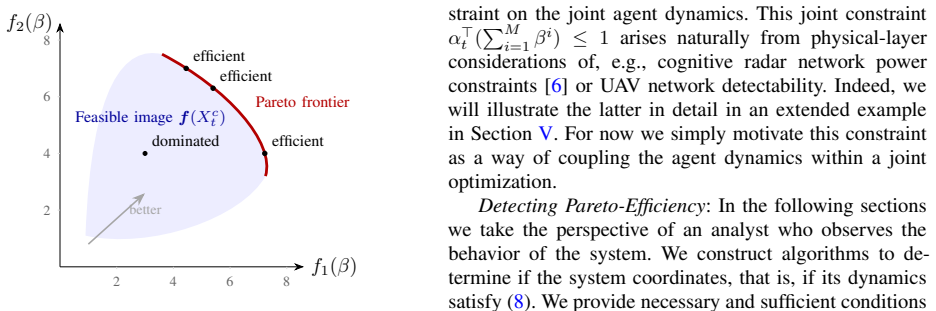
The paper's core discovery is that Pareto-efficient coordination in a linearly constrained multi-agent system is exactly characterized by the feasibility of a finite set of linear inequalities: there exist positive numbers u_i^s and λ_i^t such that u_i^s − u_i^t − λ_i^t α_t^T(β_i^s − β_i^t) ≤ 0 for every pair of time steps and every agent. If these inequalities hold, the observed responses are rationalizable as weighted-sum maximizers with strictly positive weights—and conversely; moreover, the rationalizing utilities can be written explicitly as the pointwise minimum of affine functions. The paper extends this deterministic equivalence into a statistical detector: for noisy observations, th
What carries the argument
The load-bearing object is the system of per-agent Afriat inequalities (10): for each agent i and time pairs (s,t), u_i^s − u_i^t − λ_i^t α_t^T(β_i^s − β_i^t) ≤ 0 with positive u,λ. This finite LP does three jobs at once: feasibility tests rationalizability; its minimal uniform relaxation Φ(D) defines the proximity-to-coordination metric (12); and feasible (u,λ) plug directly into the piecewise-affine utility formula (11). The second piece of machinery is the Wasserstein ambiguity set around the empirical noisy dataset: the DRO program (23) minimizes the worst-case expected violation h over distributions within 1-Wasserstein radius ϵ, and Theorem 3 rewrites this minimax problem as the semi-i
Load-bearing premise
The argument stands or falls on the claim that a single per-agent system of linear inequalities captures all the coupling in the shared constraint; the proof of that equivalence is only cited, not shown, so if the shared constraint links agents more tightly than the inequalities express, the detector and the robust estimator are both built on a mis-specified foundation.
What would settle it
Generate a dataset D by solving (8) with strictly positive weights and strictly concave utilities for many random probes α_t, then test feasibility of (10): any infeasible instance falsifies the 'necessary' direction of Theorem 1. Symmetrically, take a random dataset that satisfies (10), reconstruct utilities by (11), and check that the observed responses are optimal for (8) with those utilities; a mismatch falsifies sufficiency. Both checks are finite LPs plus one convex solve and can be run on synthetic data independent of the paper's simulations.
If this is right
- Coordination testing becomes a finite LP feasibility check on observed data alone, with no need to estimate utilities first.
- When the LP is feasible, explicit concave utilities can be reconstructed and used to predict responses to unseen probes, including identifying which agents' objectives are weighted most heavily.
- The detector (17) comes with a guaranteed Type-I error bound γ, and the chosen statistic Φ* is provably the best Type-I-error minimizer among statistics in [Φ*,Ψ].
- The Wasserstein DRO estimator reduces worst-case reconstruction error (measured by Hausdorff distance between Pareto frontiers) while keeping average error comparable to naive reconstruction.
- Because the radar–UAV derivation maps a covertness constraint to the same linear inequality, the same test works for a physical-layer coordination-detection problem, and by the paper's argument extends to any shared-linear-resource multi-agent system.
Where Pith is reading between the lines
- Editorial: the rationalizability test inherits the usual finite-data limitation of Afriat-style theorems—if utilities exist at all, continuous concave monotone ones exist—so evidence against coordination can be read as evidence against the Pareto model, not just against a particular utility class; conversely, passing the test does not certify uniqueness of the recovered preferences.
- Editorial: because the reconstructed utilities are ordinal, the scientifically meaningful output is the induced Pareto frontier, not the utility values; the paper's Hausdorff-distance evaluation could be turned into an active-learning objective for choosing future probes α_t that most sharply separate coordination from non-coordination.
- Editorial: the detector's Type-I guarantee assumes the noise distribution Λ_i^t is known well enough to compute F_Ψ; a natural extension would quantify how threshold misspecification or heavy-tailed noise degrades the bound, since in covert settings noise statistics themselves may be contested.
- Editorial: the paper treats a single shared linear constraint; multi-constraint or nonlinear resource bounds would call for a generalized revealed-preference system, and it is an open question whether the same LP equivalence survives coupling across constraints.
Editorial analysis
A structured set of objections, weighed in public.
Referee Report
Summary. The paper develops a two-stage framework for multi-agent inverse reinforcement learning under a shared linear constraint. Stage 1 tests whether observed probe-response pairs (α_t, {β_t^i}) are consistent with Pareto-efficient coordination by checking per-agent Afriat inequalities (10). It also proposes a statistical detector with a claimed Type-I-error guarantee for noisy observations (Theorem 2). Stage 2 introduces a Wasserstein distributionally robust utility reconstruction procedure (23), reformulated as a semi-infinite program (24) and solved by an exchange method. The framework is instantiated in a radar-UAV covert coordination example, with reproducible numerical experiments.
Significance. The paper addresses a timely problem and has attractive components: a nonparametric revealed-preference characterization, a statistical detection guarantee, distributionally robust reconstruction, and open-source reproducible code. If the central equivalence were sound, the paper would be a valuable multi-agent extension of Afriat's theorem and could support practical coordination detection in adversarial settings. However, the main theorem is not proved in the manuscript and its statement appears to omit cross-agent coupling in the shared constraint; moreover, the DRO objective does not match the headline accuracy metric. These issues are load-bearing for both the detector and the reconstruction algorithm, so the contribution cannot be accepted as it stands.
major comments (3)
- [Section III.A, Theorem 1 / Eqs. (9)-(10)] The equivalence is the foundation of the paper, but the proof is only a citation to the authors' own conference paper [5], and the statement as given is suspect. Model (9) has one shared constraint α_t^T Σ_i β_i ≤ 1, with a single Lagrange multiplier λ_t. The KKT conditions imply μ_i λ_i^t = λ_t, so the per-agent slopes in (10) must be proportional across i with constants independent of t. Condition (10) imposes no such cross-agent restriction. The construction (11) therefore rationalizes each agent under an individual budget α_t^T β_i ≤ α_t^T β_i^t, which is weaker than joint weighted-sum optimality under the shared budget. Collective revealed-preference theory (e.g., [32]) requires additional cross-agent conditions. Since Corollary 2, the null hypothesis (15)-(17), and the DRO slack (20)-(23) all rely on (10), the paper must either supply a complete proof or correct the theorem.
- [Section IV.C / VI.D, Eq. (23) and Table I] The stated contribution is minimizing worst-case reconstruction error, but the objective h(ψ,Φ) in (23) is the LP feasibility slack, i.e., the proximity measure of Corollary 2. Section VI evaluates reconstruction error by Hausdorff distance between true and reconstructed Pareto frontiers, and Table I reports improvements in that metric. No theorem or proposition connects the worst-case expected slack to the Hausdorff distance. Thus the numerical improvement is an empirical observation, not a consequence of (23). The authors should either prove a bound between the feasibility slack and the Hausdorff distance, or restate the contribution as minimizing worst-case expected feasibility slack.
- [Section III.B, Theorem 2 / Abstract] The phrase 'optimal statistical detector' and 'minimizes Type-I statistical detection error' is stronger than what is proved. Part 3 of Theorem 2 only compares statistics ar Φ with Φ* in [Φ*,Ψ]; the Type-I bound is essentially a p-value calibration for a fixed threshold γ. No optimality in a Neyman-Pearson class is established. The authors should define the class of detectors and the optimality criterion precisely; otherwise the claim should be softened to 'a detector with controlled Type-I error.'
minor comments (5)
- [Section III.A, Theorem 1] The theorem statement omits the monotonicity assumption that appears in Definition 3, and the proof later assumes β_i^t > 0. These assumptions should be stated explicitly in the theorem.
- [Appendix B, Lemma 1 proof] The proof is garbled in places, e.g., the set-builder notation `fβi_tg_{i≠j}[f \barβ^k_t g` is not well-formed, and the line beginning 'Now take' appears to be incorrect. Please rewrite the proof cleanly.
- [Section VI.C, Figure 5] The plotted statistic is constant at 1 over the displayed noise range. The text discusses Type-II error, but the figure would be more informative with a larger noise range or a panel showing the threshold behavior.
- [Appendix C, proof of Theorem 2] In the first paragraph, 'substituting β_i^t = β_i^t − ε_i^t' should read 'substituting \tilde β_i^t = β_i^t + ε_i^t'; as written it is a typo.
- [Section IV.D, Eq. (24)] The symbol V is used both for the scalar bound and for the set of auxiliary variables; this notation clash should be fixed.
Circularity Check
Theorem 1's per-agent Afriat inequalities are the load-bearing foundation for both the detector and the DRO, yet their proof is deferred entirely to the authors' own prior paper [5]; the claimed equivalence with the shared-constraint coordination problem is thus imported via self-citation rather than derived.
specific steps
-
self citation load bearing
[Section III.A.1, Theorem 1]
"THEOREM 1 Let D be a set of observations. The following are equivalent: 1) there exist ... (9) 2) there exist numbers u_i^j > 0, λ_i^j > 0 such that ... (10). Proof: See Theorem 1 of [5]"
The paper's central premise—that Pareto-efficient coordination (9) is equivalent to the per-agent linear program (10)—is not proved here. The proof is deferred to [5], the authors' own ICASSP paper. This equivalence is then used to define the proximity metric (12), the null hypothesis of the statistical detector (15)-(17), and the DRO objective (23). Since (10) contains no reference to the shared constraint α_t^T Σ_i β_i ≤ 1, the claimed equivalence with the joint optimization is not self-evident and is not independently verified in this paper. Any error in [5] propagates to every downstream guarantee.
-
self citation load bearing
[Section III.A.2, Corollary 1]
"COROLLARY 1 Given constants u_i^t, λ_i^t, t ∈ [T], i ∈ [M] which make (10) feasible, explicit monotone and continuous objective functions that 'rationalize' the dataset ... are given by (11) ... i.e., (9) is satisfied. Proof: See Lemma 1 of [5]."
The utility reconstruction formula (11) is asserted to satisfy the joint weighted-sum optimality condition (9), and this assertion is again justified solely by a lemma from the authors' prior work [5]. This construction is used in Algorithm 1 to predict future system responses and serves as the baseline for the robust reconstruction in Section IV. Thus the reconstruction step inherits the unverified equivalence of Theorem 1 and adds a second self-citation in place of an independent proof.
-
other
[Section IV.C, DRO formulation, after equation (23)]
"The objective (23) finds the set of parameters ψ which minimizes the worst-case expected proximity to feasibility ... Thus, when compared to the naive estimation procedure (22), (23) will better approximate the true utility functions in the worst case, making (23) a robust estimation procedure."
The DRO objective h(ψ, Φ) is exactly the same feasibility slack that defines proximity to Pareto-efficiency in (20). The paper then interprets minimizing this slack as 'better approximating the true utility functions in the worst case.' But the external reconstruction metric used in the numerical section is the Hausdorff distance between Pareto surfaces, which is not the same as the slack objective. No theorem in the paper connects worst-case slack minimization to worst-case Hausdorff error; the claimed robustness is therefore asserted through the surrogate objective, with the actual metric only checked in simulation. This is a surrogate-objective gap rather than a fitted prediction, but it is a missing support for the paper's main DRO claim.
full rationale
The statistical detector (Theorem 2) and the SIP reformulation (Theorem 3) are internally self-consistent: the Type-I error bound is a standard super-uniform p-value argument given the null hypothesis defined by (10), and the Wasserstein reformulation is an application of known duality. These are not circular. The circularity concern is concentrated at the base of the derivation chain: the equivalence (10)⇔(9) is the single load-bearing premise for the detector, the proximity measure, and the DRO objective, and its proof is deferred to the authors' own [5]. On inspection, (10) is the standard per-agent Afriat inequality and does not contain the shared budget α_t^⊤Σ_i β_i ≤ 1, so the claimed necessity/sufficiency for the joint problem is not self-evident and is not independently established here. Corollary 1's reconstruction is likewise imported from [5] and inherits this gap. The DRO section also equates minimizing worst-case feasibility slack with minimizing worst-case reconstruction error, while the actual Hausdorff validation is empirical. The paper does contain substantial independent content—the detector calibration, the SIP reduction, the exchange-method algorithm, and the UAV case study—so the score is 4 rather than 6 or 8. The core issue is a load-bearing self-citation chain, not a fitted parameter renamed as a prediction.
Axiom & Free-Parameter Ledger
free parameters (4)
- Wasserstein radius epsilon =
0.2 in experiments
- Exchange method tolerance delta =
0.1
- Detection threshold gamma =
not specified in experiments
- Noise covariance sigma^2 =
0.01 to 0.1 for detector; 0.5 to 3 for DRO
axioms (7)
- domain assumption Agents' utility functions are concave, continuous, and monotone increasing (Definition 3)
- domain assumption Theorem 1 equivalence: per-agent Afriat inequalities (10) characterize joint Pareto efficient coordination (8)
- domain assumption Noise distribution Lambda_t is known exactly for the Type-I guarantee
- ad hoc to paper Assumptions 1-3: finite support noise, lower bounded probes, bounded LP parameter set
- standard math Corollary 3.8 of [38] reformulates Wasserstein DRO as a semi-infinite program
- standard math Exchange method convergence from [35]
- ad hoc to paper Lemma 3 of [21] maps the spectral covariance bound to the linear inequality alpha^T beta <= 1
Cite this review
Pith. "Pith review of Multi-Agent Inverse Reinforcement Learning for Identifying Pareto-Efficient Coordination -- A Distributionally Robust Approach." pith.science (2026). https://pith.science/paper/KWJLYYN2
@misc{pith2026250908956,
  author       = {Pith},
  title        = {Pith review of: Multi-Agent Inverse Reinforcement Learning for Identifying Pareto-Efficient Coordination -- A Distributionally Robust Approach},
  year         = {2026},
  howpublished = {\url{https://pith.science/paper/KWJLYYN2}},
  note         = {Machine review of arXiv:2509.08956}
}
read the original abstract
Multi-agent inverse reinforcement learning (IRL) aims to identify Pareto-efficient behavior in a multi-agent system, and reconstruct utility functions of the individual agents. Motivated by the problem of detecting UAV coordination, how can we construct a statistical detector for Pareto-efficient behavior given noisy measurements of the decisions of a multi-agent system? This paper approaches this IRL problem by deriving necessary and sufficient conditions for a dataset of multi-agent system dynamics to be consistent with Pareto-efficient coordination, and providing algorithms for recovering utility functions which are consistent with the system dynamics. We derive an optimal statistical detector for determining Pareto-efficient coordination from noisy system measurements, which minimizes Type-I statistical detection error. Then, we provide a utility estimation algorithm which minimizes the worst-case estimation error over a statistical ambiguity set centered at empirical observations; this min-max solution achieves distributionally robust IRL, which is crucial in adversarial strategic interactions. We illustrate these results in a detailed example for detecting Pareto-efficient coordination among multiple UAVs given noisy measurement recorded at a radar. We then reconstruct the utility functions of the UAVs in a distributionally robust sense.
Figures



Reference graph
Works this paper leans on
-
[1]
UA V swarm intelligence: Recent advances and future trends,
Y . Zhou, B. Rao, and W. Wang, “UA V swarm intelligence: Recent advances and future trends,” IEEE Access , vol. 8, pp. 183 856– 183 878, 2020
2020
-
[2]
UA V communication networks issues: A review,
H. Nawaz, H. M. Ali, and A. A. Laghari, “UA V communication networks issues: A review,” Archives of Computational Methods in Engineering , vol. 28, no. 3, pp. 1349–1369, 2021
2021
-
[3]
P . E. Pace, Detecting and classifying low probability of intercept radar. Artech house, 2009
2009
-
[4]
Electronic warfare systems,
A. E. Spezio, “Electronic warfare systems,” IEEE Transactions on Microwave Theory and Techniques , vol. 50, no. 3, pp. 633–644, 2002
2002
-
[5]
Identifying coor- dination in a cognitive radar network–a multi-objective inverse reinforcement learning approach,
L. Snow, V . Krishnamurthy, and B. M. Sadler, “Identifying coor- dination in a cognitive radar network–a multi-objective inverse reinforcement learning approach,” International Conference on Acoustics, Speech, and Signal Processing , 2022
2022
-
[6]
Statistical detection of coordination in a cognitive radar network through inverse multi-objective optimization,
——, “Statistical detection of coordination in a cognitive radar network through inverse multi-objective optimization,” in 2023 26th International Conference on Information Fusion (FU- SION). IEEE, 2023, pp. 1–8
2023
-
[7]
Revealed preference,
H. R. V arian et al. , “Revealed preference,” Samuelsonian eco- nomics and the twenty-first century , pp. 99–115, 2006
2006
-
[8]
C. P . Chambers and F. Echenique, Revealed preference theory . Cambridge University Press, 2016, no. 56
2016
-
[9]
The construction of utility functions from expendi- ture data,
S. N. Afriat, “The construction of utility functions from expendi- ture data,” International Economic Review , vol. 8, no. 1, pp. 67–77, 1967
1967
-
[10]
Distributionally robust optimiza- tion: A review,
H. Rahimian and S. Mehrotra, “Distributionally robust optimiza- tion: A review,” arXiv preprint arXiv:1908.05659 , 2019
Pith/arXiv arXiv 1908
-
[11]
Frameworks and results in distributionally robust optimiza- tion,
——, “Frameworks and results in distributionally robust optimiza- tion,” Open Journal of Mathematical Optimization , vol. 3, pp. 1–85, 2022
2022
-
[12]
Wasserstein distributionally robust optimization: The- ory and applications in machine learning,
D. Kuhn, P . M. Esfahani, V . A. Nguyen, and S. Shafieezadeh- Abadeh, “Wasserstein distributionally robust optimization: The- ory and applications in machine learning,” in Operations re- search & management science in the age of analytics . Informs, 2019, pp. 130–166
2019
-
[13]
Thirty years of machine learning: The road to Pareto-optimal wireless networks,
J. Wang, C. Jiang, H. Zhang, Y . Ren, K.-C. Chen, and L. Hanzo, “Thirty years of machine learning: The road to Pareto-optimal wireless networks,” IEEE Communications Surveys & Tutorials , vol. 22, no. 3, pp. 1472–1514, 2020
2020
-
[14]
Pruning and ranking the Pareto optimal set, application for the dynamic multi-objective network design problem,
L. J. Wismans, T. Brands, E. C. V an Berkum, and M. C. Bliemer, “Pruning and ranking the Pareto optimal set, application for the dynamic multi-objective network design problem,” Journal of advanced transportation , vol. 48, no. 6, pp. 588–607, 2014
2014
-
[15]
Energy and age Pareto optimal trajectories in UA V-assisted wireless data collection,
Y . Liao and V . Friderikos, “Energy and age Pareto optimal trajectories in UA V-assisted wireless data collection,” IEEE Transactions on V ehicular Technology, vol. 71, no. 8, pp. 9101– 9106, 2022
2022
-
[16]
Topology control of unmanned aerial vehicle (UA V) mesh networks: A multi-objective evolutionary algorithm approach,
S. Sabino and A. Grilo, “Topology control of unmanned aerial vehicle (UA V) mesh networks: A multi-objective evolutionary algorithm approach,” in Proceedings of the 4th ACM Workshop on Micro Aerial V ehicle Networks, Systems, and Applications , 2018, pp. 45–50
2018
-
[17]
Multi-UA V task allo- cation based on improved algorithm of multi-objective parti- cle swarm optimization,
Y . Gao, Y . Zhang, S. Zhu, and Y . Sun, “Multi-UA V task allo- cation based on improved algorithm of multi-objective parti- cle swarm optimization,” in 2018 International conference on cyber-enabled distributed computing and knowledge discovery (CyberC). IEEE, 2018, pp. 443–447
2018
-
[18]
Pareto optimal pid tuning for px4-based unmanned aerial vehicles by using a multi-objective particle swarm optimization algorithm,
V . Gomez, N. Gomez, J. Rodas, E. Paiva, M. Saad, and R. Gregor, “Pareto optimal pid tuning for px4-based unmanned aerial vehicles by using a multi-objective particle swarm optimization algorithm,” Aerospace, vol. 7, no. 6, p. 71, 2020
2020
-
[19]
Achieving Pareto opti- mality through distributed learning,
J. R. Marden, H. P . Y oung, and L. Y . Pao, “Achieving Pareto opti- mality through distributed learning,” SIAM Journal on Control and Optimization , vol. 52, no. 5, pp. 2753–2770, 2014
2014
-
[20]
Multi- objective multi-agent decision making: a utility-based analysis and survey,
R. R ˘adulescu, P . Mannion, D. M. Roijers, and A. Nowé, “Multi- objective multi-agent decision making: a utility-based analysis and survey,” Autonomous Agents and Multi-Agent Systems , vol. 34, no. 1, p. 10, 2020
2020
-
[21]
Iden- tifying cognitive radars-inverse reinforcement learning using revealed preferences,
V . Krishnamurthy, D. Angley, R. Evans, and B. Moran, “Iden- tifying cognitive radars-inverse reinforcement learning using revealed preferences,” IEEE Transactions on Signal Processing , vol. 68, pp. 4529–4542, 2020
2020
-
[22]
Meta-cognition. an inverse-inverse reinforcement learning approach for cogni- tive radars,
K. Pattanayak, V . Krishnamurthy, and C. Berry, “Meta-cognition. an inverse-inverse reinforcement learning approach for cogni- tive radars,” in 2022 25th International Conference on Informa- tion Fusion (FUSION) . IEEE, 2022, pp. 01–08
2022
-
[23]
How can a cognitive radar mask its cognition?
——, “How can a cognitive radar mask its cognition?” in ICASSP 2022-2022 IEEE International Conference on Acoustics, Speech and Signal Processing (ICASSP) . IEEE, 2022, pp. 5897–5901
2022
-
[24]
Maximum en- tropy deep inverse reinforcement learning,
M. Wulfmeier, P . Ondruska, and I. Posner, “Maximum en- tropy deep inverse reinforcement learning,” arXiv preprint arXiv:1507.04888, 2015
Pith/arXiv arXiv 2015
-
[25]
Large-scale cost function learning for path planning using deep inverse reinforcement learning,
M. Wulfmeier, D. Rao, D. Z. Wang, P . Ondruska, and I. Posner, “Large-scale cost function learning for path planning using deep inverse reinforcement learning,” The International Journal of Robotics Research, vol. 36, no. 10, pp. 1073–1087, 2017
2017
-
[26]
Inferring group intent as a cooperative game. an nlp-based framework for trajectory analysis,
Y . Zhang, V . Krishnamurthy, and S. Jain, “Inferring group intent as a cooperative game. an nlp-based framework for trajectory analysis,” 2025
2025
-
[27]
The computational algorithm for the para- metric objective function,
S. Gass and T. Saaty, “The computational algorithm for the para- metric objective function,” Naval Research Logistics Quarterly , vol. 2, no. 1-2, pp. 39–45, 1955
1955
-
[28]
Miettinen, Nonlinear multiobjective optimization
K. Miettinen, Nonlinear multiobjective optimization . Springer Science & Business Media, 1999, vol. 12
1999
-
[29]
A CA V platoon control method for isolated intersections: Guaranteed feasible multi-objective approach with priority,
C. Wang, Y . Dai, and J. Xia, “A CA V platoon control method for isolated intersections: Guaranteed feasible multi-objective approach with priority,” Energies, vol. 13, no. 3, p. 625, 2020
2020
-
[30]
Multi-objective optimization framework for enhancing efficiency and sustainability in smart grids,
R. Revathi, N. Senthilnathan, V . K. Chinnaiyan, and J. S. Ra- jesh, “Multi-objective optimization framework for enhancing efficiency and sustainability in smart grids,” Energy Conversion and Management , vol. 341, p. 120079, 2025
2025
-
[31]
Revealed stochastic preference: a synthesis,
D. L. McFadden, “Revealed stochastic preference: a synthesis,” in Rationality and Equilibrium: A Symposium in Honor of Marcel K. Richter . Springer, 2006, pp. 1–20
2006
-
[32]
The revealed pref- erence approach to collective consumption behaviour: Testing and sharing rule recovery,
L. Cherchye, B. De Rock, and F. V ermeulen, “The revealed pref- erence approach to collective consumption behaviour: Testing and sharing rule recovery,” The Review of Economic Studies , vol. 78, no. 1, pp. 176–198, 2011
2011
-
[33]
Recent advances in robust optimization: An overview,
V . Gabrel, C. Murat, and A. Thiele, “Recent advances in robust optimization: An overview,” European journal of operational research, vol. 235, no. 3, pp. 471–483, 2014
2014
-
[34]
Distributionally robust optimization: A review on theory and applications,
F. Lin, X. Fang, and Z. Gao, “Distributionally robust optimization: A review on theory and applications,” Numerical Algebra, Control and Optimization , vol. 12, no. 1, pp. 159–212, 2022. : 15
2022
-
[35]
Wasserstein distributionally robust inverse multiobjective optimization,
C. Dong and B. Zeng, “Wasserstein distributionally robust inverse multiobjective optimization,” in Proceedings of the AAAI Con- ference on Artificial Intelligence , vol. 35, no. 7, 2021, pp. 5914– 5921
2021
-
[36]
Adaptive distributionally robust optimization,
D. Bertsimas, M. Sim, and M. Zhang, “Adaptive distributionally robust optimization,” Management Science , vol. 65, no. 2, pp. 604–618, 2019
2019
-
[37]
Wasserstein distributionally robust look-ahead economic dispatch,
B. K. Poolla, A. R. Hota, S. Bolognani, D. S. Callaway, and A. Cherukuri, “Wasserstein distributionally robust look-ahead economic dispatch,” IEEE Transactions on Power Systems , vol. 36, no. 3, pp. 2010–2022, 2020
2010
-
[38]
Decomposition algorithm for distribu- tionally robust optimization using wasserstein metric,
F. Luo and S. Mehrotra, “Decomposition algorithm for distribu- tionally robust optimization using wasserstein metric,” arXiv preprint arXiv:1704.03920 , 2017
Pith/arXiv arXiv 2017
-
[39]
Semi-infinite programming: the- ory, methods, and applications,
R. Hettich and K. O. Kortanek, “Semi-infinite programming: the- ory, methods, and applications,” SIAM review , vol. 35, no. 3, pp. 380–429, 1993
1993
-
[40]
Cutting-plane training of structural svms,
T. Joachims, T. Finley, and C.-N. J. Y u, “Cutting-plane training of structural svms,” Machine learning , vol. 77, pp. 27–59, 2009
2009
-
[41]
Power allocation for target detection in radar networks based on low probability of intercept: A cooperative game theoretical strategy,
C. Shi, S. Salous, F. Wang, and J. Zhou, “Power allocation for target detection in radar networks based on low probability of intercept: A cooperative game theoretical strategy,” Radio Science, vol. 52, no. 8, pp. 1030–1045, 2017
2017
-
[42]
Hiding unmanned aerial vehicles for wireless transmissions by covert communications,
S. Y an, S. V . Hanly, I. B. Collings, and D. L. Goeckel, “Hiding unmanned aerial vehicles for wireless transmissions by covert communications,” in ICC 2019-2019 IEEE International Con- ference on Communications (ICC) . IEEE, 2019, pp. 1–6
2019
-
[43]
UA V-enabled covert wireless data collection,
X. Zhou, S. Y an, F. Shu, R. Chen, and J. Li, “UA V-enabled covert wireless data collection,” IEEE Journal on Selected Areas in Communications, vol. 39, no. 11, pp. 3348–3362, 2021
2021
-
[44]
UA V-enabled covert federated learning,
X. Hou, J. Wang, C. Jiang, X. Zhang, Y . Ren, and M. Debbah, “UA V-enabled covert federated learning,”IEEE Transactions on Wireless Communications, vol. 22, no. 10, pp. 6793–6809, 2023
2023
-
[45]
Survey of maneuvering target tracking. part i. dynamic models,
X. R. Li and V . P . Jilkov, “Survey of maneuvering target tracking. part i. dynamic models,” IEEE Transactions on aerospace and electronic systems , vol. 39, no. 4, pp. 1333–1364, 2003
2003
-
[46]
Bar-Shalom, X
Y . Bar-Shalom, X. R. Li, and T. Kirubarajan, Estimation with applications to tracking and navigation: theory algorithms and software. John Wiley & Sons, 2004
2004
-
[47]
Multi-target tracking using joint probabilistic data association,
T. E. Fortmann, Y . Bar-Shalom, and M. Scheffe, “Multi-target tracking using joint probabilistic data association,” in 1980 19th IEEE Conference on Decision and Control including the Symposium on Adaptive Processes . IEEE, 1980, pp. 807–812
1980
-
[48]
Joint probabilistic data association revisited,
S. H. Rezatofighi, A. Milan, Z. Zhang, Q. Shi, A. Dick, and I. Reid, “Joint probabilistic data association revisited,” in Proceedings of the IEEE international conference on computer vision , 2015, pp. 3047–3055
2015
-
[49]
H. L. V an Trees,Detection, estimation, and modulation theory, part I: detection, estimation, and linear modulation theory . John Wiley & Sons, 2004
2004
-
[50]
Optimal waveform selection for tracking systems,
D. J. Kershaw and R. J. Evans, “Optimal waveform selection for tracking systems,” IEEE Transactions on Information Theory , vol. 40, no. 5, pp. 1536–1550, 1994
1994
-
[51]
Bar-Shalom and X.-R
Y . Bar-Shalom and X.-R. Li, Multitarget-multisensor tracking: principles and techniques . YBs Storrs, CT, 1995, vol. 19. VIII. Appendix A. Kalman Filter Dynamics Consider the linear Gaussian dynamics ( 31), ( 32). Based on observations yi 1,...,y i k associated to target i, the tracking functionality in the radar computes the target i state posterior πi ...
1995
-
[52]
collective rationality
Extracting a Covertness Bound By Lemma 3 of [ 21], we can represent a limit ¯Σ−1 on the radar’s precision of target i measurement, Σ∗−1 t (αt,βi t) as the simple linear inequality α⊤ t βi t 1, i.e., α⊤ t βi t 1() Σ∗−1 t (αt,βi t) ¯Σ−1 where the constant 1 bound is taken without loss of gener- ality. The key idea behind this equivalence is to show the asym...
2025
-
[53]
Triangular Pulse - Continuous Wave s(t) = {√ 3 2θ ( 1 |t| θ ) θ<t<θ 0 otherwise R(α) = [ c2θ2 12η 0 0 5c2 2ω2cθ2η ]
-
[54]
Gaussian Pulse - Continuous Wave s(t) = ( 1 πθ2 )1/4 exp (t2 2θ2 ) R(α) = [ c2θ2 sη 0 0 c2 2ω2cθ2η ]
-
[55]
Gaussian Pulse - Linear Frequency Modulation Chirp s(t) = ( 1 πθ2 1 )1/4 exp ( ( 1 2θ2 1 jθ2 ) t2 ) R(α) = c2θ2 1 2η −c2θ2θ2 1 ωcη −c2θ2θ2 1 ωcη c2 ω2cη ( 1 2θ2 1 + 2θ2 2θ2 1 ) E. Multi-T arget Filtering: Joint Probabilistic Data Association Filter The joint probabilistic data association filter (JPDAF) operates under the regime where n measurement...
-
[56]
none of the targets
Filter Dynamics Define the empirical validation matrix Ω = [ ωjt,j 2 [n],t 2 f0,...,m g, with ωjt = 1 if measurement j is in the validation gate of target t, and 0 otherwise. It is common to let the t = 0 index correspond to "none of the targets". Now we construct an object θ known as the "joint association event", as θ = m∩ j=1 θjtj where - θjt represents...
-
[57]
a measurement is associated to only one source, m∑ t=0 ˆωjt(θ) = 1, 8j2 [n] (42)
-
[58]
target detection indicator
at most one measurement originates from each target, δt(θ) := n∑ j=1 ˆωjt(θ) 1, 8t2 [m] (43) Denote by Θ the set of all feasible events. The binary variable δt(θ) is known as the "target detection indicator" since it indicates whether, in event θ, a measurement j has been associated to target t. We may also define a "measurement association indicator" τj(θ...
2025
-
[59]
Extracting a Revealed Preference Bound The crucial observation is that, as in the Kalman filter algebraic Riccati equation ( 33), the covariance ( 46) is monotone decreasing in βi t for all i, since this corre- sponds to increasing ˆRk for fixed k. Thus, the asymptotic measurement precision (inverse of asymptotic predicted covariance) is monotone non-decrea...
2025
discussion (0)
Sign in with ORCID, Apple, or X to comment. Anyone can read and Pith papers without signing in.