REVIEW 4 major objections 5 minor 16 references
Gradient-Attention Guided Dual-Masking Synergetic Framework for Robust Text-based Person Retrieval
T0 review · 4 major / 5 minor · reviewed 2026-08-04 · deepseek-v4-flash
Pith's one-line read This paper claims that pairing a five-million-pair web-sourced person dataset with a gradient-attention-guided dual-masking training framework advances text-based person retrieval to new state-of-the-art Rank-1 scores on three benchmarks.
desk verdict Competent incremental paper: the new 5M WebPerson dataset is the real contribution; the dual-masking mechanism is plausible but under-validated, and the paper needs revision but deserves a serious referee. read the letter →
The pith
A machine-rendered reading of the paper's core claim, the machinery that carries it, and where it could break.
The reading
What carries the argument
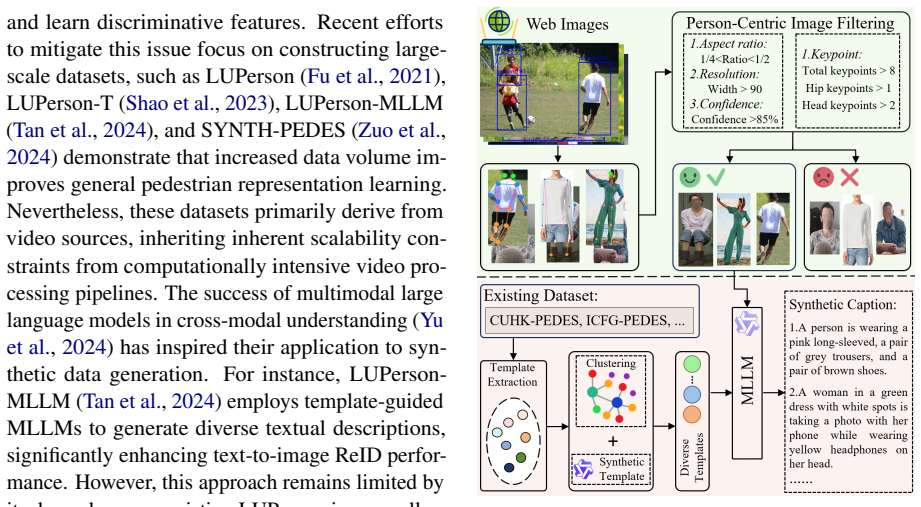
The Gradient-Attention Similarity Score (GASS) is the paper's central mechanism: it combines per-layer gradient importance of the [eos] token with multi-scale pooled attention maps in the last transformer layers, producing a scalar per text token that is meant to measure how much that token contributes to image-text matching. This score sets two sigmoidal masking probabilities—one that hides low-scoring ('noise') tokens during contrastive alignment and one that hides high-scoring ('informative') tokens for a masked-token-prediction loss. The WebPerson construction pipeline—person detection and pose filtering of web images followed by template-guided MLLM captioning—is the companion mechanism
What would settle it
Take a random sample of WebPerson captions, have annotators mark each token as visually grounded or hallucinated, and compare those labels with GASS rankings. If a substantial fraction of low-scoring tokens are actually present in the image (or high-scoring tokens are hallucinated), the masking mechanism's stated role is not driving the reported gains. A complementary experiment: flip the two masks—predict low-scoring tokens and suppress high-scoring ones—and check whether Rank-1 holds; if it does, the score's ranking is not the operative cause.
Extended reading notes
Core claim
The paper's central claim is that a single token-level score, the Gradient-Attention Similarity Score (GASS), can separate noise from signal in automatically generated pedestrian captions, and that using it for two complementary masking tasks improves cross-modal alignment. Low-scoring tokens are treated as MLLM hallucinations and masked during contrastive learning, while high-scoring tokens are masked and then predicted through a cross-modal decoder, forcing the model to encode fine-grained attributes rather than relying on global sentence-level similarity. Paired with WebPerson, a 5M-pair image-text corpus distilled from web data, GA-DMS reports Rank-1 accuracies of 77.60 on CUHK-PEDES, 69
Load-bearing premise
The load-bearing premise is that the Gradient-Attention Similarity Score ranks text tokens correctly—low scores really are hallucinated noise and high scores really are informative attributes; the paper never validates this ordering against human labels of caption noise.
Editorial extensions
If this is right
- If the reported results hold, GA-DMS with WebPerson pre-training establishes new state-of-the-art Rank-1 scores on CUHK-PEDES (77.60), ICFG-PEDES (69.51), and RSTPReid (71.25).
- The dataset is the main driver of transfer: at the same 1M scale, WebPerson pre-training outperforms existing person pre-training corpora in fine-tuning, and 5M samples improve direct transfer further.
- GASS-based masking is more effective than cosine-similarity masking and random masking in the paper's ablations, implying that gradient and attention information carry signal beyond global text-image similarity.
- Scaling WebPerson from 0.1M to 5M monotonically improves Rank-1 in the paper's experiments, supporting the claim that high-quality web-sourced person data is a scalable alternative to manual annotation.
- The dual-masking design contributes beyond the similarity-distribution-matching loss: adding masked token prediction on informative tokens improves all metrics in the ablation table.
Reading between the lines
- A direct testable extension: if GASS truly identifies hallucinations, the same score could serve as a token-level interpretability map for MLLM-generated captions in other vision-language tasks, not just person retrieval.
- The paper's filtering pipeline (upright pose, visible keypoints, aspect ratio) likely selects conventional full-body pedestrian shots; whether the approach transfers to occluded, crouching, or heavily cropped persons is an open question the paper does not address.
- The authors state in the Limitations section that compute limited WebPerson to 5M pairs; the paper's scaling curve therefore does not show where gains saturate, leaving the strongest version of the scale claim untested.
- One could test whether masking low-S tokens actually removes hallucinated attributes by comparing model retrieval behavior on captions with and without those tokens; the paper shows weight maps but not a behavioral check.
Editorial analysis
A structured set of objections, weighed in public.
Referee Report
Summary. The paper presents two contributions to text-based person retrieval: WebPerson, a web-sourced dataset of 5M image-text pairs generated with an MLLM-based filtering/captioning pipeline, and GA-DMS, a CLIP-based framework that introduces a per-token Gradient-Attention Similarity Score (S). The score is used in two complementary masking branches: low-S tokens are treated as noisy and masked during contrastive/SDM learning, while high-S tokens are treated as informative and are masked and predicted in an auxiliary Masked Token Prediction loss. The method is pre-trained on WebPerson and fine-tuned on CUHK-PEDES, ICFG-PEDES, and RSTPReid, where it reports state-of-the-art Rank-1 accuracies of 77.60, 69.51, and 71.25, respectively. The paper includes ablations on masking components, masking-cap hyperparameters, and dataset scale.
Significance. If the claims hold, the contributions are significant in two ways. First, WebPerson is a large, publicly released person-centric image-text dataset that could facilitate future work, and the paper provides code and data links. Second, the dual-masking idea—using a model's own gradients and attention to mask noisy versus informative tokens—is an interesting self-supervised mechanism for fine-grained alignment. The paper's central empirical claim, however, depends on the untested assumption that the gradient-attention similarity score S ranks tokens by noise versus informativeness. The ablations do not currently isolate this assumption from confounds such as data source, mask rate, and regularization effects. With additional validation experiments and reproduction details, the contributions would constitute a solid advance; without them, the state-of-the-art claim is not fully established.
major comments (4)
- [§4.1, §4.2.1, §4.2.2, Tab. 4, §5.3] The core premise that low-S tokens are hallucinated noise and high-S tokens are informative is not validated. No human or synthetic token-level noise labels are used anywhere; Tab. 4 compares GASS to CSS but not to ground-truth token rankings, and the masking rates for the two branches are not reported. The text in §5.3 claims that the method 'consistently outperforms random masking baselines,' but this comparison is not tabulated or described. This matters because the masking mechanism could act as a dropout-like regularizer, with the gains coming from SDM, MTP, or data scale rather than from the correctness of S. Notably, the qualitative example in Fig. 4/§5.3 identifies 'white lace top' as a noise token, although that phrase is a discriminative clothing attribute; this contradicts the intended semantics and further illustrates the need for validation. I recommend adding a random-maski
- [Eqs. (5) and (9), Tab. 5] The sigmoid parameters λ and γ are load-bearing: they determine how S is converted into masking probabilities. Tab. 5 lists hyperparameters for pre-training but omits λ and γ entirely, and they are not given in the main text. Without these values, the exact masking behavior cannot be reproduced or checked against the claims made in §4.2.1–§4.2.2. The authors should report λ and γ and, ideally, show their sensitivity.
- [Tab. 1 and Tab. 3, §5.1–§5.2] The headline comparison against NAM is confounded by multiple simultaneous changes: the pre-training data source (WebPerson vs. LUPerson-MLLM), the data scale, and the added SDM+MTP objectives. Tab. 1 shows Ours(1.0M) versus NAM but does not include a NAM baseline trained on WebPerson, nor a GA-DMS variant trained on LUPerson-MLLM. Tab. 4, the ablation, is conducted only on a 0.5M WebPerson sample and does not include the NAM/LUPerson-MLLM configuration. Consequently, the incremental effect of GASS over the other components is not isolated. A matched comparison—using the same pre-training data, mask budget, and objectives, toggling only GASS versus CSS or random masking—is necessary to support the attribution in §5.1.
- [Tab. 1, §5.1] All results appear to be single runs with no error bars or seed variance. This is particularly important for the CUHK-PEDES comparison, where Ours(1.0M) exceeds NAM by only 0.20 Rank-1 (77.02 vs. 76.82). With no variance estimate, this small margin is within plausible run-to-run noise. I recommend reporting multiple seeds with standard deviations, or at least demonstrating that the reported rankings are stable across seeds.
minor comments (5)
- [§5.3] Typo: 'for pertaining' should be 'for pre-training'.
- [Tab. 2 and §5.2] Row labels are inconsistent: 'Ours (0.1M)', 'Web-Person (1.0M)', and 'Ours (5.0M)' appear to mix model and dataset names. Use a single naming convention (e.g., 'Pretraining data' vs. 'Method') so readers can distinguish dataset-quality effects from method effects.
- [§3.2 and Fig. 4] The sentence in §5.3 identifying 'white lace top' as a noise token is confusing and should be clarified or corrected; it is inconsistent with the qualitative claim that GASS suppresses hallucinated tokens, because the quoted phrase is part of the discriminative description in the example.
- [Throughout] The framework is called 'Synergetic' in the title and abstract but 'Synergic' in Fig. 3; unify the spelling. Also fix 'LuPerson-T' in §2.2.
- [Appendix A.1] Tab. 5 lists 'Temperature 0.02' but does not state where the temperature is used; the temperature τ in Eq. (6) should be cross-referenced for clarity.
Circularity Check
No significant circularity: the central SOTA claim is benchmarked externally; the gradient-attention score is an internal heuristic, not a fitted input renamed as a prediction.
full rationale
The paper's claimed derivation chain is not circular. The gradient-attention similarity score S (Eq. 4) is computed from the model's own gradients and attention, and the masking probabilities (Eqs. 5 and 9) are functions of S; however, the paper never defines the target result in terms of S. The downstream Rank-1/mAP numbers in Tab. 1 are measured against external benchmarks (CUHK-PEDES, ICFG-PEDES, RSTPReid), and the contribution of S is tested by ablation (Tab. 4: GASS vs CSS, plus the claimed but untabulated random-masking comparison). Hyperparameters αn and αi are tuned on the downstream datasets (Fig. 5), which is a reporting weakness but not a circular step: the final accuracies are not algebraically determined by those two scalars. The self-citations in Sec. 3.2 (Yang et al., 2025; Gu et al., 2025b for template clustering) and elsewhere are not load-bearing for the central claim. The unvalidated assumption that low-S tokens correspond to MLLM hallucinations is a robustness/correctness concern, not a circularity, because the paper does not use S as the measure of its own success; no reduction of the reported SOTA to its own inputs is exhibited.
Assumptions & free parameters
free parameters (6)
- alpha_n (noise masking probability cap) =
0.2
- alpha_i (informative masking probability cap) =
0.3
- lambda, gamma (sigmoid slope and midpoint in Equations 5 and 9) =
not reported
- beta (MTP loss weight) =
0.4
- k (number of k-means clusters for template selection) =
not reported
- C (multi-scale pooling scales) =
[1, 2]
assumptions (4)
- domain assumption The three benchmarks CUHK-PEDES, ICFG-PEDES, RSTPReid are sufficient proxies for text-based person retrieval quality.
- ad hoc to paper Low gradient-attention similarity identifies noisy tokens while high similarity identifies informative tokens.
- domain assumption MLLM-generated captions from templates are diverse and accurate enough for pretraining despite hallucination.
- standard math CLIP ViT-B/16 plus IRRA-style cross-modal module is a valid base architecture for this task.
Cite this review
Pith. "Pith review of Gradient-Attention Guided Dual-Masking Synergetic Framework for Robust Text-based Person Retrieval." pith.science (2026). https://pith.science/paper/5ENVLNOU
@misc{pith2026250909118,
  author       = {Pith},
  title        = {Pith review of: Gradient-Attention Guided Dual-Masking Synergetic Framework for Robust Text-based Person Retrieval},
  year         = {2026},
  howpublished = {\url{https://pith.science/paper/5ENVLNOU}},
  note         = {Machine review of arXiv:2509.09118}
}
read the original abstract
Although Contrastive Language-Image Pre-training (CLIP) exhibits strong performance across diverse vision tasks, its application to person representation learning faces two critical challenges: (i) the scarcity of large-scale annotated vision-language data focused on person-centric images, and (ii) the inherent limitations of global contrastive learning, which struggles to maintain discriminative local features crucial for fine-grained matching while remaining vulnerable to noisy text tokens. This work advances CLIP for person representation learning through synergistic improvements in data curation and model architecture. First, we develop a noise-resistant data construction pipeline that leverages the in-context learning capabilities of MLLMs to automatically filter and caption web-sourced images. This yields WebPerson, a large-scale dataset of 5M high-quality person-centric image-text pairs. Second, we introduce the GA-DMS (Gradient-Attention Guided Dual-Masking Synergetic) framework, which improves cross-modal alignment by adaptively masking noisy textual tokens based on the gradient-attention similarity score. Additionally, we incorporate masked token prediction objectives that compel the model to predict informative text tokens, enhancing fine-grained semantic representation learning. Extensive experiments show that GA-DMS achieves state-of-the-art performance across multiple benchmarks.
Figures


Figures from the paper (3 more)


Reference graph
Works this paper leans on
-
[1]
Dressed in a Tiger costume, the person has a dark blonde ponytail and is carrying a small stuffed animal
-
[2]
Minwoo Byeon, Beomhee Park, Haecheon Kim, Sungjun Lee, Woonhyuk Baek, and Saehoon Kim
Rasa: Relation and sensitivity aware represen- tation learning for text-based person search.IJCAI. Minwoo Byeon, Beomhee Park, Haecheon Kim, Sungjun Lee, Woonhyuk Baek, and Saehoon Kim
-
[8]
A man wearing a orange jersey with yellow stripes, a pair of black shorts and a pair of green shoes
Person transfer gan to bridge domain gap for person re-identification. InCVPR, pages 79–88. Yu Wu, Yana Wei, Haozhe Wang, Yongfei Liu, Sibei Yang, and Xuming He. 2023. Grounded image text matching with mismatched relation reasoning. In ICCV, pages 2976–2987. Linhui Xiao, Xiaoshan Yang, Fang Peng, Ming Yan, Yaowei Wang, and Changsheng Xu. 2023. Clip- vg: S...
arXiv 2023
-
[10]
She is also wearing black pants and black shoes
The woman is wearing a red and orange costume with a hood on her head. She is also wearing black pants and black shoes
-
[11]
He is also wearing a black hat and has a whi t e gol f ba g o n h i s shoulder
The man is wearing a green shirt, black shorts, and white shoes. He is also wearing a black hat and has a whi t e gol f ba g o n h i s shoulder
-
[12]
He is also wearing a black hat
The man is wearing a green polo shirt, black shorts, and white shoes. He is also wearing a black hat
-
[13]
He is wearing dark colored jeans and white sneakers
The man is wearing a white shirt with a black line on the sleeves. He is wearing dark colored jeans and white sneakers. He is carrying a blue umbrella and a blue bag
-
[14]
T h e y a r e a l s o carrying an umbrella
The person in the image is wearing a white t-shirt and dark- c o l o r e d p a n t s . T h e y a r e a l s o carrying an umbrella
Show all 16 references
-
[15]
A woman wearing a white shirt with black writing on it, a pink jacket, a pair of blue jeans
-
[16]
Figure 8: Visualization of some examples in our WebPerson dataset
The person is dressed in a pink blazer with gold buttons, paired with a white graphic t- shirt and blue jeans. Figure 8: Visualization of some examples in our WebPerson dataset. WebPerson to serve as an effective training cor- pus for developing robust models that generalize w...
-
[2018]
InCVPR, pages 5363–5372
Dual attention matching network for context- aware feature sequence based person re-identification. InCVPR, pages 5363–5372. Guanglu Song, Biao Leng, Yu Liu, Congrui Hetang, and Shaofan Cai. 2018. Region-based quality estimation network for large-scale person re-identification...
2018
-
[2020]
InComputer vision–ECCV 2020: 16th European conference, glas- gow, UK, August 23–28, 2020, proceedings, part XII 16, pages 402–420
Vitaa: Visual-textual attributes alignment in person search by natural language. InComputer vision–ECCV 2020: 16th European conference, glas- gow, UK, August 23–28, 2020, proceedings, part XII 16, pages 402–420. Springer. 10 Zijie Wang, Aichun Zhu, Jingyi Xue, Xili Wan, Chao L...
2020
-
[2021]
InCVPR, pages 14750–14759
Unsupervised pre-training for person re- identification. InCVPR, pages 14750–14759. Dengpan Fu, Dongdong Chen, Hao Yang, Jianmin Bao, Lu Yuan, Lei Zhang, Houqiang Li, Fang Wen, and Dong Chen. 2022. Large-scale pre-training for per- son re-identification with noisy labels. InCV...
2022
-
[2022]
https: //github.com/kakaobrain/coyo-dataset
Coyo-700m: Image-text pair dataset. https: //github.com/kakaobrain/coyo-dataset. Fei-Long Chen, Du-Zhen Zhang, Ming-Lun Han, Xiu- Yi Chen, Jing Shi, Shuang Xu, and Bo Xu. 2023. Vlp: A survey on vision-language pre-training.Machine Intelligence Research, 20(1):38–56. Yuhao Chen...
2023 arXiv
-
[2023]
Xiang An, Kaicheng Yang, Xiangzi Dai, Ziyong Feng, and Jiankang Deng
Unicom: Universal and compact represen- tation learning for image retrieval.arXiv preprint arXiv:2304.05884. Xiang An, Kaicheng Yang, Xiangzi Dai, Ziyong Feng, and Jiankang Deng. 2024. Multi-label cluster dis- crimination for visual representation learning. In ECCV, pages 428–...
2024 arXiv
-
[2024]
Tiancheng Gu, Kaicheng Yang, Ziyong Feng, Xingjun Wang, Yanzhao Zhang, Dingkun Long, Yingda Chen, Weidong Cai, and Jiankang Deng
Rwkv-clip: A robust vision-language repre- sentation learner.arXiv preprint arXiv:2406.06973. Tiancheng Gu, Kaicheng Yang, Ziyong Feng, Xingjun Wang, Yanzhao Zhang, Dingkun Long, Yingda Chen, Weidong Cai, and Jiankang Deng. 2025a. Breaking the modality barrier: Universal embed...
2024 arXiv
Reviewed August 4, 2026 · model on record in the stance chip above.
Discussion (0). Sign in to comment.