A Methanol-mediated Room-Temperature Synthesis of Tellurium-Loaded Liquid Scintillators for Neutrinoless Double Beta Decay Search
Pith reviewed 2026-05-18 17:58 UTC · model grok-4.3
The pith
Methanol-mediated room-temperature synthesis produces Te-loaded scintillators with 20.1 m attenuation length and year-long stability.
A machine-rendered reading of the paper's core claim, the machinery that carries it, and where it could break.
Core claim
The authors establish that a direct reaction of telluric acid with diols such as 1,2-hexanediol in methanol at 25 plus or minus 5 degrees Celsius forms Te-diol compounds that enable fabrication of Te-loaded liquid scintillators exhibiting an attenuation length of 20.1 plus or minus 1.1 meters at 430 nanometers for 1 percent Te mass loading and long-term spectral stability approaching or exceeding one year for both 1 percent and 3 percent loadings, with light yield comparable to prior azeotropic and SNO+ methods.
What carries the argument
Te-diol compounds formed by methanol acting as both solvent and catalyst in the water-free heterogeneous synthesis at ambient temperature.
Load-bearing premise
The optical transparency and stability performance measured on small lab-scale samples will hold without degradation when the synthesis is scaled to the large volumes required for a full neutrinoless double-beta decay detector.
What would settle it
A measurement of attenuation length and spectral stability on a Te-LS batch produced at detector-module scale volumes that shows clear degradation below 20 meters or loss of one-year stability would falsify the central performance claims.
Figures



read the original abstract
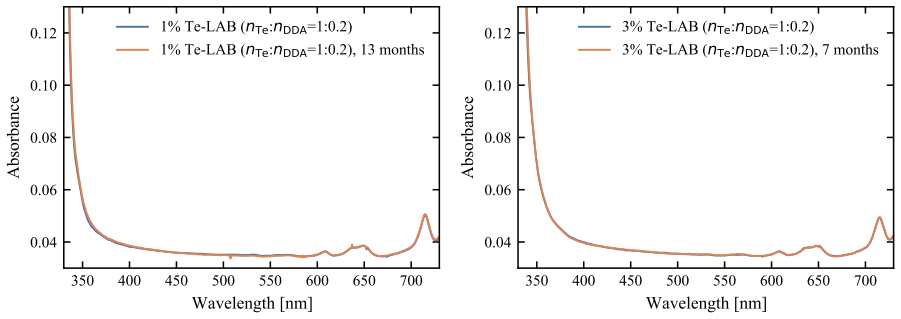
This study establishes a methanol-mediated room-temperature synthesis approach for tellurium-diol (Te-diol) compounds for use in tellurium-loaded liquid scintillator (Te-LS). The synthesis involves the direct reaction of telluric acid with diols (e.g., 1,2-hexanediol) in methanol (MeOH) under ambient conditions (25$\pm$5\textdegree C), with the key features of lower energy consumption and enhanced safety compared with high-temperature azeotropic distillation method. Mechanistic studies reveal that MeOH serves not merely as a solvent but also exhibits a catalytic effect, playing a dual role in this water-free, heterogeneous room-temperature synthesis. The Te-diol compounds enable fabrication of high-performance Te samples exhibiting exceptional optical transparency (attenuation length = 20.1$\pm$1.1 m at $\lambda$=430 nm for 1\% Te mass loading), which is reported here for the first time. Furthermore, the Te-LS achieves long-term spectral stability approaching or exceeding one year for both 1\% and 3\% Te mass loadings, and demonstrates a light yield comparable those of both the azeotropic distillation method and the SNO+ collaboration's Type I loading method, albeit modestly lower than that of their Type II method. The developed protocol offers the potential for a more energy efficient alternative for large-scale Te-LS production, particularly valuable for next-generation neutrinoless double-beta decay experiments.
Editorial analysis
A structured set of objections, weighed in public.
Referee Report
Summary. The manuscript presents a methanol-mediated room-temperature synthesis for tellurium-diol compounds to produce tellurium-loaded liquid scintillators (Te-LS). It claims this method is safer and lower-energy than high-temperature azeotropic distillation, yielding samples with attenuation length 20.1 ± 1.1 m at 430 nm for 1% Te mass loading, spectral stability approaching or exceeding one year at 1% and 3% loadings, and light yields comparable to prior azeotropic and SNO+ Type I methods.
Significance. If the reported optical and stability performance can be reproduced and scaled, the synthesis would offer a practical route to large-volume Te-LS production for next-generation 0νββ experiments, reducing energy use and safety risks relative to conventional approaches. The attenuation length value is presented as a first-time achievement for this loading level.
major comments (1)
- [Results] The headline optical and stability metrics (attenuation length 20.1±1.1 m at 430 nm and multi-month to one-year stability) are reported exclusively for small lab-scale preparations. No volume-dependent attenuation data, scaled-batch uniformity measurements, or long-term results from larger volumes are provided, which is load-bearing for the claim that the method yields material suitable for tonne-scale 0νββ detectors where mixing, impurities, and container effects become dominant.
minor comments (2)
- [Abstract] The abstract states light yields are 'comparable' to azeotropic and SNO+ Type I methods but provides no numerical values or uncertainties; adding these would improve clarity.
- [Results] The manuscript reports quantitative metrics (attenuation length with uncertainty, stability duration) but does not include raw data tables or full error-analysis details in the main text or supplementary material.
Simulated Author's Rebuttal
We thank the referee for their constructive feedback, which helps clarify the scope and limitations of our reported results. We address the single major comment below and have revised the manuscript to better contextualize the scale of the presented data.
read point-by-point responses
-
Referee: [Results] The headline optical and stability metrics (attenuation length 20.1±1.1 m at 430 nm and multi-month to one-year stability) are reported exclusively for small lab-scale preparations. No volume-dependent attenuation data, scaled-batch uniformity measurements, or long-term results from larger volumes are provided, which is load-bearing for the claim that the method yields material suitable for tonne-scale 0νββ detectors where mixing, impurities, and container effects become dominant.
Authors: We agree that all quantitative optical and stability results were obtained from laboratory-scale preparations (hundreds of mL). This constitutes a genuine limitation for claims of direct suitability for tonne-scale detectors, where mixing uniformity, impurity control, and container effects could become significant. In the revised manuscript we will add a new paragraph in the Discussion section that explicitly states the current data are from small-scale syntheses, acknowledges the potential impact of the factors raised by the referee, and outlines planned future experiments to test volume scaling. We will also adjust the language in the abstract and conclusions to describe the method as a promising route whose large-scale viability requires further validation rather than asserting immediate applicability. revision: yes
Circularity Check
No circularity: experimental measurements reported directly from lab samples
full rationale
This is an experimental methods paper on a room-temperature synthesis protocol for Te-diol compounds in liquid scintillators. The central claims—attenuation length of 20.1±1.1 m at 430 nm for 1% loading and spectral stability up to or exceeding one year—are presented as directly measured quantities on small-volume preparations, with comparisons to external benchmarks such as the azeotropic distillation method and SNO+ Type I/II loadings. No equations, fitted parameters, predictions, or derivations appear in the provided text. No self-citations, uniqueness theorems, or ansatzes are invoked to support the performance metrics. The paper does not reduce any result to its own inputs by construction; all reported values rest on empirical observation rather than self-referential logic. Scaling concerns raised by the skeptic are questions of extrapolation and applicability, not circularity in the derivation chain.
Axiom & Free-Parameter Ledger
axioms (1)
- domain assumption Attenuation length and light-yield measurements on small samples accurately represent bulk material performance under detector operating conditions.
Lean theorems connected to this paper
-
IndisputableMonolith/Cost/FunctionalEquation.leanwashburn_uniqueness_aczel unclear?
unclearRelation between the paper passage and the cited Recognition theorem.
methanol-mediated room-temperature synthesis … attenuation length = 20.1±1.1 m at λ=430 nm … long-term spectral stability approaching or exceeding one year
-
IndisputableMonolith/Foundation/AbsoluteFloorClosure.leanabsolute_floor_iff_bare_distinguishability unclear?
unclearRelation between the paper passage and the cited Recognition theorem.
Te-diol compounds enable fabrication of high-performance Te samples
What do these tags mean?
- matches
- The paper's claim is directly supported by a theorem in the formal canon.
- supports
- The theorem supports part of the paper's argument, but the paper may add assumptions or extra steps.
- extends
- The paper goes beyond the formal theorem; the theorem is a base layer rather than the whole result.
- uses
- The paper appears to rely on the theorem as machinery.
- contradicts
- The paper's claim conflicts with a theorem or certificate in the canon.
- unclear
- Pith found a possible connection, but the passage is too broad, indirect, or ambiguous to say the theorem truly supports the claim.
Forward citations
Cited by 1 Pith paper
-
Doping of a Borexino-like Liquid Scintillator with Tellurium-Diols
Doping of a pseudocumene-based liquid scintillator with tellurium-diols up to 2% concentration preserves principal scintillation characteristics with reduced light yield and faster decay times.
Reference graph
Works this paper leans on
-
[1]
Baryogenesis Without Grand Unification,
M. Fukugita and T. Yanagida, “Baryogenesis Without Grand Unification,” Phys. Lett. B 174, 45-47 (1986) doi:10.1016/0370-2693(86)91126-3
-
[2]
Neutrinoless Double Beta De- cay and the Baryon Asymmetry of the Universe,
F. F. Deppisch, L. Graf, J. Harz and W. C. Huang, “Neutrinoless Double Beta De- cay and the Baryon Asymmetry of the Universe,” Phys. Rev. D98, no.5, 055029 (2018) doi:10.1103/PhysRevD.98.055029
-
[3]
Leptogenesis as the origin of matter,
W. Buchmuller, R. D. Peccei and T. Yanagida, “Leptogenesis as the origin of matter,” Ann. Rev. Nucl. Part. Sci.55, 311-355 (2005) doi:10.1146/annurev.nucl.55.090704.151558 15
-
[5]
I. J. Arnquistet al.[Majorana], “Final Results of the Majorana Demonstrator’s Search for Double-Beta Decay of Ge76 to Excited States of Se76,” Phys. Rev. Lett.134no.24, 242501 (2025) doi:10.1103/PhysRevLett.134.242501 [arXiv:2410.03995 [nucl-ex]]
-
[6]
Neutrinoless double-beta decay search with the LEGEND experi- ment,
R. Brugnera [LEGEND], “Neutrinoless double-beta decay search with the LEGEND experi- ment,”JINST20, no.3, C03050 (2025) doi: 10.1088/1748-0221/20/03/C03050
-
[7]
D. Q. Adamset al.[CUORE], “Search for Majorana neutrinos exploiting millikelvin cryo- genics with CUORE, the CUORE Collaboration,” Nature609, no.7904, 53 (2022) doi: 10.1038/s41586-022-04497-4
-
[8]
The CUPID neutrinoless double-beta decay experiment,
D. Trotta [CUPID], “The CUPID neutrinoless double-beta decay experiment,” NIM A1066, 169657(2024) doi: 10.1016/j.nima.2024.169657
-
[9]
G. Antonet al.[EXO-200], “Search for Neutrinoless Double-βDecay with the Com- plete EXO-200 Dataset,” Phys. Rev. Lett.123, no.16, 161802 (2019) doi: 10.1103/Phys- RevLett.123.161802 [arXiv:1906.02723 [hep-ex]]
-
[10]
Sensitivity and discovery potential of the proposed nEXO experiment to neutrinoless double-βdecay,
J. B. Albertet al.[nEXO], “Sensitivity and discovery potential of the proposed nEXO experiment to neutrinoless double-βdecay,” Phys. Rev. C97, no.6, 065503 (2018) doi: 10.1103/PhysRevC.97.065503
-
[11]
Search for the Majorana Nature of Neutrinos in the Inverted Mass Ordering Region with KamLAND-Zen,
S. Abeet al.[KamLAND-Zen], “Search for the Majorana Nature of Neutrinos in the Inverted Mass Ordering Region with KamLAND-Zen,” Phys. Rev. Lett.130no.5, 051801 (2023) doi:10.1103/PhysRevLett.130.051801 [arXiv:2203.02139 [hep-ex]]
-
[12]
S. Biller [SNO+], “SNO+ with Tellurium”, Phys. Procedia61, 205-210 (2015) doi: 10.1016/j.phpro.2014.12.033 [arXiv:1405.3401 [physics.ins-det]]
work page internal anchor Pith review Pith/arXiv arXiv doi:10.1016/j.phpro.2014.12.033 2015
-
[13]
A New Technique to Load 130 Te in Liquid Scintillator for Neutrinoless Double Beta Decay Experiments
S. Biller and S. Manecki for the SNO+ collaboration, “A New Technique to Load 130 Te in Liquid Scintillator for Neutrinoless Double Beta Decay Experiments”, IOP Conf. Series: Journal of Physics: Conf. Series888, 012084 (2017) doi: 10.1088/1742-6596/888/1/012084
-
[14]
A method to load tellurium in liquid scintillator for the study of neutrinoless double beta decay
D. J. Auty, D. Bartlett, S. D. Biller, D. Chauhan, M. Chen, O. Chkvorets, S. Connolly, X. Dai, E. Fletcher and K. Frankiewicz,et al., “A method to load tellurium in liquid scintillator for the study of neutrinoless double beta decay”, NIM A1051, 168204 (2023) doi:10.1016/j.nima.2023.168204 [arXiv:2212.12444 [physics.ins-det]]
-
[15]
Prospects for THEIA: an advanced liquid scintillator neutrino experiment,
D. Guffanti [THEIA Proto], “Prospects for THEIA: an advanced liquid scintillator neutrino experiment,” JPCS1468, 012124 (2020) doi:10.1088/1742-6596/1468/1/012124
-
[16]
A. Abuslemeet al.[JUNO], “JUNO physics and detector,” Prog. Part. Nucl. Phys.123 (2022), 103927 (2022) doi:10.1016/j.ppnp.2021.103927 [arXiv:2104.02565 [hep-ex]]. 16
-
[17]
Physics potential of searching for $0\nu\beta\beta$ decays in JUNO
J. Zhao, L. J. Wen, Y. F. Wang and J. Cao, “Physics potential of searching for 0νββde- cays in JUNO,” Chin. Phys. C41, no.5, 053001 (2017) doi:10.1088/1674-1137/41/5/053001 [arXiv:1610.07143 [hep-ex]]
work page internal anchor Pith review Pith/arXiv arXiv doi:10.1088/1674-1137/41/5/053001 2017
-
[18]
A novel approach in synthesizing Te-diol compounds for tellurium-loaded liquid scintillator,
Y. Y. Ding, M. C. Liu, L. J. Wen, Y. x. Li, G. s. Li and Z. y. Zhang, “A novel approach in synthesizing Te-diol compounds for tellurium-loaded liquid scintillator,” NIM A1049, 168111 (2023) doi:10.1016/j.nima.2023.168111
-
[19]
M., Bintanja, R., Blackport, R
H. C. Han, J. X. Ye, G. S. Li and L. J. Wen, “An automated relative light yield mea- surement setup for liquid scintillator,” JINST20, no.06, P06049 (2025) doi:10.1088/1748- 0221/20/06/P06049 17
discussion (0)
Sign in with ORCID, Apple, or X to comment. Anyone can read and Pith papers without signing in.