REVIEW 3 major objections 4 minor 114 references
Two leading cosmological simulations agree on the physics of galaxy quenching but disagree sharply on what the VLT-MOONRISE survey will see at cosmic noon.
Reviewed by Pith at T0; open to challenge. T0 means a machine referee read the full paper against a public rubric. the ladder, T0–T4 →
T0 review · deepseek-v4-flash
2026-08-04 18:44 UTC pith:UZ2OEN3Z
load-bearing objection Useful MOONRISE-era predictions from a familiar RF pipeline, but the boldest EAGLE claim contradicts the paper's own Table 2 and needs a hard look before it is taken at face value. the 3 major comments →
Environmental vs. intrinsic quenching at cosmic noon: Predictions from cosmological hydrodynamical simulations for VLT-MOONRISE
The pith
A machine-rendered reading of the paper's core claim, the machinery that carries it, and where it could break.
Core claim
Using Random Forest classification on simulated galaxies at z=0, 1, and 2, the authors find that supermassive black hole mass is the best predictor of quiescence for central galaxies and high-mass satellites, while group halo mass is the best predictor for low-mass satellites, at every epoch. The split between low- and high-mass satellites is defined by a bespoke mass threshold derived from the bimodality of the quenched satellite stellar mass function, with a 0.2 dex buffer. The starkest discrepancy between the two simulations is in the mass threshold analysis: IllustrisTNG predicts environmentally quenched low-mass satellites that would be visible within VLT-MOONRISE's survey limits, where
What carries the argument
The central machinery is a Random Forest classifier applied to simulated galaxies, with input features including black hole mass, halo mass, stellar mass, local over-density, and distance to central. The classifier identifies the most causally predictive parameter for quiescence while controlling for inter-correlations. This is combined with a bespoke mass-threshold method that locates the local minimum of the gradient of a Schechter fit to the quenched satellite stellar mass function, adds a 0.2 dex buffer, and splits satellites into low- and high-mass classes. The 'MOONRISE-Like' sample construction applies the survey's mass completeness limit, a 2D+z observer space, and 70% completeness t
Load-bearing premise
The paper assumes that the split between low- and high-mass satellites, derived from the fitted dip in the quenched satellite stellar mass function plus a 0.2 dex buffer, cleanly separates environmental from intrinsic quenching; if that dip is an artifact of simulations over-quenching low-mass satellites, the EAGLE/TNG prediction difference could reverse.
What would settle it
If VLT-MOONRISE finds a significant population of quenched low-mass satellites (log M*/M_sun ~9.5-10) in groups at z~1-2, EAGLE's prediction fails; if it finds essentially none, TNG's prediction fails. Concretely, counting quenched low-mass satellites above the survey's mass completeness limit in the first MOONRISE data release would settle which simulated prediction is right.
If this is right
- If VLT-MOONRISE detects a population of quenched low-mass satellites at z~1-2, it would validate the TNG prediction and challenge EAGLE's quenching prescription.
- If VLT-MOONRISE finds essentially no environmentally quenched low-mass satellites above its mass limit, the EAGLE prediction would be favored over TNG.
- Measurements of quenched fraction versus black hole mass can distinguish TNG's preventative 'kinetic mode' AGN feedback from EAGLE's thermal feedback, especially through the presence or absence of rejuvenation.
- The Random Forest results imply that halo mass, rather than local density alone, is the superior environmental predictor; accurate halo mass estimates in MOONRISE will be essential.
- The study's mass-threshold method yields a specific, testable feature in the quenched stellar mass function: a dip separating the environmental and intrinsic quenching regimes that should appear if the bimodality is real.
Where Pith is reading between the lines
- If MOONRISE finds a significant abundance of quenched low-mass satellites, it would indirectly support TNG-style preventative AGN feedback and challenge EAGLE's thermal feedback; the opposite would support EAGLE. This is an editorial inference, not stated in the paper.
- The paper implicitly suggests that density-only environmental studies at cosmic noon may misclassify high-mass satellite quenching as environmental when the true driver is black hole mass; one could test this by running the same Random Forest analysis with and without density as an input on MOONRISE data.
- The mass-threshold method could be applied to other cosmological simulations or to the observed quenched mass function to check whether the bimodality is a robust feature or an artifact of simulation over-quenching; if it is artificial, the threshold-based predictions would need revision.
- A testable extension is to measure the quenched fraction of low-mass satellites as a function of distance to the central galaxy and halo mass in MOONRISE, which would directly probe the ram-pressure, starvation, and interaction mechanisms the paper identifies as likely drivers.
Editorial analysis
A structured set of objections, weighed in public.
Referee Report
Summary. This paper uses the IllustrisTNG and EAGLE simulations at z=0, 1, and 2 to identify which physical properties best predict quiescence for centrals, high-mass satellites, and low-mass satellites, with an eye toward VLT-MOONRISE. After constructing a 'MOONRISE-Like' sample (M*>10^9.5 Msun, 2D+z observer space, 70% completeness), the authors apply Random Forest classification to rank M_BH, M_*, M_Halo, delta, and D_cen. They find that M_BH dominates for centrals and high-mass satellites, while M_Halo dominates for low-mass satellites. They also derive redshift-dependent mass thresholds by fitting Schechter functions to quenched satellite stellar mass functions, and use these to claim a key divergence: TNG predicts environmentally quenched low-mass satellites visible to MOONRISE, whereas EAGLE predicts essentially none. The paper closes with a series of testable predictions for MOONRISE, including a possible distinction between EAGLE and TNG in the abundance of low-mass quenched satellites at cosmic noon.
Significance. If the central predictions were robust, this would be a timely and useful paper for planning MOONRISE science. Its strengths are the construction of survey-like samples, transparent reporting of Random Forest hyperparameters (Tables C1-C8), the use of two state-of-the-art simulations, and multiple complementary analyses (quenched fractions, Delta f_Q, radial trends). However, one of the headline predictions is internally contradicted by the paper's own Table 2, and the class-split methodology is at risk of circularity because the satellite mass thresholds are explicitly designed to separate the two quenching mechanisms and are then used to demonstrate that the mechanisms differ. With the internal contradiction corrected and the threshold sensitivity tested, the paper would provide a valuable comparative test of TNG versus EAGLE for MOONRISE.
major comments (3)
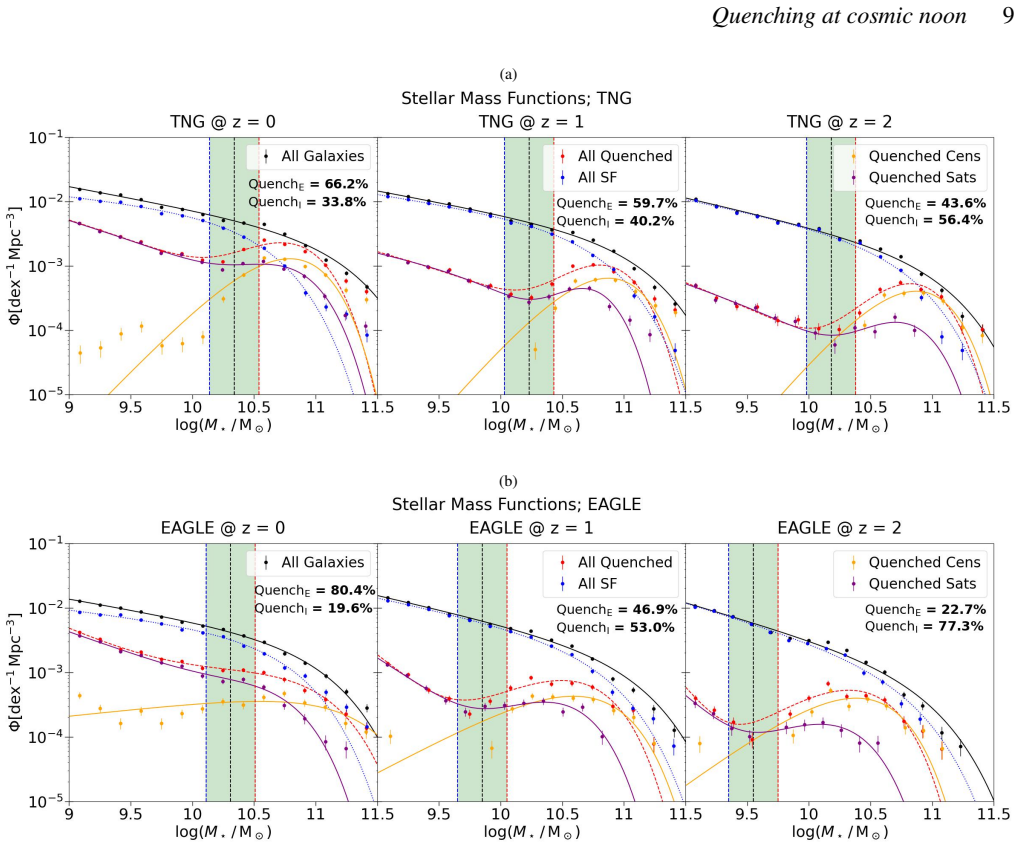
- [Sec. 4.1, Table 2, Fig. 6, Table C6] The text in Sec. 4.1 states that the EAGLE MOONRISE-Like samples at z>=1 are 'essentially devoid of low-mass satellites', and Fig. 6 and Sec. 4.3 repeat that no low-mass satellites are present at z=1,2. This is contradicted by Table 2: EAGLE z=1 MOONRISE-Like has N_LMS=406 and N_LMS,Q=45. With the z=1 bisecting mass of 9.85+/-0.2 (Table 3), the low-mass threshold after the 0.2 dex buffer is 9.65, so the sample contains galaxies with 9.5<log(M*/Msun)<9.65. Table C6 leaves the RF entries for EAGLE ML LM at z=1 and z=2 as ellipses. The claim that environmental quenching is 'undetectable' or that EAGLE predicts 'essentially none' is therefore not supported by the provided counts. Please re-run the z=1 low-mass satellite analysis, quantify expected counts in the MOONRISE volume, and revise the conclusion accordingly.
- [Sec. 4.1 and Abstract] Satellites are split using thresholds explicitly 'designed to separate environmental and intrinsic quenching mechanisms' (Abstract). The threshold is the minimum gradient of the quenched satellite SMF plus a 0.2 dex buffer (Sec. 4.1). The RF conclusion that low-mass satellites quench environmentally is then obtained from these very classes, so part of the result is baked into the sample definition. This matters because the low-mass upturn may be a simulation artifact (Kukstas et al. 2022, cited in Sec. 4.1). Please test the stability of the conclusions by varying the buffer (e.g., +/-0.1, +/-0.3 dex, and no buffer) and re-applying the RF and Delta f_Q analyses, or by using a continuous approach that does not preselect classes. Without such a test, the central dichotomy is not independent of the class definition.
- [Sec. 4.4, Figs. 9-10] The abstract and Sec. 4.4 claim 'strong evidence for the rejuvenation of star formation from z=2 to z=0 in EAGLE'. This is inferred from cross-sectional quenched fractions as a function of M_BH at three separate redshifts, not from tracking individual galaxies. Differential assembly histories could produce the same pattern without galaxies transitioning back to star formation. Please support the claim with merger-tree tracking of individual galaxies, or soften the wording to 'consistent with rejuvenation'.
minor comments (4)
- [Sec. 4.2, Sec. 4.3.1] Typos: 'uni-model' should be 'unimodal' in Sec. 4.2; 'wains' should be 'wanes' in Sec. 4.3.1.
- [Eq. (12), References] Eq. (12) appears to have a typo: p_i(n^2) should be p_i(n)^2. Also, the duplicated Pedregosa et al. (2011a,b) references should be merged.
- [Sec. 3.3, Sec. 5] Random Forest relative importance is referred to as 'causal' in several places. Since RF importance is a predictive/associational measure, I recommend rephrasing to avoid overclaiming causality.
- [Sec. 3.4, Eq. (14)] Please comment on the sensitivity of the sSFR quenching threshold to the -11.5 dex exclusion boundary and to the 3-sigma choice. This threshold controls all downstream quenched fractions and could affect the satellite counts in Table 2.
Circularity Check
Headline EAGLE/MOONRISE prediction reduces to the fitted mass threshold; QuenchE/I labels are definitional. Central RF results remain independent.
specific steps
-
self definitional
[Section 4.1 (QuenchE/QuenchI definitions) and Section 4.5.1 (use of QuenchI evolution)]
"The values of QuenchE and QuenchI are determined by evaluating the integral of the quenched Schechter function for the low and high-mass regimes (respectively), normalized by the total area under the quenched stellar mass function. ... for EAGLE QuenchI moves from 20% to 80% over the same redshift interval. This points to less effective environmental quenching at higher redshifts."
Environmental and intrinsic quenching are not measured independently; they are defined by the fitted bisecting mass. All quenched galaxies below the threshold are counted as 'environmentally quenched' (QuenchE) and all above as 'intrinsically quenched' (QuenchI). Since the threshold itself was chosen to separate the two mechanisms, the QuenchE/QuenchI fractions and their redshift trends (e.g., QuenchI rising from 20% to 80% in EAGLE) are a restatement of the fitted threshold evolution (Table 3: EAGLE threshold drops from 10.30 to 9.55) rather than an independent empirical finding. The Random Forest analysis provides some independent validation, but the specific QuenchE/I trend is definitional.
-
fitted input called prediction
[Section 4.1, after Table 3, and Section 4.3 / Fig. 6 caption]
"the low-mass thresholds at z = 1 & 2 (i.e., log(M*/M_sun) <= 9.65 and log(M*/M_sun) <= 9.35, respectively) lie near, or even below, the MOONRISE survey mass completeness limit. Therefore, the 'MOONRISE-Like' sample sets at z>=1 for EAGLE are essentially devoid of 'low-mass' satellites, i.e., satellites which are expected to quench solely via environmental means."
The paper's starkest falsifiable prediction—that EAGLE predicts essentially no environmentally quenched low-mass satellites within MOONRISE—is an arithmetic consequence of the fitted bisecting mass (Table 3) combined with the MOONRISE mass cut (log M*/M_sun > 9.5). The 'low-mass satellite' class is defined by that fitted threshold, so the prediction reduces to 'the fitted threshold lies below the survey limit.' The +/-0.2 dex buffer is hand-chosen; shifting it would change the sample and could reverse the prediction. The claim of being 'essentially devoid' is also internally inconsistent with Table 2, which lists 406 EAGLE low-mass satellites (45 quenched) in the z=1 MOONRISE-Like sample. Thus the headline prediction is not an independent consequence of EAGLE's physics but a relabeling of
full rationale
The paper contains substantial independent analysis: the Random Forest classification is a genuine machine-learning measurement within each galaxy class, and the finding that black hole mass dominates for centrals/high-mass satellites while halo mass dominates for low-mass satellites is not logically forced by the mass-threshold construction. The self-citations (e.g., Goubert et al. 2024) are not load-bearing for these results. However, two parts of the argument are partially circular. First, the QuenchE/QuenchI fractions are defined by the mass threshold that was itself designed to separate environmental and intrinsic mechanisms, so trends in those fractions (e.g., 'environmental quenching weakens with redshift in EAGLE') are largely a restatement of the fitted threshold's evolution. Second, the headline MOONRISE prediction for EAGLE is essentially the fitted threshold compared with the survey mass limit; it is a prediction only in the weak sense that the fitted value is a model output. The internal inconsistency between Table 2 (406 EAGLE low-mass satellites at z=1) and the text 'essentially devoid' is a correctness/falsifiability concern rather than circularity, but it underscores how closely the prediction is tied to the threshold definition. Overall score 5: partial circularity affecting the headline EAGLE/MOONRISE claim, while the central RF results remain independent.
Axiom & Free-Parameter Ledger
free parameters (5)
- sSFR quenching threshold per simulation and redshift =
mu_SF - 3 sigma_SF from Gaussian fit (e.g., f_Q about 30% at z=0, <10% at z=2)
- Bisecting stellar mass thresholds for satellites =
TNG: 10.30, 10.25, 10.15 at z=0,1,2; EAGLE: 10.30, 9.85, 9.55
- Buffer zone of +/-0.2 dex around bisecting mass =
0.2 dex
- sSFR exclusion boundary for Gaussian fitting =
log(sSFR/yr^-1) < -11.5
- Random Forest hyperparameters (min_samples_leaf, train:test, balancing) =
MSL values in Appendix C tables, e.g., 15-500
axioms (5)
- domain assumption The bimodality of the quenched satellite stellar mass function reflects two physically distinct quenching channels: environmental at low mass and intrinsic at high mass.
- domain assumption Random Forest feature importance, computed with all features evaluated at every node, identifies causal drivers of quenching rather than mere correlations.
- domain assumption The TNG and EAGLE simulations are sufficiently realistic to predict observable quenching populations at cosmic noon.
- domain assumption The Gaussian fit to the star-forming sSFR peak gives an unbiased separation between quenched and star-forming galaxies at each epoch.
- domain assumption The MOONRISE-like sample construction (2D+z observer space, 70% completeness, M*>10^9.5) preserves the quenching signal relevant to the real survey.
Cite this review
Pith. "Pith review of Environmental vs. intrinsic quenching at cosmic noon: Predictions from cosmological hydrodynamical simulations for VLT-MOONRISE." pith.science (2026). https://pith.science/paper/UZ2OEN3Z
@misc{pith2026250909626,
  author       = {Pith},
  title        = {Pith review of: Environmental vs. intrinsic quenching at cosmic noon: Predictions from cosmological hydrodynamical simulations for VLT-MOONRISE},
  year         = {2026},
  howpublished = {\url{https://pith.science/paper/UZ2OEN3Z}},
  note         = {Machine review of arXiv:2509.09626}
}
read the original abstract
We present an investigation into the quenching of simulated galaxies across cosmic time, honing in on the role played by both intrinsic and environmental mechanisms at different epochs. In anticipation of VLT-MOONRISE, the first wide-field spectroscopic galaxy survey to target cosmic noon, this work provides clear predictions to compare to the future observations. We investigate the quenching of centrals, high-mass satellites, and low-mass satellites from two cosmological hydrodynamical simulations: IllustrisTNG and EAGLE. Satellites are split according to bespoke mass thresholds, designed to separate environmental and intrinsic quenching mechanisms. To determine the best parameter for predicting quiescence, we apply a Random Forest classification analysis for each galaxy class at each epoch. The Random Forest classification determines supermassive black hole mass as the best predictor of quiescence in centrals and high-mass satellites. Alternatively, the quenching of low-mass satellites is best predicted by group halo mass, at all epochs. Additionally, we investigate the evolution in the dependence of the quenched fraction with various parameters, revealing a more complex picture. There is strong evidence for the rejuvenation of star formation from z = 2 to z = 0 in EAGLE, but not in IllustrisTNG. The starkest discrepancy between simulations rests in the mass threshold analysis. While IllustrisTNG predicts the existence of environmentally quenched satellites visible within the survey limits of MOONRISE, EAGLE does not. Hence, MOONRISE will provide critical data that is needed to evaluate current models, and constrain future models, of quenching processes.
Figures



Reference graph
Works this paper leans on
-
[2]
Aird J., Coil A. L., Georgakakis A., 2018, @doi [ ] 10.1093/mnras/stx2700 , https://ui.adsabs.harvard.edu/abs/2018MNRAS.474.1225A 474, 1225
-
[3]
Bah \'e Y. M., et al., 2017, @doi [ ] 10.1093/mnras/stx1403 , https://ui.adsabs.harvard.edu/abs/2017MNRAS.470.4186B 470, 4186
-
[4]
Barsanti S., et al., 2018, @doi [The Astrophysical Journal] 10.3847/1538-4357/aab61a , 857, 71
-
[5]
Bluck A. F. L., Ellison S. L., Patton D. R., Simard L., Mendel J. T., Teimoorinia H., Moreno J., Starkenburg E., 2014, @doi [arXiv e-prints] 10.48550/arXiv.1412.3862 , https://ui.adsabs.harvard.edu/abs/2014arXiv1412.3862B p. arXiv:1412.3862
work page internal anchor Pith review Pith/arXiv arXiv doi:10.48550/arxiv.1412.3862 2014
-
[6]
Bluck A. F. L., et al., 2016, @doi [ ] 10.1093/mnras/stw1665 , 462, 2559
-
[7]
Bluck A. F. L., et al., 2019, @doi [ ] 10.1093/mnras/stz363 , 485, 666
-
[8]
Bluck A. F. L., Maiolino, Roberto Sánchez, Sebastian F Ellison, Sara L Thorp, Mallory D Piotrowska, Joanna M Teimoorinia, Hossen Bundy, Kevin A 2020a, @doi [ ] 10.1093/mnras/stz3264 , 492, 96
-
[9]
Bluck A. F. L., et al., 2020b, @doi [ ] 10.1093/mnras/staa2806 , 499, 230
-
[10]
Bluck A. F. L., Maiolino R., Brownson S., Conselice C. J., Ellison S. L., Piotrowska J. M., Thorp M. D., 2022, @doi [A&A] 10.1051/0004-6361/202142643 , 659, A160
-
[11]
Bluck A. F. L., Piotrowska J. M., Maiolino R., 2023, @doi [ ] 10.3847/1538-4357/acac7c , 944, 108
-
[12]
Bluck A. F. L., et al., 2024, Galaxy quenching at the high redshift frontier: A fundamental test of cosmological models in the early universe with JWST-CEERS, Submitted
2024
-
[13]
Bondi H., Hoyle F., 1944, @doi [ ] 10.1093/mnras/104.5.273 , 104, 273
-
[17]
Brinchmann J., Charlot S., White S. D. M., Tremonti C., Kauffmann G., Heckman T., Brinkmann J., 2004, @doi [ ] 10.1111/j.1365-2966.2004.07881.x , 351, 1151
arXiv 2004
-
[18]
Brownson S., Bluck A. F. L., Maiolino R., Jones G. C., 2022, @doi [ ] 10.1093/mnras/stab3749 , 511, 1913
-
[19]
Bundy K., et al., 2006, @doi [ ] 10.1086/507456 , https://ui.adsabs.harvard.edu/abs/2006ApJ...651..120B 651, 120
doi:10.1086/507456 2006
-
[20]
Busca N., Balland C., 2018, @doi [arXiv e-prints] 10.48550/arXiv.1808.09955 , https://ui.adsabs.harvard.edu/abs/2018arXiv180809955B p. arXiv:1808.09955
-
[21]
Carnall A. C., et al., 2023, @doi [Monthly Notices of the Royal Astronomical Society] 10.1093/mnras/stad369 , 520, 3974
-
[22]
Carnall A. C., et al., 2024, @doi [Monthly Notices of the Royal Astronomical Society] 10.1093/mnras/stae2092 , 534, 325
-
[23]
Chabrier G., 2003, @doi [ ] 10.1086/376392 , https://ui.adsabs.harvard.edu/abs/2003PASP..115..763C 115, 763
doi:10.1086/376392 2003
-
[24]
Cirasuolo M., et al., 2020, @doi [The Messenger] 10.18727/0722-6691/5195 , https://ui.adsabs.harvard.edu/abs/2020Msngr.180...10C 180, 10
-
[25]
K., Kang X., 2020, @doi [The Astrophysical Journal] 10.3847/1538-4357/ab6730 , 889, 156
Contini E., Gu Q., Ge X., Rhee J., Yi S. K., Kang X., 2020, @doi [The Astrophysical Journal] 10.3847/1538-4357/ab6730 , 889, 156
-
[26]
M., 2009, @doi [ ] 10.1111/j.1365-2966.2009.15548.x , 400, 1225
Cortese L., Hughes T. M., 2009, @doi [ ] 10.1111/j.1365-2966.2009.15548.x , 400, 1225
arXiv 2009
-
[27]
A., et al., 2015, @doi [ ] 10.1093/mnras/stv725 , 450, 1937
Crain R. A., et al., 2015, @doi [ ] 10.1093/mnras/stv725 , 450, 1937
-
[28]
Cramer W. J., Kenney J. D. P., Sun M., Crowl H., Yagi M., Jáchym P., Roediger E., Waldron W., 2019, @doi [The Astrophysical Journal] 10.3847/1538-4357/aaefff , 870, 63
-
[30]
D'Eugenio F., et al., 2025, @doi [ ] 10.3847/1538-4365/ada148 , https://ui.adsabs.harvard.edu/abs/2025ApJS..277....4D 277, 4
-
[31]
De Lucia G., Fontanot F., Hirschmann M., Xie L., 2025, @doi [arXiv e-prints] 10.48550/arXiv.2502.01724 , https://ui.adsabs.harvard.edu/abs/2025arXiv250201724D p. arXiv:2502.01724
-
[32]
Dekel A., Birnboim Y., 2006, @doi [ ] 10.1111/j.1365-2966.2006.10145.x , https://ui.adsabs.harvard.edu/abs/2006MNRAS.368....2D 368, 2
arXiv 2006
-
[33]
Dom \' nguez S \'a nchez H., Huertas-Company M., Bernardi M., Tuccillo D., Fischer J. L., 2018, @doi [ ] 10.1093/mnras/sty338 , https://ui.adsabs.harvard.edu/abs/2018MNRAS.476.3661D 476, 3661
-
[34]
Donnari M., Pillepich A., Nelson D., Marinacci F., Vogelsberger M., Hernquist L., 2021, @doi [Monthly Notices of the Royal Astronomical Society] 10.1093/mnras/stab1950 , 506, 4760
-
[35]
Eisenstein D. J., et al., 2023a, @doi [arXiv e-prints] 10.48550/arXiv.2306.02465 , https://ui.adsabs.harvard.edu/abs/2023arXiv230602465E p. arXiv:2306.02465
-
[36]
Eisenstein D. J., et al., 2023b, @doi [arXiv e-prints] 10.48550/arXiv.2310.12340 , https://ui.adsabs.harvard.edu/abs/2023arXiv231012340E p. arXiv:2310.12340
-
[37]
Fabian A., 2012, @doi [ARA&A] 10.1146/annurev-astro-081811-125521 , 50, 455
-
[38]
Fabian A. C., Walker S. A., Celotti A., Ghisellini G., Mocz P., Blundell K. M., McMahon R. G., 2014, @doi [ ] 10.1093/mnrasl/slu065 , https://ui.adsabs.harvard.edu/abs/2014MNRAS.442L..81F 442, L81
-
[39]
Fang Y., Clampitt J., Dalal N., Jain B., Rozo E., Moustakas J., Rykoff E., 2016, @doi [ ] 10.1093/mnras/stw2108 , https://ui.adsabs.harvard.edu/abs/2016MNRAS.463.1907F 463, 1907
-
[40]
Finkelstein S. L., et al., 2023, @doi [ ] 10.3847/2041-8213/acade4 , https://ui.adsabs.harvard.edu/abs/2023ApJ...946L..13F 946, L13
-
[41]
Foltz R., et al., 2018, @doi [The Astrophysical Journal] 10.3847/1538-4357/aad80d , 866, 136
-
[42]
Gabor J. M., Davé R., 2014, @doi [Monthly Notices of the Royal Astronomical Society] 10.1093/mnras/stu2399 , 447, 374
-
[43]
et al., 2014, @doi [A&A] 10.1051/0004-6361/201322790 , 562, A23
Garilli, B. et al., 2014, @doi [A&A] 10.1051/0004-6361/201322790 , 562, A23
-
[44]
Genel S., et al., 2014, @doi [ ] 10.1093/mnras/stu1654 , 445, 175
-
[45]
Girelli, Giacomo Bolzonella, Micol Cimatti, Andrea 2019, @doi [A&A] 10.1051/0004-6361/201834547 , 632, A80
-
[46]
Goto T., Yamauchi C., Fujita Y., Okamura S., Sekiguchi M., Smail I., Bernardi M., Gomez P. L., 2003, @doi [Monthly Notices of the Royal Astronomical Society] 10.1046/j.1365-2966.2003.07114.x , 346, 601
arXiv 2003
-
[47]
Goubert P. H., Bluck A. F. L., Piotrowska J. M., Maiolino R., 2024, @doi [Monthly Notices of the Royal Astronomical Society] 10.1093/mnras/stae269 , 528, 4891
-
[48]
Gunn J. E., Gott J. Richard I., 1972, @doi [ ] 10.1086/151605 , https://ui.adsabs.harvard.edu/abs/1972ApJ...176....1G 176, 1
doi:10.1086/151605 1972
-
[49]
Hamadouche M. L., et al., 2024, @doi [arXiv e-prints] 10.48550/arXiv.2412.09592 , https://ui.adsabs.harvard.edu/abs/2024arXiv241209592H p. arXiv:2412.09592
-
[50]
Henriques B. M. B., White S. D. M., Lilly S. J., Bell E. F., Bluck A. F. L., Terrazas B. A., 2019, @doi [ ] 10.1093/mnras/stz577 , 485, 3446
-
[51]
Hoyle F., Lyttleton R. A., 1939, @doi [Proceedings of the Cambridge Philosophical Society] 10.1017/S0305004100021150 , https://ui.adsabs.harvard.edu/abs/1939PCPS...35..405H 35, 405
-
[52]
et al., 2015, @doi [A&A] 10.1051/0004-6361/201425176 , 579, A2
Ilbert, O. et al., 2015, @doi [A&A] 10.1051/0004-6361/201425176 , 579, A2
-
[53]
Ji Z., Giavalisco M., Williams C. C., Faber S. M., Ferguson H. C., Guo Y., Liu T., Lee B., 2018, @doi [The Astrophysical Journal] 10.3847/1538-4357/aacc2c , 862, 135
-
[54]
Kapferer W., Sluka C., Schindler S., Ferrari C., Ziegler B., 2009, @doi [ ] 10.1051/0004-6361/200811551 , https://ui.adsabs.harvard.edu/abs/2009A&A...499...87K 499, 87
-
[55]
Kartaltepe J. S., et al., 2023, @doi [ ] 10.3847/2041-8213/acad01 , https://ui.adsabs.harvard.edu/abs/2023ApJ...946L..15K 946, L15
-
[56]
Kawinwanichakij L., et al., 2017, @doi [ ] 10.3847/1538-4357/aa8b75 , https://ui.adsabs.harvard.edu/abs/2017ApJ...847..134K 847, 134
-
[57]
Kennicutt Jr. R. C., 1998, @doi [ ] 10.1146/annurev.astro.36.1.189 , https://ui.adsabs.harvard.edu/abs/1998ARA&A..36..189K 36, 189
-
[58]
Kocevski D. D., et al., 2023, @doi [ ] 10.3847/2041-8213/acad00 , https://ui.adsabs.harvard.edu/abs/2023ApJ...946L..14K 946, L14
-
[59]
Kukstas E., et al., 2022, @doi [Monthly Notices of the Royal Astronomical Society] 10.1093/mnras/stac3438 , 518, 4782
-
[60]
Lilly S. J., et al., 2007, @doi [ ] 10.1086/516589 , https://ui.adsabs.harvard.edu/abs/2007ApJS..172...70L 172, 70
doi:10.1086/516589 2007
-
[61]
Lim S., Tacchella S., Maiolino R., Schaye J., Schaller M., 2025, @doi [arXiv e-prints] 10.48550/arXiv.2504.02027 , https://ui.adsabs.harvard.edu/abs/2025arXiv250402027L p. arXiv:2504.02027
-
[62]
Lotz M., Remus R.-S., Dolag K., Biviano A., Burkert A., 2019, @doi [Monthly Notices of the Royal Astronomical Society] 10.1093/mnras/stz2070 , 488, 5370
-
[63]
Madau P., Dickinson M., 2014, @doi [Annual Review of Astronomy and Astrophysics] https://doi.org/10.1146/annurev-astro-081811-125615 , 52, 415
-
[64]
Maiolino R., et al., 2012, @doi [ ] 10.1111/j.1745-3933.2012.01303.x , 425L, L66
arXiv 2012
-
[65]
Maiolino R., et al., 2020, @doi [The Messenger] 10.18727/0722-6691/5197 , https://ui.adsabs.harvard.edu/abs/2020Msngr.180...24M 180, 24
-
[66]
Mao Z., Kodama T., Pérez-Martínez J. M., Suzuki T. L., Yamamoto N., Adachi K., 2022, @doi [A&A] 10.1051/0004-6361/202243733 , 666, A141
-
[67]
Marasco A., Crain R. A., Schaye J., Bah \'e Y. M., van der Hulst T., Theuns T., Bower R. G., 2016, @doi [ ] 10.1093/mnras/stw1498 , https://ui.adsabs.harvard.edu/abs/2016MNRAS.461.2630M 461, 2630
-
[68]
Marinacci F., et al., 2018, @doi [ ] 10.1093/mnras/sty2206 , 480, 5113
-
[69]
McAlpine S., et al., 2016, @doi [A&C] https://doi.org/10.1016/j.ascom.2016.02.004 , 15, 72
-
[70]
Moore B., Katz N., Lake G., Dressler A., Oemler A., 1996, @doi [Nature] 10.1038/379613a0 , 379, 613
doi:10.1038/379613a0 1996
-
[71]
Moore B., Governato F., Quinn T., Stadel J., Lake G., 1998, @doi [ ] 10.1086/311333 , 499, L5
doi:10.1086/311333 1998
-
[72]
Moore B., Lake G., Quinn T., Stadel J., 1999, @doi [ ] 10.1046/j.1365-8711.1999.02345.x , https://ui.adsabs.harvard.edu/abs/1999MNRAS.304..465M 304, 465
arXiv 1999
-
[73]
P., et al., 2018, @doi [ ] 10.1093/mnras/sty618 , 477, 1206
Naiman J. P., et al., 2018, @doi [ ] 10.1093/mnras/sty618 , 477, 1206
-
[74]
Nelson D., et al., 2018, @doi [ ] 10.1093/mnras/stx3040 , 475, 624
-
[75]
Pedregosa F., et al., 2011a, Journal of Machine Learning Research, 12, 2825
-
[76]
Pedregosa F., et al., 2011b, Journal of Machine Learning Research, 12, 2825
-
[77]
Peng Y., et al., 2010, @doi [ ] 10.1088/0004-637X/721/1/193 , 721, 193
-
[78]
J., Renzini A., Carollo M., 2012, @doi [ ] 10.1088/0004-637X/757/1/4 , 757, 4
Peng Y., Lilly S. J., Renzini A., Carollo M., 2012, @doi [ ] 10.1088/0004-637X/757/1/4 , 757, 4
-
[79]
et al., 2018, @doi [A&A] 10.1051/0004-6361/201732465 , 619, A147
Pentericci, L. et al., 2018, @doi [A&A] 10.1051/0004-6361/201732465 , 619, A147
-
[80]
Pillepich A., et al., 2018a, @doi [ ] 10.1093/mnras/stx2656 , 473, 4077
-
[81]
Pillepich A., et al., 2018b, @doi [ ] 10.1093/mnras/stx3112 , 475, 648
-
[82]
Piotrowska J. M., Bluck A. F. L., Maiolino R., Peng Y., 2022, @doi [MNRAS] 10.1093/mnras/stab3673 , 512, 1052
-
[83]
Planck Collaboration et al., 2014, @doi [A&A] 10.1051/0004-6361/201321529 , 571, A1
-
[84]
Planck Collaboration et al., 2016, @doi [A&A] 10.1051/0004-6361/201525830 , 594, A13
-
[85]
J., 1984, @doi [ ] 10.1086/162078 , https://ui.adsabs.harvard.edu/abs/1984ApJ...281...95P 281, 95
Postman M., Geller M. J., 1984, @doi [ ] 10.1086/162078 , https://ui.adsabs.harvard.edu/abs/1984ApJ...281...95P 281, 95
doi:10.1086/162078 1984
discussion (0)
Sign in with ORCID, Apple, or X to comment. Anyone can read and Pith papers without signing in.