REVIEW 4 major objections 6 minor 3 cited by
Reconstructing the origin of black hole mergers using sparse astrophysical models
T0 review · 4 major / 6 minor · reviewed 2026-08-04 · deepseek-v4-flash
Pith's one-line read This paper establishes that the 87 binary black hole mergers observed by LIGO-Virgo are best described as a near-even mixture of AGN-assisted and isolated-binary formation channels, and that this split can be inferred from a sparse grid of
desk verdict Sparse-grid mixture analysis is a useful step, but the abstract's AGN rate is not robust once an empirical component is added, and the paper has internal arithmetic errors. read the letter →
The pith
A machine-rendered reading of the paper's core claim, the machinery that carries it, and where it could break.
The reading
What carries the argument
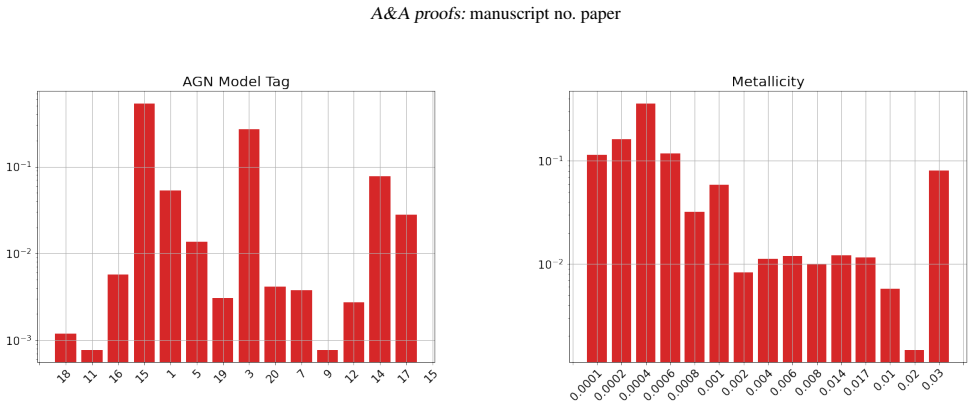
The machinery is a hierarchical Bayesian mixture model built on a discrete grid of simulations. Each of the 14 AGN and 19 SEVN runs supplies a probability distribution over binary parameters (masses, mass ratio, spins), and the total merger rate is written as a weighted sum of these distributions, with one weight (rate) per model plus a small number of empirical components. The likelihood for all 87 events is then used to sample posterior weights and per-model hyperparameters. This lets a sparse, theory-driven set of simulations—not a continuous analytical function—carry the astrophysical uncertainty in the population.
What would settle it
Count the mass-ratio distribution of high total-mass mergers in the upcoming O4 catalog: the model predicts a clear excess of low-q (q ≲ 0.5) systems above roughly 60 M☉, supplied by the AGN channel. If the observed set shows no such excess—for instance, all events with M ≳ 60 M☉ have q ≳ 0.8—the claimed AGN contribution of about 21 Gpc⁻³ yr⁻¹ would be excluded.
Extended reading notes
Core claim
The central claim of the paper is that the observed binary black hole population is consistent with a mixture of AGN-assisted and isolated-binary (SEVN) formation, and the paper estimates the mixing fractions from the 87 detections. The reported best-fit rates are a total of 46.2 Gpc⁻³ yr⁻¹, with 21.2 Gpc⁻³ yr⁻¹ from AGN-assisted mergers and 25.0 Gpc⁻³ yr⁻¹ from SEVN isolated binaries. The two channels separate cleanly in parameter space: AGN-assisted mergers dominate high total masses and low mass ratios, while SEVN mergers dominate low masses and near-equal mass ratios. The analysis also yields posterior estimates for the AGN disk parameters (f_v ≈ 0.09, τ ≈ 932 × 10⁵ yr, λ ≈ 0.74) and a S
Load-bearing premise
The inference rests on the discrete grid of 14 AGN and 19 SEVN simulations spanning the true space of merger distributions; if the real formation-channel parameters lie off this grid, or if the six omitted AGN models are not simply under-sampled, the reported rates and parameter values are biased.
Editorial extensions
If this is right
- If the inferred split is correct, roughly half of future BBH detections should trace to AGN-assisted origins, giving electromagnetic and host-galaxy follow-up a concrete rate to test.
- The AGN channel's preference for low mass ratios and high total masses predicts that the most asymmetric, heaviest mergers will preferentially come from AGN disks, a signature that can be checked as the catalog grows.
- The inferred SEVN metallicity near Z ≈ 6 × 10⁻⁴ connects the isolated-binary channel to low-metallicity star-forming galaxies, which is testable with galaxy surveys.
- Adding a generic power-law+peak empirical component drops the AGN contribution from 21.2 to 5.1 Gpc⁻³ yr⁻¹ while SEVN stays near 31.6 Gpc⁻³ yr⁻¹, so the AGN share depends on how completely alternative stellar-origin populations are modeled.
Reading between the lines
- The credible intervals for the AGN parameters are discrete-grid-selected values, not continuum estimates; an interpolated or emulated model space would give smoother posteriors and likely broader uncertainty.
- The six AGN simulations dropped for low BBH counts could hide viable regions of parameter space; re-running them with more Monte Carlo samples might move the AGN share.
- If the SEVN spin model were replaced by a more realistic prescription, the mass-ratio/spin fingerprint separating the two channels could shift, so the 21/25 split should be read as conditional on the toy spin assumption.
Editorial analysis
A structured set of objections, weighed in public.
Referee Report
Summary. The paper extends the mixture-model population inference of Gayathri et al. (2023) to a discrete set of simulated astrophysical formation models: 14 AGN-assisted merger simulations (from 20, with 6 discarded) and 19 SEVN isolated-binary models (15 metallicities and 4 common-envelope efficiencies). The authors analyze 87 BBH detections from O1–O3, estimating merger rates and channel fractions under AGN-only, AGN+SEVN, and PL+G+AGN+SEVN mixture models. The abstract reports a total rate of 46.2 Gpc^-3 yr^-1 for the AGN+SEVN model, with AGN contributing 21.2 and SEVN 25.0 Gpc^-3 yr^-1, and the paper frames these as quantifying the relative contributions of the two formation channels.
Significance. The methodological direction—using sparse simulated catalogs directly as components in a hierarchical mixture likelihood—is timely and potentially valuable for GW population inference, as it avoids restrictive parametric prescriptions and can incorporate realistic model uncertainties. The paper also makes explicit, falsifiable predictions for channel rates and model parameters using public LVK data. However, the numerical results are not internally self-consistent: the paper's own four-component analysis (Fig. 8) yields an AGN rate that is roughly a quarter of the headline value, and the abstract/conclusions omit this sensitivity. As presented, the central claim of a robust AGN/SEVN decomposition is not yet supported.
major comments (4)
- [Abstract; Fig. 7 caption; Fig. 8 caption] The abstract reports an AGN rate of 21.2 Gpc^-3 yr^-1 from the AGN+SEVN model, but the four-component PL+G+AGN+SEVN result in the Fig. 8 caption gives AGN = 5.1 Gpc^-3 yr^-1, a factor ~4 lower. Moreover, the Fig. 8 caption states a total of 58.1 Gpc^-3 yr^-1 while the listed components sum to 29.56 + 2.66 + 5.1 + 31.63 = 68.95 Gpc^-3 yr^-1. This arithmetic inconsistency makes the central rate claim irreproducible, and the model-dependence of the AGN rate is not reported in the abstract or conclusion.
- [Section 2.1, Table 1] Six of the 20 AGN simulations are excluded from the analysis solely because they produce a low number of BBH samples, with no quantitative threshold or justification. If the excluded models occupy a different region of parameter space, this post-hoc selection can bias the inferred channel fractions and parameter estimates. Please provide the selection criterion and a robustness test (e.g., repeating the analysis with all 20 models or with a minimum sample count).
- [Sections 4.1 and 4.3] The AGN parameter estimates are inconsistent between the AGN-only and AGN+SEVN analyses. Section 4.1 reports f_v = 0.86^{+0.05}_{-0.71}, τ ≈ 42.1×10^5 yr, λ ≈ 0.31, while Section 4.3 reports f_v = 0.09^{+0.21}_{-0.08}, τ ≈ 932×10^5 yr, λ ≈ 0.74. The text in §4.3 states these estimates are 'consistent', which is contradicted by the quoted values. This instability underlines the sensitivity of the inferred AGN parameters to the model set and undermines the conclusion's claim of consistent AGN parameter estimation.
- [Section 3.3] The likelihood uses Gaussian fits to the event posterior distributions in (M, η, χ_eff), referencing Delfavero et al. (2021). No validation is shown that these approximations are adequate for the 87 events, several of which have non-Gaussian or multi-modal posteriors (e.g., due to spin degeneracies and mass-ratio constraints). Since the quantitative rates and channel fractions rest on this likelihood, a comparison using full posterior samples for at least a subset of events is needed to rule out systematic bias.
minor comments (6)
- [References] There are duplicate bibliography entries: Bartos et al. (2017) appears twice, Iorio et al. (2023) twice, and Wysocki et al. (2019) twice.
- [Section 3.3] The text mentions a broken power-law empirical model, but no results for it are reported anywhere in the paper.
- [Notation] The symbol α is used for both the SEVN common-envelope efficiency and the disk viscosity parameter α_SS; please disambiguate to avoid confusion.
- [Equations (5) and (6)] There are typographical issues: in Eq. (5), 'p_sevn(X|Λ_sev)' is missing a closing brace, and in Eq. (6), 'Rg' and 'R pl' are inconsistently subscripted.
- [Fig. 2 caption] The caption defines N_i as the number of binaries in the i-th AGN model and N as the number in the highest-τ model, but the text uses N without clear definition.
- [Section 4.1] The rate is quoted as '39.5 +10.34 −11.06,Gpc−3,yr−1'; the punctuation and units should be formatted consistently as Gpc^{-3} yr^{-1}.
Circularity Check
No significant circularity: the analysis is an externally grounded mixture fit to LVK data using independently simulated model grids.
full rationale
The paper performs a standard hierarchical mixture-model inference: the observed 87 BBH events are taken from the independent GWTC catalog, and the AGN and SEVN component distributions are precomputed simulation outputs from prior work (Tagawa et al. 2021; Iorio et al. 2023). These model distributions are not constructed from the observed events nor defined in terms of the inferred rates; the mixture fractions and total rates are free parameters estimated from the data. The headline AGN/SEVN split (21.2 vs 25.0 Gpc^-3 yr^-1) is therefore a fitted result, not a prediction that reduces to its inputs by construction. The method generalizes the authors' earlier work (Gayathri et al. 2023), but the formalism is re-derived in Section 3 and is not imported as an unexamined uniqueness theorem. Self-citations to the authors' own simulations and code are present, but those cited results are independently produced and externally falsifiable, so they do not constitute load-bearing circularity. The internal inconsistency in Fig. 8 (component rates 29.56 + 2.66 + 5.1 + 31.63 = 68.95, not the stated 58.1) and the sensitivity of the AGN rate to inclusion of the PL+G empirical component are correctness/model-dependence concerns, not circularity. Similarly, the decision to discard six AGN models with low BBH sample counts is a modeling-choice concern. No equation defines a predicted quantity in terms of a fitted quantity, and no fitted parameter is relabeled as a prediction. Thus the derivation chain is self-contained against external data and simulation outputs, and no significant circularity is found.
Assumptions & free parameters
free parameters (4)
- Total merger rate R =
46.2 Gpc^-3 yr^-1 (AGN+SEVN case)
- AGN component rate R_agn =
21.2 Gpc^-3 yr^-1
- SEVN component rate R_sevn =
25.0 Gpc^-3 yr^-1
- Power-law+peak empirical model parameters =
not reported in the paper
assumptions (4)
- standard math Bayes' theorem and the likelihood formula (Eq. 4) as derived in Wysocki et al. 2019.
- domain assumption The 14 AGN and 19 SEVN models adequately span the space of plausible formation-channel distributions, and the 6 excluded AGN models are unrepresentative.
- domain assumption Gaussian approximations to single-event likelihoods in (M, eta, chi_eff) are sufficiently accurate for population inference.
- domain assumption The selection function and detection efficiency are correctly folded into the expected detection count mu(R,X).
Cite this review
Pith. "Pith review of Reconstructing the origin of black hole mergers using sparse astrophysical models." pith.science (2026). https://pith.science/paper/UTL2F3N4
@misc{pith2026250909647,
  author       = {Pith},
  title        = {Pith review of: Reconstructing the origin of black hole mergers using sparse astrophysical models},
  year         = {2026},
  howpublished = {\url{https://pith.science/paper/UTL2F3N4}},
  note         = {Machine review of arXiv:2509.09647}
}
abstract
The astrophysical origin of binary black hole mergers discovered by LIGO and Virgo remains uncertain. Efforts to reconstruct the processes that lead to mergers typically rely on either astrophysical models with fixed parameters, or continuous analytical models that can be fit to observations. Given the complexity of astrophysical formation mechanisms, these methods typically cannot fully take into account model uncertainties, nor can they fully capture the underlying processes. Here, we present a merger population analysis that can take a discrete set of simulated model distributions as its input to interpret observations. The analysis can take into account multiple formation scenarios as fractional contributors to the total set of observations, and can naturally account for model uncertainties. We apply this technique to investigate the origin of black hole mergers observed by LIGO Virgo. Specifically, we consider a model of AGN assisted black hole merger distributions, exploring a range of AGN parameters along with several {{SEVN}} population synthesis models that vary in common envelope efficiency parameter ($\alpha$) and metallicity ($Z$). We estimate the posterior distributions for AGN+SEVN models using $87$ BBH detections from the $O1--O3$ observation runs. The inferred total merger rate is $46.2 {Gpc}^{-3} {yr}^{-1}$, with the AGN sub-population contributing $21.2{Gpc}^{-3}{yr}^{-1}$ and the SEVN sub-population contributing $25.0 {Gpc}^{-3} {yr}^{-1}$.
Figures


Figures from the paper (6 more)




Forward citations
Cited by 3 Pith papers
-
Assessing the waveform systematics from parameter estimation to population inference with eccentricity
Eccentric waveform-model differences, small per event, accumulate across the GWTC-4 catalog and alter inferred redshift evolution and effective-spin population distributions.
-
Uncovering Hierarchical Sub-Population of Binary Black Holes
A flexible six-component fit to 259 LIGO/Virgo/KAGRA black-hole mergers finds a roughly geometric sequence of mass peaks but no aligned-spin signal except in the lowest-mass component.
-
Properties of black hole mergers in disks of active galactic nuclei
Black hole merger properties in AGN disks match observed distributions when gas accretion and hierarchical mergers are included, varying strongly with disk parameters.
Reference graph
Works this paper leans on
-
[1]
Aasi, J. et al. 2015, Class. Quantum Grav., 32, 074001
2015
-
[2]
Abac, A. G. et al. 2025 [arXiv:2508.18082]
arXiv 2025
-
[3]
P., Abbott, R., Abbott, T
Abbott, B. P., Abbott, R., Abbott, T. D., et al. 2019, Phys. Rev. X, 9, 031040
2019
-
[4]
Abbott, B. P. et al. 2017, Phys. Rev. Lett., 119, 161101
2017
-
[5]
Abbott, R., Abbott, T. D., Abraham, S., et al. 2020, arXiv:2010.14527
arXiv 2020
-
[6]
Abbott, R. et al. 2021, Astrophys. J. Lett., 913, L7
2021
-
[7]
Abbott, R. et al. 2024, Phys. Rev. D, 109, 022001
2024
-
[8]
Acernese, F. et al. 2015, Class. Quantum Grav., 32, 024001
2015
Show all 50 references
-
[9]
Akutsu, T. et al. 2019, Nature Astron., 3, 35
2019
-
[10]
2014, Astrophys
Antonini, F. 2014, Astrophys. J., 794, 106
2014
-
[11]
Artymowicz, P., Lin, D. N. C., & Wampler, E. J. 1993, Astrophys. J., 409, 592
1993
-
[12]
2017, Nature Comm., 8, 831
Bartos, I., Haiman, Z., Marka, Z., et al. 2017, Nature Comm., 8, 831
2017
-
[13]
2017, Astrophys
Bartos, I., Kocsis, B., Haiman, Z., & Márka, S. 2017, Astrophys. J., 835, 165
2017
-
[14]
2017, ApJ, 835, 165
Bartos, I., Kocsis, B., Haiman, Z., & Márka, S. 2017, ApJ, 835, 165
2017
-
[15]
2021, Mon
Bouffanais, Y ., Mapelli, M., Santoliquido, F., et al. 2021, Mon. Not. Roy. Astron. Soc., 505, 3873
2021
-
[16]
2012, MNRAS, 427, 127
Bressan, A., Marigo, P., Girardi, L., et al. 2012, MNRAS, 427, 127
2012
-
[17]
2015, MNRAS, 452, 1068
Chen, Y ., Bressan, A., Girardi, L., et al. 2015, MNRAS, 452, 1068
2015
-
[18]
Colloms, S., Berry, C. P. L., Veitch, J., & Zevin, M. 2025, Astrophys. J., 988, 189
2025
-
[19]
2019, MNRAS, 485, 4641
Costa, G., Girardi, L., Bressan, A., et al. 2019, MNRAS, 485, 4641
2019
-
[20]
2023, Mon
Costa, G., Mapelli, M., Iorio, G., et al. 2023, Mon. Not. Roy. Astron. Soc., 525, 2891
2023
-
[21]
2021, Normal Approximate Likelihoods to Gravitational Wave Events
Delfavero, V ., O’Shaughnessy, R., Wysocki, D., & Yelikar, A. 2021, Normal Approximate Likelihoods to Gravitational Wave Events
2021
-
[22]
2021, ApJ, 913, L23
Edelman, B., Doctor, Z., & Farr, B. 2021, ApJ, 913, L23
2021
-
[23]
E., & Galaudage, S
Farah, A., Fishbach, M., Essick, R., Holz, D. E., & Galaudage, S. 2022, ApJ, 931, 108
2022
-
[24]
L., Belczynski, K., Wiktorowicz, G., et al
Fryer, C. L., Belczynski, K., Wiktorowicz, G., et al. 2012, ApJ, 749, 91
2012
-
[25]
2023, Astrophys
Gayathri, V ., Wysocki, D., Yang, Y ., et al. 2023, Astrophys. J. Lett., 945, L29
2023
-
[26]
2021, Astrophys
Gayathri, V ., Yang, Y ., Tagawa, H., Haiman, Z., & Bartos, I. 2021, Astrophys. J. Lett., 920, L42
2021
-
[27]
C., Metzger, B
Generozov, A., Stone, N. C., Metzger, B. D., & Ostriker, J. P. 2018, Mon. Not. Roy. Astron. Soc., 478, 4030
2018
-
[28]
2022, in 56th Rencontres de Moriond on Gravitation
Ghosh, A. 2022, in 56th Rencontres de Moriond on Gravitation
2022
-
[29]
& Tan, J
Goodman, J. & Tan, J. C. 2004, Astrophys. J., 608, 108
2004
-
[30]
J., Mori, K., Bauer, F
Hailey, C. J., Mori, K., Bauer, F. E., et al. 2018, Nature, 556, 70
2018
-
[31]
2023, MNRAS, 524, 426
Iorio, G., Mapelli, M., Costa, G., et al. 2023, MNRAS, 524, 426
2023
-
[32]
Iorio, G. et al. 2023, Mon. Not. Roy. Astron. Soc., 524, 426
2023
-
[33]
2023, Mon
Karathanasis, C., Mukherjee, S., & Mastrogiovanni, S. 2023, Mon. Not. Roy. Astron. Soc., 523, 4539
2023
-
[34]
2025, Astron
Korb, E., Mapelli, M., Iorio, G., Costa, G., & Dall’Amico, M. 2025, Astron. Astrophys., 695, A199
2025
-
[35]
2021, Formation Channels of Single and Binary Stellar-Mass Black Holes
Mapelli, M. 2021, Formation Channels of Single and Binary Stellar-Mass Black Holes
2021
-
[36]
2021, Symmetry, 13, 1678
Mapelli, M., Santoliquido, F., Bouffanais, Y ., et al. 2021, Symmetry, 13, 1678
2021
-
[37]
McKernan, B., Ford, K. E. S., Kocsis, B., Lyra, W., & Winter, L. M. 2014, Mon. Not. Roy. Astron. Soc., 441, 900
2014
-
[38]
McKernan, B., Ford, K. E. S., Lyra, W., & Perets, H. B. 2012, MNRAS, 425, 460 Miralda-Escudé, J. & Gould, A. 2000, ApJ, 545, 847
2012
-
[39]
1993, Astrophys
Morris, M. 1993, Astrophys. J., 408, 496
1993
-
[40]
T., Costa, G., Girardi, L., et al
Nguyen, C. T., Costa, G., Girardi, L., et al. 2022, A&A, 665, A126
2022
-
[41]
L., Morscher, M., Pattabiraman, B., et al
Rodriguez, C. L., Morscher, M., Pattabiraman, B., et al. 2015, Phys. Rev. Lett., 115, 051101, [Erratum: Phys.Rev.Lett. 116, 029901 (2016)]
2015
-
[42]
1991, MNRAS, 250, 505
Smith, J. 1991, MNRAS, 250, 505
1991
-
[43]
2022, SEVN: Stellar EV olution for N- body, Astrophysics Source Code Library, record ascl:2206.019
Spera, M., Mapelli, M., & Bressan, A. 2022, SEVN: Stellar EV olution for N- body, Astrophysics Source Code Library, record ascl:2206.019
2022
-
[44]
2019, Mon
Spera, M., Mapelli, M., Giacobbo, N., et al. 2019, Mon. Not. Roy. Astron. Soc., 485, 889
2019
-
[45]
2021, MNRAS, 507, 3362 The LIGO Scientific Collaboration, the Virgo Collaboration, & the KAGRA Col- laboration
Tagawa, H., Haiman, Z., Bartos, I., Kocsis, B., & Omukai, K. 2021, MNRAS, 507, 3362 The LIGO Scientific Collaboration, the Virgo Collaboration, & the KAGRA Col- laboration. 2025, arXiv e-prints, arXiv:2507.08219
2021 arXiv
-
[46]
& Talbot, C
Thrane, E. & Talbot, C. 2019, PASA, 36, e010
2019
-
[47]
Wong, K. W. K., Breivik, K., Kremer, K., & Callister, T. 2021, Phys. Rev. D, 103, 083021
2021
-
[49]
2019, Phys
Wysocki, D., Lange, J., & O’Shaughnessy, R. 2019, Phys. Rev. D, 100, 043012
2019
-
[50]
2019, Phys
Yang, Y ., Bartos, I., Gayathri, V ., et al. 2019, Phys. Rev. Lett., 123, 181101
2019
-
[51]
S., Berry, C
Zevin, M., Bavera, S. S., Berry, C. P. L., et al. 2021, Astrophys. J., 910, 152 Article number, page 9
2021
Reviewed August 4, 2026 · model on record in the stance chip above.
Discussion (0). Sign in to comment.