REVIEW 5 major objections 4 minor 54 references
DiTReducio accelerates DiT-based TTS by 75% with no training, reusing cached outputs across denoising steps and CFG branches.
Reviewed by Pith at T0; open to challenge. T0 means a machine referee read the full paper against a public rubric. the ladder, T0–T4 →
2026-08-04 19:07 UTC pith:C3YEYTQP
load-bearing objection A useful training-free caching scheme for DiT-TTS, with a new branch-skip trick and an honest but under-validated transfer story; worth revising and re-reviewing, but the headline FLOPs number is off and the fixed-strategy-table generalization is unproven. the 5 major comments →
DiTReducio: A Training-Free Acceleration for DiT-Based TTS via Progressive Calibration
The pith
A machine-rendered reading of the paper's core claim, the machinery that carries it, and where it could break.
Core claim
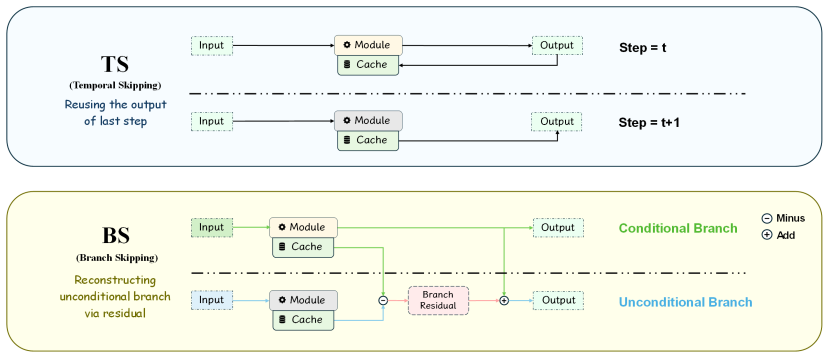
The central discovery is that DiT-based TTS models exhibit two forms of computation redundancy that can be exploited without retraining: temporal redundancy (module outputs at adjacent denoising steps are similar enough that caching and reusing them is nearly lossless) and branch redundancy (under classifier-free guidance, conditional and unconditional branch outputs diverge slowly, so the unconditional branch can be reconstructed from the conditional branch plus a cached residual). The paper further shows that temporal redundancy correlates strongly with a diagonal-like attention pattern—tokens attending mainly to their neighbors—whereas a striped attention pattern is less redundant. DiTRed
What carries the argument
The central objects are the two skip operations and the progressive calibration that selects them. Temporal Skipping (TS) replaces a module's output at step t with its cached output from step t-1. Branch Skipping (BS) computes only the conditional branch and synthesizes the unconditional branch as the conditional output plus a cached branch residual from the previous step. The calibration algorithm measures the mean absolute error between compressed and uncompressed outputs against a dynamic per-layer threshold (l/L)*delta, greedily recording which strategy is safe for each layer-step pair. The diagonal-like attention pattern acts as a cheap pre-filter that identifies layer-step pairs where
Load-bearing premise
The strategy table built from a few calibration runs on clean, high-quality audio transfers to arbitrary real-world inputs, because internal redundancy is input-agnostic.
What would settle it
Take a calibrated F5-TTS strategy table and evaluate it on a diverse set of test utterances that vary in speaker, emotion, background noise, and utterance length; if word error rate or speaker similarity degrades sharply on any subset while the uncompressed baseline stays flat, the input-agnostic assumption fails.
If this is right
- Once calibrated, the strategy table transfers across different inputs, so the speedup costs nothing at inference and requires no changes to the model weights.
- DiTReducio is compatible with FlashAttention and other efficient attention libraries because it skips whole module executions rather than modifying attention arithmetic.
- The compression threshold provides a controllable quality-speed trade-off; beyond an optimal threshold (around T4 in these experiments), further compression abruptly degrades quality, indicating a practical compression limit.
- Both skip methods are necessary: TS alone accelerates but degrades quality (WER rises sharply at high thresholds), while BS alone preserves quality but caps the achievable speedup.
- The framework extends across different DiT-based TTS architectures, including a multi-condition CFG variant, by computing multiple branch residuals.
Where Pith is reading between the lines
- The same redundancy mechanisms—adjacent-step caching and branch-residual reconstruction—likely transfer to other diffusion-based generative domains (e.g., music or sound-effect synthesis), and the pattern-guided check phase could be retargeted with minimal adaptation.
- The input-agnostic assumption is the main risk: a strategy table calibrated on clean, high-quality speech may underperform on atypical speakers, noisy inputs, or unusual durations; testing this distribution shift would directly stress the paper's central premise.
- The diagonal-like versus striped attention distinction invites a functional interpretation—striped patterns may encode global alignment or speaker identity—and if confirmed, could lead to more targeted skipping rules than threshold-based calibration.
- Because the speedup comes from skipping whole modules rather than altering arithmetic, it should stack multiplicatively with existing acceleration techniques like step distillation or quantization; the paper leaves that composition untested.
Editorial analysis
A structured set of objections, weighed in public.
Referee Report
Summary. The paper introduces DiTReducio, a training-free acceleration framework for DiT-based text-to-speech models. It identifies temporal and branch redundancies in attention and feed-forward modules, and proposes Temporal Skipping (TS) and Branch Skipping (BS). A three-phase progressive calibration procedure (Check, Pre-Calibration, Calibration) builds a fixed strategy table that, at inference, skips selected computations for each layer-step pair. Experiments on F5-TTS and MegaTTS 3 report large FLOPs reductions and RTF improvements while claiming preserved generation quality, with ablations showing the contribution of the Check/Pre-Calibration phases and of the two skipping methods.
Significance. If established, the contribution is practically useful: DiTReducio offers a plug-and-play, training-free acceleration route for DiT-based TTS, complementing distillation-based approaches and remaining compatible with FlashAttention. The paper's empirical observation of strong temporal and branch redundancy in speech DiTs, and the attempt to link attention patterns to redundancy, are valuable. The ablations also usefully separate the effects of TS and BS. However, the current evidence has several load-bearing gaps: the headline FLOPs number is not supported by the reported table, no external training-free baselines are compared, the calibration/evaluation data protocol is underspecified, and the threshold selection partially builds quality preservation into the experimental setting.
major comments (5)
- [Abstract and Table 1] The abstract claims a 75.4% reduction in FLOPs, but Table 1 reports Ops Ratio values of 34.42% (F5-TTS, T6) and 27.52% (MegaTTS 3, T6), corresponding to at most 65.58% and 72.48% reductions, respectively. The 75.4% figure is not derivable from the table. Similarly, the 37.1% RTF improvement is the F5-TTS T6 value, while the FLOPs number appears to come from a different model/condition; combining the best numbers across models is misleading. Please state the exact model, threshold, and metric for each headline claim, and correct the inconsistency.
- [Section 4.2 / Related Work 2.2] No training-free acceleration baselines are evaluated. The paper positions DiTReducio against DeepCache, token merging, and other inference acceleration methods, but Table 1 only compares compressed models against their own uncompressed T0. To support the claim that DiTReducio provides competitive or superior acceleration-quality trade-offs, results for at least one existing training-free method (e.g., DeepCache or a token-merging variant) under the same metrics and thresholds are needed. The internal ablation (TS-only, BS-only) is not a substitute for external comparisons.
- [Section 4.1 and Limitations] The data used for the Check, Pre-Calibration, and Calibration phases is not described. Section 4.1 lists only LibriSpeech-PC test-clean as the evaluation task. If the calibration utterances are drawn from the same test-clean set used for SIM-o/WER evaluation, the reported numbers reflect table overfitting to that distribution. Since the strategy table is fixed at inference, the paper must specify the calibration corpus, ensure it is disjoint from evaluation, and include a transfer experiment (e.g., different speakers, durations, or noise conditions) to support the Section 3.4 claim that redundancy patterns are input-agnostic. The Limitations statement that the framework 'demands high-quality calibration audio for optimal performance' underscores this risk.
- [Section 4.1, threshold setting] The thresholds are chosen so that the maximum threshold results in approximately 10% SIM-o degradation. Because the operating point advertised as preserving quality (T4) is selected from a range whose upper endpoint is quality-constrained, the observation that quality is 'preserved' is partly a selection criterion rather than an independent finding. The paper should report the full threshold sweep with quality and efficiency metrics, state the decision rule for picking the operating point, and provide confidence intervals across the 5 seeds. This is particularly important because Table 1 shows SIM-o falling from 0.750 to 0.626 at T6 for MegaTTS 3, a 16.5% relative degradation, which exceeds the stated 10% bound.
- [Section 3.3, Figure 4] The text says 'At lower similarity, specifically below 0.1, the percentage of redundant pairs remains relatively low, fluctuating between 75% and 90%.' A percentage between 75% and 90% is not 'low' in any absolute sense; this is internally inconsistent and confuses the claimed monotonic trend. The authors should clarify the baseline or expected level, and either correct the claim or the figure interpretation. Also, Figure 4 lacks explicit axis labels for the 'similarity interval' used.
minor comments (4)
- [Abstract] Typo: 'remain an limitation' should be 'remain a limitation.'
- [Algorithm 1 and Section 3.4] The threshold notation is inconsistent: Algorithm 1 uses (l/L)·δ, while the text writes 'l/L δ' without parentheses. This is understandable but should be made uniform for clarity.
- [Appendix A.1] The modified F5-TTS implementation concatenates conditional and unconditional inputs into a single batch. The authors state this retains functional equivalence, but the modification may affect numerical behavior due to different batch statistics in normalization layers. Please state whether any normalization statistics change and how this was verified.
- [Section 4.1, metric definition] FLOPs ('Ops Ratio') and RTF are measured under different conditions: for MegaTTS 3 only DiT inference is timed, while for F5-TTS total inference is used. This should be stated prominently in the results discussion, as it affects cross-model comparisons of RTF improvements.
Circularity Check
No circular derivation: the calibration strategy is an empirical compression profile validated on separate inference runs, not a quantity defined in terms of its own prediction.
full rationale
DiTReducio derives a static layer-step compression table by measuring reconstruction error (Eq. 3, Algorithm 1) and attention-pattern similarity on the model's own outputs. This is parameter fitting, not a derivation of the outcome from the outcome. The reported SIM-o and WER are computed under the resulting table on LibriSpeech-PC test-clean and are not used to select the per-pair strategies; the global threshold range is chosen to include a mild SIM-o drop, but the strategy itself is selected by internal output-error thresholds. The input-agnostic transfer premise is quoted from Sun et al. 2024, an external prior work with no author overlap, so it is an external assumption, not a self-citation chain. The limitations also mention calibration-audio dependence, but that is a robustness/transfer concern, not circularity. No equation reduces to another by definition, and no fitted parameter is renamed as a prediction.
Axiom & Free-Parameter Ledger
free parameters (2)
- Compression threshold delta =
max 0.3 (F5-TTS), max 1.2 (MegaTTS 3), six discrete levels T1-T6
- Check-Phase top-q percentage =
10%
axioms (3)
- domain assumption DiT internal redundancy patterns are input-agnostic and depend only on architecture and weights
- domain assumption Mean absolute error between the uncompressed and compressed model output at a single layer-step is a valid proxy for final generated speech quality
- ad hoc to paper Diagonal-like attention pattern (high similarity to identity matrix) is a reliable indicator of high temporal redundancy
Cite this review
Pith. "Pith review of DiTReducio: A Training-Free Acceleration for DiT-Based TTS via Progressive Calibration." pith.science (2026). https://pith.science/paper/C3YEYTQP
@misc{pith2026250909748,
  author       = {Pith},
  title        = {Pith review of: DiTReducio: A Training-Free Acceleration for DiT-Based TTS via Progressive Calibration},
  year         = {2026},
  howpublished = {\url{https://pith.science/paper/C3YEYTQP}},
  note         = {Machine review of arXiv:2509.09748}
}
read the original abstract
While Diffusion Transformers (DiT) have advanced non-autoregressive (NAR) speech synthesis, their high computational demands remain an limitation. Existing DiT-based text-to-speech (TTS) model acceleration approaches mainly focus on reducing sampling steps through distillation techniques, yet they remain constrained by training costs. We introduce DiTReducio, a training-free acceleration framework that compresses computations in DiT-based TTS models via progressive calibration. We propose two compression methods, Temporal Skipping and Branch Skipping, to eliminate redundant computations during inference. Moreover, based on two characteristic attention patterns identified within DiT layers, we devise a pattern-guided strategy to selectively apply the compression methods. Our method allows flexible modulation between generation quality and computational efficiency through adjustable compression thresholds. Experimental evaluations conducted on F5-TTS and MegaTTS 3 demonstrate that DiTReducio achieves a 75.4% reduction in FLOPs and improves the Real-Time Factor (RTF) by 37.1%, while preserving generation quality.
Figures



Reference graph
Works this paper leans on
-
[1]
Philip Anastassiou, Jiawei Chen, Jitong Chen, Yuanzhe Chen, Zhuo Chen, Ziyi Chen, Jian Cong, Lelai Deng, Chuang Ding, Lu Gao, and 1 others. 2024. Seed-tts: A family of high-quality versatile speech generation models. arXiv preprint arXiv:2406.02430
Pith/arXiv arXiv 2024
-
[2]
Daniel Bolya, Cheng-Yang Fu, Xiaoliang Dai, Peizhao Zhang, Christoph Feichtenhofer, and Judy Hoffman. 2022. Token merging: Your vit but faster. arXiv preprint arXiv:2210.09461
Pith/arXiv arXiv 2022
-
[3]
Daniel Bolya and Judy Hoffman. 2023. Token merging for fast stable diffusion. In Proceedings of the IEEE/CVF conference on computer vision and pattern recognition, pages 4599--4603
2023
-
[4]
Thibault Castells, Hyoung-Kyu Song, Bo-Kyeong Kim, and Shinkook Choi. 2024. Ld-pruner: Efficient pruning of latent diffusion models using task-agnostic insights. In Proceedings of the IEEE/CVF Conference on Computer Vision and Pattern Recognition, pages 821--830
2024
-
[5]
Sanyuan Chen, Shujie Liu, Long Zhou, Yanqing Liu, Xu Tan, Jinyu Li, Sheng Zhao, Yao Qian, and Furu Wei. 2024 a . Vall-e 2: Neural codec language models are human parity zero-shot text to speech synthesizers. arXiv preprint arXiv:2406.05370
Pith/arXiv arXiv 2024
-
[6]
Yushen Chen, Zhikang Niu, Ziyang Ma, Keqi Deng, Chunhui Wang, Jian Zhao, Kai Yu, and Xie Chen. 2024 b . F5-tts: A fairytaler that fakes fluent and faithful speech with flow matching. arXiv preprint arXiv:2410.06885
Pith/arXiv arXiv 2024
-
[7]
Zhengyang Chen, Sanyuan Chen, Yu Wu, Yao Qian, Chengyi Wang, Shujie Liu, Yanmin Qian, and Michael Zeng. 2022. Large-scale self-supervised speech representation learning for automatic speaker verification. In ICASSP 2022-2022 IEEE International Conference on Acoustics, Speech and Signal Processing (ICASSP), pages 6147--6151. IEEE
2022
-
[8]
Tri Dao, Dan Fu, Stefano Ermon, Atri Rudra, and Christopher R \'e . 2022. Flashattention: Fast and memory-efficient exact attention with io-awareness. Advances in neural information processing systems, 35:16344--16359
2022
-
[9]
Wei Deng, Siyi Zhou, Jingchen Shu, Jinchao Wang, and Lu Wang. 2025. Indextts: An industrial-level controllable and efficient zero-shot text-to-speech system. arXiv preprint arXiv:2502.05512
Pith/arXiv arXiv 2025
-
[10]
Zhihao Du, Qian Chen, Shiliang Zhang, Kai Hu, Heng Lu, Yexin Yang, Hangrui Hu, Siqi Zheng, Yue Gu, Ziyang Ma, and 1 others. 2024. Cosyvoice: A scalable multilingual zero-shot text-to-speech synthesizer based on supervised semantic tokens. arXiv preprint arXiv:2407.05407
Pith/arXiv arXiv 2024
-
[11]
Sefik Emre Eskimez, Xiaofei Wang, Manthan Thakker, Canrun Li, Chung-Hsien Tsai, Zhen Xiao, Hemin Yang, Zirun Zhu, Min Tang, Xu Tan, and 1 others. 2024. E2 tts: Embarrassingly easy fully non-autoregressive zero-shot tts. In 2024 IEEE Spoken Language Technology Workshop (SLT), pages 682--689. IEEE
2024
-
[12]
Wenhao Guan, Qi Su, Haodong Zhou, Shiyu Miao, Xingjia Xie, Lin Li, and Qingyang Hong. 2024. Reflow-tts: A rectified flow model for high-fidelity text-to-speech. In ICASSP 2024-2024 IEEE International Conference on Acoustics, Speech and Signal Processing (ICASSP), pages 10501--10505. IEEE
2024
-
[13]
Ali Hassani, Steven Walton, Jiachen Li, Shen Li, and Humphrey Shi. 2023. Neighborhood attention transformer. In Proceedings of the IEEE/CVF conference on computer vision and pattern recognition, pages 6185--6194
2023
-
[14]
Yefei He, Luping Liu, Jing Liu, Weijia Wu, Hong Zhou, and Bohan Zhuang. 2023. Ptqd: Accurate post-training quantization for diffusion models. arXiv preprint arXiv:2305.10657
Pith/arXiv arXiv 2023
-
[15]
Jonathan Ho and Tim Salimans. 2022. Classifier-free diffusion guidance. arXiv preprint arXiv:2207.12598
Pith/arXiv arXiv 2022
-
[16]
Rongjie Huang, Yi Ren, Jinglin Liu, Chenye Cui, and Zhou Zhao. 2022 a . Generspeech: Towards style transfer for generalizable out-of-domain text-to-speech. Advances in Neural Information Processing Systems, 35:10970--10983
2022
-
[17]
Rongjie Huang, Chunlei Zhang, Yongqi Wang, Dongchao Yang, Luping Liu, Zhenhui Ye, Ziyue Jiang, Chao Weng, Zhou Zhao, and Dong Yu. 2023. Make-a-voice: Unified voice synthesis with discrete representation. arXiv preprint arXiv:2305.19269
Pith/arXiv arXiv 2023
-
[18]
Rongjie Huang, Zhou Zhao, Huadai Liu, Jinglin Liu, Chenye Cui, and Yi Ren. 2022 b . Prodiff: Progressive fast diffusion model for high-quality text-to-speech. In Proceedings of the 30th ACM International Conference on Multimedia, pages 2595--2605
2022
-
[19]
Myeonghun Jeong, Hyeongju Kim, Sung Jun Cheon, Byoung Jin Choi, and Nam Soo Kim. 2021. Diff-tts: A denoising diffusion model for text-to-speech. arXiv preprint arXiv:2104.01409
Pith/arXiv arXiv 2021
-
[20]
Ziyue Jiang, Yi Ren, Ruiqi Li, Shengpeng Ji, Boyang Zhang, Zhenhui Ye, Chen Zhang, Bai Jionghao, Xiaoda Yang, Jialong Zuo, and 1 others. 2025. Megatts 3: Sparse alignment enhanced latent diffusion transformer for zero-shot speech synthesis. arXiv preprint arXiv:2502.18924
Pith/arXiv arXiv 2025
-
[21]
Zeqian Ju, Yuancheng Wang, Kai Shen, Xu Tan, Detai Xin, Dongchao Yang, Yanqing Liu, Yichong Leng, Kaitao Song, Siliang Tang, and 1 others. 2024. Naturalspeech 3: Zero-shot speech synthesis with factorized codec and diffusion models. arXiv preprint arXiv:2403.03100
Pith/arXiv arXiv 2024
-
[22]
Heeseung Kim, Sungwon Kim, and Sungroh Yoon. 2022. Guided-tts: A diffusion model for text-to-speech via classifier guidance. In International Conference on Machine Learning, pages 11119--11133. PMLR
2022
-
[23]
Zhenglun Kong, Peiyan Dong, Xiaolong Ma, Xin Meng, Wei Niu, Mengshu Sun, Xuan Shen, Geng Yuan, Bin Ren, Hao Tang, and 1 others. 2022. Spvit: Enabling faster vision transformers via latency-aware soft token pruning. In European conference on computer vision, pages 620--640. Springer
2022
-
[24]
Keon Lee, Dong Won Kim, Jaehyeon Kim, and Jaewoong Cho. 2024. Ditto-tts: Efficient and scalable zero-shot text-to-speech with diffusion transformer. arXiv preprint arXiv:2406.11427
Pith/arXiv arXiv 2024
-
[25]
Xiuyu Li, Yijiang Liu, Long Lian, Huanrui Yang, Zhen Dong, Daniel Kang, Shanghang Zhang, and Kurt Keutzer. 2023. Q-diffusion: Quantizing diffusion models. In Proceedings of the IEEE/CVF International Conference on Computer Vision, pages 17535--17545
2023
-
[26]
Yingahao Aaron Li, Rithesh Kumar, and Zeyu Jin. 2024. Dmdspeech: Distilled diffusion model surpassing the teacher in zero-shot speech synthesis via direct metric optimization. arXiv preprint arXiv:2410.11097
Pith/arXiv arXiv 2024
-
[27]
Songxiang Liu, Dan Su, and Dong Yu. 2022. Diffgan-tts: High-fidelity and efficient text-to-speech with denoising diffusion gans. arXiv preprint arXiv:2201.11972
Pith/arXiv arXiv 2022
-
[28]
Cheng Lu, Yuhao Zhou, Fan Bao, Jianfei Chen, Chongxuan Li, and Jun Zhu. 2022 a . Dpm-solver: A fast ode solver for diffusion probabilistic model sampling in around 10 steps. Advances in Neural Information Processing Systems, 35:5775--5787
2022
-
[29]
Cheng Lu, Yuhao Zhou, Fan Bao, Jianfei Chen, Chongxuan Li, and Jun Zhu. 2022 b . Dpm-solver++: Fast solver for guided sampling of diffusion probabilistic models. arXiv preprint arXiv:2211.01095
Pith/arXiv arXiv 2022
-
[30]
Xinyin Ma, Gongfan Fang, Michael Bi Mi, and Xinchao Wang. 2024 a . Learning-to-cache: Accelerating diffusion transformer via layer caching. Advances in Neural Information Processing Systems, 37:133282--133304
2024
-
[31]
Xinyin Ma, Gongfan Fang, and Xinchao Wang. 2024 b . Deepcache: Accelerating diffusion models for free. In Proceedings of the IEEE/CVF conference on computer vision and pattern recognition, pages 15762--15772
2024
-
[32]
Shivam Mehta, Ruibo Tu, Jonas Beskow, \'E va Sz \'e kely, and Gustav Eje Henter. 2024. Matcha-tts: A fast tts architecture with conditional flow matching. In ICASSP 2024-2024 IEEE International Conference on Acoustics, Speech and Signal Processing (ICASSP), pages 11341--11345. IEEE
2024
-
[33]
Aleksandr Meister, Matvei Novikov, Nikolay Karpov, Evelina Bakhturina, Vitaly Lavrukhin, and Boris Ginsburg. 2023. Librispeech-pc: Benchmark for evaluation of punctuation and capitalization capabilities of end-to-end asr models. In 2023 IEEE automatic speech recognition and understanding workshop (ASRU), pages 1--7. IEEE
2023
-
[34]
William Peebles and Saining Xie. 2023. Scalable diffusion models with transformers. In Proceedings of the IEEE/CVF international conference on computer vision, pages 4195--4205
2023
-
[35]
Alec Radford, Jong Wook Kim, Tao Xu, Greg Brockman, Christine McLeavey, and Ilya Sutskever. 2023. Robust speech recognition via large-scale weak supervision. In International conference on machine learning, pages 28492--28518. PMLR
2023
-
[36]
Robin Rombach, Andreas Blattmann, Dominik Lorenz, Patrick Esser, and Bj \"o rn Ommer. 2022. High-resolution image synthesis with latent diffusion models. In Proceedings of the IEEE/CVF conference on computer vision and pattern recognition, pages 10684--10695
2022
-
[37]
Omid Saghatchian, Atiyeh Gh Moghadam, and Ahmad Nickabadi. 2025. Cached adaptive token merging: Dynamic token reduction and redundant computation elimination in diffusion model. arXiv preprint arXiv:2501.00946
Pith/arXiv arXiv 2025
-
[38]
Tim Salimans and Jonathan Ho. 2022. Progressive distillation for fast sampling of diffusion models. arXiv preprint arXiv:2202.00512
Pith/arXiv arXiv 2022
-
[39]
Axel Sauer, Dominik Lorenz, Andreas Blattmann, and Robin Rombach. 2024. Adversarial diffusion distillation. In European Conference on Computer Vision, pages 87--103. Springer
2024
-
[40]
Yuzhang Shang, Zhihang Yuan, Bin Xie, Bingzhe Wu, and Yan Yan. 2023. Post-training quantization on diffusion models. In Proceedings of the IEEE/CVF conference on computer vision and pattern recognition, pages 1972--1981
2023
-
[41]
Yakun Song, Zhuo Chen, Xiaofei Wang, Ziyang Ma, and Xie Chen. 2025. Ella-v: Stable neural codec language modeling with alignment-guided sequence reordering. In Proceedings of the AAAI Conference on Artificial Intelligence, volume 39, pages 25174--25182
2025
-
[42]
Xibo Sun, Jiarui Fang, Aoyu Li, and Jinzhe Pan. 2024. Unveiling redundancy in diffusion transformers (dits): A systematic study. arXiv preprint arXiv:2411.13588
Pith/arXiv arXiv 2024
-
[43]
Ben Wan, Tianyi Zheng, Zhaoyu Chen, Yuxiao Wang, and Jia Wang. 2025. Pruning for sparse diffusion models based on gradient flow. arXiv preprint arXiv:2501.09464
Pith/arXiv arXiv 2025
-
[44]
Chengyi Wang, Sanyuan Chen, Yu Wu, Ziqiang Zhang, Long Zhou, Shujie Liu, Zhuo Chen, Yanqing Liu, Huaming Wang, Jinyu Li, and 1 others. 2023. Neural codec language models are zero-shot text to speech synthesizers. arXiv preprint arXiv:2301.02111
Pith/arXiv arXiv 2023
-
[45]
Xinsheng Wang, Mingqi Jiang, Ziyang Ma, Ziyu Zhang, Songxiang Liu, Linqin Li, Zheng Liang, Qixi Zheng, Rui Wang, Xiaoqin Feng, and 1 others. 2025. Spark-tts: An efficient llm-based text-to-speech model with single-stream decoupled speech tokens. arXiv preprint arXiv:2503.01710
Pith/arXiv arXiv 2025
-
[46]
Yuancheng Wang, Haoyue Zhan, Liwei Liu, Ruihong Zeng, Haotian Guo, Jiachen Zheng, Qiang Zhang, Xueyao Zhang, Shunsi Zhang, and Zhizheng Wu. 2024. Maskgct: Zero-shot text-to-speech with masked generative codec transformer. arXiv preprint arXiv:2409.00750
Pith/arXiv arXiv 2024
-
[47]
Detai Xin, Xu Tan, Kai Shen, Zeqian Ju, Dongchao Yang, Yuancheng Wang, Shinnosuke Takamichi, Hiroshi Saruwatari, Shujie Liu, Jinyu Li, and 1 others. 2024. Rall-e: Robust codec language modeling with chain-of-thought prompting for text-to-speech synthesis. arXiv preprint arXiv:2404.03204
Pith/arXiv arXiv 2024
-
[48]
Long Xing, Qidong Huang, Xiaoyi Dong, Jiajie Lu, Pan Zhang, Yuhang Zang, Yuhang Cao, Conghui He, Jiaqi Wang, Feng Wu, and 1 others. 2024. Pyramiddrop: Accelerating your large vision-language models via pyramid visual redundancy reduction. arXiv preprint arXiv:2410.17247
Pith/arXiv arXiv 2024
-
[49]
Jin Xu, Zhifang Guo, Jinzheng He, Hangrui Hu, Ting He, Shuai Bai, Keqin Chen, Jialin Wang, Yang Fan, Kai Dang, and 1 others. 2025. Qwen2. 5-omni technical report. arXiv preprint arXiv:2503.20215
Pith/arXiv arXiv 2025
-
[50]
Zhihang Yuan, Hanling Zhang, Lu Pu, Xuefei Ning, Linfeng Zhang, Tianchen Zhao, Shengen Yan, Guohao Dai, and Yu Wang. 2024. Ditfastattn: Attention compression for diffusion transformer models. Advances in Neural Information Processing Systems, 37:1196--1219
2024
-
[51]
Manzil Zaheer, Guru Guruganesh, Kumar Avinava Dubey, Joshua Ainslie, Chris Alberti, Santiago Ontanon, Philip Pham, Anirudh Ravula, Qifan Wang, Li Yang, and 1 others. 2020. Big bird: Transformers for longer sequences. Advances in neural information processing systems, 33:17283--17297
2020
-
[52]
Xuanlei Zhao, Xiaolong Jin, Kai Wang, and Yang You. 2024. Real-time video generation with pyramid attention broadcast. arXiv preprint arXiv:2408.12588
Pith/arXiv arXiv 2024
-
[53]
online" 'onlinestring :=
ENTRY address archivePrefix author booktitle chapter edition editor eid eprint eprinttype howpublished institution journal key month note number organization pages publisher school series title type volume year doi pubmed url lastchecked label extra.label sort.label short.list INTEGERS output.state before.all mid.sentence after.sentence after.block STRING...
-
[54]
write newline
" write newline "" before.all 'output.state := FUNCTION n.dashify 't := "" t empty not t #1 #1 substring "-" = t #1 #2 substring "--" = not "--" * t #2 global.max substring 't := t #1 #1 substring "-" = "-" * t #2 global.max substring 't := while if t #1 #1 substring * t #2 global.max substring 't := if while FUNCTION word.in bbl.in capitalize " " * FUNCT...
This paper was first reviewed by deepseek-v4-flash on August 4, 2026.
discussion (0)
Sign in with ORCID, Apple, or X to comment. Anyone can read and Pith papers without signing in.