REVIEW 3 major objections 4 minor 19 references
Lower-depth local encoding circuits for the surface code
T0 review · 3 major / 4 minor · reviewed 2026-08-15 · deepseek-v4-flash
Pith's one-line read This paper constructs depth-d encoding circuits for the rotated surface code on a square grid with nearest-neighbor gates, halving the depth of the best previous local encoder and proving that no composition of growth steps can beat it.
desk verdict Genuine depth-d encoding family with a real proof gap in the arbitrary-d correctness of the growth pattern. read the letter →
The pith
A machine-rendered reading of the paper's core claim, the machinery that carries it, and where it could break.
The reading
What carries the argument
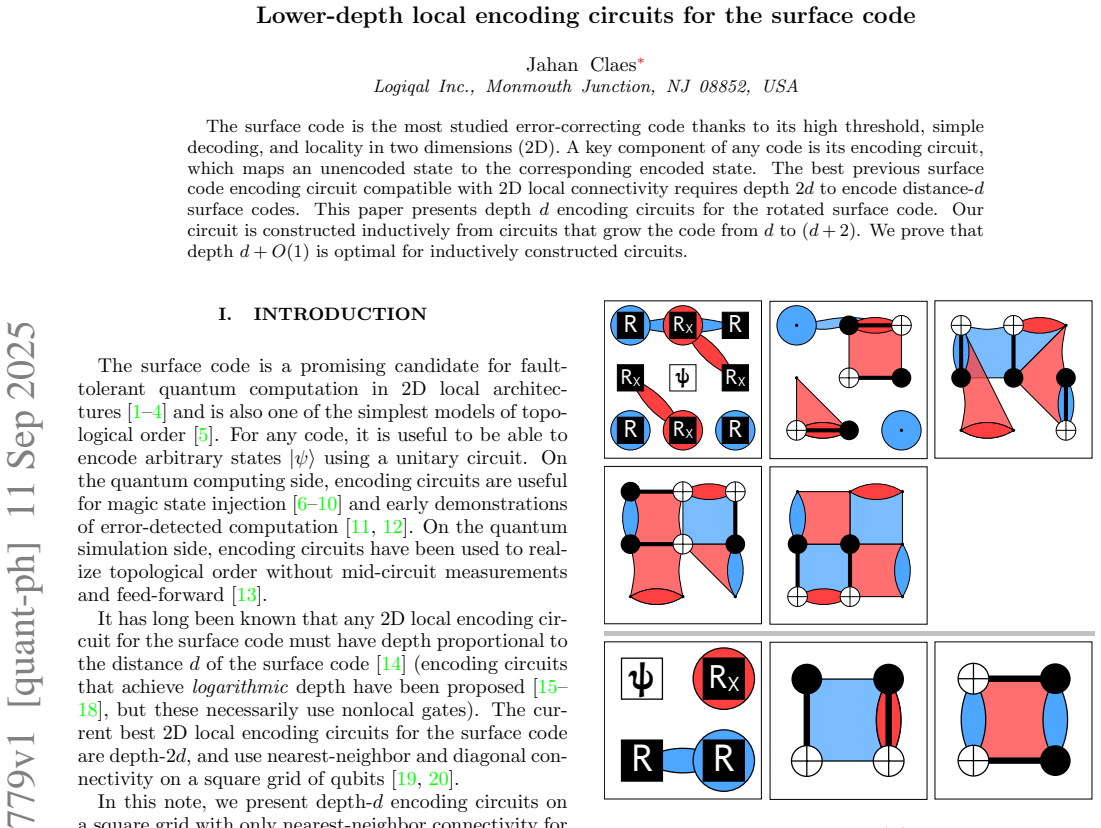
The carrier of the construction is a pair of depth-2 growth circuits, drawn for $d=3\to5$ and $d=4\to6$, in which a repeated patch of qubits is tiled to reach arbitrary $d$. Each growth step prepares $4(d+1)$ fresh qubits and entangles them with the existing code so that the stabilizer group expands from distance $d$ to distance $d+2$. The optimality argument is a counting argument over stabilizer weights: before a growth step the fresh qubits carry $4(d+1)$ independent single-qubit stabilizers, a depth-one circuit can only spread each into a one- or two-qubit operator, but a distance-$(d+2)$ surface code has no single-qubit stabilizers and at most $2(d+1)$ two-qubit stabilizers in any basis, so a depth-one growth step is impossible.
What would settle it
Run a classical stabilizer simulation of the tiled growth circuit for $d=7$, starting from the distance-3 base code and applying the odd-distance growth step twice, and check that the output stabilizer group is exactly that of a distance-7 rotated surface code and that logical operator weights reach 7; any mismatch at this or a larger distance falsifies the inductive claim.
Extended reading notes
Core claim
The central discovery is a family of Clifford circuits that encode a rotated surface code of distance $d$ in depth $d+[d\bmod 2]$ on a square grid with only nearest-neighbor gates, using $6d+O(1)$ two-qubit gates. The construction is inductive: a depth-4 circuit encodes the distance-3 base code, a depth-2 circuit encodes the distance-2 base code, and then two patterned depth-2 circuits—one for odd and one for even $d$—insert $4(d+1)$ fresh qubits and grow the code from distance $d$ to $d+2$. The paper further proves that any Clifford circuit achieving such a growth step needs depth at least two, because a depth-one layer cannot transform $4(d+1)$ independent single-qubit stabilizers into the stabilizer structure of a distance-$(d+2)$ surface code, which has no single-qubit stabilizers and at most $2(d+1)$ two-qubit stabilizers in any basis. Consequently every inductively built encoder must have depth $d+O(1)$, making the new circuits depth-optimal within that framework.
Load-bearing premise
The construction assumes without a written proof that the growth pattern drawn for small distances continues to produce a valid encoding circuit when the marked qubits are repeated to any larger distance; if that pattern fails at some distance, the depth-$d$ result loses its foundation.
Editorial extensions
If this is right
- State injection for the rotated surface code becomes roughly half as deep as with the previous best local encoder, reducing the time window in which physical errors can accumulate during encoding.
- The circuit runs on a square grid with only nearest-neighbor coupling, so it matches the connectivity of common two-dimensional qubit arrays without requiring diagonal interactions.
- The gate count drops from $8d+O(1)$ to $6d+O(1)$, lowering the number of physical entangling operations per encoding round.
- Any future encoder that beats depth $d+O(1)$ must abandon the strategy of composing small distance-growth steps, since this paper shows that class of constructions is already optimal up to constants.
- The same circuits can serve as the state-preparation stage for magic-state cultivation and for realizing topologically ordered states without mid-circuit measurement.
Reading between the lines
- The stabilizer-counting argument may transfer to other topological CSS codes: any growth process that adds $m$ fresh qubits and ends in a code whose stabilizer bases contain fewer than $m$ two-qubit generators would inherit the same depth-two lower bound.
- The proof does not rule out non-inductive encoders, so a sub-linear-depth local encoding circuit remains a logical possibility; a natural next step is to search for one using interactive circuit construction tools similar to those that enabled this design.
- Since the even-distance base case is only depth 2 and each growth step adds a constant depth per two distance units, the parity constant in $d+[d\bmod 2]$ is already fixed; the remaining slack is only in the constant $O(1)$ term, which could be probed by optimizing the distance-3 base encoder.
Signed reviews
Editorial analysis
A structured set of objections, weighed in public.
Referee Report
Summary. The paper proposes a family of low-depth encoding circuits for the rotated surface code on a square lattice with nearest-neighbor gates. The construction is inductive: small base codes of distance 2 or 3 are encoded with short circuits, and then depth-2 growth circuits increase the distance from d to d+2. For even d the total depth is d; for odd d it is d+1. The paper also proves a lower bound stating that any inductive encoder built from d to (d+1) or d to (d+2) growth steps must have depth d+O(1), and it compares resource counts with the previous depth-2d circuit of Higgott et al. (2021).
Significance. If the proposed infinite family of growth circuits is correct for all distances, the paper achieves a genuine improvement over the best known 2D local surface-code encoders, halving the depth and reducing the gate count. The lower bound, if fully established, would show that this depth is optimal within the specified inductive class, which is a meaningful but restricted notion of optimality. The paper is clearly written and the small instances are verified with the interactive Crumble tool, which provides useful evidence for those finite cases. The main value of the paper depends on two unproven technical assertions, so the significance is conditional on those being resolved.
major comments (3)
- [Sec. II, Fig. 2] The construction of the infinite family of growth circuits is not proved. The text states that for d>4 one repeats the two purple-highlighted qubits and for d=2 one removes them, but it does not provide a written stabilizer-propagation argument or an induction showing that the depth-2 circuit maps the stabilizer group of the distance-d rotated surface code to that of the distance-(d+2) code for every d. The Crumble interactive links verify only finitely many small instances and cannot certify arbitrary distance. Since the headline claim of a depth-d encoding circuit rests entirely on this family, a rigorous proof of correctness is required, including boundary and corner cases.
- [Sec. III] The lower-bound proof relies on the assertion that 'every basis of stabilizers of a (d+2) surface code has at most 2(d+1) two-qubit stabilizers and no single-qubit stabilizers,' but no proof or citation is given. This assertion is load-bearing: it is the only step that rules out a depth-one d to (d+2) growth circuit. Without a proof, the claimed optimality of depth d+O(1) for inductive encoders is not established. The authors should either prove this stabilizer-basis statement or provide a precise reference.
- [Abstract and Sec. II] The abstract claims 'depth d encoding circuits,' but Sec. II states that the total circuit depth is d + [d mod 2], which equals d+1 for odd d. For example, the d=3 base circuit has depth 4, so the claim 'depth d' is literally false for odd distances. The abstract should be corrected to state the depth as d+O(1) or as d+[d mod 2].
minor comments (4)
- [Sec. II] The notation [d mod 2] is nonstandard and could be confused with an integer part or floor; please define it explicitly or replace it with (d mod 2).
- [Sec. I] The gate counts '6d+O(1)' and '8d+O(1)' are stated without specifying whether the base encoding circuits are included; please clarify the counting convention.
- [Sec. II, Fig. 2] The figures are dense and the legend for the purple-highlighted qubits is minimal; adding a panel that explicitly shows the repeating pattern for a larger d (e.g., d=5 to d=7 or d=6 to d=8) would improve readability, especially for the boundary and corner regions.
- [Sec. II] The sentence 'Previous work on unitary circuits likely did not discover our low-depth construction because Crumble was not available at the time' is speculative and not relevant to the technical content; please remove or rephrase.
Circularity Check
No significant circularity: the construction and lower bound are self-contained; unproven pattern-correctness and stabilizer-basis assertions are correctness gaps, not circular reasoning.
full rationale
The paper's derivation chain contains no fitted parameters, no data-driven predictions, and no load-bearing self-citations. The depth-d encoding construction is presented as an explicit family of Clifford circuits; its correctness is asserted via diagrams and interactive Crumble links, which leaves an unproven gap if the purple-qubit repetition pattern fails at some distance d, but this is not circular because no equation or fitted parameter was used to force the claimed result. The Section III optimality argument for inductive circuits is a direct counting argument: if a depth-one unitary is applied to 4(d+1) product-state stabilizers, each stabilizer remains one- or two-local, while the target code's stabilizer basis supposedly contains at most 2(d+1) two-qubit stabilizers; the cited structural fact about surface-code stabilizer bases is independent of the construction and is not derived from the conclusion. The only self-citation, [8] (Claes 2025, arXiv:2509.05232), is an application reference and does not carry the central claim. No circular step meets the quoted-evidence threshold, so the honest finding is no circularity.
Assumptions & free parameters
assumptions (3)
- ad hoc to paper The d to (d+2) growth circuits in Fig. 2 correctly encode the surface code for all d, including the repeated purple pattern.
- domain assumption Every basis of stabilizers of a (d+2) surface code has at most 2(d+1) two-qubit stabilizers and no single-qubit stabilizers.
- ad hoc to paper Initial base circuits for d=2 and d=3 are valid encoders.
Cite this review
Pith. "Pith review of Lower-depth local encoding circuits for the surface code." pith.science (2026). https://pith.science/paper/UN2JUV3V
@misc{pith2026250909779,
  author       = {Pith},
  title        = {Pith review of: Lower-depth local encoding circuits for the surface code},
  year         = {2026},
  howpublished = {\url{https://pith.science/paper/UN2JUV3V}},
  note         = {Machine review of arXiv:2509.09779}
}
abstract
The surface code is the most studied error-correcting code thanks to its high threshold, simple decoding, and locality in two dimensions (2D). A key component of any code is its encoding circuit, which maps an unencoded state to the corresponding encoded state. The best previous surface code encoding circuit compatible with 2D local connectivity requires depth $2d$ to encode distance-$d$ surface codes. This paper presents depth $d$ encoding circuits for the rotated surface code. Our circuit is constructed inductively from circuits that grow the code from $d$ to $(d+2)$. We prove that depth $d+O(1)$ is optimal for inductively constructed circuits.
Figures

Reference graph
Works this paper leans on
-
[19]
O. Higgott, M. Wilson, J. Hefford, J. Dborin, F. Hanif, S. Burton, and D. E. Browne, Optimal local unitary en- coding circuits for the surface code, Quantum5, 517 (2021)
work page 2021
-
[1]
S. B. Bravyi and A. Y. Kitaev, Quantum codes on a lattice with boundary (1998), arXiv:quant-ph/9811052 [quant-ph]. 3
arXiv 1998
-
[2]
Dennis, A
E. Dennis, A. Kitaev, A. Landahl, and J. Preskill, Topological quantum memory, Journal of Mathematical Physics43, 4452 (2002)
2002
-
[3]
A. G. Fowler, M. Mariantoni, J. M. Martinis, and A. N. Cleland, Surface codes: Towards practical large-scale quantum computation, Physical Review A86, 032324 (2012)
2012
-
[4]
A. Y. Kitaev, Quantum computations: algorithms and error correction, Russian Mathematical Surveys52, 1191 (1997)
1997
-
[5]
A. Y. Kitaev, Fault-tolerant quantum computation by anyons, Annals of physics303, 2 (2003)
2003
- [7]
-
[8]
J. Claes, Cultivating|T⟩states on the surface code with only two-qubit gates (2025), arXiv:2509.05232 [quant- ph]
arXiv 2025
Show all 19 references
-
[9]
Sahay, P.-K
K. Sahay, P.-K. Tsai, K. Chang, Q. Su, T. B. Smith, S. Singh, and S. Puri, Fold-transversal surface code cul- tivation (2025), arXiv:2509.05212 [quant-ph]
2025
-
[10]
Vaknin, S
Y. Vaknin, S. Jacoby, A. Grimsmo, and A. Retzker, Magic state cultivation on the surface code (2025), arXiv:2502.01743 [quant-ph]
2025
-
[11]
Bluvstein, S
D. Bluvstein, S. J. Evered, A. A. Geim, S. H. Li, H. Zhou, T. Manovitz, S. Ebadi, M. Cain, M. Kali- nowski, D. Hangleiter, J. P. Bonilla Ataides, N. Maskara, I. Cong, X. Gao, P. Sales Rodriguez, T. Karolyshyn, G. Semeghini, M. J. Gullans, M. Greiner, V. Vuleti´ c, and M. D. Lu...
2024
-
[12]
P. S. Rodriguez, J. M. Robinson, P. N. Jepsen, Z. He, C. Duckering, C. Zhao, K. Wu, J. Campo, K. Bagnall, M. Kwon,et al., Experimental demonstration of logical magic state distillation (2024), arXiv:2412.15165
2024
-
[13]
K. J. Satzinger, Y. Liu, A. Smith, C. Knapp, M. New- man, C. Jones, Z. Chen, C. Quintana, X. Mi, A. Dunsworth, C. Gidney, I. Aleiner, F. Arute, K. Arya, J. Atalaya, R. Babbush, J. C. Bardin, R. Barends, J. Basso, A. Bengtsson, A. Bilmes, M. Broughton, B. B. Buckley, D. A. Buel...
2021 arXiv
-
[14]
Bravyi, M
S. Bravyi, M. B. Hastings, and F. Verstraete, Lieb- Robinson bounds and the generation of correlations and topological quantum order, Physical Review Letters97, 050401 (2006)
2006
-
[15]
Vidal, Class of quantum many-body states that can be efficiently simulated, Physical Review Letters101, 110501 (2008)
G. Vidal, Class of quantum many-body states that can be efficiently simulated, Physical Review Letters101, 110501 (2008)
2008
-
[16]
Aguado and G
M. Aguado and G. Vidal, Entanglement renormaliza- tion and topological order, Physical Review Letters100, 070404 (2008)
2008
-
[17]
Liao and D
P. Liao and D. L. Feder, Graph-state representation of the toric code, Physical Review A104, 012432 (2021)
2021
-
[18]
Tsai and S
P.-K. Tsai and S. Puri, A unitary encoder for surface codes (2025), arXiv:2506.04084 [quant-ph]
2025 arXiv
-
[20]
P. Chen, B. Yan, and S. X. Cui, Quantum circuits for toric code and X-cube fracton model, Quantum8, 1276 (2024), arXiv:2210.01682 [cond-mat]
2024 arXiv
Reviewed August 15, 2026 · model on record in the stance chip above.
Discussion (0). Continue with ORCID to comment.