REVIEW 3 major objections 5 minor 25 references
Gravitational lensing by Lema\^{\i}tre-Tolman-Bondi wormholes in a Friedmann universe
T0 review · 3 major / 5 minor · reviewed 2026-08-15 · deepseek-v4-flash
Pith's one-line read This paper shows that the shadow of a dynamic wormhole in an expanding universe first shrinks and then grows, and that its angular size obeys a specific power law in the wormhole's size.
desk verdict Careful first lensing study of dynamic LTB wormholes, with a time-dependent shadow and a scaling law, but the plotted observation-time range in Fig. 5 appears to be before the wormhole is causally visible, so the headline results need re-scoping. read the letter →
The pith
A machine-rendered reading of the paper's core claim, the machinery that carries it, and where it could break.
The reading
What carries the argument
The central object is an LTB wormhole matched to a closed dust-filled Friedmann universe through the choices F(R)=2b(1+$R^{2}$)^k and h(R)=1/(1+$R^{2}$), with matching conditions at a boundary chi_* linking the wormhole coordinate R_* to the cosmological coordinate chi_*. The argument runs through the small-eta approximation r ~ (3/2)^{2/3} $F^{{1/3}}$ $tau^{{2/3}}$, which reduces photon motion to turning points at F(R_t)=(500/243)(L/C)^3. The shadow radius is then obtained from the standard coordinate formula for image angles, with L_sh replaced by the minimum angular momentum L_min ~ $\sqrt$(K) chi_*^{1+2k/3}, yielding the power-law angular size.
What would settle it
Integrate null geodesics numerically in the exact LTB metric for the same F(R)=2b(1+$R^{2}$)^k and h(R)=1/(1+$R^{2}$) without expanding in eta, place an observer at chi_obs=1, and measure the shadow angular diameter at several observation times. If the curve is monotone rather than shrink-then-grow, or if the d_sh versus chi_* data at fixed observation time deviate from the chi_*^{1+2k/3} slope, the paper's central claim is refuted.
Extended reading notes
Core claim
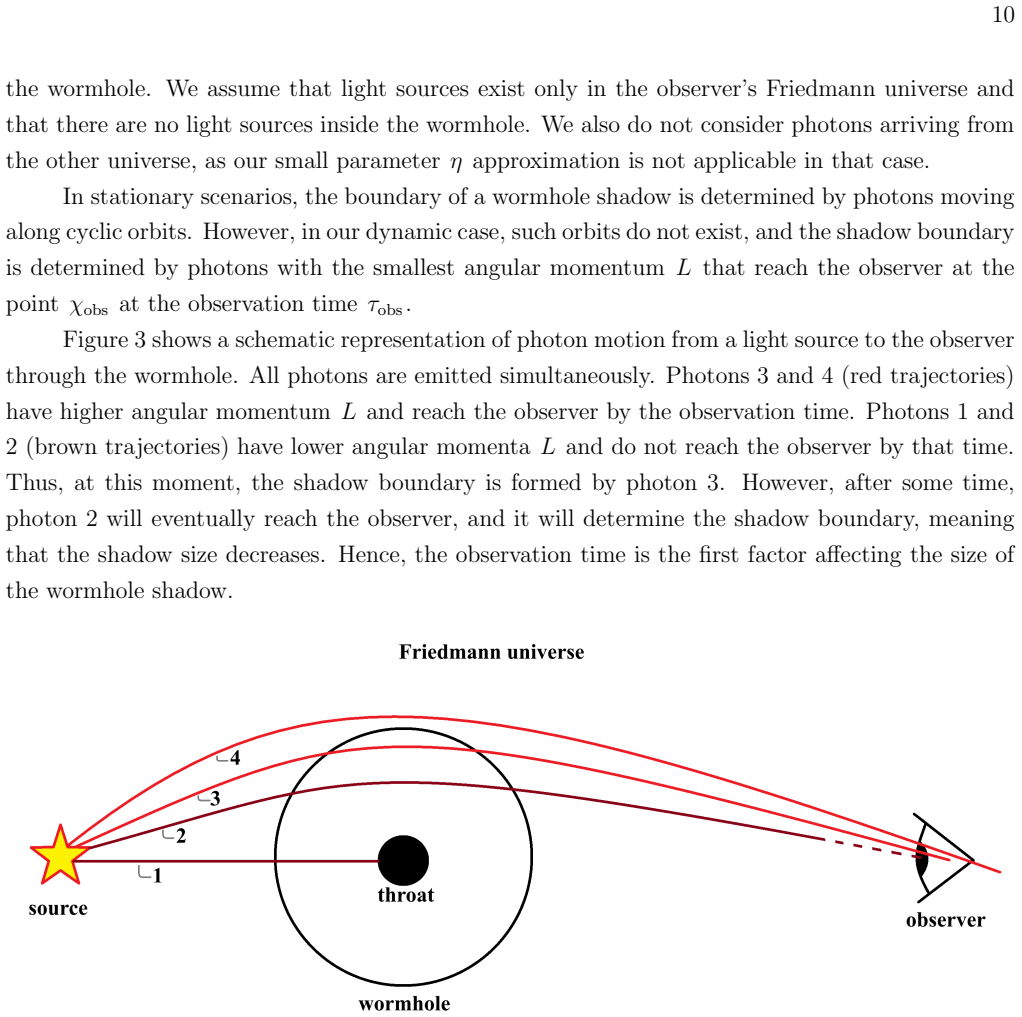
In the small-eta regime, the boundary of the wormhole shadow on the observer's sky is set by the smallest photon angular momentum L_sh that has reached the observer by the observation time tau_obs. Early in the observation, this boundary moves inward because lower-L photons keep arriving, so the shadow shrinks; later, the expansion of the Friedmann universe stretches the image and the shadow grows. Analytically, the shadow diameter obeys d_sh ~ chi_*^{1+2k/3}, where chi_* is the coordinate boundary of the wormhole region and k is the exponent in the mass-distribution function F(R)=2b(1+$R^{2}$)^k, and the paper reports that numerical ray tracing confirms this power law. The authors emphasize that the analysis covers only the beginning of the wormhole's evolution, when it appears together with the universe, and that late-forming wormholes require dropping the small-eta and tau_0=0 assumptions.
Load-bearing premise
The whole shadow calculation uses the small-eta approximation with tau_0(R)=0, so it describes only the very first stage of a wormhole born together with the universe; if that early-birth, small-eta regime is abandoned, the non-monotonic shadow and the power law need not survive.
Editorial extensions
If this is right
- An observer watching a young LTB wormhole should see its shadow shrink as lower-angular-momentum photons keep arriving, then grow as cosmic expansion dominates.
- Because the shadow size scales as chi_*^{1+2k/3}, a measured angular size would constrain the combination of wormhole-region size and dust-density exponent.
- The shadow boundary is time-dependent rather than set by closed photon orbits, so dynamic wormholes have no single static shadow radius and any observational report must specify the observation time.
- The results apply to wormholes born simultaneously with the universe; later-forming wormholes or late-time observations require an extension beyond the small-eta, tau_0=0 regime, as the paper itself notes.
- The dust-density deficit around wormhole regions may connect such objects to observed cosmic voids, suggesting a possible observational target beyond direct shadow imaging.
Reading between the lines
- Beyond the paper, a full numerical integration of null geodesics in the exact LTB metric without the small-eta cutoff could test whether the two-phase shrink-then-grow shadow persists for photons that pass near the throat, where eta grows large.
- As an extension, if the non-monotonic signature survives for wormholes formed at later cosmic times, it would offer a way to distinguish LTB wormholes from static wormholes and ordinary lenses, whose shadows do not shrink then grow.
- One testable extension is to scan other density profiles F(R): if the shadow size continues to follow a power law in chi_* with an exponent set by the profile, shadow scaling would become a probe of the radial mass distribution rather than a special property of the chosen model.
- A further editorial inference is that the late-time growth phase might be observable as a population of lensing objects whose shadows enlarge at a rate tracking cosmic expansion, a signature that could be sought in time-domain surveys.
Signed reviews
Editorial analysis
A structured set of objections, weighed in public.
Referee Report
Summary. The paper studies gravitational lensing by time-dependent Lemaître-Tolman-Bondi (LTB) dust wormholes that are matched to a closed Friedmann dust-filled universe. The authors derive null geodesic equations in the LTB metric within a small-η approximation, match the wormhole region to the Friedmann cosmology via the conditions of Ref. [14], and define a time-dependent shadow as the set of directions from which photons have not yet reached the observer by a given observation time. The central results are a claimed non-monotonic dependence of the shadow angular size on observation time, caused at early times by the gradual arrival of smaller-angular-momentum photons and at later times by the cosmological expansion, and a scaling law d_sh ∼ χ_*^{1+2k/3} for the shadow size as a function of the wormhole boundary coordinate χ_*. The paper is presented as an initial-stage analysis, with the limitations of the small-η approximation and the choice τ_0(R)=0 acknowledged in the conclusion.
Significance. If the results were established, this would be a useful contribution to the observational phenomenology of dynamic wormholes, providing one of the first treatments of a time-dependent wormhole shadow in a cosmological setting. The paper contains a careful derivation of the geodesic equations in the small-η regime, explicit matching conditions, and numerical plots of photon paths and shadow sizes. However, the two headline claims are derived and plotted in regimes where the small-η approximation is not valid, and the paper's own conclusion admits that the analysis covers only the initial stage. Because the non-monotonic shadow and the power-law scaling are consequences of extrapolating the approximation into regimes where the throat has either collapsed or has η significantly larger than 0.1, the significance is currently conditional on a substantial revision that addresses the validity domain.
major comments (3)
- [§4.3, Figs. 4–5] The small-η approximation is stated in Section 2 (after Eq. (7)) to be valid for η≤0.1, which at the throat R=0 corresponds to τ/b≈η^3/6≤1.7×10^-4, while the exact LTB throat, from Eq. (5) with h=1 and F=2b, recollapses at τ=2πb≈6.28b. However, Figs. 4 and 5 display observation times τ_obs/b≈27, 38, and 40, which are both orders of magnitude beyond the η≤0.1 validity bound and later than the throat recollapse. At those epochs the configuration is no longer a wormhole, so the claimed non-monotonic shadow is not a property of the physical model under study. The authors need to restrict the plots to times before the throat recollapses and to epochs where η≤0.1 along the entire photon path, or to solve the geodesic equations in the exact LTB metric.
- [§4.3, Eqs. (36)–(38)] The shadow boundary at late observation times is controlled by photons whose angular momentum tends to L_min, which have a turning point at the throat R_t=0 according to Eq. (23). At R=0 the parameter η is maximal: for L=L_min the integrand in Eq. (20) diverges at the turning point, so the affine parameter and the coordinate time τ grow without bound, and the small-η assumption fails precisely at the location where the scaling d_sh∼χ_*^{1+2k/3} is evaluated. Section 5 acknowledges that η increases near the throat, but this caveat is not applied to Eq. (38) or to Fig. 5. The power law is therefore not established; a full treatment of the geodesics or a rigorous error bound that covers the photon ensemble defining the shadow boundary is required.
- [§4.3, Fig. 5 vs. Table 1] Figure 5 reports τ_obs/b ranging from about 25 to 40 for χ_*≈0.015, but using the matching relation b=a0 sin^{3+2k}χ_* and the observer parameters (χ_obs=1, η_obs=1.1) that are used for Table 1 gives τ_obs/b≈1.4×10^5, not the plotted range. The paper does not state the η_obs values corresponding to Fig. 5; if the plotted range actually corresponds to smaller η_obs, then the claimed non-monotonic dependence is not being presented for the same observer configuration as the rest of the paper. This inconsistency must be clarified and reconciled.
minor comments (5)
- [§3, heading] The heading contains a typo: 'pohoton motion' should be 'photon motion'.
- [§3.1, Eq. (12)] The symbol L is used both for the Lagrangian and for the conserved angular momentum; please use a different symbol for one of them to avoid confusion.
- [§4.3, Eq. (34)] The expression for α_sh should be derived step by step; as written the factors (1−cos η_obs)^2 in the numerator and denominator are not transparent and the overall dimensions are unclear.
- [§4.3, Fig. 6] The 'black line' in Fig. 6 should specify whether it is the analytic expression (38) with a fixed normalization or a numerical fit, and the adopted proportionality constant should be given.
- [§1, Introduction] The description of Ref. [18] is somewhat dismissive; a neutral formulation would be more appropriate for a journal report.
Circularity Check
No significant circularity: the shadow scaling is an algebraic consequence of the chosen LTB model functions, not a fitted or imported result.
full rationale
The analysis is not circular. The central calculation begins from the LTB metric (1), the small-η expansions (7), and the explicit model functions F=2b(1+R^2)^k, h=1/(1+R^2) chosen in (21). The turning-point condition (23), the minimum angular momentum (36), the junction relations (32), and the shadow-radius formula (34) are all derived in this paper from the geodesic equations; the final power law (38) is an algebraic consequence of these equations, not an input. The parameter k is a free model parameter and is not fitted to the shadow size; no quantity that is 'predicted' is also used to determine a parameter. The citations to the authors' earlier papers [13,14] supply the background wormhole-existence conditions and the junction conditions; they are not the source of the shadow prediction, which is computed here. The paper itself in Section 5 limits the validity to small η and τ0(R)=0 and says the results are incomplete; even if the plotted observation times in Figs. 4-5 exceed the strict domain of the expansion, that is a validity/correctness concern about extrapolating an approximation, not a circular reduction of the result to its inputs.
Assumptions & free parameters
free parameters (4)
- k =
0.1 in examples
- chi_* (wormhole boundary coordinate) =
e.g., 0.015 (R_*=65.5) in Fig. 5
- observer conformal time eta_obs =
1.1
- observer position chi_obs =
1
assumptions (6)
- standard math LTB dust solution with elliptic branch and Lambda=0 is a valid GR model.
- domain assumption Wormhole throat conditions hold, as in Eq. (6).
- domain assumption Matching conditions to the closed Friedmann universe, Eqs. (31) and (32).
- ad hoc to paper Small-eta approximation with relative errors around 10^{-3}.
- ad hoc to paper tau0(R)=0 for all R.
- domain assumption No light sources inside the wormhole and no photons from the other universe.
Cite this review
Pith. "Pith review of Gravitational lensing by Lema\^{\i}tre-Tolman-Bondi wormholes in a Friedmann universe." pith.science (2026). https://pith.science/paper/XYO6R2JN
@misc{pith2026250909797,
  author       = {Pith},
  title        = {Pith review of: Gravitational lensing by Lema\^\itre-Tolman-Bondi wormholes in a Friedmann universe},
  year         = {2026},
  howpublished = {\url{https://pith.science/paper/XYO6R2JN}},
  note         = {Machine review of arXiv:2509.09797}
}
abstract
The Lema\^{\i}tre-Tolman-Bondi (LTB) solution to the Einstein equations describes the dynamics of a self-gravitating spherically symmetric dust cloud with an arbitrary density profile and any distribution of initial velocities, encoded in three arbitrary functions $f(R)$, $F(R)$, and $\tau_0(R)$, where $R$ is a radial coordinate in the comoving reference frame. A particular choice of these functions corresponds to a wormhole geometry with a throat defined as a sphere of minimum radius at a fixed time instant. In this paper we explore LTB wormholes and discuss their possible observable appearance studying in detail the effects of gravitational lensing by such objects. For this aim, we study photon motion in wormhole space-time inscribed in a closed Friedmann dustfilled universe and find the wormhole shadow as it could be seen by a distant observer. Since the LTB wormhole is a dynamic object, we analyze the dependence of its shadow size on the observation time and on the initial size of the wormhole region. We reveal that the angular size of the shadow exhibits a non-monotonic dependence on the observation time. At early times, the shadow size decreases as photons with smaller angular momentum gradually reach the observer. At later times, the expansion of the Friedmann Universe becomes a dominant factor that leads to an increase in the shadow size.
Figures


Figures from the paper (3 more)


Reference graph
Works this paper leans on
-
[14]
Possible wormholes in a Friedmann universe
K.A. Bronnikov, P.E. Kashargin, S.V. Sushkov, Possible wormholes in a Friedmann universe, Universe 9, 465 (2023). doi:10.3390/universe9110465 [arXiv:2309.03166 [gr-qc]]
work page Pith review arXiv 2023
-
[1]
M.S. Morris, K.S. Thorne, Wormholes in spacetime and their use for interstellar travel: A tool for teaching general relativity. Am. J. Phys.56(5), 395–412 (1988).https://doi.org/10.1119/1.15620
doi:10.1119/1.15620 1988
-
[2]
D. Hochberg, M. Visser, Geometric structure of the generic static traversable wormhole throat. Phys. Rev. D56, 4745 (1997)
work page 1997
-
[3]
Will, The confrontation between General Relativity and experiment, Living Rev
Clifford M. Will, The confrontation between General Relativity and experiment, Living Rev. Relativity 17, 4 (2014); arXiv: 1403.7377
arXiv 2014
-
[4]
Jose Luis Bl´ azquez-Salcedo, Christian Knoll, Eugen Radu, Traversable wormholes in Einstein-Dirac- Maxwell theory, Phys. Rev. Lett.126, 101102 (2021). 16
work page 2021
-
[5]
R. A. Konoplya, A. Zhidenko, Traversable wormholes in General Relativity without exotic matter, Phys. Rev. Lett.128, 091104 (2022); arXiv: 2106.05034
arXiv 2022
-
[6]
Traversable wormholes in Einstein-Dirac-Maxwell theory
Kirill Bronnikov, Sergey Bolokhov, Serguey Krasnikov, Milena Skvortsova, A note on “Traversable wormholes in Einstein-Dirac-Maxwell theory”, Grav. Cosmol.27, 401–402 (2021); arXiv: 2104.10933
arXiv 2021
-
[7]
K.A. Bronnikov, V.G. Krechet,. Potentially observable cylindrical wormholes without exotic matter in GR. Phys. Rev. D99, 084051 (2019); arXiv: 1807.03641
arXiv 2019
Show all 25 references
-
[8]
Bronnikov, V.G
K.A. Bronnikov, V.G. Krechet, V.B. Oshurko, Rotating Melvin-like universes and wormholes in general relativity, Symmetry2020(12), 1306 (2020); arXiv: 2007.01145
2020 arXiv
-
[9]
David Hochberg, Matt Visser, Dynamic wormholes, anti-trapped surfaces, and energy conditions, Phys. Rev. D58, 044021 (1998); arXiv: gr-qc/9802046
1998 arXiv
-
[10]
Aaron V. B. Arellano, Francisco S. N. Lobo, Evolving wormhole geometries within nonlinear electro- dynamics, Class. Quantum Grav.23, 5811 (2006); arXiv: grqc/0608003
2006
-
[11]
Bronnikov
K.A. Bronnikov. Nonlinear electrodynamics, regular black holes and wormholes. Int. J. Mod. Phys. D 27, 1841005 (2018); arXiv: 1711.00087
2018 arXiv
-
[12]
Kashargin, S
P. Kashargin, S. Sushkov, Collapsing wormholes sustained by dustlike matter. Universe6(10), 186 (2020)
2020
-
[13]
Bronnikov, P.E
K.A. Bronnikov, P.E. Kashargin, S.V. Sushkov, Magnetized dusty black holes and wormholes, Universe 7(11), 419 (2021). doi:10.3390/universe7110419 [arXiv:2109.12670 [gr-qc]]
2021 arXiv
-
[15]
Lemaˆ ıtre, The expanding universe
A.G. Lemaˆ ıtre, The expanding universe. Gen. Rel. Grav.29, 641–680 (1997).https://doi.org/10. 1023/A:1018855621348
1997
-
[16]
Tolman, Effect of inhomogeneity on cosmological models
R.C. Tolman, Effect of inhomogeneity on cosmological models. Proc. Nat. Acad. Sci.20, 169–176 (1934).https://doi.org/10.1073/pnas.20.3.169
1934 doi
-
[17]
Bondi, Spherically symmetrical models in general relativity
H. Bondi, Spherically symmetrical models in general relativity. Mon. Not. Roy. Astron. Soc.107, 410–425 (1947).https://doi.org/10.1093/mnras/107.5-6.410
1947 doi
-
[18]
Subenoy Chakraborty, Madhukrishna Chakraborty, A study on existence of wormhole in Lemaitre- Tolman-Bondi model, arXiv: 2409.01331
-
[19]
Sajadi, N
S.N. Sajadi, N. Riazi, Gravitational lensing by polytropic wormholes, arXiv: 1611.04343
-
[20]
Bugaev, Igor D
Mikhail A. Bugaev, Igor D. Novikov, Serge V. Repin, Polina S. Samorodskaya, Uniform sky glow (CMB) observed through the throat of a wormhole, arXiv: 2305.18041
-
[21]
Mikhail Bugaev, Igor Novikov, Serge Repin, Polina Samorodskaya, Igor Novikov Jr., Observing of back- ground electromagnetic radiation of the real sky through the throat of a wormhole, arXiv: 2412.06872. 17
-
[22]
Bronnikov, K.A
K.A. Bronnikov, K.A. Baleevskikh, On gravitational lensing by symmetric and asymmetric wormholes, Grav. Cosmol.25, 44-49 (2019); arXiv: 1812.05704
2019 arXiv
-
[23]
Ishkaeva, S.V
V.A. Ishkaeva, S.V. Sushkov, Image of an accreting general Ellis-Bronnikov wormhole, Phys. Rev. D 108(8), 084054 (2023).https://doi.org/10.1103/PhysRevD.108.084054
2023 doi
-
[24]
Landau, E.M
L.D. Landau, E.M. Lifshitz,The Classical Theory of Fields. Oxford: Pergamon Press, 1975, Volume 2, 402 p
1975
-
[25]
Vazquez, E.P
S.E. Vazquez, E.P. Esteban, Strong field gravitational lensing by a Kerr black hole. Nuovo Cimento B.119(5), 489–519 (2004)
2004
Reviewed August 15, 2026 · model on record in the stance chip above.
Discussion (0). Continue with ORCID to comment.