REVIEW 4 major objections 5 minor 38 references
A generalized independent atom model approach for net ionization of molecules by multiply-charged heavy-ion impact
T0 review · 4 major / 5 minor · reviewed 2026-08-04 · deepseek-v4-flash
Pith's one-line read A generalized independent atom model that adds double-scattering events predicts larger net ionization cross sections for multiply-charged heavy ions near the Bragg peak, while matching the earlier model for protons.
desk verdict A plausible heuristic extension of IAM-PCM that adds double-scattering via a bulk mean free path; the central effect is real but unverified, and the paper is honest about that. read the letter →
The pith
A machine-rendered reading of the paper's core claim, the machinery that carries it, and where it could break.
The reading
What carries the argument
The central object is the xPCM pixel sum, Eq. (2): m_pix = 1 + (1/m) sum_{i<j} Theta(d_ij - lambda_i), where m is the number of overlapping atomic disks for a given molecular orientation, d_ij is the projectile-path separation between atoms i and j, and lambda_i = 1/(n_i sigma_i) is the mean free path for the process evaluated with the first-encountered atom's number density n_i and net-ionization cross section sigma_i. The Heaviside function converts the mean-free-path condition into a step decision for whether a double collision contributes; this is what turns single-collision PCM into multiple-scattering xPCM.
What would settle it
Measure the total electron-production cross section for C6+ or He2+ on uracil or anthracene in the Bragg-peak region (roughly 50–300 keV/amu). xPCM predicts a clear enhancement over PCM—e.g., about 25–30% for C6+ + H2O and a factor of two for He2+ + anthracene—while PCM predicts the lower curve. If a precision measurement follows the old PCM curve, the double-scattering step is falsified.
Extended reading notes
Core claim
The central claim is that net ionization in ion-molecule collisions can be enhanced by sequential projectile-atom double collisions, and that this enhancement is captured by a simple extension of the PCM pixel-assignment rule: when two atomic cross-section disks overlap along the projectile trajectory and their separation exceeds the mean free path for the first atom, an extra 1/m pixel is assigned to the partner atom. This yields the modified pixel sum m_pix = 1 + (1/m) sum_{i<j} Theta(d_ij - lambda_i). The paper finds that for proton impact the double-scattering terms vanish (the mean free paths are too long), so PCM is recovered, while for highly charged ions the mean free paths become sh
Load-bearing premise
The load-bearing premise is that a bulk mean free path, lambda_i = 1/(n_i sigma_i), can be turned into a sharp yes/no threshold via Theta(d_ij - lambda_i) for whether a second atom is ionized; this treats a few-atom molecule as a homogeneous medium and ignores that scattering is stochastic.
Editorial extensions
If this is right
- For proton impact on small molecules (uracil, THF, valine, water) up to a few Å in size, xPCM and PCM cross sections are essentially identical, confirming that earlier PCM proton results are unaffected.
- For highly charged projectiles near the Bragg peak, xPCM predicts net ionization cross sections that exceed PCM by about 25–30% for water (C6+), by a factor of two for anthracene (He2+), and substantially for adenine and uracil, while remaining below additivity-rule values.
- The model identifies multiple ionizing scattering as the physical mechanism that makes experimental data for multiply-charged ions sit between the PCM and additivity limits, without needing molecular electronic-structure input beyond geometry.
- Applied to capture processes, where mean free paths are short in the 10–50 keV/amu range, the method implies larger deviations between PCM and xPCM than for ionization.
Reading between the lines
- Replacing the Heaviside step in Eq. (2) by a probability weight (e.g., 1 - exp(-d_ij/lambda_i)) would soften the onset of double scattering and could be tested against the same data; the paper does not consider this.
- If xPCM is right, radiation-therapy Monte Carlo codes using IAM-PCM cross sections for heavy-ion beams should adopt the double-scattering correction for ring-structured or dense molecular targets, where the effect is largest.
- A decisive experiment would be charged-state-selected total ionization for He2+ and C6+ on anthracene and adenine in the 50–300 keV/amu range, where the models differ by up to a factor of two; current data are too sparse to discriminate.
- For molecules larger than about 10 Å, the pairwise treatment may underestimate multiple scattering because triple collisions become possible; a hierarchy of scatterings (with a factor 1/m each) could be added.
Signed reviews
Editorial analysis
A structured set of objections, weighed in public.
Referee Report
Summary. The paper extends the independent atom model with pixel counting (PCM) for ion-molecule collisions to include double-scattering events. A mean free path lambda_i = 1/(n_i sigma_i) is computed for each atomic species using the molecular van der Waals volume, and Eq. (2) adds a Heaviside contribution Theta(d_ij - lambda_i) to the pixel sum whenever two atoms along the projectile path are separated by more than the mean free path of the first atom. The method is applied to proton, He2+, C4+, and C6+ impact on water, uracil, adenine, tetrahydrofuran, valine, and anthracene. xPCM reproduces PCM for protons (except for anthracene) and predicts enhanced net ionization for highly charged ions near the Bragg peak, e.g., 25-30% for C6+ + H2O and up to a factor of two for He2+ + anthracene. Comparisons with experiment are mixed, and the authors state in Section IV that the experimental data are not yet sufficient to draw a definite conclusion.
Significance. If valid, xPCM would provide a simple correction to IAM-PCM for heavy-ion collisions relevant to radiation therapy, using no fitted molecular parameters and preserving the previously demonstrated good agreement for proton projectiles. The work is transparent about its limitations and makes falsifiable predictions in an energy/charge regime where experimental data are being actively measured. However, the physical basis of the double-scattering criterion is not established, and the current experimental comparisons do not clearly support the enhancement in the Bragg-peak region. The contribution is best viewed as a plausible heuristic model proposal rather than a validated quantitative theory.
major comments (4)
- [§II.A, Eq. (1); §II.B, Eq. (2)] The load-bearing assumption that a bulk mean free path can serve as a per-pair double-scattering threshold is not justified. lambda_i = 1/(n_i sigma_i) is computed from a global number density n_i = N_i/V_vdW (Table I), yet it is applied to a specific atom pair separated by d_ij along the trajectory. For a molecule with only a few atoms, there is no bulk medium between atoms, and the step function Theta(d_ij - lambda_i) converts a stochastic scattering process into a deterministic event. The predicted enhancements in Figs. 5-9 follow directly from this threshold. The authors do not discuss sensitivity to the vdW volume definition, nor do they compare against a more explicit few-body scattering model. This is the central physical assumption and needs either a derivation, a probabilistic smooth version, or a systematic sensitivity test.
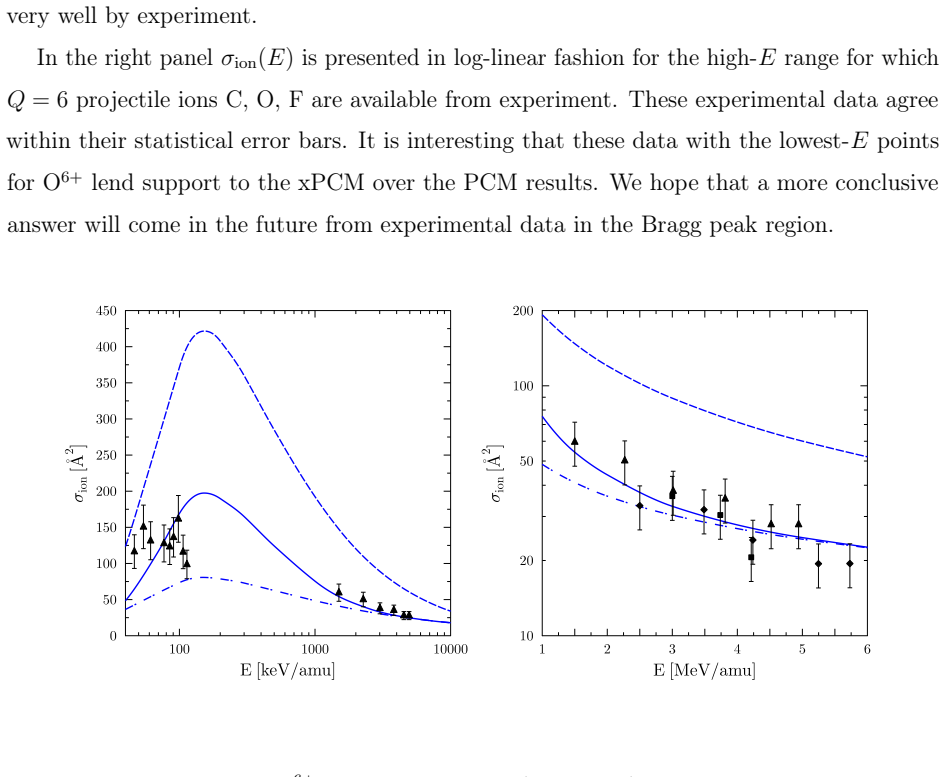
- [§III.B, Fig. 7; §IV] The experimental evidence is not only inconclusive but partially contradictory for the central claim. For C4+ + uracil, the authors state that between 20 and 100 keV/amu the approach to the Bragg-peak region 'is described better by PCM than by xPCM.' Since the paper's main claim is that xPCM corrects PCM for highly charged ions near the Bragg peak, this is a directly relevant dataset that favors the old model in the region of interest. The later support from O6+ data rests on a few low-energy points with substantial scatter. The conclusion that the data are not sufficient is honest, but the mixed comparison should be analyzed quantitatively rather than left as inconclusive.
- [§III, atomic cross section validity] The Results state that TC-BGM cross sections for projectile charge Q=6 are 'deemed reliable for impact energies greater than 40 keV/amu.' The xPCM enhancements for C6+ are claimed near the Bragg peak; if the enhanced region extends below this threshold, the input atomic cross sections themselves are uncertain. The manuscript should specify the energy range of the enhanced region and confirm that it lies within the stated validity range of the atomic data.
- [§II.B, Eq. (4)] The model truncates at double collisions, with maximum pixel sum mpix = (m+1)/2, far below the additivity-rule limit m. For anthracene and C6+, Fig. 2 shows mean free paths smaller than typical bond lengths, so a trajectory could encounter three or more atoms with overlapping disks and short mean free paths. The paper does not justify why triple and higher-order collisions are negligible; this is not a perturbation since the step function already assigns probability one to double events. An iterative mean-free-path treatment along the trajectory would be a natural extension and should be discussed or tested.
minor comments (5)
- [§II.A] There is a duplicated paragraph: the text beginning 'For proton collisions it follows...' appears twice in identical form.
- [§II.B, Eq. (2)] The symbol m is used both for the number of overlapping disks and as the denominator in the pixel weights. This should be clarified, especially since m could be confused with the total number of atoms in the molecule.
- [§II.B] The conversion from the pixel sum mpix to the final orientation-averaged molecular cross section is not written out. The reader is referred implicitly to previous PCM work; including the averaging formula explicitly would make the paper more self-contained.
- [References] Refs. [13] and [14] have identical titles, one being a book chapter and one an arXiv preprint; this is confusing and should be consolidated or distinguished in the citation text.
- [§II.A] Small typo: 'atoms are primary candidates for ionizing multiple scattering' should presumably read 'Carbon atoms are primary candidates...'.
Circularity Check
No significant circularity: xPCM predictions follow from a stated parameter-free model construction, not from fitting to the molecular data it is compared with.
full rationale
The paper proposes an extended independent-atom model (xPCM) whose central prediction—enhanced net ionization for highly charged projectiles near the Bragg peak while agreeing with PCM for protons—is a direct consequence of its explicitly defined mean-free-path criterion in Eq. (2), λ_i = 1/(n_i σ_i), and the Heaviside condition Θ(d_ij − λ_i). This is a model assumption, not a result derived from the molecular experimental data the paper compares against. The atomic cross sections σ_i are external inputs from the previously published TC-BGM method; they are parameter-free, validated against atomic-target data, and do not include the molecular net-ionization results being predicted. No parameter is fitted to the molecular data, and the paper explicitly acknowledges that the experimental situation is not yet conclusive (Section IV). The agreement between PCM and xPCM for protons follows from the large mean free paths for proton impact (so the Heaviside term vanishes), which is a consistency check of the construction rather than a circular reduction. The vdW-volume number densities are geometric inputs, not fitted. The paper cites its own prior work, but those citations provide independent computational machinery and prior PCM results; they are not invoked as an unverified uniqueness theorem or as a substitute for the present derivation. Therefore no load-bearing step reduces by definition or by self-citation to the paper's own inputs.
Assumptions & free parameters
assumptions (6)
- domain assumption Projectile nuclei move classically while electrons are treated quantum mechanically.
- domain assumption Molecular cross sections can be decomposed into independent atomic contributions with only molecular geometry as input.
- ad hoc to paper The bulk mean free path formula lambda = 1/(n sigma) applies to projectile-atom collisions within a molecule.
- ad hoc to paper Double scattering between atoms i and j occurs whenever the separation d_ij exceeds lambda_i, with probability 1 (step function).
- ad hoc to paper Only double collisions are considered; triple and higher-order collisions are neglected.
- domain assumption Atomic net ionization cross sections from TC-BGM calculations are accurate inputs.
Cite this review
Pith. "Pith review of A generalized independent atom model approach for net ionization of molecules by multiply-charged heavy-ion impact." pith.science (2026). https://pith.science/paper/DSDLUXA7
@misc{pith2026250909832,
  author       = {Pith},
  title        = {Pith review of: A generalized independent atom model approach for net ionization of molecules by multiply-charged heavy-ion impact},
  year         = {2026},
  howpublished = {\url{https://pith.science/paper/DSDLUXA7}},
  note         = {Machine review of arXiv:2509.09832}
}
read the original abstract
The previously applied independent atom model (IAM) for highly charged ion-molecule collisions which implemented the suppression of multiple ionization and capture on the basis of geometric overlaps of cross-sectional areas representing ion-atom cross sections using a pixel counting method (PCM), [Phys. Rev. A {\bf 101}, 062709 (2020)] is extended to incorporate the possibility of multiple collisions within the molecule. This is accomplished on the basis of estimated mean free paths for sequential projectile-atom collisions. The IAM-PCM was demonstrated to be successful in describing proton-molecule collisions, and moderately-charged ion impact at high collision energies. The new model does agree with these results, but has important consequences for highly charged projectiles providing larger cross sections than IAM-PCM, but still well below the simple additivity rule results.
Figures


Figures from the paper (6 more)



Reference graph
Works this paper leans on
-
[1]
Dal Cappello, P
C. Dal Cappello, P. A. Hervieux, I. Charpentier, and F. Ruiz-Lopez, Phys. Rev. A78, 042702 (2008)
2008
-
[2]
Sarkadi, Phys
L. Sarkadi, Phys. Rev. A92, 062704 (2015)
2015
-
[3]
Sarkadi, Journal of Physics B: Atomic, Molecular and Optical Physics49, 185203 (2016)
L. Sarkadi, Journal of Physics B: Atomic, Molecular and Optical Physics49, 185203 (2016)
2016
-
[4]
Jorge, M
A. Jorge, M. Horbatsch, C. Illescas, and T. Kirchner, Phys. Rev. A99, 062701 (2019)
2019
-
[5]
N. D. Cariatore, N. Bachi, and S. Otranto, Phys. Rev. A106, 012808 (2022)
2022
-
[6]
A. Itoh, Y. Iriki, M. Imai, C. Champion, and R. D. Rivarola, Phys. Rev. A88, 052711 (2013)
2013
-
[7]
Bhogale, S
A. Bhogale, S. Bhattacharjee, M. R. Chowdhury, C. Bagdia, M. F. Rojas, J. M. Monti, A. Jorge, M. Horbatsch, T. Kirchner, R. D. Rivarola, and L. C. Tribedi, Phys. Rev. A105, 062822 (2022)
2022
-
[8]
M. A. Quinto, N. J. Esponda, R. D. Rivarola, and J. M. Monti, Phys. Rev. A111, 042815 (2025)
2025
Show all 38 references
-
[9]
Gulyás, S
L. Gulyás, S. Egri, H. Ghavaminia, and A. Igarashi, Phys. Rev. A93, 032704 (2016)
2016
-
[10]
Gulyás, Phys
L. Gulyás, Phys. Rev. A108, 032815 (2023)
2023
-
[11]
H. J. Lüdde, A. Achenbach, T. Kalkbrenner, H.-C. Jankowiak, and T. Kirchner, Eur. Phys. J. D70, 82 (2016)
2016
-
[12]
H. J. Lüdde, A. Jorge, M. Horbatsch, and T. Kirchner, Atoms8, 59 (2020)
2020
-
[13]
The independent atom model - pixel counting method for ion-molecule collisions,
H. J. Lüdde, M. Horbatsch, and T. Kirchner, “The independent atom model - pixel counting method for ion-molecule collisions,” inReviews of Light and Heavy Particle Collisions with Atoms and Molecules, edited by Dževad Belkić (World Scientific, 2025) Chap. 6, pp. 153–177
2025
-
[14]
The independent atom model – pixel counting method for ion-molecule collisions,
H. J. Lüdde, M. Horbatsch, and T. Kirchner, “The independent atom model – pixel counting method for ion-molecule collisions,” (2025), arXiv:2509.07822 [physics.atom-ph]
2025 arXiv
-
[15]
H. J. Lüdde, M. Horbatsch, and T. Kirchner, Eur. Phys. J. B91, 99 (2018)
2018
-
[16]
H. J. Lüdde, M. Horbatsch, and T. Kirchner, J. Phys. B52, 195203 (2019)
2019
-
[17]
H. J. Lüdde, M. Horbatsch, and T. Kirchner, The European Physical Journal D73, 249 (2019)
2019
-
[18]
H. J. Lüdde, M. Horbatsch, and T. Kirchner, Phys. Rev. A106, 022813 (2022)
2022
-
[19]
de Oliveira, Luca A., de Farias, Jhaison C., and Bernal, Mario A., Eur. Phys. J. D78, 147 (2024). 17
2024
-
[20]
Blanco, J
F. Blanco, J. Rosado, A. Illana, and G. García, Physics Letters A374, 4420 (2010)
2010
-
[21]
Blanco, L
F. Blanco, L. Ellis-Gibbings, and G. García, Chemical Physics Letters645, 71 (2016)
2016
-
[22]
N. A. Mori, H. Umer, L. H. Scarlett, I. Bray, and D. V. Fursa, Journal of Physics B: Atomic, Molecular and Optical Physics57, 225201 (2024)
2024
-
[23]
H. J. Lüdde, T. Kalkbrenner, M. Horbatsch, and T. Kirchner, Phys. Rev. A101, 062709 (2020)
2020
-
[24]
Zapukhlyak, T
M. Zapukhlyak, T. Kirchner, H. J. Lüdde, S. Knoop, R. Morgenstern, and R. Hoekstra, J. Phys. B38, 2353 (2005)
2005
-
[25]
Pausz, H
T. Pausz, H. J. Lüdde, M. Murakami, M. Horbatsch, and T. Kirchner, Journal of Physics: Conference Series488, 102013 (2014)
2014
-
[26]
Champion, M
C. Champion, M. Galassi, P. Weck, S. Incerti, R. Rivarola, O. Fojón, J. Hanssen, Y. Iriki, and A. Itoh, Nuclear Instruments and Methods in Physics Research Section B: Beam Interactions with Materials and Atoms314, 66 (2013), eighth International Symposium on Swift Heavy Ions i...
2013
-
[27]
Roy Chowdhury, J
M. Roy Chowdhury, J. M. Monti, D. Misra, P. F. Weck, R. D. Rivarola, and L. C. Tribedi, New Journal of Physics24, 073035 (2022)
2022
-
[28]
Rudek, D
B. Rudek, D. Bennett, M. U. Bug, M. Wang, W. Y. Baek, T. Buhr, G. Hilgers, C. Champion, and H. Rabus, The Journal of Chem- ical Physics145, 104301 (2016), https://pubs.aip.org/aip/jcp/article- pdf/doi/10.1063/1.4962171/13310005/104301_1_online.pdf
2016 doi
-
[29]
M. U. Bug, W. Yong Baek, H. Rabus, C. Villagrasa, S. Meylan, and A. B. Rosenfeld, Radiation Physics and Chemistry130, 459 (2017)
2017
-
[30]
M. A. Bolorizadeh and M. E. Rudd, Phys. Rev. A33, 888 (1986)
1986
-
[31]
L. H. Toburen, W. E. Wilson, and R. J. Popowich, Radiation Research82, 27 (1980)
1980
-
[32]
M. E. Rudd, T. V. Goffe, R. D. DuBois, and L. H. Toburen, Phys. Rev. A31, 492 (1985)
1985
-
[33]
H. Luna, A. L. F. de Barros, J. A. Wyer, S. W. J. Scully, J. Lecointre, P. M. Y. Garcia, G. M. Sigaud, A. C. F. Santos, V. Senthil, M. B. Shah, C. J. Latimer, and E. C. Montenegro, Phys. Rev. A75, 042711 (2007)
2007
-
[34]
H. Luna, W. Wolff, E. C. Montenegro, A. C. Tavares, H. J. Lüdde, G. Schenk, M. Horbatsch, and T. Kirchner, Phys. Rev. A93, 052705 (2016). 18
2016
-
[35]
C. D. Cappello, C. Champion, O. Boudrioua, H. Lekadir, Y. Sato, and D. Ohsawa, Nuclear Instruments and Methods in Physics Research Section B: Beam Interactions with Materials and Atoms267, 781 (2009)
2009
-
[36]
Iriki, Y
Y. Iriki, Y. Kikuchi, M. Imai, and A. Itoh, Phys. Rev. A84, 052719 (2011)
2011
-
[37]
Bhattacharjee, A
S. Bhattacharjee, A. Mandal, M. R. Chowdhury, C. Bagdia, J. M. Monti, R. D. Rivarola, and L. C. Tribedi, The European Physical Journal D74, 163 (2020)
2020
-
[38]
A. N. Agnihotri, S. Kasthurirangan, S. Nandi, A. Kumar, M. E. Galassi, R. D. Rivarola, O. Fojón, C. Champion, J. Hanssen, H. Lekadir, P. F. Weck, and L. C. Tribedi, Phys. Rev. A 85, 032711 (2012). 19
2012
Reviewed August 4, 2026 · model on record in the stance chip above.
Discussion (0). Continue with ORCID to comment.