REVIEW 4 major objections 5 minor 66 references
Byte by Byte: Unmasking Browser Fingerprinting at the Function Level Using V8 Bytecode Transformers
T0 review · 4 major / 5 minor · reviewed 2026-08-04 · deepseek-v4-flash
Pith's one-line read V8 bytecode alone can identify browser fingerprinting functions before they execute, yielding 98.9% function-level accuracy and 99.7% script-level accuracy.
desk verdict Function-level bytecode fingerprinting is a genuinely new idea with a strong crawl behind it, but the evaluation only measures agreement with heuristic labels; send it to review, expect major revision. read the letter →
The pith
A machine-rendered reading of the paper's core claim, the machinery that carries it, and where it could break.
The reading
What carries the argument
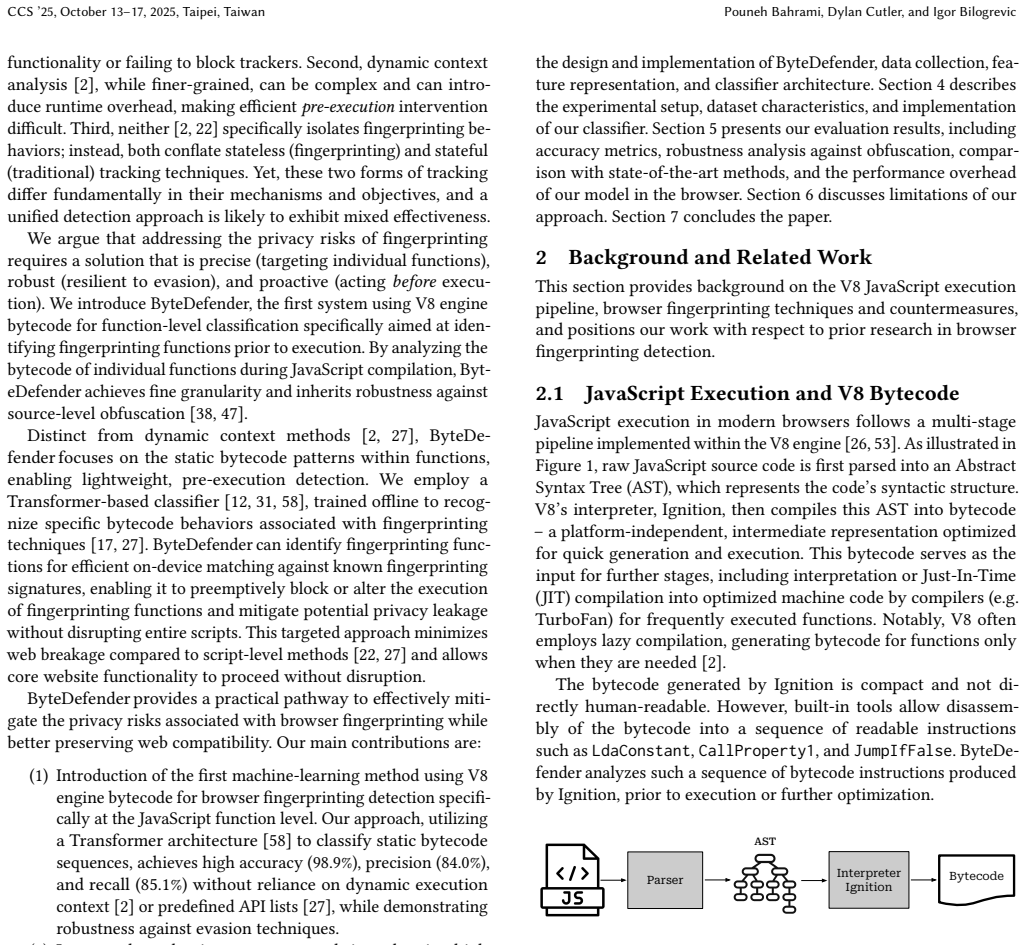
The central object is the V8 bytecode sequence: the ordered list of opcode mnemonics (for example LdaGlobal, GetNamedProperty, CallProperty1) that V8's Ignition interpreter emits from a parsed JavaScript function, with operands, offsets and literal values stripped away. This sequence is produced at compile time, before execution, and is paired with metadata (script URL, script ID, function name) so that it can be joined to execution traces. The machinery that carries the argument is a Transformer encoder which reads these token sequences and learns order-sensitive, context-dependent embeddings for classification, plus a signature variant that hashes the opcode list for lightweight in-engine
What would settle it
Take a random sample of functions from the 100k-site crawl that the heuristics labelled non-fingerprinting but that do call at least one high-entropy API, manually inspect them for fingerprinting behaviour, and compare that ground truth with ByteDefender's predictions; if a substantial share turn out to be fingerprinting, the reported 98.9% accuracy is measuring the heuristic, not real-world detection. A cheaper check is to run ByteDefender on the anonymous functions excluded from training (2,905 trace-identified fingerprinting functions): the paper leaves that generalisation unverified.
Extended reading notes
Core claim
On the paper's own terms, the central discovery is that the ordered list of V8 bytecode opcodes inside a JavaScript function is a sufficient static signal to recognise fingerprinting behaviour. A Transformer trained on these sequences labels functions as fingerprinting or not with 98.9% accuracy, 84.0% precision and 85.1% recall; a script-level version reaches 99.7% accuracy and 96.9% recall. Because only opcode names are kept—constants, property names, offsets and operands are discarded—the representation is deliberately blind to the syntactic surface that obfuscation changes, yet still captures the operational structure of canvas, audio, font and WebRTC fingerprinting. The same bytecode re
Load-bearing premise
All training and test labels come from four heuristics applied to execution traces of Chromium's high-entropy APIs; any function whose trace matches none of them is labelled non-fingerprinting, so if these heuristics miss a fingerprinting technique, the model inherits that blind spot and the reported accuracy reflects agreement with the heuristics rather than true detection.
Editorial extensions
If this is right
- Browsers could block or neutralise individual fingerprinting functions at compile time, leaving legitimate functions in the same script untouched, which matters because the paper finds every fingerprinting script in its 100k-site crawl is mixed-purpose.
- URL-based evasion—CNAME cloaking, path randomisation, domain shuffling—becomes ineffective because classification never consults the script's origin.
- Common obfuscation (variable renaming, string encoding, control-flow flattening) no longer hides fingerprinting: adding obfuscated scripts to the training set raises recall on heavily obfuscated inputs from near zero to 92% in the paper's script-level test.
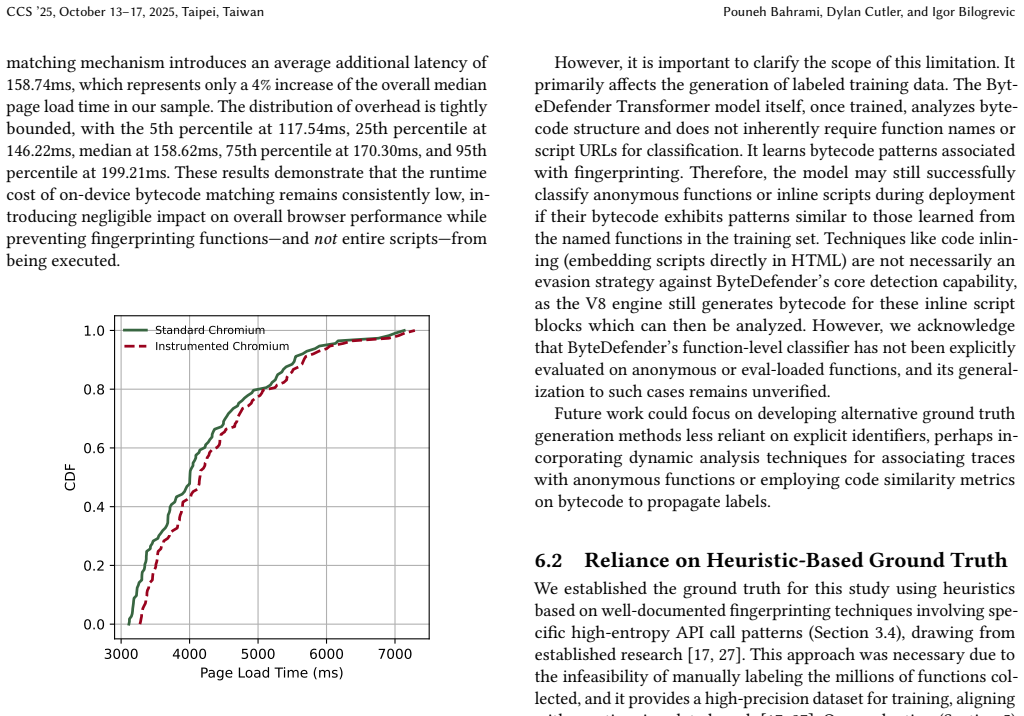
- The 4% average page-load overhead measured on 1,000 sites indicates that per-function bytecode hashing is cheap enough to run in the browser's normal compilation path.
- AST-based fingerprinting detection appears to miss a large share of real-world fingerprinting: a reimplemented AST classifier reaches 80.0% script-level recall versus 96.9% for the bytecode model.
Reading between the lines
- The opcode-sequence representation is not fingerprinting-specific; the same training recipe could plausibly flag other stateless tracking or abusive behaviours (session replay, crypto-mining) that leave distinctive operational footprints, though the paper does not test this.
- The heuristics cover only four fingerprinting families, so the model's true coverage in the wild is likely narrower than the accuracy figures suggest; a natural next step is deploying ByteDefender and manually auditing the functions it flags that the heuristics called non-fingerprinting.
- Signature matching hashes the opcode sequence exactly, so any V8 version change that alters an opcode name or encoding could invalidate the signature library; the paper acknowledges the need for retraining but does not quantify how often this would occur.
- The 4% overhead was measured with a fixed signature list; as the list grows, hash-lookup cost may rise, and the paper leaves that scaling behaviour unmeasured.
Editorial analysis
A structured set of objections, weighed in public.
Referee Report
Summary. ByteDefender proposes the first function-level browser fingerprinting detector based on V8 bytecode, using a Transformer trained on bytecode instruction sequences with labels derived from heuristic analysis of high-entropy API execution traces. The paper reports 98.9% accuracy, 84.0% precision, and 85.1% recall at the function level, 99.7% accuracy at the script level, and a 4% average page-load overhead for on-device signature matching. If these results hold, the contribution is significant: function-level, pre-execution detection of fingerprinting that is robust to source-level obfuscation and URL manipulation, addressing a real gap between script-level blockers and dynamic analysis. However, the evaluation's validity depends critically on the quality of the heuristic ground truth and on the generality of the function-level model to anonymous and eval-loaded code, both of which are acknowledged but not quantified in the manuscript.
Significance. The paper attacks a real problem—detecting fingerprinting at function granularity before execution—and introduces a novel feature representation (V8 bytecode opcode sequences) that is well-motivated and plausibly more robust to source-level obfuscation than ASTs. The large-scale crawl of 100k sites, the instrumented V8 pipeline, and the reproducible release of code are strengths. The central empirical claim, however, is only as strong as the automatically generated labels. Since the bytecode representation strips operands (§3.1), the classifier cannot see API names or string constants; it can only learn correlations between opcode patterns and the heuristic labels from §3.4. If those labels are noisy, the headline 98.9%/99.7% numbers measure agreement with the heuristic, not detection of real fingerprinting. The paper also shows that obfuscation robustness is not inherent: unaugmented recall is 0.1% (§5.3, Table 4). These issues are load-bearing and need to be addressed before the claims can be accepted.
major comments (4)
- [§3.4, §3.5] The ground-truth labels are generated by four hand-written heuristics over high-entropy API traces; any function with no matching trace is labeled non-fingerprinting. Because the bytecode representation omits operands and API names (§3.1), the classifier can only learn opcode-sequence patterns that correlate with these heuristic labels. Two concrete failure modes: (1) trace capture (§3.2, §3.3) is limited to CDP events; lazy compilation, indirect calls, eval, or tracing start/stop can cause a function's high-entropy API call to be missed, producing a false negative label. (2) The four heuristics cover only Canvas, Canvas Font, Audio, and WebRTC, omitting entire fingerprinting families such as WebGL, matchMedia, and font enumeration (as acknowledged in §6.2). Both failure modes affect training and test labels identically, so the reported 98.9% and 99.7% accuracy (Tables 2, 3) cannot be in
- [§5.3, Table 4] The obfuscation robustness claim is not supported by the unaugmented results. The first row of Table 4 shows that a model trained only on real-world scripts achieves recall of 0.1% (JavaScript Obfuscator) and 2.8% (Google Closure) on re-obfuscated inputs. Only after training on obfuscated samples does recall rise to 92.1%/78.0%. This directly contradicts the Abstract's claim of 'inherent resilience' to common code obfuscation, and the same limitation applies to the function-level model, which is not evaluated on obfuscation at all. The paper should either reframe the robustness claim as requiring obfuscation-aware training or evaluate the function-level model on obfuscated inputs without such augmentation.
- [§4.2, §6.1] A large fraction of the potential fingerprinting instances are discarded: the cleaning step removes 6.6M anonymous functions that invoked high-entropy APIs, including 2,905 that were eventually labeled fingerprinting, leaving only 4,670 named fingerprinting functions. As §6.1 admits, the model's generalization to anonymous and eval-loaded functions 'remains unverified.' Given that many real-world fingerprinting snippets are anonymous IIFEs, the deployment claim that ByteDefender can detect such functions 'if their bytecode exhibits patterns learned from named functions' is speculative. Please provide at least a targeted evaluation on a held-out set of anonymous functions (e.g., by matching via line/column or an alternative key) to support the deployment claim.
- [§4.2, §5.1] There is an internal inconsistency in the reported training-set construction. Section 4.2 states the training undersampling ratio is approximately 1:20 (FP:non-FP), while Section 5.1 states 'the training set was balanced by undersampling the non-fingerprinting class to a 1:10 ratio (FP:non-FP) after oversampling positive examples.' This discrepancy makes the reported metrics unreproducible. Please clarify the exact procedure and report the actual class distribution used in each experiment.
minor comments (5)
- [§3.1, Listing 3] Listing 3 contains 'GetNamedProprty', a typo for 'GetNamedProperty'.
- [§4.3, Figure 3] The caption reads 'Mixed Scrips' instead of 'Mixed Scripts.'
- [§5.1, Table 2] 'Transf.' in the Embed. Model column is ambiguous; spell out 'Transformer'.
- [§3.4] The heuristics are stated as text; a formal specification (e.g., pseudo-code or threshold definitions) would improve reproducibility. Specifically, the Canvas Font heuristic's 'more than 20 different font values' is not defined precisely (set of font.set values?).
- [§4.3] The paragraph on bytecode length says 'around 90% of non-fingerprinting functions have fewer than 100 bytecode instructions' and '90% of fingerprinting functions have bytecode lengths ranging between approximately 100 and 1,000.' These are observations, not controlled for function size; consider whether they indicate a length-based confound in the classifier.
Circularity Check
No significant circularity: ByteDefender is a standard supervised-learning pipeline whose reported metrics measure agreement with heuristic-derived labels; this label-validity limitation is acknowledged in the paper, but no step reduces to its own input by construction.
full rationale
The paper's derivation is a standard supervised-learning pipeline: instrumented V8 collects function bytecode, a Chrome extension captures CDP execution traces of high-entropy API calls (§3.1–§3.3), hand-written heuristics label functions from those traces (§3.4), labels are mapped to bytecode by script URL/ID/function name (§3.5), and a Transformer is trained on the labeled bytecode (§3.6–§3.7). Evaluation (§5.1) is on a held-out, deduplicated test set, so the reported 98.9% accuracy is not a fitted parameter renamed as a prediction. The classifier does not reduce to the labeling heuristics by construction: it sees only opcode mnemonics with operands stripped (§3.1), while labels come from execution traces, so whether opcode sequences predict the heuristic labels is an empirical question; the model in fact misses some positives (recall 85.1%). The claim that this equals real-world fingerprinting is limited by the heuristic ground truth, which the paper explicitly acknowledges in §6.2 ('our reliance on predefined heuristics introduces an inherent bias'), and by the exclusion of anonymous/eval-loaded functions, whose generalization is admitted to be 'unverified' in §6.1. These are label-validity and generalization threats, not circular reductions. The only self-citations ([3], [49]) are contextual or limitation references and are not load-bearing; there is no imported uniqueness theorem and no ansatz smuggled in via citation. Accordingly, no circular step can be exhibited, and the circularity score is 0.
Assumptions & free parameters
free parameters (4)
- Canvas fingerprinting text length threshold =
None (hand chosen, >=10 characters)
- Canvas font measureText count threshold =
None (hand chosen, >=20 calls)
- Canvas font distinct font values threshold =
None (hand chosen, >20 font values)
- Training undersampling ratio for non-FP class =
Stated as 1:20 in Section 4.2 and 1:10 in Section 5.1
assumptions (6)
- domain assumption High-entropy API trace patterns are a faithful proxy for fingerprinting behavior.
- domain assumption Absence of a high-entropy API trace implies the function is non-fingerprinting.
- domain assumption V8 opcode sequences without operands carry enough semantic signal to distinguish fingerprinting functions.
- domain assumption Named functions are representative of fingerprinting functions, including anonymous and eval-loaded code.
- domain assumption Chrome CDP Tracing captures all relevant high-entropy API calls made during the crawl.
- domain assumption The held-out crawl is representative of future web code.
Cite this review
Pith. "Pith review of Byte by Byte: Unmasking Browser Fingerprinting at the Function Level Using V8 Bytecode Transformers." pith.science (2026). https://pith.science/paper/KP24RLOI
@misc{pith2026250909950,
  author       = {Pith},
  title        = {Pith review of: Byte by Byte: Unmasking Browser Fingerprinting at the Function Level Using V8 Bytecode Transformers},
  year         = {2026},
  howpublished = {\url{https://pith.science/paper/KP24RLOI}},
  note         = {Machine review of arXiv:2509.09950}
}
read the original abstract
Browser fingerprinting enables persistent cross-site user tracking via subtle techniques that often evade conventional defenses or cause website breakage when script-level blocking countermeasures are applied. Addressing these challenges requires detection methods offering both function-level precision to minimize breakage and inherent robustness against code obfuscation and URL manipulation. We introduce ByteDefender, the first system leveraging V8 engine bytecode to detect fingerprinting operations specifically at the JavaScript function level. A Transformer-based classifier, trained offline on bytecode sequences, accurately identifies functions exhibiting fingerprinting behavior. We develop and evaluate light-weight signatures derived from this model to enable low-overhead, on-device matching against function bytecode during compilation but prior to execution, which only adds a 4% (average) latency to the page load time. This mechanism facilitates targeted, real-time prevention of fingerprinting function execution, thereby preserving legitimate script functionality. Operating directly on bytecode ensures inherent resilience against common code obfuscation and URL-based evasion. Our evaluation on the top 100k websites demonstrates high detection accuracy at both function- and script-level, with substantial improvements over state-of-the-art AST-based methods, particularly in robustness against obfuscation. ByteDefender offers a practical framework for effective, precise, and robust fingerprinting mitigation.
Figures


Figures from the paper (2 more)

Reference graph
Works this paper leans on
-
[1]
Martín Abadi, Ashish Agarwal, Paul Barham, Eugene Brevdo, Zhifeng Chen, Craig Citro, Greg S Corrado, Andy Davis, Jeffrey Dean, Matthieu Devin, et al
-
[2]
Abdul Haddi Amjad, Shaoor Munir, Zubair Shafiq, and Muhammad Ali Gulzar
-
[3]
Pouneh Nikkhah Bahrami, Umar Iqbal, and Zubair Shafiq. 2021. Fp-radar: Lon- gitudinal measurement and early detection of browser fingerprinting.arXiv preprint arXiv:2112.01662(2021)
arXiv 2021
-
[4]
Fingerprinting Protection Mode
bravemitigations 2018. Fingerprinting Protection Mode. https://github.com/ brave/browser-laptop/wiki/Fingerprinting-Protection-Mode
2018
-
[5]
Elie Bursztein, Artem Malyshev, Tadek Pietraszek, and Kurt Thomas. 2016. Pi- casso: Lightweight device class fingerprinting for web clients. InProceedings of the 6th Workshop on Security and Privacy in Smartphones and Mobile Devices. 93–102
2016
-
[6]
Javier Cabrera Arteaga, Martin Monperrus, and Benoit Baudry. 2019. Scalable comparison of JavaScript V8 bytecode traces. InProceedings of the 11th ACM SIGPLAN International Workshop on Virtual Machines and Intermediate Languages. 22–31
2019
-
[7]
Dell Cameron. 2018. Apple Declares War on Browser Fingerprinting, the Sneaky Tactic That Tracks You in Incognito Mode. https://gizmodo.com/apple- declareswar-on-browser-fingerprinting-the-sneak-1826549108. Accessed: 2025
2018
-
[8]
Yinzhi Cao, Song Li, and Erik Wijmans. 2017. (Cross-) browser fingerprinting via OS and hardware level features. InProceedings 2017 Network and Distributed System Security Symposium. Internet Society
2017
Show all 66 references
-
[9]
Ha Dao, Johan Mazel, and Kensuke Fukuda. 2021. CNAME cloaking-based track- ing on the web: Characterization, detection, and protection.IEEE Transactions on Network and Service Management18, 3 (2021), 3873–3888
2021
-
[10]
Anupam Das, Gunes Acar, Nikita Borisov, and Amogh Pradeep. 2018. The web’s sixth sense: A study of scripts accessing smartphone sensors. InProceedings of the 2018 ACM SIGSAC Conference on Computer and Communications Security. 1515–1532
2018
-
[11]
Amit Datta, Jianan Lu, and Michael Carl Tschantz. 2018. The effectiveness of privacy enhancing technologies against fingerprinting.arXiv preprint arXiv:1812.03920(2018)
2018 arXiv
-
[12]
Jacob Devlin. 2018. Bert: Pre-training of deep bidirectional transformers for language understanding.arXiv preprint arXiv:1810.04805(2018)
2018 arXiv
-
[13]
Yana Dimova, Gunes Acar, Lukasz Olejnik, Wouter Joosen, and Tom van Goethem
-
[14]
Disconnect tracking protection lists
Disconnect 2024. Disconnect tracking protection lists. https://disconnect.me/ trackerprotection. Accessed: 2025
2024
-
[15]
Antonin Durey, Pierre Laperdrix, Walter Rudametkin, and Romain Rouvoy. 2021. FP-Redemption: Studying browser fingerprinting adoption for the sake of web security. InDetection of Intrusions and Malware, and Vulnerability Assessment: 18th International Conference, DIMV A 2021, V...
2021
-
[16]
Peter Eckersley. 2010. How unique is your web browser?. InInternational Sym- posium on Privacy Enhancing Technologies Symposium. Springer, 1–18
2010
-
[17]
Steven Englehardt and Arvind Narayanan. 2016. Online tracking: A 1-million-site measurement and analysis. InProceedings of the 2016 ACM SIGSAC conference on computer and communications security. 1388–1401
2016
-
[18]
esprima_parsing [n. d.]. Syntactic Analysis (Parsing). https://docs.esprima.org/ en/latest/syntactic-analysis.html. Accessed: 2025
2025
-
[19]
David Fifield and Mia Gil Epner. 2016. Fingerprintability of webrtc.arXiv preprint arXiv:1605.08805(2016)
2016 arXiv
-
[20]
firefoxAntiFingerpriting [n. d.]. How to block fingerprinting with Firefox. https: //blog.mozilla.org/firefox/how-to-block-fingerprinting-with-firefox. Accessed: 2025
2025
-
[21]
Roy Frostig, Matthew James Johnson, and Chris Leary. 2018. Compiling machine learning programs via high-level tracing.Systems for Machine Learning4, 9 (2018)
2018
-
[22]
Mohammad Ghasemisharif and Jason Polakis. 2023. Read between the lines: Detecting tracking javascript with bytecode classification. InProceedings of the 2023 ACM SIGSAC Conference on Computer and Communications Security. 3475– 3489
2023
-
[23]
Yoav Goldberg. 2014. word2vec Explained: deriving Mikolov et al. ’s negative- sampling word-embedding method.arXiv preprint arXiv:1402.3722(2014)
2014 arXiv
-
[24]
google_closure [n. d.]. Google Closure compiler. https://developers.google.com/ closure/compiler. Accessed: 2025
2025
-
[25]
high_entropy_apis [n. d.]. High Entropy APIs flagged by chromium. https://github.com/chromium/chromium/blob/ aae7191b27cef1f097b23e7742afb4895ec6a9d3/docs/privacy_budget/privacy_ budget_instrumentation.md?plain=1#L196. Accessed: 2025
2025
-
[26]
Franziska Hinkelmann. 2017. Understanding V8’s Bytecode. https://medium. com/dailyjs/understanding-v8s-bytecode-317d46c94775. Accessed: 2025
2017
-
[27]
Umar Iqbal, Steven Englehardt, and Zubair Shafiq. 2021. Fingerprinting the fingerprinters: Learning to detect browser fingerprinting behaviors. In2021 IEEE Symposium on Security and Privacy (SP). IEEE, 1143–1161
2021
-
[28]
Armand Joulin, Edouard Grave, Piotr Bojanowski, and Tomas Mikolov. 2016. Bag of tricks for efficient text classification.arXiv preprint arXiv:1607.01759(2016). CCS ’25, October 13–17, 2025, Taipei, Taiwan Pouneh Bahrami, Dylan Cutler, and Igor Bilogrevic
2016 arXiv
-
[29]
Timofey Kachalov. [n. d.]. Javascript obfuscator tool. https://obfuscator.io/. Accessed: 2025
2025
-
[30]
Faezeh Kalantari, Mehrnoosh Zaeifi, Yeganeh Safaei, Marzieh Bitaab, Adam Oest, Gianluca Stringhini, Yan Shoshitaishvili, and Adam Doupé. 2024. Browser Polygraph: Efficient Deployment of Coarse-Grained Browser Fingerprints for Web-Scale Detection of Fraud Browsers. InProceeding...
2024
-
[31]
Jacob Devlin Ming-Wei Chang Kenton and Lee Kristina Toutanova. 2019. Bert: Pre-training of deep bidirectional transformers for language understanding. In Proceedings of naacL-HLT, Vol. 1
2019
-
[32]
Diederik P Kingma. 2014. Adam: A method for stochastic optimization.arXiv preprint arXiv:1412.6980(2014)
2014 arXiv
-
[33]
Pierre Laperdrix, Nataliia Bielova, Benoit Baudry, and Gildas Avoine. 2020. Browser fingerprinting: A survey.ACM Transactions on the Web (TWEB)14, 2 (2020), 1–33
2020
-
[34]
Zengrui Liu, Jimmy Dani, Yinzhi Cao, Shujiang Wu, and Nitesh Saxena. 2025. The First Early Evidence of the Use of Browser Fingerprinting for Online Tracking. InTHE WEB CONFERENCE 2025
2025
-
[35]
Tomas Mikolov, Kai Chen, Greg Corrado, and Jeffrey Dean. 2013. Efficient estimation of word representations in vector space.arXiv preprint arXiv:1301.3781 (2013)
2013 arXiv
-
[36]
Marvin Moog, Markus Demmel, Michael Backes, and Aurore Fass. 2021. Statically detecting javascript obfuscation and minification techniques in the wild. In 2021 51st Annual IEEE/IFIP International Conference on Dependable Systems and Networks (DSN). IEEE, 569–580
2021
-
[37]
Keaton Mowery and Hovav Shacham. 2012. Pixel perfect: Fingerprinting canvas in HTML5.Proceedings of W2SP2012 (2012)
2012
-
[38]
Ray Ngan, Surya Konkimalla, and Zubair Shafiq. 2022. Nowhere to hide: Detecting obfuscated fingerprinting scripts.arXiv preprint arXiv:2206.13599(2022)
2022 arXiv
-
[39]
Tom Ritter Nick Doty. 2025. W3C Fingerprinting Guidance. https://w3c.github. io/fingerprinting-guidance/. Accessed: 2025
2025
-
[40]
Fabian Pedregosa, Gaël Varoquaux, Alexandre Gramfort, Vincent Michel, Bertrand Thirion, Olivier Grisel, Mathieu Blondel, Peter Prettenhofer, Ron Weiss, Vincent Dubourg, et al . 2011. Scikit-learn: Machine learning in Python.the Journal of machine Learning research12 (2011), 2825–2830
2011
-
[41]
Victor Le Pochat, Tom Van Goethem, Samaneh Tajalizadehkhoob, Maciej Kor- czyński, and Wouter Joosen. 2018. Tranco: A research-oriented top sites ranking hardened against manipulation.arXiv preprint arXiv:1806.01156(2018)
2018 arXiv
-
[42]
privacybadger [n. d.]. Privacy Badger. https://www.eff.org/privacybadger. Ac- cessed: 2025
2025
-
[43]
Gaston Pugliese, Christian Riess, Freya Gassmann, and Zinaida Benenson. 2020. Long-term observation on browser fingerprinting: Users’ trackability and per- spective.Proceedings on Privacy Enhancing Technologies(2020)
2020
-
[44]
Alec Radford, Karthik Narasimhan, Tim Salimans, and Ilya Sutskever. 2018. Im- proving language understanding by generative pre-training.OpenAI blog(2018)
2018
-
[45]
Andreas Reiter and Alexander Marsalek. 2017. WebRTC: your privacy is at risk. InProceedings of the Symposium on Applied Computing. 664–669
2017
-
[46]
2018.Machine Learning Approaches for Automatic Detection of Web Fingerprinting
Valentino Rizzo. 2018.Machine Learning Approaches for Automatic Detection of Web Fingerprinting. Ph. D. Dissertation. Politecnico di Torino
2018
-
[47]
Muhammad Fakhrur Rozi, Sangwook Kim, and Seiichi Ozawa. 2020. Deep neural networks for malicious javascript detection using bytecode sequences. In2020 International Joint Conference on Neural Networks (IJCNN). IEEE, 1–8
2020
-
[48]
selenium [n. d.]. Selenium WebDriver. https://www.selenium.dev/ documentation/webdriver/. Accessed: 2025
2025
-
[49]
Asuman Senol, Alisha Ukani, Dylan Cutler, and Igor Bilogrevic. 2024. The double edged sword: identifying authentication pages and their fingerprinting behavior. InProceedings of the ACM Web Conference 2024. 1690–1701
2024
-
[50]
Philippe Skolka, Cristian-Alexandru Staicu, and Michael Pradel. 2019. Anything to hide? studying minified and obfuscated code in the web. InThe world wide web conference. 1735–1746
2019
-
[51]
Nitish Srivastava, Geoffrey Hinton, Alex Krizhevsky, Ilya Sutskever, and Ruslan Salakhutdinov. 2014. Dropout: a simple way to prevent neural networks from overfitting.The journal of machine learning research15, 1 (2014), 1929–1958
2014
-
[52]
Brave Privacy Team. 2020. Fingerprint randomization. https://brave.com/privacy- updates/3-fingerprint-randomization/. Accessed: 2025
2020
-
[53]
V8 team. 2017. Launching Ignition and TurboFan. https://v8.dev/blog/launching- ignition-and-turbofan. Accessed: 2025
2017
-
[54]
tormitigations [n. d.]. Fingerprinting Defenses in The Tor Browser. https://2019. www.torproject.org/projects/torbrowser/design/#fingerprinting-defenses. Ac- cessed: 2025
2019
-
[55]
tracing_CDP [n. d.]. Tracing domain in Chrome DevTools protocol. https:// chromedevtools.github.io/devtools-protocol/tot/Tracing/. Accessed: 2025
2025
-
[56]
Tim van Zalingen and Sjors Haanen. 2018. Detection of Browser Fingerprinting by Static JavaScript Code Classification
2018
-
[57]
Antoine Vastel, Pierre Laperdrix, Walter Rudametkin, and Romain Rouvoy. 2018. {Fp-Scanner}: The privacy implications of browser fingerprint inconsistencies. In27th USENIX Security Symposium (USENIX Security 18). 135–150
2018
-
[58]
Ashish Vaswani, Noam Shazeer, Niki Parmar, Jakob Uszkoreit, Llion Jones, Aidan N Gomez, Łukasz Kaiser, and Illia Polosukhin. 2017. Attention is all you need.Advances in neural information processing systems30 (2017)
2017
-
[59]
w3mitigations [n. d.]. Mitigating Browser Fingerprinting in Web Specifica- tions. https://www.w3.org/TR/fingerprinting-guidance/?utm_source=chatgpt. com#narrow-scope-availability. Accessed: 2025
2025
-
[60]
Weihang Wang, Yunhui Zheng, Xinyu Xing, Yonghwi Kwon, Xiangyu Zhang, and Patrick Eugster. 2016. Webranz: web page randomization for better advertisement delivery and web-bot prevention. InProceedings of the 2016 24th ACM SIGSOFT International Symposium on Foundations of Softwa...
2016
-
[61]
webkitBlocking [n. d.]. Tracking Prevention in WebKit. https://webkit.org/ tracking-prevention/. Accessed: 2025
2025
-
[62]
Mike West. 2024. Combating Fingerprinting with a Privacy Budget Explainer. https://github.com/bslassey/privacy-budget. Accessed: 2025
2024
-
[63]
Shujiang Wu, Song Li, Yinzhi Cao, and Ningfei Wang. 2019. Rendered private: Making{GLSL} execution uniform to prevent{WebGL-based} browser finger- printing. In28th USENIX Security Symposium (USENIX Security 19). 1645–1660. A List of high entropy APIs The following table lists ...
2019
-
[2015]
TensorFlow: Large-scale machine learning on heterogeneous systems
-
[2021]
https://api.semanticscholar.org/CorpusID:231951672
The CNAME of the Game: Large-scale Analysis of DNS-based Tracking Evasion.Proceedings on Privacy Enhancing Technologies2021 (2021), 394 – 412. https://api.semanticscholar.org/CorpusID:231951672
2021
-
[2024]
InProceedings of the 2024 on ACM SIGSAC Conference on Computer and Communications Security
Blocking Tracking JavaScript at the Function Granularity. InProceedings of the 2024 on ACM SIGSAC Conference on Computer and Communications Security. 2177–2191
2024
Reviewed August 4, 2026 · model on record in the stance chip above.
Discussion (0). Sign in to comment.