REVIEW 5 major objections 6 minor 30 references
Color Me Correctly: Bridging Perceptual Color Spaces and Text Embeddings for Improved Diffusion Generation
T0 review · 5 major / 6 minor · reviewed 2026-08-04 · deepseek-v4-flash
Pith's one-line read The paper claims that CIELab-weighted interpolation of basic color-term text embeddings, guided by an LLM's disambiguation, makes diffusion models render compound color names faithfully without retraining or reference images.
desk verdict Plausible training-free color refinement with a useful new benchmark, but the evaluation undercuts the headline claim: win rates without sample sizes and zero evidence on image quality. read the letter →
The pith
A machine-rendered reading of the paper's core claim, the machinery that carries it, and where it could break.
The reading
What carries the argument
The load-bearing mechanism is retrieval-based embedding refinement: for a target color code from the LLM, the pipeline finds the k nearest basic color terms by CIELab ΔE00 distance within the same hue group (warm/cool/neutral), then replaces the target's text token embedding with the weighted sum e_target = Σ α_i e_i, where α_i = softmax(−d_i²/(2σ²)). This translates a perceptual color code into an embedding space the diffusion model already understands. A symmetric KL-divergence color-binding loss on the cross-attention maps of color and entity tokens then steers the color to the right object region during denoising.
What would settle it
A reader could compute the method's target embedding for each TintBench compound color and measure whether the generated pixels' average CIELab color (over many seeds) is closer to the intended RGB than simply using the basic color term's embedding. If the interpolation provides no significant ΔE00 improvement over the basic term alone, the central mechanism is not carrying the reported gains.
Extended reading notes
Core claim
The paper's central discovery is that the perceptual relationships encoded in CIELab can act as a proxy for the arithmetic of color-word text embeddings. By first having an LLM disambiguate a compound color (e.g., "orange red" → "red" plus RGB(255,21,0)), and then interpolating the embeddings of the nearest basic color terms with weights derived from CIELab ΔE00 distances within the same hue group, the resulting embedding is decoded by the diffusion model into the intended hue. The key evidence is a correlation analysis showing CIELab distances align with text-embedding distances across warm, neutral, and cool color groups, and a user study in which humans preferred these outputs over eight
Load-bearing premise
The method assumes that a weighted interpolation of basic color text embeddings, with weights derived from CIELab distances to an LLM-provided RGB code, yields an embedding that the diffusion model decodes into the intended compound color; the paper's evidence for this is a correlation analysis on 11 basic colors and a single orange-to-yellow blending example, not systematic validation across TintBench categories.
Editorial extensions
If this is right
- Compound and signature colors (Duke blue, Tiffany blue) can be rendered without fine-tuning or reference images.
- The same embedding-refinement step applies across diffusion backbones; the paper demonstrates it on SD1.4 and SDXL.
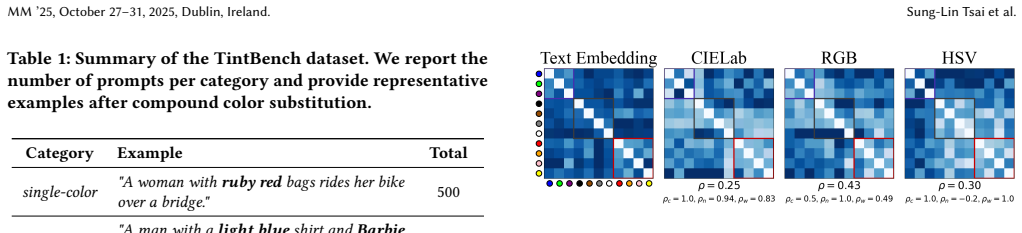
- A new benchmark, TintBench, with 1,000 naturally worded prompts across five color-term categories, becomes available for evaluating color fidelity.
- The correlation result singles out CIELab (via ΔE00) as the perceptual space most aligned with text embedding structure, guiding future color-aware prompt editing.
Reading between the lines
- If the interpolation hypothesis holds, any RGB target could be injected as a prompt embedding, enabling exact-color control (e.g., brand colors) entirely without training.
- The reliance on the LLM's RGB guess puts an unexamined ceiling on accuracy; auditing LLM color-code judgments against human-annotated references would quantify how much is lost vs. gained.
- The hue-group constraint may fail near group boundaries (e.g., teal, maroon); a natural extension would test whether cross-group interpolation with adjusted weights works better.
- The same CIELab-anchored interpolation could be applied to entity tokens in object-centric generation or video models, where color consistency across frames matters.
Signed reviews
Editorial analysis
A structured set of objections, weighed in public.
Referee Report
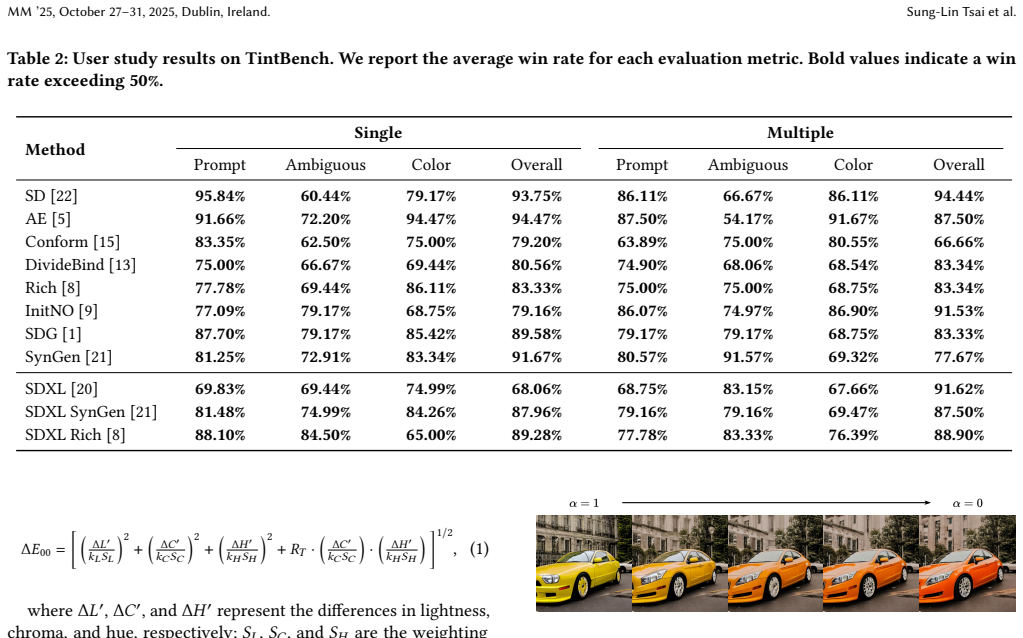
Summary. The paper proposes a training-free framework for improving color fidelity in text-to-image diffusion models. The pipeline first uses an LLM (GPT-4o) to disambiguate compound or ambiguous color terms in a prompt, producing both a clarified prompt and an RGB reference color code. It then refines the text embedding of the target color by interpolating among nearby basic color embeddings, with weights computed from CIELab ΔE00 distances via a Gaussian softmax. A cross-attention binding loss (inspired by SynGen) is also applied during denoising. The authors introduce TintBench, a benchmark derived from Flickr30k with 1,000 prompts spanning five categories of compound color names, and evaluate against seven baselines on SD 1.4 and SDXL. The central claim is that the method improves color alignment without compromising image quality, supported primarily by a user study reporting win rates in Table 2 and qualitative comparisons.
Significance. If validated, the proposed method would be a useful contribution: it is training-free, requires no reference images, and addresses a real limitation of T2I models—handling nuanced color language. The introduction of TintBench is a potentially valuable asset for future work on color fidelity evaluation. The correlation analysis between text embedding distances and perceptual color spaces (Fig. 3) is an interesting observation, and the idea of ground- ing embedding interpolation in CIELab is plausible. However, the experimental evidence in the current manuscript falls short of supporting the abstract's strong claims. The user study lacks basic statistical reporting, there is no objective color-distance metric, and the 'without compromising image quality' assertion is not backed by any measurement. These gaps are load-bearing, since the contribution's value proposition rests on both improved color alignment and preserved image quality. The method itself and the benchmark are promising, but the evaluation must be substantially strengthened before the results can be accepted.
major comments (5)
- [§5.2, Table 2] The quantitative evaluation relies entirely on a user study reported in Table 2, but no sample size, number of participants, confidence intervals, or significance tests are provided. For example, values such as 95.84% vs. 91.66% cannot be interpreted without knowing the number of comparisons; they may be within chance. The bold values (>50%) are not a statistical test. Please report N, per-method confidence intervals, and pairwise significance testing (e.g., Wilcoxon signed-rank or bootstrap).
- [§4.2, Fig. 3 and Fig. 5] The core assumption that CIELab-weighted interpolation of basic color embeddings improves color accuracy is supported only by a Spearman correlation over 11 basic colors (Fig. 3) and a single qualitative orange-yellow interpolation example (Fig. 5). No objective color-distance evaluation (e.g., mean ΔE00 between the generated image and the target RGB) is reported on TintBench. Since the paper's central claim is improved color alignment, an objective metric across the benchmark is needed to complement the subjective user study.
- [Abstract and §5.2] The abstract claims improvement 'without compromising image quality,' but no image-quality metric (FID, LPIPS, etc.) or quality-specific user study is reported. The user-study criteria—Prompt Alignment, Color Fidelity, Ambiguity Resolution—focus on semantic alignment and color, not on image quality. Please provide quantitative quality assessment or explicitly limit the claim to color alignment.
- [§5.1, Eqs. (2) and (4)] The implementation details do not specify the values of the free parameters: σ in Eq. (2), α in Eq. (4), and the number of nearest basic colors k. These parameters control the interpolation sharpness and the strength of the attention-guidance step, and the method's sensitivity to them is not discussed. Please report the chosen values and ideally include an ablation or sensitivity analysis.
- [§4.2, Fig. 3] The choice of CIELab is justified by Spearman correlations computed within three hue groups of only 11 basic color terms. The per-group sample sizes are 3–4 (e.g., warm colors are red, orange, pink, yellow), making the Spearman coefficients unstable and easily dominated by a single pairwise distance. The statement that CIELab 'consistently exhibits the highest correlation' should be supported by a permutation test or a larger set of color terms.
minor comments (6)
- [Throughout] The name of the benchmark is inconsistent: 'Tint Benchmark' in the Section 3 heading vs. 'TintBench' elsewhere. Please standardize.
- [§3.2] The construction process is unclear: the text says 100 prompts per group after clustering, but Table 1 reports 500 per final group. Please clarify the exact steps from clustering to augmentation.
- [§5.1] The experimental setup does not mention the number of participants in the user study or the number of comparisons per participant. This information is essential for interpreting Table 2.
- [Fig. 3] The axes and matrix entries of the distance-matrix heatmaps are not clearly defined. Please label the color terms and specify whether values are normalized distances.
- [Eq. (1)] The ΔE00 formula omits the parametric terms (kL, kC, kH) and the weighting functions SL, SC, SH are not defined in the text. Since the formula is used in Eq. (2), a complete definition or a citation to the standard implementation notes is needed.
- [References] Reference [7] is cited for the CC-500 prompt dataset, but the title of [7] is 'Training-Free Structured Diffusion Guidance for Compositional Text-to-Image Synthesis,' which does not appear to be the CC-500 dataset. Please verify the citation.
Circularity Check
No significant circularity: target embeddings are constructed from an LLM-provided RGB code with no fit-to-output loop; CIELab choice is an empirical design decision, not a definitional reduction.
full rationale
The paper's derivation chain is: LLM disambiguates the prompt and emits an RGB code; the code is converted to CIELab; ΔE00 distances to 11 basic color terms yield softmax weights; the target text embedding is a weighted sum of basic-color embeddings; the diffusion model generates from the modified prompt. Nothing in this chain is fitted to the generated images or to the user-study outcomes. The only design choice justified by data measured in the paper is the selection of CIELab, based on a Spearman correlation over the same 11 basic colors used later (Sec. 4.2, Fig. 3). That is a limited-sample justification, not a circular reduction: Eq. (2) does not define the generated color, and the correlation does not enter the equations used to produce the output. There are no load-bearing self-citations; references are external (ColorPeel, Moroney). The central claim is supported by a user study and qualitative examples, and lack of statistical detail is a rigor issue, not circularity. Hence no circular step.
Assumptions & free parameters
free parameters (3)
- sigma (temperature in Eq. 2)
- alpha (binding scale in Eq. 4)
- k (number of nearest basic colors in Eq. 2)
assumptions (5)
- domain assumption Text embeddings of basic color terms within each hue group track CIELab perceptual distances (Sec. 4.2, Fig. 3).
- domain assumption An LLM (GPT-4o) can correctly identify ambiguous color terms, map them to a basic color, and provide an accurate RGB reference code (Sec. 4.1).
- domain assumption Linear interpolation in text embedding space produces perceptually intermediate colors (Sec. 4.2, Fig. 5).
- standard math CIELab ΔE00 is a valid perceptual distance for guiding semantic color blending (Sec. 4.2, Eq. 1).
- domain assumption Cross-attention maps for color and entity tokens are sufficiently localized for the symmetric KL binding loss to be effective (Sec. 4.2, Eq. 3).
Cite this review
Pith. "Pith review of Color Me Correctly: Bridging Perceptual Color Spaces and Text Embeddings for Improved Diffusion Generation." pith.science (2026). https://pith.science/paper/YP66FK45
@misc{pith2026250910058,
  author       = {Pith},
  title        = {Pith review of: Color Me Correctly: Bridging Perceptual Color Spaces and Text Embeddings for Improved Diffusion Generation},
  year         = {2026},
  howpublished = {\url{https://pith.science/paper/YP66FK45}},
  note         = {Machine review of arXiv:2509.10058}
}
read the original abstract
Accurate color alignment in text-to-image (T2I) generation is critical for applications such as fashion, product visualization, and interior design, yet current diffusion models struggle with nuanced and compound color terms (e.g., Tiffany blue, lime green, hot pink), often producing images that are misaligned with human intent. Existing approaches rely on cross-attention manipulation, reference images, or fine-tuning but fail to systematically resolve ambiguous color descriptions. To precisely render colors under prompt ambiguity, we propose a training-free framework that enhances color fidelity by leveraging a large language model (LLM) to disambiguate color-related prompts and guiding color blending operations directly in the text embedding space. Our method first employs a large language model (LLM) to resolve ambiguous color terms in the text prompt, and then refines the text embeddings based on the spatial relationships of the resulting color terms in the CIELAB color space. Unlike prior methods, our approach improves color accuracy without requiring additional training or external reference images. Experimental results demonstrate that our framework improves color alignment without compromising image quality, bridging the gap between text semantics and visual generation.
Figures


Figures from the paper (4 more)



Reference graph
Works this paper leans on
-
[1]
Aishwarya Agarwal, Srikrishna Karanam, and Balaji Vasan Srinivasan. 2024. Training-free Color-Style Disentanglement for Constrained Text-to-Image Syn- thesis.arXiv preprint arXiv:2409.02429(2024)
arXiv 2024
-
[2]
1991.Basic color terms: Their universality and evolution
Brent Berlin and Paul Kay. 1991.Basic color terms: Their universality and evolution. Univ of California Press
1991
-
[3]
Muhammad Atif Butt, Kai Wang, Javier Vazquez-Corral, and Joost van de Weijer
-
[4]
Mingdeng Cao, Xintao Wang, Zhongang Qi, Ying Shan, Xiaohu Qie, and Yinqiang Zheng. 2023. Masactrl: Tuning-free mutual self-attention control for consistent image synthesis and editing. InProceedings of the IEEE/CVF international confer- ence on computer vision
2023
-
[5]
Hila Chefer, Yuval Alaluf, Yael Vinker, Lior Wolf, and Daniel Cohen-Or. 2023. Attend-and-excite: Attention-based semantic guidance for text-to-image diffusion models.ACM transactions on Graphics (TOG)(2023)
2023
-
[6]
Minghao Chen, Iro Laina, and Andrea Vedaldi. 2024. Training-free layout control with cross-attention guidance. InProceedings of the IEEE/CVF winter conference on applications of computer vision
2024
-
[7]
Weixi Feng, Xuehai He, Tsu-Jui Fu, Varun Jampani, Arjun Reddy Akula, Pradyumna Narayana, Sugato Basu, Xin Eric Wang, and William Yang Wang. 2023. Training-Free Structured Diffusion Guidance for Compositional Text-to-Image Synthesis. InThe Eleventh International Conference on Learning Representations
2023
-
[8]
Songwei Ge, Taesung Park, Jun-Yan Zhu, and Jia-Bin Huang. 2023. Expressive text- to-image generation with rich text. InProceedings of the IEEE/CVF International Conference on Computer Vision. 7545–7556
2023
Show all 30 references
-
[9]
Xiefan Guo, Jinlin Liu, Miaomiao Cui, Jiankai Li, Hongyu Yang, and Di Huang
-
[10]
Yunpeng Han, Lisai Zhang, Qingcai Chen, Zhijian Chen, Zhonghua Li, Jianxin Yang, and Zhao Cao. 2023. Fashionsap: Symbols and attributes prompt for fine- grained fashion vision-language pre-training. InProceedings of the IEEE/CVF conference on computer vision and pattern recogn...
2023
-
[11]
InProceedings of the IEEE/CVF Conference on Computer Vision and Pattern Recognition
Initno: Boosting text-to-image diffusion models via initial noise optimiza- tion. InProceedings of the IEEE/CVF Conference on Computer Vision and Pattern Recognition. 9380–9389
-
[12]
Yihan Hou, Xingchen Zeng, Yusong Wang, Manling Yang, Xiaojiao Chen, and Wei Zeng. 2025. GenColor: Generative Color-Concept Association in Visual Design. InProceedings of the 2025 CHI Conference on Human Factors in Computing Systems. 1–19
2025
-
[13]
Amir Hertz, Ron Mokady, Jay Tenenbaum, Kfir Aberman, Yael Pritch, and Daniel Cohen-or. 2023. Prompt-to-Prompt Image Editing with Cross-Attention Control. InThe Eleventh International Conference on Learning Representations
2023
-
[14]
Long Lian, Boyi Li, Adam Yala, and Trevor Darrell. 2024. LLM-grounded Diffusion: Enhancing Prompt Understanding of Text-to-Image Diffusion Models with Large Language Models.Transactions on Machine Learning Research(2024)
2024
-
[15]
Yumeng Li, Margret Keuper, Dan Zhang, and Anna Khoreva. 2023. Divide & Bind Your Attention for Improved Generative Semantic Nursing. InBMVC
2023
-
[16]
Tomas Mikolov, Kai Chen, Greg Corrado, and Jeffrey Dean. 2013. Efficient estimation of word representations in vector space.arXiv preprint arXiv:1301.3781 (2013)
2013 arXiv
-
[17]
Tuna Han Salih Meral, Enis Simsar, Federico Tombari, and Pinar Yanardag. 2024. Conform: Contrast is all you need for high-fidelity text-to-image diffusion mod- els. InProceedings of the IEEE/CVF Conference on Computer Vision and Pattern Recognition. 9005–9014
2024
-
[18]
Muragul Muratbekova and Pakizar Shamoi. 2024. Color-emotion associations in art: Fuzzy approach.IEEE Access12 (2024), 37937–37956
2024
-
[19]
Nathan Moroney. 2024. Color Terms and Stable Diffusion. InColor and Imaging Conference
2024
-
[20]
Dustin Podell, Zion English, Kyle Lacey, Andreas Blattmann, Tim Dockhorn, Jonas Müller, Joe Penna, and Robin Rombach. 2023. Sdxl: Improving latent diffusion models for high-resolution image synthesis.arXiv preprint arXiv:2307.01952 (2023)
2023 arXiv
-
[21]
Jeffrey Pennington, Richard Socher, and Christopher D Manning. 2014. Glove: Global vectors for word representation. InProceedings of the 2014 conference on empirical methods in natural language processing (EMNLP)
2014
-
[22]
Robin Rombach, Andreas Blattmann, Dominik Lorenz, Patrick Esser, and Björn Ommer. 2022. High-resolution image synthesis with latent diffusion models. In Proceedings of the IEEE/CVF conference on computer vision and pattern recognition. 10684–10695
2022
-
[23]
Royi Rassin, Eran Hirsch, Daniel Glickman, Shauli Ravfogel, Yoav Goldberg, and Gal Chechik. 2023. Linguistic Binding in Diffusion Models: Enhancing Attribute Correspondence through Attention Map Alignment. InThirty-seventh Conference on Neural Information Processing Systems
2023
-
[24]
Gaurav Sharma, Wencheng Wu, and Edul N Dalal. 2005. The CIEDE2000 color- difference formula: Implementation notes, supplementary test data, and math- ematical observations.Color Research & Application: Endorsed by Inter-Society Color Council, The Colour Group (Great Britain), ...
2005
-
[25]
Pakizar Shamoi, Muragul Muratbekova, Assylzhan Izbassar, Atsushi Inoue, and Hiroharu Kawanaka. 2023. Towards a universal understanding of color harmony: Fuzzy approach. InFuzzy Systems and Data Mining IX. IOS Press, 20–28
2023
-
[26]
Xingxi Yin, Zhi Li, Jingfeng Zhang, Chenglin Li, and Yin Zhang. 2024. ColorEdit: Training-free Image-Guided Color Editing with Diffusion Model.arXiv preprint arXiv:2411.10232(2024)
2024 arXiv
-
[27]
Ling Yang, Zhaochen Yu, Chenlin Meng, Minkai Xu, Stefano Ermon, and Bin Cui
-
[28]
InForty-first International Conference on Machine Learning
Mastering text-to-image diffusion: Recaptioning, planning, and generating with multimodal llms. InForty-first International Conference on Machine Learning
-
[30]
Peter Young, Alice Lai, Micah Hodosh, and Julia Hockenmaier. 2014. From image descriptions to visual denotations: New similarity metrics for semantic inference over event descriptions.Transactions of the association for computational linguistics(2014)
2014
-
[2024]
InEuropean Conference on Computer Vision
ColorPeel: Color prompt learning with diffusion models via color and shape disentanglement. InEuropean Conference on Computer Vision
Reviewed August 4, 2026 · model on record in the stance chip above.
Discussion (0). Continue with ORCID to comment.