REVIEW 4 major objections 6 minor 51 references
Green AI patenting is shifting from combustion engines to data processing, microgrids, and agricultural water management.
Reviewed by Pith at T0; open to challenge. T0 means a machine referee read the full paper against a public rubric. the ladder, T0–T4 →
2026-08-04 18:05 UTC pith:M6UJDEEJ
load-bearing objection A solid new Green AI patent dataset and taxonomy, but the headline 'shift' claim and market-value rankings need robustness work before policy use. the 4 major comments →
The anatomy of Green AI technologies: structure, evolution, and impact
The pith
A machine-rendered reading of the paper's core claim, the machinery that carries it, and where it could break.
Core claim
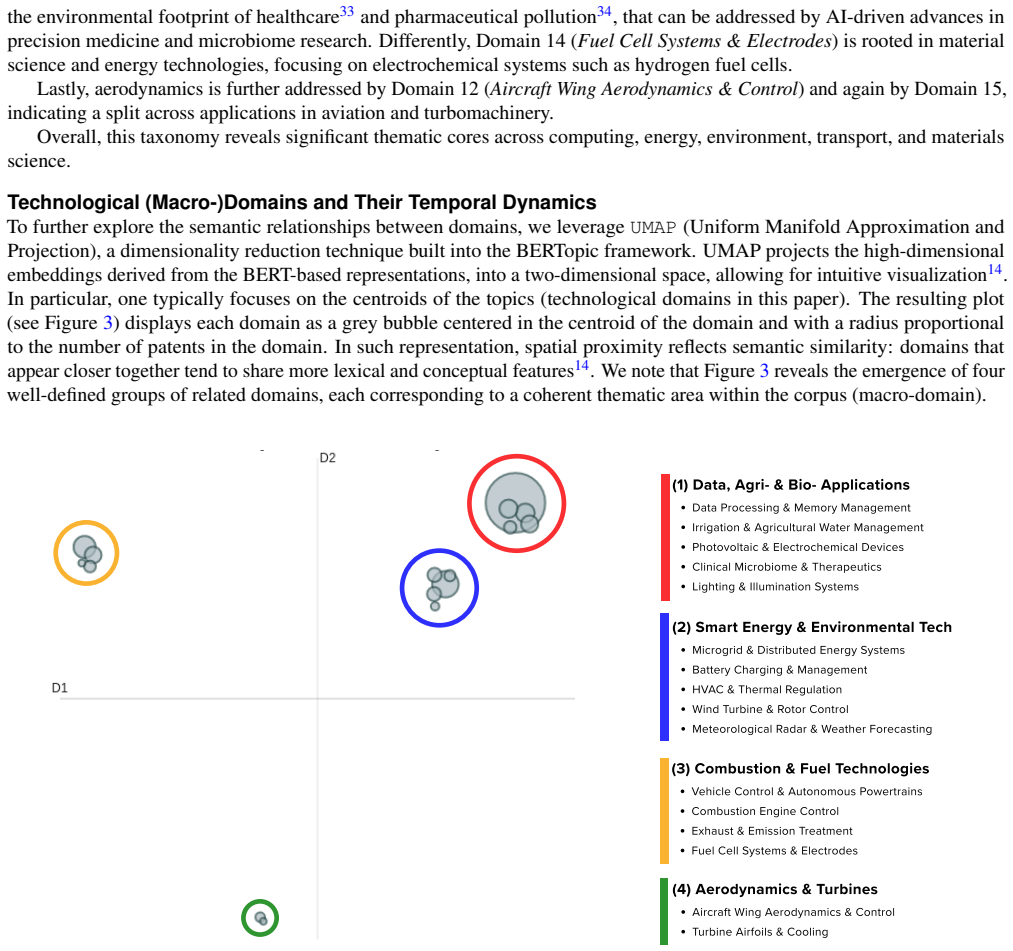
The paper claims that Green AI patenting is not a monolithic field but a set of sixteen distinct technological domains with different life cycles and value profiles. Using a machine-learning topic model on roughly 63,000 U.S. patents that are both AI-related and climate-related, it finds a clear temporal shift away from combustion-engine control, exhaust and emission treatment, and mature aerodynamics, toward data processing, microgrids, battery management, photovoltaic devices, and agricultural water management. On impact, the paper finds that some domains, such as clinical microbiome research and agricultural water management, combine high market value with strong or moderate citation impa
What carries the argument
The central instrument is a purpose-built corpus of roughly 63,000 U.S. patents that are simultaneously classified as AI-related and climate-related, combined with a machine-learning topic model that extracts latent themes from patent abstracts. The resulting sixteen-domain taxonomy, grouped into four macro-domains and validated by coherence and diversity metrics, carries the paper's temporal-shift and impact-divergence arguments; forward citations and stock-market reactions to patent grants provide the two complementary impact measures.
Load-bearing premise
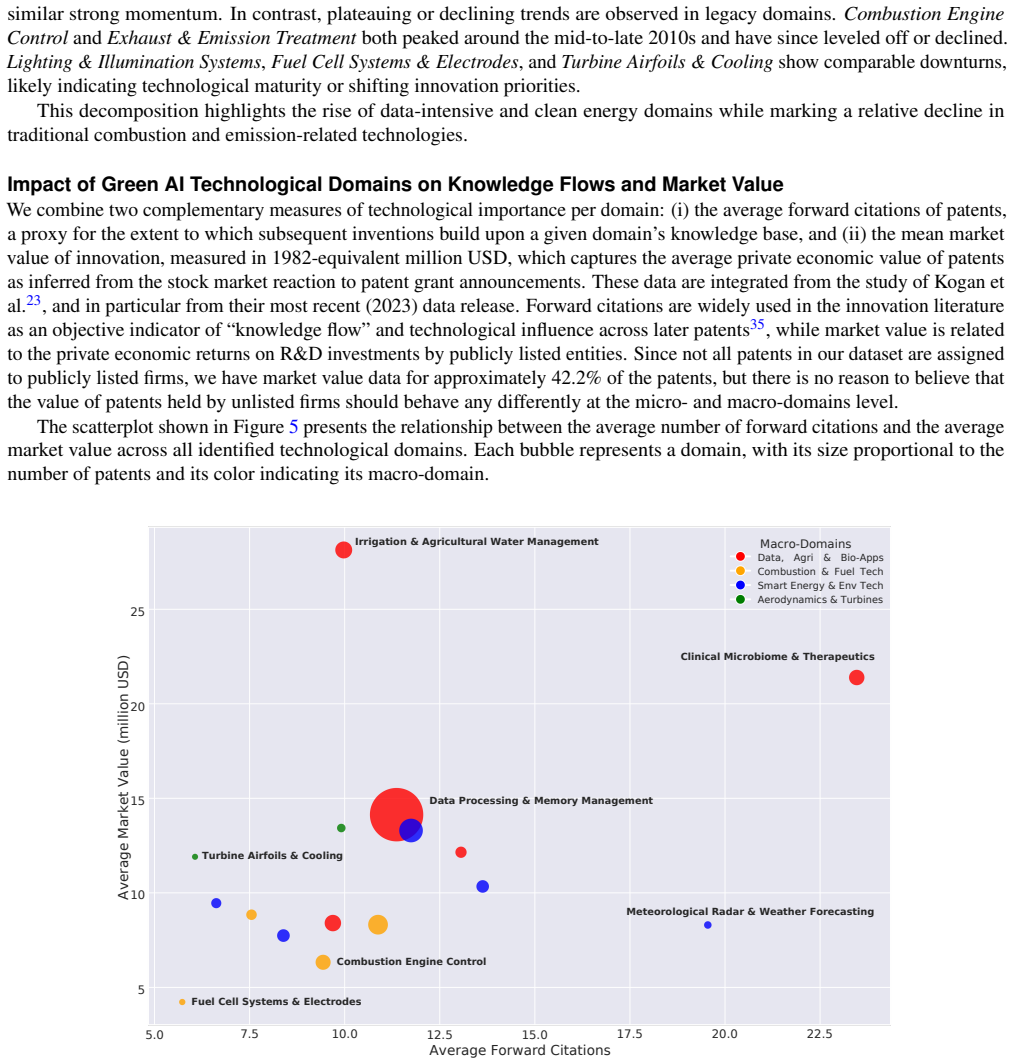
The impact rankings assume that the 42.2% of patents with stock-market value data are representative of all Green AI patents; if patents held by unlisted firms are valued differently by domain, the market-value findings are biased.
What would settle it
Compute alternative market-value estimates for the 57.8% of patents lacking stock-market data (e.g., by tracking renewal payments or later acquisitions) and re-rank the sixteen domains; the paper's claim that meteorological radar and emission treatment have weak private incentives would be falsified if those domains rise above combustion and fuel technologies in the imputed rankings.
If this is right
- If the shift continues, R&D targeting and policy incentives for climate AI should focus on data processing, microgrids, and agricultural water management rather than legacy combustion and emission systems.
- Domains with high citations but low market value, such as meteorological radar and weather forecasting, are likely underfunded by private markets and are candidates for public subsidy or procurement.
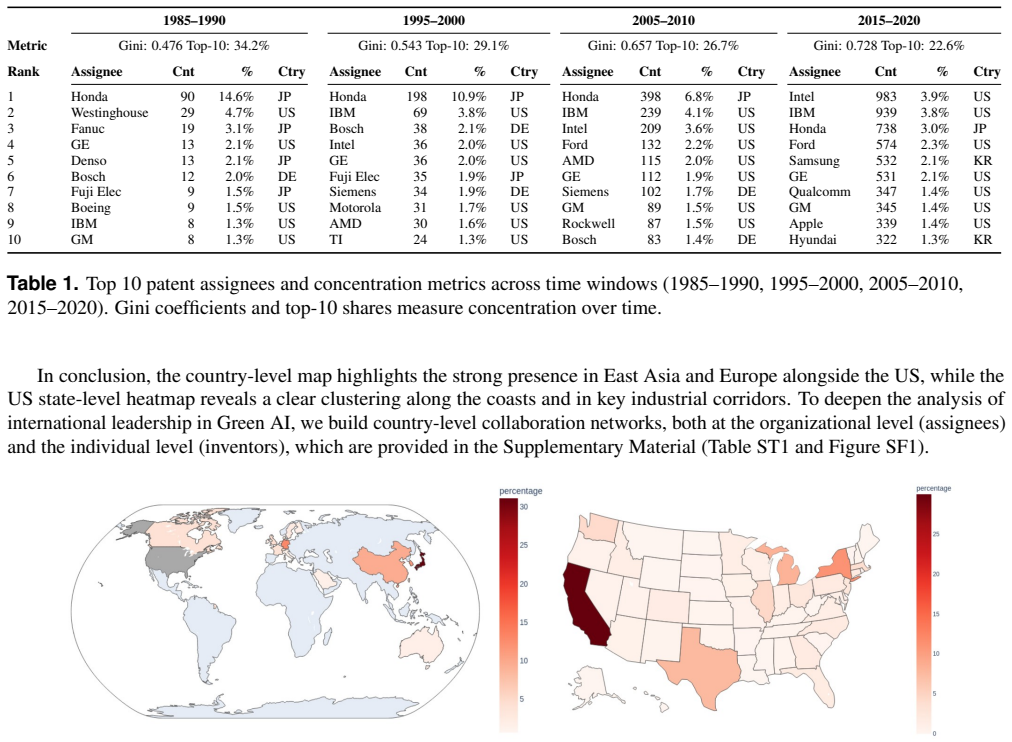
- Rising Gini concentration alongside a widening long tail means a small number of firms will hold large Green AI patent portfolios even as overall entry broadens, making monitoring for monopolistic behavior relevant.
- The release of the dataset allows other researchers to track these sixteen domains over time and test whether the observed shift accelerates, reverses, or spreads to other patent systems.
Where Pith is reading between the lines
- One extension the paper does not pursue: applying the same topic-modeling pipeline to European or Chinese patent data would show whether the U.S.-observed shift from combustion to data-centric climate AI is global or an artifact of U.S. patent-eligibility rules.
- If the value gap for meteorological radar and emission treatment reflects a genuine market failure, a natural policy experiment is to track whether government procurement or data-sharing mandates increase patenting and citations in those domains.
- The reported growth of the data-processing domain could partly reflect a patent-drafting fashion rather than new technical activity; checking citation-weighted domain shares would separate count inflation from technological influence.
- The concentration finding suggests that open-licensing or patent-pool arrangements may become important for keeping Green AI accessible, though the paper itself does not assess this.
Editorial analysis
A structured set of objections, weighed in public.
Referee Report
Summary. The paper constructs a novel dataset of 63,326 U.S. 'Green AI' patents by intersecting the CPC Y02/Y04S climate-related classes with the USPTO Artificial Intelligence Patent Dataset (AIPD). It describes the temporal dynamics, assignee concentration, geographic distribution, and technological composition of this corpus. Using BERTopic, the authors identify 16 technological domains and group them into 4 macro-domains; they then track domain-level patenting trends and combine forward citations with Kogan et al. market-value estimates to assess technological and economic impact. The headline claim is a 'clear shift' from legacy combustion-engine domains toward data processing, microgrids, and agricultural water management, with implications for climate policy and R&D priorities.
Significance. The manuscript offers a valuable descriptive contribution: the data construction is transparent, the dataset and code are deposited on Zenodo, and the systematic hyperparameter search for BERTopic is a reproducible step beyond much of the applied topic-modeling literature. If the headline shift claim and the domain-level impact rankings survive closer scrutiny, the paper provides a useful map of an important and understudied patent population. The combination of green-technology CPC tags with AIPD AI labels is a sensible and potentially reusable design. The main weaknesses are not in data construction but in the inference drawn from the topic model and in the unquantified impact comparisons; these are the load-bearing points for the paper's conclusions.
major comments (4)
- [Results: Technological (Macro-)Domains and Their Temporal Dynamics; Methods: Hyperparameter Tuning and Model Selection] The headline 'clear shift' claim rests on comparing topic-specific patent counts across 1976–2023 from a single BERTopic model fit to the full corpus. Patent language and drafting conventions change substantially over five decades, so a static 16-topic partition does not guarantee that 'Combustion Engine Control' in 1985 measures the same construct as in 2020. The Methods only say that 'consistency checks observed high stability' without reporting them, and UMAP is stochastic. If modern combustion patents use computing-oriented vocabulary, they could be absorbed into Data Processing & Memory Management, manufacturing the apparent shift. Please provide (i) multiple stochastic runs with topic-alignment statistics, (ii) period-wise refits (e.g., 1976–1995, 1996–2010, 2011–2023) with cross-period topic mapping, and (iii) validation of topic labels against CPC subclasses over time. This is ne
- [Results: Impact of Green AI Technological Domains on Knowledge Flows and Market Value; Methods: Impact analysis with for] Figure 5 compares raw average forward citations across domains whose grant-year distributions differ sharply. Older patents have had more time to accumulate citations, and no truncation correction, citation-lag adjustment, or grant-year fixed effects are used. The statement that Clinical Microbiome & Therapeutics is a 'clear outlier' and that Meteorological Radar has 'high citations but low economic return' is therefore not established. At a minimum, report citation counts by grant-year cohort and re-estimate domain differences with year fixed effects or a citation-lag model. Adding bootstrap confidence intervals would also show whether the domain-level rankings in Figure 5 are distinguishable from noise.
- [Results: Impact of Green AI Technological Domains on Knowledge Flows and Market Value; Methods: Impact analysis with for] The market-value analysis covers only 42.2% of the patents. The assertion that 'there is no reason to believe that the value of patents held by unlisted firms should behave any differently at the micro- and macro-domains level' is an untested missing-at-random assumption. Listing propensity is likely correlated with domain (e.g., automotive and electronics incumbents vs. agricultural water startups), which would bias the domain-level market-value rankings in Figure 5. Please compare matched and unmatched patents on observable characteristics (grant year, CPC subclasses, forward citations, assignee type) and provide a sensitivity analysis, such as Lee bounds or an inverse-probability weighting exercise, or explicitly relabel these rankings as exploratory.
- [Results: Technological (Macro-)Domains and Their Temporal Dynamics, Figure 4] The 'shift' from legacy to emerging domains is inferred from absolute patent counts, not relative shares. Total Green AI patenting grew by orders of magnitude over the sample period; a flat or declining absolute count for Combustion Engine Control is not the same as a structural shift in the composition of innovation. To support the headline claim, the paper should plot annual topic shares (or normalized counts) in addition to the 3-year rolling averages, and report the relative growth rates across domains.
minor comments (6)
- [Table 3] The column header 'prob' suggests these are probabilities, but the values are BERTopic c-TF-IDF scores. Please relabel and explain the metric.
- [Figure 5] The x-axis tick labels (5.0, 7.5, 10.0, 17.5, 20.0, 22.5) show an irregular gap; this is likely a plotting artifact or a typo. Please correct.
- [Discussion] There is a typo: 'hotsposts' should be 'hotspots'.
- [Conclusions] The domain name 'Meteorological Radar & Weather Management' in the Conclusions differs from 'Meteorological Radar & Weather Forecasting' used elsewhere. Please standardize.
- [Methods: Descriptive Analysis, Eq. (1)] The Gini coefficient formula contains LaTeX formatting artifacts in the displayed equation; please typeset it cleanly.
- [Methods: Hyperparameter Tuning and Model Selection] The 12.1% of documents treated as BERTopic outliers are excluded from all subsequent domain-level analyses. Please state whether the outlier rate varies systematically by grant year and whether the temporal trends in Figure 4 are robust to reassigning outliers or to alternative outlier thresholds.
Circularity Check
No significant circularity: descriptive empirical study with external data inputs; the only self-citation is non-load-bearing.
full rationale
The paper's derivation chain is a descriptive empirical analysis. The Green AI dataset is constructed by intersecting external, independently published classification systems (CPC Y02/Y04S and USPTO's AIPD AI labels). BERTopic topics are fitted to patent abstracts, and the temporal 'shift' claim is a direct summary of topic membership counts over time, not a prediction derived from fitted parameters. No equation in the paper defines a target variable in terms of the model's outputs; impact measures use external forward citations and precomputed Kogan et al. values. The only self-citation is ref. 20 (Biggi et al. 2025, co-authored by A. Mina) used to support the literature-gap statement that prior Green AI research relies on CPC rather than topic modeling; this is a literature claim and does not feed into any quantitative result, so it is not load-bearing. The assumption that the 42.2% of patents with market-value data are representative is a stated limitation, and the BERTopic temporal stability concern (single run, no cross-validation against CPC subclasses over time) is a correctness/robustness risk, not a circularity: the trends are not true by construction or by definition. The paper is self-contained against external benchmarks, so score is 0.
Axiom & Free-Parameter Ledger
free parameters (3)
- BERTopic hyperparameters (n_neighbors=30, min_dist=0.1, min_cluster_size=200, n_components=2) =
n_neighbors=30, min_dist=0.1, min_cluster_size=200, n_components=2
- AIPD AI classification threshold =
predict50_any_ai >= 0.5
- Number of topics (16) =
16
axioms (6)
- domain assumption AIPD predict50_any_ai=1 correctly identifies AI inventions.
- domain assumption CPC Y02/Y04S tags correctly identify climate mitigation and adaptation technologies.
- domain assumption BERTopic topics over patent abstracts correspond to meaningful technological domains.
- domain assumption Forward citations measure technological impact.
- domain assumption Kogan et al. market value estimates measure private economic value of patents.
- ad hoc to paper Missing market values are missing at random across domains.
Cite this review
Pith. "Pith review of The anatomy of Green AI technologies: structure, evolution, and impact." pith.science (2026). https://pith.science/paper/M6UJDEEJ
@misc{pith2026250910109,
  author       = {Pith},
  title        = {Pith review of: The anatomy of Green AI technologies: structure, evolution, and impact},
  year         = {2026},
  howpublished = {\url{https://pith.science/paper/M6UJDEEJ}},
  note         = {Machine review of arXiv:2509.10109}
}
read the original abstract
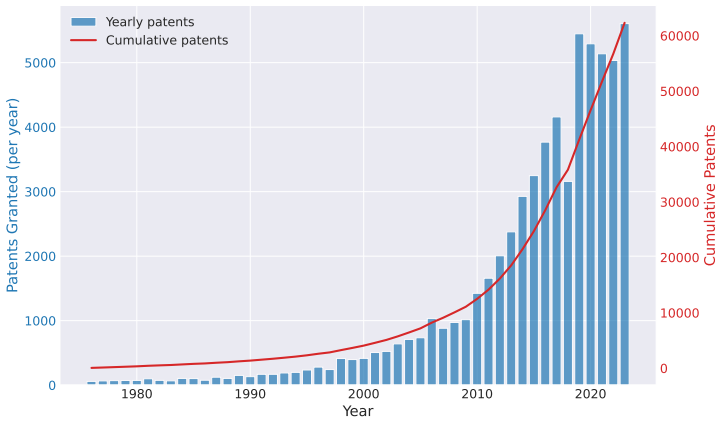
Artificial intelligence (AI) is a key enabler of innovation against climate change. In this study, we investigate the intersection of AI and climate adaptation and mitigation technologies through patent analyses of a novel dataset of approximately 63 000 Green AI patents. We analyze patenting trends, corporate ownership of the technology, the geographical distributions of patents, their impact on follow-on inventions and their market value. We use topic modeling (BERTopic) to identify 16 major technological domains, track their evolution over time, and identify their relative impact. We uncover a clear shift from legacy domains such as combustion engines technology to emerging areas like data processing, microgrids, and agricultural water management. We find evidence of growing concentration in corporate patenting against a rapidly increasing number of patenting firms. Looking at the technological and economic impact of patents, while some Green AI domains combine technological impact and market value, others reflect weaker private incentives for innovation, despite their relevance for climate adaptation and mitigation strategies. This is where policy intervention might be required to foster the generation and use of new Green AI applications.
Figures

Reference graph
Works this paper leans on
-
[2]
Maule, C. F., Mendlik, T. & Christensen, O. B. The effect of the pathway to a two degrees warmer world on the regional temperature change of europe.Clim. Serv.7, 3–11, DOI: 10.1016/j.cliser.2016.07.002 (2017)
-
[3]
Smith, G. S., Anjum, E., Francis, C.et al.Climate change, environmental disasters, and health inequities: The underlying role of structural inequalities.Curr. Environ. Heal. Reports9, 80–89, DOI: 10.1007/s40572-022-00336-w (2022)
-
[4]
Rogelj, J., Luderer, G., Pietzcker, R.et al.Energy system transformations for limiting end-of-century warming to below 1.5 °c.Nat. Clim. Chang.5, 519–527, DOI: 10.1038/nclimate2572 (2015)
-
[5]
Kaplan, A. & Haenlein, M. Siri, siri, in my hand: Who’s the fairest in the land? on the interpretations, illustrations, and implications of artificial intelligence.Bus. Horizons62, 15–25, DOI: 10.1016/j.bushor.2018.08.004 (2019)
-
[6]
Cowls, J., Tsamados, A., Taddeo, M. & Floridi, L. The ai gambit: leveraging artificial intelligence to combat climate change—opportunities, challenges, and recommendations.AI & Soc.38, 283–307, DOI: 10.1007/s00146-021-01294-x (2023)
-
[7]
H., Jaffe, A
Hall, B. H., Jaffe, A. B. & Trajtenberg, M. The nber patent citation data file: Lessons, insights and methodological tools (2001)
2001
-
[8]
Benson, C. L. & Magee, C. L. Quantitative determination of technological improvement from patent data.PloS one10, e0121635, DOI: 10.1371/journal.pone.0121635 (2015)
-
[9]
USPTO Economic Working Paper 2024-4, USPTO (2024)
Pairolero, N.et al.The artificial intelligence patent dataset (aipd) 2023 update. USPTO Economic Working Paper 2024-4, USPTO (2024). Available at https://www.uspto.gov/sites/default/files/documents/oce-aipd-2023.pdf
2023
-
[10]
Abdelrazek, A., Eid, Y ., Gawish, E., Medhat, W. & Hassan, A. Topic modeling algorithms and applications: A survey.Inf. Syst.112, 102131, DOI: 10.1016/j.is.2022.102131 (2023)
arXiv 2022
-
[11]
Momeni, A. & Rost, K. Identification and monitoring of possible disruptive technologies by patent-development paths and topic modeling.Technol. Forecast. Soc. Chang.104, 16–29, DOI: 10.1016/j.techfore.2015.12.003 (2016)
-
[12]
Najmani, K., Ajallouda, L., Benlahmar, E., Sael, N. & Zellou, A. BERTopic and LDA, which topic modeling technique to extract relevant topics from videos in the context of massive open online courses (MOOCs)? In Motahhir, S. & Bossoufi, B. (eds.)Digital Technologies and Applications. ICDTA 2023, vol. 669 ofLecture Notes in Networks and Systems, DOI: 10.100...
-
[13]
Gan, L.et al.Experimental comparison of three topic modeling methods with lda, top2vec and bertopic. In Lu, H. & Cai, J. (eds.)Artificial Intelligence and Robotics. ISAIR 2023, vol. 1998 ofCommunications in Computer and Information Science, DOI: 10.1007/978-981-99-9109-9_37 (Springer, Singapore, 2024). 14/17
-
[14]
Grootendorst, M. BERTopic: Neural topic modeling with a class-based tf-idf procedure.arXiv preprint arXiv:2203.05794 (2022)
Pith/arXiv arXiv 2022
-
[15]
Devlin, J., Chang, M.-W., Lee, K. & Toutanova, K. BERT: Pre-training of deep bidirectional transformers for language understanding. In Burstein, J., Doran, C. & Solorio, T. (eds.)Proceedings of the 2019 Conference of the North American Chapter of the Association for Computational Linguistics: Human Language Technologies, Volume 1 (Long and Short Papers), ...
-
[16]
Guizzardi, S., Colangelo, M. T., Mirandola, P. & Galli, C. Modeling new trends in bone regeneration, using the BERTopic approach.Regen. Medicine18, 719–734, DOI: 10.2217/rme-2023-0096 (2023)
-
[17]
Yun, B., Yoon, J.-I., Bae, J. & Yun, S. Analysis of autonomous vehicles patent trends between korea and overseas using BERTopic. In2024 4th International Conference on Electrical, Computer, Communications and Mechatronics Engineering (ICECCME), 1–6, DOI: 10.1109/ICECCME62383.2024.10796068 (IEEE, 2024)
arXiv 2024
-
[18]
Kim, K., Kogler, D. F. & Maliphol, S. Identifying interdisciplinary emergence in the science of science: combination of network analysis and bertopic.Humanit. Soc. Sci. Commun.11, 1–15, DOI: 10.1057/s41599-024-03044-y (2024)
-
[19]
Hou, K., Wu, M., Wu, W. & Huang, L. Topic mining and forecasting on patent map for gpu technology.The J. Supercomput. 81, 710, DOI: 10.1007/s11227-025-07215-9 (2025)
-
[20]
Biggi, G., Iori, M., Mazzei, J. & Mina, A. Green intelligence: The AI content of green technologies.Eurasian Bus. Rev. 1–38, DOI: 10.1007/s40821-024-00288-1 (2025)
-
[21]
A penny for your quotes: patent citations and the value of innovations.The Rand journal economics 172–187 (1990)
Trajtenberg, M. A penny for your quotes: patent citations and the value of innovations.The Rand journal economics 172–187 (1990). 22.Hall, B. H., Jaffe, A. B. & Trajtenberg, M. Market value and patent citations: A first look (2000)
1990
-
[23]
Kogan, L., Papanikolaou, D., Seru, A. & Stoffman, N. Technological innovation, resource allocation, and growth.The Q. J. Econ.132, 665–712, DOI: 10.1093/qje/qjw040 (2017)
-
[24]
Morris, J. J. & Alam, P. Value relevance and the dot-com bubble of the 1990s.The Q. Rev. Econ. Finance52, 243–255, DOI: 10.1016/j.qref.2012.04.001 (2012)
-
[25]
Teplykh, G. V . Innovations and productivity: the shift during the 2008 crisis.Ind. Innov.25, 53–83, DOI: 10.1080/ 13662716.2017.1286461 (2017)
arXiv 2008
-
[26]
Hingley, P. & Park, W. G. Do business cycles affect patenting? evidence from european patent office filings.Technol. Forecast. Soc. Chang.116, 76–86, DOI: 10.1016/j.techfore.2016.11.003 (2017)
-
[27]
Whalen, R. & Zingg, R. Innovating under uncertainty: The patent-eligibility of artificial intelligence after alice corp. v. cls bank international. In Langenfeld, J., Fagan, F. & Clark, S. (eds.)The Law and Economics of Privacy, Personal Data, Artificial Intelligence, and Incomplete Monitoring, vol. 30 ofResearch in Law and Economics, 59–81, DOI: 10.1108/...
-
[28]
Hu, S., Xia, Q. & Xie, Y . Technological innovation under trade disputes: how does product market competition matter? Eur. J. Innov. Manag.28, 1202–1223, DOI: 10.1108/EJIM-04-2023-0318 (2025)
-
[29]
Farris, F. A. The gini index and measures of inequality.The Am. Math. Mon.117, 851–864, DOI: 10.4169/ 000298910X523344 (2010)
2010
-
[30]
The origin and growth of industry clusters: The making of silicon valley and detroit.J
Klepper, S. The origin and growth of industry clusters: The making of silicon valley and detroit.J. Urban Econ.67, 15–32, DOI: 10.1016/j.jue.2009.09.004 (2010)
-
[31]
& Wang, N
Mattoon, R. & Wang, N. Industry clusters and economic development in the seventh district’s largest cities.Econ. Perspectives Q2, 52–66 (2014)
2014
-
[32]
Angelucci, S., Hurtado-Albir, F. J. & V olpe, A. Supporting global initiatives on climate change: The epo’s “y02-y04s” tagging scheme.World Pat. Inf.54, S85–S92, DOI: 10.1016/j.wpi.2017.04.006 (2018)
-
[33]
Heal.4, e271–e279, DOI: 10.1016/S2542-5196(20)30121-2 (2020)
Lenzen, M.et al.The environmental footprint of health care: a global assessment.The Lancet Planet. Heal.4, e271–e279, DOI: 10.1016/S2542-5196(20)30121-2 (2020)
-
[34]
Aus der Beek, T.et al.Pharmaceuticals in the environment—global occurrences and perspectives.Environ. Toxicol. Chem. 35, 823–835, DOI: 10.1002/etc.3339 (2016)
-
[35]
Aristodemou, L. & Tietze, F. Citations as a measure of technological impact: A review of forward citation-based measures. World Pat. Inf.53, 39–44, DOI: 10.1016/j.wpi.2018.05.001 (2018). 15/17
-
[36]
Graham, S. J. H. & Mowery, D. C. Intellectual property protection in the us software industry. In Cohen, W. M. & Merrill, S. A. (eds.)Patents in the Knowledge-Based Economy, 219–231 (National Academies Press, Washington, DC, 2003)
2003
-
[37]
Toole, A. A., Jones, C. & Madhavan, S. Patentsview: An open data platform to advance science and technology policy. Tech. Rep., USPTO Economic Working Paper No. 2021-1 (2021). DOI: 10.2139/ssrn.3874213. Available at SSRN: https://ssrn.com/abstract=3874213
-
[38]
Webb, M., Short, N., Bloom, N. & Lerner, J. Some facts of high-tech patenting. Working Paper 24793, National Bureau of Economic Research (2018). DOI: 10.3386/w24793
-
[39]
Reimers, N. & Gurevych, I. Sentence-bert: Sentence embeddings using siamese bert-networks (2019). https://www.sbert. net, 1908.10084
Pith/arXiv arXiv 2019
-
[40]
Wang, J. & Hsu, C.-C. A topic-based patent analytics approach for exploring technological trends in smart manufacturing. J. Manuf. Technol. Manag.32, 110–135, DOI: 10.1108/JMTM-03-2020-0106 (2021)
- [41]
-
[42]
McInnes, L., Healy, J., Saul, N. & Großberger, L. Umap: Uniform manifold approximation and projection.J. Open Source Softw.3, 861, DOI: 10.21105/joss.00861 (2018)
-
[43]
McInnes, L. & Healy, J. Accelerated hierarchical density based clustering. In2017 IEEE International Conference on Data Mining Workshops (ICDMW), 33–42, DOI: 10.1109/ICDMW.2017.12 (2017)
-
[44]
Murdock, J. & Allen, C. Visualization techniques for topic model checking. InProceedings of the AAAI Conference on Artificial Intelligence, vol. 29, DOI: 10.1609/aaai.v29i1.9268 (2015)
-
[45]
Kumar, A., Karamchandani, A. & Singh, S. Topic modeling of neuropsychiatric diseases related to gut microbiota and gut brain axis using artificial intelligence based bertopic model on pubmed abstracts.Neurosci. Informatics4, 100175, DOI: 10.1016/j.neuri.2024.100175 (2024)
arXiv 2024
-
[46]
Madrid-García, A., Freites-Núñez, D., Merino-Barbancho, B., Pérez Sancristobal, I. & Rodríguez-Rodríguez, L. Map- ping two decades of research in rheumatology-specific journals: a topic modeling analysis with bertopic.Ther. Adv. Musculoskelet. Dis.16, 1759720X241308037, DOI: 10.1177/1759720X241308037 (2024)
-
[47]
Borˇcin, M. & Jose, J. M. Optimizing bertopic: Analysis and reproducibility study of parameter influences on topic modeling. In Goharian, N.et al.(eds.)Advances in Information Retrieval. ECIR 2024, vol. 14611 ofLecture Notes in Computer Science, 179–193, DOI: 10.1007/978-3-031-56066-8_14 (Springer, Cham, 2024)
-
[48]
Farea, A., Tripathi, S., Glazko, G. & Emmert-Streib, F. Investigating the optimal number of topics by advanced text-mining techniques: Sustainable energy research.Eng. Appl. Artif. Intell.136, 108877, DOI: 10.1016/j.engappai.2024.108877 (2024)
arXiv 2024
-
[49]
& McCallum, A
Mimno, D., Wallach, H., Talley, E., Leenders, M. & McCallum, A. Optimizing semantic coherence in topic models. In Proceedings of the 2011 Conference on Empirical Methods in Natural Language Processing, 262–272 (Association for Computational Linguistics, 2011)
2011
-
[50]
Topic modeling with gensim
One-OffCoder. Topic modeling with gensim. https://datascience.oneoffcoder.com/topic-modeling-gensim.html (2020). Accessed: 2025-05-16
2020
- [51]
-
[52]
M., Anggai, S., Tukiyat, Musyafa, A
Zain, R. M., Anggai, S., Tukiyat, Musyafa, A. & Waskita, A. A. Revealing a country’s government discourse through bert- based topic modeling in the us presidential speeches. In2024 International Conference on Computer, Control, Informatics and its Applications (IC3INA), 191–196, DOI: 10.1109/IC3INA64086.2024.10732578 (IEEE, Bandung, Indonesia, 2024)
arXiv 2024
-
[53]
Emer, L., Mina, A. & Vandin, A. The anatomy of green ai technologies: structure, evolution, and impact - dataset and replicability material, DOI: https://doi.org/10.5281/zenodo.15545360 (2025). Acknowledgements The work has been partially supported by project SMaRT COnSTRUCT (CUP J53C24001460006), in the context of FAIR (PE0000013, CUP B53C22003630006) un...
This paper was first reviewed by deepseek-v4-flash on August 4, 2026.
discussion (0)
Sign in with ORCID, Apple, or X to comment. Anyone can read and Pith papers without signing in.