REVIEW 3 major objections 5 minor 63 references
Spectroscopy and transport of nonpolarons in silicon and germanium: the influence of doping and temperature
T0 review · 3 major / 5 minor · reviewed 2026-08-04 · deepseek-v4-flash
Pith's one-line read The paper shows that phonon satellites in silicon and germanium are placed correctly only by the cumulant expansion, and that their asymmetry explains germanium's higher mobility.
desk verdict A careful CE-based spectral/mobility study of Si and Ge with genuinely new predictions (Ge VBM/CBM asymmetry), but the quantitative doping/mobility claims lean on an undocumented impurity model and undoped matrix elements. read the letter →
The pith
A machine-rendered reading of the paper's core claim, the machinery that carries it, and where it could break.
The reading
What carries the argument
The central object is the retarded cumulant function C(t), which exponentiates the Fan–Migdal self-energy—the standard second-order electron-phonon self-energy—to construct the single-particle Green's function instead of solving the Dyson equation. The exponential resummation places phonon satellites at one phonon frequency above the quasiparticle peak and captures multi-phonon effects, while the long-time slope of C(t) directly yields the quasiparticle lifetime and energy shift. The same spectral functions are fed into the Kubo–Greenwood conductivity formula, and a double-grid interpolation for the electron-phonon matrix elements makes the transport calculations feasible at dense k-meshes.
What would settle it
Measure with angle-resolved photoemission at 100 K the conduction-band edge of intrinsic germanium: if a distinct satellite appears at roughly one optical-phonon energy above the quasiparticle peak, the paper's central asymmetry claim fails. A complementary ab initio test: recompute the electron-phonon self-energy on a dense q-grid at 2×10^20 cm^-3 with doping-dependent screening and check whether the predicted satellite-QP compression survives.
Extended reading notes
Core claim
On its own terms, the central discovery is the band-edge asymmetry in the nonpolaronic spectral function: in silicon the phonon satellites are resolved at both the conduction-band minimum and the valence-band maximum, while in germanium the valence-band maximum shows pronounced sidebands and the conduction-band minimum shows only weak features. The authors interpret this as a difference in the orbital character and density of states near the edges, leading to longer conduction-electron lifetimes in germanium and hence its higher electron mobility. The cumulant expansion also predicts that the Dyson-Migdal approximation overestimates the satellite–quasiparticle separation, and that temperatur
Load-bearing premise
The central premise is that free-carrier screening at doping levels up to 2×10^20 cm^-3 barely alters the short-range electron-phonon coupling computed for the undoped crystal, so that the reported doping-induced broadening and satellite compression are real; if screening does renormalize those short-range potentials, the high-doping results lose their quantitative meaning.
Editorial extensions
If this is right
- For spectral measurements, the correct satellite position is one phonon frequency above the quasiparticle peak; the Dyson-Migdal approximation places it at the wrong reference energy and should not be used for fingerprinting.
- Germanium's spectral asymmetry—strong VBM sidebands and weak CBM satellites—is a qualitative marker of its higher electron mobility; the inverse search (spectra to mobility) is viable within this framework.
- Doping effects are band-selective: n-type carriers modify the CBM and p-type the VBM, so experiments on doped samples should target the corresponding band edge.
- Because short-range potentials dominate phonon scattering in these nonpolar materials, free-carrier screening has little effect on the phonon-limited mobility; ionized-impurity scattering must be modeled separately to reproduce the experimental doping dependence.
Reading between the lines
- The predicted asymmetry suggests a screening heuristic: for covalent semiconductors, a weak phonon sideband at the transport band edge indicates a high-mobility material; this could be tested by computing low-temperature spectral functions across a series of diamond-structure compounds.
- The temperature-driven merging of satellites implies that cryogenic angle-resolved photoemission is the right experiment to observe nonpolaron fingerprints; room-temperature measurements may show only a broadened quasiparticle peak.
- At high doping, the compressed satellite-QP separation makes the spectral function more Fermi-liquid-like; one could test whether this changes hot-carrier thermalization rates or optical absorption beyond the static screening description.
- The mobility calculations rely on a double-grid interpolation that may be fragile near the degenerate valence band; using a denser interpolation or Wannier functions could shift the hole mobilities in silicon, although the Ge-Si ordering is likely robust.
Signed reviews
Editorial analysis
A structured set of objections, weighed in public.
Referee Report
Summary. The paper presents first-principles calculations of electron-phonon spectral functions and mobilities in silicon and germanium using the retarded cumulant expansion (CE) with Fan-Migdal self-energies from DFPT. It reports distinct nonpolaronic spectral fingerprints: Si shows well-resolved satellites at both the VBM and CBM, while Ge shows strong valence-band sidebands but much weaker conduction-band satellites. Temperature and doping are shown to broaden quasiparticle peaks and compress satellite-quasiparticle separation. Mobilities are computed with the Kubo-Greenwood formula, using CE, Dyson-Migdal (DM), and SERTA spectral functions, and combined with a Brooks-Herring impurity-scattering model to compare with experiment. The paper argues that Ge's higher mobility correlates with weaker CBM coupling and that the CE approach is necessary to capture these spectral and transport trends.
Significance. The central methodological claim—that CE on top of DFPT self-energies resolves nonpolaronic phonon satellites in Si and Ge beyond the DM approximation—is plausible and technically well documented. The paper provides a useful comparison between DM and CE for benchmark covalent semiconductors and connects spectral asymmetry at the CBM/VBM to transport trends. The study is reproducible in principle: all calculations are based on ABINIT, convergence tests are reported in Appendices B and D, and the spectral function calculations are parameter-free apart from the broadening η and grid sizes. However, the quantitative doping and mobility conclusions rest on two empirical or untested ingredients: the neglect of doping-dependent renormalization of e-ph matrix elements, and an undocumented Brooks-Herring impurity-scattering model. These issues do not invalidate the undoped spectral results but they do limit the strength of the claimed doping and transport validation.
major comments (3)
- [Sec. IV.1.2 and IV.3] The doped spectral and mobility calculations use undoped DFPT e-ph matrix elements, as explicitly stated: 'doping-dependent renormalization of the e-ph matrix elements is not included in our present simulations.' The justification that free-carrier screening only weakly renormalizes short-range potentials is not supported by a calculation or a specific reference for Si/Ge at concentrations up to 2e20 cm^-3, where the Thomas-Fermi screening length approaches interatomic distances. Since the doping-induced broadening and satellite-QP compression are central claims, these trends should either be shown robust against a screening model or reframed as phase-space effects only.
- [Sec. III (Eq. 15), Sec. IV.3] The Brooks-Herring impurity-limited mobility is introduced in Sec. III and used in Fig. 9, but no formula, screening length, compensation, or explicit doping/temperature dependence is reported. The 'excellent agreement' with experiment is therefore not reproducible or testable. At high doping, impurity scattering dominates the total mobility, so the agreement in Fig. 9 does not validate the CE spectral functions. A sensitivity analysis of the Brooks-Herring parameters and their relation to the experimental samples is needed before drawing quantitative conclusions.
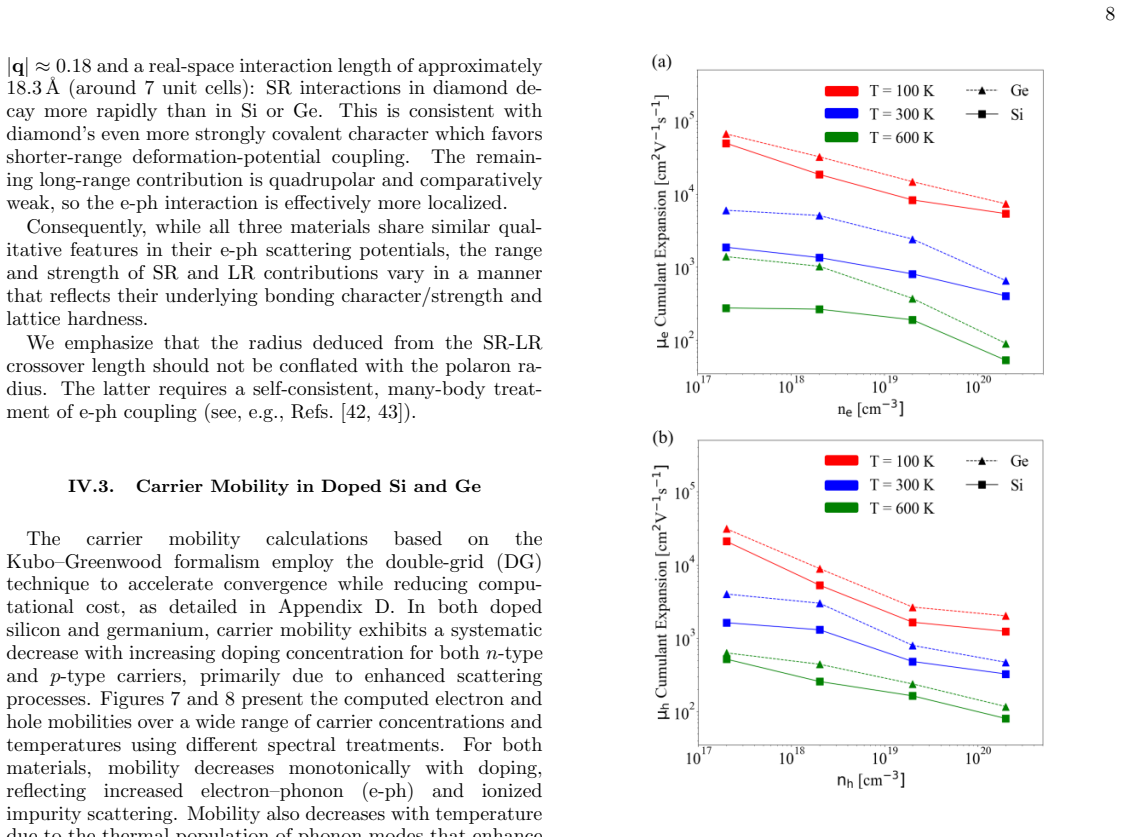
- [Appendix D and Sec. IV.3] The double-grid convergence test is shown only for electron mobility in n-type Si (Fig. D1). The p-type mobilities, which are a principal result, involve the degenerate VBM of Si and Ge, and the text itself acknowledges that linear interpolation 'cannot handle band (anti)crossings.' No equivalent convergence test is presented for hole transport. Additionally, Sec. III states that the Kubo formula is used in the diagonal approximation for the velocity operator, which is not generally adequate for degenerate VBM bands. These issues leave the quantitative p-type mobility results insufficiently supported.
minor comments (5)
- [References] Reference [22] is incomplete: it lacks authors and a full title. Reference [31] is cited in the text as 'Jae-Mo et al.' but the reference list gives Lihm and Poncé; please correct the in-text citation.
- [Fig. 3 caption] Caption contains a typo: 'for for p-type doping levels' should read 'for p-type doping levels.'
- [Sec. IV.2] The sentence 'Both atoms exhibit the same |Vq|' is unclear. Please clarify whether the two sublattice atoms are symmetry-equivalent or whether the statement refers only to the chosen displacement direction.
- [Sec. II.2.2, Eq. (9)] The definition of β_nk(ω) with an absolute value of ImΣ is standard, but the sign convention and the integration range for ω could be stated explicitly, since the satellite placement in CE depends on the relative sign of β for positive and negative ω.
- [Sec. I / Abstract] The term 'nonpolaron' is used throughout without a crisp definition. Please define it explicitly when Emin's work is cited, distinguishing it from dipolar polarons and from the interaction-range crossover discussed in Sec. IV.2.
Circularity Check
No significant circularity: the central spectral and transport results are computed from first-principles DFPT self-energies; self-citations and the empirical impurity model are non-load-bearing.
full rationale
The paper's central derivation chain is: DFPT electron-phonon matrix elements and phonon energies → Fan-Migdal self-energy (Eqs. 1–3) → cumulant spectral function (Eqs. 7–10) → Kubo-Greenwood mobility (Eq. 12). Each step is a first-principles computation, and no fitted parameter is renamed as a prediction. Doping enters through the Fermi occupations in Eq. (3), so the reported doping-induced broadening and n-/p-type selectivity are genuine consequences of the input self-energy, not a fit. The Brooks–Herring impurity mobility (Eq. 15) is explicitly described as 'experimentally motivated' and 'empirical'; it is an adjunct for benchmarking, not an output passed off as a purely first-principles prediction. The satellite position near ωLO is a formal property of the cumulant ansatz, but the material-dependent satellite intensities, temperature broadening, and mobility trends are outputs of the calculated e-ph matrix elements. Self-citations (Refs. 13, 22, 38–39) provide background on diamond quadrupoles and interpolation techniques; the Si/Ge results are recomputed here, and convergence is demonstrated in Appendices B and D. The undoped-matrix-element assumption at high doping and the undocumented impurity-model parameters are correctness/limitation concerns, not circularity. No equation reduces to its own input, and no load-bearing uniqueness claim is imported from prior work. Score 0.
Assumptions & free parameters
free parameters (4)
- Broadening parameter eta =
1 meV
- Brillouin-zone q-grid size N =
160 for Si, 120 for Ge
- Brooks-Herring screening parameters =
From experimental mobility datasets / literature
- Double-grid coarse q mesh =
Ncoarse=40
assumptions (6)
- domain assumption Second-order cumulant expansion provides sufficient accuracy for spectral functions in weakly coupled Si and Ge (Eqs. 7-10).
- standard math Fan-Migdal self-energy with Debye-Waller term and rigid-ion acoustic sum rule gives correct e-ph matrix elements (Eqs. 1-3).
- domain assumption Kubo-Greenwood formula with diagonal velocity approximation is adequate for mobility in Si and Ge (Eq. 12).
- domain assumption Free-carrier screening does not renormalize short-range e-ph matrix elements at high doping.
- domain assumption Brooks-Herring model with literature screening parameters describes ionized impurity scattering (Eq. 15).
- domain assumption Linear interpolation of e-ph matrix elements on the double grid is accurate except near band crossings (Appendix D).
Cite this review
Pith. "Pith review of Spectroscopy and transport of nonpolarons in silicon and germanium: the influence of doping and temperature." pith.science (2026). https://pith.science/paper/UOGNWQGD
@misc{pith2026250910192,
  author       = {Pith},
  title        = {Pith review of: Spectroscopy and transport of nonpolarons in silicon and germanium: the influence of doping and temperature},
  year         = {2026},
  howpublished = {\url{https://pith.science/paper/UOGNWQGD}},
  note         = {Machine review of arXiv:2509.10192}
}
read the original abstract
We perform a first-principles investigation of electron-phonon interactions in silicon and germanium, uncovering distinct non-polaronic spectral and transport fingerprints in these archetypal covalent semiconductors. Using many-body perturbation theory with the retarded cumulant expansion, we compute quasiparticle energies, lifetimes, and phonon satellites beyond the Dyson-Migdal approximation. Short-range crystal fields dominate coupling in both materials, yet their low-temperature spectral fingerprints differ: Si exhibits well-resolved satellites at both band edges, whereas Ge displays strong sidebands mainly at the valence band maximum (VBM) and much weaker features at the conduction band minimum (CBM). Phonon-induced satellites in both materials broaden and merge with the quasiparticle peak at elevated temperatures. Doping broadens peaks and compresses satellite-quasiparticle separation, with n-type carriers affecting the CBM and p-type the VBM. Mobility calculations, combining cumulant-derived phonon scattering with experimentally motivated ionized-impurity scattering models, reproduce measured trends and reveal Ge's consistently higher mobilities than Si, stemming from lighter effective masses and weaker coupling. These results link band-edge asymmetries and phonon energetics to measurable transport differences, providing a unified framework for predicting mobility in nonpolar semiconductors.
Figures


Figures from the paper (4 more)



Reference graph
Works this paper leans on
-
[1]
Jacoboni and P
C. Jacoboni and P. Lugli, The Monte Carlo Method for Semi- conductor Device Simulation (Springer, 1989)
1989
-
[2]
D. L. Rode, Low-field electron transport, in Semiconductors and Semimetals , Vol. 10 (Academic Press, 1975) pp. 1–89
1975
-
[3]
C. Canali et al., Electron and hole drift velocity measurements in silicon and their empirical relation to electric field and tem- perature, IEEE Transactions on Electron Devices 22, 1045 (1975)
1975
-
[4]
P. P. Debye and E. M. Conwell, Mobility of electrons in ger- manium, Physical Review 87, 1131–1132 (1952)
1952
-
[5]
V. A. Johnson and K. Lark-Horovitz, Electronic mobility in germanium, Physical Review 79, 409–410 (1950)
1950
-
[6]
Koenig and G
S. Koenig and G. Gunther-Mohr, The low temperature electri- cal conductivity of n-type germanium, Journal of Physics and Chemistry of Solids 2, 268–283 (1957)
1957
-
[7]
S. H. Koenig, R. D. Brown, and W. Schillinger, Electrical con- duction in n-type germanium at low temperatures, Physical Review 128, 1668–1696 (1962)
1962
-
[8]
F. J. Morin and J. P. Maita, Conductivity and hall effect in the intrinsic range of germanium, Physical Review 94, 1525–1529 (1954)
1954
Show all 63 references
-
[9]
E. Pop, S. Sinha, and K. E. Goodson, Heat generation and transport in nanometer-scale transistors, Proceedings of the IEEE 94, 1587 (2010)
2010
-
[10]
O. M. Nayfeh et al., Effects of high fields on electron transport in nanoscale silicon devices, IEEE Transactions on Electron Devices 52, 2003 (2005)
2003
-
[11]
Frohlich, Electrons in lattice fields, Advances in Physics 3, 325 (1954)
H. Frohlich, Electrons in lattice fields, Advances in Physics 3, 325 (1954)
1954
-
[12]
Emin, Polaron mechanisms for multiphonon-assisted hop- ping of small polarons, Solid State Communications 70, 127 (1989)
D. Emin, Polaron mechanisms for multiphonon-assisted hop- ping of small polarons, Solid State Communications 70, 127 (1989)
1989
-
[13]
J. C. Abreu, J. P. Nery, M. Giantomassi, X. Gonze, and M. J. Verstraete, Spectroscopic signatures of nonpolarons : the case of diamond, Phys. Chem. Chem. Phys. 24, 12580 (2022)
2022
-
[14]
A. B. Migdal, Interaction between electrons and lattice vibra- tions in a normal metal, Zh. Eksp. Teor. Fiz. 34, 1438 (1958)
1958
-
[15]
F. J. Dyson, The s matrix in quantum electrodynamics, Phys. Rev. 75, 1736 (1949)
1949
-
[16]
Guzzo, J
M. Guzzo, J. Kas, F. Sottile, M. Silly, F. Sirotti, J. Rehr, and L. Reining, Excitonic effects in x-ray absorption spectroscopy, European Physical Journal B 85, 324 (2012)
2012
-
[17]
Caruso and F
F. Caruso and F. Giustino, Ab initio calculation of the exci- tonic absorption spectrum of silicon, Physical Review B: Con- densed Matter and Materials Physics 92, 045123 (2015)
2015
-
[18]
J. J. Kas, J. J. Rehr, and J. A. Soininen, Cumulant expansion approach for the simulation of inelastic losses in x-ray absorp- tion spectra, Physical Review B 90, 085112 (2014)
2014
-
[19]
Aryasetiawan, L
F. Aryasetiawan, L. Hedin, and K. Karlsson, Electronic struc- ture of solids: The gw method, Physical Review Letters 77, 2268 (1996)
1996
-
[20]
Gumhalter, V
B. Gumhalter, V. Kov´ aˇ c, and B. Sundaram, Cumulant ex- pansion methods for describing electron-phonon interactions in solids, Journal of Physics: Condensed Matter 28, 155601 (2016)
2016
-
[21]
J. P. Nery, P. B. Allen, G. Antonius, L. Reining, A. Miglio, and X. Gonze, Quasiparticles and phonon satellites in spectral func- tions of semiconductors and insulators: Cumulants applied to the full first-principles theory and the fr¨ ohlich polaron, Physi- cal Review B 97, 1...
2018
-
[22]
Polaronic effects in diamond: Non-polar material studies, Physical Chemistry Chemical Physics (2024)
2024
-
[23]
Mishchenko, N
A. Mishchenko, N. Prokof’ev, A. Sakamoto, and B. Svistunov, Electron-phonon interactions and coupled charge-lattice dy- namics in a polaron model: A study with diagrammatic monte carlo, Phys. Rev. B: Condens. Matter Mater. Phys. 62, 6317 (2000)
2000
-
[24]
Kubo, Generalized cumulant expansion method, J
R. Kubo, Generalized cumulant expansion method, J. Phys. Soc. Jpn. 17, 1100 (1962)
1962
-
[25]
Gunnarsson, V
O. Gunnarsson, V. Meden, and K. Sch¨ onhammer, Photoemis- sion spectra of one-dimensional luttinger liquids, Phys. Rev. B: Condens. Matter Mater. Phys. 50, 10462 (1994)
1994
-
[26]
G. D. Mahan, Many-Particle Physics (Springer, Boston, 2000)
2000
-
[27]
Antonius, S
G. Antonius, S. Ponc´ e, E. Lantagne-Hurtubise, G. Auclair, X. Gonze, and M. Cˆ ot´ e, Theory of the zero-point renormal- ization of the optical gap of diamond, silicon, and germa- nium, Phys. Rev. B: Condens. Matter Mater. Phys. 92, 085137 (2015)
2015
-
[28]
Hedin, Effects of recoil on shake-up spectra in metals, Phys- ica Scripta 21, 477–480 (1980)
L. Hedin, Effects of recoil on shake-up spectra in metals, Phys- ica Scripta 21, 477–480 (1980)
1980
-
[29]
Guzzo, G
M. Guzzo, G. Lani, F. Sottile, P. Romaniello, M. Gatti, J. J. Kas, J. J. Rehr, M. G. Silly, F. Sirotti, and L. Reining, Va- lence electron photoemission spectrum of semiconductors:ab initiodescription of multiple satellites, Physical Review Letters 107, 10.1103/physrevlett.107...
2011 doi
-
[30]
Gumhalter, Ultrafast dynamics and decoherence of quasi- particles in surface bands: Development of the formalism, Physical Review B 72, 10.1103/physrevb.72.165406 (2005)
B. Gumhalter, Ultrafast dynamics and decoherence of quasi- particles in surface bands: Development of the formalism, Physical Review B 72, 10.1103/physrevb.72.165406 (2005)
2005 doi
-
[31]
Lihm and S
J.-M. Lihm and S. Ponc´ e, Beyond-quasiparticles transport with vertex correction: self-consistent ladder formalism for electron- phonon interactions (2025)
2025
-
[32]
Zhou and M
J.-J. Zhou and M. Bernardi, Predicting charge transport in the presence of polarons: The beyond-quasiparticle regime in srtio3, Physical Review Research 1, 10.1103/physrevre- search.1.033138 (2019)
2019 doi
-
[33]
Verdi, F
C. Verdi, F. Caruso, and F. Giustino, Origin of the crossover from polarons to fermi liquids in transition metal oxides, Na- ture Communications 8, 10.1038/ncomms15769 (2017)
2017 doi
-
[34]
Brooks, Scattering by ionized impurities in semiconductors, Physical Review 83 (1951)
H. Brooks, Scattering by ionized impurities in semiconductors, Physical Review 83 (1951)
1951
-
[35]
M. J. Verstraete, J. Abreu, G. E. Allemand, B. Amadon, G. Antonius, M. Azizi, L. Baguet, C. Barat, L. Bastogne, R. Bejaud, J.-M. Beuken, J. Bieder, A. Blanchet, F. Bottin, J. Bouchet, J. Bouquiaux, E. Bousquet, J. Boust, F. Brieuc, V. Brousseau-Couture, N. B. F. Bruneval, A. C...
2025
-
[36]
Gonze, B
X. Gonze, B. Amadon, G. Antonius, F. Arnardi, L. Baguet, J.-M. Beuken, J. Bieder, F. Bottin, J. Bouchet, E. Bous- quet, N. Brouwer, F. Bruneval, G. Brunin, T. Cavignac, J.- B. Charraud, W. Chen, M. Cˆ ot´ e, S. Cottenier, J. Denier, G. Geneste, P. Ghosez, M. Giantomassi, Y. Gi...
2020
-
[37]
A. H. Romero, D. C. Allan, B. Amadon, G. Antonius, T. App- lencourt, L. Baguet, J. Bieder, F. Bottin, J. Bouchet, E. Bous- quet, F. Bruneval, G. Brunin, D. Caliste, M. Cˆ ot´ e, J. Denier, C. Dreyer, P. Ghosez, M. Giantomassi, Y. Gillet, O. Gingras, D. R. Hamann, G. Hautier, F...
2020
-
[38]
Brunin, H
G. Brunin, H. P. C. Miranda, M. Giantomassi, M. Royo, M. Stengel, M. J. Verstraete, X. Gonze, G.-M. Rignanese, and G. Hautier, Electron-phonon beyond fr¨ ohlich: Dynami- cal quadrupoles in polar and covalent solids, Physical Review Letters 125, 10.1103/physrevlett.125.136601 (2020)
2020 doi
-
[39]
Brunin, H
G. Brunin, H. P. C. Miranda, M. Giantomassi, M. Royo, M. Stengel, M. J. Verstraete, X. Gonze, G.-M. Rignanese, and G. Hautier, Phonon-limited electron mobility in si, gaas, and gap with exact treatment of dynamical quadrupoles, Physical Review B 102, 10.1103/physrevb.102.094308 (2020)
2020 doi
-
[40]
Eiguren and C
A. Eiguren and C. Ambrosch-Draxl, Wannier interpolation scheme for phonon-induced potentials: Application to bulk mgb2, w, and the (1 ×1) h-covered w(110) surface, Physical Review B 78, 10.1103/physrevb.78.045124 (2008)
2008 doi
-
[41]
M. E. Levinshtein, S. L. Rumyantsev, and M. S. Shur, eds., Properties of Advanced Semiconductor Materials (John Wiley & Sons, Nashville, TN, 2001)
2001
-
[42]
W. H. Sio, C. Verdi, S. Ponc´ e, and F. Giustino, Ab initiotheory of polarons: Formalism and applications, Physical Review B 99, 10.1103/physrevb.99.235139 (2019)
2019 doi
-
[43]
F. M. Peeters and J. T. Devreese, Acoustical polaron in three dimensions: The ground-state energy and the self-trapping transition, Physical Review B 32, 3515–3521 (1985)
1985
-
[44]
Jacoboni, C
C. Jacoboni, C. Canali, G. Ottaviani, and A. Alberigi Quar- anta, A review of some charge transport properties of silicon, Solid-State Electronics 20, 77–89 (1977)
1977
-
[45]
Mousty, P
F. Mousty, P. Ostoja, and L. Passari, Relationship between resistivity and phosphorus concentration in silicon, Journal of Applied Physics 45, 4576–4580 (1974)
1974
-
[46]
Norton, T
P. Norton, T. Braggins, and H. Levinstein, Impurity and lattice scattering parameters as determined from hall and mobility analysis in silicon, Physical Review B 8, 5632–5653 (1973)
1973
-
[47]
Ottaviani, L
G. Ottaviani, L. Reggiani, C. Canali, F. Nava, and A. Alberigi- Quaranta, Hole drift velocity in silicon, Physical Review B 12, 3318–3329 (1975)
1975
-
[48]
R. A. Logan and A. J. Peters, Impurity effects upon mobility in silicon, Journal of Applied Physics 31, 122–124 (1960)
1960
-
[49]
Jacoboni, F
C. Jacoboni, F. Nava, C. Canali, and G. Ottaviani, Electron drift velocity and diffusivity in germanium, Physical Review B 24, 1014–1026 (1981)
1981
-
[50]
P. P. Debye and E. M. Conwell, Electrical properties n-type germanium, Physical Review 93, 693–706 (1954)
1954
-
[51]
W. G. Spitzer, F. A. Trumbore, and R. A. Logan, Properties of heavily doped n-type germanium, Journal of Applied Physics 32, 1822–1830 (1961)
1961
-
[52]
van Setten, M
M. van Setten, M. Giantomassi, E. Bousquet, M. Verstraete, D. Hamann, X. Gonze, and G.-M. Rignanese, The pseu- dodojo: Training and grading a 85 element optimized norm- conserving pseudopotential table, Computer Physics Commu- nications 226, 39–54 (2018)
2018
-
[53]
J. P. Perdew, K. Burke, and M. Ernzerhof, Generalized gradi- ent approximation made simple, Physical Review Letters 77, 3865–3868 (1996)
1996
-
[54]
Tran and P
F. Tran and P. Blaha, Accurate band gaps of semiconductors and insulators with a semilocal exchange-correlation potential, Physical Review Letters 102, 10.1103/physrevlett.102.226401 (2009)
2009 doi
-
[55]
J. P. Perdew and A. Zunger, Self-interaction correction to density-functional approximations for many-electron systems, Physical Review B 23, 5048–5079 (1981)
1981
-
[56]
J. P. Perdew and Y. Wang, Accurate and simple analytic rep- resentation of the electron-gas correlation energy, Physical Re- view B 45, 13244–13249 (1992)
1992
-
[57]
P. J. Collings, Simple measurement of the band gap in sili- con and germanium, American Journal of Physics 48, 197–199 (1980)
1980
-
[58]
B. D. Sukheeja, Measurement of the band gap in silicon and germanium, American Journal of Physics 51, 72–72 (1983)
1983
-
[59]
M. A. Green, Intrinsic concentration, effective densities of states, and effective mass in silicon, Journal of Applied Physics 67, 2944 (1990)
1990
-
[60]
Bludau, A
W. Bludau, A. Onton, and W. Heinke, Temperature depen- dence of the band gap of silicon and germanium, Journal of Applied Physics 45, 1846 (1974)
1974
-
[61]
Madelung, Semiconductors: Data Handbook (Springer Berlin Heidelberg, 2004)
O. Madelung, Semiconductors: Data Handbook (Springer Berlin Heidelberg, 2004)
2004
-
[62]
Gonze, P
X. Gonze, P. Boulanger, and M. Cˆ ot´ e, Theoretical approaches to the temperature and zero-point motion effects on the electronic band structure, Annalen der Physik 523, 168–178 (2010)
2010
-
[63]
Ponc´ e, Y
S. Ponc´ e, Y. Gillet, J. Laflamme Janssen, A. Marini, M. Verstraete, and X. Gonze, Temperature depen- dence of the electronic structure of semiconductors and insulators, The Journal of Chemical Physics 143, 102813 (2015), https://pubs.aip.org/aip/jcp/article- pdf/doi/10.1063/...
2015 doi
Reviewed August 4, 2026 · model on record in the stance chip above.
Discussion (0). Continue with ORCID to comment.