REVIEW 3 major objections 4 minor 1 cited by
Deep Reinforcement Learning for Active Flow Control around a Three-Dimensional Flow-Separated Wing at Re = 1,000
T0 review · 3 major / 4 minor · reviewed 2026-08-04 · deepseek-v4-flash
Pith's one-line read Deep reinforcement learning discovers a jet control for a three-dimensional separated wing that cuts mean drag by 21% and suppresses lift oscillations.
desk verdict First DRL AFC on a 3D wing, but an impossible ΔCl,rms = −124% and a single unseeded run make the central numbers unreliable. read the letter →
The pith
A machine-rendered reading of the paper's core claim, the machinery that carries it, and where it could break.
The reading
What carries the argument
The key machinery is the closed-loop DRL control loop: a Proximal Policy Optimization (PPO) agent receives 270 witness-point pressure values (three spanwise slices per pseudo-environment) and outputs a jet velocity, applied to a front/rear jet pair with opposite mass flow to ensure instantaneous mass conservation. The reward function rewards drag reduction and penalizes lift oscillations. Training is accelerated by ten parallel CFD simulations, each split into three pseudo-environments (30 trajectories per step), and by a GPU-accelerated spectral-element solver (SOD2D) communicating with the TF-Agents DRL library through a Redis/SmartSim in-memory layer. The learned policy is then run determ
What would settle it
Re-run the same DRL training with five different random seeds and measure the distribution of drag reduction. If the 21% reduction is not consistently reproduced (e.g., some seeds give no reduction or a drag increase), the central claim collapses. Alternatively, compute ΔCl,rms directly from the raw lift signals as (Cl,rms,ctrl − Cl,rms,base)/Cl,rms,base: if the controlled RMS is not smaller than the baseline RMS, the '−124%' claim fails on its own terms.
Extended reading notes
Core claim
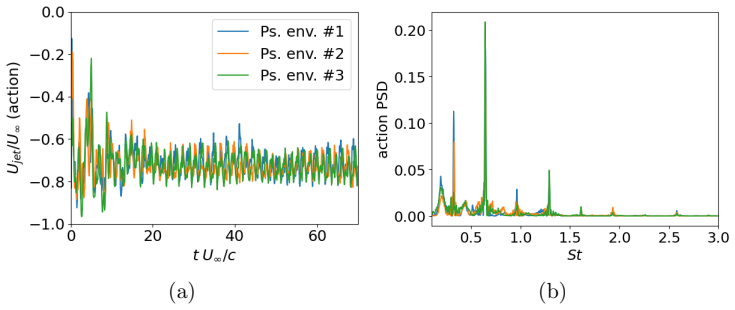
The paper's central claim is that a DRL agent, using only local surface pressure information from witness points, learns a jet actuation strategy that nearly eliminates lift fluctuations and reduces drag by 21% on a three-dimensional NACA0012 wing at Re=1,000 and AoA=20°, where vortex shedding and three-dimensional wake structures are fully developed. The learned control maintains a negative (suction) mean on the leading-edge jet and a positive (blowing) mean on the rear jet, with an oscillation frequency matching the vortex-shedding Strouhal number St=0.64. This periodic in-phase forcing extends the leading-edge shear layer, delays vortex shedding, and reduces the spanwise disorder of the w
Load-bearing premise
The central claim rests on the assumption that a single unseeded PPO training run is representative, so the observed 21% drag reduction and lift-oscillation suppression are not just run-to-run variance.
Editorial extensions
If this is right
- If the result is correct, DRL can discover effective active-flow-control strategies for three-dimensional separated wings, not just 2D airfoils or cylinders.
- The learned control, which locks to the shedding frequency, suggests that DRL can identify the dominant flow instability and exploit it with a periodic forcing that includes additional harmonic components.
- The framework's scalability—ten parallel simulations and thirty simultaneous trajectories—demonstrates a practical path toward higher Reynolds numbers and more complex geometries.
- The suppression of lift oscillations and drag reduction could translate into improved aerodynamic efficiency and reduced structural vibration in real applications.
- The method's success at Re=1,000 invites testing at higher Reynolds numbers, where separation control is more challenging and industrially relevant.
Reading between the lines
- As stated, the −124% reduction in Cl,rms exceeds the mathematically possible range for a reduction relative to baseline; the authors likely use a different normalization, and a direct comparison of raw RMS values would resolve the actual oscillation suppression.
- The reported 21% drag reduction comes from a single unseeded training run; repeating training with multiple random seeds would establish whether the learned policy is representative or merely a favorable initialization.
- Because the actions lock to the vortex-shedding frequency, a natural test is to compare the learned nonlinear policy against a simple sinusoidal forcing at St=0.64; this would quantify the added value of the policy's extra harmonic components.
- The spanwise periodic pattern of actuation may depend on the periodic boundary conditions and spanwise domain length; testing in a wider domain would probe the robustness of the control in a more realistic configuration.
Editorial analysis
A structured set of objections, weighed in public.
Referee Report
Summary. The paper presents a deep reinforcement learning (DRL) framework for active flow control (AFC) around a three-dimensional NACA0012 wing at Re=1,000 and AoA=20°. The environment is a GPU-accelerated spectral-element CFD solver (SOD2D) coupled to the TF-Agents DRL library through Redis/SmartSim, with a multi-environment, multi-agent setup. The agent actuates two spanwise-distributed jet pairs (three pseudo-environments) with a reward combining drag reduction and lift-oscillation penalty. The authors report that the learned policy reduces mean drag by 21% and lift-coefficient RMS by 124%, shifts the vortex-shedding Strouhal number from 0.56 to 0.64, and produces an actuation signal locked to the shedding frequency. They interpret these results as evidence that DRL can discover effective AFC strategies on three-dimensional separated wings.
Significance. If the reported results are correct, this would be a useful demonstration of DRL-based active flow control on a three-dimensional wing with separation, extending previous two-dimensional studies. The computational framework—GPU-accelerated solver, multi-environment MARL training, and reward decomposition—is a constructive engineering contribution, and the validation of the baseline against published airfoil data is a positive feature. However, the central quantitative claims are not presently credible. The reported ΔCl,rms = −124% is mathematically impossible for a nonnegative RMS quantity, and the drag reduction rests on a single unseeded PPO run with no statistical characterization. The scientific conclusion therefore cannot be accepted as stated, despite the soundness of the general methodology.
major comments (3)
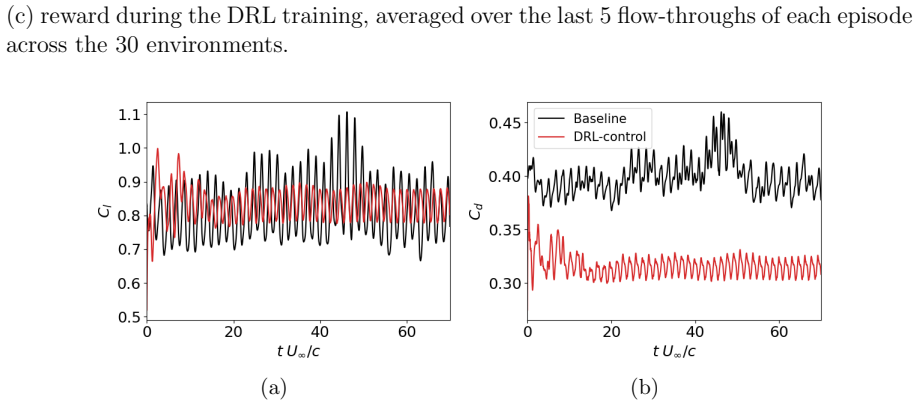
- [§3, Fig. 5 and §4] The reported lift-oscillation reduction ΔCl,rms = −124% is physically impossible. Since Cl,rms is nonnegative by definition, the relative reduction (Cl,rms,ctrl − Cl,rms,base)/Cl,rms,base cannot be less than −100%. This value is repeated in the Conclusions and must indicate a sign error, a denominator error, or a comparison against an inconsistent baseline window. The manuscript gives no raw time series or computation formula to resolve the discrepancy. This is a load-bearing error: the first central quantitative claim is invalid as stated.
- [§3, Figs. 4–5; §2.1] The reported 21% mean-drag reduction is based on a single trained policy obtained from one unseeded PPO run. DRL training is stochastic, and the paper does not report multiple seeds, error bars, or run-to-run variability. Without this information, the 21% reduction cannot be distinguished from the variance of a single training trajectory, which is a known failure mode in RL flow control. The absence of a sensitivity study for the hyperparameters α, β, and the actuator velocity bounds further weakens the claim that the observed performance is robust rather than a lucky initialization.
- [§3, Fig. 5 and text near 'root-mean-square'] The paper states that after the transient period 'the root-mean-square of the signal has been noticeably reduced' but the reported −124% implies a reduction beyond complete elimination of oscillations. Even setting aside the arithmetic, the manuscript does not specify how Cl,rms is computed over the controlled and baseline windows (sampling period, number of vortex-shedding cycles, detrending, or window alignment). A proper window-matched RMS calculation with confidence intervals is needed to support any quantitative comparison of oscillation amplitudes.
minor comments (4)
- [Abstract/Introduction] Typo: 'limitted' should be 'limited' in the Introduction. Also, the sentence 'in the present work we propose to advance AFC-DRL applicability' reads awkwardly; consider revising.
- [References] Reference [17] is attributed to 'F. Schulman' but the correct first author is John Schulman for 'Proximal Policy Optimization Algorithms'.
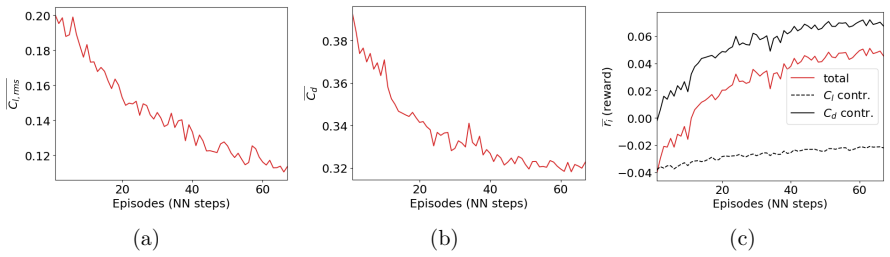
- [Figures] Figures 4 and 5 show training curves and temporal signals, but no error bars or confidence intervals are provided. Adding shading or error bands would help assess convergence and variability. Also, the caption of Fig. 3 lists panels (a)–(d), but panels (a)–(c) are cited in the text; please ensure the panel definitions match.
- [§2.2] The term 'flow-throughs' is used to describe the transient period, but a precise definition (e.g., convective time units c/U∞) would improve clarity. The paper uses 'time units' without defining the nondimensionalization.
Circularity Check
No significant circularity: the reported control improvements are empirical outcomes of a trained policy, not tautological consequences of the reward definition.
full rationale
The paper's derivation chain is: define the reward function (Eq. 1) to reward drag reduction and penalize lift oscillations; train a PPO policy; then measure Cd, Cl,rms, and the shedding Strouhal number in the CFD environment. This is an optimization result, not a first-principles derivation. The reward is the objective, but it does not by construction guarantee that the agent achieves ΔCd = −21% or ΔCl,rms = −124%; the policy could fail to learn, and the reported numbers are the outcome of the trained policy evaluated in the simulator. The emergent frequency-locking at St = 0.64 and the observed wake-structure changes (Fig. 7) are not encoded in the reward, providing independent empirical content. Baseline comparisons against Gupta et al. [22] and Kouser et al. [23] are external. The self-citations ([7], [8], [15], [16]) concern the MARL/software infrastructure and are not load-bearing for the physical claim. The physically impossible ΔCl,rms = −124% (Section 3) is a serious internal consistency/correctness problem, but it is not a circularity: it does not reduce a prediction to an input by construction. The lack of multiple seeding is a robustness limitation, not a circularity. Therefore the circularity score is 0.
Assumptions & free parameters
free parameters (3)
- α (lift oscillation penalty weight) =
0.3
- β (local vs global reward weight) =
0.8
- Actuator velocity bounds =
±1.125 U∞
assumptions (3)
- domain assumption SOD2D accurately solves the incompressible Navier-Stokes/LES equations for this flow at Re=1000.
- domain assumption Spanwise-periodic boundary conditions with three pseudo-environments capture the relevant 3D physics.
- domain assumption PPO converges to a stable policy within 67 episodes.
Cite this review
Pith. "Pith review of Deep Reinforcement Learning for Active Flow Control around a Three-Dimensional Flow-Separated Wing at Re = 1,000." pith.science (2026). https://pith.science/paper/YUPS4USO
@misc{pith2026250910195,
  author       = {Pith},
  title        = {Pith review of: Deep Reinforcement Learning for Active Flow Control around a Three-Dimensional Flow-Separated Wing at Re = 1,000},
  year         = {2026},
  howpublished = {\url{https://pith.science/paper/YUPS4USO}},
  note         = {Machine review of arXiv:2509.10195}
}
read the original abstract
This study explores the use of deep reinforcement learning (DRL) for active flow control (AFC) to reduce flow separation on wings at high angles of attack. Concretely, here the DRL agent controls the flow over the three-dimensional NACA0012 wing section at the Reynolds number Re = 1,000 and angle of attack AoA = 20 degrees, autonomously identifying optimal control actions through real-time flow data and a reward function focused on improving aerodynamic performance. The framework integrates the GPU-accelerated computational fluid dynamics (CFD) solver SOD2D with the TF-Agents DRL library via a Redis in-memory database, enabling rapid training. This work builds on previous DRL flow-control studies, demonstrating DRL potential to address complex aerodynamic challenges and push the boundaries of traditional AFC methods.
Figures


Figures from the paper (4 more)

Forward citations
Cited by 1 Pith paper
-
Plug-and-Play Benchmarking of Reinforcement Learning Algorithms for Large-Scale Flow Control
FluidGym is a PyTorch-only, fully differentiable benchmark with 13 flow-control environments, MARL support, and public baselines.
Reference graph
Works this paper leans on
-
[1]
J.J. Cerutti, C. Sardu, G. Cafiero and G. Iuso (2020). Active Flow Control on a Square-Back Road Vehicle. Fluids 5, 55. https://doi.org/10.3390/fluids5020055
-
[2]
G. Minelli, S. Krajnovi´ c, B. Basara and B.R. Noack (2016). Numerical Investigation of Active Flow Control Around a Generic Truck A-Pillar. Flow, Turbulence and Combustion 97, 1235–1254. https://doi.org/10.1007/s10494-016-9760-3
-
[3]
I. Rodriguez, O. Lehmkuhl and R. Borrell (2020). Effects of the Actuation on the Boundary Layer of an Airfoil at Reynolds Number Re = 60000. Flow, Turbulence and Combustion 105, 607–626. https://doi.org/10.1007/s10494-020-00160-y
-
[4]
P. Garnier, J. Viquerat, J. Rabault, A. Larcher, A. Kuhnle and E. Hachem (2021). A review on deep reinforcement learning for fluid mechanics. Computers & Fluids 225, 104973. https://doi.org/10.1016/j.compfluid.2021.104973
arXiv 2021
-
[5]
J. Rabault, M. Kuchta, A. Jensen, U. R´ eglade and N. Cerardi (2019). Artifi- cial neural networks trained through deep reinforcement learning discover con- trol strategies for active flow control. Journal of Fluid Mechanics 865:281–302. https://doi.org/10.1017/jfm.2019.62
-
[6]
J. Rabault and A. Kuhnle (2019). Accelerating deep reinforcement learning strate- gies of flow control through a multi-environment approach. Physics of Fluids 31 (9): 094105. https://doi.org/10.1063/1.5116415 10
-
[7]
P. Su´ arez, F.´Alcantara-´Avila, J. Rabault, A. Mir´ o, B. Font, O. Lehmkuhl and R. Vin- uesa (2025). Flow control of three-dimensional cylinders transitioning to turbulence via multi-agent reinforcement learning. https://doi.org/10.48550/arXiv.2405.17210
work page Pith review arXiv doi:10.48550/arxiv.2405.17210 2025
-
[8]
P. Su´ arez, F. ´Alcantara-´Avila, A. Mir´ o, J. Rabault, B. Font, O. Lehmkuhl and R. Vinuesa (2025). Active flow control for drag reduction through multi-agent rein- forcement learning on a turbulent cylinder atRe D = 3900. Flow, Turbulence and Combustion. https://doi.org/10.1007/s10494-025-00642-x
Show all 23 references
-
[9]
Guastoni, J
L. Guastoni, J. Rabault, P. Schlatter, H. Azizpour and R. Vinuesa (2023). Deep reinforcement learning for turbulent drag reduction in channel flows. The European Physical Journal E 46, 27. https://doi.org/10.1140/epje/s10189-023-00285-8
2023 doi
-
[10]
Sonoda, Z
T. Sonoda, Z. Liu, T. Itoh and Y. Hasegawa (2023). Reinforcement learning of control strategies for reducing skin friction drag in a fully developed turbulent channel flow. Journal of Fluid Mechanics 960:A30. https://doi.org/doi:10.1017/jfm.2023.147
2023 doi
-
[11]
Cavallazzi, L
G.M. Cavallazzi, L. Guastoni, R. Vinuesa and A. Pinelli (2024). Deep Reinforcement Learning for the Management of the Wall Regeneration Cycle in Wall-Bounded Tur- bulent Flows. Flow, Turbulence and Combustion. https://doi.org/10.1007/s10494- 024-00609-4
2024 doi
-
[12]
Vasanth, J
J. Vasanth, J. Rabault, F. Alc´ antara- ´Avila, M. Mortensen and R. Vin- uesa (2024). Multi-agent Reinforcement Learning for the Control of Three- Dimensional Rayleigh–B´ enard Convection. Flow, Turbulence and Combustion. https://doi.org/10.1007/s10494-024-00619-2
2024 doi
-
[13]
Wang, Y.-F
Y.-Z. Wang, Y.-F. Mei, N. Aubry, Z. Chen, P. Wu and W.-T. Wu (2022). Deep rein- forcement learning based synthetic jet control on disturbed flow over airfoil. Physics of Fluids 34 (3): 033606. https://doi.org/10.1063/5.0080922
2022 doi
- [14]
-
[15]
B. Font, F. Alc´ antara-´Avila, J. Rabault, R. Vinuesa and O. Lehmkuhl (2025). Deep reinforcement learning for active flow control in a turbulent separation bubble. Nature Communications 16, 1422. https://doi.org/10.1038/s41467-025-56408-6
2025 doi
-
[16]
Montal` a, B
R. Montal` a, B. Font, O. Lehmkuhl, R. Vinuesa and I. Rodr ´ ıguez (2024). Towards Ac- tive Flow Control Strategies Through Deep Reinforcement Learning, in: 9th ECCO- MAS, 3rd-7th June, Lisbon (Portugal). https://doi.org/10.23967/eccomas.2024.115
2024 doi
- [17]
-
[18]
Gasparino, F
L. Gasparino, F. Spiga and O. Lehmkuhl (2024). SOD2D: A GPU-enabled spectral fi- nite elements method for compressible scale-resolving simulations. Computer Physics Communications 297, 109067. https://doi.org/10.1016/j.cpc.2023.109067
2024
-
[19]
Guadarrama, A
S. Guadarrama, A. Korattikara, O. Ramirez, P. Castro, E. Holly, S. Fishman, K. Wang, E. Gonina, N. Wu, E. Kokiopoulou, L. Sbaiz, J- Smith, G. Bart, J. Berent, C. Harris, V. Vanhoucke and E. Brevdo (2018). TF-Agents: A library for Reinforcement Learning in TensorFlow. https://g...
2018
-
[20]
Partee, M
S. Partee, M. Ellis, A. Rigazzi, A.E. Shao, S. Bachman, G. Marques and B. Rob- bins (2022). Using machine learning at scale in HPC simulations with Smart-Sim: An application to ocean climate modeling. Journal of Computer Science 62:101707. https://doi.org/10.5281/zenodo.4682270
2022 doi
-
[21]
Belus, J
V. Belus, J. Rabault, J. Viquerat, Z. Che, E. Hachem and U. Reglade (2019). Ex- ploiting locality and translational invariance to design effective deep reinforcement learning control of the 1-dimensional unstable falling liquid film. AIP Advances 9 (12): 125014. https://doi.or...
2019 doi
-
[22]
Gupta, J
S. Gupta, J. Zhao, A. Sharma, A. Agrawal, K. Hourigan and M.C (2023). Thompson. Two- and three-dimensional wake transitions of a NACA0012 airfoil. Journal of Fluid Mechanics 954:A26. https://doi.org/10.1017/jfm.2022.958
2023 doi
-
[23]
Kouser, Y
T. Kouser, Y. Xiong, D. Yang and S. Peng (2021). Direct Numerical Sim- ulations on the three-dimensional wake transition of flows over NACA0012 airfoil at Re = 1000. International Journal of Micro Air Vehicles 13. https://doi.org/10.1177/17568293211055656 12
2021 doi
Reviewed August 4, 2026 · model on record in the stance chip above.
Discussion (0). Continue with ORCID to comment.