REVIEW 3 major objections 4 minor 2 cited by
Testing the nature of compact objects in the lower mass gap using gravitational wave observations
T0 review · 3 major / 4 minor · reviewed 2026-08-15 · deepseek-v4-flash
Pith's one-line read Model error, not detector statistics, dominates parameter recovery for non-black-hole low-mass-gap binaries; joint spin-quadrupole and tidal modeling is needed for reliable identification.
desk verdict Sound simulation-based warning about model-induced biases in low-mass-gap tests, but the headline numbers depend entirely on one inspiral-only waveform family and some priority claims are overstated. read the letter →
The pith
A machine-rendered reading of the paper's core claim, the machinery that carries it, and where it could break.
The reading
What carries the argument
The load-bearing object is the TaylorF2 inspiral-only post-Newtonian waveform, whose phase is written as $\psi(f)=2\pi f t_c+\phi_c+\frac{3}{128\eta v^5}\left(1+\psi_{\mathrm{PP}}+\psi_{\mathrm{SIQM}}+\psi_{\mathrm{tidal}}\right)$. Spin-induced quadrupole moments enter through $\kappa_i=1+\delta\kappa_i$ at 2PN and 3PN order, and tidal deformability enters through $\tilde{\Lambda}$ at 5PN and 6PN order. The same TaylorF2 family is used for both injection and recovery, and the likelihood is truncated at the innermost stable circular orbit frequency of a black hole. Because injection and recovery share the same phase model, any displacement between the true and recovered masses in the results is attributed to which physical effects are omitted from the recovery template, isolating model-error bias from waveform-model uncertainty.
What would settle it
Re-run the $(4,4)\,M_\odot$ equal-mass boson-star injection and recovery using a waveform that includes merger and ringdown, or that truncates at a boson-star-specific innermost circular orbit instead of the black-hole one. If the black-hole-binary recovery no longer returns a posterior near $(8,2)\,M_\odot$, or the joint SIQM+tidal recovery no longer returns $(4,4)\,M_\odot$, the paper’s central claim—that model error dominates and is cured by joint modeling—would be called into question. A complementary observational check is to take a future high-SNR low-mass-gap event and compare its black-hole-template posterior with its joint SIQM+tidal posterior; an $(8,2)$-like shift would confirm the bias mechanism.
Extended reading notes
Core claim
The paper’s central claim is that using an incomplete gravitational-wave model to analyze a non-black-hole low-mass-gap binary produces parameter biases large enough to misidentify the source’s nature, and that this bias is avoided only when the recovery model includes both spin-induced quadrupole moments and tidal deformability together. For a simulated equal-mass binary boson star with $\delta\kappa_1=\delta\kappa_2=10$ and $\Lambda_1=\Lambda_2=289$, the black-hole-binary recovery gives a posterior concentrated near $(8,2)\,M_\odot$—interpreted as a neutron star–black hole binary—while the SIQM-only, tides-only, and combined recoveries give approximately $(4.7,3.4)\,M_\odot$, $(4.4,3.5)\,M_\odot$, and the true $(4,4)\,M_\odot$ respectively. The authors also find that genuine black-hole-binary injections recovered with SIQM or tidal models show no significant bias and Bayes factors favor the black-hole hypothesis, so the misidentification is specific to analyzing non-black-hole signals with incomplete templates.
Load-bearing premise
The demonstration assumes that the TaylorF2 inspiral-only waveform faithfully represents both the injected boson-star signal and the recovery templates, with the SIQM and tidal phase terms entering identically, and cuts the analysis at the black-hole innermost stable circular orbit frequency without accounting for the boson star’s own matter effects; if a real spinning boson-star waveform differs in the late inspiral or merger, the measured biases may not transfer to actual observations.
Editorial extensions
If this is right
- If an observed low-mass-gap event is a non-black-hole binary, standard black-hole-binary analyses will not just be uncertain; they can actively return the wrong masses and spins, potentially classifying the source as a neutron star–black hole merger.
- Tidal-deformability tests are stronger than SIQM tests for confirming that a signal is a black hole, whereas SIQM tests are more sensitive to spin magnitudes; both effects need to be measured jointly to avoid mass-ratio bias.
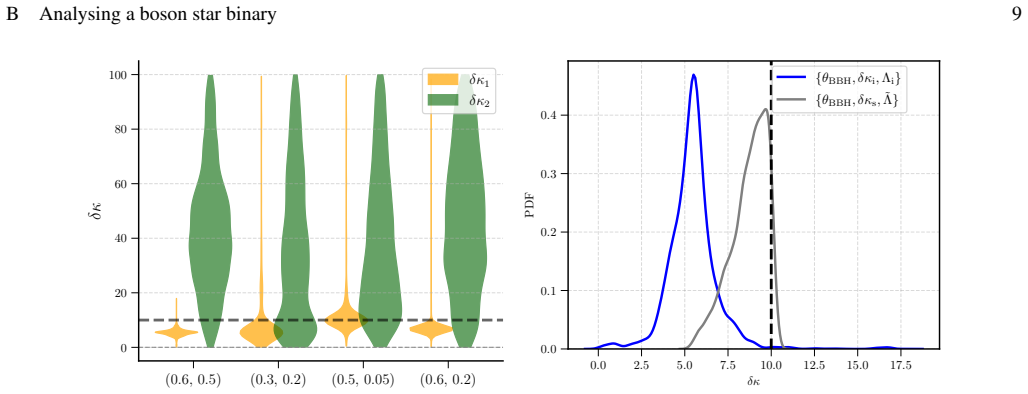
- Combining both effects is feasible: the paper recovers non-BH values of the spin-quadrupole parameter (ruling out the black-hole value) even in the joint parameter space, and using symmetric combinations reduces bias compared with estimating the individual parameters.
- Doubling the signal-to-noise ratio from 50 to 100 does not remove the biases, so these systematic errors can dominate statistical uncertainties even in the era of next-generation detectors.
Reading between the lines
- I infer that if such biases are present in real searches, a population of low-mass-gap non-BH binaries could be cataloged as neutron star–black hole binaries, changing inferred merger rates and formation-channel demographics; the paper does not quantify this population-level consequence.
- The $(4,4)\,M_\odot \to (8,2)\,M_\odot$ shift suggests that a single effective parameter (a combination of mass ratio, spin, and the omitted SIQM/tidal terms) absorbs the signal; a follow-up could build a diagnostic that flags when recovered parameters are driven by this degeneracy rather than by astrophysics.
- Because the paper uses the same TaylorF2 family for injection and recovery, I would treat the specific $(8,2)$ numbers as a property of this model family; repeating with an independent inspiral-merger-ringdown waveform would test whether the misidentification is generic or specific to the inspiral-only approximation.
- The persistence of the biases with higher SNR is established only within the inspiral-only model; with merger/ringdown and higher harmonics the degeneracies could break differently, which the paper itself flags as future work.
Signed reviews
Editorial analysis
A structured set of objections, weighed in public.
Referee Report
Summary. The paper presents a Bayesian parameter-estimation study of simulated compact-binary signals in the lower mass gap, using TaylorF2 inspiral-only waveforms augmented with spin-induced quadrupole moment (SIQM) and tidal-deformability terms. The analysis has three parts: (i) BBH injections recovered with BBH, SIQM, and tidal models to quantify null-test performance; (ii) boson-star-like injections with both SIQM and tidal effects recovered with BBH, SIQM-only, tides-only, and SIQM+tides models; and (iii) injections with each non-BH effect separately. The central result is that a simulated equal-mass (4,4) solar-mass boson-star-like binary recovered with a BBH model yields biased masses around (8,2) solar masses, which the authors argue would likely be interpreted as a neutron-star-black-hole binary, whereas the joint SIQM+tides recovery model recovers the true masses. The paper concludes that model error, not statistics, dominates parameter recovery for such signals and that joint modeling is required for reliable distinguishability tests in the low-mass gap.
Significance. If the result holds, it provides a concrete and quantitative warning for tests of black-hole nature in the lower mass gap: measuring SIQM and tidal parameters separately, or ignoring them entirely, can produce severe biases in inferred masses and spins. The paper's strengths are its use of full Bayesian inference with Bilby and dynesty, a systematic injection-recovery matrix, and explicit exploration of spin and SNR dependence. The headline (8,2) solar-mass misidentification is striking and easy to falsify or confirm with future tests. However, the demonstration is entirely internal to the TaylorF2 waveform family with a Kerr-ISCO cutoff; the paper's own Sec. IV caveats (no complete inspiral-merger-ringdown models for boson stars and an ISCO calculation that ignores the very effects being tested) mean that external waveform faithfulness remains an open question. The result is therefore best interpreted as a model-consistency demonstration until robustness to the cutoff and waveform family is shown.
major comments (3)
- [Secs. II C, III B, and IV] The central quantitative claim—that a (4,4) solar-mass boson-star-like signal is recovered as (8,2) solar masses under a BBH model—is computed with the same TaylorF2 inspiral-only waveform family used for both injection and recovery, with the likelihood truncated at the Kerr ISCO frequency. The paper itself states in Sec. IV that this ISCO calculation "does not take into account the SIQM or tidal deformability effects" and that no complete inspiral-merger-ringdown models exist for boson stars. Consequently, the specific bias has been demonstrated only for this approximate model against itself; a real spinning boson-star binary with a different terminal frequency or additional matter effects could produce a different or absent bias. The authors should either (a) test the robustness of the bias to the choice of cutoff (e.g., truncating at a boson-star ISCO or at a frequency where the TaylorF2 phase terms saturate) and to an alternative waveform approximant, or (b) explicitly restrict the claims in the abstract and Sec. III B to the inspiral-only TaylorF2 model.
- [Sec. III B ("Effect of SNR") and Fig. 5] The statement that the binary "will be identified" as having masses (8,2) solar masses is made without quantitative uncertainty. Please report the posterior median and 90% credible interval for the component masses, and ideally the joint m1-m2 posterior, for the (4,4) injection recovered with the BBH model for the case shown in Fig. 5 (spins 0.6, 0.5, SNR 100). This is needed to judge whether (8,2) is a robust posterior mode rather than a local peak or an artifact of a strongly asymmetric tail, and to support the neutron-star--black-hole misidentification claim.
- [Secs. II A and III B] The injected and recovered waveforms use identical SIQM and tidal phase parametrizations (Eqs. 4 and 5). The (SIQM tides)inj:(SIQM tides)rec recovery therefore validates internal consistency rather than waveform faithfulness. This should be stated explicitly in the discussion; otherwise readers may over-interpret the successful recovery as evidence that the TaylorF2 boson-star model is an adequate representation of the true physical signal. The distinction matters because the paper's conclusion about the importance of model accuracy is only as strong as the external validity of the TaylorF2 parametrization.
minor comments (4)
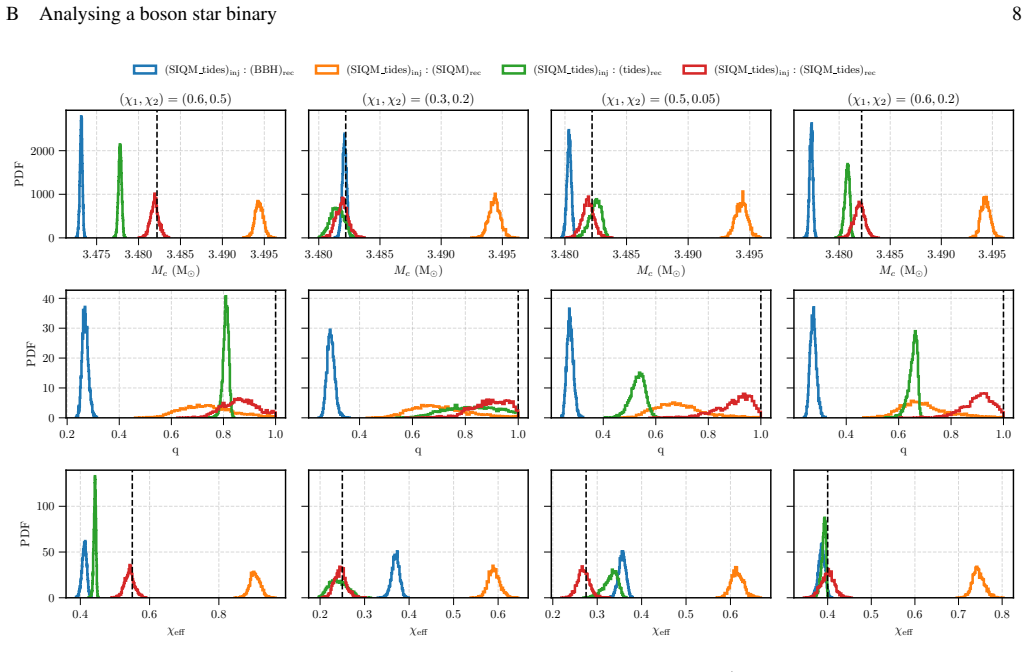
- [Sec. III B and Fig. 3] The color labeling is inconsistent between the body text and the figure caption: the text describes the correct-model recovery as "red histograms (SIQM tides)inj : (SIQM tides)rec," while the caption assigns red to "(SIQM tides)inj−(BBH) rec" and blue to the joint model. Please reconcile the color code across text, caption, and legend.
- [Fig. 6 caption] The line-style description is contradictory: it first says "SNR=50 (dashed line) and SNR=100 (solid line)," then says "the posteriors are broader with SNR=50 (solid line) and are more biased compared to SNR=100 (dashed line)." Clarify which line style corresponds to which SNR.
- [Sec. II B] The prior ranges used for the SIQM parameters delta_kappa_i and the tidal deformability parameters Lambda_i are not stated. Please specify these priors, as they directly affect the Bayes factors reported in Fig. 2 and the interpretation of the posteriors in Figs. 4 and 8.
- [Throughout] There are several typos and formatting errors: "Baye's theorem" should be "Bayes' theorem"; "signal-to-ratio" should be "signal-to-noise ratio"; "chie f f" appears in Sec. III C; "paramete" appears in the Fig. 2 caption; and the reference list contains nonstandard entries (e.g., Ref. [100]). These should be corrected in a final pass.
Circularity Check
Self-contained injection/recovery study; no load-bearing circularity, only minor self-citation for the SIQM waveform terms.
full rationale
This paper is a synthetic-signal injection/recovery study using Bayesian inference on simulated TaylorF2 waveforms; it does not fit any parameter to observational data and then rename that fit as a prediction. Its main quantitative result, that a (4,4) M_sun boson-star-like signal analyzed with a BBH recovery model is biased to roughly (8,2) M_sun, is obtained by direct likelihood computation with mismodeled templates, so it is a genuine model-mismatch calculation rather than an identity built into the inputs. The self-citations [21] and [91] supply the spin-induced quadrupole phase terms used in the waveform, but these are standard post-Newtonian results already implemented in LALSimulation and they do not by themselves assert the paper's conclusion, so the self-citation is not load-bearing. The statement that the SIQM+tides recovery model recovers the true masses is a self-consistency check by construction, since injection and recovery share the same TaylorF2 functional form with the same SIQM and tidal phase terms; however, the paper does not offer this as an independent prediction, and the headline bias claim concerns the deliberately incorrect BBH recovery model. The acknowledged caveat that the likelihood is truncated at the Kerr ISCO frequency without including boson-star ISCO or matter effects affects the astrophysical applicability of the bias estimate, not the circularity of the argument. Overall, no load-bearing circular step is present; the only mild circularity-adjacent feature is the minor self-citation for the SIQM waveform framework, so a low score is appropriate.
Assumptions & free parameters
free parameters (2)
- Spin-induced quadrupole deviation delta_kappa_1 = delta_kappa_2 =
10
- Tidal deformability Lambda_1 = Lambda_2 =
289
assumptions (4)
- domain assumption TaylorF2 stationary-phase inspiral waveform with 3.5PN point-particle, 2/3PN SIQM, and 5/6PN tidal phase terms accurately represents GW signals from low-mass-gap compact binaries.
- domain assumption Truncating the likelihood at the Kerr ISCO frequency, computed without accounting for boson-star SIQM or tidal effects, is a valid procedure for these non-BH signals.
- standard math For Kerr black holes, delta_kappa = 0 and Lambda = 0, as implied by the No-Hair conjecture.
- domain assumption Self-interacting spinning boson stars relate delta_kappa and Lambda through the mass ratio M/MB ~ 0.061, with minimal values 10 and 289.
Cite this review
Pith. "Pith review of Testing the nature of compact objects in the lower mass gap using gravitational wave observations." pith.science (2026). https://pith.science/paper/24IMRLBU
@misc{pith2026250910420,
  author       = {Pith},
  title        = {Pith review of: Testing the nature of compact objects in the lower mass gap using gravitational wave observations},
  year         = {2026},
  howpublished = {\url{https://pith.science/paper/24IMRLBU}},
  note         = {Machine review of arXiv:2509.10420}
}
abstract
As the compact binary catalog continues to grow rapidly, developing and refining tests to probe the nature of compact objects is essential for a comprehensive understanding of both the observed data and the underlying astrophysics of the binary population. We investigate the effectiveness of spin-induced multipole moments (SIQM) and tidal deformability measurements in distinguishing lower mass-gap black hole (BH) binaries from non-BH binaries with different mass and spin configurations. We perform model-agnostic tests on binary BH (BBH) simulations using full Bayesian inference, evaluating the independent and joint measurability of SIQM and tidal parameters across the parameter space. We extend the analysis to simulations of self-interacting spinning boson stars, using synthetic signals that exhibit (a) both SIQM and tidal effects and (b) each effect individually. For case (a), recovery is performed using (i) a BBH model, (ii) a model incorporating both SIQM and tidal effects, and (iii) models including either SIQM or tidal effects. For case (b), we employ (i) a BBH model and (ii) models incorporating either SIQM or tidal effects, consistent with the injection. Simulations employ TaylorF2 waveform model and consider binaries in the low mass gap with varying spin magnitudes. We find that employing an incorrect model to analyze the signal can lead to biases in parameter inference. Notably, when analyzing a simulated binary boson star-like signal with component masses $\rm{(4, 4) \, M_{\odot}}$ using a BBH model, the system is incorrectly identified as having masses $\rm{(8, 2) \, M_{\odot}}$. In contrast, using the correct recovery model that includes both SIQM and tidal deformability effects successfully recovers the true masses, highlighting the significance of waveform model accuracy in performing reliable distinguishability tests for compact objects in the low-mass gap.
Figures


Figures from the paper (5 more)


Forward citations
Cited by 2 Pith papers
-
Establishing Compactness as a Population Observable in Gravitational-Wave Astronomy
Hierarchical analysis of GWTC-3 yields C_eff = 0.5^{+0.3}_{-0.1} consistent with black holes and limits low-compactness exotic binary merger rate to <0.7 Gpc^{-3} yr^{-1}.
-
Compactness Inference in Gravitational-Wave Mergers with PhenomDECO: Catalog Benchmarks and Robustness Diagnostics
PhenomDECO analysis of GWTC-3 events finds all considered signals consistent with binary black holes once low-frequency noise effects are addressed via higher starting frequencies.
Reference graph
Works this paper leans on
-
[1]
We inject BBH signals and analyse them using a (a) BBH waveform, (b) parametrized SIQM waveforms and (c) parametrized tidal deformability waveforms. We com- pare the recovered binary parameters in these three cases and verify the ability to perform null tests for BBHs in the lower mass gap with current detectors employing SIQM and tidal deformability effe...
-
[2]
These simulations are then analysed assuming a (a) boson star model and a (b) BBH model
Second, we create mock-binary signals with boson star signatures with SIQM and tidal deformability parame- ters. These simulations are then analysed assuming a (a) boson star model and a (b) BBH model. The binary boson star model is expected to provide the correct in- ference, and the inference from the binary BH (BBH) model can be used to quantify the sy...
-
[3]
−5 8−50δκ a−50κ s +100η (1+κ s) # − 5 4χaχs h δ+80 (1−2η)κ a +80δκ s i ,(4a) ψSIQM 3 PN =π
Third, to test the limitations of parameter recovery that uses only one physical effect, we generate mock boson star simulations that include only SIQM effects and anal- yse using the (a) BBH model and (b) SIQM model, sim- ilarly, for tidal deformability effects. Though this is not a physically motivated scenario, as the exotic compact object is expected ...
2016
-
[4]
a BBH model: no SIQM or tidal-deformability parame- ters in the recovery,{θ BBH}
-
[5]
SIQM model: along with BBH parameters, only δκi are estimated,{θ BBH,δκ i}
-
[6]
Instead, the estimates ofδκi andΛ i can directly constrain the allowed parameter space of such alternative models
tidal deformability model: along with BBH parameters, onlyΛ i are estimated,{θ BBH,Λ i} The recovery models are designed from a null-test perspective, meaning it does not rely on any specific alternative model, such as boson stars or other non-BH compact objects. Instead, the estimates ofδκi andΛ i can directly constrain the allowed parameter space of suc...
-
[7]
with a BBH model,{θ BBH}
-
[8]
SIQM-only model,{θ BBH,δκ i}
Show all 110 references
-
[9]
tidal-deformability only model,{θ BBH,Λ i}
-
[10]
For the first case, the re- covery model is only characterized by the BBH parameters {θBBH}
SIQM plus tidal deformability model,{θ BBH,δκ i,Λ i} See Table I for more details. For the first case, the re- covery model is only characterized by the BBH parameters {θBBH}. However, in the second, third, and fourth cases in addition to the BBH parameters, the recovery space...
-
[11]
Effect of spin configurations In Fig. 3, we plot the posteriors on the chirp mass (Mc), mass ratio (q), effective spin parameter (χeff) for a simulated binary with total mass 8M⊙ and mass ratio q =1, considering four different spin configurations: (0.6, 0.5), (0.3, 0.2), (0.5,...
-
[12]
Effect of mass ratio To further study the curious effect of mass ratio bias, we plot the two-dimensional posteriors of the component masses for different mass ratios and injection/recovery models in Fig. 5. The spins are fixed to be 0.6,0.5 and binary produces an SNR of 100 in...
-
[13]
6, the effect of SNR in measuring the parameters of a non-BH signal is demonstrated, considering two cases, SNR=50 and SNR=100
Effect of SNR In Fig. 6, the effect of SNR in measuring the parameters of a non-BH signal is demonstrated, considering two cases, SNR=50 and SNR=100 . We demonstrate the findings by choosing a binary of total mass8M⊙ and equal mass ratio, with C Simulations of boson star binar...
2000
-
[14]
A. G. Abac et al. (LIGO Scientific, VIRGO, KAGRA) (2025), 2508.18082
2025 arXiv
-
[17]
L. S. Collaboration and V . Collaboration,Gravitational wave candidate event database (gracedb), https://gracedb. ligo.org/(2024)
2024
-
[18]
A. H. Nitz, C. D. Capano, S. Kumar, Y .-F. Wang, S. Kastha, M. Sch¨afer, R. Dhurkunde, and M. Cabero, Astrophys. J.922, 76 (2021), 2105.09151
2021 arXiv
-
[19]
Wadekar, T
D. Wadekar, T. Venumadhav, J. Roulet, A. K. Mehta, B. Zackay, J. Mushkin, and M. Zaldarriaga, Phys. Rev. D110, 044063 (2024), 2405.17400. [7]http://www.ligo.caltech.edu
2024 arXiv
-
[20]
Aasi et al
J. Aasi et al. (LIGO Scientific), Class. Quant. Grav.32, 074001 (2015), 1411.4547
2015 arXiv
-
[21]
Acernese et al
F. Acernese et al. (VIRGO), Class. Quant. Grav.32, 024001 (2015), 1408.3978
2015 arXiv
-
[22]
Iyer et al., LIGO-India Technical Report No
B. Iyer et al., LIGO-India Technical Report No. LIGO- M1100296 (2011), URL https://dcc.ligo.org/LIGO??? M1100296/public/main
2011
- [23]
-
[24]
Branchesi et al., JCAP07, 068 (2023), 2303.15923
M. Branchesi et al., JCAP07, 068 (2023), 2303.15923. [13]http://lisa.jpl.nasa.gov
2023 arXiv
-
[25]
Abbott, T
R. Abbott, T. D. Abbott, et al.,896, L44 (2020)
2020
-
[27]
Gupta, D
A. Gupta, D. Gerosa, K. G. Arun, E. Berti, W. M. Farr, and B. S. Sathyaprakash, Phys. Rev. D101, 103036 (2020), 1909.05804
2020
-
[28]
Mahapatra, D
P. Mahapatra, D. Chattopadhyay, A. Gupta, F. Antonini, M. Fa- vata, B. S. Sathyaprakash, and K. G. Arun, Phys. Rev. D111, 123030 (2025), 2503.17872
2025
-
[29]
T. B. Littenberg, B. Farr, S. Coughlin, V . Kalogera, and D. E. Holz, Astrophys. J. Lett.807, L24 (2015), 1503.03179
2015 arXiv
-
[30]
Cotturone, M
J. Cotturone, M. Zevin, and S. Biscoveanu (2025), 2507.01189
2025
-
[31]
N. K. Johnson-Mcdaniel, A. Mukherjee, R. Kashyap, P. Ajith, W. Del Pozzo, and S. Vitale, Phys. Rev. D102, 123010 (2020), 1804.08026
2020 arXiv
-
[32]
N. V . Krishnendu, K. G. Arun, and C. K. Mishra, Phys. Rev. Lett.119, 091101 (2017), 1701.06318
2017 arXiv
- [33]
-
[34]
Cardoso, E
V . Cardoso, E. Franzin, and P. Pani, Phys. Rev. Lett.116, 171101 (2016), 1602.07309
2016 arXiv
-
[36]
Cardoso, E
V . Cardoso, E. Franzin, A. Maselli, P. Pani, and G. Raposo, Phys. Rev. D95, 084014 (2017), [Addendum: Phys.Rev.D 95, 089901 (2017)], 1701.01116
2017 arXiv
- [37]
-
[39]
Ghosh and M
S. Ghosh and M. Hannam (2025), 2505.16380
2025
-
[40]
Poisson, Phys
E. Poisson, Phys. Rev.D57, 5287 (1998)
1998
-
[42]
Boh´e, G
A. Boh´e, G. Faye, and E. K. Marsat, Sylvain acd Porter, Class. Quant. Grav.32, 195010 (2015), 1501.01529
2015 arXiv
- [44]
-
[45]
N. V . Krishnendu, M. Saleem, A. Samajdar, K. G. Arun, W. Del Pozzo, and C. K. Mishra, Phys. Rev.D100, 104019 (2019), 1908.02247
2019 arXiv
-
[46]
Abbott et al
R. Abbott et al. (LIGO Scientific, Virgo), Phys. Rev. X11, 021053 (2021), 2010.14527
2021 arXiv
- [47]
-
[48]
Ryan, Phys
F. Ryan, Phys. Rev. D56, 1845 (1997)
1997
-
[49]
Pacilio, M
C. Pacilio, M. Vaglio, A. Maselli, and P. Pani, Phys. Rev. D 102, 083002 (2020), 2007.05264
2020 arXiv
-
[50]
Pappas and T
G. Pappas and T. A. Apostolatos, Phys. Rev. Lett.108, 231104 (2012), 1201.6067
2012 arXiv
-
[51]
Uchikata and S
N. Uchikata and S. Yoshida, Class. Quant. Grav.33, 025005 (2016), 1506.06485
2016 arXiv
-
[52]
Hinderer, Astrophys
T. Hinderer, Astrophys. J.677, 1216 (2008), [Erratum: Astro- phys.J. 697, 964 (2009)], 0711.2420
2008 arXiv
-
[54]
E. E. Flanagan and T. Hinderer, Phys. Rev. D77, 021502 (2008), 0709.1915
2008 arXiv
-
[55]
Sennett, T
N. Sennett, T. Hinderer, J. Steinhoff, A. Buonanno, and S. Os- sokine, Phys. Rev. D96, 024002 (2017), 1704.08651
2017 arXiv
-
[56]
Vines, E
J. Vines, E. E. Flanagan, and T. Hinderer, Phys. Rev. D83, 084051 (2011), 1101.1673
2011 arXiv
- [57]
-
[58]
B. P. Abbott et al. (Virgo, LIGO Scientific), Phys. Rev. Lett. 119, 161101 (2017), 1710.05832
2017 arXiv
-
[59]
Castro, L
G. Castro, L. Gualtieri, A. Maselli, and P. Pani, Phys. Rev. D 106, 024011 (2022), 2204.12510
2022 arXiv
-
[60]
Abdelsalhin, L
T. Abdelsalhin, L. Gualtieri, and P. Pani, Phys. Rev. D98, 104046 (2018), 1805.01487
2018 arXiv
- [61]
-
[62]
Narikawa, N
T. Narikawa, N. Uchikata, and T. Tanaka, Phys. Rev. D104, 084056 (2021), 2106.09193
2021 arXiv
- [63]
-
[64]
F. D. Ryan, Phys. Rev. D.55, 6081 (1997)
1997
-
[65]
Vaglio, C
M. Vaglio, C. Pacilio, A. Maselli, and P. Pani, Phys. Rev. D 105, 124020 (2022), 2203.07442
2022 arXiv
-
[66]
Vaglio, C
M. Vaglio, C. Pacilio, A. Maselli, and P. Pani, Phys. Rev. D 108, 023021 (2023), 2302.13954
2023 arXiv
- [67]
-
[68]
Abbott et al
R. Abbott et al. (LIGO Scientific, Virgo), Phys. Rev. D102, 043015 (2020), 2004.08342
2020 arXiv
-
[69]
B. P. Abbott et al. (LIGO Scientific, Virgo), Astrophys. J. Lett. 892, L3 (2020), 2001.01761
2020 arXiv
-
[70]
Abbott et al
R. Abbott et al. (LIGO Scientific, Virgo), Phys. Rev. Lett.125, 101102 (2020), 2009.01075
2020
-
[71]
Hannam et al., Nature610, 652 (2022), 2112.11300
M. Hannam et al., Nature610, 652 (2022), 2112.11300
2022 arXiv
-
[72]
Morras, G
G. Morras, G. Pratten, and P. Schmidt (2025), 2503.15393
2025
-
[74]
Chandra, I
K. Chandra, I. Gupta, R. Gamba, R. Kashyap, D. Chattopad- hyay, A. Gonzalez, S. Bernuzzi, and B. S. Sathyaprakash (2024), 2405.03841
2024 arXiv
- [75]
-
[76]
M. H. P. M. van Putten, M. Aghaei Abchouyeh, and M. Della Valle, Astrophys. J. Lett.972, L23 (2024), 2408.15017
2024 arXiv
-
[77]
C. S. Ye, K. Kremer, S. M. Ransom, and F. A. Rasio (2024), 2408.00076
2024 arXiv
- [78]
-
[79]
Chatziioannou, H
K. Chatziioannou, H. T. Cromartie, S. Gandolfi, I. Tews, D. Radice, A. W. Steiner, and A. L. Watts (2024), 2407.11153
2024
-
[80]
Juli´e, L
F.-L. Juli´e, L. Pompili, and A. Buonanno, Phys. Rev. D111, 024016 (2025), 2406.13654
2025 arXiv
-
[81]
Gao, S.-P
B. Gao, S.-P. Tang, H.-T. Wang, J. Yan, and Y .-Z. Fan, Phys. Rev. D110, 044022 (2024), 2405.13279
2024 arXiv
- [82]
-
[83]
E. M. S ¨anger et al. (2024), 2406.03568
2024 arXiv
-
[84]
Jedamzik, Phys
K. Jedamzik, Phys. Rev. Lett.126, 051302 (2021)
2021
-
[85]
I. Tews, P. T. H. Pang, T. Dietrich, M. W. Coughlin, S. Antier, M. Bulla, J. Heinzel, and L. Issa, Astrophys. J. Lett.908, L1 (2021), 2007.06057
2021 arXiv
-
[86]
Fasano, K
M. Fasano, K. W. K. Wong, A. Maselli, E. Berti, V . Ferrari, and B. S. Sathyaprakash, Phys. Rev. D102, 023025 (2020), 2005.01726
2020 arXiv
- [87]
-
[88]
A. Chen, N. K. Johnson-McDaniel, T. Dietrich, and R. Dudi, Phys. Rev. D101, 103008 (2020), 2001.11470
2020 arXiv
-
[89]
A. G. Abac et al. (LIGO Scientific, Virgo,, KAGRA, VIRGO), Astrophys. J. Lett.970, L34 (2024), 2404.04248
2024 arXiv
-
[90]
Colpi, S
M. Colpi, S. L. Shapiro, and I. Wasserman, Phys. Rev. Lett.57, 2485 (1986)
1986
-
[91]
Uchikata, S
N. Uchikata, S. Yoshida, and P. Pani, Phys. Rev.D94, 064015 (2016), 1607.03593
2016 arXiv
-
[92]
Marsat, Class
S. Marsat, Class. Quant. Grav.32(2015)
2015
-
[93]
Buonanno, G
A. Buonanno, G. Faye, and T. Hinderer, Phys.Rev.D87, 044009 (2013), 1209.6349
2013 arXiv
-
[94]
K. G. Arun, A. Buonanno, G. Faye, and E. Ochsner, Phys. Rev. D79, 104023 (2009), 0810.5336
2009 arXiv
-
[95]
Kidder, Phys
L. Kidder, Phys. Rev. D52, 821 (1995)
1995
-
[96]
Marsat, A
S. Marsat, A. Bohe, G. Faye, and L. Blanchet, Class.Quantum Grav.30, 055007 (2013), arXiv:1210.4143
2013 arXiv
-
[97]
A. Bohe, S. Marsat, G. Faye, and L. Blanchet, Class.Quant.Grav.30, 075017 (2013), arXiv:1212.5520
2013 arXiv
-
[98]
Boh´e, S
A. Boh´e, S. Marsat, and L. Blanchet, Class. Quant. Grav.30, 135009 (2013), 1303.7412
2013 arXiv
-
[99]
Marsat, A
S. Marsat, A. Boh ´e, L. Blanchet, and A. Buonanno, Class.Quant.Grav.31, 025023 (2014), arXiv:1307.6793
2014 arXiv
-
[100]
C. K. Mishra, A. Kela, K. G. Arun, and G. Faye, Phys. Rev. D93, 084054 (2016), 1601.05588
2016 arXiv
-
[101]
Buonanno, B
A. Buonanno, B. R. Iyer, E. Ochsner, Y . Pan, and B. S. Sathyaprakash, Phys. Rev. D80, 084043 (2009), 0907.0700
2009 arXiv
-
[102]
N. V . Krishnendu, C. K. Mishra, and K. G. Arun (2018), 1811.00317
2018 arXiv
-
[103]
B. D. Lackey, K. Kyutoku, M. Shibata, P. R. Brady, and J. L. Friedman, Phys. Rev.D89, 043009 (2014), 1303.6298
2014 arXiv
-
[104]
Pannarale, E
F. Pannarale, E. Berti, K. Kyutoku, B. D. Lackey, and M. Shi- bata, Phys. Rev.D92, 084050 (2015), 1509.00512
2015 arXiv
-
[105]
Agathos, J
M. Agathos, J. Meidam, W. Del Pozzo, T. G. F. Li, M. Tom- pitak, J. Veitch, S. Vitale, and C. Van Den Broeck, Phys. Rev. D92, 023012 (2015), 1503.05405
2015 arXiv
-
[106]
Damour, B
T. Damour, B. R. Iyer, and B. S. Sathyaprakash, Phys. Rev. D 62, 084036 (2000), gr-qc/0001023
2000 arXiv
-
[107]
Damour, B
T. Damour, B. R. Iyer, and B. S. Sathyaprakash, Phys. Rev. D63, 044023 (2001), erratum-ibid.D72 (2005) 029902, gr- qc/0010009
2001
-
[108]
Damour, B
T. Damour, B. R. Iyer, and B. S. Sathyaprakash, Phys. Rev. D66, 027502 (2002), erratum-ibid66, 027502 (2002), gr- qc/0207021
2002
-
[109]
Carter, Phys
B. Carter, Phys. Rev. Lett.26, 331 (1971), URL http://link. aps.org/doi/10.1103/PhysRevLett.26.331
1971 doi
-
[110]
R. O. Hansen, Journal of Mathematical Physics15, 46 (1974)
1974
-
[111]
LIGO Scientific Collaboration,LIGO Algorithm Library - LAL- Suite, free software (GPL) (2018)
2018
-
[112]
Ashton et al., Astrophys
G. Ashton et al., Astrophys. J. Suppl.241, 27 (2019), 1811.02042
2019 arXiv
-
[113]
R. J. E. Smith, G. Ashton, A. Vajpeyi, and C. Talbot, Mon. Not. Roy. Astron. Soc.498, 4492 (2020), 1909.11873
2020 arXiv
-
[114]
J. S. Speagle, pp. 3132–3158 (2020), 1904.02180
2020 arXiv
-
[115]
Favata, C
M. Favata, C. Kim, K. G. Arun, J. Kim, and H. W. Lee, Phys. Rev. D105, 023003 (2022), 2108.05861
2022 arXiv
-
[116]
S. Husa, S. Khan, M. Hannam, M. P ¨urrer, F. Ohme, X. Jim´enez Forteza, and A. Boh ´e, Phys. Rev. D93, 044006 (2016), 1508.07250
2016 arXiv
- [117]
-
[118]
A. J. K. Chua and M. Vallisneri, Phys. Rev. Lett.124, 041102 (2020), 1909.05966
2020 arXiv
-
[119]
Abbott et al
R. Abbott et al. (LIGO Scientific, KAGRA, VIRGO), Astro- phys. J. Lett.915, L5 (2021), 2106.15163
2021 arXiv
Reviewed August 15, 2026 · model on record in the stance chip above.
Discussion (0). Continue with ORCID to comment.