REVIEW 3 major objections 6 minor 1 cited by
FlowECG: Using Flow Matching to Create a More Efficient ECG Signal Generator
T0 review · 3 major / 6 minor · reviewed 2026-08-05 · deepseek-v4-flash
Pith's one-line read FlowECG shows flow matching can generate 12-lead ECGs with 10–25 neural function evaluations instead of 200, with comparable or better quality.
desk verdict Plausible method swap with an under-supported headline: the 10–25 NFE efficiency claim lives in an unquantified figure, and the retrained baseline is not validated. read the letter →
The pith
A machine-rendered reading of the paper's core claim, the machinery that carries it, and where it could break.
The reading
What carries the argument
The central mechanism is the linear interpolation flow path between Gaussian noise and a real ECG signal, with the network trained to predict the constant velocity pointing from noise to data. Because the path is straight and the target velocity is constant, a simple Euler integration of the learned ODE from t=0 to t=1 produces a sample, and fewer integration steps are needed than diffusion denoising steps because there is no noise schedule to traverse. The architecture is the same structured state-space backbone as the diffusion baseline, so the comparison isolates the training objective and the sampling procedure.
What would settle it
A reader could refute the central claim by independently training the same two models on the same public 12-lead ECG data and measuring the four metrics over multiple random seeds and sampling budgets. If the 10–25 step outputs show a clinically significant drop in waveform fidelity, or if the at-200-step advantage over the diffusion baseline reverses under repeated runs, the claim fails. A blinded cardiologist review of real, flow-generated, and diffusion-generated ECGs at matched budgets would settle whether the reduced-step outputs are clinically usable.
Extended reading notes
Core claim
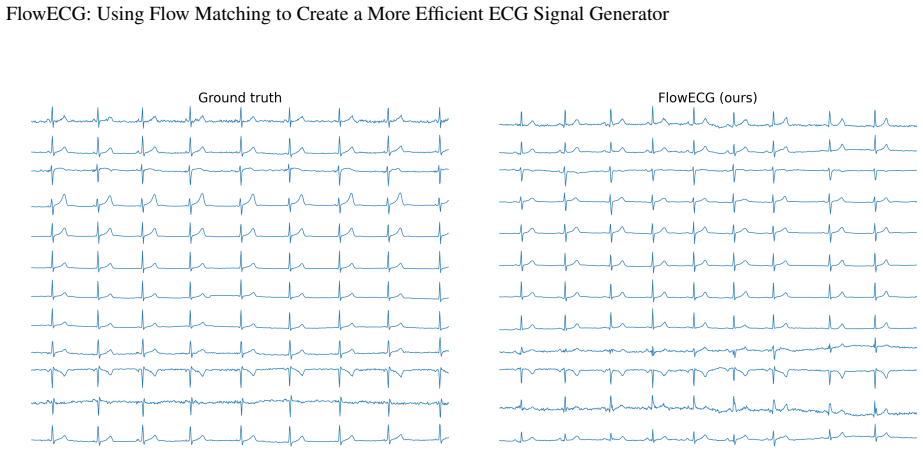
FlowECG is a flow-matching adaptation of an established diffusion ECG architecture: it keeps the same 36-layer residual network with structured state-space layers and the same diagnostic-label conditioning, but replaces discrete denoising steps with a learned continuous vector field. Training creates linear interpolations between Gaussian noise and real ECG signals and regresses the network to the constant velocity pointing from noise to data; sampling solves the resulting ordinary differential equation from noise to signal. At 200 neural function evaluations, FlowECG improves maximum mean discrepancy, Wasserstein distance, and spectral similarity relative to the retrained diffusion baseline
Load-bearing premise
The evaluation assumes that the four summary statistics measured on a single run without error bars adequately capture how good a synthetic ECG is, and that the diffusion model compared against was trained and evaluated fairly; if either assumption is wrong, the speed-up claim still stands but the quality comparison does not.
Editorial extensions
If this is right
- ECG synthesis with 10–25 forward passes instead of 200 puts generative ECG models within reach of real-time clinical screening and bedside monitoring, where latency and compute are constrained.
- Because each evaluation is one forward pass, the roughly tenfold reduction transfers almost directly to wall-clock and energy savings when producing large synthetic datasets for augmentation or privacy-preserving sharing.
- The generated 12-lead ECGs preserve physiologically consistent lead relationships and waveform morphology, so downstream tasks that rely on anatomically coherent multi-lead signals remain supported.
- The stability of flow matching under reduced sampling budgets suggests that adaptive sampling strategies—spending more steps on difficult conditioning labels and fewer on easy ones—could work without retraining.
Reading between the lines
- Not tested in the paper: whether the quality margins persist across multiple random seeds and with repeated training runs; the reported numbers are single-run, so the numerical advantage over the baseline may shift under replication.
- A testable extension the authors leave implicit is using the deterministic noise-to-signal map learned by flow matching for controlled interpolation between diagnostic conditions, which stochastic diffusion sampling does not offer as cleanly.
- The efficiency result plausibly extends to longer or multi-channel physiological recordings beyond the 12-lead ECG, since the same straight-path flow objective has been used successfully for other waveform domains; the paper does not demonstrate this.
- A direct clinical falsification route is a blinded cardiologist comparison of real, flow-generated, and diffusion-generated ECGs at matched sampling budgets; the four summary metrics in the paper do not by themselves certify clinical equivalence.
Editorial analysis
A structured set of objections, weighed in public.
Referee Report
Summary. The paper adapts the SSSD-ECG architecture to flow matching for conditional 12-lead ECG generation, replacing the diffusion process with a continuous ODE-based flow trained with a standard conditional flow-matching loss. On PTB-XL, Table 1 reports that at 200 neural function evaluations FlowECG improves on MMD, Wasserstein distance, and spectral similarity over a retrained SSSD-ECG baseline, while DTW is slightly worse. The main claim is that FlowECG maintains quality at 10--25 NFE, whereas SSSD-ECG degrades sharply when its 200 evaluation budget is reduced; this is supported only by Figure 2, with no numeric values for FlowECG at reduced NFE.
Significance. If the low-NFE result holds, the contribution is practically valuable: an order-of-magnitude reduction in sampling cost for synthetic ECG generation could enable larger-scale augmentation and real-time deployment. The methodological step is incremental but sensible, reusing a proven architecture with standard flow matching. The paper does not provide code, machine-checked proofs, or parameter-free derivations; the evaluation is empirical, so the strength of the contribution rests entirely on the reliability of the reported comparisons.
major comments (3)
- [§3.3, Figure 2] The central efficiency claim is not supported by reported numbers. The text gives SSSD-ECG degradation values (DTW > 600 at 2 NFE, > 200 at 25 NFE) but provides no numeric values for FlowECG at any reduced NFE, no table of the NFE sweep, no error bars, no seeds, and no sample counts. A reader cannot tell whether FlowECG's 10--25 NFE curves are within noise of its own 200-NFE performance or of the baseline's 200-NFE performance. This is load-bearing because the headline contribution is exactly 'comparable with 10--25 evaluations.' Please add a table reporting all four metrics for FlowECG and SSSD-ECG at NFE 2, 5, 10, 25, 50, 100, 200, with mean ± std over at least three seeds/evaluation runs and the number of generated and test samples, plus an appropriate statistical comparison for the 10--25 versus 200 NFE claim.
- [§3.3, Table 1] The baseline fairness is not established. The manuscript says the baseline is a 'retrained SSSD-ECG,' but it does not validate the retrained model against published SSSD-ECG results, nor does it report training duration, convergence, or hyperparameter search. If the retrained baseline is weaker than the published model, the 200-NFE comparison and the subsequent NFE comparison could be misleading. Please report the published SSSD-ECG values alongside the retrained ones, or use released checkpoints, and state how the retraining was performed (epochs, early stopping, random seeds, final training loss). This is needed to support the claim that FlowECG outperforms the baseline on three of four metrics.
- [§2.3, §3.3] The evaluation protocol is underspecified. The manuscript does not state how many real and generated ECGs were used for the metrics, which PTB-XL split is used, how the conditioning-label distribution is matched, the kernel choice for MMD, or the exact feature set for the Wasserstein metric. These choices can materially change DTW, MMD, and Wasserstein values and affect the comparisons at all NFE levels. Please provide a precise protocol, including sample counts and preprocessing, and consider reporting per-lead results in addition to the averaged values.
minor comments (6)
- [§2.3] The heading 'Mean Maximum Discrepancy' should be 'Maximum Mean Discrepancy.'
- [Eq. (1)] The flow-matching loss is not fully defined: specify the interpolation x_t = (1-t)x_0 + t x_1 and the target velocity u_t = x_1 - x_0, and clarify the distribution of x_0 and x_1 in the expectation.
- [§3.3] The abstract and Section 3.3 are inconsistent about the reduced-NFE claim: the abstract says 10--25 evaluations, while the text says '10-20 NFE.' Please align these statements.
- [§3.1] Typo: 'bette capture' should be 'better capture.'
- [Figure 2] The figure lacks axis labels, a legend, and numeric annotations; given that it is the sole evidence for the central efficiency claim, it should be self-contained and accompanied by the numeric table requested above.
- [§2.3.3] The abbreviation 'SimScore' appears in Table 1 but is not defined in the text; define it where the spectral similarity score is introduced.
Circularity Check
No significant circularity: the central efficiency claim rests on an empirical NFE comparison and on a standard, externally sourced flow-matching objective, not on fitted parameters or self-citation chains.
full rationale
The paper's derivation chain is self-contained on the key claim: FlowECG is trained with the standard flow-matching L2 objective (Eq. 8) from the external flow-matching literature (ref. 15), and its efficiency advantage is measured directly against a retrained SSSD-ECG baseline under varying NFE values. No fitted parameter or learned constant is renamed as a prediction: the evaluation metrics in Section 2.3 are computed independently from generated samples, and Table 1 plus Figure 2 report observed comparisons rather than outputs implied by the objective. The only self-citation is the background reference [1] in the introduction, which is used to motivate deep generative models generally and is not load-bearing for the flow-matching formulation, the architecture choice, or the sampling-efficiency result. No uniqueness theorem, ansatz, or known-result-renaming is imported from the authors' prior work. The main limitations (absence of error bars/seeds and uncertainty about the faithfulness of the retrained baseline) are comparison-validity concerns, not circularity, because they affect whether the empirical result is trustworthy, not whether the result reduces to its own inputs by construction.
Assumptions & free parameters
assumptions (6)
- standard math The flow matching objective with linear interpolation between noise and data is valid for learning ECG distributions.
- domain assumption The SSSD-ECG architecture, including 36 residual layers and bidirectional S4 blocks, is a suitable and competitive backbone for conditional ECG generation.
- domain assumption The four metrics (DTW, Wasserstein, MMD, spectral similarity) adequately capture the quality and clinical fidelity of synthetic ECGs.
- domain assumption The linear reconstructions III = II - I, aVL = (I - III)/2, aVF = (II + III)/2, -aVR = (I + II)/2 preserve physiological lead relationships in generated signals.
- domain assumption The retrained SSSD-ECG baseline is a faithful reproduction of the published state-of-the-art model.
- domain assumption The learned velocity field is smooth enough that coarse Euler integration with 10 to 25 steps accurately approximates the true ODE solution.
Cite this review
Pith. "Pith review of FlowECG: Using Flow Matching to Create a More Efficient ECG Signal Generator." pith.science (2026). https://pith.science/paper/QRMMJ2M6
@misc{pith2026250910491,
  author       = {Pith},
  title        = {Pith review of: FlowECG: Using Flow Matching to Create a More Efficient ECG Signal Generator},
  year         = {2026},
  howpublished = {\url{https://pith.science/paper/QRMMJ2M6}},
  note         = {Machine review of arXiv:2509.10491}
}
read the original abstract
Synthetic electrocardiogram generation serves medical AI applications requiring privacy-preserving data sharing and training dataset augmentation. Current diffusion-based methods achieve high generation quality but require hundreds of neural network evaluations during sampling, creating computational bottlenecks for clinical deployment. We propose FlowECG, a flow matching approach that adapts the SSSD-ECG architecture by replacing the iterative diffusion process with continuous flow dynamics. Flow matching learns direct transport paths from noise to data distributions through ordinary differential equation solving. We evaluate our method on the PTB-XL dataset using Dynamic Time Warping, Wasserstein distance, Maximum Mean Discrepancy, and spectral similarity metrics. FlowECG matches SSSD-ECG performance at 200 neural function evaluations, outperforming the baseline on three metrics. The key finding shows that FlowECG maintains generation quality with substantially fewer sampling steps, achieving comparable results with 10-25 evaluations compared to 200 for diffusion methods. This efficiency improvement reduces computational requirements by an order of magnitude while preserving physiologically realistic 12-lead ECG characteristics. The approach enables practical deployment in resource-limited clinical settings where real-time generation or large-scale synthetic data creation is needed.
Figures

Forward citations
Cited by 1 Pith paper
-
Signal or Noise? Understanding Generative Models for Real-World Sensor Time Series
Across 14 sensor generation settings, flow-matching models are the strongest overall baseline, while demographic conditioning, time-frequency modeling, and moderate synthetic augmentation improve hard regimes and down...
Reference graph
Works this paper leans on
-
[1]
Deep generative models as the probability transformation functions
Vitalii Bondar, Vira Babenko, Roman Trembovetskyi, Yurii Korobeinyk, and Viktoriya Dzyuba. Deep generative models as the probability transformation functions. arXiv preprint arXiv:2506.17171, 2025
work page Pith review arXiv 2025
-
[2]
Generation of ecg signals from a reaction-diffusion model spatially discretized
MA Quiroz-Juárez, O Jiménez-Ramírez, R Vázquez-Medina, V Breña-Medina, JL Aragón, and RA Barrio. Generation of ecg signals from a reaction-diffusion model spatially discretized. Scientific reports, 9(1):19000, 2019
work page 2019
-
[3]
Chris Donahue, Julian McAuley, and Miller Puckette. Adversarial audio synthesis. arXiv preprint arXiv:1802.04208, 2018
arXiv 2018
-
[4]
Vajira Thambawita, Jonas L Isaksen, Steven A Hicks, Jonas Ghouse, Gustav Ahlberg, Allan Linneberg, Niels Grarup, Christina Ellervik, Morten Salling Olesen, Torben Hansen, et al. Deepfake electrocardiograms using generative adversarial networks are the beginning of the end for privacy issues in medicine. Scientific reports, 11(1):21896, 2021
work page 2021
-
[5]
Synsiggan: Generative adversarial networks for synthetic biomedical signal generation
Debapriya Hazra and Yung-Cheol Byun. Synsiggan: Generative adversarial networks for synthetic biomedical signal generation. Biology, 9(12):441, 2020
work page 2020
-
[6]
Generative adversarial network with transformer generator for boosting ecg classification
Yi Xia, Yangyang Xu, Peng Chen, Jun Zhang, and Yongliang Zhang. Generative adversarial network with transformer generator for boosting ecg classification. Biomedical Signal Processing and Control, 80:104276, 2023
work page 2023
-
[7]
Diffusion-based conditional ecg generation with structured state space models
Juan Miguel Lopez Alcaraz and Nils Strodthoff. Diffusion-based conditional ecg generation with structured state space models. Computers in biology and medicine, 163:107115, 2023
work page 2023
-
[8]
Diffecg: A versatile probabilistic diffusion model for ecg signals synthesis
Nour Neifar, Achraf Ben-Hamadou, Afef Mdhaffar, and Mohamed Jmaiel. Diffecg: A versatile probabilistic diffusion model for ecg signals synthesis. In 2024 IEEE/ACIS 22nd International Conference on Software Engineering Research, Management and Applications (SERA), pages 182–188, 2024
work page 2024
Show all 19 references
-
[9]
Ecg synthesis via diffusion-based state space augmented transformer
Md Haider Zama and Friedhelm Schwenker. Ecg synthesis via diffusion-based state space augmented transformer. Sensors, 23(19):8328, 2023
2023
-
[10]
Biodiffusion: A versatile diffusion model for biomedical signal synthesis
Xiaomin Li, Mykhailo Sakevych, Gentry Atkinson, and Vangelis Metsis. Biodiffusion: A versatile diffusion model for biomedical signal synthesis. Bioengineering, 11(4):299, 2024
2024
-
[11]
Vaeeg: Variational auto-encoder for extracting eeg representation
Tong Zhao, Yi Cui, Taoyun Ji, Jiejian Luo, Wenling Li, Jun Jiang, Zaifen Gao, Wenguang Hu, Yuxiang Yan, Yuwu Jiang, et al. Vaeeg: Variational auto-encoder for extracting eeg representation. NeuroImage, 304:120946, 2024
2024
-
[12]
Simgans: Simulator-based generative adversarial networks for ecg synthesis to improve deep ecg classification
Tomer Golany, Kira Radinsky, and Daniel Freedman. Simgans: Simulator-based generative adversarial networks for ecg synthesis to improve deep ecg classification. In International Conference on Machine Learning, pages 3597–3606. PMLR, 2020
2020
-
[13]
Periodwave: Multi-period flow matching for high-fidelity waveform generation
Sang-Hoon Lee, Ha-Yeong Choi, and Seong-Whan Lee. Periodwave: Multi-period flow matching for high-fidelity waveform generation. arXiv preprint arXiv:2408.07547, 2024
2024 arXiv
-
[14]
Ptb-xl, a large publicly available electrocardiography dataset
Patrick Wagner, Nils Strodthoff, Ralf-Dieter Bousseljot, Dieter Kreiseler, Fatima I Lunze, Wojciech Samek, and Tobias Schaeffter. Ptb-xl, a large publicly available electrocardiography dataset. Scientific data, 7(1):1–15, 2020
2020
-
[15]
Flow matching for generative modeling
Yaron Lipman, Ricky TQ Chen, Heli Ben-Hamu, Maximilian Nickel, and Matt Le. Flow matching for generative modeling. arXiv preprint arXiv:2210.02747, 2022
2022 arXiv
-
[16]
Spectral similarity measure using frequency spectrum for hyperspectral image classification
Ke Wang, Bin Yong, Xingfa Gu, Pengfeng Xiao, and Xueliang Zhang. Spectral similarity measure using frequency spectrum for hyperspectral image classification. IEEE Geoscience and Remote Sensing Letters, 12(1):130–134, 2015
2015
-
[17]
Borgwardt, Malte J
Arthur Gretton, Karsten M. Borgwardt, Malte J. Rasch, Bernhard Schölkopf, and Alexander Smola. A kernel two-sample test. J. Mach. Learn. Res., 13(null):723–773, March 2012. 7 FlowECG: Using Flow Matching to Create a More Efficient ECG Signal Generator
2012
-
[18]
Calibrated reliable regression using maximum mean discrepancy
Peng Cui, Wenbo Hu, and Jun Zhu. Calibrated reliable regression using maximum mean discrepancy. Advances in Neural Information Processing Systems, 33:17164–17175, 2020
2020
-
[19]
Diffwave: A versatile diffusion model for audio synthesis
Zhifeng Kong, Wei Ping, Jiaji Huang, Kexin Zhao, and Bryan Catanzaro. Diffwave: A versatile diffusion model for audio synthesis. arXiv preprint arXiv:2009.09761, 2020. 8
2009 arXiv
Reviewed August 5, 2026 · model on record in the stance chip above.
Discussion (0). Continue with ORCID to comment.