REVIEW 4 major objections 5 minor 219 references
A Survey on LiDAR-based Autonomous Aerial Vehicles
T0 review · 4 major / 5 minor · reviewed 2026-08-04 · deepseek-v4-flash
Pith's one-line read This survey argues that LiDAR is the enabling sensor for high-speed, GPS-denied autonomous drone flight, and positions itself as the first dedicated comprehensive review of LiDAR-based autonomous UAV systems.
desk verdict Useful survey with a genuinely good resource table, but its 'first/only' claims and one glaring misattribution mean the historical sections need fixing before I'd trust them. read the letter →
The pith
A machine-rendered reading of the paper's core claim, the machinery that carries it, and where it could break.
The reading
What carries the argument
The load-bearing mechanism is the LiDAR sensor itself, in three generations: 2D laser rangefinders, mechanical 3D LiDARs such as the VLP-16, and solid-state LiDARs such as the Livox Avia and MID360. On the software side, the survey identifies LiDAR-inertial odometry (FAST-LIO2 and variants) as the state-estimation workhorse, occupancy grid maps like D-Map for efficient 3D mapping, and safe-flight-corridor trajectory optimization, particularly MINCO-based methods, for high-speed planning. These components together are what the survey claims convert raw point clouds into 20 m/s autonomous flight.
What would settle it
A literature search turning up either an earlier dedicated LiDAR-based UAV survey or an earlier self-rotating UAV with fully autonomous navigation in unknown GPS-denied environments would falsify the paper's central priority claims.
Extended reading notes
Core claim
The central claim is that LiDAR-based UAV autonomy has progressed from bulky 2D laser mapping on large helicopters to a mature, high-speed capability: modern solid-state LiDARs weighing roughly 265–500 g, combined with LiDAR-inertial odometry and safe-flight-corridor trajectory optimization, enable fully autonomous flight at over 13.7 m/s in cluttered scenes and over 20 m/s in open ones, without GPS. The paper's distinctive assertions are historical and taxonomic: it is the first dedicated comprehensive review of LiDAR-based autonomous UAVs, and within the literature it identifies PULSAR as the only self-rotating UAV to achieve complete autonomous navigation in unknown GPS-denied environment
Load-bearing premise
The survey's value and its 'only' and 'first' claims rest on the assumption that its literature search is complete and its per-paper summaries are accurate; the text itself suggests this assumption is imperfect, since the attribution in Sec. III-A-1 does not match the cited reference.
Editorial extensions
If this is right
- If LiDAR is the enabling sensor, further miniaturization and cost reduction (e.g., flash LiDAR, FMCW) will extend high-speed autonomy to smaller and cheaper UAVs.
- Two-stage planning—front-end path or corridor search plus back-end trajectory optimization—is the preferred framework for LiDAR-based UAVs, with safe-flight-corridor methods like MINCO becoming standard.
- The demonstrated milestones (PULSAR and the autonomous tail-sitter) imply that LiDAR can overcome sensor field-of-view and aerodynamic challenges that camera-based systems have not solved.
- LiDAR-based swarms, such as Swarm-LIO2, can achieve cooperative state estimation and tracking in cluttered environments, pointing toward multi-UAV exploration as a near-term application.
- Future progress will come from multi-sensor fusion (LiDAR plus camera and radar) and learning-based perception to handle sparsity and adverse weather, rather than from LiDAR alone.
Reading between the lines
- If the survey's causal story is right—that sensor range and accuracy drive autonomy speed—then FMCW LiDAR's per-point velocity measurements should trigger the next generation of aggressive-flight algorithms, since they promise motion estimation without scan matching.
- The survey's milestone claims are priority claims; I would treat them as hypotheses to be verified by an independent literature search, since the survey's own citation inconsistencies (e.g., the 1998 attribution in Sec. III-A-1) show per-paper summaries can be unreliable.
- The survey's framework suggests a testable extension: benchmarking LiDAR-based planners against camera-based ones at equal speed in identical cluttered environments would isolate LiDAR's contribution to autonomy from planning and control.
- If the open-source list is representative, the field's center of gravity lies in a few research groups; reproducing these systems outside those groups remains a barrier, so the survey's value may be as much a guide to building as to understanding.
Editorial analysis
A structured set of objections, weighed in public.
Referee Report
Summary. This survey reviews LiDAR-based autonomous UAV systems across sensing hardware, perception (state estimation, occupancy mapping, dynamic object detection), planning and control, open-source resources, and applications. It argues that LiDAR is a key enabler of high-speed and GPS-denied autonomy, and it makes several categorical claims: that a dedicated comprehensive review has been absent, that the authors' PULSAR platform is the only self-rotating UAV achieving full autonomous navigation, and that reference [205] is the first tail-sitter VTOL UAV with fully autonomous flight. The paper is organized as a conventional narrative survey with figures, a taxonomy of planning approaches, and a table of open-source projects, ending with future directions.
Significance. If the survey's coverage is reliable, it would serve as a useful entry point to a fast-moving area and a convenient condensation of sensor, algorithm, and platform developments. The paper has tangible strengths: a clear structure, a broad reference list, a useful tabulation of open-source resources with links, and an accessible discussion of how LiDAR characteristics interact with UAV-specific constraints. The authors are well-positioned to write such a survey, and several described systems come with publicly available code. The value, however, depends on the accuracy and representativeness of the literature summaries, because the survey's main contribution is the map itself rather than new technical results. The current manuscript does not yet provide enough methodological transparency or historical accuracy to fully support the categorical 'first/only/comprehensive' claims.
major comments (4)
- [I; Fig. 1] The paper's central claim is that it fills a gap by being a 'dedicated and comprehensive review' of LiDAR-based autonomous UAVs. No search protocol, inclusion criteria, or screening process is documented. The only quantitative support, Fig. 1, uses the Web of Science query ("LiDAR" OR "Laser") AND ("UAV" OR "MAV" OR "Drone" OR "Aerial"), which counts broad LiDAR-UAV publications, not specifically autonomous systems, and is too coarse to substantiate a 'comprehensive' coverage claim. I recommend adding a methodology paragraph that states databases, query strings, time span, inclusion/exclusion criteria, and screening counts, or softening the claim to 'a representative review of recent work.'
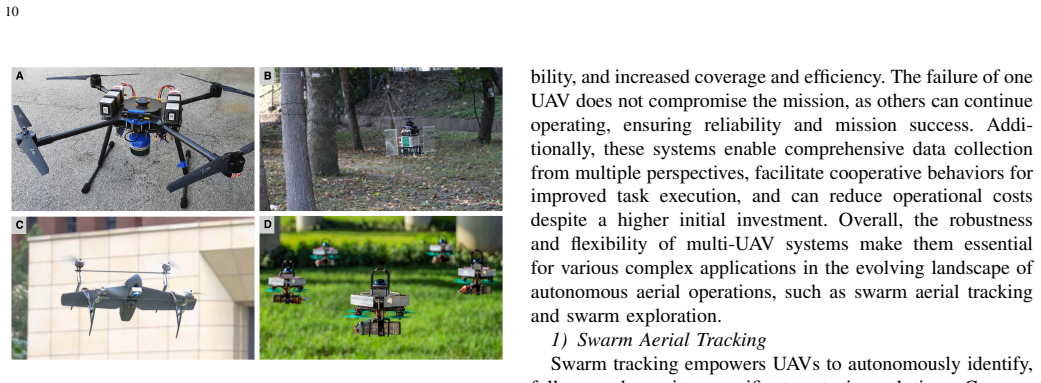
- [VI-B-1; VI-B-2] Categorical priority claims are load-bearing but rest on a small, non-systematic reference base. Section VI-B-1 calls PULSAR [161] 'the only one exception' among self-rotating autonomous UAVs, but the comparison considers only [198]–[202] and then [203]–[204]. Section VI-B-2 states that [205] is 'the first tail-sitter VTOL UAV that achieves fully autonomous flight ability,' while the discussion mentions only [206] and [207]. No evidence is provided that the search covered earlier or concurrent work, especially in the aeronautics and control literature. These statements should be softened to 'to the best of our knowledge' or supported by a documented systematic search with an explicit enumeration of the candidate set.
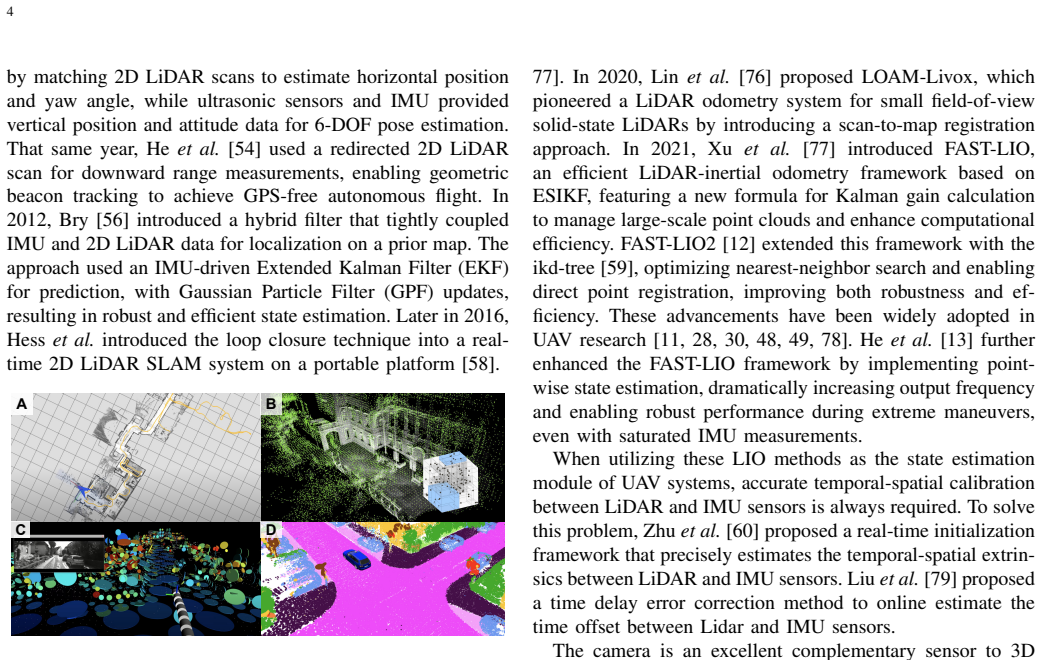
- [III-A-1] The historical state-estimation timeline contains a clear factual error: the text says 'In 1998, Miller et al. used a 2D laser range finder for environmental mapping,' but no Miller et al. 1998 appears in the bibliography; the 1998 mapping work discussed in the surrounding context is Ryan [37], '3-D site mapping with the CMU autonomous helicopter.' The next sentence dates Thrun et al. [22] to 'By 2003,' but reference [22] is the 2006 Field and Service Robotics paper 'Scan alignment and 3-D surface modeling with a helicopter platform.' Because this subsection is explicitly historical, these errors undermine confidence in the accuracy of the per-paper summaries. The attribution and date must be corrected, and the other timeline claims should be rechecked.
- [VI; Table I] The milestone and open-source selections are heavily weighted toward the authors' own laboratory: PULSAR [161], the tail-sitter system [205], IPC [145], ROG-Map [48], D-Map [49], FAST-LIO/FAST-LIVO, Swarm-LIO2 [62], and MARSIM, among others. This is not itself an error, but when the same self-citations are used both to define the milestones and to support the 'only/first' and 'comprehensive' claims, there is a risk of circularity in the evidence selection. I ask the authors to state the criteria by which systems were chosen for these sections and, where possible, to include independent or competing works so the reader can judge representativeness.
minor comments (5)
- [III-B-1] Heading typo: 'Occupancy Rerepsentations' should be 'Occupancy Representations.'
- [IV-A-2-b] Duplicate phrase: 'building and updating the ESDF-map can be can be computationally heavy.'
- [VI-B-2] Typos: 'clusterd environments,' 'ourdoor park,' and 'compete autonomous flight' (the last also in VI-B-1) should read 'cluttered,' 'outdoor,' and 'complete.'
- [Table I] Several rows lack references or are not clearly LiDAR-based: Fast-Drone-250, Agilicious, and OmniNxt are labeled Vision-based; A-LOAM and Geometry Control have no reference. Clarify the inclusion criteria and add citations or notes.
- [Fig. 1 caption] The caption says the plot counts 'publications related to LiDAR-based UAV,' but the query does not include 'autonomous.' The count therefore likely includes many non-autonomous LiDAR-UAV papers; the caption should be clarified.
Circularity Check
No circularity: survey has no mathematical derivation; its 'first/only' claims are literature assertions supported by primary citations, not reductions to the paper's own inputs.
full rationale
This is a survey paper with no equations, fitted parameters, or predictive derivations, so there is no formal chain in which a result is equivalent to its input by construction. The strongest claims are literature-scope assertions: that a dedicated comprehensive review of LiDAR-based autonomous UAVs 'remains absent' (Sec. I), that PULSAR is 'the only one exception' among self-rotating autonomous UAVs (Sec. VI-B-1), and that [205] is 'the first tail-sitter VTOL UAV that achieves fully autonomous flight ability' (Sec. VI-B-2). These claims cite the authors' own previous publications, but the citations point to peer-reviewed, externally checkable systems (e.g., Science Robotics and IEEE T-RO); the survey does not derive those priority claims from the citations themselves, nor does it use a self-citation as a uniqueness theorem to forbid alternatives. The absence of a documented search protocol is a methodological completeness limitation, not circular reasoning. The factual misattribution in Sec. III-A-1 (a 1998 mapping effort attributed to 'Miller et al.' with reference [37] being M. Ryan's CMU helicopter paper) undermines confidence in the survey's summaries, but it is an accuracy issue, not a circularity issue. Therefore no circular steps are identified and the circularity score is 0.
Assumptions & free parameters
assumptions (3)
- domain assumption The Web of Science search with the stated terms ('LiDAR' OR 'Laser') AND ('UAV' OR 'MAV' OR 'Drone' OR 'Aerial') captures the relevant population of LiDAR-based UAV publications.
- domain assumption The curated selection of works and open-source projects is representative of the state of the art.
- domain assumption Per-paper descriptions in the survey are faithful to the original sources.
Cite this review
Pith. "Pith review of A Survey on LiDAR-based Autonomous Aerial Vehicles." pith.science (2026). https://pith.science/paper/FW7HYYKA
@misc{pith2026250910730,
  author       = {Pith},
  title        = {Pith review of: A Survey on LiDAR-based Autonomous Aerial Vehicles},
  year         = {2026},
  howpublished = {\url{https://pith.science/paper/FW7HYYKA}},
  note         = {Machine review of arXiv:2509.10730}
}
read the original abstract
This survey offers a comprehensive overview of recent advancements in LiDAR-based autonomous Unmanned Aerial Vehicles (UAVs), covering their design, perception, planning, and control strategies. Over the past decade, LiDAR technology has become a crucial enabler for high-speed, agile, and reliable UAV navigation, especially in GPS-denied environments. The paper begins by examining the evolution of LiDAR sensors, emphasizing their unique advantages such as high accuracy, long-range depth measurements, and robust performance under various lighting conditions, making them particularly well-suited for UAV applications. The integration of LiDAR with UAVs has significantly enhanced their autonomy, enabling complex missions in diverse and challenging environments. Subsequently, we explore essential software components, including perception technologies for state estimation and mapping, as well as trajectory planning and control methodologies, and discuss their adoption in LiDAR-based UAVs. Additionally, we analyze various practical applications of the LiDAR-based UAVs, ranging from industrial operations to supporting different aerial platforms and UAV swarm deployments. The survey concludes by discussing existing challenges and proposing future research directions to advance LiDAR-based UAVs and enhance multi-UAV collaboration. By synthesizing recent developments, this paper aims to provide a valuable resource for researchers and practitioners working to push the boundaries of LiDAR-based UAV systems.
Figures


Figures from the paper (3 more)


Reference graph
Works this paper leans on
-
[37]
3-d site mapping with the cmu autonomous helicopter,
M. Ryan, “3-d site mapping with the cmu autonomous helicopter,” in The 5th International Conference on Intelligent Autonomous Systems, 1998, 1998
1998
-
[205]
Autonomous tail-sitter flights in unknown environments,
G. Lu, Y . Ren, F. Zhu, H. Li, R. Xue, Y . Cai, X. Lyu, and F. Zhang, “Autonomous tail-sitter flights in unknown environments,”IEEE Trans- actions on Robotics, vol. 41, pp. 1098–1117, 2025
2025
-
[161]
A self-rotating, single-actuated uav with extended sensor field of view for autonomous navigation,
N. Chen, F. Kong, W. Xu, Y . Cai, H. Li, D. He, Y . Qin, and F. Zhang, “A self-rotating, single-actuated uav with extended sensor field of view for autonomous navigation,”Science Robotics, vol. 8, no. 76, p. eade4538, 2023
2023
-
[198]
Piccolissimo: The smallest micro aerial vehicle,
M. Piccoli and M. Yim, “Piccolissimo: The smallest micro aerial vehicle,” in2017 IEEE International Conference on Robotics and Automation (ICRA). IEEE, 2017, pp. 3328–3333
2017
-
[202]
Splitflyer air: A modular quadcopter that disassembles into two bicopters mid-air,
S. Bai and P. Chirarattananon, “Splitflyer air: A modular quadcopter that disassembles into two bicopters mid-air,”IEEE/ASME Transac- tions on Mechatronics, vol. 27, no. 6, pp. 4729–4740, 2022
2022
-
[203]
Lockheed martin’s samarai nano air vehicle: challenges, research, and realization,
S. Jameson, K. Fregene, M. Chang, N. Allen, H. Youngren, and J. Scroggins, “Lockheed martin’s samarai nano air vehicle: challenges, research, and realization,” in50th AIAA Aerospace Sciences Meeting Including the New Horizons Forum and Aerospace Exposition, 2012, p. 584
2012
-
[204]
Autonomous quadrotor flight despite rotor failure with onboard vision sensors: Frames vs. events,
S. Sun, G. Cioffi, C. De Visser, and D. Scaramuzza, “Autonomous quadrotor flight despite rotor failure with onboard vision sensors: Frames vs. events,”IEEE Robotics and Automation Letters, vol. 6, no. 2, pp. 580–587, 2021
2021
-
[206]
Swashplateless-elevon actuation for a dual-rotor tail-sitter vtol uav,
N. Chen, F. Kong, H. Li, J. Liu, Z. Ye, W. Xu, F. Zhu, X. Lyu, and F. Zhang, “Swashplateless-elevon actuation for a dual-rotor tail-sitter vtol uav,” in2023 IEEE/RSJ International Conference on Intelligent Robots and Systems (IROS). IEEE, 2023, pp. 6970–6976
2023
-
[207]
Trajectory generation and tracking control for aggressive tail-sitter flights,
G. Lu, Y . Cai, N. Chen, F. Kong, Y . Ren, and F. Zhang, “Trajectory generation and tracking control for aggressive tail-sitter flights,”The International Journal of Robotics Research, vol. 43, no. 3, pp. 241–280, 2024
2024
-
[22]
Scan alignment and 3-d surface modeling with a helicopter platform,
S. Thrun, M. Diel, and D. H ¨ahnel, “Scan alignment and 3-d surface modeling with a helicopter platform,” inField and Service Robotics: Recent Advances in Reserch and Applications. Springer, 2006, pp. 287–297
2006
-
[145]
Integrated planning and control for quadrotor navigation in presence of suddenly appearing objects and disturbances,
W. Liu, Y . Ren, and F. Zhang, “Integrated planning and control for quadrotor navigation in presence of suddenly appearing objects and disturbances,”IEEE Robotics and Automation Letters, pp. 1–8, 2023
2023
-
[48]
Rog-map: An efficient robocentric occupancy grid map for large-scene and high-resolution lidar-based motion planning,
Y . Ren, Y . Cai, F. Zhu, S. Liang, and F. Zhang, “Rog-map: An efficient robocentric occupancy grid map for large-scene and high-resolution lidar-based motion planning,” in2024 IEEE/RSJ International Con- ference on Intelligent Robots and Systems (IROS). IEEE, 2024, pp. 8119–8125
2024
-
[49]
Occupancy grid mapping without ray-casting for high-resolution lidar sensors,
Y . Cai, F. Kong, Y . Ren, F. Zhu, J. Lin, and F. Zhang, “Occupancy grid mapping without ray-casting for high-resolution lidar sensors,”IEEE Transactions on Robotics, 2023
2023
-
[62]
Swarm-lio2: Decentralized, efficient lidar-inertial odometry for uav swarms,
F. Zhu, Y . Ren, L. Yin, F. Kong, Q. Liu, R. Xue, W. Liu, Y . Cai, G. Lu, H. Li,et al., “Swarm-lio2: Decentralized, efficient lidar-inertial odometry for uav swarms,”IEEE Transactions on Robotics, vol. 41, pp. 960–981, 2024
2024
Show all 219 references
-
[1]
Review of photogrammetric and lidar applications of uav,
L. Kovani ˇc, B. Topitzer, P. Pet’ovsk `y, P. Bli ˇst’an, M. B. Gergel’ov ´a, and M. Bliˇst’anov´a, “Review of photogrammetric and lidar applications of uav,”Applied Sciences, vol. 13, no. 11, p. 6732, 2023
2023
-
[2]
A review on uav-based applications for precision agriculture,
D. C. Tsouros, S. Bibi, and P. G. Sarigiannidis, “A review on uav-based applications for precision agriculture,”Information, vol. 10, no. 11, pp. 349–374, 2019
2019
-
[3]
State-of-the-art technologies for uav inspections,
S. Jordan, J. Moore, S. Hovet, J. Box, J. Perry, K. Kirsche, D. Lewis, and Z. T. H. Tse, “State-of-the-art technologies for uav inspections,” IET Radar, Sonar & Navigation, vol. 12, no. 2, pp. 151–164, 2018
2018
-
[4]
Applications of drone in disaster management: A scoping review,
S. M. S. M. Daud, M. Y . P. M. Yusof, C. C. Heo, L. S. Khoo, M. K. C. Singh, M. S. Mahmood, and H. Nawawi, “Applications of drone in disaster management: A scoping review,”Science & Justice, vol. 62, no. 1, pp. 30–42, 2022
2022
-
[5]
A drone fleet model for last- mile distribution in disaster relief operations,
B. Rabta, C. Wankm ¨uller, and G. Reiner, “A drone fleet model for last- mile distribution in disaster relief operations,”International Journal of Disaster Risk Reduction, vol. 28, pp. 107–112, 2018
2018
-
[6]
Radar odometry for au- tonomous ground vehicles: A survey of methods and datasets,
N. J. Abu-Alrub and N. A. Rawashdeh, “Radar odometry for au- tonomous ground vehicles: A survey of methods and datasets,”IEEE Transactions on Intelligent Vehicles, vol. 9, no. 3, pp. 4275–4291, 2023
2023
-
[7]
Vision-based state estimation and trajectory control towards high-speed flight with a quadrotor
S. Shen, Y . Mulgaonkar, N. Michael, and V . Kumar, “Vision-based state estimation and trajectory control towards high-speed flight with a quadrotor.” inRobotics: Science and Systems, vol. 1. Citeseer, 2013, p. 32
2013
-
[8]
Safe local exploration for replanning in cluttered unknown environments for microaerial vehicles,
H. Oleynikova, Z. Taylor, R. Siegwart, and J. Nieto, “Safe local exploration for replanning in cluttered unknown environments for microaerial vehicles,”IEEE Robotics and Automation Letters, vol. 3, no. 3, pp. 1474–1481, 2018
2018
-
[9]
Robust and efficient quadrotor trajectory generation for fast autonomous flight,
B. Zhou, F. Gao, L. Wang, C. Liu, and S. Shen, “Robust and efficient quadrotor trajectory generation for fast autonomous flight,”IEEE Robotics and Automation Letters, vol. 4, no. 4, pp. 3529–3536, 2019
2019
-
[10]
Safety-assured high-speed navigation for mavs,
Y . Ren, F. Zhu, G. Lu, Y . Cai, L. Yin, F. Kong, J. Lin, N. Chen, and F. Zhang, “Safety-assured high-speed navigation for mavs,”Science Robotics, vol. 10, no. 98, p. eado6187, 2025
2025
-
[11]
Online whole-body motion planning for quadrotor using multi-resolution search,
Y . Ren, S. Liang, F. Zhu, G. Lu, and F. Zhang, “Online whole-body motion planning for quadrotor using multi-resolution search,” in2023 IEEE International Conference on Robotics and Automation (ICRA). IEEE, 2023, pp. 1594–1600
2023
-
[12]
Fast-lio2: Fast direct lidar-inertial odometry,
W. Xu, Y . Cai, D. He, J. Lin, and F. Zhang, “Fast-lio2: Fast direct lidar-inertial odometry,”IEEE Transactions on Robotics, 2022
2022
-
[13]
Point-lio: Robust high-bandwidth light detection and ranging inertial odometry,
D. He, W. Xu, N. Chen, F. Kong, C. Yuan, and F. Zhang, “Point-lio: Robust high-bandwidth light detection and ranging inertial odometry,” Advanced Intelligent Systems, vol. 5, no. 7, p. 2200459, 2023
2023
-
[14]
Dynamic control barrier function-based model predictive control to safety-critical obstacle-avoidance of mobile robot,
Z. Jian, Z. Yan, X. Lei, Z. Lu, B. Lan, X. Wang, and B. Liang, “Dynamic control barrier function-based model predictive control to safety-critical obstacle-avoidance of mobile robot,” in2023 IEEE International Conference on Robotics and Automation (ICRA). Ieee, 2023, pp. 3679–3685
2023
-
[15]
Learning quadrupedal locomotion over challenging terrain,
J. Lee, J. Hwangbo, L. Wellhausen, V . Koltun, and M. Hutter, “Learning quadrupedal locomotion over challenging terrain,”Science robotics, vol. 5, no. 47, p. eabc5986, 2020
2020
-
[16]
Survey of advances in guidance, navigation, and control of unmanned rotorcraft systems,
F. Kendoul, “Survey of advances in guidance, navigation, and control of unmanned rotorcraft systems,”Journal of Field Robotics, vol. 29, no. 2, pp. 315–378, 2012
2012
-
[17]
Survey on computer vision for uavs: Current developments and trends,
C. Kanellakis and G. Nikolakopoulos, “Survey on computer vision for uavs: Current developments and trends,”Journal of Intelligent & Robotic Systems, vol. 87, pp. 141–168, 2017
2017
-
[18]
A review of gnss-independent uav navigation techniques,
N. Gyagenda, J. V . Hatilima, H. Roth, and V . Zhmud, “A review of gnss-independent uav navigation techniques,”Robotics and Au- tonomous Systems, vol. 152, p. 104069, 2022
2022
-
[19]
A review of uav autonomous navigation in gps-denied environments,
Y . Chang, Y . Cheng, U. Manzoor, and J. Murray, “A review of uav autonomous navigation in gps-denied environments,”Robotics and Autonomous Systems, p. 104533, 2023
2023
-
[20]
Lidar odometry survey: recent advancements and remaining challenges,
D. Lee, M. Jung, W. Yang, and A. Kim, “Lidar odometry survey: recent advancements and remaining challenges,”Intelligent Service Robotics, vol. 17, no. 2, pp. 95–118, 2024
2024
-
[21]
Lidar-based place recognition for au- tonomous driving: A survey,
Y . Zhang, P. Shi, and J. Li, “Lidar-based place recognition for au- tonomous driving: A survey,”ACM Computing Surveys, vol. 57, no. 4, pp. 1–36, 2024
2024
-
[23]
P-cap: Pre- computed alternative paths to enable aggressive aerial maneuvers in cluttered environments,
J. Zhang, R. G. Chadha, V . Velivela, and S. Singh, “P-cap: Pre- computed alternative paths to enable aggressive aerial maneuvers in cluttered environments,” in2018 IEEE/RSJ International Conference on Intelligent Robots and Systems (IROS). IEEE, 2018, pp. 8456– 8463
2018
-
[24]
Evaluation of uav lidar for mapping coastal environments,
Y .-C. Lin, Y .-T. Cheng, T. Zhou, R. Ravi, S. M. Hasheminasab, J. E. Flatt, C. Troy, and A. Habib, “Evaluation of uav lidar for mapping coastal environments,”Remote Sensing, vol. 11, no. 24, p. 2893, 2019
2019
-
[25]
Geometrically constrained tra- jectory optimization for multicopters,
Z. Wang, X. Zhou, C. Xu, and F. Gao, “Geometrically constrained tra- jectory optimization for multicopters,”IEEE Transactions on Robotics, vol. 38, no. 5, pp. 3259–3278, 2022
2022
-
[26]
Treescope: An agricultural robotics dataset for lidar-based mapping of trees in forests and or- chards,
D. Cheng, F. Cladera, A. Prabhu, X. Liu, A. Zhu, P. C. Green, R. Ehsani, P. Chaudhari, and V . Kumar, “Treescope: An agricultural robotics dataset for lidar-based mapping of trees in forests and or- chards,” in2024 IEEE International Conference on Robotics and Automation (ICRA...
2024
-
[27]
An autonomous uav system based on adaptive lidar inertial odometry for practical exploration in complex environments,
B. Kim, M. B. Azhari, J. Park, and D. H. Shim, “An autonomous uav system based on adaptive lidar inertial odometry for practical exploration in complex environments,”Journal of Field Robotics, vol. 41, no. 3, pp. 669–698, 2024
2024
-
[28]
Avoiding dynamic small obstacles with onboard sensing and computation on aerial robots,
F. Kong, W. Xu, Y . Cai, and F. Zhang, “Avoiding dynamic small obstacles with onboard sensing and computation on aerial robots,” IEEE Robotics and Automation Letters, vol. 6, no. 4, pp. 7869–7876, 2021
2021
-
[29]
Mars-lvig dataset: A multi-sensor aerial robots slam dataset for lidar-visual-inertial-gnss fusion,
H. Li, Y . Zou, N. Chen, J. Lin, X. Liu, W. Xu, C. Zheng, R. Li, D. He, F. Kong,et al., “Mars-lvig dataset: A multi-sensor aerial robots slam dataset for lidar-visual-inertial-gnss fusion,”The International Journal of Robotics Research, p. 02783649241227968, 2024
2024
-
[30]
Bubble planner: Planning high-speed smooth quadrotor trajectories using receding corridors,
Y . Ren, F. Zhu, W. Liu, Z. Wang, Y . Lin, F. Gao, and F. Zhang, “Bubble planner: Planning high-speed smooth quadrotor trajectories using receding corridors,” in2022 IEEE/RSJ International Conference on Intelligent Robots and Systems (IROS), 2022, pp. 6332–6339
2022
-
[31]
Slope inspection under dense vegetation using lidar-based quadrotors,
W. Liu, Y . Ren, R. Guo, V . W. Kong, A. S. Hung, F. Zhu, Y . Cai, H. Wu, Y . Zou, and F. Zhang, “Slope inspection under dense vegetation using lidar-based quadrotors,”Nature Communications, vol. 16, no. 1, pp. 7411–7424, 2025
2025
-
[32]
Research on vision-based servoing and trajectory prediction strategy for capturing illegal drones,
J. Ma, P. Chen, X. Xiong, L. Zhang, S. Yu, and D. Zhang, “Research on vision-based servoing and trajectory prediction strategy for capturing illegal drones,”Drones, vol. 8, no. 4, pp. 127–143, 2024
2024
-
[33]
A robust lidar- based indoor exploration framework for uavs in uncooperative envi- ronments,
W. Bolz, M. Cella, N. Maikisch, F. Vultaggio, F. d’Apolito, F. Bruckm ¨uller, C. Sulzbachner, and P. Fanta-Jende, “A robust lidar- based indoor exploration framework for uavs in uncooperative envi- ronments,” in2024 International Conference on Unmanned Aircraft Systems (ICUAS)...
2024
-
[34]
Air bumper: A collision detection and reaction framework for autonomous mav 13 navigation,
R. Wang, Z. Guo, Y . Chen, X. Wang, and B. M. Chen, “Air bumper: A collision detection and reaction framework for autonomous mav 13 navigation,” in2024 IEEE International Conference on Robotics and Automation (ICRA). IEEE, 2024, pp. 15 735–15 741
2024
-
[35]
Developing a flying explorer for autonomous digital modelling in wild unknowns,
N. Zhang, Y . Pan, Y . Jin, P. Jin, K. Hu, X. Huang, and H. Kang, “Developing a flying explorer for autonomous digital modelling in wild unknowns,”Sensors, vol. 24, no. 3, p. 1021, 2024
2024
-
[36]
Optical ranging system uses laser transmitter,
M. Stitch, E. Woodbury, and J. Morse, “Optical ranging system uses laser transmitter,”Electronics, vol. 34, pp. 51–53, 1961
1961
-
[38]
Conflict-free navigation in unknown urban environments,
D. H. Shim, H. Chung, and S. S. Sastry, “Conflict-free navigation in unknown urban environments,”IEEE robotics & automation magazine, vol. 13, no. 3, pp. 27–33, 2006
2006
-
[39]
Flight trials of a rotorcraft unmanned aerial vehicle landing autonomously at unprepared sites,
C. Theodore, D. Rowley, A. Ansar, L. Matthies, S. Goldberg, D. Hub- bard, and M. Whalley, “Flight trials of a rotorcraft unmanned aerial vehicle landing autonomously at unprepared sites,” inAnnual forum proceedings-American helicopter society, vol. 62, no. 2. AMERICAN HELICOPT...
2006
-
[40]
Little ben: The ben franklin racing team’s entry in the 2007 darpa urban challenge,
J. Bohren, T. Foote, J. Keller, A. Kushleyev, D. Lee, A. Stewart, P. Vernaza, J. Derenick, J. Spletzer, and B. Satterfield, “Little ben: The ben franklin racing team’s entry in the 2007 darpa urban challenge,” Journal of Field Robotics, vol. 25, no. 9, pp. 598–614, 2008
2007
-
[41]
Online quadrotor trajectory generation and autonomous navigation on point clouds,
F. Gao and S. Shen, “Online quadrotor trajectory generation and autonomous navigation on point clouds,” in2016 IEEE International Symposium on Safety, Security, and Rescue Robotics (SSRR). IEEE, 2016, pp. 139–146
2016
-
[42]
Falco: Fast likelihood- based collision avoidance with extension to human-guided navigation,
J. Zhang, C. Hu, R. G. Chadha, and S. Singh, “Falco: Fast likelihood- based collision avoidance with extension to human-guided navigation,” Journal of Field Robotics, vol. 37, no. 8, pp. 1300–1313, 2020
2020
-
[43]
Ouster OS1-128 sensor,
“Ouster OS1-128 sensor,” https://ouster.com/products/scanning-lidar/ os1-sensor, 2024. [Online]. Available: https://ouster.com/products/ scanning-lidar/os1-sensor
2024
-
[44]
Livox Avia LiDAR,
“Livox Avia LiDAR,” https://www.livoxtech.com/avia/specs, 2024. [Online]. Available: https://www.livoxtech.com/avia/specs [45]Livox Mid-360 User Manual, Livox Technology Company Limited, Jan. 2023, https://www.livoxtech.com/mid-360
2024
-
[46]
Fmcw lidar system to reduce hard- ware complexity and post-processing techniques to improve distance resolution,
C. Kim, Y . Jung, and S. Lee, “Fmcw lidar system to reduce hard- ware complexity and post-processing techniques to improve distance resolution,”Sensors, vol. 20, no. 22, pp. 6676–6687, 2020
2020
-
[47]
Fully integrated fmcw lidar op- tical engine on a single silicon chip,
K. Sayyah, R. Sarkissian, P. Patterson, B. Huang, O. Efimov, D. Kim, K. Elliott, L. Yang, and D. Hammon, “Fully integrated fmcw lidar op- tical engine on a single silicon chip,”Journal of Lightwave Technology, vol. 40, no. 9, pp. 2763–2772, 2022
2022
-
[50]
On-manifold model predictive control for trajectory tracking on robotic systems,
G. Lu, W. Xu, and F. Zhang, “On-manifold model predictive control for trajectory tracking on robotic systems,”IEEE Transactions on Industrial Electronics, pp. 1–10, 2022
2022
-
[51]
Loam: Lidar odometry and mapping in real- time
J. Zhang and S. Singh, “Loam: Lidar odometry and mapping in real- time.” inRobotics: Science and Systems, vol. 2, no. 9. Berkeley, CA, 2014, pp. 1–9
2014
-
[52]
Fast-livo2: Fast, direct lidar-inertial-visual odometry,
C. Zheng, W. Xu, Z. Zou, T. Hua, C. Yuan, D. He, B. Zhou, Z. Liu, J. Lin, F. Zhu,et al., “Fast-livo2: Fast, direct lidar-inertial-visual odometry,”IEEE Transactions on Robotics, vol. 41, pp. 326–346, 2024
2024
-
[53]
Autonomous in- door hovering with a quadrotor,
G. Angeletti, J. P. Valente, L. Iocchi, and D. Nardi, “Autonomous in- door hovering with a quadrotor,” inWorkshop Proc. SIMPAR. Citeseer, 2008, pp. 472–481
2008
-
[54]
Planning in information space for a quadrotor helicopter in a gps-denied environment,
R. He, S. Prentice, and N. Roy, “Planning in information space for a quadrotor helicopter in a gps-denied environment,” in2008 IEEE International conference on Robotics and Automation. IEEE, 2008, pp. 1814–1820
2008
-
[55]
Efficient planning under uncertainty for a target-tracking micro-aerial vehicle,
R. He, A. Bachrach, and N. Roy, “Efficient planning under uncertainty for a target-tracking micro-aerial vehicle,” in2010 IEEE International Conference on Robotics and Automation. IEEE, 2010, pp. 1–8
2010
-
[56]
State estimation for aggressive flight in gps-denied environments using onboard sensing,
A. Bry, A. Bachrach, and N. Roy, “State estimation for aggressive flight in gps-denied environments using onboard sensing,” in2012 IEEE international conference on robotics and automation. IEEE, 2012, pp. 1–8
2012
-
[57]
Method for registration of 3-d shapes,
P. J. Besl and N. D. McKay, “Method for registration of 3-d shapes,” inSensor fusion IV: control paradigms and data structures, vol. 1611. Spie, 1992, pp. 586–606
1992
-
[58]
Real-time loop closure in 2d lidar slam,
W. Hess, D. Kohler, H. Rapp, and D. Andor, “Real-time loop closure in 2d lidar slam,” in2016 IEEE international conference on robotics and automation (ICRA). IEEE, 2016, pp. 1271–1278
2016
-
[59]
ikd-tree: An incremental kd tree for robotic applications,
Y . Cai, W. Xu, and F. Zhang, “ikd-tree: An incremental kd tree for robotic applications,”arXiv preprint arXiv:2102.10808, 2021
2021 arXiv
-
[60]
Robust real-time lidar-inertial initializa- tion,
F. Zhu, Y . Ren, and F. Zhang, “Robust real-time lidar-inertial initializa- tion,” in2022 IEEE/RSJ International Conference on Intelligent Robots and Systems (IROS). IEEE, 2022, pp. 3948–3955
2022
-
[61]
Swarm-lio: Decentralized swarm lidar-inertial odometry,
F. Zhu, Y . Ren, F. Kong, H. Wu, S. Liang, N. Chen, W. Xu, and F. Zhang, “Swarm-lio: Decentralized swarm lidar-inertial odometry,” in2023 IEEE International Conference on Robotics and Automation (ICRA). IEEE, 2023, pp. 3254–3260
2023
-
[63]
Efficient and prob- abilistic adaptive voxel mapping for accurate online lidar odometry,
C. Yuan, W. Xu, X. Liu, X. Hong, and F. Zhang, “Efficient and prob- abilistic adaptive voxel mapping for accurate online lidar odometry,” IEEE Robotics and Automation Letters, vol. 7, no. 3, pp. 8518–8525, 2022
2022
-
[64]
Fast-livo: Fast and tightly-coupled sparse-direct lidar-inertial-visual odometry,
C. Zheng, Q. Zhu, W. Xu, X. Liu, Q. Guo, and F. Zhang, “Fast-livo: Fast and tightly-coupled sparse-direct lidar-inertial-visual odometry,” in2022 IEEE/RSJ international conference on intelligent robots and systems (IROS). IEEE, 2022, pp. 4003–4009
2022
-
[65]
Suma++: Efficient lidar-based semantic slam,
X. Chen, A. Milioto, E. Palazzolo, P. Giguere, J. Behley, and C. Stach- niss, “Suma++: Efficient lidar-based semantic slam,” in2019 IEEE/RSJ International Conference on Intelligent Robots and Systems (IROS). IEEE, 2019, pp. 4530–4537
2019
-
[66]
Sloam: Semantic lidar odometry and mapping for forest inventory,
S. W. Chen, G. V . Nardari, E. S. Lee, C. Qu, X. Liu, R. A. F. Romero, and V . Kumar, “Sloam: Semantic lidar odometry and mapping for forest inventory,”IEEE Robotics and Automation Letters, vol. 5, no. 2, pp. 612–619, 2020
2020
-
[67]
Velodyne VLP-16 Lite LiDAR,
“Velodyne VLP-16 Lite LiDAR,” https://velodynelidar.com/products/ puck-lite/, 2024. [Online]. Available: https://velodynelidar.com/ products/puck/
2024
-
[68]
Planning dynamically feasible trajectories for quadrotors using safe flight corridors in 3-d complex environments,
S. Liu, M. Watterson, K. Mohta, K. Sun, S. Bhattacharya, C. J. Taylor, and V . Kumar, “Planning dynamically feasible trajectories for quadrotors using safe flight corridors in 3-d complex environments,” IEEE Robotics and Automation Letters, vol. 2, no. 3, pp. 1688–1695, 2017
2017
-
[69]
Flying on point clouds: Online trajectory generation and autonomous navigation for quadrotors in cluttered environments,
F. Gao, W. Wu, W. Gao, and S. Shen, “Flying on point clouds: Online trajectory generation and autonomous navigation for quadrotors in cluttered environments,”Journal of Field Robotics, vol. 36, no. 4, pp. 710–733, 2019
2019
-
[70]
P-cap: Pre- computed alternative paths to enable aggressive aerial maneuvers in cluttered environments,
J. Zhang, R. G. Chadha, V . Velivela, and S. Singh, “P-cap: Pre- computed alternative paths to enable aggressive aerial maneuvers in cluttered environments,” in2018 IEEE/RSJ International Conference on Intelligent Robots and Systems (IROS), 2018, pp. 8456–8463
2018
-
[71]
P-cal: Pre-computed alternative lanes for aggressive aerial collision avoidance,
——, “P-cal: Pre-computed alternative lanes for aggressive aerial collision avoidance,” inThe 12th International Conference on Field and Service Robotics (FSR), 2019
2019
-
[72]
Efficient surfel-based slam using 3d laser range data in urban environments
J. Behley and C. Stachniss, “Efficient surfel-based slam using 3d laser range data in urban environments.” inRobotics: science and systems, vol. 2018, 2018, p. 59
2018
-
[73]
Tightly coupled 3d lidar inertial odometry and mapping,
H. Ye, Y . Chen, and M. Liu, “Tightly coupled 3d lidar inertial odometry and mapping,” in2019 international conference on robotics and automation (ICRA). IEEE, 2019, pp. 3144–3150
2019
-
[74]
Robust odometry and mapping for multi-lidar systems with online extrinsic calibration,
J. Jiao, H. Ye, Y . Zhu, and M. Liu, “Robust odometry and mapping for multi-lidar systems with online extrinsic calibration,”IEEE Trans- actions on Robotics, vol. 38, no. 1, pp. 351–371, 2021
2021
-
[75]
Low-cost retina-like robotic lidars based on incommensurable scanning,
Z. Liu, F. Zhang, and X. Hong, “Low-cost retina-like robotic lidars based on incommensurable scanning,”IEEE/ASME Transactions on Mechatronics, vol. 27, no. 1, pp. 58–68, 2021
2021
-
[76]
Loam livox: A fast, robust, high-precision lidar odometry and mapping package for lidars of small fov,
J. Lin and F. Zhang, “Loam livox: A fast, robust, high-precision lidar odometry and mapping package for lidars of small fov,” in2020 IEEE international conference on robotics and automation (ICRA). IEEE, 2020, pp. 3126–3131
2020
-
[77]
Fast-lio: A fast, robust lidar-inertial odometry package by tightly-coupled iterated kalman filter,
W. Xu and F. Zhang, “Fast-lio: A fast, robust lidar-inertial odometry package by tightly-coupled iterated kalman filter,”IEEE Robotics and Automation Letters, vol. 6, no. 2, pp. 3317–3324, 2021
2021
-
[78]
Bubble explorer: Fast uav exploration in large-scale and cluttered 3d-environments using occlusion-free spheres,
B. Tang, Y . Ren, F. Zhu, R. He, S. Liang, F. Kong, and F. Zhang, “Bubble explorer: Fast uav exploration in large-scale and cluttered 3d-environments using occlusion-free spheres,” in2023 IEEE/RSJ International Conference on Intelligent Robots and Systems (IROS). IEEE, 2023, p...
2023
-
[79]
Time delay error online correction of lidar-imu system through msckf integrated dlrnn method,
W. Liu, Z. Li, W. Li, P. Gardoni, H. Du, and M. A. Sotelo, “Time delay error online correction of lidar-imu system through msckf integrated dlrnn method,”IEEE/ASME Transactions on Mechatronics, 2023
2023
-
[80]
R3live++: A robust, real-time, radiance re- construction package with a tightly-coupled lidar-inertial-visual state estimator,
J. Lin and F. Zhang, “R3live++: A robust, real-time, radiance re- construction package with a tightly-coupled lidar-inertial-visual state estimator,”IEEE Transactions on Pattern Analysis and Machine Intel- ligence, 2024
2024
-
[81]
Continuous- time fixed-lag smoothing for lidar-inertial-camera slam,
J. Lv, X. Lang, J. Xu, M. Wang, Y . Liu, and X. Zuo, “Continuous- time fixed-lag smoothing for lidar-inertial-camera slam,”IEEE/ASME Transactions on Mechatronics, vol. 28, no. 4, pp. 2259–2270, 2023
2023
-
[82]
Decentralized swarm trajectory generation for lidar-based aerial tracking in cluttered envi- ronments,
L. Yin, F. Zhu, Y . Ren, F. Kong, and F. Zhang, “Decentralized swarm trajectory generation for lidar-based aerial tracking in cluttered envi- ronments,” in2023 IEEE/RSJ International Conference on Intelligent Robots and Systems (IROS). IEEE, 2023, pp. 9285–9292
2023
-
[83]
Fusion of visual-inertial odometry with lidar relative localization for cooperative guidance of a micro-scale aerial vehicle,
V . Pritzl, M. Vrba, P. ˇStˇep´an, and M. Saska, “Fusion of visual-inertial odometry with lidar relative localization for cooperative guidance of a micro-scale aerial vehicle,”arXiv preprint arXiv:2306.17544, 2023
2023
-
[84]
Thrun, W
S. Thrun, W. Burgard, and D. Fox,Probabilistic Robotics. MIT Press, 2005
2005
-
[85]
Sonar-based real-world mapping and navigation,
A. Elfes, “Sonar-based real-world mapping and navigation,”IEEE Journal on Robotics and Automation, vol. 3, no. 3, pp. 249–265, 1987
1987
-
[86]
Sensor fusion in certainty grids for mobile robots,
H. P. Moravec, “Sensor fusion in certainty grids for mobile robots,”AI magazine, vol. 9, no. 2, pp. 61–61, 1988
1988
-
[87]
Octomap: An efficient probabilistic 3d mapping framework based on octrees,
A. Hornung, K. M. Wurm, M. Bennewitz, C. Stachniss, and W. Bur- gard, “Octomap: An efficient probabilistic 3d mapping framework based on octrees,”Autonomous robots, vol. 34, no. 3, pp. 189–206, 2013
2013
-
[88]
V oxblox: Incremental 3d euclidean signed distance fields for on-board mav planning,
H. Oleynikova, Z. Taylor, M. Fehr, R. Siegwart, and J. Nieto, “V oxblox: Incremental 3d euclidean signed distance fields for on-board mav planning,” in2017 IEEE/RSJ International Conference on Intelligent Robots and Systems (IROS), 2017, pp. 1366–1373
2017
-
[89]
Fiesta: Fast incremental euclidean distance fields for online motion planning of aerial robots,
L. Han, F. Gao, B. Zhou, and S. Shen, “Fiesta: Fast incremental euclidean distance fields for online motion planning of aerial robots,” in2019 IEEE/RSJ International Conference on Intelligent Robots and Systems (IROS). IEEE, 2019, pp. 4423–4430
2019
-
[90]
Learning polyline maps from range scan data acquired with mobile robots,
M. Veeck and W. Veeck, “Learning polyline maps from range scan data acquired with mobile robots,” in2004 IEEE/RSJ International Conference on Intelligent Robots and Systems (IROS)(IEEE Cat. No. 04CH37566), vol. 2. IEEE, 2004, pp. 1065–1070
2004
-
[91]
Robotic mapping with polygonal random fields,
M. Paskin and S. Thrun, “Robotic mapping with polygonal random fields,”arXiv preprint arXiv:1207.1399, 2012
2012 arXiv
-
[92]
Gaussian process occupancy maps,
S. T. O’Callaghan and F. T. Ramos, “Gaussian process occupancy maps,”The International Journal of Robotics Research, vol. 31, no. 1, pp. 42–62, 2012
2012
-
[93]
Gpmap: A unified framework for robotic mapping based on sparse gaussian processes,
S. Kim and J. Kim, “Gpmap: A unified framework for robotic mapping based on sparse gaussian processes,” inField and service robotics. Springer, 2015, pp. 319–332
2015
-
[94]
Fast, accurate gaussian process occupancy maps via test-data octrees and nested bayesian fusion,
J. Wang and B. Englot, “Fast, accurate gaussian process occupancy maps via test-data octrees and nested bayesian fusion,” in2016 IEEE International Conference on Robotics and Automation (ICRA). IEEE, 2016, pp. 1003–1010
2016
-
[95]
Learning-aided 3-d occupancy mapping with bayesian generalized kernel inference,
K. Doherty, T. Shan, J. Wang, and B. Englot, “Learning-aided 3-d occupancy mapping with bayesian generalized kernel inference,”IEEE Transactions on Robotics, vol. 35, no. 4, pp. 953–966, 2019
2019
-
[96]
Oct-trees and their use in rep- resenting three-dimensional objects,
C. L. Jackins and S. L. Tanimoto, “Oct-trees and their use in rep- resenting three-dimensional objects,”Computer Graphics and Image Processing, vol. 14, no. 3, pp. 249–270, 1980
1980
-
[97]
3d normal distributions transform occupancy maps: An efficient repre- sentation for mapping in dynamic environments,
J. P. Saarinen, H. Andreasson, T. Stoyanov, and A. J. Lilienthal, “3d normal distributions transform occupancy maps: An efficient repre- sentation for mapping in dynamic environments,”The International Journal of Robotics Research, vol. 32, no. 14, pp. 1627–1644, 2013
2013
-
[98]
Confidence-rich grid mapping,
A.-A. Agha-Mohammadi, E. Heiden, K. Hausman, and G. Sukhatme, “Confidence-rich grid mapping,”The International Journal of Robotics Research, vol. 38, no. 12-13, pp. 1352–1374, 2019
2019
-
[99]
Hilbert maps: Scalable continuous occupancy mapping with stochastic gradient descent,
F. Ramos and L. Ott, “Hilbert maps: Scalable continuous occupancy mapping with stochastic gradient descent,”The International Journal of Robotics Research, vol. 35, no. 14, pp. 1717–1730, 2016
2016
-
[100]
Probabilistic map fusion for fast, incremental occupancy mapping with 3d hilbert maps,
K. Doherty, J. Wang, and B. Englot, “Probabilistic map fusion for fast, incremental occupancy mapping with 3d hilbert maps,” in2016 IEEE international conference on robotics and automation (ICRA). IEEE, 2016, pp. 1011–1018
2016
-
[101]
Large-scale 3d scene reconstruction with hilbert maps,
V . Guizilini and F. Ramos, “Large-scale 3d scene reconstruction with hilbert maps,” in2016 IEEE/RSJ International Conference on Intelligent Robots and Systems (IROS). IEEE, 2016, pp. 3247–3254
2016
-
[102]
Continuous occupancy map fusion with fast bayesian hilbert maps,
W. Zhi, L. Ott, R. Senanayake, and F. Ramos, “Continuous occupancy map fusion with fast bayesian hilbert maps,” in2019 International Conference on Robotics and Automation (ICRA). IEEE, 2019, pp. 4111–4117
2019
-
[103]
Efficient, multifidelity perceptual rep- resentations via hierarchical gaussian mixture models,
S. Srivastava and N. Michael, “Efficient, multifidelity perceptual rep- resentations via hierarchical gaussian mixture models,”IEEE Transac- tions on Robotics, vol. 35, no. 1, pp. 248–260, 2018
2018
-
[104]
Variable resolution occu- pancy mapping using gaussian mixture models,
C. O’Meadhra, W. Tabib, and N. Michael, “Variable resolution occu- pancy mapping using gaussian mixture models,”IEEE Robotics and Automation Letters, vol. 4, no. 2, pp. 2015–2022, 2018
2015
-
[105]
A universal grid map library: Imple- mentation and use case for rough terrain navigation,
P. Fankhauser and M. Hutter, “A universal grid map library: Imple- mentation and use case for rough terrain navigation,”Robot Operating System (ROS) The Complete Reference (Volume 1), pp. 99–120, 2016
2016
-
[106]
Real-time 3d reconstruction at scale using voxel hashing,
M. Nießner, M. Zollh ¨ofer, S. Izadi, and M. Stamminger, “Real-time 3d reconstruction at scale using voxel hashing,”ACM Transactions on Graphics (ToG), vol. 32, no. 6, pp. 1–11, 2013
2013
-
[107]
Ericson,Real-time collision detection
C. Ericson,Real-time collision detection. Crc Press, 2004
2004
-
[108]
Probabilistic quadtrees for variable-resolution mapping of large environments,
G. K. Kraetzschmar, G. P. Gassull, and K. Uhl, “Probabilistic quadtrees for variable-resolution mapping of large environments,”IFAC Proceed- ings Volumes, vol. 37, no. 8, pp. 675–680, 2004
2004
-
[109]
Hierarchies of octrees for efficient 3d mapping,
K. M. Wurm, D. Hennes, D. Holz, R. B. Rusu, C. Stachniss, K. Kono- lige, and W. Burgard, “Hierarchies of octrees for efficient 3d mapping,” in2011 IEEE/RSJ International Conference on Intelligent Robots and Systems. IEEE, 2011, pp. 4249–4255
2011
-
[110]
Efficient octree-based volumetric slam supporting signed-distance and occupancy mapping,
E. Vespa, N. Nikolov, M. Grimm, L. Nardi, P. H. Kelly, and S. Leutenegger, “Efficient octree-based volumetric slam supporting signed-distance and occupancy mapping,”IEEE Robotics and Automa- tion Letters, vol. 3, no. 2, pp. 1144–1151, 2018
2018
-
[111]
Ufomap: An efficient probabilistic 3d mapping framework that embraces the unknown,
D. Duberg and P. Jensfelt, “Ufomap: An efficient probabilistic 3d mapping framework that embraces the unknown,”IEEE Robotics and Automation Letters, vol. 5, no. 4, pp. 6411–6418, 2020
2020
-
[112]
Multi-resolution 3d mapping with explicit free space representation for fast and accurate mobile robot motion planning,
N. Funk, J. Tarrio, S. Papatheodorou, M. Popovi ´c, P. F. Alcantarilla, and S. Leutenegger, “Multi-resolution 3d mapping with explicit free space representation for fast and accurate mobile robot motion planning,” IEEE Robotics and Automation Letters, vol. 6, no. 2, pp. 3553–3...
2021
-
[113]
R-trees: A dynamic index structure for spatial searching,
A. Guttman, “R-trees: A dynamic index structure for spatial searching,” inProceedings of the 1984 ACM SIGMOD international conference on Management of data, 1984, pp. 47–57
1984
-
[114]
Gmmap: Memory-efficient continuous occupancy map using gaussian mixture model,
P. Z. X. Li, S. Karaman, and V . Sze, “Gmmap: Memory-efficient continuous occupancy map using gaussian mixture model,”IEEE Transactions on Robotics, 2024
2024
-
[115]
Motion-based detection and tracking in 3d lidar scans,
A. Dewan, T. Caselitz, G. D. Tipaldi, and W. Burgard, “Motion-based detection and tracking in 3d lidar scans,” in2016 IEEE international conference on robotics and automation (ICRA). IEEE, 2016, pp. 4508– 4513
2016
-
[116]
Mapless online detection of dynamic objects in 3d lidar,
D. Yoon, T. Tang, and T. Barfoot, “Mapless online detection of dynamic objects in 3d lidar,” in2019 16th Conference on Computer and Robot Vision (CRV). IEEE, 2019, pp. 113–120
2019
-
[117]
Dufomap: Efficient dynamic awareness mapping,
D. Duberg, Q. Zhang, M. Jia, and P. Jensfelt, “Dufomap: Efficient dynamic awareness mapping,”IEEE Robotics and Automation Letters, 2024
2024
-
[118]
Moving event detection from lidar point streams,
H. Wu, Y . Li, W. Xu, F. Kong, and F. Zhang, “Moving event detection from lidar point streams,”Nature Communications, vol. 15, no. 1, p. 345, 2024
2024
-
[119]
Fapp: Fast and adaptive perception and planning for uavs in dynamic cluttered environments,
M. Lu, X. Fan, H. Chen, and P. Lu, “Fapp: Fast and adaptive perception and planning for uavs in dynamic cluttered environments,”IEEE Transactions on Robotics, 2024
2024
-
[120]
Receding moving object segmentation in 3d lidar data using sparse 4d convolutions,
B. Mersch, X. Chen, I. Vizzo, L. Nunes, J. Behley, and C. Stachniss, “Receding moving object segmentation in 3d lidar data using sparse 4d convolutions,”IEEE Robotics and Automation Letters, vol. 7, no. 3, pp. 7503–7510, 2022
2022
-
[121]
Deflow: decoder of scene flow network in autonomous driving,
Q. Zhang, Y . Yang, H. Fang, R. Geng, and P. Jensfelt, “Deflow: decoder of scene flow network in autonomous driving,” in2024 IEEE International Conference on Robotics and Automation (ICRA). IEEE, 2024, pp. 2105–2111
2024
-
[122]
Intel Realsense Depth Camera D435i,
“Intel Realsense Depth Camera D435i,” https://www.intelrealsense. com/depth-camera-d435i, 2024. [Online]. Available: https://www. intelrealsense.com/depth-camera-d435i
2024
-
[123]
Randomized kinodynamic planning,
S. LaValle and J. Kuffner, “Randomized kinodynamic planning,” in Proceedings 1999 IEEE International Conference on Robotics and Automation (Cat. No. 99CH36288C), vol. 1. IEEE, 1999, pp. 473–479
1999
-
[124]
Kinodynamic rrt*: Asymptotically optimal motion planning for robots with linear dynamics,
D. J. Webb and J. Van Den Berg, “Kinodynamic rrt*: Asymptotically optimal motion planning for robots with linear dynamics,” in2013 IEEE international conference on robotics and automation. IEEE, 2013, pp. 5054–5061
2013
-
[125]
Asymptotically optimal sampling-based kinodynamic planning,
Y . Li, Z. Littlefield, and K. E. Bekris, “Asymptotically optimal sampling-based kinodynamic planning,”The International Journal of Robotics Research, vol. 35, no. 5, pp. 528–564, 2016. 15
2016
-
[126]
Planning long dynamically feasible maneuvers for autonomous vehicles,
M. Likhachev and D. Ferguson, “Planning long dynamically feasible maneuvers for autonomous vehicles,”The International Journal of Robotics Research, vol. 28, no. 8, pp. 933–945, 2009
2009
-
[127]
Path planning for non-circular micro aerial vehicles in constrained environments,
B. MacAllister, J. Butzke, A. Kushleyev, H. Pandey, and M. Likhachev, “Path planning for non-circular micro aerial vehicles in constrained environments,” in2013 ieee international conference on robotics and automation. IEEE, 2013, pp. 3933–3940
2013
-
[128]
Incremental micro-uav motion replanning for exploring unknown environments,
M. Pivtoraiko, D. Mellinger, and V . Kumar, “Incremental micro-uav motion replanning for exploring unknown environments,” in2013 IEEE international conference on robotics and automation. IEEE, 2013, pp. 2452–2458
2013
-
[129]
Search-based motion planning for quadrotors using linear quadratic minimum time control,
S. Liu, N. Atanasov, K. Mohta, and V . Kumar, “Search-based motion planning for quadrotors using linear quadratic minimum time control,” in2017 IEEE/RSJ international conference on intelligent robots and systems (IROS). IEEE, 2017, pp. 2872–2879
2017
-
[130]
Minimum snap trajectory generation and control for quadrotors,
D. Mellinger and V . Kumar, “Minimum snap trajectory generation and control for quadrotors,” in2011 IEEE International Conference on Robotics and Automation, 2011, pp. 2520–2525
2011
-
[131]
Polynomial trajectory planning for aggressive quadrotor flight in dense indoor environments,
C. Richter, A. Bry, and N. Roy, “Polynomial trajectory planning for aggressive quadrotor flight in dense indoor environments,” inRobotics Research: The 16th International Symposium ISRR. Springer, 2016, pp. 649–666
2016
-
[132]
Rapidly-exploring random trees: A new tool for path planning,
S. LaValle, “Rapidly-exploring random trees: A new tool for path planning,”Research Report 9811, 1998
1998
-
[133]
Mapless-planner: A robust and fast planning framework for aggressive autonomous flight without map fusion,
J. Ji, Z. Wang, Y . Wang, C. Xu, and F. Gao, “Mapless-planner: A robust and fast planning framework for aggressive autonomous flight without map fusion,” in2021 IEEE international conference on robotics and automation (ICRA). IEEE, 2021, pp. 6315–6321
2021
-
[134]
Alternating minimiza- tion based trajectory generation for quadrotor aggressive flight,
Z. Wang, X. Zhou, C. Xu, J. Chu, and F. Gao, “Alternating minimiza- tion based trajectory generation for quadrotor aggressive flight,”IEEE Robotics and Automation Letters, vol. 5, no. 3, pp. 4836–4843, 2020
2020
-
[135]
An efficient b-spline-based kinodynamic replanning framework for quadrotors,
W. Ding, W. Gao, K. Wang, and S. Shen, “An efficient b-spline-based kinodynamic replanning framework for quadrotors,”IEEE Transactions on Robotics, vol. 35, no. 6, pp. 1287–1306, 2019
2019
-
[136]
Chomp: Covari- ant hamiltonian optimization for motion planning,
M. Zucker, N. Ratliff, A. D. Dragan, M. Pivtoraiko, M. Klingensmith, C. M. Dellin, J. A. Bagnell, and S. S. Srinivasa, “Chomp: Covari- ant hamiltonian optimization for motion planning,”The International journal of robotics research, vol. 32, no. 9-10, pp. 1164–1193, 2013
2013
-
[137]
Continuous-time trajectory optimization for online uav replanning,
H. Oleynikova, M. Burri, Z. Taylor, J. Nieto, R. Siegwart, and E. Galceran, “Continuous-time trajectory optimization for online uav replanning,” in2016 IEEE/RSJ international conference on intelligent robots and systems (IROS). IEEE, 2016, pp. 5332–5339
2016
-
[138]
Raptor: Robust and perception- aware trajectory replanning for quadrotor fast flight,
B. Zhou, J. Pan, F. Gao, and S. Shen, “Raptor: Robust and perception- aware trajectory replanning for quadrotor fast flight,”IEEE Transac- tions on Robotics, vol. 37, no. 6, pp. 1992–2009, 2021
1992
-
[139]
Ego-planner: An esdf- free gradient-based local planner for quadrotors,
X. Zhou, Z. Wang, H. Ye, C. Xu, and F. Gao, “Ego-planner: An esdf- free gradient-based local planner for quadrotors,”IEEE Robotics and Automation Letters, vol. 6, no. 2, pp. 478–485, 2020
2020
-
[140]
Real-time safe trajectory generation for quadrotor flight in cluttered environments,
J. Chen, K. Su, and S. Shen, “Real-time safe trajectory generation for quadrotor flight in cluttered environments,” in2015 IEEE International Conference on Robotics and Biomimetics (ROBIO). IEEE, 2015, pp. 1678–1685
2015
-
[141]
Faster: Fast and safe trajectory planner for navigation in unknown environments,
J. Tordesillas, B. T. Lopez, M. Everett, and J. P. How, “Faster: Fast and safe trajectory planner for navigation in unknown environments,” IEEE Transactions on Robotics, vol. 38, no. 2, pp. 922–938, 2021
2021
-
[142]
Flying in dynamic scenes with multitarget velocimetry and perception-enhanced plan- ning,
H. Chen, C.-Y . Wen, F. Gao, and P. Lu, “Flying in dynamic scenes with multitarget velocimetry and perception-enhanced plan- ning,”IEEE/ASME Transactions on Mechatronics, 2023
2023
-
[143]
Computing large convex regions of obstacle- free space through semidefinite programming,
R. Deits and R. Tedrake, “Computing large convex regions of obstacle- free space through semidefinite programming,” inAlgorithmic Founda- tions of Robotics XI: Selected Contributions of the Eleventh Interna- tional Workshop on the Algorithmic Foundations of Robotics. Springer,...
2015
-
[144]
Fast iterative region inflation for computing large 2-d/3-d convex regions of obstacle-free space,
Q. Wang, Z. Wang, M. Wang, J. Ji, Z. Han, T. Wu, R. Jin, Y . Gao, C. Xu, and F. Gao, “Fast iterative region inflation for computing large 2-d/3-d convex regions of obstacle-free space,”IEEE Transactions on Robotics, vol. 41, pp. 3223–3243, 2025
2025
-
[146]
Flight pid controller design for a uav quadrotor
A. Salih, M. Moghavvemi, and H. A. Mohamed, “Flight pid controller design for a uav quadrotor.”Scientific Research and Essays (SRE), vol. 5, no. 23, pp. 3660–3667, 2010
2010
-
[147]
Dynamic analysis and pid control for a quadrotor,
J. Li and Y . Li, “Dynamic analysis and pid control for a quadrotor,” in 2011 IEEE International Conference on Mechatronics and Automation. IEEE, 2011, pp. 573–578
2011
-
[148]
PX4 Controller Diagrams,
“PX4 Controller Diagrams,” https://docs.px4.io/main/en/flight stack/ controller diagrams.html, 2024. [Online]. Available: https://docs.px4. io/main/en/flight stack/controller diagrams.html
2024
-
[149]
Lqr control for a quadrotor using unit quaternions: Mod- eling and simulation,
E. Reyes-Valeria, R. Enriquez-Caldera, S. Camacho-Lara, and J. Guichard, “Lqr control for a quadrotor using unit quaternions: Mod- eling and simulation,” inCONIELECOMP 2013, 23rd International Conference on Electronics, Communications and Computing. IEEE, 2013, pp. 172–178
2013
-
[150]
Feedback linearization lqr control for quadcopter position tracking,
E. Kuantama, I. Tarca, and R. Tarca, “Feedback linearization lqr control for quadcopter position tracking,” in2018 5th International Conference on Control, Decision and Information Technologies (CoDIT). IEEE, 2018, pp. 204–209
2018
-
[151]
Performance, precision, and payloads: Adaptive nonlinear mpc for quadrotors,
D. Hanover, P. Foehn, S. Sun, E. Kaufmann, and D. Scaramuzza, “Performance, precision, and payloads: Adaptive nonlinear mpc for quadrotors,”IEEE Robotics and Automation Letters, vol. 7, no. 2, pp. 690–697, 2021
2021
-
[152]
Nonlinear mpc for quadrotor fault-tolerant control,
F. Nan, S. Sun, P. Foehn, and D. Scaramuzza, “Nonlinear mpc for quadrotor fault-tolerant control,”IEEE Robotics and Automation Letters, vol. 7, no. 2, pp. 5047–5054, 2022
2022
-
[153]
A comparative study of nonlinear mpc and differential-flatness-based control for quadrotor agile flight,
S. Sun, A. Romero, P. Foehn, E. Kaufmann, and D. Scaramuzza, “A comparative study of nonlinear mpc and differential-flatness-based control for quadrotor agile flight,”IEEE Transactions on Robotics, vol. 38, no. 6, pp. 3357–3373, 2022
2022
-
[154]
Nonlinear mpc for collision avoidance and control of uavs with dynamic obstacles,
B. Lindqvist, S. S. Mansouri, A.-a. Agha-mohammadi, and G. Niko- lakopoulos, “Nonlinear mpc for collision avoidance and control of uavs with dynamic obstacles,”IEEE robotics and automation letters, vol. 5, no. 4, pp. 6001–6008, 2020
2020
-
[155]
Predictive control of aerial swarms in cluttered environments,
E. Soria, F. Schiano, and D. Floreano, “Predictive control of aerial swarms in cluttered environments,”Nature Machine Intelligence, vol. 3, no. 6, pp. 545–554, 2021
2021
-
[156]
Mpc based linear equivalence with control barrier functions for vtol-uavs,
A. M. Ali, H. A. Hashim, and C. Shen, “Mpc based linear equivalence with control barrier functions for vtol-uavs,” in2024 American Control Conference (ACC). IEEE, 2024, pp. 1–6
2024
-
[157]
A novel null-space-based uav trajectory tracking controller with collision avoidance,
M. C. P. Santos, C. D. Rosales, M. Sarcinelli-Filho, and R. Carelli, “A novel null-space-based uav trajectory tracking controller with collision avoidance,”IEEE/ASME Transactions on Mechatronics, vol. 22, no. 6, pp. 2543–2553, 2017
2017
-
[158]
Omninxt: A fully open-source and compact aerial robot with omnidirectional visual perception,
P. Liu, C. Feng, Y . Xu, Y . Ning, H. Xu, and S. Shen, “Omninxt: A fully open-source and compact aerial robot with omnidirectional visual perception,” in2024 IEEE/RSJ International Conference on Intelligent Robots and Systems (IROS). IEEE, 2024, pp. 10 605–10 612
2024
-
[159]
Uniquad: A unified and versatile quadrotor platform series for uav research and application,
Y . Zhang, X. Chen, P. Liu, J. Wang, H. Zou, and S. Shen, “Uniquad: A unified and versatile quadrotor platform series for uav research and application,”arXiv preprint arXiv:2407.00578, 2024
2024 arXiv
-
[160]
Agilicious: Open- source and open-hardware agile quadrotor for vision-based flight,
P. Foehn, E. Kaufmann, A. Romero, R. Penicka, S. Sun, L. Bauersfeld, T. Laengle, G. Cioffi, Y . Song, A. Loquercio,et al., “Agilicious: Open- source and open-hardware agile quadrotor for vision-based flight,” Science robotics, vol. 7, no. 67, p. eabl6259, 2022
2022
-
[162]
Aerial gym–isaac gym simulator for aerial robots,
M. Kulkarni, T. J. Forgaard, and K. Alexis, “Aerial gym–isaac gym simulator for aerial robots,”arXiv preprint arXiv:2305.16510, 2023
2023 arXiv
-
[163]
Marsim: A light-weight point-realistic simulator for lidar- based uavs,
F. Kong, X. Liu, B. Tang, J. Lin, Y . Ren, Y . Cai, F. Zhu, N. Chen, and F. Zhang, “Marsim: A light-weight point-realistic simulator for lidar- based uavs,”IEEE Robotics and Automation Letters, vol. 8, no. 5, pp. 2954–2961, 2023
2023
-
[164]
Flightmare: A flexible quadrotor simulator,
Y . Song, S. Naji, E. Kaufmann, A. Loquercio, and D. Scaramuzza, “Flightmare: A flexible quadrotor simulator,” inConference on Robot Learning. PMLR, 2021, pp. 1147–1157
2021
-
[165]
Airsim drone racing lab,
R. Madaan, N. Gyde, S. Vemprala, M. Brown, K. Nagami, T. Taubner, E. Cristofalo, D. Scaramuzza, M. Schwager, and A. Kapoor, “Airsim drone racing lab,” inNeurIPS 2019 competition and demonstration track. PMLR, 2020, pp. 177–191
2019
-
[166]
Rotors—a modular gazebo mav simulator framework,
F. Furrer, M. Burri, M. Achtelik, and R. Siegwart, “Rotors—a modular gazebo mav simulator framework,”Robot Operating System (ROS) The Complete Reference (Volume 1), pp. 595–625, 2016
2016
-
[167]
Heuristic-based incre- mental probabilistic roadmap for efficient uav exploration in dynamic environments,
Z. Xu, C. Suzuki, X. Zhan, and K. Shimada, “Heuristic-based incre- mental probabilistic roadmap for efficient uav exploration in dynamic environments,” in2024 IEEE International Conference on Robotics and Automation (ICRA). IEEE, 2024, pp. 11 832–11 838
2024
-
[168]
General, single-shot, target-less, and automatic lidar-camera extrinsic calibration toolbox,
K. Koide, S. Oishi, M. Yokozuka, and A. Banno, “General, single-shot, target-less, and automatic lidar-camera extrinsic calibration toolbox,” in2023 IEEE International Conference on Robotics and Automation (ICRA). IEEE, 2023, pp. 11 301–11 307. 16
2023
-
[169]
Lvi-exc: A target-free lidar- visual-inertial extrinsic calibration framework,
Z. Wang, L. Zhang, Y . Shen, and Y . Zhou, “Lvi-exc: A target-free lidar- visual-inertial extrinsic calibration framework,” inProceedings of the 30th ACM International Conference on Multimedia, 2022, pp. 3319– 3327
2022
-
[170]
Pixel-level extrinsic self cali- bration of high resolution lidar and camera in targetless environments,
C. Yuan, X. Liu, X. Hong, and F. Zhang, “Pixel-level extrinsic self cali- bration of high resolution lidar and camera in targetless environments,” IEEE Robotics and Automation Letters, vol. 6, no. 4, pp. 7517–7524, 2021
2021
-
[171]
Extending kalibr: Calibrating the extrinsics of multiple imus and of individual axes,
J. Rehder, J. Nikolic, T. Schneider, T. Hinzmann, and R. Siegwart, “Extending kalibr: Calibrating the extrinsics of multiple imus and of individual axes,” in2016 IEEE International Conference on Robotics and Automation (ICRA). IEEE, 2016, pp. 4304–4311
2016
-
[172]
Lio-sam: Tightly-coupled lidar inertial odometry via smoothing and mapping,
T. Shan, B. Englot, D. Meyers, W. Wang, C. Ratti, and D. Rus, “Lio-sam: Tightly-coupled lidar inertial odometry via smoothing and mapping,” in2020 IEEE/RSJ international conference on intelligent robots and systems (IROS). IEEE, 2020, pp. 5135–5142
2020
-
[173]
Real-time planning of minimum-time trajectories for agile uav flight,
K. Teissing, M. Novosad, R. Penicka, and M. Saska, “Real-time planning of minimum-time trajectories for agile uav flight,”IEEE Robotics and Automation Letters, vol. 9, no. 11, pp. 10 351–10 358, 2024
2024
-
[174]
Minimum-time quadrotor waypoint flight in cluttered environments,
R. Penicka and D. Scaramuzza, “Minimum-time quadrotor waypoint flight in cluttered environments,”IEEE Robotics and Automation Letters, vol. 7, no. 2, pp. 5719–5726, 2022
2022
-
[175]
Time-optimal planning for quadrotor waypoint flight,
P. Foehn, A. Romero, and D. Scaramuzza, “Time-optimal planning for quadrotor waypoint flight,”Science Robotics, vol. 6, no. 56, p. eabh1221, 2021
2021
-
[176]
Teach- repeat-replan: A complete and robust system for aggressive flight in complex environments,
F. Gao, L. Wang, B. Zhou, X. Zhou, J. Pan, and S. Shen, “Teach- repeat-replan: A complete and robust system for aggressive flight in complex environments,”IEEE Transactions on Robotics, vol. 36, no. 5, pp. 1526–1545, 2020
2020
-
[177]
PAMPC: Perception- aware model predictive control for quadrotors,
D. Falanga, P. Foehn, P. Lu, and D. Scaramuzza, “PAMPC: Perception- aware model predictive control for quadrotors,” inIEEE/RSJ Int. Conf. Intell. Robot. Syst. (IROS), 2018
2018
-
[178]
Differential flatness of quadrotor dynamics subject to rotor drag for accurate tracking of high-speed trajectories,
M. Faessler, A. Franchi, and D. Scaramuzza, “Differential flatness of quadrotor dynamics subject to rotor drag for accurate tracking of high-speed trajectories,”IEEE Robotics and Automation Letters, vol. 3, no. 2, pp. 620–626, 2017
2017
-
[179]
Autonomous drone racing: A survey,
D. Hanover, A. Loquercio, L. Bauersfeld, A. Romero, R. Penicka, Y . Song, G. Cioffi, E. Kaufmann, and D. Scaramuzza, “Autonomous drone racing: A survey,”IEEE Transactions on Robotics, 2024
2024
-
[180]
Autonomous wind-turbine blade inspection using lidar-equipped un- manned aerial vehicle,
M. Car, L. Markovic, A. Ivanovic, M. Orsag, and S. Bogdan, “Autonomous wind-turbine blade inspection using lidar-equipped un- manned aerial vehicle,”IEEE access, vol. 8, pp. 131 380–131 387, 2020
2020
-
[181]
Lidar-based automated uav inspec- tion of wind turbine rotor blades,
C. Castelar Wembers, J. Pflughaupt, L. Moshagen, M. Kurenkov, T. Lewejohann, and G. Schildbach, “Lidar-based automated uav inspec- tion of wind turbine rotor blades,”Journal of Field Robotics, vol. 41, no. 4, pp. 1116–1132, 2024
2024
-
[182]
High level framework for bridge inspection using lidar-equipped uav,
N. Bolourian, M. M. Soltani, A. Albahria, and A. Hammad, “High level framework for bridge inspection using lidar-equipped uav,” in ISARC. Proceedings of the International Symposium on Automation and Robotics in Construction, vol. 34. IAARC Publications, 2017
2017
-
[183]
Lidar-equipped uav path planning considering potential locations of defects for bridge inspection,
N. Bolourian and A. Hammad, “Lidar-equipped uav path planning considering potential locations of defects for bridge inspection,”Au- tomation in Construction, vol. 117, p. 103250, 2020
2020
-
[184]
Uav-lidar aids automatic intelligent powerline inspection,
H. Guan, X. Sun, Y . Su, T. Hu, H. Wang, H. Wang, C. Peng, and Q. Guo, “Uav-lidar aids automatic intelligent powerline inspection,” International Journal of Electrical Power & Energy Systems, vol. 130, p. 106987, 2021
2021
-
[185]
Au- tonomous reactive lidar-based mapping for powerline inspection,
J. Paneque, V . Valseca, J. Mart ´ınez-de Dios, and A. Ollero, “Au- tonomous reactive lidar-based mapping for powerline inspection,” in2022 International Conference on Unmanned Aircraft Systems (ICUAS). IEEE, 2022, pp. 962–971
2022
-
[186]
Search and rescue under the forest canopy using multiple uavs,
Y . Tian, K. Liu, K. Ok, L. Tran, D. Allen, N. Roy, and J. P. How, “Search and rescue under the forest canopy using multiple uavs,”The International Journal of Robotics Research, vol. 39, no. 10-11, pp. 1201–1221, 2020
2020
-
[187]
Evaluation of secondary landslide susceptibility for the rescue activity using lidar uav data,
S. Doshida, “Evaluation of secondary landslide susceptibility for the rescue activity using lidar uav data,”Understanding and Reducing Landslide Disaster Risk: Volume 2 From Mapping to Hazard and Risk Zonation 5th, pp. 283–287, 2021
2021
-
[188]
Visual inertial lidar odometry and mapping (vi-loam) fusion for uav-based parcel delivery,
D. Dissanayaka, “Visual inertial lidar odometry and mapping (vi-loam) fusion for uav-based parcel delivery,” Ph.D. dissertation, Memorial University of Newfoundland, 2022
2022
-
[189]
A hierarchical unsupervised method for power line classification from airborne lidar data,
Y . Wang, Q. Chen, L. Liu, and K. Li, “A hierarchical unsupervised method for power line classification from airborne lidar data,”Interna- tional journal of digital earth, vol. 12, no. 12, pp. 1406–1422, 2019
2019
-
[190]
Lidar applications in precision agriculture for cultivating crops: A review of recent advances,
G. Rivera, R. Porras, R. Florencia, and J. P. S ´anchez-Sol´ıs, “Lidar applications in precision agriculture for cultivating crops: A review of recent advances,”Computers and electronics in agriculture, vol. 207, p. 107737, 2023
2023
-
[191]
Estimation of sugarcane yield using a machine learning approach based on uav-lidar data,
J.-X. Xu, J. Ma, Y .-N. Tang, W.-X. Wu, J.-H. Shao, W.-B. Wu, S.-Y . Wei, Y .-F. Liu, Y .-C. Wang, and H.-Q. Guo, “Estimation of sugarcane yield using a machine learning approach based on uav-lidar data,” Remote Sensing, vol. 12, no. 17, p. 2823, 2020
2020
-
[192]
Geltip: A finger-shaped optical tactile sensor for robotic manipulation,
D. F. Gomes, Z. Lin, and S. Luo, “Geltip: A finger-shaped optical tactile sensor for robotic manipulation,” in2020 IEEE/RSJ International Conference on Intelligent Robots and Systems (IROS). IEEE, 2020, pp. 9903–9909
2020
-
[193]
Monitoring the effects of weed management strategies on tree canopy structure and growth using uav-lidar in a young almond orchard,
T. Caras, R. N. Lati, D. Holland, V . M. Dubinin, K. Hatib, I. Shulner, O. Keiesar, G. Liddor, and T. Paz-Kagan, “Monitoring the effects of weed management strategies on tree canopy structure and growth using uav-lidar in a young almond orchard,”Computers and Electronics in Ag...
2024
-
[194]
Analysis of cotton height spatial variability based on uav-lidar,
K. Liu, X. Dong, and B. Qiu, “Analysis of cotton height spatial variability based on uav-lidar,”International Journal of Precision Agricultural Aviation, vol. 3, no. 3, 2020
2020
-
[195]
High-throughput phenotyping of canopy height in cool-season crops using sensing techniques,
C. Zhang, W. A. Craine, R. J. McGee, G. J. Vandemark, J. B. Davis, J. Brown, S. H. Hulbert, and S. Sankaran, “High-throughput phenotyping of canopy height in cool-season crops using sensing techniques,”Agronomy Journal, vol. 113, no. 4, pp. 3269–3280, 2021
2021
-
[196]
Automatic individual tree detection and canopy segmentation from three-dimensional point cloud images ob- tained from ground-based lidar,
K. Itakura and F. Hosoi, “Automatic individual tree detection and canopy segmentation from three-dimensional point cloud images ob- tained from ground-based lidar,”Journal of Agricultural Meteorology, vol. 74, no. 3, pp. 109–113, 2018
2018
-
[197]
On-ground vineyard reconstruction using a lidar-based automated system,
H. Moreno, C. Valero, J. M. Bengochea-Guevara, ´A. Ribeiro, M. Garrido-Izard, and D. And ´ujar, “On-ground vineyard reconstruction using a lidar-based automated system,”Sensors, vol. 20, no. 4, p. 1102, 2020
2020
-
[199]
A controllable flying vehicle with a single moving part,
W. Zhang, M. W. Mueller, and R. D’Andrea, “A controllable flying vehicle with a single moving part,” in2016 IEEE International Conference on Robotics and Automation (ICRA). IEEE, 2016, pp. 3275–3281
2016
-
[200]
Design and control of the first foldable single-actuator rotary wing micro aerial vehicle,
S. K. H. Win, L. S. T. Win, D. Sufiyan, and S. Foong, “Design and control of the first foldable single-actuator rotary wing micro aerial vehicle,”Bioinspiration & biomimetics, vol. 16, no. 6, p. 066019, 2021
2021
-
[201]
A bioinspired revolving-wing drone with passive attitude stability and efficient hovering flight,
S. Bai, Q. He, and P. Chirarattananon, “A bioinspired revolving-wing drone with passive attitude stability and efficient hovering flight,” Science Robotics, vol. 7, no. 66, p. eabg5913, 2022
2022
-
[208]
Swarm of micro flying robots in the wild,
X. Zhou, X. Wen, Z. Wang, Y . Gao, H. Li, Q. Wang, T. Yang, H. Lu, Y . Cao, C. Xu,et al., “Swarm of micro flying robots in the wild,” Science Robotics, vol. 7, no. 66, p. eabm5954, 2022
2022
-
[209]
Active perception based formation control for multiple aerial vehicles,
R. Tallamraju, E. Price, R. Ludwig, K. Karlapalem, H. H. B ¨ulthoff, M. J. Black, and A. Ahmad, “Active perception based formation control for multiple aerial vehicles,”IEEE Robotics and Automation Letters, vol. 4, no. 4, pp. 4491–4498, 2019
2019
-
[210]
Do you see what i see? coordinating multiple aerial cameras for robot cinematography,
A. Bucker, R. Bonatti, and S. Scherer, “Do you see what i see? coordinating multiple aerial cameras for robot cinematography,” in 17 2021 IEEE International Conference on Robotics and Automation (ICRA). IEEE, 2021, pp. 7972–7979
2021
-
[211]
3d human reconstruction in the wild with collaborative aerial cameras,
C. Ho, A. Jong, H. Freeman, R. Rao, R. Bonatti, and S. Scherer, “3d human reconstruction in the wild with collaborative aerial cameras,” in2021 IEEE/RSJ International Conference on Intelligent Robots and Systems (IROS). IEEE, 2021, pp. 5263–5269
2021
-
[212]
Autonomous aerial cine- matography in unstructured environments with learned artistic decision- making,
R. Bonatti, W. Wang, C. Ho, A. Ahuja, M. Gschwindt, E. Camci, E. Kayacan, S. Choudhury, and S. Scherer, “Autonomous aerial cine- matography in unstructured environments with learned artistic decision- making,”Journal of Field Robotics, vol. 37, no. 4, pp. 606–641, 2020
2020
-
[213]
Racer: Rapid collaborative explo- ration with a decentralized multi-uav system,
B. Zhou, H. Xu, and S. Shen, “Racer: Rapid collaborative explo- ration with a decentralized multi-uav system,”IEEE Transactions on Robotics, vol. 39, no. 3, pp. 1816–1835, 2023
2023
-
[214]
Fast and communication-efficient multi-uav exploration via voronoi parti- tion on dynamic topological graph,
Q. Dong, H. Xi, S. Zhang, Q. Bi, T. Li, Z. Wang, and X. Zhang, “Fast and communication-efficient multi-uav exploration via voronoi parti- tion on dynamic topological graph,” in2024 IEEE/RSJ International Conference on Intelligent Robots and Systems (IROS). IEEE, 2024, pp. 14 0...
2024
-
[215]
Smmr-explore: Submap-based multi-robot exploration system with multi-robot multi-target potential field exploration method,
J. Yu, J. Tong, Y . Xu, Z. Xu, H. Dong, T. Yang, and Y . Wang, “Smmr-explore: Submap-based multi-robot exploration system with multi-robot multi-target potential field exploration method,” in2021 IEEE International Conference on Robotics and Automation (ICRA). IEEE, 2021, pp. ...
2021
-
[216]
On solving mirror reflection in lidar sensing,
S.-W. Yang and C.-C. Wang, “On solving mirror reflection in lidar sensing,”IEEE/ASME Transactions on Mechatronics, vol. 16, no. 2, pp. 255–265, 2010
2010
-
[217]
Mems mirrors for lidar: A review,
D. Wang, C. Watkins, and H. Xie, “Mems mirrors for lidar: A review,” Micromachines, vol. 11, no. 5, p. 456, 2020
2020
-
[218]
Metasurface-enhanced light detection and ranging technology,
R. Juliano Martins, E. Marinov, M. A. B. Youssef, C. Kyrou, M. Jou- bert, C. Colmagro, V . Gˆat´e, C. Turbil, P.-M. Coulon, D. Turover,et al., “Metasurface-enhanced light detection and ranging technology,”Nature Communications, vol. 13, no. 1, p. 5724, 2022
2022
-
[219]
Autonomous door opening with the interacting-boomcopter unmanned aerial vehicle,
D. McArthur, A. Chowdhury, and D. Cappelleri, “Autonomous door opening with the interacting-boomcopter unmanned aerial vehicle,” Journal of Mechanisms and Robotics, vol. 12, pp. 1–10, 12 2019
2019
-
[220]
Learning high-speed flight in the wild,
A. Loquercio, E. Kaufmann, R. Ranftl, M. M ¨uller, V . Koltun, and D. Scaramuzza, “Learning high-speed flight in the wild,”Science Robotics, vol. 6, no. 59, p. eabg5810, 2021. Yunfan Renreceived his B.Eng. degree in Automa- tion from Harbin Institute of Technology, Shenzhen, C...
2021
Reviewed August 4, 2026 · model on record in the stance chip above.
Discussion (0). Continue with ORCID to comment.