REVIEW 3 major objections 4 minor 46 references
Achieving fully-compensated ferrimagnetism through two-dimensional heterojunctions
T0 review · 3 major / 4 minor · reviewed 2026-08-04 · deepseek-v4-flash
Pith's one-line read Stacking two equally magnetized 2D ferromagnets can create a fully-compensated ferrimagnet with pronounced spin-splitting, as demonstrated in CrI3/CrGeTe3 heterojunctions.
desk verdict Clean, distinct design principle for fully-compensated ferrimagnets; the flagship CrI3/CrGeTe3 claim is plausible but rides on a marginal DFT energy difference and a Hubbard U that the paper never justifies. read the letter →
The pith
A machine-rendered reading of the paper's core claim, the machinery that carries it, and where it could break.
The reading
What carries the argument
The key object is the vertical heterojunction of two equal-moment ferromagnetic monolayers, arranged in A-type antiferromagnetic order. Replacing the magnetic moment of an atom by the total moment of a primitive cell allows the two sublattices to be chemically distinct while still canceling magnetically; because they are not connected by any symmetry operation, the band structure can show spin-splitting despite zero net magnetization. The authors verify this with spin-polarized DFT+U calculations, examining four magnetic configurations (FM, AFM1, AFM2, AFM3) and comparing their energies as functions of the Hubbard U and of biaxial strain.
What would settle it
Measure the magnetic ground state of an exfoliated CrI3/CrGeTe3 bilayer using magnetometry or neutron scattering: if the net magnetic moment is 12 µB per unit cell rather than zero, the central claim is false. Alternatively, a higher-level computation (e.g., quantum Monte Carlo or self-consistent GW) showing that the ferromagnetic state remains lowest in energy for all realistic values of U would also contradict the paper's conclusion.
Extended reading notes
Core claim
The central claim is that a fully-compensated ferrimagnet — zero net magnetic moment with nonzero spin-splitting — can be obtained by vertically stacking two different ferromagnetic monolayers with equal total magnetic moments, provided the interlayer coupling is A-type antiferromagnetic. Unlike altermagnets, where the two spin sublattices are connected by rotation or mirror symmetries, here the sublattices share no symmetry, which is exactly what permits the spin-splitting. For the AB-stacked CrI3/CrGeTe3 heterojunction, density functional theory with a Hubbard U shows that AFM1 ordering becomes the ground state for U just above 0.2 eV, and the total magnetic moment is strictly zero while a
Load-bearing premise
The A-type antiferromagnetic order (AFM1) must be the true ground state of the CrI3/CrGeTe3 heterojunction, but at U=0 density functional theory favors the ferromagnetic state by 0.28 meV, so the result depends on electron correlation or tensile strain being large enough to flip that ordering.
Editorial extensions
If this is right
- If the strategy works, fully-compensated ferrimagnets can be assembled from the many already-synthesized 2D ferromagnets, avoiding the experimental hurdles of alloying or electric-field switching.
- The resulting materials combine zero net moment with large, non-volatile spin-splitting, making them promising for low-energy spintronics, high-density data storage, and sensitive magnetic sensors.
- Because the approach does not require strict lattice matching or a particular stacking manner, it should be easier to realize experimentally than symmetry-sensitive altermagnet bilayers.
- Tensile strain can stabilize the A-type antiferromagnetic order, providing a practical tuning knob for achieving fully-compensated ferrimagnetism even in materials that prefer other magnetic orders at equilibrium.
- The same construction can, in principle, be applied to pairs of antiferromagnets or altermagnets, though the resulting spin-splitting will likely be weaker than using ferromagnets.
Reading between the lines
- An electron-counting rule for interlayer magnetic coupling, which the paper cites, could allow rapid screening of candidate monolayer pairs before expensive DFT calculations, turning the proposal into a high-throughput design tool.
- Because the ground-state competition between FM and AFM1 in CrI3/CrGeTe3 is extremely close (0.28 meV), the material may be highly sensitive to interlayer spacing, twist angle, or chemical functionalization — parameters that could be used to switch the magnetic ground state electrically or mechanically.
- If the A-type antiferromagnetic order holds at finite temperature, heterojunctions of this type might exhibit the anomalous Hall and magneto-optical Kerr effects with zero net magnetization, opening a path to antiferromagnetic spintronics without the need for symmetry-engineered altermagnets.
Editorial analysis
A structured set of objections, weighed in public.
Referee Report
Summary. The paper proposes a general strategy for achieving fully-compensated ferrimagnetism: stack two different two-dimensional ferromagnetic monolayers with equal total magnetic moments in an A-type antiferromagnetic (AFM1) interlayer arrangement. The resulting zero net moment and spin splitting follow from the symmetry-breaking between the two sublattices. The authors perform GGA+U+DFT-D3 calculations for AB-stacked CrI3/CrGeTe3 and report that at U=0 the FM state is lower than AFM1 by 0.28 meV per formula unit, while AFM1 becomes the ground state for U>0.2 eV or, at U=0, for tensile strain above a threshold (Fig. 4). In the AFM1 state they find a strictly zero total magnetic moment and pronounced spin splitting. They also present YBr2/YCl2 as a second example and show that CrI3/CrBr3 remains FM. The central design idea is symmetry-based and does not require strict lattice matching, but the material-specific realization depends critically on establishing AFM1 as the physical ground state.
Significance. The conceptual framework is attractive: if robust, it provides a non-volatile, experimentally accessible route to fully-compensated ferrimagnetism in vdW heterostructures, without alloying disorder, electric fields, or ferroelectric switching. The paper gives a clear workflow—equal-moment FM monolayers in AFM1 order—and the total-moment and spin-splitting diagnostics are appropriate. The computational protocol is well specified, and the YBr2/YCl2 example adds useful evidence for the design rule. The main weakness is that the flagship CrI3/CrGeTe3 prediction is conditional on a Hubbard-U threshold and on an energy difference of 0.28 meV at U=0, which is below typical DFT accuracy. If the authors can supply a physically justified U or beyond-DFT validation, or carefully reframe the claim as a candidate prediction, the work would be a valuable contribution. As written, the material-specific result is not yet robust enough for the strength of the abstract's assertions.
major comments (3)
- [Material realization, Figs. 2(c)-(d)] The claim that CrI3/CrGeTe3 is a fully-compensated ferrimagnet rests on AFM1 being the ground state. At U=0, the FM state is lower than AFM1 by only 0.28 meV per formula unit, which is within the numerical uncertainty of DFT and is likely sensitive to the vdW functional. The paper does not provide an independent determination of the Hubbard U for Cr 3d in this heterojunction, nor a beyond-DFT check (e.g., HSE06, cRPA, or comparison with experimentally known interlayer coupling). As a result, the statement 'CrI3/CrGeTe3 is a fully-compensated ferrimagnet' is not yet supported; the calculation shows that it would be if U>0.2 eV or tensile strain exceeds a threshold. Please quantify the sensitivity and either justify the chosen U or reframe the conclusion as conditional.
- [Strain engineering, Fig. 4 and text after Fig. 4] The strain threshold for stabilizing AFM1 is reported inconsistently. Fig. 4(b) indicates that AFM1 becomes the ground state for a/a0 > 1.016, but the text later states 'When a/a0 is greater than 1.106 ... becoming a fully-compensated ferrimagnet even if U=0.00 eV.' If 1.016 is correct, the later number is a typo; if 1.106 is intended, the claim is not supported by the data in Fig. 4, which only go up to 1.04 and show AFM1 starting at 1.02. Please reconcile the threshold and provide data across the transition, including the region near 1.016-1.10, to support the strain-engineering route.
- [Introduction and Discussion] The paper repeatedly emphasizes that the approach is 'insensitive to stacking manner' and that 'our proposal ... does not have any symmetry requirements for the stacking manner.' However, only AA and AB stackings are tested, and AB is found to be lower in energy by about 21 meV relative to AA in the AFM1 reference. This does not establish insensitivity to stacking; it only shows that the fully-compensated condition is not tied to a particular high-symmetry registry. A more continuous stacking scan or an explicit statement about the limitations of the current stacking sampling is needed to support the abstract's broader claim.
minor comments (4)
- [Material realization, paragraph on magnetic configurations] At U=0, the FM configuration is the ground state, yet the paper computes and plots band structures for the AFM1 configuration at U=0 (Fig. 3). This is useful as a metastable-state analysis, but it should be clearly labeled as such in the text and figure caption to avoid the impression that AFM1 is the equilibrium order at U=0.
- [Material realization, total magnetic moment discussion] The statement 'all the total magnetic moments ... are strictly 0.00 µB' is only valid for the AFM1 (and possibly AFM2/AFM3) configurations, not for the FM state, which has 12 µB. Please clarify that this statement applies to the AFM1 ordering.
- [General typography and references] There are several typographical errors that should be corrected: 'Whin' and 'ordeing' in the material realization section, 'alternagnets' for 'altermagnets' in the introduction, and 'Rrog. Mater. Sci.' in Ref. [43] (should be 'Prog. Mater. Sci.'). Also, 'a/a0' is printed inconsistently; unify notation.
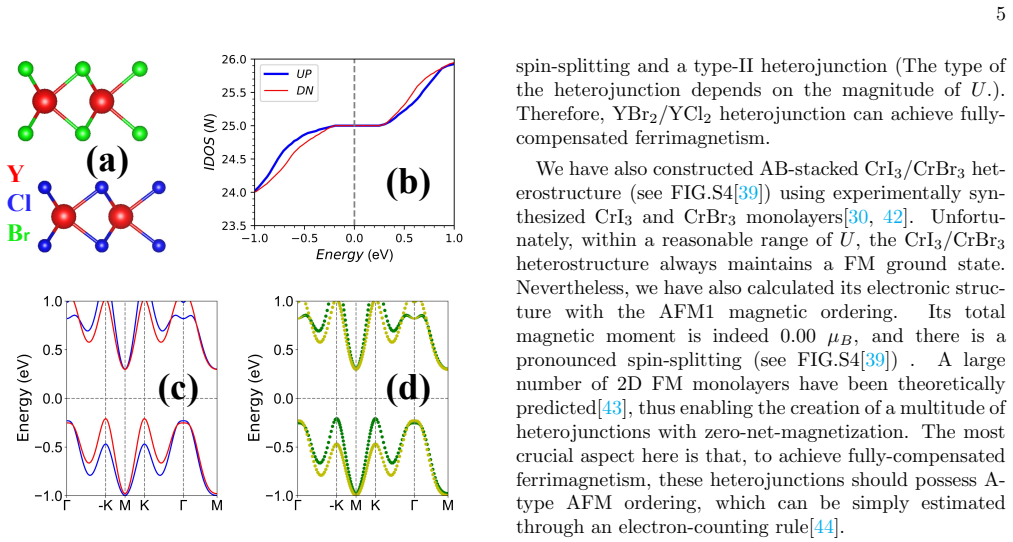
- [YBr2/YCl2 example] For the YBr2/YCl2 heterojunction, only U=2.00 eV is used. Since the paper's main message emphasizes U dependence, it would be useful to state whether the AFM1 ground state persists over a range of U values for this second example.
Circularity Check
No significant circularity: the design rule is an explicit conditional, and the U/strain dependence is a robustness caveat rather than a circular input.
full rationale
Walking the derivation chain, the central proposal is an explicit conditional: stacking two ferromagnetic monolayers with equal total magnetic moments in an A-type antiferromagnetic arrangement yields zero net moment and, because the layers are chemically distinct, spin-splitting. This is stated as a construction principle, not as a derived empirical prediction, and it is not circular. The CrI3/CrGeTe3 material claim is then tested by first-principles calculations that compare four magnetic configurations and scan both Hubbard U and strain. The paper transparently reports that at U=0 the FM state is lower by 0.28 meV/f.u. and that AFM1 becomes the ground state only for U > 0.2 eV or tensile strain beyond about 1.6%. This is parameter sensitivity and a lack of independent experimental calibration of U, which are correctness/robustness concerns, not circular reductions: U is swept, not fitted to the target result. The zero total magnetic moment and spin-splitting are computed under the specified AFM1 ordering and are supported by integrated densities of states and the band gap, rather than being inserted as the desired output. Some definitions and the IDOS criterion are cited from the authors' own prior work [20], but those statements are elementary and are also directly recalculated here, so the self-citation is not load-bearing. No equation, fitted parameter, or ansatz is renamed as a prediction. The derivation is therefore self-contained given its stated computational assumptions.
Assumptions & free parameters
free parameters (1)
- Hubbard U for Cr/Y d orbitals =
U > 0.2 eV for AFM1 ground state; representative U = 1, 2, 3 eV (CrI3/CrGeTe3); U = 2 eV (YBr2/YCl2)
assumptions (3)
- domain assumption PBE-GGA+U with Dudarev correction and DFT-D3 describes the magnetic ground state and band structure of the heterojunctions accurately enough.
- domain assumption The total magnetic moment of the heterojunction is the difference of the two monolayer total moments, so equal monolayer moments give zero net moment.
- ad hoc to paper The AFM1 (A-type antiferromagnetic) ordering can be stabilized by choosing U > 0.2 eV or by tensile strain.
Cite this review
Pith. "Pith review of Achieving fully-compensated ferrimagnetism through two-dimensional heterojunctions." pith.science (2026). https://pith.science/paper/MANGLWUS
@misc{pith2026250910768,
  author       = {Pith},
  title        = {Pith review of: Achieving fully-compensated ferrimagnetism through two-dimensional heterojunctions},
  year         = {2026},
  howpublished = {\url{https://pith.science/paper/MANGLWUS}},
  note         = {Machine review of arXiv:2509.10768}
}
abstract
In addition to altermagnets, fully-compensated ferrimagnets are another category of collinear magnetic materials that possess zero-net total magnetic moment and exhibit spin-splitting, making them promising for low-energy spintronics, high-density data storage and high-sensitivity sensors. Although many methods, such as alloying, external electric field, Janus engineering, ferroelectric field and spin ordering, have been proposed to achieve fully-compensated ferrimagnetism, these approaches either face experimental difficulties or produce a small spin-splitting or are volatile. Here, we propose to form vertical heterostructures by stacking two different but equally magnetized two-dimensional ferromagnetic materials. If an A-type antiferromagnetic ordering is satisfied, a fully compensated ferrimagnet can be formed. This vertical heterostructure approach is insensitive to lattice matching and stacking manner, thus being more conducive to experimental realization. Through first-principles calculations, we verify our proposal with several examples, focusing in particular on $\mathrm{CrI_3}$/$\mathrm{CrGeTe_3}$ heterojunction composed of experimentally synthesized $\mathrm{CrI_3}$ and $\mathrm{CrGeTe_3}$ monolayers. The calculations show that $\mathrm{CrI_3}$/$\mathrm{CrGeTe_3}$ is a fully-compensated ferrimagnet, with pronounced spin-splitting, and that tensile strain is more favorable for achieving fully-compensated ferrimagnetism. Our work provides an experimentally feasible strategy for realizing fully-compensated ferrimagnetism, thereby further advancing the development of this field.
Figures


Figures from the paper (1 more)
Reference graph
Works this paper leans on
-
[1]
Hu, Half-metallic antiferromagnet as a prospective material for spintronics, Adv
X. Hu, Half-metallic antiferromagnet as a prospective material for spintronics, Adv. Mater.24, 294 (2012)
2012
-
[2]
Jungwirth, J
T. Jungwirth, J. Sinova, A. Manchon, X. Marti, J. Wun- derlich and C. Felser, The multiple directions of antifer- romagnetic spintronics, Nat. Phys.14, 200 (2018)
2018
-
[3]
˘Smejkal, J
L. ˘Smejkal, J. Sinova and T. Jungwirth, Beyond conven- tional ferromagnetism and antiferromagnetism: A phase with nonrelativistic spin and crystal rotation symmetry, Phys. Rev. X12, 031042 (2022)
2022
-
[4]
Mazin, Altermagnetism-a new punch line of fundamen- tal magnetism, Phys
I. Mazin, Altermagnetism-a new punch line of fundamen- tal magnetism, Phys. Rev. X12, 040002 (2022)
2022
-
[5]
Y. Liu, J. Yu and C. C. Liu, Twisted Magnetic Van der Waals Bilayers: An Ideal Platform for Altermagnetism, Phys. Rev. Lett.133, 206702 (2024)
2024
-
[6]
X. Duan, J. Zhang, Z. Zhang, I ˘Zuti´cand T. Zhou, An- tiferroelectric Altermagnets: Antiferroelectricity Alters Magnets, Phys. Rev. Lett.134, 106801 (2025)
2025
-
[7]
H.-Y. Ma, M. L. Hu, N. N. Li, J. P. Liu, W. Yao, J. F. Jia and J. W. Liu, Multifunctional antiferromagnetic ma- terials with giant piezomagnetism and noncollinear spin current, Nat. Commun.12, 2846 (2021)
2021
-
[8]
M. Gu, Y. Liu, H. Zhu, K. Yananose, X. Chen, Y. Hu, A. Stroppa and Q. Liu, Ferroelectric Switchable Altermag- netism, Phys. Rev. Lett.134, 106802 (2025)
2025
Show all 46 references
-
[9]
S. D. Guo, Hidden altermagnetism, Front. Phys. (Beijing)21, 025201 (2026)
2026
-
[10]
L. Bai, W. Feng, S. Liu, L. ˘Smejkal, Y. Mokrousov, and Y. Yao, Altermagnetism: Exploring New Frontiers in Magnetism and Spintronics, Adv. Funct. Mater.34, 2409327 (2024)
2024
-
[11]
S. D. Guo, X. S. Guo, D. C. Liang and G. Wang, Symmetry-breaking induced transition among net-zero- magnetization magnets, J. Mater. Chem. C13, 11997 (2025)
2025
-
[12]
van Leuken and R
H. van Leuken and R. A. de Groot, Half-Metallic Anti- ferromagnets, Phys. Rev. Lett.74, 1171 (1995)
1995
-
[13]
Akai and M
H. Akai and M. Ogura, Half-Metallic Diluted Antiferro- magnetic Semiconductors, Phys. Rev. Lett.97, 026401 (2006)
2006
-
[14]
Wurmehl, H
S. Wurmehl, H. C. Kandpal, G. H. Fecher, and C. Felser, Valence electron rules for prediction of half- metallic compensated-ferrimagnetic behaviour of Heusler compounds with complete spin polarization, J. Phys.: Condens. Matter18, 6171 (2006)
2006
-
[15]
Kawamura, Kazuyoshi Yoshimi, Kenichiro Hashimoto, Akito Kobayashi and Takahiro Misawa, Compensated Ferrimagnets with Colossal Spin Splitting in Organic Compounds, Phys
T. Kawamura, Kazuyoshi Yoshimi, Kenichiro Hashimoto, Akito Kobayashi and Takahiro Misawa, Compensated Ferrimagnets with Colossal Spin Splitting in Organic Compounds, Phys. Rev. Lett.132, 156502 (2024)
2024
-
[16]
M. ˘Zic, K. Rode, N. Thiyagarajah, Y. C. Lau, D. Betto, J. M. D. Coey, S. Sanvito, K. J. O’Shea and C. A. Fer- guson, Designing a fully compensated half-metallic ferri- magnet, Phys. Rev. B93, 140202(R) (2016)
2016
-
[17]
H. A. Zhou, T. Xu, H. Bai and W. Jiang, Efficient Spin- tronics with Fully Compensated Ferrimagnets, J. Phys. Soc. Jpn.90, 081006 (2021)
2021
-
[18]
Galanakis and E
I. Galanakis and E. Saso˘glu, HighT C half-metallic fully- compensated ferrimagnetic Heusler compounds, Appl. Phys. Lett.99, 052509 (2011)
2011
-
[19]
X. Y. Hou, Z. F. Gao, H. C. Yang, P. J. Guo and Z. Y. Lu, Luttinger compensated magnetic material LaMn 2SbO6, arXiv:2504.09447 (2025)
2025 arXiv
-
[20]
Y. Liu, S. D. Guo, Y. Li and C. C. Liu, Two-dimensional fully-compensated Ferrimagnetism, Phys. Rev. Lett. 134, 116703 (2025)
2025
-
[21]
S. D. Guo, Valley polarization in two-dimensional zero- net-magnetization magnets, Appl. Phys. Lett.126, 080502 (2025)
2025
-
[22]
S. D. Guo, Y. L. Tao, Z. Y. Zhuo, G. Zhu and Y. S. Ang, Electric-field-tuned anomalous valley Hall effect in A-type hexagonal antiferromagnetic monolayers, Phys. Rev. B109, 134402 (2024)
2024
-
[23]
S. D. Guo, W. Xu, Y. Xue, G. Zhu and Y. S. Ang, Layer-locked anomalous valley Hall effect in a two- dimensional A-type tetragonal antiferromagnetic insula- tor, Phys. Rev. B109, 134426 (2024)
2024
-
[24]
S. D. Guo, P. Li and G. Wang, First-principles calcu- lations study of valley polarization in antiferromagnetic bilayer systems, Phys. Rev. B111, L140404 (2025)
2025
-
[25]
Zhang, S
L. Zhang, S. D. Guo and G. Wang, Spontaneous and reversible spin-splitting in ferroelectric A-type antiferro- magnetism, J. Mater. Chem. C12, 8485 (2024)
2024
-
[26]
J. Feng, X. Zhou, J. Chen, M. Xu, X. Yang and Y. Li, Ferroelectric antiferromagnetic lifting of spin-valley de- generacy, Phys. Rev. B111, 214446 (2025)
2025
-
[27]
Cheng, H
N. Cheng, H. Cheng, X. Zhao, G. Hu, X. Yuan and J. Ren. Ferroelectric polarization manipulates the layer- polarized anomalous Hall effect in bilayers with fully compensated ferrimagnetism, Phys. Rev. B111, 195154 (2025)
2025
-
[28]
F. Yao, M. Liao, M. Gibertini et al., Switching on and off the spin polarization of the conduction band in anti- ferromagnetic bilayer transistors. Nat. Nanotechnol.20, 609 (2025)
2025
-
[29]
S. D. Guo, S. Chen and G. Wang, Spin ordering-induced fully-compensated ferrimagnetism, arXiv:2507.10848 (2025)
2025 arXiv
-
[30]
Huang, G
B. Huang, G. Clark, E. Navarro-Moratalla et al., Layer- dependent ferromagnetism in a van der Waals crystal down to the monolayer limit, Nature546, 270 (2017)
2017
-
[31]
C. Gong, L. Li, Z. Li et al., Discovery of intrinsic fer- romagnetism in two-dimensional Van der Waals crystals. Nature546, 265 (2017)
2017
-
[32]
Hohenberg and W
P. Hohenberg and W. Kohn, Inhomogeneous Electron Gas, Phys. Rev.136, B864 (1964); W. Kohn and L. J. Sham, Self-Consistent Equations Including Exchange and Correlation Effects, Phys. Rev.140, A1133 (1965)
1964
-
[33]
Kresse, Ab initio molecular dynamics for liquid met- als, J
G. Kresse, Ab initio molecular dynamics for liquid met- als, J. Non-Cryst. Solids193, 222 (1995)
1995
-
[34]
Kresse and J
G. Kresse and J. Furthm¨uller, Efficiency of ab-initio total energy calculations for metals and semiconductors using a plane-wave basis set, Comput. Mater. Sci. 6,15(1996)
1996
-
[35]
Kresse and D
G. Kresse and D. Joubert, From ultrasoft pseudopoten- tials to the projector augmented-wave method, Phys. Rev. B59, 1758 (1999)
1999
-
[36]
J. P. Perdew, K. Burke and M. Ernzerhof, Generalized gradient approximation made simple, Phys. Rev. Lett. 77, 3865 (1996)
1996
-
[37]
S. L. Dudarev, G. A. Botton, S. Y. Savrasov, C. J. Humphreys, and A. P. Sutton, Electron-energy-loss spec- tra and the structural stability of nickel oxide: An LSDA+U study, Phys. Rev. B57, 1505 (1998)
1998
-
[38]
Grimme, S
S. Grimme, S. Ehrlich and L. Goerigk, Effect of the 7 damping function in dispersion corrected density func- tional theory, J. Comput. Chem.32, 1456 (2011)
2011
-
[39]
See Supplemental Material at [] for the crystal structures, the integrated densities of states and the related energy band structures
-
[40]
S. D. Guo, W. Q. Mu and B. G. Liu, Valley-polarized quantum anomalous Hall insulator in monolayer, 2D Mater.9, 035011 (2022)
2022
-
[41]
Huang, W.-Y
B. Huang, W.-Y. Liu, X.-C. Wu, S.-Z. Li , H. Li, Z. Yang and W.-B. Zhang, Large spontaneous valley polarization and high magnetic transition temperature in stable two- dimensional ferrovalley YX 2 (X=I, Br, and Cl), Phys. Rev. B107, 045423 (2023)
2023
-
[42]
W. Chen, Z. Sun, Z. Wang, L. Gu, X. Xu, S. Wu and C. Gao, Direct observation of van der Waals stackingdepen- dent interlayer magnetism, Science366, 983 (2019)
2019
-
[43]
S. Xing, J. Zhou, X. Zhang, S. Elliott and Z. Sun, The- ory, properties and engineering of 2D magnetic materials, Rrog. Mater. Sci.132, 101036 (2023)
2023
-
[44]
Xiao and B
J. Xiao and B. Yan, An electron-counting rule to de- termine the interlayer magnetic coupling of the van der Waals materials, 2D Mater.7, 045010 (2020)
2020
-
[45]
Zeng and Y.-J
S. Zeng and Y.-J. Zhao, Bilayer stacking -type altermag- net: A general approach to generating two-dimensional altermagnetism, Phys. Rev. B110, 174410 (2024)
2024
-
[46]
W. Sun, H. Ye, L. Liang, N. Ding, S. Dong and S.-S. Wang, Stacking-dependent ferroicity of a reversed bi- layer: Altermagnetism or ferroelectricity. Phys. Rev. B 110, 224418 (2024)
2024
Reviewed August 4, 2026 · model on record in the stance chip above.
Discussion (0). Sign in to comment.