REVIEW 4 major objections 5 minor 1 cited by
Conditional Independence Testing Using Exchangeable Pairs
T0 review · 4 major / 5 minor · reviewed 2026-08-15 · deepseek-v4-flash
Pith's one-line read Exchangeable pairs make conditional independence tests exact at every n
desk verdict A clever exchangeable-pairs CI test with a sound exact-model-X randomization core, but the abstract promises an estimated-X|Z analysis the full text never delivers, and one remark explicitly breaks the exchangeability assumption. read the letter →
The pith
A machine-rendered reading of the paper's core claim, the machinery that carries it, and where it could break.
The reading
What carries the argument
The load-bearing objects are the CI variant $(X',Y,Z)$ and the coordinate-swap resampling scheme. Given each $X'_i\sim P_{X\mid Z_i}$ independent of $Y_i$ given $Z_i$, the paper forms ordered pairs $(X_i,X'_i,Y_i,Z_i)$ and measures dependence by the Gaussian-kernel MMD $\zeta_\sigma(P)=\mathbb{E}K(V_1,V_2)+\mathbb{E}K(V'_1,V'_2)-2\mathbb{E}K(V_1,V'_2)$ with $K(a,b)=\exp(-\sigma^2\|a-b\|^2/2)$. The estimator is a degree-two U-statistic with a bounded core, which yields dimension-free exponential concentration; the null degeneracy of the core gives the $\sum_i\lambda_i(U_i^2-1)$ limit. Calibration uses the exact exchangeability of $X_i$ and $X'_i$ under $H_0$: flipping the two coordinates in every subset $\pi\in\{0,1\}^n$ produces a resampling distribution whose $(1-\alpha)$-quantile is bounded by $2(\alpha(n-1))^{-1}$ almost surely, so the p-value is finite-sample valid.
What would settle it
Simulate i.i.d. data under $H_0$ from a known distribution with accessible $P_{X\mid Z}$, sample the CI variants exactly, and run the coordinate-flip test over a grid of $n$, $d$, and $\alpha$ with many replications: the claim is that the rejection frequency never exceeds $\alpha$, so any stable exceedance would falsify Proposition 2.1. The same design with $X'_i$ drawn from a deliberately misspecified conditional distribution would show how the guarantee erodes when the model-X assumption is relaxed.
Extended reading notes
Core claim
The central claim is that conditional independence testing can be reformulated as a two-sample problem: compare $(X,Y,Z)$ with its conditionally independent variant $(X',Y,Z)$, where $X'\mid Z$ has the same law as $X\mid Z$ and $X'\perp\!\!\!\perp Y\mid Z$. The paper proves that the Gaussian-kernel discrepancy $\zeta_\sigma(P)$ between these two laws is zero exactly under $H_0$ and positive under $H_1$, that its U-statistic estimator $\hat\zeta_{n,\sigma}$ concentrates exponentially fast with constants free of dimension, and that the coordinate-flip resampling p-value $p_n$ obeys $P\{p_n<\alpha\}\le\alpha$ for all $n$ and $d$ under $H_0$. It then shows the test is consistent against fixed alternatives, attains a nontrivial limiting power $L(\beta)$ against local contiguous alternatives at rate $n^{-1/2}$, and remains consistent when $d$ grows with $n$ as long as $n\zeta_\sigma(P)$ diverges.
Load-bearing premise
The load-bearing premise is that the analyst can sample $X'_i$ from the true conditional distribution of $X$ given $Z_i$, independently of $Y_i$ given $Z_i$ for every observation, so that without exact model-X sampling the coordinate-swap exchangeability behind the finite-sample bound fails.
Editorial extensions
If this is right
- Under exact model-X sampling, the test controls the type I error at level $\alpha$ for every finite $n$ and every dimension $d$, without smoothness or moment assumptions beyond the existence of $X\mid Z$.
- The test is consistent against any fixed alternative because $\zeta_\sigma(P)>0$ under $H_1$ and the resampling critical value $\hat c_{1-\alpha}$ is $O_P(n^{-1})$.
- Against local contiguous alternatives at distance $n^{-1/2}$, the power converges to a nontrivial limit $L(\beta)$ that increases from $\alpha$ to one as $\beta$ grows.
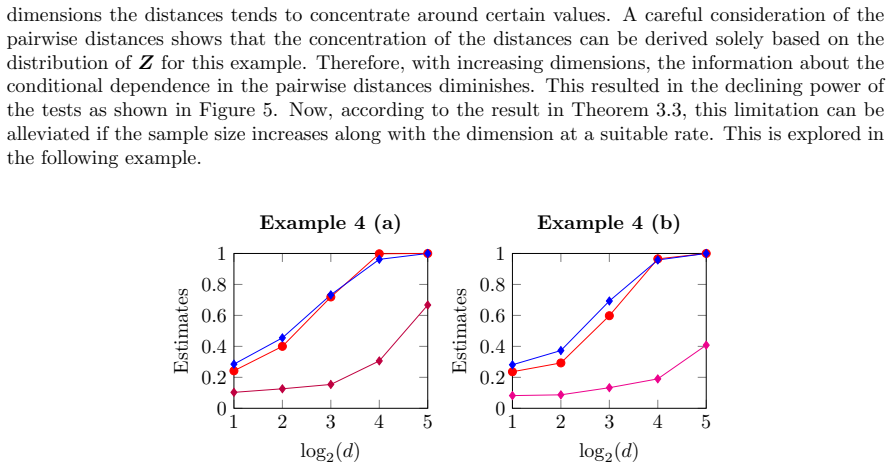
- When the dimension $d$ grows with the sample size, power converges to one provided $n\zeta_\sigma(P)\to\infty$; dimension enters only through the size of the population discrepancy.
- The randomized p-value $p_{n,B}$ approximates the exact flip p-value $p_n$ with error of order $O_P(B^{-1/2})$ plus $(B+1)^{-1}$, so moderate $B$ suffices in practice.
Reading between the lines
- The paper's abstract announces an investigation of estimating $P_{X\mid Z}$, but the full text proves no theorem for estimated or misspecified conditional distributions; if $X'_i$ is generated from an estimate or a generative model, the exchangeability behind Proposition 2.1 no longer follows, and a direct simulation under $H_0$ with misspecified sampling would show how rejection rates depart from
- The coordinate-flip calibration is a general exchangeability principle: any statistic that is invariant under swapping each $X_i$ with $X'_i$ inherits the same finite-sample type I error argument, suggesting the exchangeable-pairs construction could be combined with dependence measures other than the Gaussian-kernel MMD.
- Because $\zeta_\sigma(P)$ is a kernel MMD between a vector and its CI variant, a finite battery of bounded kernels (Laplace, inverse quadratic, or others) could in principle be used to detect different dependence geometries; the paper notes the extension to other bounded kernels but does not study the power of such a battery.
- The model-X assumption is likely replaceable by a doubly robust variant in which only the regression of $X$ on $Z$ is estimated well, as is done in recent work on conditional randomization tests; testing that variant would be a natural next step beyond the paper's exact-exchangeability setting.
Signed reviews
Editorial analysis
A structured set of objections, weighed in public.
Referee Report
Summary. The paper proposes a conditional independence test based on an exchangeable-pairs construction in the model-X framework. For each observation (X_i,Y_i,Z_i), an exchangeable counterpart X'_i is drawn from the true conditional distribution of X given Z, independently of Y given Z. The population discrepancy ζσ(P) is the Gaussian-kernel MMD between (X,Y,Z) and its conditionally independent variant (X',Y,Z), and it is estimated by a bounded U-statistic on the augmented sample. A coordinate-swap resampling scheme calibrates the test, yielding a finite-sample type I error guarantee under exact model-X sampling (Proposition 2.1) and consistency against fixed alternatives (Proposition 2.3). The paper further claims asymptotic null and alternative distributions, local asymptotic power and "Pitman efficiency" against contiguous alternatives, high-dimensional consistency, and competitive empirical performance.
Significance. The core idea is attractive and, under the oracle model-X assumption, the central randomization argument is sound: the coordinate-swap p-value gives exact finite-sample type I error control, the estimator is a bounded U-statistic with exponential concentration, and the fixed-alternative consistency argument is simple and convincing. This provides a useful complement to the CRT that requires only one augmented sample and reuses pairwise distances. However, several advertised contributions are not actually established: the abstract promises an analysis of estimated X|Z that never appears, Theorem 2.5 is internally inconsistent, the label "Pitman efficiency" is not supported by any optimality comparison, and the local-power derivation has a substantial gap. With careful correction and re-scoping, the exchangeable-pairs methodology could be a solid contribution, but the current version overclaims.
major comments (4)
- [Abstract; Section 2.3; Remark 1] The abstract promises that the effect of estimating the conditional distribution used to generate the exchangeable pairs is investigated and that a condition preserving validity and power is established. No such theorem, lemma, or formal condition appears in the full text; Section 5 only says it would be interesting to study generative-model-based sampling. More seriously, Remark 1 suggests using GenAI to generate X given observations on (Y,Z), which makes X' dependent on Y given Z and destroys the coordinate-swap exchangeability on which Proposition 2.1 rests. This is both a missing promised result and an internal inconsistency: the finite-sample type I error guarantee is only established for oracle sampling from the true P_{X|Z}.
- [Theorem 2.5 and Appendix A] Theorem 2.5 states that under H1, sqrt(n)(ζ̂_{n,σ} − ζσ(P)) converges in distribution to N(0,1). The proof in Appendix A concludes asymptotic normality with variance 4σ1², where σ1² = Var(g1), and no argument shows that 4σ1² = 1. Since σ1² depends on P and σ, the limiting variance is not generally 1. The theorem is false as stated; it should either state N(0,4σ1²) or the statistic must be studentized by a consistent estimator of its asymptotic variance.
- [Section 3.1; Theorem 3.2] The label "Pitman efficient" is not justified. Theorem 3.2 derives a limiting power function L(β), but it does not compare the test with an optimal benchmark or compute an asymptotic relative efficiency, which is what Pitman efficiency standardly means. In addition, the abstract claims that the test attains the minimax separation rate for the proposed discrepancy measure; no minimax separation result is stated or proved anywhere in the text. These claims should be substantiated or removed.
- [Theorems 3.1 and 3.2; proof of Theorem 3.1] The local alternative F_{1−βn/√n} = (1−βn/√n)G + (βn/√n)F changes the conditional distribution of X|Z, but the procedure requires drawing X'_i from the true P_{X|Z}; under the mixture alternative, X'_i must be generated from the mixture conditional rather than from G_{X|Z}. The contiguity calculation in the proof of Theorem 3.1 computes the log-likelihood ratio only for V_i and omits the likelihood ratio contribution of the generated X'_i given Z_i, so the shift term βE_F{ψ_i} is not derived for the actual augmented-data experiment. Moreover, the displayed limiting covariance matrix in the same proof has a negative lower-right entry (−β²/2 E[...]) instead of a nonnegative variance. The local-power analysis needs to be reformulated (for example, by restricting to alternatives with fixed X|Z or by deriving the full likelihood ratio for the augmented data) before Theorems 3.1 and 3.2 can be considered established.
minor comments (5)
- [Abstract and throughout] There are numerous typographical errors, including "Keywards" in the abstract, "hypothesises" in Section 1, "afficacy" in Section 5, and "Piman efficiency" in the text following Theorem 3.2.
- [Section 5] The sentence "A test of spherical symmetry is also proposed" is incorrect; the paper proposes a test of conditional independence, not a test of spherical symmetry.
- [Theorem 3.2 statement and proof] The displayed power formula in Theorem 3.2(b) has the form (Z_i + βE_F{ψ_i})², but the proof in Appendix A writes "λ_i(Z_i + β²E[ψ_i(V_1,V'_1)] − 1)" and omits the square; the notation should be harmonized.
- [Figure 3] The legend uses "GCM.fix test" while the text defines "wGCM.fix test"; these should be made consistent.
- [Lemma A.1 and Remark 5] Lemma A.1 refers to "spherically symmetric variants" although the construction is coordinate swapping, not spherical symmetry. In Remark 5, the justification "V1 =D V'2" is incorrect; the cancellation follows from V1 =D V'1 when ζσ(G) = 0.
Circularity Check
No material circularity: the finite-sample validity and consistency follow from the model-X exchangeability construction and standard resampling arguments; the only self-citation is a minor technical lemma, not load-bearing.
full rationale
The derivation chain is self-contained given the model-X assumption. Definition 1 defines the CI variant by X'|Z =D X|Z and X' ⊥⊥ Y|Z; Theorem 2.1 proves ζσ(P)=0 iff X⊥⊥Y|Z via characteristic functions, not by assuming the conclusion. Eq. (4) estimates ζσ(P), and Theorems 2.3-2.5 establish concentration and limit laws by bounded-difference and U-statistic arguments. Proposition 2.1's P{p_n<α}≤α is the standard exact randomization-test property: under H0, coordinate-swapping X_i and X'_i preserves the joint law of (X_i,X'_i,Y_i,Z_i), so the resampling p-value in (6) is stochastically uniform; this is a theorem about the constructed statistic, not a fitted input renamed as a prediction. Proposition 2.2 bounds the resampling critical value by 2(α(n-1))^{-1}, and Proposition 2.3 combines this with consistency of ζ̂ to get power → 1. No uniqueness theorem, ansatz-via-citation, or fitted parameter carries the argument. The one self-citation ('as in Lemma 1 from Banerjee (2024)') appears only in a technical approximation step of the proof of Theorem 3.2 and is accompanied by standard references (Lee 1990; Van der Vaart 2000); it is not load-bearing. A separate completeness issue: the top abstract promises a study of estimating the conditional distribution used to generate X', but the full text contains no such theorem, and Remark 1's suggestion to generate X' from (Y,Z) is not covered by Proposition 2.1. This is an overclaim/limitation, not circularity.
Assumptions & free parameters
free parameters (1)
- Gaussian kernel bandwidth σ
assumptions (3)
- domain assumption Exact knowledge or accurate generative model for X|Z (model-X assumption)
- standard math Gaussian characteristic function identity used to close the MMD expression (Theorem 2.2)
- domain assumption Contiguity and second-moment conditions on the likelihood ratio f/g in the local alternative analysis
Cite this review
Pith. "Pith review of Conditional Independence Testing Using Exchangeable Pairs." pith.science (2026). https://pith.science/paper/PBZBCN5I
@misc{pith2026250910817,
  author       = {Pith},
  title        = {Pith review of: Conditional Independence Testing Using Exchangeable Pairs},
  year         = {2026},
  howpublished = {\url{https://pith.science/paper/PBZBCN5I}},
  note         = {Machine review of arXiv:2509.10817}
}
abstract
This article considers the problem of testing conditional independence between two random vectors \(bm X\) and \(\bm Y\) given a confounding random vector \(\bm Z\). An exchangeable-pairs framework is introduced through which the conditional independence testing problem is reformulated as a two-sample testing problem. The framework is motivated by ideas from the model-X literature and is based on a fundamental exchangeability property that holds under the null hypothesis of conditional independence. An energy-distance/maximum mean discrepancy type measure is employed on the resulting exchangeable pairs to quantify departures from conditional independence. A consistent estimator of the proposed discrepancy measure is constructed and its theoretical properties are established under general assumptions. A conditional independence test is then developed using this estimator as a test statistic and is calibrated through a suitable resampling procedure. It is shown that the proposed test is consistent against fixed alternatives, possesses nontrivial asymptotic power against local contiguous alternatives, attains the minimax separation rate for detecting alternatives characterized by the proposed discrepancy measure, and remains consistent when the data dimension diverges with the sample size. The effect of estimating the conditional distribution used to generate the exchangeable pairs is also investigated, and condition under which validity and power properties are preserved is established. Extensive simulation studies demonstrate that the proposed procedure performs competitively with some state-of-the-art methods.
Figures


Figures from the paper (3 more)


Forward citations
Cited by 1 Pith paper
-
CRT*: Conditional Randomization Testing with Heterogeneous External and Unlabeled Data
CRT* adaptively fuses internal, external, and unlabeled data via transfer learning and smooth residual bootstrap to give valid and more powerful conditional randomization tests under distributional heterogeneity.
Reference graph
Works this paper leans on
-
[1]
Azadkia, M. and Chatterjee, S. (2021). A simple measure of conditional dependence. Ann. Statist. , 49(6):3070--3102
work page 2021
- [2]
-
[3]
Banerjee, B. (2024). Testing distributional equality for functional random variables. J. Multivariate Anal. , 203:105318
work page 2024
-
[4]
A Ball Divergence Based Measure For Conditional Independence Testing
Banerjee, B., Bhattacharya, B. B., and Ghosh, A. K. (2024). A ball divergence based measure for conditional independence testing. arXiv preprint arXiv:2407.21456
work page Pith review arXiv 2024
-
[5]
Barber, R. F. and Cand\`es, E. J. (2019). A knockoff filter for high-dimensional selective inference. Ann. Statist. , 47(5):2504--2537
work page 2019
-
[6]
Bergsma, W. (2004). Testing conditional independence for continuous random variables . Report Eurandom. Eurandom
work page 2004
-
[7]
Berrett, T. B., Wang, Y., Barber, R. F., and Samworth, R. J. (2019). The conditional permutation test for independence while controlling for confounders. J. R. Stat. Soc., B: Stat. Methodol. , 82(1):175--197
work page 2019
-
[8]
Cai, Z., Li, R., and Zhang, Y. (2022). A distribution free conditional independence test with applications to causal discovery. J. Mach. Learn. Res. , 23:Paper No. [85], 41
work page 2022
Show all 64 references
-
[9]
Candes, E., Fan, Y., Janson, L., and Lv, J. (2018). Panning for gold: ‘model- X ’ knockoffs for high dimensional controlled variable selection. J. R. Stat. Soc., B: Stat. Methodol. , 80(3):551--577
2018
-
[10]
Cook, R. D. and Li, B. (2002). Dimension reduction for conditional mean in regression. Ann. Statist. , 30(2):455--474
2002
-
[11]
Dawid, A. P. (1980). Conditional independence for statistical operations. Ann. Statist. , 8(3):598--617
1980
-
[12]
Deb, N., Ghosal, P., and Sen, B. (2020). Measuring association on topological spaces using kernels and geometric graphs. arXiv preprint arXiv:2010.01768
2020 arXiv
-
[13]
R., Yao, G., and West, M
Dobra, A., Hans, C., Jones, B., Nevins, J. R., Yao, G., and West, M. (2004). Sparse graphical models for exploring gene expression data. Journal of Multivariate Analysis , 90(1):196--212
2004
-
[14]
Doran, G., Muandet, K., Zhang, K., and Sch \"o lkopf, B. (2014). A permutation-based kernel conditional independence test. In UAI , pages 132--141
2014
-
[15]
Fan, J., Feng, Y., and Xia, L. (2020). A projection-based conditional dependence measure with applications to high-dimensional undirected graphical models. J. Econometrics , 218(1):119--139
2020
-
[16]
Fisher, R. A. (1924). The distribution of the partial correlation coefficient. Metron , 3:329--332
1924
-
[17]
Fukumizu, K., Gretton, A., Sun, X., and Sch \"o lkopf, B. (2007). Kernel measures of conditional dependence. Advances in neural information processing systems , 20
2007
-
[18]
M., Rasch, M
Gretton, A., Borgwardt, K. M., Rasch, M. J., Sch \"o lkopf, B., and Smola, A. (2012). A kernel two-sample test. J. Mach. Learn. Res. , 13(1):723--773
2012
-
[19]
Gy \"o rfi, L., Kohler, M., Krzy \.z ak, A., and Walk, H. (2002). A distribution-free theory of nonparametric regression . Springer
2002
-
[20]
Huang, T.-M. (2010). Testing conditional independence using maximal nonlinear conditional correlation. Ann. Statist. , 38(4):2047--2091
2010
-
[21]
Huang, Z., Deb, N., and Sen, B. (2022). Kernel partial correlation coefficient---a measure of conditional dependence. J. Mach. Learn. Res. , 23:Paper No. [216], 58
2022
-
[22]
and Ramdas, A
Katsevich, E. and Ramdas, A. (2022). On the power of conditional independence testing under model- X . Electron. J. Stat. , 16(2):6348--6394
2022
-
[23]
and Sabatti, C
Katsevich, E. and Sabatti, C. (2019). Multilayer knockoff filter: controlled variable selection at multiple resolutions. Ann. Appl. Stat. , 13(1):1--33
2019
-
[24]
Kim, I., Neykov, M., Balakrishnan, S., and Wasserman, L. (2022). Local permutation tests for conditional independence. Ann. Statist. , 50(6):3388--3414
2022
-
[25]
Lauritzen, S. L. (1996). Graphical models , volume 17. Clarendon Press
1996
-
[26]
Lee, A. J. (1990). U - S tatistics: T heory and P ractice , volume 110 of Statistics: Textbooks and Monographs . Marcel Dekker, Inc., New York
1990
-
[27]
Li, B. (2018). Sufficient dimension reduction: Methods and applications with R . Chapman and Hall/CRC
2018
-
[28]
and Fan, X
Li, C. and Fan, X. (2020). On nonparametric conditional independence tests for continuous variables. Wiley Interdiscip. Rev. Comput. Stat. , 12(3):e1489, 11
2020
-
[29]
Li, S., Zhang, Y., Zhu, H., Wang, C., Shu, H., Chen, Z., Sun, Z., and Yang, Y. (2024). K-nearest-neighbor local sampling based conditional independence testing. Advances in Neural Information Processing Systems , 36
2024
-
[30]
and Gozalo, P
Linton, O. and Gozalo, P. (1996). Conditional independence restrictions: Testing and estimation. Technical report, Cowles Foundation for Research in Economics, Yale University
1996
-
[31]
Liu, M., Katsevich, E., Janson, L., and Ramdas, A. (2021). Fast and powerful conditional randomization testing via distillation . 109(2):277--293
2021
-
[32]
Maathuis, M., Drton, M., Lauritzen, S., and Wainwright, M. (2018). Handbook of graphical models . CRC Press
2018
-
[33]
and Spang, R
Markowetz, F. and Spang, R. (2007). Inferring cellular networks--a review. BMC bioinformatics , 8:1--17
2007
-
[34]
Massart, P. (1990). The tight constant in the D voretzky- K iefer- W olfowitz inequality. Ann. Probab. , 18(3):1269--1283
1990
-
[35]
Neykov, M., Balakrishnan, S., and Wasserman, L. (2021). Minimax optimal conditional independence testing. Ann. Statist. , 49(4):2151--2177
2021
-
[36]
Niu, Z., Chakraborty, A., Dukes, O., and Katsevich, E. (2022). Reconciling model-x and doubly robust approaches to conditional independence testing. arXiv preprint arXiv:2211.14698
2022 arXiv
-
[37]
K., Sen, B., and Sz \'e kely, G
Patra, R. K., Sen, B., and Sz \'e kely, G. J. (2016). On a nonparametric notion of residual and its applications. Statistics & Probability Letters , 109:208--213
2016
-
[38]
Pearl, J. (1988). Probabilistic reasoning in intelligent systems: networks of plausible inference . Morgan Kaufmann, San Mateo, CA
1988
-
[39]
Peters, J., Janzing, D., and Sch \"o lkopf, B. (2017). Elements of causal inference: foundations and learning algorithms . The MIT Press
2017
-
[40]
and Hansen, N
Petersen, L. and Hansen, N. R. (2021). Testing conditional independence via quantile regression based partial copulas. J. Mach. Learn. Res. , 22:Paper No. 70, 47
2021
-
[41]
J., and Gretton, A
Pogodin, R., Schrab, A., Li, Y., Sutherland, D. J., and Gretton, A. (2024). Practical kernel tests of conditional independence. arXiv preprint arXiv:2402.13196
2024
-
[42]
Runge, J. (2018). Conditional independence testing based on a nearest-neighbor estimator of conditional mutual information. In International Conference on Artificial Intelligence and Statistics , pages 938--947. PMLR
2018
-
[43]
and Ghosh, A
Sarkar, S. and Ghosh, A. K. (2018). Some multivariate tests of independence based on ranks of nearest neighbors. Technometrics , 60(1):101--111
2018
-
[44]
Scetbon, M., Meunier, L., and Romano, Y. (2022). An asymptotic test for conditional independence using analytic kernel embeddings. In International Conference on Machine Learning , pages 19328--19346. PMLR
2022
-
[45]
o rrmann, J., and B\
Scheidegger, C., H\" o rrmann, J., and B\" u hlmann, P. (2022). The weighted generalised covariance measure. J. Mach. Learn. Res. , 23:Paper No. [273], 68
2022
-
[46]
Sesia, M., Sabatti, C., and Cand\`es, E. J. (2019). Gene hunting with hidden M arkov model knockoffs. Biometrika , 106(1):1--18
2019
-
[47]
Shah, R. D. and Peters, J. (2020). The hardness of conditional independence testing and the generalised covariance measure. Ann. Statist. , 48(3):1514--1538
2020
-
[48]
and Sriperumbudur, B
Sheng, T. and Sriperumbudur, B. K. (2023). On distance and kernel measures of conditional dependence. Journal of Machine Learning Research , 24(7):1--16
2023
-
[49]
Shi, H., Drton, M., and Han, F. (2022). On the power of chatterjee's rank correlation. Biometrika , 109(2):317--333
2022
-
[50]
Shi, H., Drton, M., and Han, F. (2024). On A zadkia-- C hatterjee's conditional dependence coefficient. Bernoulli , 30(2):851--877
2024
-
[51]
Song, K. (2009). Testing conditional independence via R osenblatt transforms. Ann. Statist. , 37(6B):4011--4045
2009
-
[52]
V., Zhang, K., and Visweswaran, S
Strobl, E. V., Zhang, K., and Visweswaran, S. (2019). Approximate kernel-based conditional independence tests for fast non-parametric causal discovery. Journal of Causal Inference , 7(1):20180017
2019
-
[53]
and White, H
Su, L. and White, H. (2007). A consistent characteristic function-based test for conditional independence. J. Econometrics , 141(2):807--834
2007
-
[54]
and White, H
Su, L. and White, H. (2008). A nonparametric H ellinger metric test for conditional independence. Econometric Theory , 24(4):829--864
2008
-
[55]
and White, H
Su, L. and White, H. (2014). Testing conditional independence via empirical likelihood. J. Econometrics , 182(1):27--44
2014
-
[56]
Sz\' e kely, G. J. and Rizzo, M. L. (2014). Partial distance correlation with methods for dissimilarities. Ann. Statist. , 42(6):2382--2412
2014
-
[57]
Sz \'e kely, G. J. and Rizzo, M. L. (2023). The Energy of Data and Distance Correlation . Chapman and Hall/CRC
2023
-
[58]
and Han, F
Tran, L. and Han, F. (2024). On a rank-based azadkia-chatterjee correlation coefficient. arXiv preprint arXiv:2412.02668
2024 arXiv
-
[59]
Van der Vaart, A. W. (2000). Asymptotic S tatistics , volume 3. Cambridge university press
2000
-
[60]
Veraverbeke, N., Omelka, M., and Gijbels, I. (2011). Estimation of a conditional copula and association measures. Scandinavian Journal of Statistics , 38(4):766--780
2011
-
[61]
Wainwright, M. J. (2019). High-dimensional statistics: A non-asymptotic viewpoint , volume 48 of Cambridge Series in Statistical and Probabilistic Mathematics . Cambridge University Press, Cambridge
2019
-
[62]
Wang, X., Pan, W., Hu, W., Tian, Y., and Zhang, H. (2015). Conditional distance correlation. J. Amer. Statist. Assoc. , 110(512):1726--1734
2015
-
[63]
Zhang, K., Peters, J., Janzing, D., and Sch \"o lkopf, B. (2012). Kernel-based conditional independence test and application in causal discovery. arXiv preprint arXiv:1202.3775
2012 arXiv
-
[64]
Zhang, Y., Huang, L., Yang, Y., and Shao, X. (2025). Doubly robust conditional independence testing with generative neural networks. J. R. Stat. Soc. Ser. B. Stat. Methodol. , page qkaf047
2025
Reviewed August 15, 2026 · model on record in the stance chip above.
Discussion (0). Continue with ORCID to comment.