REVIEW 2 major objections 7 minor 23 references
GAPrune: Gradient-Alignment Pruning for Domain-Aware Embeddings
T0 review · 2 major / 7 minor · reviewed 2026-08-15 · deepseek-v4-flash
Pith's one-line read GAPrune claims that a per-parameter score combining domain Fisher information, magnitude, and general-domain gradient alignment keeps one-shot embedding performance within 2.5% of dense at 50% sparsity and, after 100 retraining steps…
desk verdict Missing dense-retrain control undermines the retraining-boost claim, but the one-shot results and the DAI score make this a plausible, if not yet proven, pruning recipe. read the letter →
The pith
A machine-rendered reading of the paper's core claim, the machinery that carries it, and where it could break.
The reading
What carries the argument
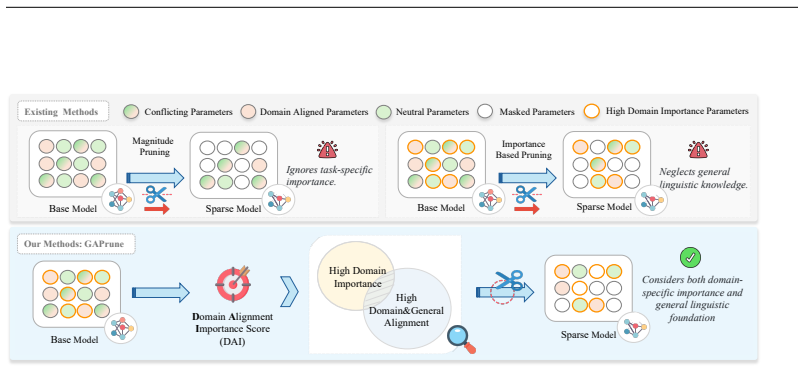
The core mechanism is the Domain Alignment Importance (DAI) score, a per-parameter scalar used to rank which weights survive the binary mask. It is defined as $\mathrm{DAI}_j = ((F^{\mathrm{dom}}_{jj} - \beta F^{\mathrm{gen}}_{jj})|\theta_j| + \gamma\sqrt{|\theta_j|})(1+\alpha s_j^g)$, where $F^{\mathrm{dom}}_{jj}$ and $F^{\mathrm{gen}}_{jj}$ are diagonal Fisher information estimates computed from InfoNCE gradients on 5,000 k-means-selected domain and general triplets, $s_j^g$ is the cosine similarity between the averaged domain and general gradients for parameter $j$, and $(\alpha,\beta,\gamma)=(0.2,1.0,0.5)$ in the experiments. The first term is an information-bottleneck trade-off that rewards domain-specific importance and penalizes general-only importance, the square-root term keeps parameters with large representational capacity in the running, and the alignment factor boosts parameters whose gradients cooperate across domains while lowering the score of parameters with conflicting gradients. Pruning keeps the top $(1-s)d$ parameters by this score.
What would settle it
Zero out each retained parameter individually on a 50%-sparse GAPrune mask and measure the change on the actual FinMTEB or ChemTEB task; if the summed task-loss changes are uncorrelated with DAI scores, then the score is not tracking benchmark-relevant importance and the gains should not replicate. A cheaper check is to rerun the one-shot evaluation with a different 5,000-sample k-means subset or a random subset of the same size; if performance swings by more than a small fraction of the reported 2.5% margin, the sampling step, not the alignment signal, is doing the work.
Extended reading notes
Core claim
The central claim is that the right unit of analysis for domain-aware pruning is not the parameter's weight alone, nor its Fisher information on domain data, but the relationship between what the parameter contributes to the domain objective and what it contributes to general language objectives. The paper defines this through DAI scores: a parameter scores high when domain Fisher information is high, general Fisher information is low, magnitude is substantial, and the averaged InfoNCE gradients from general and domain data point in the same direction. Low-scoring parameters are masked, including parameters whose gradients conflict across domains; the paper reports that such masks keep one-shot performance within 2.5% of the dense model at 50% sparsity, and that after 100 retraining steps the pruned Qwen3-Embedding-4B exceeds the dense model by 4.51% on FinMTEB and 1.73% on ChemTEB. The paper also reports that DAI rankings are negatively correlated with Fisher-based rankings, around -0.41 and -0.46, while domain and general Fisher rankings correlate at 0.978, which it reads as evidence that Fisher information alone cannot distinguish domain-specific from general parameters.
Load-bearing premise
The load-bearing premise is that InfoNCE gradients measured on 5,000 k-means-selected triplets from each corpus rank parameter importance the same way the downstream benchmark metrics do; if that sampled gradient landscape diverges from nDCG@10, classification accuracy, or STS correlation, DAI misranks parameters and the reported margins do not transfer.
Editorial extensions
If this is right
- At 50% sparsity, one-shot GAPrune masks keep Qwen3-Embedding-4B within 2.41% of dense on FinMTEB and 2.31% on ChemTEB, while the same sparsity with magnitude pruning loses 3.40% and 4.44%, and random pruning collapses by 59-68%.
- After only 100 InfoNCE retraining steps, the pruned Qwen3-Embedding-4B beats the dense model by 4.51% on FinMTEB and by 1.73% on ChemTEB; on e5-mistral-7B the corresponding gains are 1.81% and 13.33%, so the effect is reported across two architectures.
- The gradient-alignment term is doing distinct work: the DAI ranking correlates only -0.406 with domain Fisher and -0.459 with general Fisher, whereas the two Fisher-only rankings correlate at 0.978, implying that single-objective importance scores are roughly domain-agnostic in this setting.
- Pruned embeddings retain better geometry than Fisher-based pruning: at 50% sparsity GAPrune keeps 1820 of 2560 effective dimensions, improves alignment loss to 0.51, and maintains cosine similarity 0.22 to dense embeddings, compared with 1605 effective dimensions for domain Fisher.
- Applying the mask only to MLP layers cuts reported FLOPs by 33.4%, from 8.24T to 5.48T, making the compression route concrete for deployment.
Reading between the lines
- A natural extension the paper does not test: the same DAI signal could be reused for selective updating or freezing during continual domain adaptation, not just for masking, since a parameter with negative cross-domain alignment is exactly one that domain fine-tuning would otherwise overwrite.
- Because the calibration pipeline needs only 5,000 triplets per corpus plus a general triplet set, the method's cost is small enough that a practitioner could treat the DAI score as a cheap proxy for domain conflict and test it on other shifted-semantics domains such as legal or biomedical text; the paper only demonstrates finance and chemistry, so that transfer is an extrapolation.
- A testable prediction follows from the negative correlation between DAI and Fisher rankings: if gradient alignment is the active ingredient, then adding the same alignment factor to other importance estimators, such as magnitude, Hessian-based, or activation-based scores, should improve their one-shot pruning curves on domain benchmarks even if those estimators work well on general-language tasks.
Signed reviews
Editorial analysis
A structured set of objections, weighed in public.
Referee Report
Summary. This paper proposes GAPrune, a one-shot pruning framework for LLM-based embedding models, targeting domain-aware compression. The method samples 5,000 contrastive triplets per corpus via k-means, computes per-parameter Fisher information on general and domain data, and introduces a cross-domain gradient alignment score; these signals are combined into a Domain-Alignment Importance (DAI) score with a magnitude regularizer, and the lowest-DAI MLP parameters are masked. Experiments on FinMTEB and ChemTEB with Qwen3-Embedding-4B and e5-mistral-7B-Instruct at 30% and 50% sparsity report that one-shot GAPrune stays within 2.5% of the dense model and outperforms random, magnitude, and Fisher baselines, while prune-and-retrain evaluations report +4.51% on FinMTEB and +1.73% on ChemTEB for Qwen3-Embedding-4B after 100 retraining steps.
Significance. If the one-shot results hold, GAPrune is a useful and practical contribution: it is a single-pass pruning method, it is evaluated on two recent domain benchmarks, and the one-shot comparisons are internally consistent across two model architectures and two domains. The negative rank correlation with Fisher-based importance (Appendix E) and the layer-wise analysis indicate that the method selects a genuinely different parameter subset, which is an interesting empirical finding. The paper also provides code and detailed appendix material. However, the headline enhancement claim rests on a confounded comparison, and the gradient-alignment term as written degenerates to a sign, so the conceptual novelty and the retraining advantages need to be re-established.
major comments (2)
- [§4.3, Table 2] The reported +4.51% on FinMTEB and +1.73% on ChemTEB compare retrained pruned models against an unretrained dense model. This confounds the effect of pruning with the effect of 100-step InfoNCE domain fine-tuning. A dense model given the same retraining recipe could plausibly improve by a comparable amount, so the abstract's claim that pruning 'not only preserves but enhances' domain capabilities is not supported. The appropriate control, 'dense + retrain' under identical data, optimizer, number of steps, and evaluation, is missing. Please add this control or substantially reframe the enhancement claim; the relative ranking of the pruned methods in Table 2 remains informative but the dense comparison does not establish enhancement.
- [§3.2.2, Eq. (4)] Eq. (4) defines g^gen_j and g^dom_j as per-parameter scalar gradients, and the cosine similarity of two scalars is sign(g^gen_j * g^dom_j), i.e., only {-1, 0, 1} (or 0 when a gradient is zero). The text states that s^g_j lies in [-1,1] and discusses s^g_j ≈ 0 as a partial-alignment regime; this continuous interpretation is not realized by the stated computation. The modulation term (1 + alpha * s_j) in Eq. (5) consequently takes only three values. Please redefine the gradients as vectors over a batch or calibration set, or explicitly describe the estimator as sign agreement and revisit whether alpha is a meaningful continuous sensitivity parameter.
minor comments (7)
- [§4.1, §4.3] Retraining hyperparameters are missing: optimizer, learning rate, batch size, and schedule for the 100 InfoNCE steps are not reported. These details are necessary to reproduce Table 2 and to implement the requested dense-retrain control.
- [Tables 1–3] No standard deviations or multiple runs are reported anywhere. Several claimed advantages are small (e.g., GAPrune 50% FinMTEB average 0.5224 vs. Magnitude 0.5171 in Table 1), so repeated-seed statistics are needed to support the 'outperforms all baselines' claim.
- [§3.2.3] The hyperparameters beta = 1.0, alpha = 0.2, and gamma = 0.5 are fixed without sensitivity analysis, and the calibration subset size k = 5,000 is also fixed; all four quantities are free choices that can materially change the selected mask.
- [§3.2.3, Eq. (5)] F^dom_jj and F^gen_jj are raw Fisher estimates that can have very different scales, so subtracting them directly with beta = 1.0 makes the first DAI term scale-dependent. Please discuss normalization of the two Fisher terms or report their relative scales on the models used.
- [§4.2] The statement that General Fisher pruning 'degrades by over 30% on FinMTEB' is only true for Qwen3-Embedding-4B at 50% sparsity; at 30% sparsity the drop is 2.39%. Please qualify the claim with the specific configuration.
- [§3.2.1, §4.1] The k-means calibration subset is selected using Qwen3-Embedding-0.6B embeddings even when the pruned model is e5-mistral-7B-Instruct; checking sensitivity to the embedding model used for sampling would strengthen the method.
- [Algorithm 1, Eq. (4)] The alignment score notation is inconsistent: s^g_j appears in Eq. (4) while s_g,j appears in Algorithm 1. Please unify the notation.
Circularity Check
No circularity: GAPrune's DAI score is an empirical pruning criterion evaluated on held-out benchmarks; its claims do not reduce to its inputs by construction.
full rationale
The paper's derivation chain is an empirical pipeline: sample triplet subsets, compute per-parameter Fisher information and gradient alignment (Eqs. 3-4), combine them into the DAI score (Eq. 5), mask the lowest-DAI parameters, and evaluate on FinMTEB/ChemTEB. DAI is defined only from gradients, Fisher information, and magnitudes; it contains no term that encodes the benchmark metrics (nDCG@10, classification accuracy, Spearman correlation), so the one-shot pruning results are not equivalent to the scoring criterion by construction. The domain data used for DAI is explicitly disjoint from the evaluation set: 'We sample 5,000 examples from each dataset and ensure no overlap with the evaluation set.' The self-citations (Tang & Yang 2024, 2025) supply the general triplet data, the finance triplet data, and the FinMTEB benchmark; these are resources, not assumptions that logically entail the reported gains. The Table 2 comparison of retrained pruned models against an unretrained dense baseline is a legitimate experimental confound (the +4.51%/+1.73% may partly reflect 100-step domain fine-tuning), but that is a missing-control issue, not a circular reduction: no equation in the paper defines the claimed enhancement in terms of the pruning input. Eq. (4)'s cosine similarity of scalar gradients can only take values in {-1,0,1}, a technical inconsistency, but it does not make the results circular. Overall, the central claims have independent empirical content and are falsifiable against the baselines and benchmarks.
Assumptions & free parameters
free parameters (4)
- beta (general Fisher penalty) =
1.0
- alpha (alignment sensitivity) =
0.2
- gamma (magnitude regularization) =
0.5
- calibration subset size k =
5,000 per dataset
assumptions (4)
- domain assumption InfoNCE triplet loss is a valid proxy for downstream retrieval, classification, and STS performance
- domain assumption A 5,000-sample k-means subset preserves the gradient statistics of the full corpus
- ad hoc to paper Information Bottleneck principle applies to parameter subnetwork selection in this form
- ad hoc to paper Unpruned dense model would not show the same retraining gains
Cite this review
Pith. "Pith review of GAPrune: Gradient-Alignment Pruning for Domain-Aware Embeddings." pith.science (2026). https://pith.science/paper/AICTRR3T
@misc{pith2026250910844,
  author       = {Pith},
  title        = {Pith review of: GAPrune: Gradient-Alignment Pruning for Domain-Aware Embeddings},
  year         = {2026},
  howpublished = {\url{https://pith.science/paper/AICTRR3T}},
  note         = {Machine review of arXiv:2509.10844}
}
read the original abstract
Domain-specific embedding models have shown promise for applications that require specialized semantic understanding, such as coding agents and financial retrieval systems, often achieving higher performance gains than general models. However, state-of-the-art embedding models are typically based on LLMs, which contain billions of parameters, making deployment challenging in resource-constrained environments. Model compression through pruning offers a promising solution, but existing pruning methods treat all parameters uniformly, failing to distinguish between general semantic representations and domain-specific patterns, leading to suboptimal pruning decisions. Thus, we propose GAPrune, a pruning framework that addresses this challenge by considering both domain importance and preserving general linguistic foundation. Our method uses Fisher Information to measure importance and general-domain gradient alignment to assess parameter behavior, then combines these signals using our Domain Alignment Importance (DAI) scoring. Lower DAI scores indicate that the parameter is either less important for the domain task or creates conflicts between domain and general objectives. Experiments on two domain benchmarks, FinMTEB and ChemTEB, show that GAPrune maintains performance within 2.5% of dense models in one-shot pruning at 50% sparsity, while outperforming all baselines. With retraining in 100 steps, GAPrune achieves +4.51% improvement on FinMTEB and +1.73% on ChemTEB, demonstrating that our pruning strategy not only preserves but enhances domain-specific capabilities. Our findings demonstrate that principled pruning strategies can achieve model compression and enhanced domain specialization, providing the research community with a new approach for development.
Figures

Reference graph
Works this paper leans on
-
[1]
Greenback bears and fiscal hawks: Finance is a jungle and text embeddings must adapt
Peter Anderson, Mano Vikash Janardhanan, Jason He, Wei Cheng, and Charlie Flanagan. Greenback bears and fiscal hawks: Finance is a jungle and text embeddings must adapt. InProceedings of the 2024 Conference on Empirical Methods in Natural Language Processing: Industry Track, pp. 362–370. Association for Computational Linguistics, November
work page 2024
-
[7]
Codexembed: A generalist embedding model family for multiligual and multi-task code retrieval
Ye Liu, Rui Meng, Shafiq Joty, Silvio Savarese, Caiming Xiong, Yingbo Zhou, and Semih Yavuz. Codexembed: A generalist embedding model family for multiligual and multi-task code retrieval. arXiv preprint arXiv:2411.12644,
-
[8]
Mteb: Massive text em- bedding benchmark
Niklas Muennighoff, Nouamane Tazi, Loic Magne, and Nils Reimers. Mteb: Massive text em- bedding benchmark. InProceedings of the 17th Conference of the European Chapter of the Association for Computational Linguistics, pp. 2014–2037,
work page 2014
-
[10]
Pranav Rajpurkar, Jian Zhang, Konstantin Lopyrev, and Percy Liang
URLhttps://openai.com/ blog/gpt-4o-mini. Pranav Rajpurkar, Jian Zhang, Konstantin Lopyrev, and Percy Liang. SQuAD: 100,000+ questions for machine comprehension of text. InProceedings of the 2016 Conference on Empirical Methods in Natural Language Processing, pp. 2383–2392, Austin, Texas, November
work page 2016
-
[11]
11 Nils Reimers and Iryna Gurevych
Association for Computational Linguistics. 11 Nils Reimers and Iryna Gurevych. Sentence-bert: Sentence embeddings using siamese bert- networks. InProceedings of the 2019 Conference on Empirical Methods in Natural Language Processing. Association for Computational Linguistics, 11
work page 2019
-
[12]
Yixuan Tang and Yi Yang. Pooling and attention: What are effective designs for llm-based embed- ding models?arXiv preprint arXiv:2409.02727,
-
[13]
FinMTEB: Finance massive text embedding benchmark
Yixuan Tang and Yi Yang. FinMTEB: Finance massive text embedding benchmark. InThe 2025 Conference on Empirical Methods in Natural Language Processing,
work page 2025
-
[14]
Faster gaze prediction with dense networks and fisher pruning.arXiv preprint arXiv:1801.05787,
Lucas Theis, Iryna Korshunova, Alykhan Tejani, and Ferenc Husz ´ar. Faster gaze prediction with dense networks and fisher pruning.arXiv preprint arXiv:1801.05787,
Show all 23 references
-
[16]
The information bottleneck method.arXiv preprint physics/0004057,
Naftali Tishby, Fernando C Pereira, and William Bialek. The information bottleneck method.arXiv preprint physics/0004057,
-
[17]
Adapting general-purpose embedding models to private datasets using keyword-based retrieval
Yubai Wei, Jiale Han, and Yi Yang. Adapting general-purpose embedding models to private datasets using keyword-based retrieval. InFindings of the Association for Computational Linguistics: ACL 2025, pp. 6856–6870. Association for Computational Linguistics, July
2025
-
[18]
Miles Williams, George Chrysostomou, Vitor Jeronymo, and Nikolaos Aletras
ISBN 979-8- 89176-256-5. Miles Williams, George Chrysostomou, Vitor Jeronymo, and Nikolaos Aletras. Compressing lan- guage models for specialized domains.arXiv preprint arXiv:2502.18424,
-
[19]
Lawyer gpt: A legal large language model with enhanced domain knowledge and reasoning capabilities
Shunyu Yao, Qingqing Ke, Qiwei Wang, Kangtong Li, and Jie Hu. Lawyer gpt: A legal large language model with enhanced domain knowledge and reasoning capabilities. InProceedings of the 2024 3rd International Symposium on Robotics, Artificial Intelligence and Information Engineer...
2024
-
[20]
Pruning as a domain-specific llm extractor
Nan Zhang, Yanchi Liu, Xujiang Zhao, Wei Cheng, Runxue Bao, Rui Zhang, Prasenjit Mitra, and Haifeng Chen. Pruning as a domain-specific llm extractor. InFindings of the Association for Computational Linguistics: NAACL 2024, pp. 1417–1428,
2024
-
[21]
Qwen3 embedding: Advanc- ing text embedding and reranking through foundation models.arXiv preprint arXiv:2506.05176,
Yanzhao Zhang, Mingxin Li, Dingkun Long, Xin Zhang, Huan Lin, Baosong Yang, Pengjun Xie, An Yang, Dayiheng Liu, Junyang Lin, Fei Huang, and Jingren Zhou. Qwen3 embedding: Advanc- ing text embedding and reranking through foundation models.arXiv preprint arXiv:2506.05176,
-
[22]
12 A ALGORITHMSUMMARY Algorithm 1 presents the complete GAPrune procedure, which operates through three sequential stages: (1) representative sampling to distill essential statistical properties from both general and domain-specific corpora, (2) comprehensive parameter analysi...
2023
-
[23]
We then compute Pearson correlation coefficients between the normalized rank scores of different methods across all common parameters
based on the parameter’s relative importance within that method. We then compute Pearson correlation coefficients between the normalized rank scores of different methods across all common parameters. Table 8: Correlation matrix between different pruning methods based on normal...
2020
-
[2015]
Scaling laws for neural language models.arXiv preprint arXiv:2001.08361,
Jared Kaplan, Sam McCandlish, Tom Henighan, Tom B Brown, Benjamin Chess, Rewon Child, Scott Gray, Alec Radford, Jeffrey Wu, and Dario Amodei. Scaling laws for neural language models.arXiv preprint arXiv:2001.08361,
2001 arXiv
-
[2016]
Finescope: Precision pruning for domain-specialized large language models using sae-guided self-data cultivation.arXiv preprint arXiv:2505.00624,
Chaitali Bhattacharyya and Yeseong Kim. Finescope: Precision pruning for domain-specialized large language models using sae-guided self-data cultivation.arXiv preprint arXiv:2505.00624,
-
[2018]
Large language models are overparameterized text encoders
DK Thennal, Tim Fischer, and Chris Biemann. Large language models are overparameterized text encoders. InProceedings of the 10th Workshop on Representation Learning for NLP (RepL4NLP- 2025), pp. 170–184,
2025
-
[2020]
Chembed: Enhancing chemical literature search through domain-specific text embeddings.arXiv preprint arXiv:2508.01643,
Ali Shiraee Kasmaee, Mohammad Khodadad, Mehdi Astaraki, Mohammad Arshi Saloot, Nicholas Sherck, Hamidreza Mahyar, and Soheila Samiee. Chembed: Enhancing chemical literature search through domain-specific text embeddings.arXiv preprint arXiv:2508.01643,
-
[2023]
Representation learning with contrastive predic- tive coding.arXiv preprint arXiv:1807.03748,
Aaron van den Oord, Yazhe Li, and Oriol Vinyals. Representation learning with contrastive predic- tive coding.arXiv preprint arXiv:1807.03748,
-
[2024]
Ms marco: A human generated machine reading comprehension dataset.arXiv preprint arXiv:1611.09268,
10 Payal Bajaj, Daniel Campos, Nick Craswell, Li Deng, Jianfeng Gao, Xiaodong Liu, Rangan Ma- jumder, Andrew McNamara, Bhaskar Mitra, Tri Nguyen, et al. Ms marco: A human generated machine reading comprehension dataset.arXiv preprint arXiv:1611.09268,
-
[2025]
Towards domain specification of embedding models in medicine.arXiv preprint arXiv:2507.19407,
Mohammad Khodadad, Ali Shiraee, Mahdi Astaraki, and Hamidreza Mahyar. Towards domain specification of embedding models in medicine.arXiv preprint arXiv:2507.19407,
Reviewed August 15, 2026 · model on record in the stance chip above.
Discussion (0). Continue with ORCID to comment.