REVIEW 3 major objections 6 minor 45 references
Quantifier Scope Interpretation in Language Learners and LLMs
T0 review · 3 major / 6 minor · reviewed 2026-08-15 · deepseek-v4-flash
Pith's one-line read Most LLMs prefer surface-scope readings, like humans, but only a subset reproduce the English–Chinese contrast in inverse-scope availability.
desk verdict Useful cross-linguistic LLM scope benchmark, but the abstract's surface-scope preference claim is contradicted by the paper's own EU results. read the letter →
The pith
A machine-rendered reading of the paper's core claim, the machinery that carries it, and where it could break.
The reading
What carries the argument
The load-bearing machinery is surprisal-based interpretation scoring: each model assigns a conditional probability to a target sentence given a story context, and the reading whose context yields lower surprisal is treated as preferred. Masked models are scored by pseudo-log-likelihood and autoregressive models by chain-rule token probabilities. The second component is the Human Similarity score, a Jensen-Shannon divergence between an LLM's response distribution and human per-item acceptability ratings, with lower divergence meaning greater human-likeness. This turns the psycholinguistic truth-value judgment task into a probability comparison and makes cross-model and cross-language differences measurable.
What would settle it
Run the same seven LLMs on the exact item set given to human participants and compare surprisal-ranked preferences with human ratings item by item. If the models no longer show inverse scope more likely in English than in Chinese, or if a direct 7-point acceptability probe of Chinese inverse-scope items returns ratings equal to surface-scope ratings, the claim that a subset of LLMs captures human-like cross-linguistic scope contrast fails.
Extended reading notes
Core claim
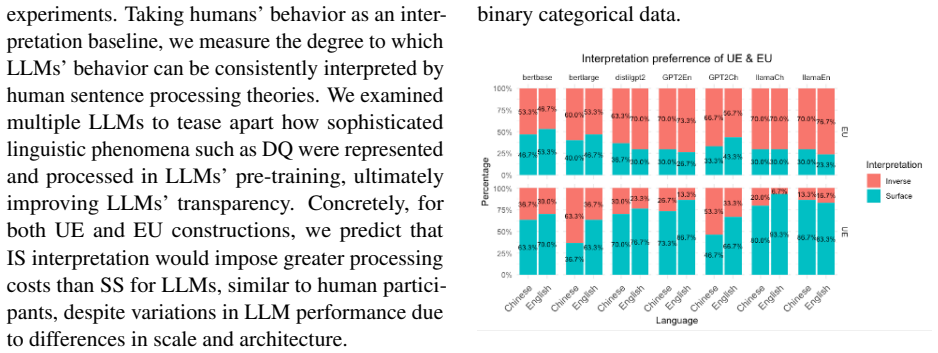
On the paper's own terms, the discovery is that seven LLMs, scored by the conditional probability that a sentence is accepted in a context favoring one reading, mostly prefer surface scope for universal-existential sentences such as “Every child climbed a tree,” matching humans. For the reverse construction “A child climbed every tree,” most LLMs prefer the inverse reading, which is the opposite of the human pattern. Only the two BERT models show inverse scope being more likely in English than in Chinese for both constructions, mirroring the human cross-linguistic contrast. Human Similarity scores, computed with Jensen-Shannon divergence, show the GPT-family models closest to human judgments, LLaMA intermediate, and BERT lowest, especially against Chinese speakers; training-language effects appear but are not consistent, with the Chinese-trained GPT-2 failing to replicate the Chinese-trained LLaMA's behavior.
Load-bearing premise
The load-bearing premise is that surprisal scores computed on the expanded story contexts measure the same scope-interpretation preference as the human truth-value judgments on the original, shorter stories, and the paper itself flags that the items were not identical.
Editorial extensions
If this is right
- Quantifier scope becomes a reusable diagnostic: a model's preference between surface and inverse scope can be read off surprisal without prompting.
- If this result generalizes, autoregressive models (GPT, LLaMA) are better global proxies for human judgments, while masked models (BERT) are better at capturing one specific cross-linguistic contrast.
- The language of pre-training data does not guarantee human-like cross-linguistic behavior: the Chinese-trained GPT-2 did not reproduce the Chinese-trained LLaMA's pattern.
- The EU result, where most LLMs prefer inverse scope while humans prefer surface scope, marks a boundary case for using LLMs as models of human sentence processing.
- Because BERT models were the only ones showing inverse scope more likely in English than in Chinese, architecture likely modulates how language-specific semantic knowledge is encoded.
Reading between the lines
- If the LLM items were made identical to the human items, the reported Human Similarity ordering could change; the paper's own limitation note says the LLM items were expanded, so the ranking is not final.
- The universal LLM preference for inverse scope in EU sentences could mean LLMs exploit the entailment from 'a child climbed every tree' differently than humans do; a test using contexts that block that entailment would show whether the preference disappears.
- A direct 7-point acceptability probe of inverse-scope Chinese items, along the lines of the exploratory Deepseek test, would settle whether the human-like English–Chinese difference is a grammatical contrast or only a relative surprisal effect.
- The 'LLMs behave like L2 learners' pattern suggests cross-linguistic transfer in training data; training the same architecture on carefully balanced English and Chinese corpora could test whether the English-like bias disappears.
Signed reviews
Editorial analysis
A structured set of objections, weighed in public.
Referee Report
Summary. The paper studies how seven LLMs interpret doubly quantified sentences in English and Chinese, using surprisal-based probabilities to infer preference for surface scope (SS) versus inverse scope (IS) in two structures: UE (e.g., "Every child climbed a tree") and EU (e.g., "A child climbed every tree"). Experiment 1 reports that for UE, most models prefer SS over IS, with some language-dependent variation; for EU, models predominantly prefer IS, a pattern the authors call unexpected. Experiment 2 compares LLM surprisal distributions with human truth-value judgment data from Fang (2023) using a Jensen-Shannon-divergence-based Human Similarity score, finding that GPT and LLaMA models are more human-like than BERT models and that L2-learner-like patterns emerge. The abstract and conclusion claim that most LLMs prefer surface scope and align with human tendencies, and that only some models differentiate English from Chinese in IS availability.
Significance. If the surface-scope claim were restricted to UE constructions, the study would contribute a useful cross-linguistic, cross-architecture dataset for LLM quantifier-scope behavior, and the direct computation of surprisals from pretrained weights without any fitting to the target results is a methodological strength. The inclusion of both UE and EU constructions and Chinese materials goes beyond prior LLM scope work, and the EU inverse-scope preference is a falsifiable negative result. However, the overgeneralized headline claim and the non-identical stimuli in Experiment 2 mean that the human-alignment conclusions, as currently stated, are not supported by the evidence presented.
major comments (3)
- [Abstract, §5 Conclusion, §4.1 Discussion] The claim that "most LLMs prefer the surface scope interpretations" is contradicted by the paper's own Experiment 1 results for EU sentences. Section 2.4 states that for EU structures "all LLMs predominantly preferred IS readings," and Table 3 shows that every statistically significant SS-vs-IS contrast favors inverse scope (e.g., DistilGPT2, GPT-2En, LlamaEn, and LlamaCh in English; BERT-large and LlamaEn in Chinese), with no EU cell showing a significant surface-scope preference. The authors themselves describe the EU results as "unexpected" (§4.1). Since EU constitutes half the materials, all occurrences of the surface-scope preference claim must be restricted to UE constructions, and the EU inverse-scope preference should be reported as a central negative result rather than as an aside.
- [§3.2, §3.3, §6 Limitations] The Human Similarity comparison in Experiment 2 relies on non-identical stimuli for humans and LLMs: human ratings came from the original story contexts in Fang (2023), while LLM surprisals were computed on expanded and enriched contexts (Section 2.1). As the authors acknowledge in Section 6, the items "were not identical," and this discrepancy threatens the construct validity of HS scores, because surprisal differences may reflect context length or detail rather than scope interpretation. The HS analysis also lacks a baseline (e.g., human-human agreement or a chance-level reference) and Figure 4 shows no error bars or per-item dispersion. Without identical items, a baseline, and uncertainty estimates, the claim that HS scores show LLMs "approximate human language use" is not fully supported; the authors should either rerun the comparison on identical items or substantially temper these alignment claims.
- [§2.4 Results] The only significant Language effect in the per-LLM analyses is BERT-large in the UE condition, reported as b=1.1, p=.0499. Because seven models and two structures are tested, this borderline p-value, uncorrected for multiple comparisons, is too weak to support the Discussion's emphasis on BERT models exhibiting cross-linguistic contrasts. The authors should report multiplicity-adjusted p-values or, at minimum, all model-specific p-values, and in the Discussion distinguish strong effects (e.g., the EU patterns for LlamaCh) from this borderline finding.
minor comments (6)
- [§3.3] There is a typo: "ANOV A tests" should read "ANOVA tests."
- [Figure 3 caption] "Experimental 2" should be "Experiment 2."
- [§2.4] The inline text contains "allps" without a space; it should read "all ps."
- [§4.2] The sentence "As shown in Tables 1 and 2" appears to refer to the results tables; it should refer to Tables 2 and 3, since Table 1 is a gloss of the Chinese sentence.
- [§2.1] The labels UE and EU are not defined explicitly; "30 existential quantifier (UE)" is confusing because UE denotes the universal-existential structure "Every ... a ..." and EU denotes the existential-universal structure "A ... every ...". Please define the labels at first use.
- [§4.3] The exploratory Deepseek-R1 analysis lacks details about model version, sampling parameters, and prompt robustness; since it is not central to the paper's claims, it would fit better in a clearly marked exploratory subsection or in the appendix.
Circularity Check
No circularity: LLM surprisals are direct outputs, the human baseline is independent, and the flagged issues are validity/consistency caveats rather than circular reductions.
full rationale
Adjudication: no circular step. Experiment 1 computes surprisals directly from pretrained weights using Minicons and compares SS vs IS surprisal; no parameter is fitted to the target preference and no model is trained on the scope task. The binary SS/IS labels are simply lower-surprisal comparisons, not predictions derived from fitted inputs. Experiment 2's human baseline comes from Fang (2023), a self-citation by the first author, but it supplies independent empirical judgments; the HS metric (Duan et al., 2024) is a post-hoc descriptive comparison and does not feed back into the LLM surprisals. The load-bearing caveat is validity, not circularity: Section 6 states, 'the items used for deriving LLM data were not identical to those used in the human experiment... this discrepancy may weaken the validity of direct comparisons,' which should temper the human-alignment claims but does not make them circular. Separately, the abstract's unqualified 'most LLMs prefer the surface scope' conflicts with Section 2.4's 'For EU structures, all LLMs predominantly preferred IS readings' and Table 3, but that is an internal consistency/overgeneralization problem, not a derivation-from-inputs problem. Score 0.
Assumptions & free parameters
assumptions (5)
- domain assumption Surprisal (lower value) indicates preferred interpretation for an LLM.
- domain assumption Pseudo-log-likelihood scoring for masked models (BERT) yields a valid sentence probability proxy.
- domain assumption LLM items expanded from human items preserve the same scope biasing as the original human TVJT stories.
- domain assumption Chinese only permits surface scope in the relevant configurations (scope rigidity).
- domain assumption Human Similarity score based on Jensen-Shannon divergence validly indexes human-LLM alignment.
Cite this review
Pith. "Pith review of Quantifier Scope Interpretation in Language Learners and LLMs." pith.science (2026). https://pith.science/paper/7IYKDF2P
@misc{pith2026250910860,
  author       = {Pith},
  title        = {Pith review of: Quantifier Scope Interpretation in Language Learners and LLMs},
  year         = {2026},
  howpublished = {\url{https://pith.science/paper/7IYKDF2P}},
  note         = {Machine review of arXiv:2509.10860}
}
read the original abstract
Sentences with multiple quantifiers often lead to interpretive ambiguities, which can vary across languages. This study adopts a cross-linguistic approach to examine how large language models (LLMs) handle quantifier scope interpretation in English and Chinese, using probabilities to assess interpretive likelihood. Human similarity (HS) scores were used to quantify the extent to which LLMs emulate human performance across language groups. Results reveal that most LLMs prefer the surface scope interpretations, aligning with human tendencies, while only some differentiate between English and Chinese in the inverse scope preferences, reflecting human-similar patterns. HS scores highlight variability in LLMs' approximation of human behavior, but their overall potential to align with humans is notable. Differences in model architecture, scale, and particularly models' pre-training data language background, significantly influence how closely LLMs approximate human quantifier scope interpretations.
Figures


Reference graph
Works this paper leans on
-
[1]
Catherine Anderson. 2004. The structure and real-time comprehension of quantifier scope ambiguity. Northwestern University
work page 2004
-
[2]
Joseph Aoun and Yen-hui Audrey Li. 1989. Scope and constituency. Linguistic inquiry, 20(2):141--172
work page 1989
-
[3]
Adrian Brasoveanu and Jakub Dotla c il. 2015. Strategies for scope taking. Natural Language Semantics, 23:1--19
work page 2015
-
[4]
James Britton, Yan Cong, Yu-Yin Hsu, Emmanuele Chersoni, and Philippe Blache. 2024. On the influence of discourse connectives on the predictions of humans and language models. Frontiers in Human Neuroscience, 18:1363120
work page 2024
-
[5]
Zhenguang G Cai, Xufeng Duan, David A Haslett, Shuqi Wang, and Martin J Pickering. 2024. Do large language models resemble humans in language use? arXiv preprint arXiv:2303.08014
arXiv 2024
-
[6]
Chia-Ying Chu, Alison Gabriele, and Utako Minai. 2014. Acquisition of quantifier scope interpretation by chinese-speaking learners of english. In Selected proceedings of the 5th Conference on Generative Approaches to Language Acquisition North America, pages 157--168
work page 2014
-
[7]
Yan Cong, Emmanuele Chersoni, Yu-Yin Hsu, Alessandro Lenci, and 1 others. 2023. Are language models sensitive to semantic attraction? a study on surprisal. Association for Computational Linguistics
work page 2023
-
[8]
Yiming Cui, Ziqing Yang, and Xin Yao. 2023. Efficient and effective text encoding for chinese llama and alpaca. arXiv preprint arXiv:2304.08177
arXiv 2023
Show all 45 references
-
[9]
Vittoria Dentella, Fritz G \"u nther, and Evelina Leivada. 2023. Systematic testing of three language models reveals low language accuracy, absence of response stability, and a yes-response bias. Proceedings of the National Academy of Sciences, 120(51):e2309583120
2023
-
[10]
Jacob Devlin, Ming-Wei Chang, Kenton Lee, and Kristina Toutanova. 2018. Bert: Pre-training of deep bidirectional transformers for language understanding. arXiv preprint arXiv:1810.04805
2018 arXiv
-
[11]
Jakub Dotla c il and Adrian Brasoveanu. 2015. The manner and time course of updating quantifier scope representations in discourse. Language, Cognition and Neuroscience, 30(3):305--323
2015
-
[12]
Xufeng Duan, Bei Xiao, Xuemei Tang, and Zhenguang G Cai. 2024. Hlb: Benchmarking llms' humanlikeness in language use. arXiv preprint arXiv:2409.15890
2024 arXiv
-
[13]
Shaohua Fang. 2023. Quantifier scope in L2 learners: Interpretation, processing, and acquisition. Ph.D. thesis, University of Pittsburgh
2023
-
[14]
Shaohua Fang, Hongchen Wu, and Yang Zhao. 2025. Experimental investigation on quantifier scope in chinese relative clauses. Linguistics Vanguard, (0)
2025
-
[15]
Silvia P Gennari and Maryellen C MacDonald. 2006. Acquisition of negation and quantification: Insights from adult production and comprehension. Language Acquisition, 13(2):125--168
2006
-
[16]
Daya Guo, Dejian Yang, Haowei Zhang, Junxiao Song, Ruoyu Zhang, Runxin Xu, Qihao Zhu, Shirong Ma, Peiyi Wang, Xiao Bi, and 1 others. 2025. Deepseek-r1: Incentivizing reasoning capability in llms via reinforcement learning. arXiv preprint arXiv:2501.12948
2025 arXiv
-
[17]
Jennifer Hu, Kyle Mahowald, Gary Lupyan, Anna Ivanova, and Roger Levy. 2024. Language models align with human judgments on key grammatical constructions. Proceedings of the National Academy of Sciences, 121(36):e2400917121
2024
-
[18]
C-T James Huang. 1998. Logical relations in Chinese and the theory of grammar. Taylor & Francis
1998
-
[19]
Tania Ionin. 2010. The scope of indefinites: An experimental investigation. Natural language semantics, 18:295--350
2010
-
[20]
Gaurav Kamath, Sebastian Schuster, Sowmya Vajjala, and Siva Reddy. 2024. Scope ambiguities in large language models. Transactions of the Association for Computational Linguistics, 12:738--754
2024
-
[21]
Howard S Kurtzman and Maryellen C MacDonald. 1993. Resolution of quantifier scope ambiguities. Cognition, 48(3):243--279
1993
-
[22]
Alexandra Kuznetsova, Per B Brockhoff, and Rune HB Christensen. 2017. lmertest package: tests in linear mixed effects models. Journal of statistical software, 82:1--26
2017
-
[23]
Thomas Hun-tak Lee. 1986. STUDIES ON QUANTIFICATION IN CHINESE (SYNTAX, LANGUAGE ACQUISITION, QUANTIFIER SCOPE, CHINA). University of California, Los Angeles
1986
-
[24]
R Lenth, P Buerkner, M Herve, J Love, H Riebl, and H Singmann. 2020. Estimated marginal means. AKA least-squares means, 1(3)
2020
-
[25]
Yue Li, Yan Cong, and Elaine J Francis. 2025. Beyond binary animacy: A multi-method investigation of lms’ sensitivity in english object relative clauses. In Proceedings of the Workshop on Cognitive Modeling and Computational Linguistics, pages 184--196
2025
-
[26]
Jeffrey Lidz. 2018. The scope of children’s scope: Representation, parsing and learning. Glossa: a journal of general linguistics, 3(1)
2018
-
[27]
Jeffrey Lidz and Julien Musolino. 2002. Children's command of quantification. Cognition, 84(2):113--154
2002
-
[28]
Ian R McKenzie, Alexander Lyzhov, Michael Pieler, Alicia Parrish, Aaron Mueller, Ameya Prabhu, Euan McLean, Aaron Kirtland, Alexis Ross, Alisa Liu, and 1 others. 2023. Inverse scaling: When bigger isn't better. arXiv preprint arXiv:2306.09479
2023 arXiv
-
[29]
Kanishka Misra. 2022. minicons: Enabling flexible behavioral and representational analyses of transformer language models. arXiv preprint arXiv:2203.13112
2022 arXiv
-
[30]
Alec Radford, Jeff Wu, Rewon Child, David Luan, Dario Amodei, and Ilya Sutskever. 2019. Language models are unsupervised multitask learners
2019
-
[31]
Tanya Miriam Reinhart. 1976. The syntactic domain of anaphora. Ph.D. thesis, Massachusetts Institute of Technology
1976
-
[32]
Eddy G Ruys. 2002. Wide scope indefinites; the genealogy of a mutant meme. Ms., Utrecht University
2002
-
[33]
Victor Sanh, Lysandre Debut, Julien Chaumond, and Thomas Wolf. 2019. Distilbert, a distilled version of bert: smaller, faster, cheaper and lighter. arXiv preprint arXiv:1910.01108
2019 arXiv
-
[34]
Lisa Schut, Yarin Gal, and Sebastian Farquhar. 2025. Do multilingual llms think in english? arXiv preprint arXiv:2502.15603
2025 arXiv
-
[35]
Gregory Scontras, Maria Polinsky, C-Y Edwin Tsai, and Kenneth Mai. 2017. Cross-linguistic scope ambiguity: When two systems meet. Glossa: A journal of general linguistics, 2(1):1--28
2017
-
[36]
Hugo Touvron, Louis Martin, Kevin Stone, Peter Albert, Amjad Almahairi, Yasmine Babaei, Nikolay Bashlykov, Soumya Batra, Prajjwal Bhargava, Shruti Bhosale, and 1 others. 2023. Llama 2: Open foundation and fine-tuned chat models. arXiv preprint arXiv:2307.09288
2023 arXiv
-
[37]
O'Reilly Media, Inc
Lewis Tunstall, Leandro Von Werra, and Thomas Wolf. 2022. Natural language processing with transformers. " O'Reilly Media, Inc."
2022
-
[38]
Mien-Jen Wu, Tania Ionin, MM Brown, and B Dailey. 2019. L1-mandarin l2-english speakers’ acquisition of english universal quantifier-negation scope. In Proceedings of the 43rd annual Boston University conference on language development, pages 716--729
2019
-
[39]
Xiang Zhang, Senyu Li, Bradley Hauer, Ning Shi, and Grzegorz Kondrak. 2023. Don't trust chatgpt when your question is not in english: a study of multilingual abilities and types of llms. arXiv preprint arXiv:2305.16339
2023 arXiv
-
[40]
Zhe Zhao, Hui Chen, Jinbin Zhang, Xin Zhao, Tao Liu, Wei Lu, Xi Chen, Haotang Deng, Qi Ju, and Xiaoyong Du. 2019. Uer: An open-source toolkit for pre-training models. EMNLP-IJCNLP 2019, page 241
2019
-
[41]
Zhe Zhao, Yudong Li, Cheng Hou, Jing Zhao, and 1 others. 2023. Tencentpretrain: A scalable and flexible toolkit for pre-training models of different modalities. ACL 2023, page 217
2023
-
[42]
Peng Zhou and Stephen Crain. 2009. Scope assignment in child language: Evidence from the acquisition of chinese. Lingua, 119(7):973--988
2009
-
[43]
Peng Zhou and Liqun Gao. 2009. Scope processing in chinese. Journal of Psycholinguistic Research, 38:11--24
2009
-
[44]
online" 'onlinestring :=
ENTRY address archivePrefix author booktitle chapter edition editor eid eprint eprinttype howpublished institution journal key month note number organization pages publisher school series title type volume year doi pubmed url lastchecked label extra.label sort.label short.list...
-
[45]
write newline
" write newline "" before.all 'output.state := FUNCTION n.dashify 't := "" t empty not t #1 #1 substring "-" = t #1 #2 substring "--" = not "--" * t #2 global.max substring 't := t #1 #1 substring "-" = "-" * t #2 global.max substring 't := while if t #1 #1 substring * t #2 gl...
Reviewed August 15, 2026 · model on record in the stance chip above.
Discussion (0). Continue with ORCID to comment.