REVIEW 4 major objections 5 minor 2 cited by
Hydrocarbon Hazes on Temperate sub-Neptune K2-18b supported by data from the James Webb Space Telescope
T0 review · 4 major / 5 minor · reviewed 2026-08-04 · deepseek-v4-flash
Pith's one-line read The paper argues that hydrocarbon hazes, not instrumental offsets, reconcile the combined JWST spectrum of the temperate sub-Neptune K2-18b.
desk verdict A useful joint retrieval and honest sensitivity study, but the haze-support claim is not yet secure: the haze continuum and zero MIRI offset are fixed by hand, not tested. read the letter →
The pith
A machine-rendered reading of the paper's core claim, the machinery that carries it, and where it could break.
The reading
What carries the argument
The key mechanism is a 'haze continuum' constructed from Mie-scattering opacity of laboratory-produced haze analogues — a Titan-like tholin and a 1000×-solar-metallicity exoplanet haze — using five discrete particle radii (0.20–1.93 µm) and number densities, uniformly distributed between 10^-8 and 10^-5 bar. This continuum adds a strong, non-uniform Rayleigh-scattering slope at short wavelengths and an elevated continuum across the NIR, reconciling the NIRISS/NIRSpec features with the stronger MIRI features. It works together with CH4 and CO2 gas opacity and reduces the atmospheric scale-height requirement, thereby lowering the retrieved molecular abundances.
What would settle it
Fit the same combined dataset with a retrieval that includes both the haze continuum and a free MIRI offset parameter, and check whether the offset posterior is consistent with zero; if it is not, the haze model is compensating for an instrumental artifact. Alternatively, acquire a new independent MIRI visit of K2-18b: if the mid-infrared transit depths shift by more than the current error bars relative to the near-infrared, the no-offset assumption fails; and a high-significance non-detection of the predicted C2H4 feature at ~10.5 µm would undermine the photochemical-haze interpretation.
Extended reading notes
Core claim
The central discovery the paper argues for is that the muted near-infrared features and stronger mid-infrared features in the combined JWST spectrum of K2-18b are a single coherent atmospheric signature of hydrocarbon hazes. The authors find that retrievals including a haze continuum made of five particle sizes of either a Titan-like tholin or a 1000×-solar-metallicity haze analogue fit all the data without requiring any offset between the NIRISS/NIRSpec and MIRI instruments. The best-fitting atmosphere is H2-dominated with mean molecular weight ~2.4 Daltons, with CH4 and CO2 as the dominant absorbers; the retrieved abundances are systematically 1–2 dex lower than in haze-free studies, easin
Load-bearing premise
The load-bearing premise is that the MIRI LRS spectrum and the published NIRISS/NIRSpec spectra share a common absolute baseline with no inter-instrument offset; if a real offset exists (of order 110–165 ppm, as some other studies suggest), the fitted haze continuum would absorb it and the case for hydrocarbon hazes weakens or disappears.
Editorial extensions
If this is right
- K2-18b is a hydrogen-dominated mini-Neptune rather than a water-world or high-molecular-weight Hycean planet; the main atmospheric absorbers are CH4 and CO2 at moderate abundances.
- The NIR-vs-MIRI feature mismatch can be read as evidence for haze rather than as an instrumental systematic; other sub-Neptune spectra showing similar muted near-IR features may be explained the same way.
- The mass–temperature degeneracy means that improved stellar characterization (and thus more precise planetary mass) is a prerequisite for reliable conclusions about the planet's temperature and chemical inventory.
- Hydrocarbon haze points to active methane photochemistry; the paper identifies a possible C2H4 feature near 10.5 µm that future JWST observations could test.
- Haze-free retrievals on temperate sub-Neptunes may overestimate methane and carbon dioxide abundances and mean molecular weight, since haze opacity mimics a larger scale height.
Reading between the lines
- If hydrocarbon hazes are common on temperate sub-Neptunes, the NIRISS-vs-MIRI amplitude gap could become a cheap diagnostic for haze in archival JWST data before any detailed retrieval is performed.
- The haze particle sizes and number densities were specifically tuned to match the NIRISS/NIRSpec datasets; a physically self-consistent microphysical model is needed to check whether such a population can actually form and survive in K2-18b's upper atmosphere.
- A decisive test of the no-offset claim would be to run the same retrievals with a free MIRI offset parameter alongside the haze continuum; if the offset posterior excludes zero, the proposed haze continuum is absorbing an instrumental artifact.
- If future multi-visit MIRI observations show that the mid-infrared baseline shifts by ~100 ppm relative to the near-infrared, the haze interpretation would need to be revised, since the same haze continuum would no longer fit all visits simultaneously.
Editorial analysis
A structured set of objections, weighed in public.
Referee Report
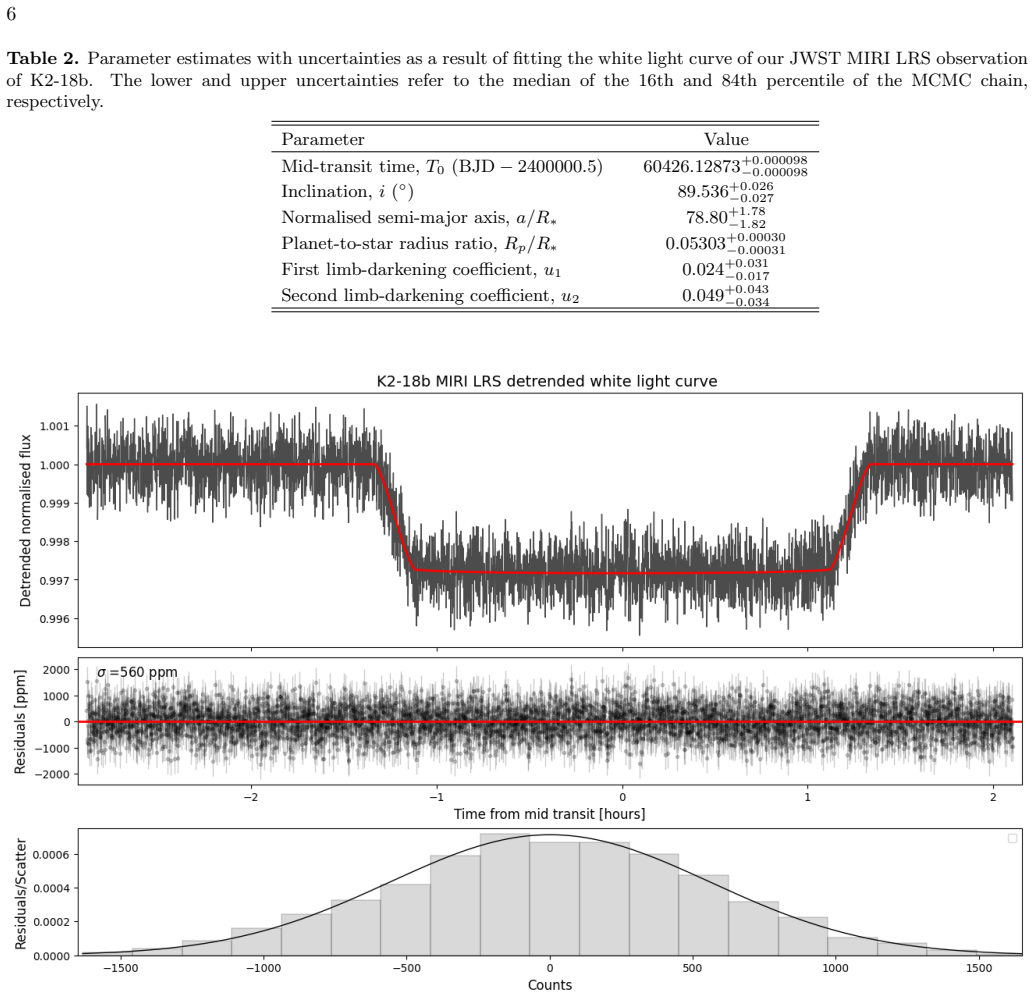
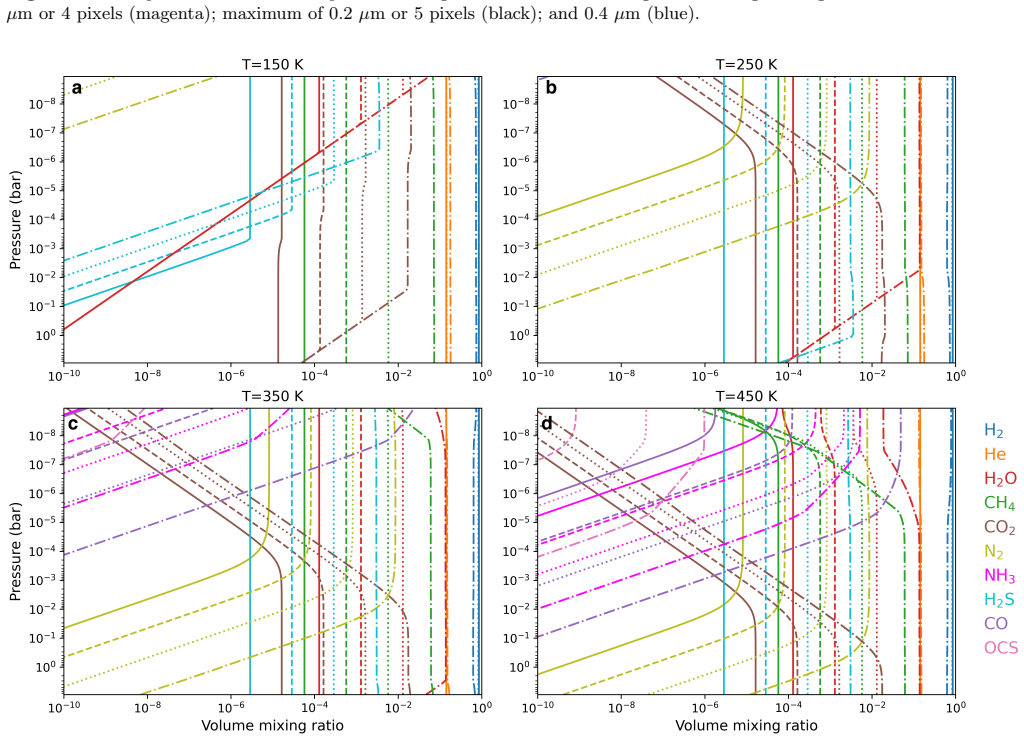
Summary. The paper presents a new analysis of the K2-18b JWST transmission spectrum, combining an independent reduction of MIRI LRS data (using the JWST Science Calibration Pipeline and PyLightcurve) with previously published NIRISS SOSS and NIRSpec G395H spectra from Madhusudhan et al. (2023). Free-chemistry TauREx retrievals are performed on the combined 0.85–12 μm spectrum, with molecular species guided by equilibrium chemistry (GGchem). The central claim is that including a hydrocarbon haze continuum—built from five discrete particle radii and number densities of either Titan-like (K84) or 1000× solar metallicity (H24) laboratory haze analogues—can explain the full spectrum without invoking instrumental offsets, and that this reduces the retrieved CH4 and CO2 abundances relative to haze-free studies. The paper also investigates the impact of stellar parameter uncertainties on derived planetary density and explores the degeneracy between planetary mass, temperature, and mean molecular weight.
Significance. If the result holds, the paper would provide a physically motivated explanation for the apparent amplitude mismatch between NIRISS/NIRSpec and MIRI features on K2-18b and would support the presence of hydrocarbon hazes on a temperate sub-Neptune. The independent MIRI reduction and the explicit treatment of stellar parameter uncertainties are useful contributions. The paper is honest about many limitations and points to needed follow-up work. However, the central claim of 'strongly supporting' hydrocarbon hazes rests on an untested assumption about inter-instrument offsets and a hand-constructed haze continuum; the current evidence is suggestive rather than demonstrative.
major comments (4)
- [Section 4.2; Appendix A.2] The no-offset choice is asserted rather than tested. Section 4.2 states 'we intentionally chose not to apply an offset to the MIRI data,' while Appendix A.2 shows that changing the number of masked integrations shifts transit depths by 92–143 ppm—comparable to the 110–165 ppm offsets retrieved by Luque et al. (2025). The claim that haze provides a consistent explanation 'without invoking instrumental offsets' requires demonstrating that a haze-free model with free per-instrument offsets (or a free gray/continuum component) does not fit the combined data at least as well. The current model comparison (Figures 7 and 16) fixes offsets to zero, so the improved fit could arise from the haze continuum absorbing an unmodeled MIRI offset. I recommend adding retrievals that (a) allow free offsets between NIRISS, NIRSpec, and MIRI with no haze, and (b) allow a free gray cloud/continuum, and compar
- [Section 4.2; Table 4] The haze continuum is constructed from five fixed particle radii and number densities, described as 'constructed specifically for the NIRISS and NIRSpec datasets considered.' These parameters are not retrieved and are set by hand. This makes the support for haze conditional on an untested, arbitrarily chosen aerosol population. The comparison 'haze vs. haze-free' is therefore not a comparison of two retrieved models. The paper should test the sensitivity of the conclusion to the assumed radii/densities (e.g., by retrieving a parameterized haze distribution or by repeating retrievals over a grid of plausible values) and should report whether the improvement over the haze-free case persists across that range.
- [Section 3.3; Tables 7-8] The MAP-retrieved planetary mass sits at the upper edge of the prior [3.2, 14.3] M⊕ (MAP values 14.08–14.26 M⊕; medians 13.2–13.5 M⊕), so the reported mass of ~14 M⊕ is not a well-constrained inference but a boundary-hitting result. The 2σ uncertainties of ~71% partly reflect this. The strong correlation between mass and temperature (Section 4.4) means the elevated temperatures favored in the baseline retrievals are entangled with this unconstrained mass. The paper should explicitly discuss the prior-edge behavior and, ideally, extend the prior or use an independent mass constraint from the density estimate in Table 6.
- [Figures 7 and 16; Section 3.3.1] The 'haze-free atmosphere' shown as the grey dashed line in Figures 7 and 16 is not a separately retrieved haze-free model; it is the best-fit haze model with the haze continuum removed after the fit. Such a curve naturally degrades the fit, but it is not a test of whether a haze-free retrieval with different gas abundances, temperatures, or mass could fit the data. The paper states 'a haze-free model systematically underestimates the continuum level,' but this is based on the post-hoc removal, not on a haze-free retrieval. A proper haze-free retrieval (with the same free parameters but no haze) should be run and compared on equal footing.
minor comments (5)
- [Abstract and Section 5] Typo: 'hydrocarbon haze hazes' appears in the Abstract and in Section 5 ('presence of hydrocarbon haze hazes'); should be 'hydrocarbon hazes'.
- [Figure 4 caption] The caption refers to 'the mid-transit-removed lightcurve in Figure 4' but the lightcurve is shown in Figure 3. Please correct the cross-reference.
- [Table 7] The entry 'Mp = 6.07M⊕ ⋄∗ 1' and 'Mp = 6.07M⊕ ⋄∗ 2' is confusing; consider formatting as two separate rows with distinct solution labels.
- [Section 2.2.2] The package name 'PyLightcurve' is used; if the official name is 'PyLightcurve' (Tsiaras et al. 2016a), please ensure consistency in the Software section.
- [Section 4.2] The sentence 'the haze continua were constructed specifically for the NIRISS and NIRSpec datasets considered' is a key limitation and should be flagged more prominently in the abstract or conclusions, not only in the discussion.
Circularity Check
Haze support is partly built in: the haze continuum was hand-constructed for the NIRISS/NIRSpec data and MIRI offsets were fixed to zero by assumption, so the central 'haze without offsets' claim is not an independent test.
-
fitted input called prediction
[Section 4.2 (Instrumental Offsets and Systematics); Table 4; Section 3.3.1]
"In this work, the haze continua were constructed specifically for the NIRISS and NIRSpec datasets considered. Incorporating an instrumental offset into our retrievals would therefore require modifying assumptions about particle radii and number densities (Table 4)."
The paper claims that hazy models explain the reduced NIRISS/NIRSpec feature amplitudes, but the haze continuum was explicitly constructed for those same datasets, with fixed particle radii and number densities chosen a priori (Table 4). The improved fit over a haze-free model is therefore a statement that a component tuned to these data improves the fit, not an independent confirmation of haze. The MIRI spectrum is used only as a baseline anchor ('fit a haze slope in the NIR'), so the full-spectrum agreement inherits the NIR tuning.
-
self definitional
[Section 4.2; Section 5 (Conclusions); Abstract]
"In this study, we intentionally chose not to apply an offset to the MIRI data."
The central conclusion 'without invoking instrumental offsets in the MIRI LRS data' is the logical restatement of the modeling choice to exclude an offset parameter: the retrieval cannot discover an offset that is not allowed to vary. Because the fixed haze continuum is broad and nearly gray, it is degenerate with a ~100-150 ppm MIRI offset of the kind reported by Luque et al. (2025), so the 'no offset needed' claim is an assumption rather than a derived result.
full rationale
The paper is not globally circular: the molecular retrievals rest on external opacity data (ExoMol line lists), an independent MIRI LRS reduction, and standard Bayesian tools, and the stellar-parameter and density analyses are based on published empirical calibrations rather than on the target result. However, the paper's headline claim—that hydrocarbon hazes are strongly supported and that the full JWST spectrum is explained without instrumental offsets—contains two load-bearing components that reduce to inputs by construction. First, the haze continuum was 'constructed specifically for the NIRISS and NIRSpec datasets considered' (Section 4.2), so the improved NIR fit is a hand-tuned reproduction of the very data it is invoked to explain; the haze parameters are fixed, not retrieved, and the MIRI data are used only as a baseline anchor. Second, the conclusion that no MIRI offset is required follows directly from the decision not to include an offset parameter; the paper's own Appendix A.2 shows 92-143 ppm extraction shifts, and literature offsets are comparable to the continuum signal attributed to haze. These issues do not invalidate the molecular abundance results or the value of an independent MIRI reduction, but they mean the 'support for hazes' is substantially built into the setup rather than emerging from a test that could have failed. Score 6 reflects this partial circularity: one or more predictions/claims reduce by construction, while independent content remains.
Assumptions & free parameters
free parameters (5)
- Planetary mass M_p (fitted) =
median 13.24 +0.76/-1.47 M⊕ (Titan-like baseline); prior [3.2,14.3]
- Atmospheric temperature T (fitted) =
median 422 +48/-74 K (Titan-like), 434 +53/-70 K (H24 baseline)
- Haze continuum particle radii and number densities (hand-set) =
r = 0.20, 0.43, 0.75, 0.91, 1.93 µm; n = 1e5, 2e4, 1e3, 1e3, 1.5e3 m^-3
- CH4 and CO2 volume mixing ratios (fitted) =
log X_CH4 ~ -3.5 to -3.8, log X_CO2 ~ -3.2 to -4.1 (baseline MAP, Table 7)
- log P_max (fitted) =
unconstrained across [0,3] bar (log)
assumptions (6)
- domain assumption Isothermal temperature profile represents the average atmospheric structure
- domain assumption Laboratory haze analogues (K84 Titan tholin; H24 ×1000Z) represent K2-18b photochemical haze optical properties
- domain assumption No inter-instrument offset between MIRI LRS and NIRISS/NIRSpec data
- ad hoc to paper Haze layer bounded to 1e-8 to 1e-5 bar with uniform particle properties over altitude
- ad hoc to paper Uniform prior on planetary mass M_p in [3.2,14.3] M⊕
- standard math Mie theory for spherical particles
invented entities (1)
-
K2-18b hydrocarbon haze continuum (five discrete particle populations)
Cite this review
Pith. "Pith review of Hydrocarbon Hazes on Temperate sub-Neptune K2-18b supported by data from the James Webb Space Telescope." pith.science (2026). https://pith.science/paper/7XTJXVMC
@misc{pith2026250910947,
  author       = {Pith},
  title        = {Pith review of: Hydrocarbon Hazes on Temperate sub-Neptune K2-18b supported by data from the James Webb Space Telescope},
  year         = {2026},
  howpublished = {\url{https://pith.science/paper/7XTJXVMC}},
  note         = {Machine review of arXiv:2509.10947}
}
abstract
K2-18b, a sub-Neptune orbiting in the habitable zone of an M dwarf, has attracted significant interest following observations with the Hubble Space Telescope (HST) and, more recently, with the James Webb Space Telescope (JWST), which reveal detectable atmospheric features across the near- and mid-infrared. Using free-chemistry Bayesian retrievals, we investigate whether hydrocarbon hazes can explain the apparent mismatch of spectral feature amplitudes between the JWST NIRISS/NIRSpec and MIRI LRS datasets. We additionally assess the impact of stellar parameter uncertainties on the derived bulk properties of the planet and explore how planetary mass uncertainties affect atmospheric retrievals. We find that hazy scenarios can reproduce the combined JWST spectrum and provide a consistent explanation for the reduced NIRISS/NIRSpec feature amplitudes relative to the stronger MIRI features. Across all retrievals, the atmosphere remains consistent with an H$_2$-dominated sub-Neptune, with CH$_4$ and CO$_2$ as the dominant absorbers. Our hazy models retrieve systematically lower molecular abundances compared to haze-free models, reflecting the degeneracy between haze opacity and mean molecular weight. In addition, we identify strong degeneracies between planetary mass, temperature, and mean molecular weight. The retrieved planetary mass is particularly poorly constrained, with $2\sigma$ uncertainties reaching up to $\sim71\%$. We demonstrate that different mass assumptions can significantly bias the inferred atmospheric properties, with higher masses favouring warmer and lower mean molecular weight atmospheres. Breaking these degeneracies will require improved stellar characterisation to obtain more precise mass measurements. More laboratory-focused studies and future JWST observations are essential for interpreting these temperate sub-Neptune atmospheres.
Figures


Figures from the paper (14 more)




Forward citations
Cited by 2 Pith papers
-
Coupling magma-ocean and atmospheres in spectral retrievals of sub-Neptunes
MELTYQ couples magma-atmosphere equilibrium models with spectral retrievals to constrain sub-Neptune magma oxidation states and volatile inventories from transmission spectra.
-
Influence of CO versus CH$_4$ on organic haze formation in atmospheres of diverse terrestrial exoplanets
CH4 produces 5–90× more organic haze than CO across N2-, CO2-, and H2O-rich terrestrial-exoplanet gas mixtures, with denser, chemically richer particles.
Reference graph
Works this paper leans on
-
[1]
, " * write output.state after.block = add.period write newline
ENTRY address archivePrefix author booktitle chapter doi edition editor eprint howpublished institution journal key month number organization pages publisher school series title misctitle type volume year version url label extra.label sort.label short.list INTEGERS output.state before.all mid.sentence after.sentence after.block FUNCTION init.state.consts ...
-
[2]
write newline
" write newline "" before.all 'output.state := FUNCTION format.url url empty "" new.block "" url * "" * if FUNCTION format.eprint eprint empty "" archivePrefix empty "" archivePrefix "arXiv" = new.block " " eprint * " " * new.block " " eprint * " " * if if if FUNCTION format.doi doi empty "" " " doi * " " * if FUNCTION format.pid doi empty eprint empty ur...
-
[3]
thebibliography [1] 20pt to REFERENCES 6pt =0pt -12pt 10pt plus 3pt =0pt =0pt =1pt plus 1pt =0pt =0pt -12pt =13pt plus 1pt =20pt =13pt plus 1pt \@M =10000 =-1.0em =0pt =0pt 0pt =0pt =1.0em @enumiv\@empty 10000 10000 `\.\@m \@noitemerr \@latex@warning Empty `thebibliography' environment \@ifnextchar \@reference \@latexerr Missing key on reference command E...
arXiv 2021
-
[4]
Ag \'u ndez , M., Mart \' nez , J. I., de Andres , P. L., Cernicharo , J., & Mart \' n-Gago , J. A. 2020, , 637, A59, 10.1051/0004-6361/202037496
-
[5]
2012, Astronomy & Astrophysics, 548, A73, 10.1051/0004-6361/201220365
Ag \'u ndez, M., Venot, O., Iro, N., et al. 2012, Astronomy & Astrophysics, 548, A73, 10.1051/0004-6361/201220365
-
[6]
F., Changeat , Q., Venot , O., Waldmann , I
Al-Refaie , A. F., Changeat , Q., Venot , O., Waldmann , I. P., & Tinetti , G. 2022, , 932, 123, 10.3847/1538-4357/ac6dcd
-
[7]
Al-Refaie , A. F., Changeat, Q., Waldmann, I. P., & Tinetti, G. 2021, The Astrophysical Journal, 917, 37, 10.3847/1538-4357/ac0252
-
[8]
Alderson, L., Moran, S. E., Wallack, N. L., et al. 2025, The Astronomical Journal, 169, 142, 10.3847/1538-3881/adad64
Show all 123 references
- [9]
-
[10]
J., & Scott, P
Asplund, M., Grevesse, N., Sauval, A. J., & Scott, P. 2009, Annual Review of Astronomy and Astrophysics, 47, 481, 10.1146/annurev.astro.46.060407.145222
2009
-
[11]
P., Tollerud , E
Astropy Collaboration , Robitaille , T. P., Tollerud , E. J., et al. 2013, , 558, A33, 10.1051/0004-6361/201322068
2013 doi
-
[12]
M., Sip o cz , B
Astropy Collaboration , Price-Whelan , A. M., Sip o cz , B. M., et al. 2018, , 156, 123, 10.3847/1538-3881/aabc4f
2018 doi
-
[13]
M., Lim , P
Astropy Collaboration , Price-Whelan , A. M., Lim , P. L., et al. 2022, , 935, 167, 10.3847/1538-4357/ac7c74
2022 doi
-
[14]
C., Buchhave, L
August, P. C., Buchhave, L. A., Diamond-Lowe , H., et al. 2025, Astronomy and Astrophysics, 695, A171, 10.1051/0004-6361/202452611
2025 doi
-
[15]
Azzam , A. A. A., Tennyson , J., Yurchenko , S. N., & Naumenko , O. V. 2016, , 460, 4063, 10.1093/mnras/stw1133
2016 doi
-
[16]
B., Col \'o n, K
Barclay, T., Kostov, V. B., Col \'o n, K. D., et al. 2021, The Astronomical Journal, 162, 300, 10.3847/1538-3881/ac2824
2021 doi
-
[17]
K., Changeat, Q., Garland, R., et al
Barstow, J. K., Changeat, Q., Garland, R., et al. 2020, Monthly Notices of the Royal Astronomical Society, 493, 4884, 10.1093/mnras/staa548
2020 doi
-
[18]
2017, The Astrophysical Journal, 834, 187, 10.3847/1538-4357/834/2/187
Benneke, B., Werner, M., Petigura, E., et al. 2017, The Astrophysical Journal, 834, 187, 10.3847/1538-4357/834/2/187
2017 doi
-
[19]
2019, The Astrophysical Journal Letters, 887, L14, 10.3847/2041-8213/ab59dc
Benneke, B., Wong, I., Piaulet, C., et al. 2019, The Astrophysical Journal Letters, 887, L14, 10.3847/2041-8213/ab59dc
2019 doi
-
[20]
2022, Nature Astronomy, 6, 537, 10.1038/s41550-022-01678-z
B \'e zard, B., Charnay, B., & Blain, D. 2022, Nature Astronomy, 6, 537, 10.1038/s41550-022-01678-z
2022 doi
-
[21]
2021, Astronomy & Astrophysics, 646, A15, 10.1051/0004-6361/202039072
Blain, D., Charnay, B., & B \'e zard, B. 2021, Astronomy & Astrophysics, 646, A15, 10.1051/0004-6361/202039072
2021 doi
-
[22]
F., & Huffman, D
Bohren, C. F., & Huffman, D. R. 2008, Absorption and Scattering of Light by Small Particles (John Wiley & Sons)
2008
-
[23]
P., et al
Bouwman, J., Kendrew, S., Greene, T. P., et al. 2023, Publications of the Astronomical Society of the Pacific, 135, 038002, 10.1088/1538-3873/acbc49
2023 doi
-
[24]
2014, Astronomy & Astrophysics, 564, A125, 10.1051/0004-6361/201322971
Buchner, J., Georgakakis, A., Nandra, K., et al. 2014, Astronomy & Astrophysics, 564, A125, 10.1051/0004-6361/201322971
2014 doi
-
[25]
2020, in Astronomical Data Analysis Software and Systems XXIX , Vol
Bushouse, H. 2020, in Astronomical Data Analysis Software and Systems XXIX , Vol. 527, 583
2020
-
[26]
Chachan , Y., & Stevenson , D. J. 2018, , 854, 21, 10.3847/1538-4357/aaa459
2018 doi
-
[27]
F., et al
Changeat , Q., Edwards , B., Al-Refaie , A. F., et al. 2022, , 260, 3, 10.3847/1538-4365/ac5cc2
2022 doi
-
[28]
L., Tennyson, J., & Yurchenko, S
Chubb, K. L., Tennyson, J., & Yurchenko, S. N. 2020, Monthly Notices of the Royal Astronomical Society, 493, 1531, 10.1093/mnras/staa229
2020 doi
-
[29]
2000, Astronomy and Astrophysics, 363, 1081
Claret, A. 2000, Astronomy and Astrophysics, 363, 1081
2000
-
[30]
2019, , 621, A49, 10.1051/0004-6361/201833995
Cloutier , R., Astudillo-Defru , N., Doyon , R., et al. 2019, , 621, A49, 10.1051/0004-6361/201833995
2019 doi
-
[31]
A., Yurchenko, S
Coles, P. A., Yurchenko, S. N., & Tennyson, J. 2019, Monthly Notices of the Royal Astronomical Society, 490, 4638, 10.1093/mnras/stz2778
2019 doi
-
[32]
J., Monaghan, C., Benneke, B., & Dang, L
Connors, N. J., Monaghan, C., Benneke, B., & Dang, L. 2025, The Astrophysical Journal Letters, 989, L11, 10.3847/2041-8213/adee0d
2025 doi
-
[33]
J., & Madhusudhan, N
Cooke, G. J., & Madhusudhan, N. 2024, Considerations for Photochemical Modeling of Possible Hycean Worlds , arXiv. 2410.07313
2024 arXiv
-
[34]
D., & Charbonneau, D
Dressing, C. D., & Charbonneau, D. 2015, The Astrophysical Journal, 807, 45, 10.1088/0004-637X/807/1/45
2015 doi
-
[35]
2020, The Astronomical Journal, 161, 44, 10.3847/1538-3881/abc6a5
Edwards, B., Changeat, Q., Mori, M., et al. 2020, The Astronomical Journal, 161, 44, 10.3847/1538-3881/abc6a5
2020 doi
-
[36]
2023, , 269, 31, 10.3847/1538-4365/ac9f1a
Edwards , B., Changeat , Q., Tsiaras , A., et al. 2023, , 269, 31, 10.3847/1538-4365/ac9f1a
2023 doi
-
[37]
L., Welch, B
Eriksson, G., Holm, J. L., Welch, B. J., et al. 1971, Acta Chemica Scandinavica, 25, 2651, 10.3891/acta.chem.scand.25-2651
1971 doi
-
[38]
2022, TransitSpectroscopy, 0.3.11, Zenodo, 10.5281/zenodo.6960924
Espinoza, N. 2022, TransitSpectroscopy, 0.3.11, Zenodo, 10.5281/zenodo.6960924
2022 doi
-
[39]
D., Radica, M., Welbanks, L., et al
Feinstein, A. D., Radica, M., Welbanks, L., et al. 2023, Nature, 614, 670, 10.1038/s41586-022-05674-1
2023 doi
-
[40]
P., & Bridges, M
Feroz, F., Hobson, M. P., & Bridges, M. 2009, Monthly Notices of the Royal Astronomical Society, 398, 1601, 10.1111/j.1365-2966.2009.14548.x
2009
-
[41]
W., Lang, D., & Goodman, J
Foreman-Mackey , D., Hogg, D. W., Lang, D., & Goodman, J. 2013, Publications of the Astronomical Society of the Pacific, 125, 306, 10.1086/670067
2013 doi
- [42]
- [43]
-
[44]
2022, VizieR Online Data Catalog, I/355
Gaia Collaboration . 2022, VizieR Online Data Catalog, I/355
2022
-
[45]
2009, , 693, 722, 10.1088/0004-637X/693/1/722
Grasset , O., Schneider , J., & Sotin , C. 2009, , 693, 722, 10.1088/0004-637X/693/1/722
2009 doi
-
[46]
P., Bell, T
Greene, T. P., Bell, T. J., Ducrot, E., et al. 2023, Nature, 618, 39, 10.1038/s41586-023-05951-7
2023 doi
-
[47]
H., et al
Gressier, A., Espinoza, N., Allen, N. H., et al. 2024, The Astrophysical Journal, 975, L10, 10.3847/2041-8213/ad73d1
2024 doi
-
[48]
R., Millman, K
Harris, C. R., Millman, K. J., van der Walt, S. J., et al. 2020, Nature, 585, 357, 10.1038/s41586-020-2649-2
2020 doi
-
[49]
E., et al
He , C., Radke , M., Moran , S. E., et al. 2024, Nature Astronomy, 8, 182, 10.1038/s41550-023-02140-4
2024 doi
-
[50]
J., & McCarthy , Jr., D
Henry , T. J., & McCarthy , Jr., D. W. 1993, , 106, 773, 10.1086/116685
1993 doi
-
[51]
M., He, C., Lewis, N
H \"o rst, S. M., He, C., Lewis, N. K., et al. 2018, Nature Astronomy, 2, 303, 10.1038/s41550-018-0397-0
2018 doi
-
[52]
2021, The Astrophysical Journal Letters, 921, L8, 10.3847/2041-8213/ac1f92
Hu, R., Damiano, M., Scheucher, M., et al. 2021, The Astrophysical Journal Letters, 921, L8, 10.3847/2041-8213/ac1f92
2021 doi
- [53]
-
[54]
2024, The Astrophysical Journal, 975, 146, 10.3847/1538-4357/ad76ac
Huang, Z., Yu, X., Tsai, S.-M., et al. 2024, The Astrophysical Journal, 975, 146, 10.3847/1538-4357/ad76ac
2024 doi
-
[55]
O., Wende-von Berg , S., Dreizler, S., et al
Husser, T. O., Wende-von Berg , S., Dreizler, S., et al. 2013, Astronomy and Astrophysics, 553, A6, 10.1051/0004-6361/201219058
2013 doi
-
[56]
2012, , 753, 66, 10.1088/0004-637X/753/1/66
Ikoma , M., & Hori , Y. 2012, , 753, 66, 10.1088/0004-637X/753/1/66
2012 doi
-
[57]
Innes, H., Tsai, S.-M., & Pierrehumbert, R. T. 2023, The Astrophysical Journal, 953, 168, 10.3847/1538-4357/ace346
2023 doi
-
[58]
2025, , 987, 174, 10.3847/1538-4357/add3fe
Ito , Y., Kimura , T., Ohno , K., Fujii , Y., & Ikoma , M. 2025, , 987, 174, 10.3847/1538-4357/add3fe
2025 doi
-
[59]
E., van der Avoird , A., et al
Karman, T., Gordon, I. E., van der Avoird , A., et al. 2019, Icarus, 328, 160, 10.1016/j.icarus.2019.02.034
2019 doi
-
[60]
2019, The Astrophysical Journal, 877, 109, 10.3847/1538-4357/ab1b1d
Kawashima, Y., & Ikoma, M. 2019, The Astrophysical Journal, 877, 109, 10.3847/1538-4357/ab1b1d
2019 doi
-
[61]
2015, Publications of the Astronomical Society of the Pacific, 127, 623, 10.1086/682255
Kendrew, S., Scheithauer, S., Bouchet, P., et al. 2015, Publications of the Astronomical Society of the Pacific, 127, 623, 10.1086/682255
2015 doi
-
[62]
N., Sagan, C., Arakawa, E
Khare, B. N., Sagan, C., Arakawa, E. T., et al. 1984, Icarus, 60, 127, 10.1016/0019-1035(84)90142-8
1984 doi
-
[63]
2022, Experimental Astronomy, 53, 547, 10.1007/s10686-020-09696-3
Kokori, A., Tsiaras, A., Edwards, B., et al. 2022, Experimental Astronomy, 53, 547, 10.1007/s10686-020-09696-3
2022 doi
-
[64]
2019, The Astrophysical Journal Supplement Series, 244, 11, 10.3847/1538-4365/ab346b
Kruse, E., Agol, E., Luger, R., & Foreman-Mackey , D. 2019, The Astrophysical Journal Supplement Series, 244, 11, 10.3847/1538-4365/ab346b
2019 doi
-
[65]
K., Pitrou, A., & Seibert, S
Lam, S. K., Pitrou, A., & Seibert, S. 2015, in Proceedings of the Second Workshop on the LLVM Compiler Infrastructure in HPC, 1--6
2015
-
[66]
2024, Astronomy & Astrophysics, 686, A131, 10.1051/0004-6361/202348928
Leconte, J., Spiga, A., Cl \'e ment, N., et al. 2024, Astronomy & Astrophysics, 686, A131, 10.1051/0004-6361/202348928
2024 doi
-
[67]
E., Rothman, L
Li, G., Gordon, I. E., Rothman, L. S., et al. 2015, The Astrophysical Journal Supplement Series, 216, 15, 10.1088/0067-0049/216/1/15
2015 doi
- [68]
-
[69]
N., Yu, X., Glein, C
Luu, C. N., Yu, X., Glein, C. R., et al. 2024, Volatile-Rich Sub-Neptunes as Hydrothermal Worlds : The Case of K2-18 b, arXiv. 2409.06258
2024 arXiv
-
[70]
F., et al
Ma, S., Ito, Y., Al-Refaie , A. F., et al. 2023, The Astrophysical Journal, 957, 104, 10.3847/1538-4357/acf8ca
2023 doi
- [71]
-
[72]
2025, , 983, L40, 10.3847/2041-8213/adc1c8
Madhusudhan , N., Constantinou , S., Holmberg , M., et al. 2025, , 983, L40, 10.3847/2041-8213/adc1c8
2025 doi
-
[73]
C., Welbanks, L., Piette, A
Madhusudhan, N., Nixon, M. C., Welbanks, L., Piette, A. A. A., & Booth, R. A. 2020, The Astrophysical Journal Letters, 891, L7, 10.3847/2041-8213/ab7229
2020 doi
-
[74]
Madhusudhan, N., Piette, A. A. A., & Constantinou, S. 2021, The Astrophysical Journal, 918, 1, 10.3847/1538-4357/abfd9c
2021 doi
-
[75]
2023, The Astrophysical Journal Letters, 956, L13, 10.3847/2041-8213/acf577
Madhusudhan, N., Sarkar, S., Constantinou, S., et al. 2023, The Astrophysical Journal Letters, 956, L13, 10.3847/2041-8213/acf577
2023 doi
-
[76]
M., Eiroa , C., Montes , D., & Montesinos , B
Maldonado , J., Mart \' nez-Arn \'a iz , R. M., Eiroa , C., Montes , D., & Montesinos , B. 2010, , 521, A12, 10.1051/0004-6361/201014948
2010 doi
-
[77]
2020, Know your star, know your planet: The K2-18 planetary system as an example,, Zenodo, 10.5281/zenodo.5654735
Maldonado, J., & Micela, G. 2020, Know your star, know your planet: The K2-18 planetary system as an example,, Zenodo, 10.5281/zenodo.5654735
2020 doi
-
[78]
2015, , 577, A132, 10.1051/0004-6361/201525797
Maldonado , J., Affer , L., Micela , G., et al. 2015, , 577, A132, 10.1051/0004-6361/201525797
2015 doi
-
[79]
W., Gaidos , E., & Ansdell , M
Mann , A. W., Gaidos , E., & Ansdell , M. 2013, , 779, 188, 10.1088/0004-637X/779/2/188
2013 doi
-
[80]
P., Yachmenev, A., Tennyson, J., & Yurchenko, S
Mant, B. P., Yachmenev, A., Tennyson, J., & Yurchenko, S. N. 2018, Monthly Notices of the Royal Astronomical Society, 478, 3220, 10.1093/mnras/sty1239
2018 doi
-
[81]
M., MacDonald, R
May, E. M., MacDonald, R. J., Bennett, K. A., et al. 2023, The Astrophysical Journal, 959, L9, 10.3847/2041-8213/ad054f
2023 doi
-
[82]
S., Orton, G., Line, M., et al
Meadows, V. S., Orton, G., Line, M., et al. 2008, Icarus, 197, 585, 10.1016/j.icarus.2008.05.023
2008 doi
-
[83]
2018, Journal of Geophysical Research (Planets), 123, 2295, 10.1029/2018JE005582
Miozzi , F., Morard , G., Antonangeli , D., et al. 2018, Journal of Geophysical Research (Planets), 123, 2295, 10.1029/2018JE005582
2018 doi
-
[84]
T., Morton, T
Montet, B. T., Morton, T. D., Foreman-Mackey, D., et al. 2015, The Astrophysical Journal, 809, 25, 10.1088/0004-637X/809/1/25
2015 doi
-
[85]
E., Stevenson, K
Moran, S. E., Stevenson, K. B., Sing, D. K., et al. 2023, The Astrophysical Journal Letters, 948, L11, 10.3847/2041-8213/accb9c
2023 doi
-
[86]
2020, , 159, 75, 10.3847/1538-3881/ab63dc
Morello , G., Claret , A., Martin-Lagarde , M., et al. 2020, , 159, 75, 10.3847/1538-3881/ab63dc
2020 doi
-
[87]
I., Line, M
Moses, J. I., Line, M. R., Visscher, C., et al. 2013, The Astrophysical Journal, 777, 34, 10.1088/0004-637X/777/1/34
2013 doi
-
[88]
2020, The Astrophysical Journal Letters, 896, L22, 10.3847/2041-8213/ab9530
Mousis, O., Deleuil, M., Aguichine, A., et al. 2020, The Astrophysical Journal Letters, 896, L22, 10.3847/2041-8213/ab9530
2020 doi
-
[89]
V., Swain, M
Mugnai, L. V., Swain, M. R., Estrela, R., & Roudier, G. M. 2024, Monthly Notices of the Royal Astronomical Society, 531, 35, 10.1093/mnras/stae1073
2024 doi
-
[90]
C., et al
Neves , V., Bonfils , X., Santos , N. C., et al. 2012, , 538, A25, 10.1051/0004-6361/201118115
2012 doi
-
[91]
Ohno, K., & Fortney, J. J. 2022, The Astrophysical Journal, 930, 50, 10.3847/1538-4357/ac6029
2022 doi
-
[92]
2020, The Astrophysical Journal Letters, 895, L47, 10.3847/2041-8213/ab93d7
Ohno, K., & Kawashima, Y. 2020, The Astrophysical Journal Letters, 895, L47, 10.3847/2041-8213/ab93d7
2020 doi
-
[93]
C., Mann, A
Ohno, K., Thao, P. C., Mann, A. W., & Fortney, J. J. 2022, The Astrophysical Journal Letters, 940, L30, 10.3847/2041-8213/ac9f3f
2022 doi
-
[94]
N., & Tennyson, J
Owens, A., Yurchenko, S. N., & Tennyson, J. 2024, Monthly Notices of the Royal Astronomical Society, 530, 4004, 10.1093/mnras/stae1110
2024 doi
-
[95]
Pierrehumbert, R. T. 2023, The Astrophysical Journal, 944, 20, 10.3847/1538-4357/acafdf
2023 doi
-
[96]
L., Kyuberis, A
Polyansky, O. L., Kyuberis, A. A., Zobov, N. F., et al. 2018, Monthly Notices of the Royal Astronomical Society, 480, 2597, 10.1093/mnras/sty1877
2018 doi
-
[97]
E., Pica-Ciamarra , L., Holmberg, M., et al
Rigby, F. E., Pica-Ciamarra , L., Holmberg, M., et al. 2024, The Astrophysical Journal, 975, 101, 10.3847/1538-4357/ad6c38
2024 doi
-
[98]
S., Gordon , I
Rothman , L. S., Gordon , I. E., Babikov , Y., et al. 2013, , 130, 4, 10.1016/j.jqsrt.2013.07.002
2013 doi
-
[99]
L., et al
Scheucher, M., Wunderlich, F., Grenfell, J. L., et al. 2020, The Astrophysical Journal, 898, 44, 10.3847/1538-4357/ab9084
2020 doi
- [100]
-
[101]
Shorttle, O., Jordan, S., Nicholls, H., Lichtenberg, T., & Bower, D. J. 2024, The Astrophysical Journal Letters, 962, L8, 10.3847/2041-8213/ad206e
2024 doi
-
[102]
J., & Seager, S
Sousa-Silva , C., Petkowski, J. J., & Seager, S. 2019, Physical Chemistry Chemical Physics, 21, 18970, 10.1039/C8CP07057A
2019 doi
- [103]
-
[104]
W., Kitzmann, D., Patzer, A
Stock, J. W., Kitzmann, D., Patzer, A. B. C., & Sedlmayr, E. 2018, Monthly Notices of the Royal Astronomical Society, 10.1093/mnras/sty1531
2018 doi
-
[105]
2021, The Astrophysical Journal, 922, L27, 10.3847/2041-8213/ac399a
Tsai, S.-M., Innes, H., Lichtenberg, T., et al. 2021, The Astrophysical Journal, 922, L27, 10.3847/2041-8213/ac399a
2021 doi
-
[106]
P., Rocchetto, M., et al
Tsiaras, A., Waldmann, I. P., Rocchetto, M., et al. 2016 a , Astrophysics Source Code Library, ascl:1612.018
2016
-
[107]
P., Tinetti, G., Tennyson, J., & Yurchenko, S
Tsiaras, A., Waldmann, I. P., Tinetti, G., Tennyson, J., & Yurchenko, S. N. 2019, Nature Astronomy, 3, 1086, 10.1038/s41550-019-0878-9
2019 doi
-
[108]
P., et al
Tsiaras, A., Rocchetto, M., Waldmann, I. P., et al. 2016 b , The Astrophysical Journal, 820, 99, 10.3847/0004-637X/820/2/99
2016 doi
-
[109]
P., Zingales, T., et al
Tsiaras, A., Waldmann, I. P., Zingales, T., et al. 2018, The Astronomical Journal, 155, 156, 10.3847/1538-3881/aaaf75
2018 doi
-
[110]
Valencia , D., Guillot , T., Parmentier , V., & Freedman , R. S. 2013, , 775, 10, 10.1088/0004-637X/775/1/10
2013 doi
-
[111]
D., & O'Connell , R
Valencia , D., Sasselov , D. D., & O'Connell , R. J. 2007, , 665, 1413, 10.1086/519554
2007 doi
-
[112]
E., et al
Virtanen, P., Gommers, R., Oliphant, T. E., et al. 2020, Nature Methods, 17, 261, 10.1038/s41592-019-0686-2
2020 doi
-
[113]
V., Klippenstein , S
Vuitton , V., Yelle , R. V., Klippenstein , S. J., H \"o rst , S. M., & Lavvas , P. 2019, , 324, 120, 10.1016/j.icarus.2018.06.013
2019 doi
-
[114]
H., Niemann, H., Yelle, R
Waite, J. H., Niemann, H., Yelle, R. V., et al. 2005, Science (New York, N.Y.), 308, 982, 10.1126/science.1110652
2005 doi
-
[115]
C., McGill, P., et al
Welbanks, L., Nixon, M. C., McGill, P., et al. 2025, The Challenges of Detecting Gases in Exoplanet Atmospheres , arXiv, 10.48550/arXiv.2504.21788
2025 doi
-
[116]
B., Johnson, S
White, W. B., Johnson, S. M., & Dantzig, G. B. 1958, Journal of Chemical Physics, 28, 751, 10.1063/1.1744264
1958 doi
-
[117]
F., Batalha, N
Wogan, N. F., Batalha, N. E., Zahnle, K. J., et al. 2024, The Astrophysical Journal Letters, 963, L7, 10.3847/2041-8213/ad2616
2024 doi
-
[118]
H., et al
Woitke , P., Helling , C., Hunter , G. H., et al. 2018, Astronomy & Astrophysics, 614, A1, 10.1051/0004-6361/201732193
2018 doi
-
[119]
S., Wright, D., Goodson, G
Wright, G. S., Wright, D., Goodson, G. B., et al. 2015, Publications of the Astronomical Society of the Pacific, 127, 595, 10.1086/682253
2015 doi
-
[120]
2024, The Astrophysical Journal Letters, 971, L48, 10.3847/2041-8213/ad6b25
Yang, J., & Hu, R. 2024, The Astrophysical Journal Letters, 971, L48, 10.3847/2041-8213/ad6b25
2024 doi
-
[121]
N., Mellor, T
Yurchenko, S. N., Mellor, T. M., Freedman, R. S., & Tennyson, J. 2020, Monthly Notices of the Royal Astronomical Society, 496, 5282, 10.1093/mnras/staa1874
2020 doi
-
[122]
N., Owens, A., Kefala, K., & Tennyson, J
Yurchenko, S. N., Owens, A., Kefala, K., & Tennyson, J. 2024, Monthly Notices of the Royal Astronomical Society, 528, 3719, 10.1093/mnras/stae148
2024 doi
-
[123]
B., Sasselov, D
Zeng, L., Jacobsen, S. B., Sasselov, D. D., et al. 2019, Proceedings of the National Academy of Sciences, 116, 9723, 10.1073/pnas.1812905116
2019 doi
Reviewed August 4, 2026 · model on record in the stance chip above.
Discussion (0). Sign in to comment.