REVIEW 5 major objections 5 minor 104 references
Writers with different personalities want different AI writing companions, and matching design to personality is the route to better human-AI collaboration.
Reviewed by Pith at T0; open to challenge. T0 means a machine referee read the full paper against a public rubric. the ladder, T0–T4 →
T0 review · deepseek-v4-flash
2026-08-04 17:03 UTC pith:PZUCODFH
load-bearing objection Solid exploratory co-design mapping personality to AI writing companion features, but the 'strong connections' claim outruns the evidence; worth reviewing. the 5 major comments →
"Pragmatic Tools or Empowering Friends?" Discovering and Co-Designing Personality-Aligned AI Writing Companions
The pith
A machine-rendered reading of the paper's core claim, the machinery that carries it, and where it could break.
Core claim
The paper claims that personality, operationalized through the MBTI Sensing/Intuition and Thinking/Feeling dimensions, predicts how writers want an AI companion to function and feel. Writers grouped as Creative Feelers preferred a supportive, customizable 'friend' with emotional warmth, visual personalization, and guiding dialogue, while Practical Logicians preferred a precise, transparent 'tool' with structured reasoning and direct answers. The two moderate profiles fell between, valuing a mix of both. The prototype review found strong alignment between writer profile and prototype preference, leading the authors to conclude that personality-driven divergence in AI writing support is a viab
What carries the argument
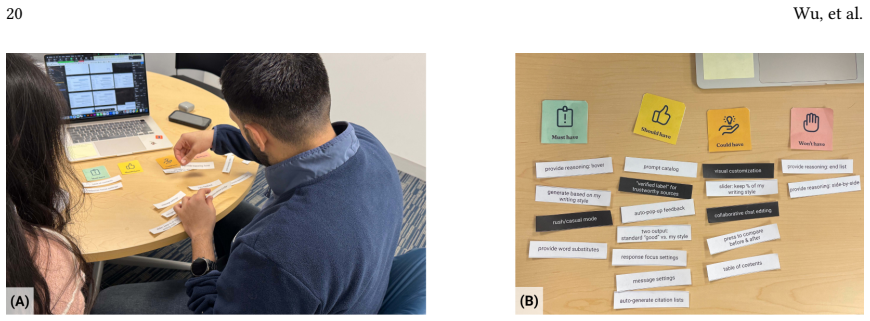
The central machinery is a four-quadrant writer-profile model built from two MBTI dimensions—Sensing/Intuition and Thinking/Feeling—that partitions writers into Analytical Thinkers, Creative Feelers, Practical Logicians, and Empathetic Sensors. Co-design workshops with 24 writers map each profile's desired functions, interaction dynamics, and visual representations; those maps are condensed into two contrasting high-fidelity prototypes, 'The Solution Master' (structured, efficiency-focused) and 'The Empowering Pal' (warm, flexible). A MoSCoW prioritization exercise with 8 participants scores feature importance per profile, and the preference ratings across prototypes supply the evidence that
Load-bearing premise
The study assumes that MBTI's Sensing/Intuition and Thinking/Feeling labels capture stable, writing-relevant cognitive styles, so that sorting writers into four quadrants creates groups whose differences in preference are genuinely caused by personality rather than by the sorting itself.
What would settle it
Re-run the prototype evaluation with writers grouped by Big Five traits or by measured writing-process behavior instead of MBTI self-report; if the same two prototypes are not differentially preferred, or if all profiles rate the two designs equally, the claimed personality-driven divergence collapses.
If this is right
- AI writing assistants should offer at least two distinct interaction modes—one task-oriented and transparent, one emotionally supportive and flexible—rather than a single default interface.
- Feature sets like response settings, revision reasoning, and citation lists will be valued more by some personality profiles and perceived as clutter by others, so progressive disclosure or widget-based customization is a natural next step.
- Matching a companion's tone, visual style, and proactive behavior to a writer's profile should increase engagement, trust, and perceived collaboration quality, though the paper does not directly measure writing outcomes.
- The two moderate profiles (Analytical Thinkers, Empathetic Sensors) suggest that many users will want hybrid or task-dependent switching between the two design philosophies.
- Using participatory co-design with personality-based grouping can surface design requirements that a generic usability study would miss.
Where Pith is reading between the lines
- A natural extension would be to replace MBTI labels with direct measures of cognitive style or Big Five traits and test whether the same prototype preferences replicate, which would separate personality effects from MBTI artifacts.
- The results imply that task context may matter as much as stable personality: the same writer may want a 'tool' for a routine revision and a 'friend' for an open-ended creative draft, so future systems could adapt dynamically within a session.
- If personality-aligned design changes perceived fluency and motivation as participants reported, a controlled study comparing matched vs. mismatched companions on measurable writing quality and completion time would be the decisive test.
- The divergence between Creative Feelers and Practical Logicians may extend beyond writing to other knowledge-work tools, suggesting a general design axis of supportive-empathic vs. structured-transparent AI collaboration.
Editorial analysis
A structured set of objections, weighed in public.
Referee Report
Summary. The paper reports a two-phase participatory design study on personality-aligned AI writing companions. Twenty-four writers, grouped into four MBTI-derived profiles (Analytical Thinkers, Creative Feelers, Practical Logicians, Empathetic Sensors), took part in co-design workshops that elicited desired functionalities, interaction dynamics, and visual representations (DQ1). The authors then built two contrasting Figma/web prototypes, "The Solution Master" (TSM) and "The Empowering Pal" (TEP), drawing features chiefly from the bipolar profiles, and evaluated them with eight participants from the original workshop using MoSCoW prioritization, comparative ratings, and qualitative feedback (DQ2). The paper claims a 'strong connection' between writer profiles and prototype/feature preferences, positioned as proof-of-concept for personality-driven divergence in AI writing support.
Significance. If the claim were fully supported, this would be a useful contribution to HCI research on human-AI teaming and personalization: it demonstrates a full co-design cycle from personality-based grouping to concrete, contrasting design artifacts, and it surfaces a feature set (e.g., reasoning transparency, emotional scale, revision tracking) that the field can build on. The qualitative divergences between Creative Feelers and Practical Logicians are credible and illustrate how the same AI capability can be valued or rejected depending on user expectations. The paper also deserves credit for being explicit about its exploratory proof-of-concept framing and for reporting its limitations (Section 8). However, the quantitative evidence is much weaker than the abstract claims, and the evaluation design has a potential self-endorsement confound that is not addressed. The empirical core is a useful design-space mapping rather than a validated demonstration of personality-driven preferences.
major comments (5)
- [Abstract; Section 6.2.3, Table 4] The abstract states 'strong connections between writer profiles and feature preferences' and Section 6.2.3 claims Table 4 'consistently revealed a strong connection.' The evidence is 8 participants (2 per profile), with no inferential test, no confidence intervals, and no effect-size measure. In Table 4, the pattern is clearest for Creative Feelers and Practical Logicians, while Analytical Thinkers split and Empathetic Sensors lean TSM while valuing both. This is at most suggestive. Please replace 'strong connection' with claim-appropriate language such as 'preliminary patterns' or 'qualitative divergence consistent with profiles,' and report the raw rankings and per-participant scores transparently.
- [Sections 5.1, 6.1, 6.2] The evaluation is contaminated by participant self-endorsement. The prototypes were built from features proposed in the co-design workshops (e.g., Section 5.1 states TSM is 'mainly informed by Practical Logicians' needs' and TEP by Creative Feelers' needs), and the eight evaluation participants are a subset of the same 24 workshop participants (Section 6.1, Appendix A). When P5 praises 'Visual customization' and P20 praises 'Provide reasoning,' they are recognizing features they or their profile-mates suggested earlier. The observed preference alignment could therefore reflect 'people like what they designed,' not a stable personality-driven divergence. This issue is not disclosed in Section 8. To salvage the central claim, the authors need either (a) an independent-sample replication, even small, with participants who did not contribute ideas, or (b) a re-framing of the contribution as
- [Section 6.2.1, Table 3] The MoSCoW scores are computed with hand-chosen weights (Must Have = 5, Should Have = 3, Could Have = 1, Won't Have = 0). The paper gives no justification for these weights and no robustness analysis. Given the small per-profile counts (n=2 per profile), small changes in weights can change the highlighted top features and the conclusions. Please show raw frequencies, report whether the top-feature sets are stable under alternative weightings (e.g., 4/3/2/0, or equal weights), and avoid treating the numerical scores as precise measurements.
- [Section 3.3, Table 1] The cross-validation of the MBTI-based grouping relies on correlations with Big Five dimensions in a sample of 24. Some correlations are substantial (e.g., E/I with Extraversion r=0.71, S/N with Openness r=0.67, T/F with Agreeableness r=-0.53), but the sample is small and the interpretation 'providing converging evidence' (Section 3.3) overstates the strength. The paper should acknowledge that these correlations themselves have wide uncertainty and that MBTI's dichotomous structure discards within-group variability. This concern is partially acknowledged in Section 8, but the abstract-level claim depends on the grouping being meaningful; please add a caveat in the results or a continuous Big Five sensitivity analysis if available.
- [Section 5.1; Section 6.2.3] The prototypes were deliberately built around the two bipolar profiles, with ideas from Analytical Thinkers and Empathetic Sensors 'carefully weighed' and assigned to one prototype. This makes the evaluation results for the middle groups hard to interpret: a mixed preference (e.g., P9 wanting to combine both; P15 saying choice depends on task) is as compatible with 'moderate groups straddle the design space' as with 'features chosen for them were arbitrary.' The paper should explicitly separate the bipolar-profile validation from the four-profile claim and note that the design of TSM/TEP does not provide a fair test for the two moderate profiles.
minor comments (5)
- [Section 3.3] Typo: 'MBTI-intiated' should be 'MBTI-initiated'.
- [Section 5.3.1] The text says 'displaying the full range of features outlined in Table 1' but the feature list is Table 2; please fix the cross-reference.
- [Section 6.1] The MoSCoW acronym is defined as 'Must Have (Mo), Should Have (S), Could Have (Co), and Won't Have (W)' but the table uses 'Won't Have' as W; the hyphenation and capitalization should be consistent.
- [Section 2.3] The participatory design literature is presented briefly; it would help to state explicitly how the workshops' group size (same-profile triads) supports the claimed 'rich discussion' and whether within-profile homogeneity was verified.
- [Section 6.2.3] Table 4's 'Experiencing & Choice' row mixes factual choices with the 'Preferred version' row; consider separating quantitative scores from qualitative choices for readability, and add participant-level detail so the n=2 per profile is visible.
Circularity Check
Prototype evaluation reuses the same participants whose co-design ideas built the prototypes, so the reported profile–preference link partly reduces to self-endorsement.
specific steps
-
fitted input called prediction
[Section 5.1 (Prototype Feature Selection); Section 6 (Review and Refinement Workshop); Table 4; Abstract]
"we consolidated the four profile probes into a bipolar model: “The Solution Master” (TSM) focuses on efficiency and structured reasoning that mainly informed by Practical Logicians’ needs, and “The Empowering Pal” (TEP) promotes emotional connection and flexibility that mainly grounded in Creative Feelers’ needs. ... Eight participants were invited from the previous workshop, with two representatives from each of the four writer profiles (4×2)."
The prototypes are constructed from features proposed by the profile groups in the first workshop: TEP contains Visual Customization, Rush/Casual Mode, Emotional Scale, and Chat Organization—features first articulated by Creative Feelers—while TSM contains Response Settings, Provide Reasoning, Table of Contents, and Compare Before & After, requested by Practical Logicians and Sensing profiles. The evaluators are a subset of the same 24 participants, so they are rating systems assembled from their own previously stated preferences. The abstract's 'strong connections between writer profiles and feature preferences' is therefore substantially a re-description of the construction: each profile endorses the prototype built from its own suggestions. This is analogous to fitting a model on traini
full rationale
The central claim that personality drives divergent preferences for AI writing companions is supported mainly by the second workshop, in which participants rated prototypes that had been built from the first workshop's co-design ideas. Since the evaluators were drawn from the same 24 participants who proposed those ideas, the profile-preference alignment in Tables 3 and 4 is largely a self-endorsement effect: Creative Feelers prefer TEP because TEP contains Creative Feelers' own suggested features, and Practical Logicians prefer TSM for the same reason. This is a genuine methodological circularity in the evidence chain, though not a formal logical equivalence: the researchers did synthesize and choose among features, and participants could have rejected prototypes, so some independent judgment remains. The paper acknowledges the small evaluation sample but does not address the same-participant confound; future work with a fresh sample would be needed to break the loop. The MBTI assumptions are a validity concern, not circularity. The one self-citation ([97]) is not load-bearing. Overall, the 'proof-of-concept' claim partially reduces to its own construction, warranting a score of 6.
Axiom & Free-Parameter Ledger
free parameters (1)
- MoSCoW category weights =
5/3/1/0
axioms (4)
- domain assumption MBTI S/N and T/F dichotomies capture writing-relevant cognitive styles and can group writers into four profiles.
- domain assumption The four writer profiles are internally homogeneous and stable enough that two representatives can stand in for each group in the evaluation.
- ad hoc to paper Big Five correlations in a sample of 24 provide sufficient cross-validation of the MBTI-based grouping.
- domain assumption Self-reported feature preferences and workshop discussions reflect genuine needs rather than demand characteristics.
read the original abstract
The growing popularity of AI writing assistants presents exciting opportunities to craft tools that cater to diverse user needs. This study explores how personality shapes preferences for AI writing companions and how personalized designs can enhance human-AI teaming. In an exploratory co-design workshop, we worked with 24 writers with different profiles to surface ideas and map the design space for personality-aligned AI writing companions, focusing on functionality, interaction dynamics, and visual representations. Building on these insights, we developed two contrasting prototypes tailored to distinct writer profiles and engaged 8 participants with them as provocations to spark reflection and feedback. The results revealed strong connections between writer profiles and feature preferences, providing proof-of-concept for personality-driven divergence in AI writing support. This research highlights the critical role of team match in human-AI collaboration and underscores the importance of aligning AI systems with individual cognitive needs to improve user engagement and collaboration productivity.
Figures


Reference graph
Works this paper leans on
-
[1]
The Myers-Briggs Company 2025
2025. The Myers-Briggs Company 2025. https://www.themyersbriggs.com/
2025
-
[2]
Philip Achimugu, Ali Selamat, Roliana Ibrahim, and Mohd Naz’ri Mahrin. 2014. A systematic literature review of software requirements prioritization research.Information and software technology56, 6 (2014), 568–585
2014
-
[3]
Robert W Andrews, J Mason Lilly, Divya Srivastava, and Karen M Feigh. 2023. The role of shared mental models in human-AI teams: a theoretical review.Theoretical Issues in Ergonomics Science24, 2 (2023), 129–175
2023
-
[4]
Hassan Banaruee, Hooshang Khoshsima, and Afsane Askari. 2017. Corrective Feedback and Personality Type: A Case Study of Iranian L2 Learners. Global Journal of Educational Studies3, 2 (2017), 14–21
2017
-
[5]
Murray R. Barrick, Greg L. Stewart, Mitchell J. Neubert, and Michael K. Mount. 1998. Relating member ability and personality to work-team processes and team effectiveness.Journal of Applied Psychology83, 3 (1998), 377–391. doi:10.1037/0021-9010.83.3.377
-
[6]
Russell W Belk. 1988. Possessions and the extended self.Journal of consumer research15, 2 (1988), 139–168
1988
-
[7]
Oloff C Biermann, Ning F Ma, and Dongwook Yoon. 2022. From tool to companion: Storywriters want AI writers to respect their personal values and writing strategies. InProceedings of the 2022 ACM Designing Interactive Systems Conference. 1209–1227
2022
-
[8]
Kirsten Boehner, Janet Vertesi, Phoebe Sengers, and Paul Dourish. 2007. How HCI interprets the probes. InProceedings of the SIGCHI conference on Human factors in computing systems. 1077–1086
2007
-
[9]
Tone Bratteteig and Ina Wagner. 2016. Unpacking the notion of participation in participatory design.Computer Supported Cooperative Work (CSCW)25 (2016), 425–475
2016
-
[10]
Tools or Friends?
Virginia Braun and Victoria Clarke. 2024. Thematic analysis. InEncyclopedia of quality of life and well-being research. Springer, 7187–7193. Manuscript submitted to ACM “Tools or Friends?” Personality-Aligned Writing Companions 27
2024
-
[11]
Roger Bruning, Michael Dempsey, Douglas F Kauffman, Courtney McKim, and Sharon Zumbrunn. 2013. Examining dimensions of self-efficacy for writing.Journal of educational psychology105, 1 (2013), 25
2013
-
[12]
Roger Bruning and Christy Horn. 2000. Developing motivation to write.Educational psychologist35, 1 (2000), 25–37
2000
-
[13]
Cindy Chung and James Pennebaker. 2011. The psychological functions of function words. InSocial communication. Psychology Press, 343–359
2011
-
[14]
Elizabeth Clark, Anne Spencer Ross, Chenhao Tan, Yangfeng Ji, and Noah A Smith. 2018. Creative writing with a machine in the loop: Case studies on slogans and stories. InProceedings of the 23rd International Conference on Intelligent User Interfaces. 329–340
2018
-
[15]
Hai Dang, Karim Benharrak, Florian Lehmann, and Daniel Buschek. 2022. Beyond text generation: Supporting writers with continuous automatic text summaries. InProceedings of the 35th Annual ACM Symposium on User Interface Software and Technology. 1–13
2022
-
[16]
2000.The big five personality factors: the psycholexical approach to personality.Hogrefe & Huber Publishers
Boele De Raad. 2000.The big five personality factors: the psycholexical approach to personality.Hogrefe & Huber Publishers
2000
-
[17]
Paul Deane, Nora Odendahl, Thomas Quinlan, Mary Fowles, Cyndi Welsh, and Jennifer Bivens-Tatum. 2008. Cognitive models of writing: Writing proficiency as a complex integrated skill.ETS Research Report Series2008, 2 (2008), i–36
2008
-
[18]
Fernando Delgado, Stephen Yang, Michael Madaio, and Qian Yang. 2023. The participatory turn in ai design: Theoretical foundations and the current state of practice. InProceedings of the 3rd ACM Conference on Equity and Access in Algorithms, Mechanisms, and Optimization. 1–23
2023
-
[19]
Zijian Ding and Joel Chan. 2023. Mapping the Design Space of Interactions in Human-AI Text Co-creation Tasks.arXiv preprint arXiv:2303.06430 (2023)
Pith/arXiv arXiv 2023
-
[20]
Helga Dittmar. 1991. Meanings of material possessions as reflections of identity: Gender and social-marterial position in society.Journal of Social Behavior and Personality6, 6 (1991), 165
1991
-
[21]
Ann Hill Duin, Isabel Pedersen, Jim Hall, Dan Card, and Lee-Ann Kastman Breuch. 2023. Co-AI Technical Writing: Documentation, Experimentation, User Testing, & Ethical Design. In2023 IEEE International Professional Communication Conference (ProComm). IEEE, 41–43
2023
-
[22]
Essaid El Bachari, El Hassan Abelwahed, and Mohammed El Adnani. 2012. An adaptive teaching strategy model in e-learning using learners’ preference: LearnFit framework.International Journal of Web Science 31, 3 (2012), 257–274
2012
-
[23]
Aidan Z Fitzsimons. 2024. Overcoming challenges to personal narrative co-writing with AI: A participatory design approach for under-resourced high school students and those that support them. InProceedings of the 16th Conference on Creativity & Cognition. 17–20
2024
-
[24]
Linda Flower and John R Hayes. 1981. A cognitive process theory of writing.College Composition & Communication32, 4 (1981), 365–387
1981
-
[25]
David C Funder. 2012. Accurate personality judgment.Current Directions in Psychological Science21, 3 (2012), 177–182
2012
-
[26]
Lita Furby. 1978. Possession in humans: An exploratory study of its meaning and motivation.Social Behavior and Personality: an international journal6, 1 (1978), 49–65
1978
-
[27]
Adrian Furnham. 1996. The big five versus the big four: the relationship between the Myers-Briggs Type Indicator (MBTI) and NEO-PI five factor model of personality.Personality and individual differences21, 2 (1996), 303–307
1996
-
[28]
Richard P Gabriel, Jilin Chen, and Jeffrey Nichols. 2015. InkWell: A Creative Writer’s Creative Assistant. InProceedings of the 2015 ACM SIGCHI Conference on Creativity and Cognition. 93–102
2015
-
[29]
Jianfeng Gao, Michel Galley, and Lihong Li. 2018. Neural approaches to conversational AI. InThe 41st international ACM SIGIR conference on research & development in information retrieval. 1371–1374
2018
-
[30]
John Maurice Gayed, May Kristine Jonson Carlon, Angelu Mari Oriola, and Jeffrey S Cross. 2022. Exploring an AI-based writing Assistant’s impact on English language learners.Computers and Education: Artificial Intelligence3 (2022), 100055
2022
-
[31]
Katy Ilonka Gero and Lydia B Chilton. 2019. Metaphoria: An algorithmic companion for metaphor creation. InProceedings of the 2019 CHI conference on human factors in computing systems. 1–12
2019
-
[32]
Katy Ilonka Gero, Vivian Liu, and Lydia Chilton. 2022. Sparks: Inspiration for science writing using language models. InProceedings of the 2022 ACM Designing Interactive Systems Conference. 1002–1019
2022
-
[33]
Stephen D Gladis. 1993. Are you the write type?Training & Development47, 7 (1993), 32–37
1993
-
[34]
Tanya Goyal, Junyi Jessy Li, and Greg Durrett. 2022. News summarization and evaluation in the era of gpt-3.arXiv preprint arXiv:2209.12356(2022)
Pith/arXiv arXiv 2022
-
[35]
Connor Graham and Mark Rouncefield. 2008. Probes and participation. InProceedings of the Tenth Anniversary Conference on Participatory Design
2008
-
[36]
Big Five
Robert J Harvey, William D Murry, and Steven E Markham. 1995. A “Big Five” scoring system for the Myers-Briggs type indicator. Inannual conference of the Society for Industrial and Organizational Psychology, Orlando, FL
1995
-
[37]
Tung-hsien He. 2019. Personality facets, writing strategy use, and writing performance of college students learning English as a foreign language. Sage Open9, 3 (2019), 2158244019861483
2019
-
[38]
Fred Hohman, Andrew Head, Rich Caruana, Robert DeLine, and Steven M Drucker. 2019. Gamut: A design probe to understand how data scientists understand machine learning models. InProceedings of the 2019 CHI conference on human factors in computing systems. 1–13
2019
-
[39]
Yi-Ching Huang, Yu-Ting Cheng, Lin-Lin Chen, and Jane Yung-jen Hsu. 2019. Human-AI Co-learning for data-driven AI.arXiv preprint arXiv:1910.12544(2019)
Pith/arXiv arXiv 2019
-
[40]
Michael Ivanov and Paul D Werner. 2010. Behavioral communication: Individual differences in communication style.Personality and Individual Differences49, 1 (2010), 19–23
2010
-
[41]
Maurice Jakesch, Advait Bhat, Daniel Buschek, Lior Zalmanson, and Mor Naaman. 2023. Co-writing with opinionated language models affects users’ views. InProceedings of the 2023 CHI conference on human factors in computing systems. 1–15. Manuscript submitted to ACM 28 Wu, et al
2023
-
[42]
George H Jensen and John K DiTiberio. 1984. Personality and individual writing processes.College Composition & Communication35, 3 (1984), 285–300
1984
-
[43]
Matthew Jörke, Yasaman S Sefidgar, Talie Massachi, Jina Suh, and Gonzalo Ramos. 2023. Pearl: A technology probe for machine-assisted reflection on personal data. InProceedings of the 28th International Conference on Intelligent User Interfaces. 902–918
2023
-
[44]
2016.Psychological types
Carl Jung and John Beebe. 2016.Psychological types. Routledge
2016
-
[45]
Melissa A Kacena, Lilian I Plotkin, and Jill C Fehrenbacher. 2024. The use of artificial intelligence in writing scientific review articles.Current Osteoporosis Reports22, 1 (2024), 115–121
2024
-
[46]
Arja Kangasharju, Liisa Ilomäki, Minna Lakkala, and Auli Toom. 2022. Lower secondary students’ poetry writing with the AI-based poetry machine. Computers and Education: Artificial Intelligence3 (2022), 100048
2022
-
[47]
Robert B Kaplan. 1966. Cultural thought patterns in inter-cultural education.Language learning16, 1 (1966)
1966
-
[48]
Ronit Kark and Abraham Carmeli. 2009. Alive and creating: The mediating role of vitality and aliveness in the relationship between psychological safety and creative work involvement.Journal of Organizational Behavior: The International Journal of Industrial, Occupational and Organizational Psychology and Behavior30, 6 (2009), 785–804
2009
-
[49]
Finn Kensing and Jeanette Blomberg. 1998. Participatory design: Issues and concerns.Computer supported cooperative work (CSCW)7 (1998), 167–185
1998
-
[50]
Dongwhan Kim and Joonhwan Lee. 2019. Designing an algorithm-driven text generation system for personalized and interactive news reading. International Journal of Human–Computer Interaction35, 2 (2019), 109–122
2019
-
[51]
Jinhee Kim, Hyunkyung Lee, and Young Hoan Cho. 2022. Learning design to support student-AI collaboration: Perspectives of leading teachers for AI in education.Education and Information Technologies27, 5 (2022), 6069–6104
2022
-
[52]
Tatiana Kravchenko, Tatiana Bogdanova, and Timofey Shevgunov. 2022. Ranking requirements using MoSCoW methodology in practice. In Computer Science On-line Conference. Springer, 188–199
2022
-
[53]
Sandra Krebs Hirsh and Jean M Kummerow. 1998. Introduction to type in organizations.Edmonton, AB: CPP(1998)
1998
-
[54]
Albrecht CP Küfner, Mitja D Back, Steffen Nestler, and Boris Egloff. 2010. Tell me a story and I will tell you who you are! Lens model analyses of personality and creative writing.Journal of Research in Personality44, 4 (2010), 427–435
2010
-
[55]
1993.People types & tiger stripes
Gordon D Lawrence. 1993.People types & tiger stripes. ERIC
1993
-
[56]
2013.The science of writing: Theories, methods, individual differences and applications
C Michael Levy and Sarah Ransdell. 2013.The science of writing: Theories, methods, individual differences and applications. Routledge
2013
-
[57]
Claire Liang, Julia Proft, Erik Andersen, and Ross A Knepper. 2019. Implicit communication of actionable information in human-ai teams. In Proceedings of the 2019 CHI conference on human factors in computing systems. 1–13
2019
-
[58]
Zhicheng Lin. 2023. Why and how to embrace AI such as ChatGPT in your academic life.Royal Society open science10, 8 (2023), 230658
2023
-
[59]
Yihe Liu, Anushk Mittal, Diyi Yang, and Amy Bruckman. 2022. Will AI console me when I lose my pet? Understanding perceptions of AI-mediated email writing. InProceedings of the 2022 CHI conference on human factors in computing systems. 1–13
2022
-
[60]
Andrés Lucero. 2012. Framing, aligning, paradoxing, abstracting, and directing: how design mood boards work. InProceedings of the designing interactive systems conference. 438–447
2012
-
[61]
Fahimeh Marefat. 2006. Student Writing, Personality Type of the Student and the Rater: Any Interrelationship?The Reading Matrix6 (2006), 116–124
2006
-
[62]
Deborah McCutchen. 2000. Knowledge, processing, and working memory: Implications for a theory of writing.Educational psychologist35, 1 (2000), 13–23
2000
-
[63]
Piotr Mirowski, Kory W Mathewson, Jaylen Pittman, and Richard Evans. 2023. Co-writing screenplays and theatre scripts with language models: Evaluation by industry professionals. InProceedings of the 2023 CHI conference on human factors in computing systems. 1–34
2023
-
[64]
Max Murphy. 2024. Artificial intelligence and personality: Large language models’ ability to predict personality type.Emerging Media2, 2 (2024), 311–324
2024
-
[65]
2003.MBTI manual: A guide to the development and use of the Myers-Briggs Type Indicator
Isabel Briggs Myers. 2003.MBTI manual: A guide to the development and use of the Myers-Briggs Type Indicator. CPP
2003
-
[66]
Justin Nicholes. 2017. Measuring ownership of creative versus academic writing: Implications for interdisciplinary praxis.Writing in Practice3 (2017)
2017
-
[67]
Haekyu Park, Gonzalo Ramos, Jina Suh, Christopher Meek, Rachel Ng, and Mary Czerwinski. 2023. FoundWright: A System to Help People Re-find Pages from Their Web-history.arXiv preprint arXiv:2305.07930(2023)
Pith/arXiv arXiv 2023
-
[68]
Sun Young Park, Pei-Yi Kuo, Andrea Barbarin, Elizabeth Kaziunas, Astrid Chow, Karandeep Singh, Lauren Wilcox, and Walter S Lasecki. 2019. Identifying challenges and opportunities in human-AI collaboration in healthcare. InCompanion Publication of the 2019 Conference on Computer Supported Cooperative Work and Social Computing. 506–510
2019
-
[69]
Miranda A.G. Peeters, Harrie F.J.M. Van Tuijl, Christel G. Rutte, and Isabelle M.M.J. Reymen. 2006. Personality and team performance: A meta-analysis.European Journal of Personality20, 5 (2006), 377–396. doi:10.1002/per.588
doi:10.1002/per.588 2006
-
[70]
James W Pennebaker and Laura A King. 1999. Linguistic styles: language use as an individual difference.Journal of personality and social psychology 77, 6 (1999), 1296
1999
-
[71]
Tools or Friends?
David J Pittenger. 2005. Cautionary comments regarding the Myers-Briggs type indicator.Consulting Psychology Journal: Practice and Research57, 3 (2005), 210. Manuscript submitted to ACM “Tools or Friends?” Personality-Aligned Writing Companions 29
2005
-
[72]
Beatrice Rammstedt and Oliver P John. 2007. Measuring personality in one minute or less: A 10-item short version of the Big Five Inventory in English and German.Journal of research in Personality41, 1 (2007), 203–212
2007
-
[73]
Mohi Reza, Jeb Thomas-Mitchell, Peter Dushniku, Nathan Laundry, Joseph Jay Williams, and Anastasia Kuzminykh. 2025. Co-Writing with AI, on Human Terms: Aligning Research with User Demands Across the Writing Process.arXiv preprint arXiv:2504.12488(2025)
Pith/arXiv arXiv 2025
-
[74]
Jeba Rezwana and Mary Lou Maher. 2022. Understanding user perceptions, collaborative experience and user engagement in different human-AI interaction designs for co-creative systems. InProceedings of the 14th Conference on Creativity and Cognition. 38–48
2022
-
[75]
Eduardo Salas, Nancy J Cooke, and Michael A Rosen. 2008. On teams, teamwork, and team performance: Discoveries and developments.Human factors50, 3 (2008), 540–547
2008
-
[76]
Alireza Salemi, Sheshera Mysore, Michael Bendersky, and Hamed Zamani. 2023. Lamp: When large language models meet personalization.arXiv preprint arXiv:2304.11406(2023)
Pith/arXiv arXiv 2023
-
[77]
Elizabeth B-N Sanders. 2002. From user-centered to participatory design approaches. InDesign and the social sciences. CRC Press, 18–25
2002
-
[78]
Elizabeth B-N Sanders and Pieter Jan Stappers. 2008. Co-creation and the new landscapes of design.Co-design4, 1 (2008), 5–18
2008
-
[79]
1993.Participatory design: Principles and practices
Douglas Schuler and Aki Namioka. 1993.Participatory design: Principles and practices. CRC press
1993
-
[80]
Iulian Serban, Alessandro Sordoni, Ryan Lowe, Laurent Charlin, Joelle Pineau, Aaron Courville, and Yoshua Bengio. 2017. A hierarchical latent variable encoder-decoder model for generating dialogues. InProceedings of the AAAI conference on artificial intelligence, Vol. 31. 3295–3301
2017
discussion (0)
Sign in with ORCID, Apple, or X to comment. Anyone can read and Pith papers without signing in.