Cryptanalysis and design for a family of plaintext-non-delayed chaotic ciphers
Pith reviewed 2026-05-18 17:03 UTC · model grok-4.3
The pith
Statistical tests are not enough to secure plaintext-non-delayed chaotic ciphers.
A machine-rendered reading of the paper's core claim, the machinery that carries it, and where it could break.
Core claim
The chain attack breaks a class of multi-stage PNDCCs because, once a consistent decryption chain is reconstructed, all permutations become known; the entire diffusion process then reduces to solving a system of simultaneous equations.
What carries the argument
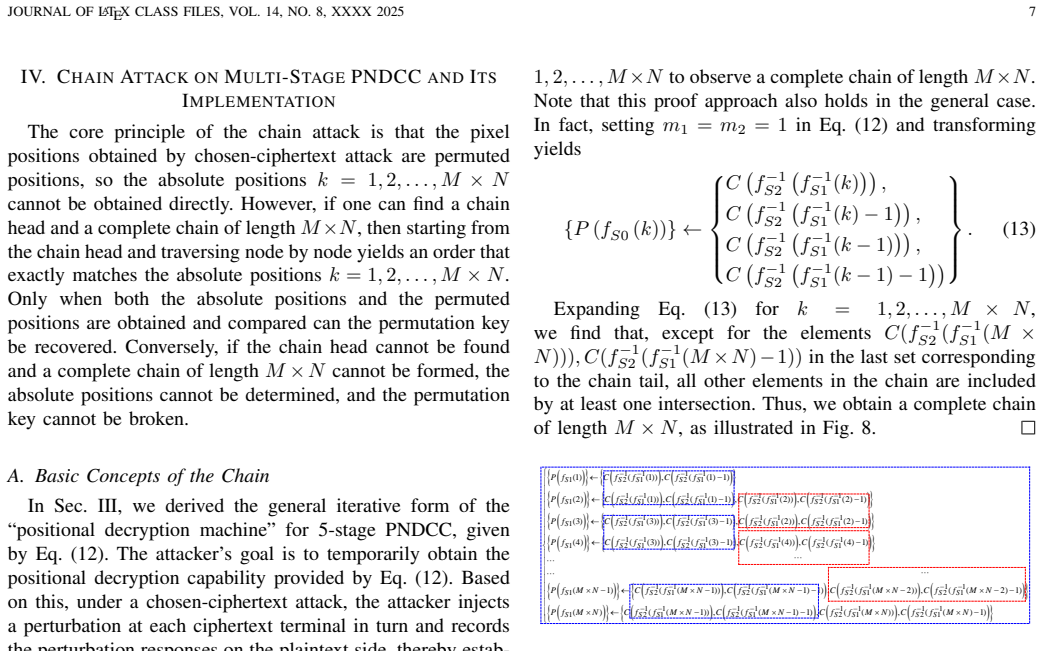
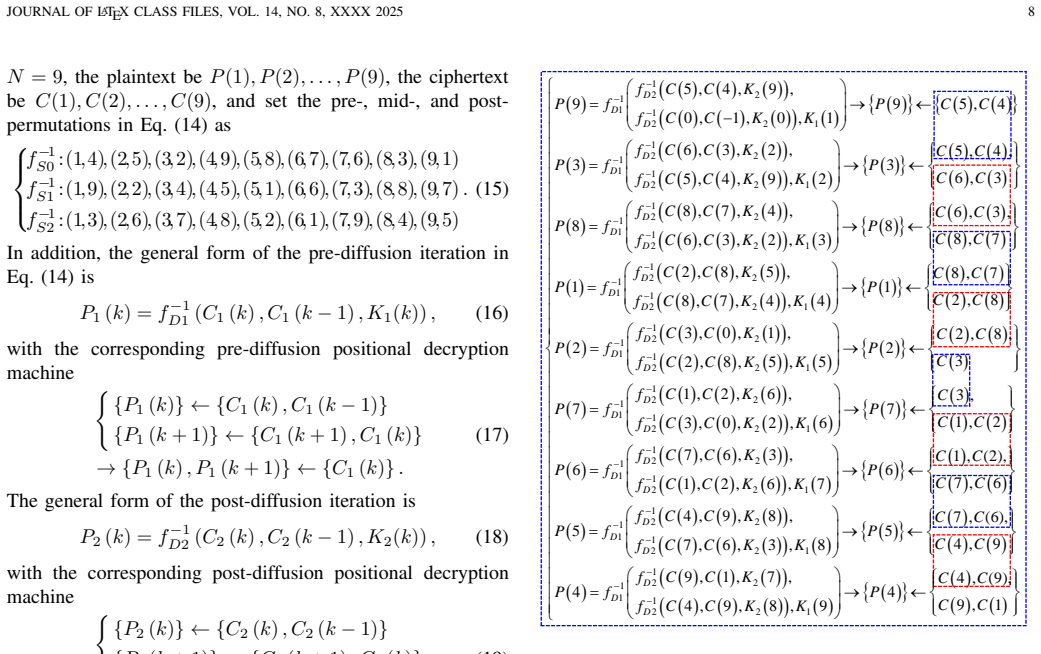
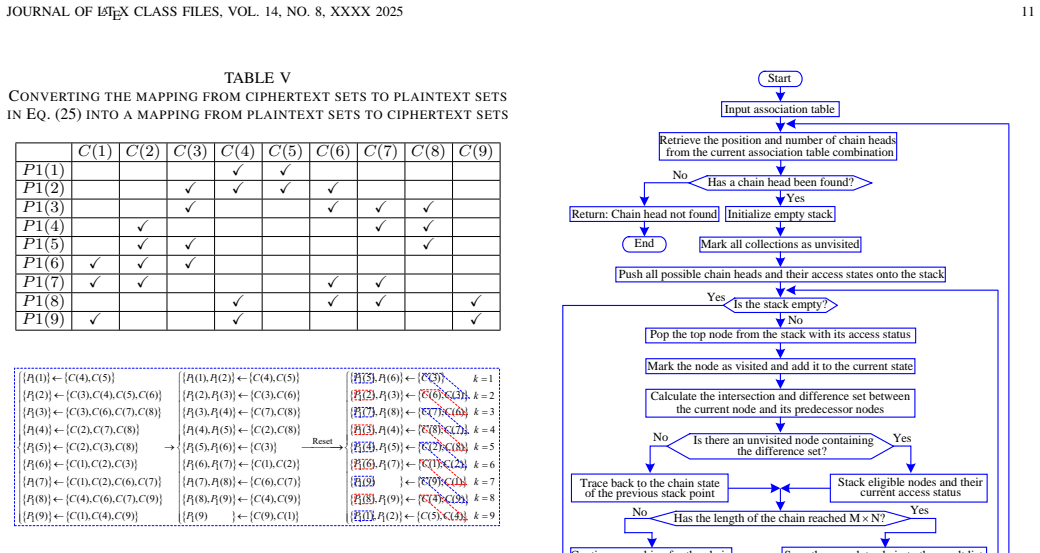
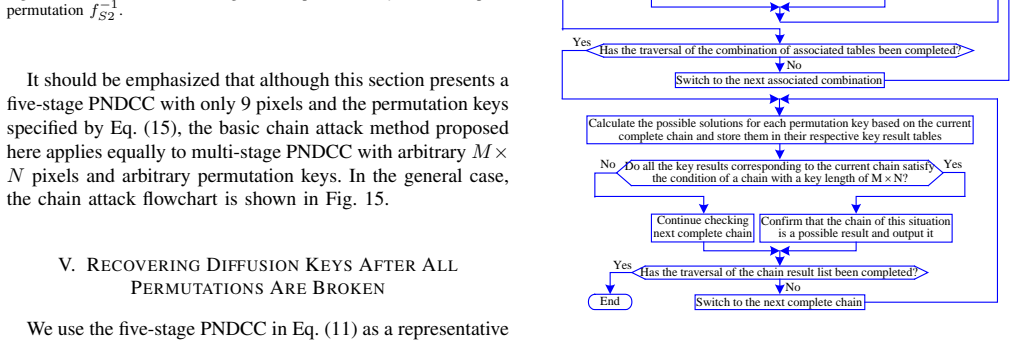
The chain attack, which recovers every permutation by applying summarized chaining rules to a consistent decryption chain.
Load-bearing premise
The mathematical model of multi-stage PNDCC and the chaining rules let an attacker reconstruct all permutations whenever a consistent decryption chain exists.
What would settle it
A concrete multi-stage PNDCC for which no consistent decryption chain exists or for which the resulting linear system remains unsolvable after any attempted chain reconstruction.
Figures




read the original abstract
Plaintext non-delayed chaotic cipher (PNDCC) means that in the diffusion equation, plaintext has no delay terms while ciphertext has a feedback term. In existing literature, chaotic cipher diffusions invariably take this form. Since its introduction, PNDCC has attracted attention but also doubts. Designers of chaotic ciphers usually claim PNDCC security by statistical tests, while rigorous cryptographic proofs are absent. Thus, it is necessary to re-examine its design rationale and empirical security. To address this issue, we present a typical example of a three-stage permutation-diffusion-permutation PNDCC, which contains multiple security vulnerabilities. Although all of its statistical indicators show good performance, we are able to break it using four different attacks. The first is a differential attack based on homogeneous operations; the second is an S-PTC attack; the third is a novel impulse-step-based differential attack (ISBDA), proposed in this paper, and the fourth is a novel chain attack, also introduced here. These results demonstrate that the fulfilment of statistical criteria is not a sufficient condition for the security of PNDCC. Then, based on a mathematical model of multi-stage PNDCC, we show that the proposed chain attack can successfully break a class of multi-stage PNDCCs. The key technique of the chain attack depends on how to reveal all permutations. To address this key problem, we summarize the chaining rules and show that, from the attacker's perspective, if the same decryption chain can be reconstructed then all permutations can be deciphered. To that end, the entire diffusion process can be broken by solving a system of simultaneous equations. Finally, as a secure improvement, we propose a new scheme termed plaintext-delayed chaotic cipher (PDCC) that can resist various cryptanalytic attacks.
Editorial analysis
A structured set of objections, weighed in public.
Referee Report
Summary. The paper examines plaintext-non-delayed chaotic ciphers (PNDCC), presents a three-stage permutation-diffusion-permutation example that passes statistical tests yet is broken by four attacks (differential, S-PTC, novel impulse-step-based differential attack, and novel chain attack), generalizes the chain attack to a class of multi-stage PNDCCs via a mathematical model and summarized chaining rules that reconstruct permutations from consistent decryption chains before solving a system of equations for the diffusion, and proposes a plaintext-delayed chaotic cipher (PDCC) as an improved design resistant to such attacks.
Significance. If the attacks and generalization hold, the work demonstrates that statistical criteria are insufficient for security in chaotic ciphers, provides concrete cryptanalytic techniques including two novel ones, and offers a design alternative; this contributes to the field by supplying falsifiable attacks on a common diffusion form and machine-checkable reconstruction rules in the chain attack.
major comments (3)
- [Abstract] Abstract, paragraph on chain attack generalization: The central claim that the chain attack breaks a class of multi-stage PNDCCs rests on the mathematical model and summarized chaining rules enabling reconstruction of all permutations from any consistent decryption chain. The manuscript must supply the explicit mathematical statements of these chaining rules (including how they apply for arbitrary permutation families and key sizes) and verify that the reconstruction step succeeds without additional attacker knowledge; otherwise the subsequent system-of-equations recovery of the diffusion does not apply to the claimed class.
- [Three-stage example] Section describing the three-stage example and attacks: The four attacks (including the novel ISBDA and chain attack) are asserted to break the cipher despite good statistical performance, but the manuscript should include concrete verification such as recovered key sizes, success probabilities, or the explicit system of equations solved in the chain attack to confirm full key recovery rather than theoretical vulnerabilities only.
- [PDCC proposal] Section on the proposed PDCC improvement: The security claims for the plaintext-delayed chaotic cipher must be supported by analysis showing resistance to the differential, S-PTC, ISBDA, and chain attacks presented earlier; without this, the improvement remains unverified against the paper's own attack techniques.
minor comments (2)
- [Mathematical model] Notation: Ensure consistent definition and use of terms such as 'chaining rules' and 'decryption chain' when first introduced in the mathematical model section.
- [Introduction] References: Add citations to prior work on chaotic cipher cryptanalysis to better situate the novel ISBDA and chain attack relative to existing differential and algebraic attacks.
Simulated Author's Rebuttal
We thank the referee for the careful reading and constructive major comments. We respond to each point below and indicate planned revisions to strengthen the presentation of the attacks and the PDCC proposal.
read point-by-point responses
-
Referee: [Abstract] Abstract, paragraph on chain attack generalization: The central claim that the chain attack breaks a class of multi-stage PNDCCs rests on the mathematical model and summarized chaining rules enabling reconstruction of all permutations from any consistent decryption chain. The manuscript must supply the explicit mathematical statements of these chaining rules (including how they apply for arbitrary permutation families and key sizes) and verify that the reconstruction step succeeds without additional attacker knowledge; otherwise the subsequent system-of-equations recovery of the diffusion does not apply to the claimed class.
Authors: We agree that the abstract and the generalization section would benefit from more explicit statements. In the revised manuscript we will insert the full mathematical formulation of the chaining rules, including their precise application to arbitrary permutation families and key sizes, together with a short verification argument showing that any consistent decryption chain suffices for permutation reconstruction without further attacker knowledge. revision: yes
-
Referee: [Three-stage example] Section describing the three-stage example and attacks: The four attacks (including the novel ISBDA and chain attack) are asserted to break the cipher despite good statistical performance, but the manuscript should include concrete verification such as recovered key sizes, success probabilities, or the explicit system of equations solved in the chain attack to confirm full key recovery rather than theoretical vulnerabilities only.
Authors: The current text presents the attacks through their mathematical derivations. To supply the requested concrete verification we will add, in the revised version, an explicit system of equations for the chain attack on the three-stage example, together with numerical results on recovered key sizes and observed success probabilities obtained from our simulations. revision: yes
-
Referee: [PDCC proposal] Section on the proposed PDCC improvement: The security claims for the plaintext-delayed chaotic cipher must be supported by analysis showing resistance to the differential, S-PTC, ISBDA, and chain attacks presented earlier; without this, the improvement remains unverified against the paper's own attack techniques.
Authors: We accept that a targeted resistance analysis is necessary. In the revised manuscript we will add a dedicated subsection that examines the PDCC against each of the four attacks, showing how the plaintext-delay term prevents the homogeneous differential relations, disrupts the S-PTC structure, invalidates the impulse-step assumptions of ISBDA, and breaks the formation of consistent decryption chains required by the chain attack. revision: yes
Circularity Check
No significant circularity: attack reduces to cipher equations and observed chaining rules
full rationale
The paper presents cryptanalytic attacks on PNDCC constructions, including a chain attack that reconstructs permutations via summarized chaining rules derived from the multi-stage model and then solves the resulting system of equations taken directly from the diffusion definition. These steps are not equivalent to their inputs by construction; the rules and equations originate from the cipher specification and attacker observations rather than from any fitted parameter or self-referential definition. No load-bearing self-citation, uniqueness theorem, or ansatz smuggling is present in the provided derivation. The statistical-test critique is independent of the attack success. The work is therefore self-contained against external benchmarks.
Axiom & Free-Parameter Ledger
axioms (2)
- domain assumption The diffusion equation takes the standard plaintext-non-delayed form with ciphertext feedback but no plaintext delay.
- ad hoc to paper The chaining rules derived from the attacker's perspective allow reconstruction of all permutations when a consistent decryption chain exists.
Lean theorems connected to this paper
-
IndisputableMonolith/Cost/FunctionalEquation.leanwashburn_uniqueness_aczel unclear?
unclearRelation between the paper passage and the cited Recognition theorem.
the diffusion equation is given by C(k) = mod(P(k)−C(k−1)−K(k),256)
What do these tags mean?
- matches
- The paper's claim is directly supported by a theorem in the formal canon.
- supports
- The theorem supports part of the paper's argument, but the paper may add assumptions or extra steps.
- extends
- The paper goes beyond the formal theorem; the theorem is a base layer rather than the whole result.
- uses
- The paper appears to rely on the theorem as machinery.
- contradicts
- The paper's claim conflicts with a theorem or certificate in the canon.
- unclear
- Pith found a possible connection, but the passage is too broad, indirect, or ambiguous to say the theorem truly supports the claim.
Reference graph
Works this paper leans on
-
[1]
A VPMIR: Adaptive verifiable privacy-preserving medical image retrieval,
D. Li, Q. L ¨u, X. Liao, T. Xiang, J. Wu, and J. Le, “A VPMIR: Adaptive verifiable privacy-preserving medical image retrieval,”IEEE Trans. Dependable Secure Comput., vol. 21, no. 5, pp. 4637–4651, Sept.–Oct. 2024, doi: 10.1109/TDSC.2024.3355223
-
[2]
Applying chaos theory for runtime hardware Trojan monitoring and detection,
H. Zhao, L. Kwiat, K. A. Kwiat, C. A. Kamhoua, and L. Njilla, “Applying chaos theory for runtime hardware Trojan monitoring and detection,”IEEE Trans. Dependable Secure Comput., vol. 17, no. 4, pp. 716–729, July–Aug. 2020, doi: 10.1109/TDSC.2018.2864733
-
[3]
S. Chatterjee, S. Roy, A. K. Das, S. Chattopadhyay, N. Kumar, and A. V . Vasilakos, “Secure biometric-based authentication scheme using Chebyshev chaotic map for multi-server environment,”IEEE Trans. Dependable Secure Comput., vol. 15, no. 5, pp. 824–839, Sept.–Oct. 2018, doi: 10.1109/TDSC.2016.2616876
-
[4]
S. Qiu, D. Wang, G. Xu, and S. Kumari, “Practical and provably secure three-factor authentication protocol based on extended chaotic- maps for mobile lightweight devices,”IEEE Trans. Dependable Se- cure Comput., vol. 19, no. 2, pp. 1338–1351, Mar.–Apr. 2022, doi: 10.1109/TDSC.2020.3022797
-
[5]
J. Peng, Y . Jiang, S. Tang, and F. Meziane, “Security of streaming media communications with logistic map and self-adaptive detection-based steganography,”IEEE Trans. Dependable Secure Comput., vol. 18, no. 4, pp. 1962–1973, July–Aug. 2021, doi: 10.1109/TDSC.2019.2946138
-
[6]
M. A. Al-Shareeda, T. Gaber, M. A. Alqarni, M. H. Alkinani, A. A. Almazroey, and A. A. Almazroi, “Chebyshev polynomial based emer- gency conditions with authentication scheme for 5G-assisted vehicular fog computing,”IEEE Trans. Dependable Secure Comput., early access, doi: 10.1109/TDSC.2025.3553868
-
[7]
J. Srinivas, A. K. Das, M. Wazid, and N. Kumar, “Anonymous lightweight chaotic map-based authenticated key agreement proto- col for industrial Internet of Things,”IEEE Trans. Dependable Se- cure Comput., vol. 17, no. 6, pp. 1133–1146, Nov.–Dec. 2020, doi: 10.1109/TDSC.2018.2857811
-
[8]
Breaking a new image cryptosystem from three perspectives,
R. Zhou and S. Yu, “Breaking a new image cryptosystem from three perspectives,”IEEE Trans. Circuits Syst. Video Technol., early access, doi: 10.1109/TCSVT.2025.3589800
-
[9]
Differential cryptanalysis of a novel image encryption algorithm based on chaos and line map,
L. Chen, B. Ma, X. Zhao, and S. Wang, “Differential cryptanalysis of a novel image encryption algorithm based on chaos and line map,” Nonlinear Dyn., vol. 87, no. 3, pp. 1797–1807, Feb. 2017
work page 2017
-
[10]
Universal differential cryptanalysis for chaotic ciphers,
Q. Wang and S. Yu, “Universal differential cryptanalysis for chaotic ciphers,”Int. J. Bifurcation Chaos, vol. 25, no. 5, p. 2550142, 2025, doi: 10.1142/S0218127425501421
-
[11]
Cryptanalyzing an image-scrambling encryp- tion algorithm of pixelbits,
C. Li, D. Lin, and J. L ¨u, “Cryptanalyzing an image-scrambling encryp- tion algorithm of pixelbits,”IEEE MultiMedia, vol. 24, no. 3, pp. 64–71, 2017
work page 2017
-
[12]
Cryptanalyzing a chaos-based image encryption algorithm using alternate structure,
L. Y . Zhang, C. Li, K.-W. Wong, S. Shu, and G. Chen, “Cryptanalyzing a chaos-based image encryption algorithm using alternate structure,”J. Syst. Softw., vol. 85, no. 9, pp. 2077–2085, 2012
work page 2077
-
[13]
Cryptanalysis of image ciphers with permutation-substitution network and chaos,
J. Chen, L. Chen, and Y . Zhou, “Cryptanalysis of image ciphers with permutation-substitution network and chaos,”IEEE Trans. Circuits Syst. Video Technol., vol. 31, no. 6, pp. 2494–2508, 2020
work page 2020
-
[14]
Universal chosen-ciphertext attack for a family of image encryption schemes,
J. Chen, L. Chen, and Y . Zhou, “Universal chosen-ciphertext attack for a family of image encryption schemes,”IEEE Trans. Multimedia, vol. 23, pp. 2372–2385, 2020
work page 2020
-
[15]
A symmetric image encryption scheme based on 3D chaotic cat maps,
G. Chen, Y . Mao, and C. Chui, “A symmetric image encryption scheme based on 3D chaotic cat maps,”Chaos Solitons Fractals, vol. 21, no. 3, pp. 749–761, 2004
work page 2004
-
[16]
A novel fast image encryption scheme based on 3D chaotic baker maps,
Y . Mao, G. Chen, and S. Lian, “A novel fast image encryption scheme based on 3D chaotic baker maps,”Int. J. Bifurcation Chaos, vol. 14, no. 10, pp. 3613–3624, 2004
work page 2004
-
[17]
Novel image encryption based on quantum walks,
Y . Yang, Q. Pan, S. Pan, and P. Xu, “Novel image encryption based on quantum walks,”Sci. Rep., vol. 5, art. no. 7784, 2015
work page 2015
-
[18]
Z. Parvin, H. Seyedarabi, and M. Shamsi, “A new secure and sensi- tive image encryption scheme based on new substitution with chaotic function,”Multimedia Tools Appl., vol. 75, no. 17, pp. 10631–10648, 2016
work page 2016
-
[19]
A novel color image encryption scheme using rectangular transform-enhanced chaotic tent maps,
X. Wu, B. Zhu, Y . Hu, and Y . Ran, “A novel color image encryption scheme using rectangular transform-enhanced chaotic tent maps,”IEEE Access, vol. 5, pp. 6429–6436, 2017
work page 2017
-
[20]
Medical image encryption using high-speed scrambling and pixel adaptive diffusion,
Z. Hua, S. Yi, and Y . Zhou, “Medical image encryption using high-speed scrambling and pixel adaptive diffusion,”Signal Process., vol. 144, pp. 134–144, 2018
work page 2018
-
[21]
A novel image encryption scheme based on Brownian motion and PWLCM chaotic system,
X. Wang and D. Xu, “A novel image encryption scheme based on Brownian motion and PWLCM chaotic system,”Nonlinear Dyn., vol. 75, no. 1, pp. 345–353, 2014
work page 2014
-
[22]
Cascade chaotic system with applications,
Y . Zhou, Z. Hua, C.-M. Pun, and C. L. P. Chen, “Cascade chaotic system with applications,”IEEE Trans. Cybern., vol. 45, no. 9, pp. 2001–2012, Sept. 2015
work page 2001
-
[23]
Image encryption using 2D logistic-adjusted-sine map,
Z. Hua and Y . Zhou, “Image encryption using 2D logistic-adjusted-sine map,”Inf. Sci., vol. 339, pp. 237–253, 2016
work page 2016
-
[24]
A new 1D chaotic system for image encryption,
Y . Zhou, L. Bao, and C. L. P. Chen, “A new 1D chaotic system for image encryption,”Signal Process., vol. 97, pp. 172–182, 2014
work page 2014
-
[25]
An efficient and secure medical image protection scheme based on chaotic maps,
C. Fu, W. Meng, Y . Zhan, Z. Zhu, F. C. M. Lau, C. K. Tse, and H. Ma, “An efficient and secure medical image protection scheme based on chaotic maps,”Comput. Biol. Med., vol. 43, no. 8, pp. 1000–1010, 2013
work page 2013
-
[26]
A novel image encryption algorithm based on genetic recombination and hyper-chaotic systems,
X. Wang and H. Zhang, “A novel image encryption algorithm based on genetic recombination and hyper-chaotic systems,”Nonlinear Dyn., vol. 83, no. 1, pp. 333–346, 2016
work page 2016
-
[27]
Novel image encryption scheme based on chaotic signals with finite-precision error,
S. Zhou, X. Wang, and Y . Zhang, “Novel image encryption scheme based on chaotic signals with finite-precision error,”Inf. Sci., vol. 621, pp. 782–798, Apr. 2023
work page 2023
-
[28]
Multi-image encryption algorithm based on novel spatiotemporal chaotic system and fractal geometry,
L. Huang and H. Gao, “Multi-image encryption algorithm based on novel spatiotemporal chaotic system and fractal geometry,”IEEE Trans. Circuits Syst. I, Reg. Papers, vol. 71, no. 8, pp. 3726–3739, Aug. 2024, doi: 10.1109/TCSI.2024.3407809
-
[29]
P. Liu, X. Wang, Y . Su, H. Liu, and S. Unar, “Globally coupled private image encryption algorithm based on infinite interval spatiotemporal chaotic system,”IEEE Trans. Circuits Syst. I, Reg. Papers, vol. 70, no. 6, pp. 2511–2522, Jun. 2023, doi: 10.1109/TCSI.2023.3250713
-
[30]
Spiral-transform- based fractal sorting matrix for chaotic image encryption,
Y . Xian, X. Wang, X. Wang, Q. Li, and X. Yan, “Spiral-transform- based fractal sorting matrix for chaotic image encryption,”IEEE Trans. Circuits Syst. I, Reg. Papers, vol. 69, no. 8, pp. 3320–3327, Aug. 2022, doi: 10.1109/TCSI.2022.3172116
-
[31]
Image encryption based on 8D hyperchaotic system using Fibonacci Q-matrix,
G. Biban, R. Chugh, and A. Panwar, “Image encryption based on 8D hyperchaotic system using Fibonacci Q-matrix,”Chaos Solitons Fractals, vol. 170, p. 113396, 2023
work page 2023
-
[32]
A robust image encryption technique based on an improved fractional order chaotic map,
J. Jackson and R. Perumal, “A robust image encryption technique based on an improved fractional order chaotic map,”Nonlinear Dyn., vol. 113, pp. 7277–7296, 2025
work page 2025
-
[33]
Symmetric ciphers based on two-dimensional chaotic maps,
J. Fridrich, “Symmetric ciphers based on two-dimensional chaotic maps,”Int. J. Bifurcation Chaos, vol. 8, no. 6, pp. 1259–1284, 1998
work page 1998
-
[34]
A chaos-based image encryption algorithm using alternate structure,
Y . Zhang, Y . Wang, and X. Shen, “A chaos-based image encryption algorithm using alternate structure,”Sci. China Ser . F Inf. Sci., vol. 50, no. 3, pp. 334–341, 2007
work page 2007
-
[35]
Wang, ”Impulse-step-based differential attack,” Code Ocean, 2025
Q. Wang, ”Impulse-step-based differential attack,” Code Ocean, 2025. [Online]. Available: https://codeocean.com/capsule/6382298/tree
-
[36]
Q. Wang, ”Chain Attack on diffusion-permutation-diffusion-permutation plaintext non-delayed chaotic cipher,” Code Ocean, 2025. [Online]. Available: https://codeocean.com/capsule/9651281/tree Qianxue Wangreceived the Ph.D. degree in Com- puter Science and Engineering, from the Depart- ment of Complex System (DISC), FEMTO-ST In- stitute, University of Franc...
discussion (0)
Sign in with ORCID, Apple, or X to comment. Anyone can read and Pith papers without signing in.