REVIEW 4 major objections 6 minor 31 references
Intrinsic Quantum Clusters in Kagome Weyl Semimetal Co3Sn2S2
T0 review · 4 major / 6 minor · reviewed 2026-08-04 · deepseek-v4-flash
Pith's one-line read Native oxygen defects, not metal vacancies, dominate the cleaved surfaces of the kagome Weyl semimetal Co3Sn2S2 and locally reshape its flat-band and in-gap electronic states.
desk verdict Credible identification of native oxygen as the dominant intrinsic defect on both cleaved surfaces of Co3Sn2S2, with termination-dependent electronic and magnetic behavior; the main soft spot is the cross-sample link between surface protrusions and STEM-EELS oxygen. read the letter →
The pith
A machine-rendered reading of the paper's core claim, the machinery that carries it, and where it could break.
The reading
What carries the argument
The load-bearing object is the oxygen interstitial, called an 'intrinsic quantum cluster': a localized point defect that perturbs the kagome flat band. Identification is carried by three probes combined: STM/STS for electronic states and field response, nc-AFM for atomic registry (15 pm protrusion on Sn, 80 pm off-center on S), and STEM-EELS for chemical identity (O K-edge at ~532 eV). The mechanism claimed for the Sn-termination response is orbital magnetism, inferred from a linear, field-induced energy shift of the flat-band resonance.
What would settle it
A decisive test would be a coregistered measurement in which the same impurity seen in STM/nc-AFM is then located in cross-sectional STEM-EELS (or atom-probe tomography) and shown to be oxygen; or a control crystal grown without any oxygen source that still shows the same surface defects. For the orbital-magnetism claim, a falsifier would be observing the same linear shift for a defect whose species is independently known to be non-oxygen, or finding that the shift is quadratic in field or dependent on tip electric field rather than B.
Extended reading notes
Core claim
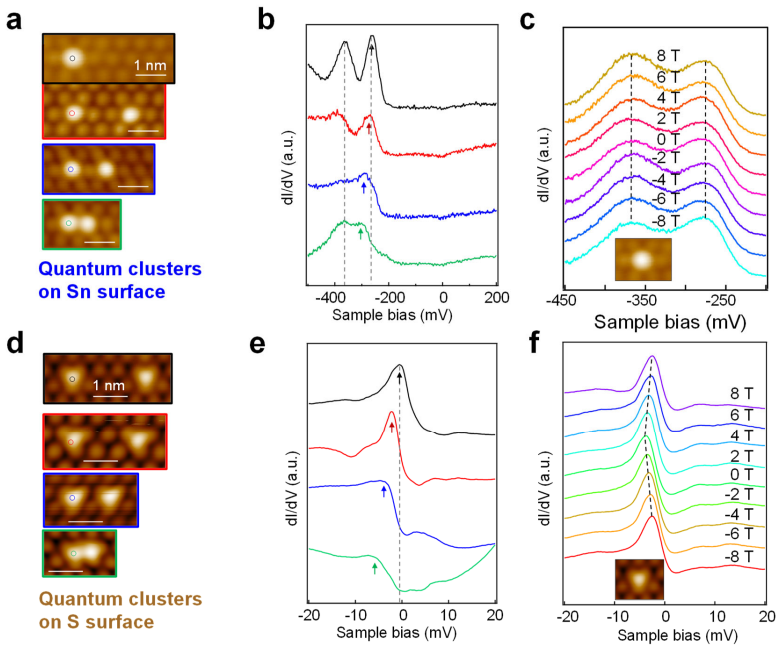
On both cleaved surfaces of Co3Sn2S2, the STM 'round impurities' are native oxygen atoms near the Sn plane, not metal vacancies. On the Sn termination, nc-AFM places oxygen in a threefold hollow 15 pm above the Sn plane; it locally hole-dopes, shifting the flat-band peak ~5 meV and extending a conductance pattern over ~15 atoms. With ±8 T perpendicular field this resonance shifts linearly, assigned to orbital-magnetism-induced unconventional Zeeman effect. On the S termination, oxygen sits ~80 pm off the hexagonal S lattice, creating occupied in-gap states: C6 at −264 mV, C2 at −362 mV, with no field shift. STEM-EELS confirms an O K-edge at ~532 eV at two inequivalent near-Sn-plane sites.
Load-bearing premise
The central claim—that the surface protrusions are oxygen—rests on matching STM/AFM surface features to oxygen signals seen by STEM-EELS in cross-sections of different crystals, not on identifying the very same atom; if the EELS oxygen is a bulk or cleavage artifact rather than the species creating each surface protrusion, the identification collapses.
Editorial extensions
If this is right
- Interpretations of Co3Sn2S2's anomalous Hall, Nernst, and orbital-magnetism signals must include oxygen as a dominant intrinsic defect, especially in high-quality crystals.
- On the Sn termination, the flat-band resonance can be shifted linearly by an external field at the atomic scale, providing a local handle on a kagome flat band.
- On the S termination, the off-center oxygen produces an energy-dependent symmetry reduction (C6 to C2), a concrete link between a single interstitial and orbital anisotropy.
- Pairing two oxygen impurities tunes their state energy and width, so inter-impurity distance acts as a hybridization knob for quantum clusters.
- These oxygen states behave differently from previously reported In dopants and S vacancies, expanding the defect-engineering palette on this topological magnet.
Reading between the lines
- The same oxygen may persist in the bulk, potentially contributing to residual resistivity or Berry-curvature responses in nominally pristine crystals; comparing crystals grown with and without oxygen exposure could test this.
- Since the S-site oxygen state is nonmagnetic and localized, it might be manipulated with an STM tip (as already done for S vacancies) to build ordered arrays of quantum clusters.
- The C6-to-C2 symmetry lowering with energy hints at a local orbital or Jahn–Teller–like instability; momentum-resolved STS or photoemission on a dense defect lattice could expose whether it is collective.
- If the linear field shift is truly orbital magnetism, the Sn-site cluster becomes a local sensor of orbital magnetic susceptibility, allowing spatial mapping of orbital moments.
Editorial analysis
A structured set of objections, weighed in public.
Referee Report
Summary. The paper reports a combined STM/STS, nc-AFM, and STEM-EELS study of intrinsic point defects on the two cleaved terminations of the magnetic Weyl semimetal Co3Sn2S2. The authors identify the dominant surface impurities as native oxygen defects. On the Sn termination, oxygen is assigned to threefold hollow sites, shifts the near-Fermi flat-band resonance, and produces a field-induced resonance shift attributed to orbital magnetism. On the S termination, oxygen is assigned to off-center interstitial sites producing in-gap states with energy-dependent C6-to-C2 symmetry and no measurable magnetic response. The paper further reports inter-impurity distance-dependent spectral evolution and concludes that oxygen defects act as tunable 'intrinsic quantum clusters' in this kagome magnet.
Significance. If the oxygen identification is correct, the work is significant: it proposes a concrete chemical identity for ubiquitous surface impurities in a widely studied topological kagome magnet, connects local defects to flat-band and orbital-magnetism physics, and combines SPM with STEM-EELS in a complementary manner. The EELS O K-edge at ~532 eV, the nc-AFM atomic positions, and the symmetry-resolved dI/dV maps are direct observations and are strengths. However, the load-bearing claim that the STM/AFM protrusions are the same oxygen species detected by STEM-EELS rests on cross-sample, cross-geometry inference rather than a same-site correlation. The 'dominate the defect landscape' claim is also not supported by a quantitative defect census. The significance is therefore conditional on additional correlation or a suitably weakened claim.
major comments (4)
- [Fig. 3 vs. Figs. 1-2] The central identification of the surface impurities as oxygen is not directly established. The EELS oxygen signals in Fig. 3 are acquired on a cross-sectional lamella and are not spatially registered to the STM/nc-AFM protrusions of Figs. 1, 2, and 4. The inference is purely structural: the EELS impurity 'adjacent to the Sn plane' is assumed to correspond to the hollow-site protrusion on Sn termination, and the site 'between S and Co3Sn atoms' to the S-termination defect. Since the EELS defects could be bulk impurities, cleavage-induced species, or FIB/SEM preparation artifacts, the sentence 'These findings confirm oxygen as a dominant impurity species' is an interpretation rather than a direct observation. Same-sample or same-site correlation, or an independent surface-sensitive chemical signature, is needed to support the abstract's claim that the clusters 'are identified as native ox
- [Abstract and Conclusion] The claim that oxygen defects 'dominate the intrinsic defect landscape on both cleaved surface terminations' is not supported by any quantitative census. The manuscript states that impurities are 'randomly distributed' and that the S-termination impurity density is comparable to that of In-doped samples in earlier work, but it does not report defect counts, relative abundances of oxygen versus S vacancies, or error bars. Without such statistics, the 'dominate' claim is not established, especially on the vacancy-rich S termination.
- [Fig. 4f and orbital-magnetism claim] The central physical conclusion for the Sn termination—a 'linear shift towards higher energy' of the near-Fermi peak under magnetic field, attributed to orbital magnetism and an 'unconventional Zeeman effect'—is not quantitatively demonstrated. The manuscript shows stacked dI/dV spectra but no plot of peak energy versus field, no linear fit, no slope, and no error bars or replicate measurements. This makes it impossible to verify the claimed linearity or to distinguish an orbital-magnetism shift from drift, tip effects, or other field-dependent artifacts.
- [Main text, Fig. 2 and Fig. 4] The magnetic-field comparison between the two terminations is based on single measurements without statistics. On the S termination the conclusion 'negligible Zeeman splitting or energy shifts' and on the Sn termination the 'pronounced linear shift' each rest on one data set. Given the small energy shifts involved (~meV), replicate spectra and an explicit account of the energy calibration and noise floor are required before the contrasting magnetic responses can be considered robust.
minor comments (6)
- [Fig. 2 caption] The caption contains two items labelled '(d)': the dI/dV spectra and the -264 mV differential conductance map. The map should be labelled (e), and the reference in the main text to 'Fig. 2e' for the map is currently inconsistent.
- [Methods, nc-AFM] 'The topological nc-AFM images' should presumably read 'topographic nc-AFM images'.
- [Fig. 3 caption] The caption describes the energy range as 'Sn M-edge energy loss range' while the feature is the O K-edge at ~532 eV. Please clarify the displayed energy window and label the spectra accordingly.
- [Main text, Fig. 1] The text refers to a 'bright triangle in the STM image' and a 'round protrusion' for the same feature; please use consistent descriptive language. Also, the AFM height differences (15 pm, 20 pm, 1.5 pm) are presented without error estimates; state whether these values are reproducible.
- [Methods, STM] The description 'equipped with 9-2-2 T magnetic field' is unclear; specify the field vector and maximum values.
- [Reference 24] Reference 24 is given only as a DOI without a journal citation; complete the bibliographic information.
Circularity Check
No significant circularity: the oxygen identification rests on direct STEM-EELS spectroscopy and STM/nc-AFM imaging, not on fitted inputs or self-citation.
full rationale
The paper's central claim—that the observed impurities are native oxygen defects—is supported by direct spectroscopic and structural measurements. The STEM-EELS data show an oxygen K-edge onset at ~532 eV at the impurity site, which is an externally calibrated fingerprint, and the differential spectra isolate the oxygen signal from control regions. STM and nc-AFM provide the real-space positions and symmetries of the surface defects. No parameter is fitted and then renamed as a prediction; no equation reduces to an input; and no load-bearing uniqueness theorem is imported from the authors' prior work. The self-citations (refs. 21, 22, 25) are used as background for flat bands, spin-orbit polarons, and surface termination assignments, not as the evidence that the defects are oxygen. The cross-sample nature of the STEM-EELS versus STM comparison is a potential evidence-strength limitation, but it is not circular: the identification is not assumed by construction. The paper is self-contained against external spectroscopic standards and therefore receives a circularity score of 0.
Assumptions & free parameters
assumptions (4)
- domain assumption dI/dV spectra and maps represent the local density of states, so their features can be assigned to impurity-induced electronic states.
- domain assumption An EELS feature with onset near 532 eV is an oxygen K-edge and identifies oxygen atoms at the probed site.
- domain assumption The two cleaved surfaces observed in STM correspond to the previously identified Sn- and S-terminated planes of Co3Sn2S2.
- domain assumption nc-AFM images reveal atomic core positions and can locate impurities relative to the lattice.
Cite this review
Pith. "Pith review of Intrinsic Quantum Clusters in Kagome Weyl Semimetal Co3Sn2S2." pith.science (2026). https://pith.science/paper/CEO7DWGV
@misc{pith2026250911230,
  author       = {Pith},
  title        = {Pith review of: Intrinsic Quantum Clusters in Kagome Weyl Semimetal Co3Sn2S2},
  year         = {2026},
  howpublished = {\url{https://pith.science/paper/CEO7DWGV}},
  note         = {Machine review of arXiv:2509.11230}
}
read the original abstract
Impurities and intrinsic point defects, which profoundly influence spin, charge, and topological degrees of freedom, are crucial parameters for tuning quantum states in quantum materials. The magnetic Weyl semimetal Co3Sn2S2 with its strong spin-orbit coupling, intrinsic ferromagnetism, and kagome lattice of correlated electrons, provides a compelling platform for studying impurity excited states. Yet, the role of intrinsic impurities in shaping its quantum states remains elusive. Here, we uncover intrinsic quantum clusters-localized intrinsic point defects that act as tunable quantum perturbations capable of reshaping electronic states and order parameters, on the surface of Co3Sn2S2 via scanning tunneling microscopy/spectroscopy and non contact atomic force microscopy, combined with scanning transmission electron microscopy/electron energy loss spectroscopy. These clusters are identified as native oxygen defects that dominate the intrinsic defect landscape on both cleaved surface terminations. On the Sn-terminated surface, oxygen impurities occupy hollow sites between three Sn atoms, and tune the flat band near the Fermi level, which exhibits orbital magnetism induced unconventional Zeeman effect under an applied magnetic field. On the S-terminated surface, oxygen interstitials reside slightly off center relative to the S lattice and generate occupied impurity states that retain sixfold symmetry at higher energies but reduce to C2 symmetry at lower energies. In contrast, these impurity states show no measurable magnetic response. Our findings establish that intrinsic oxygen-related quantum clusters act as tunable local perturbations in a topological kagome magnet, offering a versatile platform to probe and engineer impurity-driven phenomena in correlated and topological systems.
Figures


Figures from the paper (1 more)
Reference graph
Works this paper leans on
-
[1]
Balatsky, A. V. Impurity-induced states in conventional and unconventional superconductors. Rev. Mod. Phys. 78, 373–433 (2006)
2006
-
[2]
Continuous-time Monte Carlo methods for quantum impurity models
Gull, E. Continuous-time Monte Carlo methods for quantum impurity models. Rev. Mod. Phys. 83, 349–404 (2011)
2011
-
[3]
& Petrozza, A
Zhou, Y., Poli, I., Meggiolaro, D., De Angelis, F. & Petrozza, A. Defect activity in metal halide perovskites with wide and narrow bandgap. Nat Rev Mater 6, 986–1002 (2021)
2021
-
[4]
Pantelides, S. T. The electronic structure of impurities and other point defects in semiconductors. Rev. Mod. Phys. 50, 797–858 (1978)
1978
-
[5]
Li, M. et al. Defect repairing in lead bromide perovskite single crystals with biasing and bromine for X-ray photon-counting detectors. Nat. Mater. 1–8 (2025) doi:10.1038/s41563-025-02310-x
-
[6]
Liu, E. et al. Giant anomalous Hall effect in a ferromagnetic kagome-lattice semimetal. Nature Phys 14, 1125–1131 (2018)
2018
-
[7]
Morali, N. et al. Fermi-arc diversity on surface terminat ions of the magnetic Weyl semimetal Co3Sn2S2. Science 365, 1286–1291 (2019)
2019
-
[8]
Liu, D. F. et al. Magnetic Weyl semimetal phase in a Kagomé crystal. Science 365, 1282–1285 (2019)
2019
Show all 31 references
-
[9]
Wang, Q. et al. Magnetism modulation in Co3Sn2S2 by current-assisted domain wall motion. Nat Electron 6, 119–125 (2023)
2023
-
[10]
Muechler, L. et al. Emerging chiral edge states from the confinement of a magnetic Weyl semimetal in Co 3 Sn 2 S 2. Phys. Rev. B 101, 115106 (2020)
2020
-
[11]
Howard, S. et al. Evidence for one-dimensional chiral edge states in a magnetic Weyl semimetal Co3Sn2S2. Nat Commun 12, 4269 (2021)
2021
-
[12]
Guin, S. N. et al. Zero-Field Nernst Effect in a Ferro magnetic Kagome-Lattice Weyl-Semimetal Co3Sn2S2. Advanced Materials 31, 1806622 (2019)
2019
-
[13]
Yin, J.-X. et al. Negative flat band magnetism in a spin–orbit-coupled correlated kagome magnet. Nat. Phys. 15, 443–448 (2019)
2019
-
[14]
Magnetic Order Induced Chiral Phonons in a Ferromagnetic Weyl Semimetal
Che, M. Magnetic Order Induced Chiral Phonons in a Ferromagnetic Weyl Semimetal. Phys. Rev. Lett. 134, (2025)
2025
-
[15]
Che, M. et al. Discovery of terahertz-frequency or bitally coupled magnons in a kagome ferromagnet. Science Advances 11, eadw1182 (2025)
2025
-
[16]
Sakai, Y. et al. Magnetic Properties of Shandite-Phase Co3−xFexSn2S2 (x=0–1.0) Obtained with High Pressure Synthesis. J. Phys. Soc. Jpn. 84, 044705 (2015)
2015
-
[17]
The effect of electron and hole doping on the thermoelectric properties of shandite-type Co3Sn2S2. J. Solid State Chem. 251, 204–210 (2017)
2017
-
[18]
Enhanced anomalous Hall effect in the magnetic topological semimetal Co 3 Sn2 −𝑥 In 𝑥 S2
Zhou, H. Enhanced anomalous Hall effect in the magnetic topological semimetal Co 3 Sn2 −𝑥 In 𝑥 S2. Phys. Rev. B 101, 125121 (2020)
2020
-
[19]
Yin, J.-X. et al. Spin-orbit quantum impurit y in a topological magnet. Nat Commun 11, 4415 (2020)
2020
-
[20]
Electronic structure evolution of the magnetic Weyl semimetal Co3 Sn2 S2 with hole and electron doping
lohani, H. Electronic structure evolution of the magnetic Weyl semimetal Co3 Sn2 S2 with hole and electron doping. Phys. Rev. B 107, 245119 (2023)
2023
-
[21]
Xing, Y. et al. Localized spin-orbit polaron in magnetic Weyl semimetal Co3Sn2S2. Nat Commun 11, 5613 (2020)
2020
-
[22]
Chen, H. et al. Atomically precise engineering of spin–orbit polarons in a kagome magnetic Weyl semimetal. Nat Commun 15, 2301 (2024)
2024
-
[23]
Roccapriore, K. M. et al. Revealing the Chemical Bonding in Adatom Arrays via Machine Learning of Hyperspectral Scanni ng Tunneling Spectroscopy Data. ACS Nano 15, 11806–11816 (2021)
2021
-
[24]
Lv, S. et al. Bipolarity Induced Gigantic Intrinsic Anomalous Hall Effect in Iterative ‐Grown Kagome Semimetal Co3Sn2S2 Crystals. doi:10.1002/adfm.202510587
-
[25]
Huang, L. et al. Discovery and construction of surface ka gome electronic states induced by p-d electronic hybridization in Co3Sn2S2. Nat Commun 14, 5230 (2023)
2023
-
[26]
Giessibl, F. J. Atomic Resolution of the Silic on (111)-(7×7) Surface by Atomic Force Microscopy. Science 267, 68–71 (1995)
1995
-
[27]
& Meyer, G
Gross, L., Mohn, F., Moll, N., Liljeroth, P. & Meyer, G. The Chemical Structure of a Molecule Resolved by Atomic Force Microscopy. Science 325, 1110–1114 (2009)
2009
-
[28]
Barja, S. et al. Charge density wave order in 1D mirror twin boundaries of single-layer MoSe2. Nature Phys 12, 751–756 (2016)
2016
-
[29]
M., Reecht , G
Krane, N., Lotze, C., Läger, J. M., Reecht , G. & Franke, K. J. Electronic Structure and Luminescence of Quasi-Freestanding MoS2 Nanopatches on Au(111). Nano Lett. 16, 5163–5168 (2016)
2016
-
[30]
Giessibl, F. J. Atomic resolution on Si(111)-( 7×7) by noncontact atomic force microscopy with a force sensor based on a quartz tuning fork. Appl. Phys. Lett. 76, 1470–1472 (2000)
2000
-
[31]
Fu, X. et al. Building spin-1/2 antiferromagnetic Heis enberg chains with diaza-nanographenes. Nat. Synth 4, 684–693 (2025)
2025
Reviewed August 4, 2026 · model on record in the stance chip above.
Discussion (0). Sign in to comment.