REVIEW 3 major objections 4 minor 27 references
Revisiting Meter Tracking in Carnatic Music using Deep Learning Approaches
T0 review · 3 major / 4 minor · reviewed 2026-08-04 · deepseek-v4-flash
Pith's one-line read State-of-the-art deep learning models, adapted on Carnatic data, surpass the traditional probabilistic baseline in both beat and downbeat tracking.
desk verdict A transparent, replicable benchmark showing fine-tuned deep models beat the DBN baseline on Carnatic meter tracking; the main caveat is the unresolved annotation-tempo question for Adi/Rupaka. read the letter →
The pith
A machine-rendered reading of the paper's core claim, the machinery that carries it, and where it could break.
The reading
What carries the argument
The comparison rests on two architectures. The Temporal Convolutional Network is a lightweight dilated-convolution sequence model; the version tested here is trained with a multitask beat/downbeat loss and relies on a Dynamic Bayesian Network post-processor to convert activations into coherent beat sequences. Beat This! is a transformer-based tracker with a shift-tolerant loss and a sum head; it produces discrete events without post-processing. A Bar Pointer Model, a Dynamic Bayesian Network that tracks position in the metrical cycle and tempo, serves as the baseline. Musically informed parameters—beats per bar set to the four talas [3, 5, 7, 8] and a constrained tempo range—are used to adap
What would settle it
Have expert Carnatic musicians re-annotate a held-out set of Adi and Rupaka tracks at the tempo actually performed, then recompute beat and downbeat F1 for the fine-tuned transformer and the DBN baseline; if the transformer's margin over the baseline shrinks or reverses on these tracks, the central claim would not survive.
Extended reading notes
Core claim
On the Carnatic Music Rhythm dataset, a fine-tuned Beat This! model reaches 90.3 beat and 66.8 downbeat F1, and a TCN trained from scratch on Carnatic data reaches 84.6 and 63.9, both exceeding the best published Bar Pointer Model baseline (82.5 beat, 57.4 downbeat). Models trained only on Western data score far lower on downbeats, showing that learned rhythmic representations do not transfer directly. The paper concludes that modern deep learning models, tailored or fine-tuned for Carnatic music, considerably outperform the traditional DBN baseline, while noting a trade-off: the TCN with post-processing maintains better temporal continuity, whereas the transformer excels at raw accuracy wit
Load-bearing premise
The load-bearing assumption is that the ground-truth annotations in the Carnatic dataset mark the true beat and downbeat positions at the intended metrical level, especially for Adi and Rupaka; if those tracks are annotated at half tempo or inconsistently, the F-measure and continuity scores that support the superiority claims would be misleading.
Editorial extensions
If this is right
- Fine-tuning a transformer pretrained on Western data on a small Carnatic corpus (about 16.6 hours) is enough to beat the probabilistic baseline on beat and downbeat accuracy.
- Training a lightweight TCN from scratch on Carnatic data gives the best temporal continuity, especially for downbeats, making it a practical choice for real-time or resource-constrained settings.
- Off-the-shelf deep models trained only on Western music fail to generalize to Carnatic music, particularly for downbeats, so domain-specific adaptation is necessary.
- Musically informed post-processing, such as tala-specific beats-per-bar and tempo bounds, can improve results but also masks the network's intrinsic performance.
Reading between the lines
- The paper's own tempo analysis raises the possibility that Adi and Rupaka tracks are annotated at half tempo; if so, the reported gains on those talas, and the overall F1 numbers, may overstate the models' true advantage. A re-annotation study at the performed tempo is the direct test.
- The same recipe—fine-tune a Western-pretrained model on a small, culturally curated dataset—is likely transferable to other underrepresented traditions, but the Carnatic-specific challenges (edupu phase offsets, metric modulation, non-isochronous sections) suggest that musical knowledge must be encoded per tradition.
- The low continuity scores paired with high AMLt scores for Beat This! on some talas imply that raw F1 can hide metrical-level errors; evaluation practices that report continuity and phase lags together would give a fairer picture.
Editorial analysis
A structured set of objections, weighed in public.
Referee Report
Summary. The paper benchmarks two deep-learning meter-tracking systems, a Temporal Convolutional Network (TCN) and the transformer-based Beat This!, on the Carnatic Music Rhythm dataset (CMR_f), replicating the two-fold cross-validation protocol of Srinivasamurthy's DBN baseline. It compares off-the-shelf, fine-tuned, and from-scratch training strategies, and incorporates musically informed techniques such as tala-stratified splits and DBN post-processing with CMR-informed tempo/beat-per-bar settings. The headline result is that BeatThis-FT achieves beat/downbeat F1 of 90.3/66.8 and TCN-FS achieves 84.6/63.9, exceeding the BP-AMPF baseline's 82.5/57.4 (Table 7). The paper concludes that modern deep models, when adapted to Carnatic data, considerably outperform the traditional DBN baseline in both beat and downbeat tracking.
Significance. If the results hold, the paper makes a useful empirical contribution to MIR for underrepresented traditions: it provides a directly comparable replication of a published baseline, uses standard mir_eval metrics, reports per-tala breakdowns, and makes code and trained models publicly available (Appendix A). The finding that fine-tuning or training from scratch on a modest amount of Carnatic data can exceed a strong probabilistic baseline is practically relevant. However, the strength of the conclusion is limited by the unresolved annotation-level question for two of the four talas, and by the fact that continuity-aware metrics tell a more mixed story than F-measure alone. Those issues need to be addressed before the central claim can be accepted without qualification.
major comments (3)
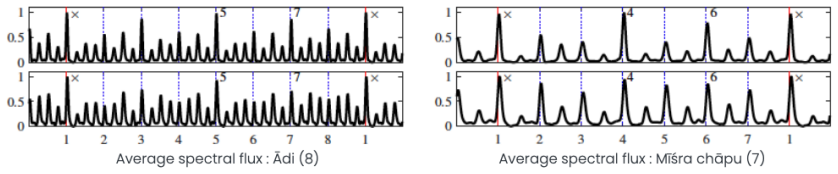
- [Sec. 5.4, Tables 4 and 7] The paper itself asks whether the Adi (8) and Rupaka (3) annotations are at half tempo, and does not answer the question. Those two talas constitute 100 of the 176 tracks, and they are exactly the talas where both leading models underperform (Tables 8 and 9). If a systematic metrical-level error exists, the F-measure and continuity scores in Table 7 do not reflect meter tracking at the musically intended level. All models are trained and evaluated on the same labels, so the relative ordering is internally consistent, but the external conclusion that deep models surpass the DBN baseline in Carnatic meter tracking assumes the annotations are musically correct. This needs to be resolved (e.g., by re-annotation of a subset by an expert, or by an IBI/tala-cycle analysis against known musical references) or the conclusion must be explicitly qualified as being relative to the CMR_f annotations
- [Sec. 5.1, Table 7, Sec. 6.2] The claim that the deep models 'considerably outperform the traditional DBN baseline in both beat and downbeat tracking' is based on F-measure only. On the beat AMLt continuity metric, BP-AMPF scores 90.6, while BeatThis-FT scores 80.0 and TCN-FS scores 88.0; only TCN-FT (91.9) is above the baseline. Thus on a continuity-aware beat metric, the deep models do not consistently outperform the baseline. The paper should either qualify the headline claim as being specific to F-measure, or justify why F-measure is the primary metric for 'meter tracking' in this context.
- [Sec. 4.4.2, Table 7] The TCN results depend on a DBN post-processor whose beats_per_bar and tempo range are set to values derived from CMR_f ([3,5,7,8] and 55-230 BPM). This is disclosed, but it is dataset-informed tuning of the post-processor. For the comparison with BP-AMPF to be fair, the manuscript should clarify whether the baseline's own tempo/meter priors were similarly tuned on CMR_f or whether they were taken from the original publication as-is. Without this, part of the reported gain of TCN-FS/TCN-FT over the baseline could be attributable to post-processor tuning rather than to the deep architecture or training strategy. An ablation with default post-processor parameters would help disentangle the contributions.
minor comments (4)
- [Sec. 4.3 and Table 7] The paper states that six models are trained per strategy, but Table 7 reports only means. Reporting standard deviations or per-fold/per-run values would be useful, especially for the near-tie comparisons such as TCN-FT beat F1 (80.7) versus BP-AMPF (82.5).
- [Sec. 3.2.2, Eq. for L_st] The shift-tolerant loss equation is introduced with m_7(.) and m_13(.) but the notation is not fully explained. Clarify that m_k denotes max pooling over k frames and define the indexing convention for the label window.
- [Sec. 4.4.2 and Fig. 12] The choice of min_tempo=55 and max_tempo=230 is described as covering 99% of tempos based on preliminary experiments. Provide the exact percentile computation and, if possible, report the sensitivity of results to the tempo-range choice.
- [Sec. 5.4] The half-tempo annotation concern is raised in the results section but is not carried into the Conclusions or Future Work. It should be listed as an explicit limitation and, ideally, as a concrete future validation step.
Circularity Check
No significant circularity; the study is an empirical benchmark with externally published baselines and held-out evaluation.
full rationale
The paper's central claim is that fine-tuned or scratch-trained deep models (BeatThis-FT, TCN-FS) outperform the published DBN baseline (BP-AMPF) on the CMR_f dataset. This claim is supported by a standard supervised evaluation protocol: the dataset is split into two predetermined folds, models are trained/fine-tuned on one fold and evaluated on the other, and results are averaged over three runs with fixed seeds. The baseline numbers (BP-HMM, BP-AMPF) are taken from Srinivasamurthy's externally published 2016 thesis and code/data, not derived within this paper. No equation in the paper is defined in terms of the quantity it purports to predict, and no fitted parameter is renamed as a prediction. The TCN and Beat This! implementations are imported from prior external work (Böck & Davies 2020; Foscarin et al. 2024; Maia et al. 2022; LAMIR 2024 hackathon), and the paper's own contribution is the adaptation and evaluation. The only caveats are data-quality and experimental-design concerns, not circularity: Section 5.4 explicitly raises whether Adi (8) and Rupaka (3) tracks are annotated at half tempo ('do the ground truth annotations reflect the actual tempo, or are the Adi (8) and Rupaka (3) tracks annotated at half tempo, potentially contributing to their underperformance?'), and the music-informed post-processor tempo range is chosen from the dataset's tempo distribution ('This range, chosen based on preliminary experiments, covers 99% of all tempos'). These are legitimate threats to the validity or generalizability of the benchmark, but they do not make the derivation circular: the ground-truth annotations are external inputs, and tuning a post-processor range on the test distribution is a leakage/overfitting issue, not a case of the prediction being equivalent to its inputs by construction. The comparison against the DBN baseline is internally consistent because all systems are evaluated on the same annotations and folds. Therefore no circular step is present.
Assumptions & free parameters
free parameters (2)
- beats_per_bar in DBN post-processor =
[3, 5, 7, 8]
- post-processor tempo range =
min_tempo=55, max_tempo=230
assumptions (2)
- domain assumption CMR_f beat and downbeat annotations are reliable ground truth at the correct metrical level.
- domain assumption The madmom DBN post-processor with Viterbi inference is an acceptable approximation of the BP-model inference used in the baseline.
Cite this review
Pith. "Pith review of Revisiting Meter Tracking in Carnatic Music using Deep Learning Approaches." pith.science (2026). https://pith.science/paper/LXVUTL2Z
@misc{pith2026250911241,
  author       = {Pith},
  title        = {Pith review of: Revisiting Meter Tracking in Carnatic Music using Deep Learning Approaches},
  year         = {2026},
  howpublished = {\url{https://pith.science/paper/LXVUTL2Z}},
  note         = {Machine review of arXiv:2509.11241}
}
abstract
Beat and downbeat tracking, jointly referred to as Meter Tracking, is a fundamental task in Music Information Retrieval (MIR). Deep learning models have far surpassed traditional signal processing and classical machine learning approaches in this domain, particularly for Western (Eurogenetic) genres, where large annotated datasets are widely available. These systems, however, perform less reliably on underrepresented musical traditions. Carnatic music, a rich tradition from the Indian subcontinent, is renowned for its rhythmic intricacy and unique metrical structures (t\=alas). The most notable prior work on meter tracking in this context employed probabilistic Dynamic Bayesian Networks (DBNs). The performance of state-of-the-art (SOTA) deep learning models on Carnatic music, however, remains largely unexplored. In this study, we evaluate two models for meter tracking in Carnatic music: the Temporal Convolutional Network (TCN), a lightweight architecture that has been successfully adapted for Latin rhythms, and Beat This!, a transformer-based model designed for broad stylistic coverage without the need for post-processing. Replicating the experimental setup of the DBN baseline on the Carnatic Music Rhythm (CMR$_f$) dataset, we systematically assess the performance of these models in a directly comparable setting. We further investigate adaptation strategies, including fine-tuning the models on Carnatic data and the use of musically informed parameters. Results show that while off-the-shelf models do not always outperform the DBN, their performance improves substantially with transfer learning, matching or surpassing the baseline. These findings indicate that SOTA deep learning models can be effectively adapted to underrepresented traditions, paving the way for more inclusive and broadly applicable meter tracking systems.
Figures


Figures from the paper (12 more)




Reference graph
Works this paper leans on
-
[1]
Timing is of the essence: Perceptual and computational techniques for rhythmic timing
Jeffrey Adam Bilmes. Timing is of the essence: Perceptual and computational techniques for rhythmic timing. Master's thesis, Massachusetts Institute of Technology, 1993. URL https://dspace.mit.edu/handle/1721.1/62091
1993
-
[2]
mirdata: Software for reproducible usage of datasets
Rachel M Bittner, Magdalena Fuentes, David Rubinstein, Andreas Jansson, Keunwoo Choi, and Thor Kell. mirdata: Software for reproducible usage of datasets. In International Society for Music Information Retrieval (ISMIR) Conference, 2019
2019
-
[3]
o ck, Filip Korzeniowski, Jan Schl \
Sebastian B \"o ck, Filip Korzeniowski, Jan Schl \"u ter, Florian Krebs, and Gerhard Widmer. madmom: a new Python Audio and Music Signal Processing Library . In Proceedings of the 24th ACM International Conference on Multimedia, pages 1174--1178, Amsterdam, The Netherlands, 10 2016. doi:10.1145/2964284.2973795
arXiv 2016
-
[4]
Deconstruct, Analyse , Reconstruct : How to improve Tempo , Beat , and Downbeat Estimation
Sebastian Böck and Matthew EP Davies. Deconstruct, Analyse , Reconstruct : How to improve Tempo , Beat , and Downbeat Estimation . In ISMIR , pages 574--582, 2020
2020
-
[5]
Joint Beat and Downbeat Tracking with Recurrent Neural Networks
Sebastian Böck, Florian Krebs, and Gerhard Widmer. Joint Beat and Downbeat Tracking with Recurrent Neural Networks . In ISMIR , pages 255--261. New York City, 2016
2016
-
[6]
Matthew E. P. Davies, Sebastian Böck, and Magdalena Fuentes. Tempo, Beat and Downbeat Estimation . https://tempobeatdownbeat.github.io/tutorial/intro.html, November 2021. URL https://tempobeatdownbeat.github.io/tutorial/intro.html
2021
-
[7]
Temporal convolutional networks for musical audio beat tracking
Matthew EP Davies and Sebastian Böck. Temporal convolutional networks for musical audio beat tracking. In 2019 27th European Signal Processing Conference ( EUSIPCO ) , pages 1--5. IEEE, 2019
2019
-
[8]
Daniel P. W. Ellis. Beat Tracking by Dynamic Programming . Journal of New Music Research, 36 0 (1): 0 51--60, 2007. Publisher: Taylor & Francis
2007
Show all 27 references
-
[9]
Beat this! Accurate beat tracking without DBN postprocessing
Francesco Foscarin, Jan Schlüter, and Gerhard Widmer. Beat this! Accurate beat tracking without DBN postprocessing. In Proceedings of the 25th International Society for Music Information Retrieval Conference ( ISMIR ) , San Francisco, CA, United States, November 2024
2024
-
[10]
BeatNet : CRNN and Particle Filtering for Online Joint Beat Downbeat and Meter Tracking
Mojtaba Heydari, Frank Cwitkowitz, and Zhiyao Duan. BeatNet : CRNN and Particle Filtering for Online Joint Beat Downbeat and Meter Tracking . In 22th International Society for Music Information Retrieval Conference , ISMIR , 2021. URL https://arxiv.org/abs/2209.07140
2021 arXiv
-
[11]
Tracking the “odd”: Meter inference in a culturally diverse music corpus
Andre Holzapfel, Florian Krebs, and Ajay Srinivasamurthy. Tracking the “odd”: Meter inference in a culturally diverse music corpus. In ISMIR - International Conference on Music Information Retrieval , pages 425--430. ISMIR, 2014
2014
-
[12]
Modeling beats and downbeats with a time-frequency transformer
Yun-Ning Hung, Ju-Chiang Wang, Xuchen Song, Wei-Tsung Lu, and Minz Won. Modeling beats and downbeats with a time-frequency transformer. In ICASSP 2022-2022 IEEE International Conference on Acoustics , Speech and Signal Processing ( ICASSP ) , pages 401--405. IEEE, 2022
2022
-
[13]
Probabilistic graphical models: principles and techniques
Daphne Koller and Nir Friedman. Probabilistic graphical models: principles and techniques. MIT press, 2009
2009
-
[14]
Rhythmic Pattern Modelling for Beat and Downbeat Tracking from Musical Audio
Florian Krebs, Sebastian Böck, and Gerhard Widmer. Rhythmic Pattern Modelling for Beat and Downbeat Tracking from Musical Audio . In Proceedings of the 14th International Society for Music Information Retrieval Conference ( ISMIR ) , Curitiba, Brazil, 2013
2013
-
[15]
An Efficient State Space Model for Joint Tempo and Meter Tracking
Florian Krebs, Sebastian Böck, and Gerhard Widmer. An Efficient State Space Model for Joint Tempo and Meter Tracking . In Proceedings of the 16th International Society for Music Information Retrieval Conference ( ISMIR ) , Malaga, Spain, 2015
2015
-
[16]
Hearing in Time: Psychological Aspects of Musical Meter
Justin London. Hearing in Time: Psychological Aspects of Musical Meter. Oxford University Press, 05 2012. ISBN 9780199744374. doi:10.1093/acprof:oso/9780199744374.001.0001. URL https://doi.org/10.1093/acprof:oso/9780199744374.001.0001
2012
-
[17]
Maia, Martín Rocamora, Luiz W
Lucas S. Maia, Martín Rocamora, Luiz W. P. Biscainho, and Magdalena Fuentes. Adapting meter tracking models to Latin American music. In Proceedings of the 23rd International Society for Music Information Retrieval Conference , pages 361--368. ISMIR, December 2022. doi:10.5281/...
2022 doi
-
[18]
LAMIR HAckathon : Adapting Deep Learning Models for Latin American Music Tasks
Giovana Morais, Richa Namballa, Xavier Juanola, Martín Rocamora, and Magdalena Fuentes. LAMIR HAckathon : Adapting Deep Learning Models for Latin American Music Tasks . https://lamir-workshop.github.io/lamir\_hackathon/, December 2024. URL https://lamir-workshop.github.io/lami...
2024
-
[19]
Dynamic Bayesian Networks: Representation, Inference and Learning
Kevin Patrick Murphy. Dynamic Bayesian Networks: Representation, Inference and Learning. Phd thesis, University of California, Berkeley, 2002. URL https://www.cs.ubc.ca/ murphyk/Thesis/thesis.pdf
2002
-
[20]
Fundamentals of Music Processing : Using Python and Jupyter Notebooks
Meinard Müller. Fundamentals of Music Processing : Using Python and Jupyter Notebooks . Springer International Publishing, Cham, 2021. ISBN 978-3-030-69807-2 978-3-030-69808-9. doi:10.1007/978-3-030-69808-9. URL https://link.springer.com/10.1007/978-3-030-69808-9
2021 doi
-
[21]
Humphrey, Justin Salamon, Oriol Nieto, Dawen Liang, and Daniel P
Colin Raffel, Brian McFee, Eric J. Humphrey, Justin Salamon, Oriol Nieto, Dawen Liang, and Daniel P. W. Ellis. mir\_eval: A transparent implementation of common mir metrics. In Proceedings of the 15th International Conference on Music Information Retrieval (ISMIR), pages 367--...
2014
-
[22]
Rao, H.A
P. Rao, H.A. Murthy, and S.R.M. Prasanna. Indian Art Music: A Computational Perspective. Sriranga Digital Software Technologies Pvt. Ltd., 2023. ISBN 9789391408091. URL https://books.google.es/books?id=g-2rEAAAQBAJ
2023
-
[23]
Sambamoorthy
P. Sambamoorthy. South Indian Music, Volumes I--VI. The Indian Music Publishing House, Madras, India, 1998
1998
-
[24]
A Data -driven Bayesian Approach to Automatic Rhythm Analysis of Indian Art Music
Ajay Srinivasamurthy. A Data -driven Bayesian Approach to Automatic Rhythm Analysis of Indian Art Music . PhD Thesis , Universitat Pompeu Fabra, Barcelona, Spain, 2016
2016
-
[25]
A supervised approach to hierarchical metrical cycle tracking from audio music recordings
Ajay Srinivasamurthy and Xavier Serra. A supervised approach to hierarchical metrical cycle tracking from audio music recordings. In Proceedings of the 39th IEEE International Conference on Acoustics, Speech and Signal Processing (ICASSP 2014), pages 5237--5241, Florence, Ital...
2014
-
[26]
Wavenet: A generative model for raw audio
Aaron Van Den Oord, Sander Dieleman, Heiga Zen, Karen Simonyan, Oriol Vinyals, Alex Graves, Nal Kalchbrenner, Andrew Senior, Koray Kavukcuoglu, et al. Wavenet: A generative model for raw audio. arXiv preprint arXiv:1609.03499, 12, 2016. URL https://arxiv.org/pdf/1609.03499
2016 arXiv
-
[27]
Bayesian Modelling of Temporal Structure in Musical Audio
Nick Whiteley, Ali Taylan Cemgil, and Simon J Godsill. Bayesian Modelling of Temporal Structure in Musical Audio . In ISMIR , pages 29--34, 2006
2006
Reviewed August 4, 2026 · model on record in the stance chip above.
Discussion (0). Sign in to comment.