Threshold and quasi-stationary distribution for the SIS model on networks
Pith reviewed 2026-05-18 16:59 UTC · model grok-4.3
The pith
Expanding the state space with a memory of when nodes last became susceptible improves the pair approximation for the SIS epidemic model on networks.
A machine-rendered reading of the paper's core claim, the machinery that carries it, and where it could break.
Core claim
The authors introduce a dynamic state-space expansion that equips nodes with a memory of their last susceptibility time. This refined pair approximation accurately identifies the epidemic threshold and the quasi-stationary fraction of infected individuals for the SIS process on both finite graphs and infinite random graphs.
What carries the argument
Dynamic expansion of the state space that gives each node a memory of when it last became susceptible, thereby refining the pair approximation by accounting for additional temporal correlations.
If this is right
- The method locates the epidemic threshold more accurately than the ordinary pair approximation on a given network.
- It supplies reliable estimates of the quasi-stationary infection level once the threshold is crossed.
- The same procedure works for both small finite graphs and large infinite random graphs.
- Implementation stays simple and requires no network-specific parameters to be fitted.
Where Pith is reading between the lines
- The same memory device could be added to other compartmental models such as SIR or SIRS to improve their network approximations.
- On empirical contact networks the refined threshold might better guide the minimal set of interventions needed to prevent sustained spread.
- Testing the approximation on networks with heterogeneous recovery rates or with slowly changing links would reveal how far the memory trick generalizes.
Load-bearing premise
Adding a memory of last susceptibility time captures the higher-order correlations that the standard pair approximation misses, without needing extra fitting parameters tuned to each network.
What would settle it
Exact solution of the full Markov-chain master equation on a small network whose true threshold and quasi-stationary distribution can be computed directly, then comparison against the approximation's predictions for the same network.
Figures



read the original abstract
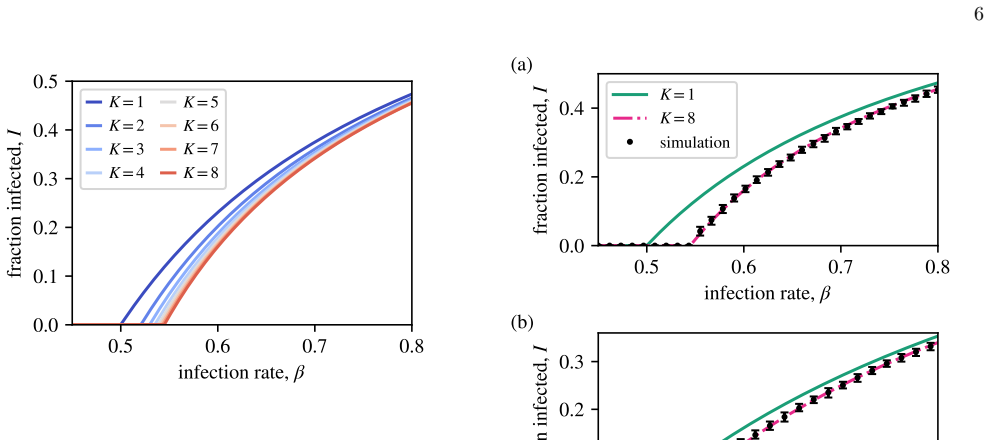
We study the Susceptible-Infectious-Susceptible (SIS) model on arbitrary networks. The well-established pair approximation treats neighboring pairs of nodes exactly while making a mean field approximation for the rest of the network. We improve the method by expanding the state space dynamically, giving nodes a memory of when they last became susceptible. The resulting approximation is simple to implement and appears to be highly accurate, both in locating the epidemic threshold and in computing the quasi-stationary fraction of infected individuals above the threshold, for both finite graphs and infinite random graphs.
Editorial analysis
A structured set of objections, weighed in public.
Referee Report
Summary. The paper studies the SIS epidemic model on arbitrary networks and proposes an improvement to the standard pair approximation by dynamically expanding the state space to include a memory variable tracking the time since each susceptible node last became susceptible. The authors claim that the resulting closed equations yield a simple-to-implement approximation that accurately locates the epidemic threshold and computes the quasi-stationary infected fraction, both for finite graphs and for infinite random graphs.
Significance. If the central claim holds without network-specific tuning or post-hoc adjustments, the method would provide a parameter-free extension of pair approximations that better captures higher-order correlations via finite memory, offering a practical advance for analyzing epidemic thresholds and endemic states on general networks.
major comments (2)
- [Abstract and §3] Abstract and §3 (derivation of enlarged-state equations): the claim that augmenting each susceptible node with its susceptibility age allows 'exact pair-level equations' for the enlarged space to close without further ad-hoc closures is not fully supported; the probability that a neighbor of a node with susceptibility age a is infected still appears to require a mean-field or pair-level assumption on the remaining graph, which may miss persistent triple correlations.
- [§4] §4 (numerical validation): the reported high accuracy on finite graphs and infinite random graphs lacks explicit error bars, direct comparison tables against standard pair approximation and simulation, and tests on a broader range of topologies; without these, it is unclear whether accuracy is general or specific to the tested networks.
minor comments (2)
- [§2] Notation for the memory variable and its update rules should be introduced with a clear table or diagram early in the methods section to aid readability.
- [§3] The manuscript would benefit from an explicit statement of the closure relation used for the neighbor-infection probability in the enlarged state space.
Simulated Author's Rebuttal
We are grateful to the referee for the careful and constructive report. We respond point by point to the major comments below, indicating the revisions we will make.
read point-by-point responses
-
Referee: [Abstract and §3] Abstract and §3 (derivation of enlarged-state equations): the claim that augmenting each susceptible node with its susceptibility age allows 'exact pair-level equations' for the enlarged space to close without further ad-hoc closures is not fully supported; the probability that a neighbor of a node with susceptibility age a is infected still appears to require a mean-field or pair-level assumption on the remaining graph, which may miss persistent triple correlations.
Authors: We thank the referee for this observation. The central technical point of the derivation in §3 is that conditioning on susceptibility age renders the enlarged-state process Markovian, so that the time derivative of each pair probability [S_a X] (where X is S_b or I) can be written exactly using only single-node probabilities with age and other pair probabilities. The infection probability for a neighbor of an S_a node is then obtained directly from the ratio of the appropriate pair probability to the marginal [S_a], without introducing any new closure relation beyond the standard pair-level neglect of correlations outside the focal pair. This is the same structural assumption used in classical pair approximations; the age variable simply refines the state space so that temporal memory is retained at the pair level. We agree that short cycles can still induce persistent triple correlations that the method does not capture, and we will revise the abstract and §3 to state the closure assumption more explicitly and to note this limitation. revision: partial
-
Referee: [§4] §4 (numerical validation): the reported high accuracy on finite graphs and infinite random graphs lacks explicit error bars, direct comparison tables against standard pair approximation and simulation, and tests on a broader range of topologies; without these, it is unclear whether accuracy is general or specific to the tested networks.
Authors: We accept this criticism. In the revised manuscript we will add (i) error bars obtained from at least 100 independent Monte Carlo realizations for both the threshold location and the quasi-stationary infected fraction, (ii) explicit tables that report the absolute and relative errors of the standard pair approximation, our dynamic-expansion method, and direct simulation for each network and parameter value, and (iii) additional numerical experiments on Barabási–Albert scale-free networks and Watts–Strogatz small-world networks with varying rewiring probabilities. These additions will make the scope and robustness of the accuracy claims clearer. revision: yes
Circularity Check
No significant circularity; derivation chain is self-contained
full rationale
The paper augments the standard pair approximation for the SIS process by dynamically expanding each node's state with a discrete memory variable tracking time since last becoming susceptible. The governing equations for the joint probabilities over these enlarged states are written directly from the underlying continuous-time Markov chain transition rules, then closed with an explicit mean-field assumption on the remaining network that does not reference the target threshold or quasi-stationary infected fraction. No parameters are fitted to simulation data, no self-citations supply load-bearing uniqueness theorems, and the memory variable is not defined in terms of the quantities it is later used to predict. Consequently the reported accuracy on finite and infinite graphs follows from the structure of the closed system rather than from any definitional or fitting equivalence to the inputs.
Axiom & Free-Parameter Ledger
axioms (2)
- domain assumption The network is static and the infection and recovery processes are Markovian with constant rates.
- ad hoc to paper Higher-order correlations beyond pairs can be captured by a finite memory of last susceptibility time.
Lean theorems connected to this paper
-
IndisputableMonolith/Foundation/RealityFromDistinction.leanreality_from_one_distinction unclear?
unclearRelation between the paper passage and the cited Recognition theorem.
Even using K=8 susceptible states gives results that agree very closely with experiment... we set γ=βq/√(K−1)
-
IndisputableMonolith/Cost/FunctionalEquation.leanwashburn_uniqueness_aczel unclear?
unclearRelation between the paper passage and the cited Recognition theorem.
the SISK pair approximation... solve the linear equation in Eq. (24) and then update ϕxji
What do these tags mean?
- matches
- The paper's claim is directly supported by a theorem in the formal canon.
- supports
- The theorem supports part of the paper's argument, but the paper may add assumptions or extra steps.
- extends
- The paper goes beyond the formal theorem; the theorem is a base layer rather than the whole result.
- uses
- The paper appears to rely on the theorem as machinery.
- contradicts
- The paper's claim conflicts with a theorem or certificate in the canon.
- unclear
- Pith found a possible connection, but the passage is too broad, indirect, or ambiguous to say the theorem truly supports the claim.
Reference graph
Works this paper leans on
-
[1]
Dynamic correlation The standard pair approximation allows us to approx- imate spatial correlations, i.e.,⟨I iIj⟩=P ij(Ii, Ij). Our SISK pair approximation also allows us to compute this and if it approximatesP ij more accurately, then it should approximate spatial correlations more accurately. How- ever, SISK additionally allows us to improve on our ap- ...
-
[2]
Random regular graphs For the SIS2 model on a random (q+ 1)-regular graph, we again have that every node and every edge is equiv- alent, and soϕ x ij =ϕ x for allijandB ij(ϕx) =qϕ x. Inserting these into to the 9×9 transition matrix, after considerable algebra, we arrive at the the self-consistent equation ϕ1 ϕ2 = βqϕ 1(β+ϕ2)(βq+q(ϕ 1+ϕ2)+1) qϕ2 1(βq+...
-
[3]
The factor of (q+1)/2 is due to the fact that a (q+1)- regular graph withnvertices hasn(q+ 1)/2 edges. While these equations describe the large-Klimit of our approach, we believe that that they are still not exact, even on random regular graphs. In particular, we have only incorporated one particular kind of memory—the time since a node was last infectiou...
-
[4]
I. Z. Kiss, J. C. Miller, and P. L. Simon,Math- ematics of Epidemics on Networks: From Exact to Approximate Models, volume 46 ofInterdisciplinary Applied Mathematics. Springer International Publish- ing, Cham (2017), URLhttp://link.springer.com/ 10.1007/978-3-319-50806-1
-
[5]
R. Pastor-Satorras, C. Castellano, P. Van Mieghem, and A. Vespignani, Epidemic processes in complex networks.Reviews of Modern Physics87(3), 925– 979 (2015), URLhttps://link.aps.org/doi/10.1103/ RevModPhys.87.925
work page 2015
- [6]
-
[7]
P. Grassberger, On the critical behavior of the general epidemic process and dynamical percolation.Math- ematical Biosciences63(2), 157–172 (1983), URL https://linkinghub.elsevier.com/retrieve/pii/ 0025556482900360
work page 1983
-
[9]
C. Moore and M. E. J. Newman, Epidemics and per- colation in small-world networks.Physical Review E 61(5), 5678–5682 (2000), URLhttps://link.aps.org/ doi/10.1103/PhysRevE.61.5678
-
[10]
O. Diekmann, M. C. M. De Jong, and J. A. J. Metz, A deterministic epidemic model taking account of re- peated contacts between the same individuals.Jour- nal of Applied Probability35(2), 448–462 (1998), URL http://www.jstor.org/stable/3215698. 10
-
[11]
R. Pastor-Satorras and A. Vespignani, Epidemic spread- ing in scale-free networks.Physical Review Letters86, 3200–3203 (2001), URLhttps://link.aps.org/doi/ 10.1103/PhysRevLett.86.3200
-
[12]
T. E. Harris, Contact interactions on a lattice.The An- nals of Probability2(6), 969 – 988 (1974), URLhttps: //doi.org/10.1214/aop/1176996493
- [13]
-
[14]
Y. Wang, D. Chakrabarti, C. Wang, and C. Faloutsos, Epidemic spreading in real networks: an eigenvalue view- point. In22nd International Symposium on Reliable Dis- tributed Systems, 2003. Proceedings., pp. 25–34 (2003), URLhttps://doi.org/10.1109/RELDIS.2003.1238052
-
[15]
D. Chakrabarti, Y. Wang, C. Wang, J. Leskovec, and C. Faloutsos, Epidemic thresholds in real networks.ACM Transactions on Information and System Security10(4), 1–26 (2008), URLhttps://dl.acm.org/doi/10.1145/ 1284680.1284681
-
[16]
P. Van Mieghem, J. Omic, and R. Kooij, Virus spread in networks.IEEE/ACM Transactions on Networking 17(1), 1–14 (2009), URLhttps://dl.acm.org/doi/10. 1109/TNET.2008.925623
-
[17]
P. Van Mieghem, The N-intertwined SIS epidemic net- work model.Computing93(2), 147–169 (2011), URL https://doi.org/10.1007/s00607-011-0155-y
-
[18]
M. J. Keeling, The effects of local spatial structure on epi- demiological invasions.Proceedings of the Royal Society of London. Series B: Biological Sciences266(1421), 859– 867 (1999), URLhttps://royalsocietypublishing. org/doi/abs/10.1098/rspb.1999.0716
-
[19]
A. S. Mata and S. C. Ferreira, Pair quenched mean- field theory for the susceptible-infected-susceptible model on complex networks.Europhysics Letters103(4), 48003 (2013), URLhttps://iopscience.iop.org/article/ 10.1209/0295-5075/103/48003
-
[20]
M. Shrestha, S. V. Scarpino, and C. Moore, Message- passing approach for recurrent-state epidemic models on networks.Physical Review E92(2), 022821 (2015), URL https://doi.org/10.1103/PhysRevE.92.022821
-
[21]
E. Cator and P. Van Mieghem, Second-order mean- field susceptible-infected-susceptible epidemic threshold. Physical Review E85(5), 056111 (2012), URLhttps: //link.aps.org/doi/10.1103/PhysRevE.85.056111
-
[22]
J. P. Gleeson, High-accuracy approximation of binary- state dynamics on networks.Physical Review Letters 107, 068701 (2011), URLhttps://link.aps.org/doi/ 10.1103/PhysRevLett.107.068701
-
[23]
B. Karrer and M. E. J. Newman, Message passing ap- proach for general epidemic models.Physical Review E 82(1), 016101 (2010), URLhttps://doi.org/10.1103/ PhysRevE.82.016101
work page 2010
- [24]
-
[25]
R. S. Ferreira and S. C. Ferreira, Critical behavior of the contact process on small-world networks.The European Physical Journal B86(11), 462 (2013), URLhttp:// link.springer.com/10.1140/epjb/e2013-40534-0
-
[26]
J. P. Gleeson, Binary-state dynamics on complex net- works: Pair approximation and beyond.Physical Review X3(2), 021004 (2013), URLhttps://link.aps.org/ doi/10.1103/PhysRevX.3.021004
-
[27]
P. Zhang, Inference of kinetic Ising model on sparse graphs.Journal of Statistical Physics148(3), 502– 512 (2012), URLhttp://link.springer.com/10.1007/ s10955-012-0547-1
work page 2012
-
[28]
A. Y. Lokhov, M. M´ ezard, and L. Zdeborov´ a, Dynamic message-passing equations for models with unidirec- tional dynamics.Physical Review E91, 012811 (2015), URLhttps://link.aps.org/doi/10.1103/PhysRevE. 91.012811
-
[29]
E. Dom´ ınguez, D. Machado, and R. Mulet, The cavity master equation: average and fixed point of the ferro- magnetic model in random graphs.Journal of Statisti- cal Mechanics: Theory and Experiment2020(7), 073304 (2020), URLhttps://dx.doi.org/10.1088/1742-5468/ ab9eb6
-
[30]
E. Aurell, D. Machado Perez, and R. Mulet, A closure for the master equation starting from the dynamic cavity method.Journal of Physics A: Mathematical and Theo- retical56(17), 17LT02 (2023), URLhttps://dx.doi. org/10.1088/1751-8121/acc8a4
-
[31]
F. Behrens, B. Hudcov´ a, and L. Zdeborov´ a, Back- tracking dynamical cavity method.Phys. Rev. X13, 031021 (2023), URLhttps://link.aps.org/doi/10. 1103/PhysRevX.13.031021
work page 2023
-
[32]
E. Ortega, D. Machado, and A. Lage-Castellanos, Dy- namics of epidemics from cavity master equations: Susceptible-infectious-susceptible models.Physical Re- view E105, 024308 (2022), URLhttps://link.aps. org/doi/10.1103/PhysRevE.105.024308
-
[33]
J. R. Norris,Markov Chains. Cambridge Series in Statis- tical and Probabilistic Mathematics, Cambridge Univer- sity Press (1997)
work page 1997
-
[34]
M. Morris and R. Rothenberg, HIV Transmission Network Metastudy Project: An Archive of Data From Eight Network Studies, 1988–2001: Version 1 (2011), URLhttps://www.icpsr.umich.edu/web/ NAHDAP/studies/22140/versions/V1
work page 1988
-
[35]
L. ˇSubelj and M. Bajec, Robust network community de- tection using balanced propagation.The European Physi- cal Journal B81(3), 353–362 (2011), URLhttp://link. springer.com/10.1140/epjb/e2011-10979-2
-
[36]
F. Krzakala, C. Moore, E. Mossel, J. Neeman, A. Sly, L. Zdeborov´ a, and P. Zhang, Spectral redemption in clustering sparse networks.Proceedings of the Na- tional Academy of Sciences110(52), 20935–20940 (2013), URLhttps://www.pnas.org/doi/abs/10.1073/ pnas.1312486110. Appendix A: Linear stability for pair-approximations First we derive a result, reminisce...
work page 2013
discussion (0)
Sign in with ORCID, Apple, or X to comment. Anyone can read and Pith papers without signing in.