Closing a catenary loop: the lariat chain, the string shooter, and the heavy elastica
Pith reviewed 2026-05-18 16:26 UTC · model grok-4.3
The pith
Closed loops of axially moving strings under gravity and drag can be formed by continuing catenary solutions past vertical points.
A machine-rendered reading of the paper's core claim, the machinery that carries it, and where it could break.
Core claim
The authors show that closed loop shapes for the string shooter are achievable by implementing analytical catenary solutions and numerically extending them with bending stiffness, overcoming the inherent difficulty in continuing the shape through vertical orientations which changes with drag strength and bifurcations.
What carries the argument
The catenary configuration of a steady axially moving, inertial, inextensible, perfectly flexible string under gravity and drag, extended to closed loops and with added bending stiffness.
If this is right
- Analytical results can be used to construct basic closed loop solutions.
- Numerical methods generate additional solutions when bending stiffness is added.
- The difficulty in closing the loop changes nature as the system bifurcates with increasing drag.
- Global balances of linear, angular, and pseudo-momentum hold for the closed system.
Where Pith is reading between the lines
- If these solutions are stable, they could explain observed behaviors in physical string shooting experiments.
- Adding bending stiffness suggests that real materials with some rigidity can still form such loops.
- Similar techniques might apply to modeling the chain fountain in closed configurations.
Load-bearing premise
The string remains steady, axially moving, inertial, inextensible, and perfectly flexible even when the configuration passes through vertical orientations and drag increases, allowing continuation of the catenary solution to close the loop.
What would settle it
Observing whether a physical string shooter maintains a closed loop when the moving string passes through a vertical segment under varying drag forces.
Figures




read the original abstract
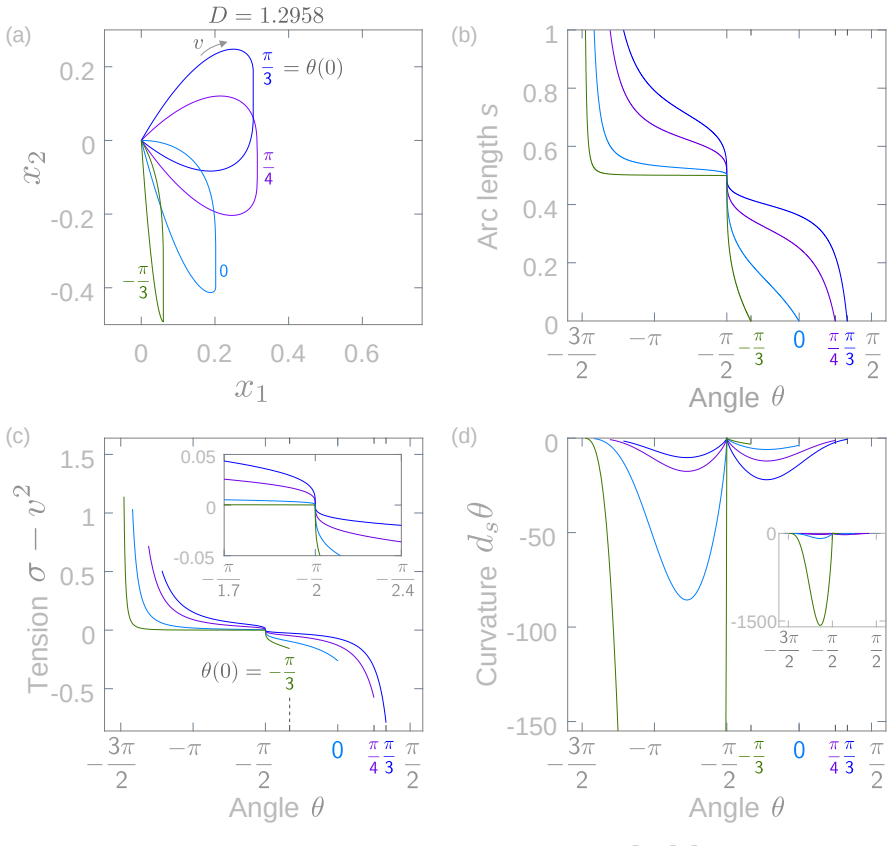
We review, critique, and extend results related to the problem of closed loop shape equilibria of a string shooter, a type of catenary consisting of steady, axially moving configurations of an inertial, inextensible, perfectly flexible string in the presence of gravity and drag forces. We relate to similar problems, including the lariat (no gravity), chain fountain (not closed), and heavy \emph{elastica} (bending stiffness). We focus on the difficulty inherent to continuing a catenary through a vertical orientation, necessary to close a loop, which difficulty changes in nature as the system undergoes bifurcations with increasing drag. We construct solutions by implementing available analytical results, and numerically generate additional solutions with added bending stiffness. We briefly discuss global balances of linear, angular, and pseudo-momentum for this system.
Editorial analysis
A structured set of objections, weighed in public.
Referee Report
Summary. The manuscript reviews, critiques, and extends results on closed-loop shape equilibria of a string shooter: steady, axially moving, inertial, inextensible, perfectly flexible string configurations under gravity and drag. It connects this to the lariat (no gravity), chain fountain (not closed), and heavy elastica (with bending stiffness). The central focus is the difficulty of continuing a catenary solution through vertical orientations to close the loop and how this changes with drag-induced bifurcations. Solutions are constructed by implementing available analytical results and by numerically generating additional solutions with added bending stiffness; global balances of linear, angular, and pseudo-momentum are briefly discussed.
Significance. If the constructions hold, the paper offers a useful synthesis of prior analytical catenary results with new numerical heavy-elastica cases that address the vertical-orientation singularity and drag bifurcations. Credit is due for the explicit implementation of existing analytical solutions and the generation of additional numerical families with small bending stiffness, which directly tackles a known continuation obstacle. The discussion of global momentum balances, even if not used as a closure, adds context for the modeling assumptions of steady axial motion, inextensibility, and near-perfect flexibility.
major comments (1)
- [Numerical generation of solutions section] Numerical generation of solutions section: the claim that additional solutions are generated with added bending stiffness to close the loop lacks any description of the discretization, boundary conditions at the vertical passage, or convergence tests as the stiffness parameter approaches zero; without these the accuracy of the reported closed-loop shapes cannot be assessed.
minor comments (2)
- [Abstract] The abstract states that prior results are 'critiqued' but the main text does not isolate specific critiques from extensions or implementations of the analytical catenary formulas.
- [Global balances paragraph] Global balances paragraph: the discussion of linear, angular, and pseudo-momentum balances would be clearer if accompanied by the explicit integral statements or the manner in which they are verified for the constructed solutions.
Simulated Author's Rebuttal
We thank the referee for their careful review and constructive comments on our manuscript. We appreciate the positive assessment of the synthesis of analytical and numerical results. Below we address the major comment.
read point-by-point responses
-
Referee: [Numerical generation of solutions section] Numerical generation of solutions section: the claim that additional solutions are generated with added bending stiffness to close the loop lacks any description of the discretization, boundary conditions at the vertical passage, or convergence tests as the stiffness parameter approaches zero; without these the accuracy of the reported closed-loop shapes cannot be assessed.
Authors: We acknowledge that the current manuscript provides limited details on the numerical implementation in the section discussing solutions with added bending stiffness. To address this, in the revised version we will add a more thorough description of the numerical method. Specifically, we will detail the discretization scheme (e.g., the type of finite element or collocation method used for the heavy elastica equations), the boundary conditions applied to handle the passage through vertical orientations (leveraging the bending stiffness to avoid singularities), and include convergence studies showing the limit as the stiffness parameter tends to zero. This will allow better assessment of the reported closed-loop shapes and their relation to the analytical catenary solutions. revision: yes
Circularity Check
No significant circularity
full rationale
The manuscript constructs solutions by implementing existing analytical catenary results from the literature and numerically generates additional heavy-elastica cases with small bending stiffness. No load-bearing step reduces a claimed prediction or first-principles result to a parameter fitted from the same data or to a self-citation whose content is itself unverified. Global momentum balances are discussed separately and are not invoked as an unverified closure. The derivation therefore remains self-contained against external benchmarks and prior independent results.
Axiom & Free-Parameter Ledger
axioms (2)
- domain assumption The string is inertial, inextensible, and perfectly flexible.
- domain assumption Configurations are steady and axially moving.
Lean theorems connected to this paper
-
IndisputableMonolith/Cost/FunctionalEquation.leanwashburn_uniqueness_aczel unclear?
unclearRelation between the paper passage and the cited Recognition theorem.
We construct solutions by implementing available analytical results, and numerically generate additional solutions with added bending stiffness.
-
IndisputableMonolith/Foundation/RealityFromDistinction.leanreality_from_one_distinction unclear?
unclearRelation between the paper passage and the cited Recognition theorem.
The equations of an axially moving catenary... (σ−v²)dsθ=cosθ, dsσ=sinθ+D
What do these tags mean?
- matches
- The paper's claim is directly supported by a theorem in the formal canon.
- supports
- The theorem supports part of the paper's argument, but the paper may add assumptions or extra steps.
- extends
- The paper goes beyond the formal theorem; the theorem is a base layer rather than the whole result.
- uses
- The paper appears to rely on the theorem as machinery.
- contradicts
- The paper's claim conflicts with a theorem or certificate in the canon.
- unclear
- Pith found a possible connection, but the passage is too broad, indirect, or ambiguous to say the theorem truly supports the claim.
Reference graph
Works this paper leans on
-
[1]
11th International Physicists’ Tournament 2019.https://2019.iptnet.info/problems/
work page 2019
-
[2]
B. Yeany. String shooter-string launcher- physics of toys.https://www.youtube.com/watch?v= rffAjZPmkuU
-
[3]
B. Chakrabarti and J. A. Hanna. Catenaries in viscous fluid.Journal of Fluids and Structures, 66:490– 516, 2016
work page 2016
-
[4]
C. C. L. Gregory. Theory of a loop revolving in air, with observations on the skin-friction.The Quarterly Journal of Mechanics and Applied Mathematics, II(1):30–39, 1949
work page 1949
-
[5]
B. Yeany. String launcher. Yeany Educational Products, Palmyra, PA
-
[6]
J. Aitken. An account of some experiments on rigidity produced by centrifugal force.Philosophical Magazine, 5(29):81–105, 1878
-
[7]
N. Tuck. Lariat chain.https://www.normantuck.com/lariatchain, 1987
work page 1987
-
[8]
T. J. Healey and J. N. Papadopoulos. Steady axial motions of strings.Journal of Applied Mechanics, 57:785–787, 1990
work page 1990
-
[9]
E. J. Routh.The Advanced Part of a Treatise on the Dynamics of a System of Rigid Bodies. Dover, New York, 1955
work page 1955
-
[10]
G. B. Airy. On the mechanical conditions of the deposit of a submarine cable.Philosophical Magazine, 16:1–18, 1858
-
[11]
W. H. Thomson. On machinery for laying submarine telegraph cables.The Engineer, 4:185–187 and 280, 1857
-
[12]
Gray.A Treatise on Gyrostatics and Rotational Motion
A. Gray.A Treatise on Gyrostatics and Rotational Motion. Dover, New York, 1959
work page 1959
-
[13]
N. C. Perkins and C. D. Mote, Jr. Theoretical and experimental stability of two translating cable equilibria.Journal of Sound and Vibration, 128:397–410, 1989
work page 1989
-
[14]
J. A. Hanna and H. King. An instability in a straightening chain. [arXiv:1110.2360]
work page internal anchor Pith review Pith/arXiv arXiv
-
[15]
J. A. Hanna and C. D. Santangelo. Slack dynamics on an unfurling string.Physical Review Letters, 109:134301, 2012
work page 2012
-
[16]
J. S. Biggins. Growth and shape of a chain fountain.Europhysics Letters, 106:44001, 2014
work page 2014
-
[17]
C. W. Allen. Obituary: Mr. C. C. L. Gregory.Nature, 205:342, 1965
work page 1965
-
[18]
E. M. Burbidge. Obituary Notice: Christopher Clive Langton Gregory.Quarterly Journal of the Royal Astronomical Society, 7:81–83, 1965
work page 1965
-
[19]
G. Judd. Effect of skin drag and rotation effects on a spinning loop of line.https://vimeo.com/ 72049798
-
[20]
J. J. Bevan and J. H. B. Deane. A rigorous mathematical treatment of the shape of a dissipative rope fountain.Proceedings of the Royal Society A, 475:20190612, 2019
work page 2019
- [21]
-
[22]
Propelled strings: Rising from friction.Physical Review Letters, 123:144501, 2019
N Taberlet, J Ferrand, and N Plihon. Propelled strings: Rising from friction.Physical Review Letters, 123:144501, 2019. 17
work page 2019
-
[23]
G. Judd. Personal communication, 2013
work page 2013
-
[24]
The charmed string: self-supporting loops through air drag.Journal of Fluid Mechanics, 877:R2, 2019
A Daerr, J Courson, M Abello, W Toutain, and B Andreotti. The charmed string: self-supporting loops through air drag.Journal of Fluid Mechanics, 877:R2, 2019
work page 2019
-
[25]
R. Munroe. Duty calls.https://xkcd.com/386/
-
[26]
J. Miller. Self siphoning bead ball-chain - from a parking garage roof.https://www.youtube.com/ watch?v=_ZhJFCSIzR8
-
[27]
O. M. O’Reilly.Modeling Nonlinear Problems in the Mechanics of Strings and Rods. Springer, New York, 2017
work page 2017
-
[28]
L. T. Watson and C. Y. Wang. Hanging an elastic ring.International Journal of Mechanical Sciences, 23:161–167, 1981
work page 1981
-
[29]
C. Y. Wang. A critical review of the heavy elastica.International Journal of Mechanical Sciences, 28:549–559, 1986
work page 1986
-
[30]
J. H. Maddocks and D. J. Dichmann. Conservation laws in the dynamics of rods.Journal of Elasticity, 34:83–96, 1994
work page 1994
-
[31]
H. Singh and J. A. Hanna. Pseudomomentum: origins and consequences.Zeitschrift für angewandte Mathematik und Physik, 72:122, 2021
work page 2021
-
[32]
L. J. F. Broer. On the dynamics of strings.Journal of Engineering Mathematics, 4:195–202, 1970
work page 1970
-
[33]
T. J. Healey. Stability of axial motions of nonlinearly elastic loops.Zeitschrift für angewandte Mathe- matik und Physik, 47:809–816, 1996
work page 1996
- [34]
-
[35]
D. M. Stump and G. H. M. van der Heijden. Matched asymptotic expansions for bent and twisted rods: applications for cable and pipeline laying.Journal of Engineering Mathematics, 38:13–31, 2000
work page 2000
-
[36]
P. Wolfe. Hanging cables with small bending stiffness.Nonlinear Analysis, Theory, Methods & Appli- cations, 20(10):1193–1204, 1993. 18
work page 1993
discussion (0)
Sign in with ORCID, Apple, or X to comment. Anyone can read and Pith papers without signing in.