Learn to Relax with Large Language Models: Solving Constraint Optimization Problems via Bidirectional Coevolution
Pith reviewed 2026-05-18 16:59 UTC · model grok-4.3
The pith
Large language models can solve hard constraint optimization problems by synthesizing principled relaxation strategies and evolving them bidirectionally with search algorithms.
A machine-rendered reading of the paper's core claim, the machinery that carries it, and where it could break.
Core claim
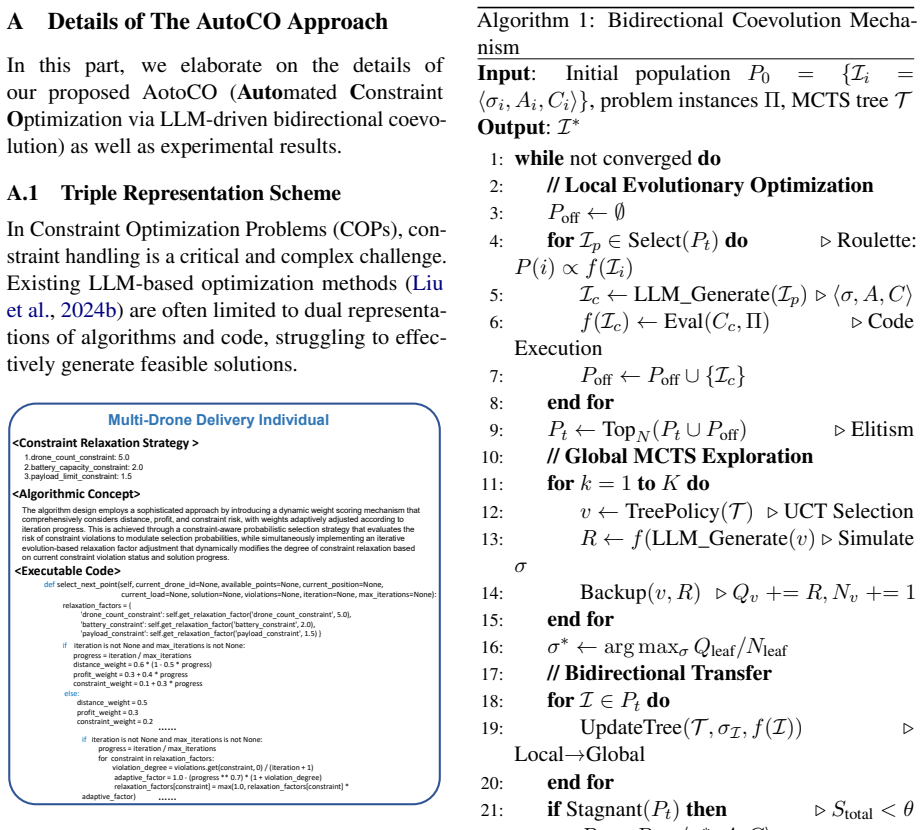
AutoCO couples operations-research principles of constraint relaxation with LLM reasoning via a unified triple-representation that links relaxation strategies, algorithmic principles, and executable codes, allowing the model to synthesize, justify, and instantiate both principled and directly runnable relaxations, while a bidirectional global-local coevolution mechanism pairs MCTS for exploring relaxation trajectories with evolutionary algorithms for local intensification to balance diversification and intensification and prevent premature convergence.
What carries the argument
Unified triple-representation binding relaxation strategies, algorithmic principles, and executable codes, together with bidirectional coevolution between global Monte Carlo Tree Search trajectories and local evolutionary intensification.
If this is right
- LLM-based solvers can shift from verification to active problem reformulation on complex instances.
- Hard constraint problems become more tractable when relaxation trajectories are explored globally and refined locally in a closed loop.
- Optimization outputs gain verifiability because each relaxation step stays grounded in established operations-research principles.
- Premature convergence is reduced through explicit exchange of priors and feedback between global and local search components.
Where Pith is reading between the lines
- The same relaxation-plus-coevolution pattern could be tested on scheduling or logistics problems where constraint tightening is equally central.
- Future checks might examine whether the method remains effective when the underlying LLM changes or when problem size grows beyond current benchmarks.
- One open question is how to add automated soundness checks so that synthesized relaxations never admit solutions that violate the original constraints.
Load-bearing premise
Large language models can reliably synthesize, justify, and instantiate relaxation strategies that are both principled and directly executable as code.
What would settle it
Applying the method to the same hard COP benchmarks and observing that performance does not exceed current approaches or that many generated relaxations produce invalid or infeasible solutions.
Figures




read the original abstract
Large Language Model (LLM)-based optimization has recently shown promise for autonomous problem solving, yet most approaches still cast LLMs as passive constraint checkers rather than proactive strategy designers, limiting their effectiveness on complex Constraint Optimization Problems (COPs). To address this, we present AutoCO, an end-to-end Automated Constraint Optimization method that tightly couples operations-research principles of constraint relaxation with LLM reasoning. A core innovation is a unified triple-representation that binds relaxation strategies, algorithmic principles, and executable codes. This design enables the LLM to synthesize, justify, and instantiate relaxation strategies that are both principled and executable. To navigate fragmented solution spaces, AutoCO employs a bidirectional global-local coevolution mechanism, synergistically coupling Monte Carlo Tree Search (MCTS) for global relaxation-trajectory exploration with Evolutionary Algorithms (EAs) for local solution intensification. This continuous exchange of priors and feedback explicitly balances diversification and intensification, thus preventing premature convergence. Extensive experiments on three challenging COP benchmarks validate AutoCO's consistent effectiveness and superior performance, especially in hard regimes where current methods degrade. Results highlight AutoCO as a principled and effective path toward proactive, verifiable LLM-driven optimization.
Editorial analysis
A structured set of objections, weighed in public.
Referee Report
Summary. The manuscript introduces AutoCO, an end-to-end Automated Constraint Optimization method that tightly couples operations-research principles of constraint relaxation with LLM reasoning. A core innovation is a unified triple-representation that binds relaxation strategies, algorithmic principles, and executable codes, enabling the LLM to synthesize, justify, and instantiate principled and executable relaxation strategies. AutoCO employs a bidirectional global-local coevolution mechanism that synergistically couples Monte Carlo Tree Search (MCTS) for global relaxation-trajectory exploration with Evolutionary Algorithms (EAs) for local solution intensification, explicitly balancing diversification and intensification to prevent premature convergence. The paper claims that extensive experiments on three challenging COP benchmarks validate AutoCO's consistent effectiveness and superior performance, especially in hard regimes where current methods degrade.
Significance. If the empirical claims hold, this work could meaningfully advance LLM-driven optimization by positioning LLMs as proactive strategy designers grounded in OR principles rather than passive constraint checkers. The unified triple-representation and bidirectional coevolution offer a coherent architecture for navigating fragmented solution spaces in COPs, with potential for more verifiable and robust solvers if the performance gains are reproducible and the relaxation strategies are shown to be reliably principled.
major comments (2)
- Abstract: the central claim of 'consistent effectiveness and superior performance' on three COP benchmarks, along with prevention of premature convergence, is load-bearing for the paper's contribution, yet the abstract provides no quantitative results, error bars, baseline comparisons, or details on how the relaxation strategies were validated as principled; the results section must supply these to allow assessment of the effectiveness claims.
- Framework description (unified triple-representation and bidirectional coevolution): the assumption that LLMs can reliably synthesize OR-grounded relaxation strategies that are both principled and directly executable is central to the method, but without concrete examples, ablation studies, or metrics on the quality of generated strategies (e.g., feasibility rates or adherence to OR principles), it remains unclear whether this component functions as asserted or reduces to heuristic prompting.
minor comments (2)
- Abstract: consider specifying the three COP benchmarks by name to provide immediate context for the claimed superiority.
- Notation: ensure the unified triple-representation is formally defined (e.g., as a tuple or data structure) rather than described only at a high level, to improve clarity for readers implementing the method.
Simulated Author's Rebuttal
We thank the referee for their constructive and insightful comments. We address each major comment point by point below, indicating where revisions will be incorporated to strengthen the manuscript.
read point-by-point responses
-
Referee: Abstract: the central claim of 'consistent effectiveness and superior performance' on three COP benchmarks, along with prevention of premature convergence, is load-bearing for the paper's contribution, yet the abstract provides no quantitative results, error bars, baseline comparisons, or details on how the relaxation strategies were validated as principled; the results section must supply these to allow assessment of the effectiveness claims.
Authors: We agree that the abstract would benefit from explicit quantitative highlights to better support the central claims. In the revised manuscript, we will update the abstract to include key performance metrics such as average improvement percentages over baselines, standard deviations from repeated runs, and brief notes on how relaxation strategies were validated for feasibility and OR-principle adherence. The results section (Sections 4.1–4.4) already supplies detailed tables with baseline comparisons, error bars, and analysis of strategy quality; we will add explicit cross-references from the abstract to these sections for easier assessment. revision: yes
-
Referee: Framework description (unified triple-representation and bidirectional coevolution): the assumption that LLMs can reliably synthesize OR-grounded relaxation strategies that are both principled and directly executable is central to the method, but without concrete examples, ablation studies, or metrics on the quality of generated strategies (e.g., feasibility rates or adherence to OR principles), it remains unclear whether this component functions as asserted or reduces to heuristic prompting.
Authors: The manuscript already provides concrete examples of the unified triple-representation in Section 3.2, showing LLM-generated relaxation strategies with explicit OR-principle justifications and corresponding executable code snippets. The bidirectional coevolution mechanism is illustrated with algorithmic descriptions and interaction diagrams in Section 3.3. Ablation studies in Section 4.3 quantify the contribution of these components to overall performance. To further strengthen the validation, we will add explicit metrics on strategy feasibility rates and a summary of adherence to OR principles in the revised version, making clear that the approach is grounded rather than purely heuristic. revision: partial
Circularity Check
No significant circularity identified
full rationale
The paper describes AutoCO as an architectural framework that couples LLM-based synthesis of relaxation strategies with a unified triple-representation and bidirectional MCTS-EA coevolution for COPs. No equations, parameter-fitting procedures, or derivation steps are presented that reduce any claimed prediction or result to the inputs by construction. The central claims rest on the design of the triple-representation and coevolution mechanism plus external experimental validation on three benchmarks, rather than any self-referential loop or self-citation that bears the load of the effectiveness argument. The method choices are presented as independent engineering decisions grounded in OR principles, with no evidence of renaming known results or smuggling ansatzes via prior self-work.
Axiom & Free-Parameter Ledger
axioms (2)
- domain assumption LLMs can synthesize, justify, and instantiate relaxation strategies that are both principled and executable
- domain assumption Continuous exchange of priors and feedback between global MCTS and local EA prevents premature convergence
invented entities (2)
-
unified triple-representation
no independent evidence
-
bidirectional global-local coevolution mechanism
no independent evidence
Reference graph
Works this paper leans on
-
[1]
Large Language Models as Optimizers
Novel mutation strategy for enhancing shade and lshade algorithms for global numerical opti- mization.Swarm and Evolutionary Computation, 50:100455. Mahdi Mokhtarzadeh, Reza Tavakkoli-Moghaddam, Chefi Triki, and Yaser Rahimi. 2021. A hybrid of clustering and meta-heuristic algorithms to solve a p-mobile hub location–allocation problem with the depreciatio...
work page internal anchor Pith review Pith/arXiv arXiv 2021
-
[3]
Executable Code : Do not output anything other than the specified requirements. First, read the parent's constraint relaxation strategy and problem information, and understand the current problem's constraint relaxation processing logic. Second, read the parent's algorithmic concept and executable code, learn and locate code segments related to constraint...
-
[5]
Executable Code : Do not output anything other than the specified requirements. First, read the parent's algorithmic concept and executable code, and understand the current code design logic. Second, read the current constraint relaxation strategy, and clarify the constraint relaxation strategy that needs to be implemented. Then, design a new constraint r...
-
[7]
Executable Code : Do not output anything other than the specified requirements. First, read the parent's algorithmic concept and executable code, and understand the current code design logic. Second, read the current constraint relaxation strategy, clarify the constraint relaxation strategy to be implemented and the current implementation approach for con...
-
[9]
Executable Code : Do not output anything other than the specified requirements. Parent1 :[Constraint Relaxation Strategy 1]; [Algorithmic Concept1]; [Executable Code 1] Parent2 :[Constraint Relaxation Strategy 2]; [Algorithmic Concept2]; [Executable Code 2] Figure 14: The prompt detail of crossover strategy 1 Crossover Strategy 2: Code Implementation Prom...
-
[11]
Executable Code : Do not output anything other than the specified requirements. Parent1 :[Constraint Relaxation Strategy 1]; [Algorithmic Concept1]; [Executable Code 1] Parent2 :[Constraint Relaxation Strategy 2]; [Algorithmic Concept2]; [Executable Code 2] Figure 15: The prompt detail of crossover strategy 2 Crossover Strategy 3: Algorithmic concepts Pro...
-
[12]
Algorithmic Concept:
-
[13]
Executable Code : Do not output anything other than the specified requirements. Parent1 :[Constraint Relaxation Strategy 1]; [Algorithmic Concept1]; [Executable Code 1] Parent2 :[Constraint Relaxation Strategy 2]; [Algorithmic Concept2]; [Executable Code 2] Figure 16: The prompt detail of crossover strategy 3 C Experimental Details C.1 Benchmarks To valid...
work page 1987
discussion (0)
Sign in with ORCID, Apple, or X to comment. Anyone can read and Pith papers without signing in.