Structural effects of boron doping in diamond crystals for gamma-ray light-source applications: Insights from molecular dynamics simulations
Pith reviewed 2026-05-21 21:52 UTC · model grok-4.3
The pith
Boron doping stretches diamond's lattice constant and inter-planar distances linearly, deviating from Vegard's Law by more than earlier models predict.
A machine-rendered reading of the paper's core claim, the machinery that carries it, and where it could break.
Core claim
Molecular dynamics simulations of periodic C1-xBx systems at 300 K reveal linear growth of the lattice constant and of the (110) and (100) inter-planar distances with rising boron concentration up to 5 percent; the observed deviation from Vegard's Law exceeds values reported in prior theoretical work and is ascribed to the higher structural quality achieved by modeling conditions close to microwave plasma chemical vapour deposition growth.
What carries the argument
Atomistic molecular dynamics simulations of periodic boron-doped diamond supercells that track lattice expansion and inter-planar spacing under MPCVD-like preparation conditions.
If this is right
- Designers of periodically bent crystal structures can use the reported linear relations to set doping levels that keep gamma-ray channelling efficient.
- The larger deviation from Vegard's Law implies that boron-doped diamond maintains usable crystallinity at concentrations previously thought too distorting.
- Refined simulation protocols can now generate input structures for further modeling of radiation hardness in gamma-ray source components.
Where Pith is reading between the lines
- The same linear scaling could be tested in other diamond-based devices that require precise lattice matching, such as high-power electronics.
- If the quality advantage holds in experiment, boron doping becomes a more reliable knob for tuning diamond without sacrificing the mechanical properties needed for high-energy beam applications.
- Extending the simulations to include explicit radiation-damage cascades would show whether the observed structural trends survive under operating conditions.
Load-bearing premise
The simulated crystals accurately represent the structural quality and defect levels of real microwave plasma chemical vapour deposition grown boron-doped diamond.
What would settle it
Direct X-ray diffraction measurement of the lattice constant and inter-planar spacings in actual 5 percent boron-doped diamond crystals grown by MPCVD, compared against the simulated linear trends.
Figures



read the original abstract
Boron-doped diamond crystals (BDD, C$_{1-x}$B$_{x}$) exhibit exceptional mechanical strength, electronic tunability, and resistance to radiation damage. This makes them promising materials for use in gamma-ray crystal-based light sources. To better understand and quantify the structural distortions introduced by doping, which are critical for maintaining channelling efficiency, we perform atomistic-level molecular dynamics simulations on periodic C$_{1-x}$B$_{x}$ systems of various sizes. These simulations allow the influence of boron concentration on the lattice constant and the (110) and (100) inter-planar distances to be evaluated over the concentration range from pure diamond (0%) to 5% boron at room temperature (300 K). Linear relationships between both lattice constant and inter-planar distance with increasing dopant concentration are observed, with a deviation from Vegard's Law. This deviation is larger than that reported by other theoretical and computational studies; however, this may be attributed to an enhanced crystal quality over these studies, a vital aspect when considering gamma-ray crystal light source design. The methodology presented here incorporates several refinements to closely reflect the conditions of microwave plasma chemical vapour deposition (MPCVD) crystal growth. Validation of the methodology is provided through a comprehensive statistical analysis of the structure of our generated crystals. These results enable reliable atomistic modelling of doped diamond crystals and support their use in the design and fabrication of periodically bent structures for next-generation gamma-ray light source technologies.
Editorial analysis
A structured set of objections, weighed in public.
Referee Report
Summary. The manuscript uses molecular dynamics simulations of periodic C_{1-x}B_x diamond systems (0–5% boron) at 300 K to quantify doping-induced changes in lattice constant and (110)/(100) inter-planar distances. Linear trends are reported, together with a deviation from Vegard's law that exceeds values in prior theoretical studies; the authors attribute the larger deviation to superior crystal quality achieved by refinements that better match MPCVD growth conditions. Validation rests on internal statistical metrics (defect counts, radial distribution functions) of the generated structures.
Significance. If the structural trends and quality attribution hold, the work supplies atomistic guidance for maintaining channelling efficiency in boron-doped diamond crystals intended for gamma-ray light sources. The MPCVD-oriented simulation protocol and statistical validation of generated structures constitute clear strengths that could support reproducible modelling of periodically bent doped-diamond devices.
major comments (3)
- [Abstract] Abstract: the statement that the observed larger deviation from Vegard's law 'may be attributed to an enhanced crystal quality' is not supported by any direct numerical comparison of computed lattice constants or (110)/(100) spacings against experimental XRD values for MPCVD-grown BDD at 0–5% boron; without such benchmarking the attribution remains an untested interpretation.
- [Results/Discussion] Results/Discussion: the claim that internal statistical analysis (defect counts, RDFs) demonstrates that the simulated crystals accurately represent real MPCVD BDD quality is load-bearing for the central interpretation, yet no quantitative comparison is provided to defect metrics or lattice-expansion data reported in prior simulations or experiments at comparable concentrations.
- [Methods] Methods: the interatomic potential and its specific parameterisation for boron–carbon interactions are not described in sufficient detail to allow assessment of whether the reported linear trends and Vegard's deviation are robust or potential-dependent.
minor comments (2)
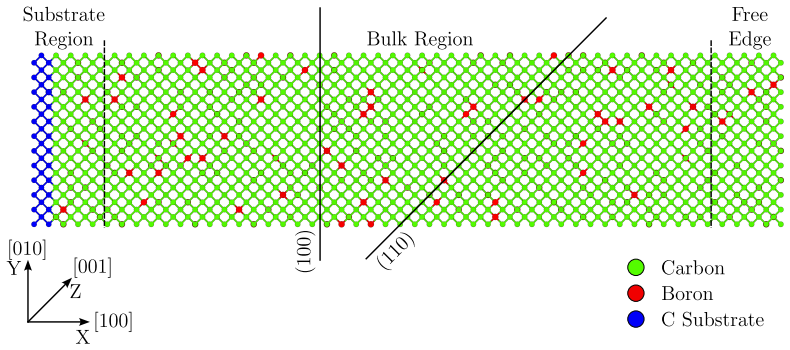
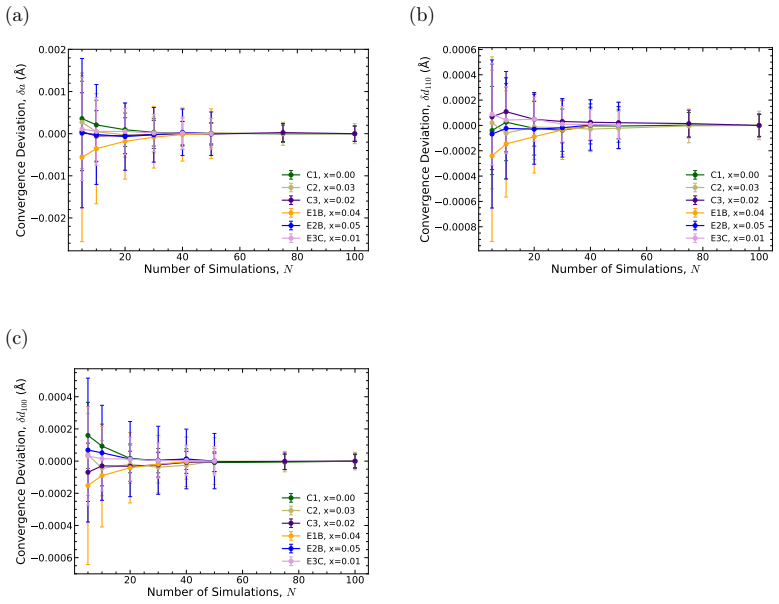
- [Figures] Figure captions should explicitly state the system sizes, number of independent trajectories, and how error bars (if present) were obtained from the MD statistics.
- [Results] Add a short table comparing the present lattice constants at selected boron fractions with the closest available experimental and prior computational values.
Simulated Author's Rebuttal
We thank the referee for their detailed and constructive review of our manuscript. We address each major comment below and have revised the manuscript accordingly to improve clarity and support for our claims.
read point-by-point responses
-
Referee: [Abstract] Abstract: the statement that the observed larger deviation from Vegard's law 'may be attributed to an enhanced crystal quality' is not supported by any direct numerical comparison of computed lattice constants or (110)/(100) spacings against experimental XRD values for MPCVD-grown BDD at 0–5% boron; without such benchmarking the attribution remains an untested interpretation.
Authors: We agree that a direct numerical comparison to experimental XRD data would strengthen the attribution. Comprehensive experimental lattice-expansion measurements for high-quality MPCVD-grown BDD in the narrow 0–5% range are limited in the literature, which is why our interpretation relies on the simulation protocol being tuned to MPCVD conditions and on internal quality metrics. In the revised manuscript we will rephrase the abstract to present the attribution as a reasoned interpretation supported by our protocol and metrics rather than a definitive claim, and we will add a short discussion paragraph referencing available experimental and prior theoretical lattice constants at comparable concentrations. revision: partial
-
Referee: [Results/Discussion] Results/Discussion: the claim that internal statistical analysis (defect counts, RDFs) demonstrates that the simulated crystals accurately represent real MPCVD BDD quality is load-bearing for the central interpretation, yet no quantitative comparison is provided to defect metrics or lattice-expansion data reported in prior simulations or experiments at comparable concentrations.
Authors: We accept that quantitative comparisons to prior work would make the validation more robust. The revised Results/Discussion section will include explicit numerical comparisons of our defect densities and RDF peak widths to values reported in earlier simulation studies and to experimental defect or strain data for BDD at 0–5% boron. These additions will directly support the claim that our refined protocol yields higher crystal quality. revision: yes
-
Referee: [Methods] Methods: the interatomic potential and its specific parameterisation for boron–carbon interactions are not described in sufficient detail to allow assessment of whether the reported linear trends and Vegard's deviation are robust or potential-dependent.
Authors: We thank the referee for this observation. The Methods section will be expanded to specify the exact interatomic potential employed, the source reference, the functional form and all adjustable parameters used for B–C interactions, and any cross-validation performed against known diamond and boron-carbide properties. This will enable readers to evaluate the robustness of the reported trends. revision: yes
Circularity Check
No circularity in MD-derived lattice parameters; results are direct simulation outputs.
full rationale
The paper computes lattice constants and (110)/(100) inter-planar distances via molecular dynamics trajectories on periodic C1-xBx supercells at 300 K. These quantities are extracted directly from the equilibrated atomic configurations rather than from any equation that reduces to a fitted parameter or self-referential definition. The noted larger deviation from Vegard's law is an observational outcome compared to prior studies, with the attribution to 'enhanced crystal quality' offered as an interpretive remark supported by internal metrics (defect counts, radial distribution functions). No self-citation chain, imported uniqueness theorem, or ansatz smuggling is load-bearing for the structural claims. The methodology is self-contained against the simulation benchmarks and statistical validation described.
Axiom & Free-Parameter Ledger
free parameters (1)
- Boron concentration sampling points
axioms (1)
- domain assumption The chosen interatomic potential accurately reproduces boron-carbon bonding and lattice distortions in diamond at room temperature.
Reference graph
Works this paper leans on
-
[1]
K. Muzyka, J. Sun, T. H. Fereja, Y. Lan, W. Zhang, G. Xu, Boron-doped diamond: current progress and challenges in view of electroanalytical applications , Anal. Methods 11 (2019) 397--414. https://doi.org/10.1039/C8AY02197J doi:10.1039/C8AY02197J
-
[2]
Einaga, Boron-Doped Diamond Electrodes: Fundamentals for Electrochemical Applications , Acc
Y. Einaga, Boron-Doped Diamond Electrodes: Fundamentals for Electrochemical Applications , Acc. Chem. Res. 55 (24) (2022) 3605--3615. https://doi.org/10.1021/acs.accounts.2c00597 doi:10.1021/acs.accounts.2c00597
-
[3]
M. Alkahtani, D. K. Zharkov, A. V. Leontyev, A. G. Shmelev, V. G. Nikiforov, P. R. Hemmer, Lightly Boron-Doped Nanodiamonds for Quantum Sensing Applications , Nanomaterials 12 (4) (2022). https://doi.org/10.3390/nano12040601 doi:10.3390/nano12040601
-
[4]
S. Bhattacharya, J. Boyd, S. Reichardt, V. Allard, A. H. Talebi, N. Maccaferri, O. Shenderova, A. L. Lereu, L. Wirtz, G. Strangi, R. M. Sankaran, Intervalence plasmons in boron-doped diamond , Nat. Commun. 16 (1) (2025) 444. https://doi.org/10.1038/s41467-024-55353-0 doi:10.1038/s41467-024-55353-0
-
[5]
L. Thaiyotin, T. Phetchakul, S. Cheirsirikul, S. Supadech, UV photodetectors from B-doped diamond film , in: 2000 TENCON Proceedings. Intelligent Systems and Technologies for the New Millennium (Cat. No.00CH37119) , Vol. 3, 2000, pp. 230--233 vol.3. https://doi.org/10.1109/TENCON.2000.892263 doi:10.1109/TENCON.2000.892263
-
[6]
A. S. Aksenova, A. A. Altuhov, E. V. Ryabeva, V. T. Samosadnyi, V. S. Feshchenko, A. P. Chernyaev, V. A. Shepelev, The investigation of boron-doped diamond absorbance spectrum , J. Phys. Conf. Ser. 798 (1) (2017) 012149. https://doi.org/10.1088/1742-6596/798/1/012149 doi:10.1088/1742-6596/798/1/012149
-
[7]
A. V. Korol, A. V. Solov'yov, W. Greiner, Channeling and Radiation in Periodically Bent Crystals , Springer Berlin, Heidelberg, 2014. https://doi.org/https://doi.org/10.1007/978-3-642-54933-5 doi:https://doi.org/10.1007/978-3-642-54933-5
-
[8]
S. H. Connell, J. H \"a rtwig, A. Masvaure, D. Mavunda, T. N. Tran Thi , https://events.saip.org.za/event/34/attachments/1143/1398/SAIP2014-169.pdf Towards a crystal undulator , in: C. Engelbrecht, S. Karataglidis (Eds.), Proceedings of the 59th Annual Conference of the South African Institute of Physics (SAIP2014) , University of Johannesburg, Johannesbu...
work page 2015
-
[9]
T. N. Tran Thi, J. Morse, D. Caliste, B. Fernandez, D. Eon, J. H \" a rtwig, C. Barbay, C. Mer-Calfati, N. Tranchant, J. C. Arnault, T. A. Lafford, J. Baruchel, Synchrotron Bragg Diffraction Imaging Characterization of Synthetic Diamond Crystals for Optical and Electronic Power Device Applications , J. Appl. Crystallogr. 50 (2) (2017) 561--569. https://do...
-
[10]
A. V. Korol, A. V. Solov'yov, Crystal-based Intensive Gamma-ray Light Sources , Europ. Phys. J. D. 74 (10) (2020) 201. https://doi.org/10.1140/epjd/e2020-10239-8 doi:10.1140/epjd/e2020-10239-8
-
[11]
A. Korol, A. V. Solov'yov, Novel Lights Sources Beyond Free Electron Lasers , Springer Nature, Cham, 2022. https://doi.org/https://doi.org/10.1007/978-3-031-04282-9 doi:https://doi.org/10.1007/978-3-031-04282-9
-
[12]
A. V. Korol, A. V. Solov'yov, Atomistic Modeling and Characterizaion of Light Sources Based on Small-amplitude Short-period Periodically Bent Crystals , Nucl. Instrum. Methods Phys. Res. B 537 (2023) 1--13. https://doi.org/https://doi.org/10.1016/j.nimb.2023.01.012 doi:https://doi.org/10.1016/j.nimb.2023.01.012
-
[13]
G. B. Sushko, A. V. Korol, A. V. Solov'yov, Extremely Brilliant Crystal-based Light Sources , Europ. Phys. J. D. 76 (9) (2022) 166. https://doi.org/10.1140/epjd/s10053-022-00502-7 doi:10.1140/epjd/s10053-022-00502-7
-
[14]
Lindhard, Influence Of Crystal Lattice On Motion Of Energetic Charged Particles , Kongel
J. Lindhard, Influence Of Crystal Lattice On Motion Of Energetic Charged Particles , Kongel. Dan. Vidensk. Selsk., Mat.-Fys. Medd. 34 (14) (1965) 1--64
work page 1965
-
[15]
Kumakhov, On the Theory of Electromagnetic Radiation of Charged Particles in a Crystal , Phys
M. Kumakhov, On the Theory of Electromagnetic Radiation of Charged Particles in a Crystal , Phys. Lett. A 57 (1) (1976) 17--18. https://doi.org/https://doi.org/10.1016/0375-9601(76)90438-2 doi:https://doi.org/10.1016/0375-9601(76)90438-2
-
[16]
U. I. Uggerh j, The Interaction of Relativistic Particles with Strong Crystalline Fields , Rev. Mod. Phys. 77 (4) (2005) 1131--1171. https://doi.org/10.1103/RevModPhys.77.1131 doi:10.1103/RevModPhys.77.1131
-
[17]
A. V. Korol, A. V. Solov'yov, W. Greiner, Photon Emission by an Ultra-relativistic Particle Channeling in a Periodically Bent Crystal , Int. J. Mod. Phys. E 08 (01) (1999) 49--100. https://doi.org/10.1142/S0218301399000069 doi:10.1142/S0218301399000069
-
[18]
V. Guidi, L. Lanzoni, A. Mazzolari, G. Martinelli, A. Tralli, Design of a Crystalline Undulator Based on Patterning by Tensile Si3N4 Strips on a Si Crystal , Appl. Phys. Lett. 90 (11) (2007) 114107. https://doi.org/10.1063/1.2712510 doi:10.1063/1.2712510
-
[19]
V. Guidi, L. Lanzoni, A. Mazzolari, Patterning and Modeling of Mechanically Bent Silicon Plates Deformed through Coactive Stresses , Thin Solid Films 520 (3) (2011) 1074--1079. https://doi.org/https://doi.org/10.1016/j.tsf.2011.09.008 doi:https://doi.org/10.1016/j.tsf.2011.09.008
-
[20]
L. Malagutti, L. Bandiera, F. Bonaf\` e , N. Canale, D. De Salvador , P. Fedeli, J. R. Garrido, V. Guidi, L. Lanzoni, A. Korol, F. Mancarella, R. Negrello, G. Patern\` o , M. Romagnoni, F. Sgarbossa, A. Solov'yov, A. Sytov, D. Valzani, A. Mazzolari, From simulation to fabrication: Realizing silicon crystalline undulators with silicon nitride stressor laye...
-
[21]
S. Bellucci, S. Bini, V. M. Biryukov, Y. A. Chesnokov, S. Dabagov, G. Giannini, V. Guidi, Y. M. Ivanov, V. I. Kotov, V. A. Maisheev, C. Malag\`u, G. Martinelli, A. A. Petrunin, V. V. Skorobogatov, M. Stefancich, D. Vincenzi, Experimental Study for the Feasibility of a Crystalline Undulator , Phys. Rev. Lett. 90 (3) (2003) 034801. https://doi.org/10.1103/P...
-
[22]
V. Guidi, A. Antonini, S. Baricordi, F. Logallo, C. Malag\` u , E. Milan, A. Ronzoni, M. Stefancich, G. Martinelli, A. Vomiero, Tailoring of Silicon Crystals for Relativistic-particle Channeling , Nucl. Instrum. Methods Phys. Res. B 234 (1) (2005) 40--46. https://doi.org/https://doi.org/10.1016/j.nimb.2005.01.008 doi:https://doi.org/10.1016/j.nimb.2005.01.008
-
[23]
E. Bagli, L. Bandiera, V. Bellucci, A. Berra, R. Camattari, D. De Salvador, G. Germogli, V. Guidi, L. Lanzoni, D. Lietti, A. Mazzolari, M. Prest, V. V. Tikhomirov, E. Vallazza, Experimental evidence of planar channeling in a periodically bent crystal , Eur. Phys. J. C 74 (10) (2014) 3114. https://doi.org/10.1140/epjc/s10052-014-3114-x doi:10.1140/epjc/s10...
-
[24]
R. Camattari, G. Patern \` o , M. Romagnoni, V. Bellucci, A. Mazzolari, V. Guidi, Homogeneous self-standing curved monocrystals, obtained using sandblasting, to be used as manipulators of hard X-rays and charged particle beams , J. Appl. Crystallogr. 50 (1) (2017) 145--151. https://doi.org/10.1107/S1600576716018768 doi:10.1107/S1600576716018768
-
[25]
P. Balling, J. Esberg, K. Kirsebom, D. Le, U. Uggerh j, S. Connell, J. H\" a rtwig, F. Masiello, A. Rommeveaux, Bending diamonds by femtosecond laser ablation , Nucl. Instrum. Methods Phys. Res. B 267 (17) (2009) 2952--2957. https://doi.org/https://doi.org/10.1016/j.nimb.2009.06.109 doi:https://doi.org/10.1016/j.nimb.2009.06.109
-
[26]
V. Bellucci, R. Camattari, V. Guidi, A. Mazzolari, G. Patern\` o , G. Mattei, C. Scian, L. Lanzoni, Ion implantation for manufacturing bent and periodically bent crystals , Appl. Phys. Lett. 107 (6) (2015) 064102. https://doi.org/10.1063/1.4928553 doi:10.1063/1.4928553
-
[27]
V. Baryshevsky, I. Dubovskaya, A. Grubich, Generation of gamma-quanta by channeled particles in the presence of a variable external field , Phys. Lett. A 77 (1) (1980) 61--64. https://doi.org/https://doi.org/10.1016/0375-9601(80)90637-4 doi:https://doi.org/10.1016/0375-9601(80)90637-4
-
[28]
H. Ikezi, Y. Lin-Liu, T. Ohkawa, Channeling Radiation in a Periodically Distorted Crystal , Phys. Rev. B 30 (3) (1984) 1567--1569. https://doi.org/10.1103/PhysRevB.30.1567 doi:10.1103/PhysRevB.30.1567
-
[29]
G. V. Dedkov, Channeling Radiation in a Crystal Undergoing an Action of Ultrasonic or Electromagnetic Waves , Phys. Stat. Sol. 184 (2) (1994) 535--542. https://doi.org/https://doi.org/10.1002/pssb.2221840227 doi:https://doi.org/10.1002/pssb.2221840227
-
[30]
A. V. Korol, A. V. Solov'yov, W. Greiner, Coherent Radiation of an Ultrarelativistic Charged Particle Channelled in a Periodically Bent Crystal , J. Phys. G 24 (5) (1998) L45. https://doi.org/10.1088/0954-3899/24/5/001 doi:10.1088/0954-3899/24/5/001
-
[31]
W. Wagner, B. Azadegan, H. Buettig, L. S. Grigoryan, A. Mkrtchyan, J. Pawelke, Channeling Radiation on Quartz Stimulated by Acoustic Waves , Nuovo Cimento C 34 (4) (2011) 133–140. https://doi.org/10.1393/ncc/i2011-10899-4 doi:10.1393/ncc/i2011-10899-4
-
[32]
K. Kaleris, E. Kaselouris, V. Dimitriou, E. Kaniolakis-Kaloudis, M. Bakarezos, M. Tatarakis, N. A. Papadogiannis, G. B. Sushko, A. V. Korol, A. V. Solov'yov, Narrowband -ray radiation generation by acoustically driven crystalline undulators , Phys. Rev. Accel. Beams 28 (2025) 033502. https://doi.org/10.1103/PhysRevAccelBeams.28.033502 doi:10.1103/PhysRevA...
-
[33]
Breese, Beam bending using graded composition strained layers , Nucl
M. Breese, Beam bending using graded composition strained layers , Nucl. Instrum. Methods Phys. Res. B 132 (3) (1997) 540--547. https://doi.org/https://doi.org/10.1016/S0168-583X(97)00455-2 doi:https://doi.org/10.1016/S0168-583X(97)00455-2
-
[34]
U. Mikkelsen, E. Uggerh j, A Crystalline Undulator Based on Graded Composition Strained Layers in a Superlattice , Nucl. Instrum. Methods Phys. Res. B 160 (3) (2000) 435--439. https://doi.org/https://doi.org/10.1016/S0168-583X(99)00637-0 doi:https://doi.org/10.1016/S0168-583X(99)00637-0
-
[35]
R. Avakian, K. Avetyan, K. Ispirian, E. Melikian, Bent crystallographic planes in gradient crystals and crystalline undulators , Nucl. Instrum. Meth. Phys. Res. A 508 (3) (2003) 496--499. https://doi.org/https://doi.org/10.1016/S0168-9002(03)01656-5 doi:https://doi.org/10.1016/S0168-9002(03)01656-5
-
[36]
W. Krause, A. Korol, A. Solov'yov, W. Greiner, Photon emission by ultra-relativistic positrons in crystalline undulators: the high-energy regime , Nucl. Instrum. Meth. Phys. Res. A 483 (1) (2002) 455--460. https://doi.org/https://doi.org/10.1016/S0168-9002(02)00361-3 doi:https://doi.org/10.1016/S0168-9002(02)00361-3
-
[37]
H. J. Goldschmid, Interstitial Alloys , Butterworths, London, 1967. https://doi.org/https://doi.org/10.1007/978-1-4899-5880-8 doi:https://doi.org/10.1007/978-1-4899-5880-8
-
[38]
M. N. R. Ashfold, P. W. May, C. A. Rego, N. M. Everitt, Thin film diamond by chemical vapour deposition methods , Chem. Soc. Rev. 23 (1994) 21--30. https://doi.org/10.1039/CS9942300021 doi:10.1039/CS9942300021
-
[39]
F. Brunet, P. Germi, M. Pernet, A. Deneuville, E. Gheeraert, F. Laugier, M. Burdin, G. Rolland, The effect of boron doping on the lattice parameter of homoepitaxial diamond films , Diam. Relat. Mater. 7 (6) (1998) 869--873. https://doi.org/https://doi.org/10.1016/S0925-9635(97)00316-6 doi:https://doi.org/10.1016/S0925-9635(97)00316-6
-
[40]
J. E. Field (Ed.), Properties of natural and synthetic Diamond , Academic Press, London, 1992
work page 1992
-
[41]
K. W. B \"o er, U. W. Pohl, Crystal Defects , Springer International Publishing, Cham, 2020, pp. 1--54. https://doi.org/10.1007/978-3-319-06540-3_15-4 doi:10.1007/978-3-319-06540-3_15-4
-
[42]
A. Tallaire, V. Mille, O. Brinza, T. N. Tran Thi , J. Brom, Y. Loguinov, A. Katrusha, A. Koliadin, J. Achard, Thick CVD diamond films grown on high-quality type IIa HPHT diamond substrates from New Diamond Technology , Diam. Relat. Mater. 77 (2017) 146--152. https://doi.org/https://doi.org/10.1016/j.diamond.2017.07.002 doi:https://doi.org/10.1016/j.diamon...
-
[43]
B. Campbell, A. Mainwood, Radiation Damage of Diamond by Electron and Gamma Irradiation , physica status solidi (a) 181 (1) (2000) 99--107. https://doi.org/https://doi.org/10.1002/1521-396X(200009)181:1<99::AID-PSSA99>3.0.CO;2-5 doi:https://doi.org/10.1002/1521-396X(200009)181:1<99::AID-PSSA99>3.0.CO;2-5
-
[44]
B. Campbell, W. Choudhury, A. Mainwood, M. Newton, G. Davies, Lattice damage caused by the irradiation of diamond , Nucl. Instrum. Meth. Phys. Res. A 476 (3) (2002) 680--685. https://doi.org/https://doi.org/10.1016/S0168-9002(01)01664-3 doi:https://doi.org/10.1016/S0168-9002(01)01664-3
-
[45]
M. D. Dickers, G. B. Sushko, A. V. Korol, N. J. Mason, F. Fantuzzi, A. V. Solov'yov, Dopant concentration effects on Si _ 1-x Ge _ x crystals for emerging light-source technologies: a molecular dynamics study , Europ. Phys. J. D. 78 (6) (2024) 77. https://doi.org/10.1140/epjd/s10053-024-00870-2 doi:10.1140/epjd/s10053-024-00870-2
-
[46]
I. A. Solov'yov, A. V. Yakubovich, P. V. Nikolaev, I. Volkovets, A. V. Solov'yov, MesoBioNano Explorer--a Universal Program for Multiscale Computer Simulations of Complex Molecular Structure and Dynamics. , J. Comput. Chem. 33 (30) (2012) 2412--2439. https://doi.org/10.1002/jcc.23086 doi:10.1002/jcc.23086
-
[47]
G. B. Sushko, I. A. Solov'yov, A. V. Solov'yov, Modeling MesoBioNano Systems with MBN Studio Made Easy , J. Mol. Graph. Model. 88 (2019) 247--260. https://doi.org/10.1016/j.jmgm.2019.02.003 doi:10.1016/j.jmgm.2019.02.003
-
[48]
Tersoff, New empirical approach for the structure and energy of covalent systems , Phys
J. Tersoff, New empirical approach for the structure and energy of covalent systems , Phys. Rev. B 37 (1988) 6991--7000. https://doi.org/10.1103/PhysRevB.37.6991 doi:10.1103/PhysRevB.37.6991
-
[49]
Tersoff, Modeling solid-state chemistry: Interatomic potentials for multicomponent systems , Phys
J. Tersoff, Modeling solid-state chemistry: Interatomic potentials for multicomponent systems , Phys. Rev. B 39 (1989) 5566--5568. https://doi.org/10.1103/PhysRevB.39.5566 doi:10.1103/PhysRevB.39.5566
-
[50]
K. Matsunaga, C. Fisher, H. Matsubara, Tersoff Potential Parameters for Simulating Cubic Boron Carbonitrides , Jpn. J. Appl. Phys. 39 (01 2000). https://doi.org/10.1143/JJAP.39.L48 doi:10.1143/JJAP.39.L48
-
[51]
T. Saotome, K. Ohashi, T. Sato, H. Maeta, K. Haruna, F. Ono, Thermal expansion of a boron-doped diamond single crystal at low temperatures , J. Phys. Condens. Matter 10 (1998) 1267--1272
work page 1998
-
[52]
u llung der Atome , Zeitschrift f\
L. Vegard, Die Konstitution der Mischkristalle und die Raumf\" u llung der Atome , Zeitschrift f\" u r Physik 5 (1) (1921) 17--26. https://doi.org/10.1007/BF01349680 doi:10.1007/BF01349680
-
[53]
W. Hayami, T. Hiroto, K. Soga, T. Ogitsu, K. Kimura, Thermodynamic stability of elemental boron allotropes with varying numbers of interstitial atoms , J. Solid State Chem. 329 (2024) 124407. https://doi.org/https://doi.org/10.1016/j.jssc.2023.124407 doi:https://doi.org/10.1016/j.jssc.2023.124407
-
[54]
V. V. Brazhkin, E. A. Ekimov, A. G. Lyapin, S. V. Popova, A. V. Rakhmanina, S. M. Stishov, V. M. Lebedev, Y. Katayama, K. Kato, Lattice parameters and thermal expansion of superconducting boron-doped diamonds , Phys. Rev. B 74 (2006) 140502. https://doi.org/10.1103/PhysRevB.74.140502 doi:10.1103/PhysRevB.74.140502
-
[55]
E. Bustarret, E. Gheeraert, K. Watanabe, Optical and electronic properties of heavily boron-doped homo-epitaxial diamond , Phys. Status Solidi (a) 199 (1) (2003) 9--18. https://doi.org/https://doi.org/10.1002/pssa.200303819 doi:https://doi.org/10.1002/pssa.200303819
-
[56]
T. Wojewoda, P. Achatz, L. Ort\' e ga, F. Omn\` e s, C. Marcenat, E. Bourgeois, X. Blase, F. Jomard, E. Bustarret, Doping-induced anisotropic lattice strain in homoepitaxial heavily boron-doped diamond , Diam. Relat. Mater. 17 (7) (2008) 1302--1306. https://doi.org/https://doi.org/10.1016/j.diamond.2008.01.040 doi:https://doi.org/10.1016/j.diamond.2008.01.040
-
[57]
A. Kawano, H. Ishiwata, S. Iriyama, R. Okada, T. Yamaguchi, Y. Takano, H. Kawarada, Superconductor-to-insulator transition in boron-doped diamond films grown using chemical vapor deposition , Phys. Rev. B 82 (2010) 085318. https://doi.org/10.1103/PhysRevB.82.085318 doi:10.1103/PhysRevB.82.085318
-
[58]
K. T. Jacob, S. Raj, L. Rannesh, Vegard's law: a fundamental relation or an approximation? , Int. J. of Mater. Res. 98 (9) (2007) 776--779. https://doi.org/doi:10.3139/146.101545 doi:doi:10.3139/146.101545
-
[59]
E. Bourgeois, E. Bustarret, P. Achatz, F. Omn\`es, X. Blase, Impurity dimers in superconducting B-doped diamond: Experiment and first-principles calculations , Phys. Rev. B 74 (2006) 094509. https://doi.org/10.1103/PhysRevB.74.094509 doi:10.1103/PhysRevB.74.094509
-
[60]
J. P. Goss, P. R. Briddon, R. Jones, Z. Teukam, D. Ballutaud, F. Jomard, J. Chevallier, M. Bernard, A. Deneuville, Deep hydrogen traps in heavily B-doped diamond , Phys. Rev. B 68 (2003) 235209. https://doi.org/10.1103/PhysRevB.68.235209 doi:10.1103/PhysRevB.68.235209
-
[61]
J. P. Goss, P. R. Briddon, Theory of boron aggregates in diamond: First-principles calculations , Phys. Rev. B 73 (2006) 085204. https://doi.org/10.1103/PhysRevB.73.085204 doi:10.1103/PhysRevB.73.085204
-
[62]
J. P. Goss, R. J. Eyre, P. R. Briddon, Bound substitutional impurity pairs in diamond: a density functional study , J. Phys. Condens. Matter 20 (8) (2008) 085217. https://doi.org/10.1088/0953-8984/20/8/085217 doi:10.1088/0953-8984/20/8/085217
-
[63]
T. Watanabe, S. Yoshioka, T. Yamamoto, H. Sepehri-Amin, T. Ohkubo, S. Matsumura, Y. Einaga, The local structure in heavily boron-doped diamond and the effect this has on its electrochemical properties , Carbon 137 (2018) 333--342. https://doi.org/https://doi.org/10.1016/j.carbon.2018.05.026 doi:https://doi.org/10.1016/j.carbon.2018.05.026
-
[64]
A. Verkhovtsev, I. A. Solov'yov, A. V. Korol, G. B. Sushko, A. V. Solov'yov, MBN Explorer and MBN Studio Tutorials: Version 5.0 , MesoBioNano Science Publishing, Frankfurt am Main, Germany, 2024
work page 2024
-
[65]
T. Lundström, B. Lönnberg, J. Bauer, Thermal expansion of -rhombohedral boron, J. Alloys Compd. 267 (1) (1998) 54--58. https://doi.org/https://doi.org/10.1016/S0925-8388(97)00545-8 doi:https://doi.org/10.1016/S0925-8388(97)00545-8
-
[66]
P. Jacobson, S. Stoupin, Thermal expansion coefficient of diamond in a wide temperature range, Diam. Relat. Mater. 97 (2019) 107469. https://doi.org/https://doi.org/10.1016/j.diamond.2019.107469 doi:https://doi.org/10.1016/j.diamond.2019.107469
-
[67]
H. Backe, J. Baruchel, S. B\' e nichou, R. Dowek, D. Eon, P. Everaere, L. Kirste, P. Klag, W. Lauth, P. Stra n \' a k, T. N. T. Caliste, Observation of narrow-band radiation from a boron-doped diamond superlattice with an 855 MeV electron beam (2025). http://arxiv.org/abs/2504.17988 arXiv:2504.17988 , https://doi.org/10.48550/arXiv.2504.17988 doi:10.48550...
work page internal anchor Pith review Pith/arXiv arXiv doi:10.48550/arxiv.2504.17988 2025
-
[68]
J. Zhang, C. Yan, H. Wang, Y. Liu, W. Wang, M. Saenger, Hafnium-doped GaN with n-type electrical resistivity in the 10 ^ -4 \; \; cm range , Appl. Phys. Lett. 99 (20) (2011) 202113. https://doi.org/10.1063/1.3663570 doi:10.1063/1.3663570
-
[69]
rep., Horizon Europe EIC-Pathfinder Project TECHNO-CLS, internal report, Grant Agreement No
TECHNO-CLS Consortium , TECHNO-CLS Periodic Report: Reporting Period 3 , Tech. rep., Horizon Europe EIC-Pathfinder Project TECHNO-CLS, internal report, Grant Agreement No. 101046458, unpublished (2025)
work page 2025
-
[70]
I. A. Solov'yov, G. Sushko, I. Friis, A. V. Solov'yov, Multiscale modeling of stochastic dynamics processes with MBN Explorer , J. Comput. Chem. 43 (21) (2022) 1442--1458. https://doi.org/https://doi.org/10.1002/jcc.26948 doi:https://doi.org/10.1002/jcc.26948
-
[71]
I. A. Solov'yov, A. Prosvetov, G. Sushko, A. V. Solov'yov, Stochastic dynamics simulation of the focused electron beam induced deposition process (2025). http://arxiv.org/abs/2506.18163 arXiv:2506.18163 , https://doi.org/10.48550/arXiv.2506.18163 doi:10.48550/arXiv.2506.18163
-
[72]
C. A. Klein, G. F. Cardinale, Young’s modulus and Poisson’s ratio of CVD diamond, Diam. Relat. Mater. 2 (5) (1993) 918–923. https://doi.org/10.1016/0925-9635(93)90250-6 doi:10.1016/0925-9635(93)90250-6
-
[73]
M. Mohr, A. Caron, P. Herbeck-Engel, R. Bennewitz, P. Gluche, K. Brühne, H.-J. Fecht, Young’s modulus, fracture strength, and Poisson’s ratio of nanocrystalline diamond films, J. Appl. Phys. 116 (12) (2014) 124308. https://doi.org/10.1063/1.4896729 doi:10.1063/1.4896729
-
[74]
P. Hess, The mechanical properties of various chemical vapor deposition diamond structures compared to the ideal single crystal, J. Appl. Phys. 111 (5) (2012) 051101. https://doi.org/10.1063/1.3683544 doi:10.1063/1.3683544
-
[75]
D. G. Clerc, H. Ledbetter, Second-order and third-order elastic properties of diamond: An ab initio study, J. Phys. Chem. Solids 66 (10) (2005) 1589–1597. https://doi.org/10.1016/j.jpcs.2005.05.075 doi:10.1016/j.jpcs.2005.05.075
-
[76]
X. Liu, Y.-Y. Chang, S. N. Tkachev, C. R. Bina, S. D. Jacobsen, Elastic and mechanical softening in boron-doped diamond, Sci. Rep. 7 (1) (2017) 42921. https://doi.org/10.1038/srep42921 doi:10.1038/srep42921
-
[77]
X. J. F. Nye, Physical Properties of Crystals, Oxford University Press, London, England, 1985
work page 1985
discussion (0)
Sign in with ORCID, Apple, or X to comment. Anyone can read and Pith papers without signing in.