Quantum ground-state cooling of two librational modes of a nanorotor
Pith reviewed 2026-05-18 15:53 UTC · model grok-4.3
The pith
Coherent scattering in a cavity cools two librational modes of a silica nanorotor to near the quantum ground state.
A machine-rendered reading of the paper's core claim, the machinery that carries it, and where it could break.
Core claim
By trapping silica nanodimers and trimers and using coherent scattering in a high-finesse cavity, two distinct librational modes are cooled to quantum ground-state occupation numbers as low as n_beta = 0.54 plus or minus 0.32 and n_alpha = 0.21 plus or minus 0.03; simultaneous cooling of both modes yields n_beta = 0.73 plus or minus 0.22 and n_alpha = 1.02 plus or minus 0.08 and aligns the nanorotors to a space-fixed axis with precision better than 20 microradians, close to the zero-point amplitude.
What carries the argument
Coherent scattering of light from the librational motion into a high-finesse optical cavity, which extracts energy from both rotational degrees of freedom and produces sideband asymmetries that report the occupation numbers.
If this is right
- Nanorotors become available as platforms for studying nonlinear quantum dynamics in a compact closed configuration space.
- Simultaneous ground-state cooling of two rotational modes enables space-fixed alignment at the scale of the zero-point libration amplitude.
- Repetitive laser-induced loading of nanodimers and trimers into the tweezer makes the protocol repeatable for further experiments.
- The achieved alignment precision supports applications in quantum sensing that rely on controlled rotational degrees of freedom.
Where Pith is reading between the lines
- Reaching these occupation numbers may allow future tests of quantum mechanics that exploit the nonlinear rotational dynamics unavailable to linear oscillators.
- The same cavity-cooling approach could be extended to larger or more complex nanoscale rotors once the loading and detection methods are scaled.
- Precise alignment to a lab-fixed axis opens the possibility of coupling the nanorotor to other quantum systems, such as spins or photons, for hybrid experiments.
Load-bearing premise
The observed sideband asymmetries in the scattered light spectra accurately report the true quantum occupation numbers of the two librational modes without large systematic errors from calibration, heating, or mode coupling.
What would settle it
An independent measurement of the same modes, for example by direct detection of the zero-point motion amplitude or by comparing the cooling rates against a calibrated heating model, that yields occupation numbers significantly higher than the reported values.
Figures




read the original abstract
Controlling the motion of nanoscale objects at the quantum limit promises new tests of quantum mechanics and advanced sensors. Rotational motion is of particular interest, as it follows nonlinear dynamics in a compact, closed configuration space, which opens up a plethora of phenomena and applications beyond the possibilities of free or trapped linear motion. A prerequisite for such experiments is the capability to trap nanorotors and initialize them in a quantum ground state of libration. Here, we demonstrate the reliable, repetitive laser-induced loading of silica nanodimers and trimers into an optical tweezer. Coherent scattering in a high-finesse cavity allows us to cool two different librational modes to the quantum ground state with occupation numbers as low as $n_{\beta}=0.54\pm0.32$ and $n_{\alpha}=0.21\pm0.03$. By simultaneously cooling both degrees of freedom ($n_\beta=0.73\pm0.22$, $n_\alpha=1.02\pm0.08$) we align nanorotors to a space-fixed axis with precision better than 20$\,\mu$rad, close to the zero-point amplitude of librations.
Editorial analysis
A structured set of objections, weighed in public.
Referee Report
Summary. The manuscript reports reliable laser-induced loading of silica nanodimers and trimers into an optical tweezer, followed by cooling of two librational modes to the quantum ground state via coherent scattering in a high-finesse cavity. Occupation numbers as low as n_β=0.54±0.32 and n_α=0.21±0.03 are achieved in individual cooling; simultaneous cooling yields n_β=0.73±0.22 and n_α=1.02±0.08 while aligning the nanorotor to a space-fixed axis with precision better than 20 μrad.
Significance. If the extracted occupation numbers accurately reflect the true steady-state values, the work constitutes a notable advance in quantum control of rotational degrees of freedom. Ground-state cooling of two librational modes in a compact, closed configuration space enables future studies of nonlinear quantum rotational dynamics and high-precision alignment for sensing applications.
major comments (2)
- [Results and data analysis (cooling spectra)] The central claim that the librational modes reach the reported ground-state occupations rests on extraction of n from sideband asymmetry (or integrated sideband powers) in the cavity output spectra. No explicit heating-rate measurements, bounds on residual tweezer intensity noise, or black-body contributions are provided to rule out systematic inflation of the inferred n; the large uncertainty on n_β already signals possible unmodeled channels.
- [Simultaneous cooling results] In the simultaneous-cooling data set the occupations rise above 0.7, consistent with a possible trade-off from residual mode coupling. The manuscript must demonstrate that the two librational modes remain sufficiently decoupled (e.g., via cross-talk measurements or independent heating-rate tests) for the alignment precision claim to hold.
minor comments (2)
- [Abstract and methods] The abstract states 'repetitive laser-induced loading' but quantitative statistics on loading success rate, trap lifetime, or particle-size distribution should be added to the methods or supplementary information for reproducibility.
- [Introduction / experimental setup] Notation for the two librational modes (α, β) is introduced without an explicit definition or coordinate diagram in the main text; a brief figure or equation defining the axes relative to the dimer/trimer geometry would improve clarity.
Simulated Author's Rebuttal
We thank the referee for their careful reading of the manuscript and for highlighting these important points regarding the robustness of our cooling results. We address each major comment below and have made revisions to strengthen the presentation of the data analysis.
read point-by-point responses
-
Referee: [Results and data analysis (cooling spectra)] The central claim that the librational modes reach the reported ground-state occupations rests on extraction of n from sideband asymmetry (or integrated sideband powers) in the cavity output spectra. No explicit heating-rate measurements, bounds on residual tweezer intensity noise, or black-body contributions are provided to rule out systematic inflation of the inferred n; the large uncertainty on n_β already signals possible unmodeled channels.
Authors: We agree that additional supporting analysis would strengthen the central claim. The sideband asymmetry extraction follows the standard procedure in cavity optomechanics and the quoted uncertainties are obtained directly from the spectral fits. In the revised manuscript we will add explicit estimates of heating rates arising from residual tweezer intensity noise and black-body radiation, together with quantitative bounds showing that these contributions remain well below the achieved cooling rates and do not materially inflate the reported occupation numbers. revision: yes
-
Referee: [Simultaneous cooling results] In the simultaneous-cooling data set the occupations rise above 0.7, consistent with a possible trade-off from residual mode coupling. The manuscript must demonstrate that the two librational modes remain sufficiently decoupled (e.g., via cross-talk measurements or independent heating-rate tests) for the alignment precision claim to hold.
Authors: We acknowledge that residual coupling could in principle affect the simultaneous-cooling results. The manuscript already reports that both modes remain near or below unit occupation under simultaneous cooling, and the alignment precision is extracted from the joint steady state. In the revision we will include cross-talk measurements obtained by independently heating one mode while monitoring the other, together with a brief discussion of the observed decoupling level, to support the alignment claim. revision: yes
Circularity Check
No circularity: direct experimental extraction of occupation numbers from spectra
full rationale
This is an experimental paper reporting laser loading of nanodimers/trimers into an optical tweezer followed by cavity-based cooling of two librational modes. Occupation numbers n_β and n_α are obtained by measuring sideband asymmetries or integrated powers in the cavity output spectrum; these are direct data products, not outputs of a theoretical derivation that reduces to fitted inputs by construction. No self-definitional steps, fitted-input predictions, or load-bearing self-citations appear in the reported chain. The central claims rest on observed spectra and calibration, which remain externally falsifiable and independent of the final quoted values.
Axiom & Free-Parameter Ledger
axioms (1)
- domain assumption The librational modes of the trapped nanorotor can be treated as independent quantum harmonic oscillators coupled to the cavity field via coherent scattering.
Lean theorems connected to this paper
-
IndisputableMonolith/Foundation/RealityFromDistinction.leanreality_from_one_distinction unclear?
unclearRelation between the paper passage and the cited Recognition theorem.
The total Hamiltonian then describes the energy associated with the population of the two cavity modes, the two mechanical modes of frequency Ωμ as well as the interaction between them: H = Σν ℏΔ a†ν aν + Σμ ℏΩμ b†μ bμ + Uint
-
IndisputableMonolith/Cost/FunctionalEquation.leanwashburn_uniqueness_aczel unclear?
unclearRelation between the paper passage and the cited Recognition theorem.
nμ = Γμ + A+μ / (A−μ − A+μ) + nϕ(Ωμ)
What do these tags mean?
- matches
- The paper's claim is directly supported by a theorem in the formal canon.
- supports
- The theorem supports part of the paper's argument, but the paper may add assumptions or extra steps.
- extends
- The paper goes beyond the formal theorem; the theorem is a base layer rather than the whole result.
- uses
- The paper appears to rely on the theorem as machinery.
- contradicts
- The paper's claim conflicts with a theorem or certificate in the canon.
- unclear
- Pith found a possible connection, but the passage is too broad, indirect, or ambiguous to say the theorem truly supports the claim.
Reference graph
Works this paper leans on
-
[1]
(Fig. 4b). We have repeated the procedure of trap- ping, shape assessment, evacuation to high vacuum and cavity cooling for a series of nanoparticles over a period of ∼28hours. Half a dozen nanorotors, marked (i)–(vi) in Fig. 4b–d, were successfully cooled (near) to their libra- tional quantum ground state. They comprise dumbbells, trimers, and clusters. ...
-
[2]
ST acknowledges support from the Austrian Academy of Sciences (ÖAW) through an ESQ discovery project. BAS acknowledges funding by the Carl-Zeiss Foundation through the project QPhoton and by the DFG–510794108. UD acknowledges the support of the Austrian Science Fund (FWF) START grant 10.55776/STA175. Author contributions:ST conceived the experiment with s...
-
[3]
Sakurai, J. J. & Napolitano, J.Modern Quantum Me- chanics(Cambridge University Press, 2020), 3rd edn
work page 2020
-
[4]
Delić, U.et al.Cooling of a levitated nanoparticle to the motional quantum ground state.Science367, 892–895 (2020)
work page 2020
-
[5]
Tebbenjohanns, F., Mattana, M. L., Rossi, M., Frimmer, M. & Novotny, L. Quantum control of a nanoparticle optically levitated in cryogenic free space.Nature595, 378–382 (2021)
work page 2021
-
[6]
Magrini, L.et al.Real-time optimal quantum control of mechanical motion at room temperature.Nature595, 373–377 (2021)
work page 2021
-
[7]
Ranfagni, A., Børkje, K., Marino, F. & Marin, F. Two- dimensional quantum motion of a levitated nanosphere. Phys. Rev. Research4, 033051 (2022)
work page 2022
-
[8]
Deplano, Q., Pontin, A., Ranfagni, A., Marino, F. & Marin, F. High purity two-dimensional levitated mechan- ical oscillator.Nat. Commun.16, 4215 (2025)
work page 2025
-
[9]
Piotrowski, J.et al.Simultaneous ground-state cooling of two mechanical modes of a levitated nanoparticle.Nat. Phys.19, 1009–1013 (2023)
work page 2023
-
[10]
Wang, C.et al.Ground-state cooling of a mechanical oscillator by a noisy environment.Nat. Commun.15, 7395 (2024)
work page 2024
-
[11]
Whittle, C.et al.Approaching the motional ground state of a 10-kg object.Science372, 1333–1336 (2021)
work page 2021
-
[12]
Teufel, J. D.et al.Sideband cooling of micromechanical motion to the quantum ground state.Nature475, 359– 363 (2011)
work page 2011
-
[13]
M.et al.Torsional Optomechanics of a Lev- itated Nonspherical Nanoparticle.Phys
Hoang, T. M.et al.Torsional Optomechanics of a Lev- itated Nonspherical Nanoparticle.Phys. Rev. Lett.117, 123604 (2016)
work page 2016
-
[15]
Rashid, M., Toros, M., Setter, A. & Ulbricht, H. Preces- sion motion in levitated optomechanics.Phys. Rev. Lett. 121, 253601 (2018)
work page 2018
-
[16]
Koch, C. P., Lemeshko, M. & Sugny, D. Quantum con- trol of molecular rotation.Rev. Mod. Phys.91, 035005 (2019)
work page 2019
-
[17]
Ahn, J.et al.Optically levitated nanodumbbell torsion balance and ghz nanomechanical rotor.Phys. Rev. Lett. 121, 033603 (2018)
work page 2018
-
[18]
Reimann, R.et al.GHzRotationofanOpticallyTrapped Nanoparticle in Vacuum.Phys. Rev. Lett.121, 033602 (2018)
work page 2018
-
[19]
Yu, X.et al.6 ghz hyperfast rotation of an optically levitated nanosphere in vacuum.Phot. Res.9, 1344–1350 (2021)
work page 2021
-
[20]
Ahn, J.et al.Ultrasensitive torque detection with an op- tically levitated nanorotor.Nat. Nanotechnol.15, 89–93 (2020)
work page 2020
-
[21]
Jin, Y.et al.6 GHz hyperfast rotation of an optically levitated nanoparticle in vacuum.Photon. Res.9, 1344– 1350 (2021)
work page 2021
-
[22]
Schuck, M., Steinert, D., Nussbaumer, T. & Kolar, J. W. Ultrafast rotation of magnetically levitated macroscopic steel spheres.Sci. Adv.4, e1701519 (2018)
work page 2018
-
[23]
Ju, P.et al.Near-Field GHz Rotation and Sensing with an Optically Levitated Nanodumbbell.Nano Lett.23, 10157–10163 (2023)
work page 2023
-
[24]
Kuhn, S.et al.Optically driven ultra-stable nanome- chanical rotor.Nat. Commun.8, 1670 (2017)
work page 2017
-
[25]
& Safko, J.Classical mechanics (Pearson, 2014), 3rd edn
Goldstein, H., Poole, C. & Safko, J.Classical mechanics (Pearson, 2014), 3rd edn. 7
work page 2014
-
[26]
Ma, Y., Khosla, K. E., Stickler, B. A. & Kim, M. S. Quantum persistent tennis racket dynamics of nanoro- tors.Phys. Rev. Lett.125, 053604 (2020)
work page 2020
- [27]
-
[28]
Hoang, T. M., Ahn, J., Bang, J. & Li, T. Electron spin control of optically levitated nanodiamonds in vacuum. Nat. Commun.7, 12250 (2016)
work page 2016
-
[29]
Rusconi, C., Pöchhacker, V., Kustura, K., Cirac, J. & Romero-Isart, O. Quantum Spin Stabilized Magnetic Levitation.Phys. Rev. Lett.119, 167202 (2017)
work page 2017
-
[30]
Delord, T.et al.Ramsey interferences and spin echoes from electron spins inside a levitating macroscopic parti- cle.Phys. Rev. Lett.121, 053602 (2018)
work page 2018
-
[31]
Delord, T., Huillery, P., Nicolas, L. & Hétet, G. Spin- cooling of the motion of a trapped diamond.Nature580, 56–59 (2020)
work page 2020
-
[32]
Arita, Y.et al.Cooling the optical-spin driven limit cycle oscillations of a levitated gyroscope.Commun. Phys.6, 238 (2023)
work page 2023
-
[33]
Jin, Y.et al.Quantum control and berry phase of elec- tron spins in rotating levitated diamonds in high vacuum. Nat. Commun.15, 5063 (2024)
work page 2024
-
[34]
Stickler, B. A., Hornberger, K. & Kim, M. S. Quantum rotations of nanoparticles.Nat. Rev. Phys.3, 589–597 (2021)
work page 2021
-
[35]
A.et al.Probing macroscopic quantum su- perpositions with nanorotors.New J
Stickler, B. A.et al.Probing macroscopic quantum su- perpositions with nanorotors.New J. Phys.20, 122001 (2018)
work page 2018
-
[36]
Schrinski, B., Stickler, B. A. & Hornberger, K. Collapse- induced orientational localization of rigid rotors [invited]. J. Opt. Soc. Am. B.34, C1–C7 (2017)
work page 2017
-
[37]
Decoherenceasawaytomeasure extremely soft collisions with dark matter.Phys
Riedel, C.J.&Yavin, I. Decoherenceasawaytomeasure extremely soft collisions with dark matter.Phys. Rev. D 96, 023007 (2017)
work page 2017
-
[38]
Carney, D.et al.Mechanical quantum sensing in the search for dark matter.Quantum Sci. Technol.6, 024002 (2021)
work page 2021
-
[39]
Moore, D. C. & Geraci, A. A. Searching for new physics using optically levitated sensors.Quantum Science and Technology6, 014008 (2021)
work page 2021
-
[40]
Friedrich, B. & Herschbach, D. Alignment and trapping of molecules in intense laser fields.Phys. Rev. Lett.74, 4623–4626 (1995)
work page 1995
-
[41]
Revival Structure of Aligned Rotational Wave Packets.Phys
Seideman, T. Revival Structure of Aligned Rotational Wave Packets.Phys. Rev. Lett.83, 4971–4974 (1999)
work page 1999
-
[42]
D.et al.Nonadiabatic alignment of asym- metric top molecules: Rotational revivals.J
Poulsen, M. D.et al.Nonadiabatic alignment of asym- metric top molecules: Rotational revivals.J. Chem. Phys.121, 783–791 (2004)
work page 2004
-
[43]
A.et al.Rotranslational cavity cooling of dielectricrodsanddisks.Phys
Stickler, B. A.et al.Rotranslational cavity cooling of dielectricrodsanddisks.Phys. Rev. A94, 033818(2016)
work page 2016
-
[44]
Schäfer, J., Rudolph, H., Hornberger, K. & Stickler, B. A. Cooling Nanorotors by Elliptic Coherent Scatter- ing.Phys. Rev. Lett.126, 163603 (2021)
work page 2021
-
[45]
Rudolph, H., Schäfer, J., Stickler, B. A. & Hornberger, K. Theory of nanoparticle cooling by elliptic coherent scattering.Phys. Rev. A103, 043514 (2021)
work page 2021
-
[46]
Kamba, M., Shimizu, R. & Aikawa, K. Nanoscale feed- back control of six degrees of freedom of a near-sphere. Nat. Commun.14, 7943 (2023)
work page 2023
-
[47]
Pontin, A., Fu, H., Toroš, M., Monteiro, T. S. & Barker, P. F. Simultaneous cavity cooling of all six degrees of freedom of a levitated nanoparticle.Nat. Phys.19, 1003– 1008 (2023)
work page 2023
-
[48]
Phys.doi:10.1038/s41567–025– 02976–9 (2025)
Dania, L.et al.High-purity quantum optomechanics at room temperature.Nat. Phys.doi:10.1038/s41567–025– 02976–9 (2025)
-
[49]
Arita, Y.et al.Rotational Dynamics and Heating of Trapped Nanovaterite Particles.ACS Nano10, 11505– 11510 (2016)
work page 2016
-
[50]
Hechenblaikner, G., Gangl, M., Horak, P. & Ritsch, H. Cooling an atom in a weakly driven high- Q cavity.Phys. Rev. A58, 3030–3042 (1998)
work page 1998
-
[51]
Vuletić, V., Chan, H. W. & Black, A. T. Three- dimensional cavity Doppler cooling and cavity sideband cooling by coherent scattering.Phys. Rev. A64, 033405 (2001)
work page 2001
-
[52]
Jain, V.et al.Direct Measurement of Photon Recoil from a Levitated Nanoparticle.Phys. Rev. Lett.116, 243601 (2016)
work page 2016
-
[53]
Rabl, P., Genes, C., Hammerer, K. & Aspelmeyer, M. Phase-noise induced limitations on cooling and coherent evolution in optomechanical systems.Phys. Rev. A80, 063819 (2009)
work page 2009
-
[54]
Meyer, N.et al.Resolved-sideband cooling of a levitated nanoparticle in the presence of laser phase noise.Phys. Rev. Lett.123, 153601 (2019)
work page 2019
-
[55]
Parniak, M., Galinskiy, I., Zwettler, T. & Polzik, E. S. High-frequency broadband laser phase noise cancellation using a delay line.Opt. Expr.29, 6935–6946 (2021)
work page 2021
-
[56]
Schrinski, B., Stickler, B. A. & Hornberger, K. Inter- ferometric control of nanorotor alignment.Phys. Rev. A 105, L021502 (2022)
work page 2022
-
[57]
Spanner, M., Shapiro, E. A. & Ivanov, M. Coherent control of rotational wave-packet dynamics via fractional revivals.Phys. Rev. Lett.92, 093001 (2004)
work page 2004
-
[58]
Asenbaum, P., Kuhn, S., Nimmrichter, S., Sezer, U. & Arndt, M. Cavity cooling of free silicon nanoparticles in high vacuum.Nat. Commun.4, 1–7 (2013)
work page 2013
-
[59]
Nikkhou, M., Hu, Y. H., Sabin, J. A. & Millen, J. Direct and clean loading of nanoparticles into optical traps at millibar pressures.Photonics8, 9 (2021)
work page 2021
-
[60]
S., Mestres, P., Dania, L., Schmöger, L
Bykov, D. S., Mestres, P., Dania, L., Schmöger, L. & Northup, T.E. Directloadingofnanoparticlesunderhigh vacuumintoaPaultrapforlevitodynamicalexperiments. Appl. Phys. Lett.115, 034101 (2019)
work page 2019
-
[61]
Ahn, J.et al.Optically Levitated Nanodumbbell Torsion Balance and GHz Nanomechanical Rotor.Phys. Rev. Lett.121, 033603 (2018)
work page 2018
-
[62]
W.et al.Direct imaging of rotational wave- packet dynamics of diatomic molecules.Phys
Dooley, P. W.et al.Direct imaging of rotational wave- packet dynamics of diatomic molecules.Phys. Rev. A68 (2003)
work page 2003
-
[63]
Weber, S. J., Oppermann, M. & Marangos, J. P. Role of rotational wave packets in strong field experiments. Phys. Rev. Lett.111, 263601 (2013)
work page 2013
-
[64]
Butler, P. J. G. The current picture of the structure and assembly of tobacco mosaic virus.J. Gen. Vir.65, 253–279 (1984)
work page 1984
-
[65]
Dago, S.et al.Stabilizing nanoparticles in the intensity minimum: feedback levitation on an inverted potential. Opt. Express32, 45133–45141 (2024)
work page 2024
-
[66]
H.et al.Laser noise in cavity- optomechanical cooling and thermometry.New J
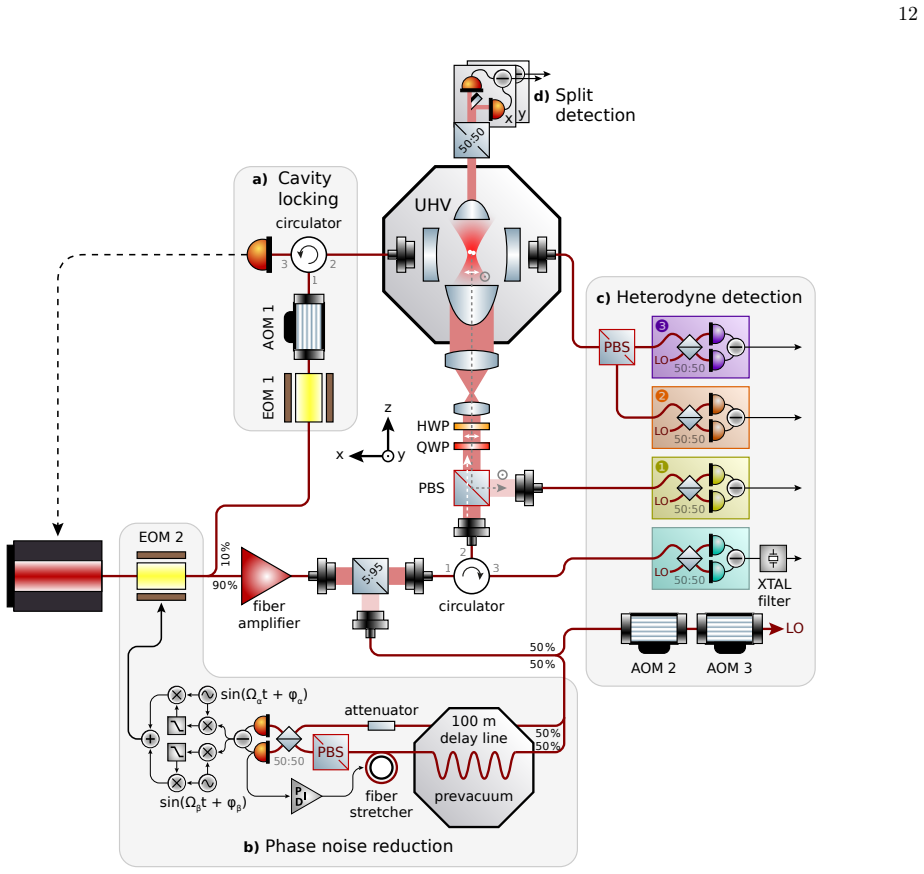
Safavi-Naeini, A. H.et al.Laser noise in cavity- optomechanical cooling and thermometry.New J. Phys. 15, 035007 (2013). 8 SUPPLEMENTARY INFORMATION A. Optical Setup The extended optical setup is shown in Fig. 5. Light emitted by an infrared fiber laser (NKT Photonics Koheras Adjustik E15) passes through the fiber electro-optical modulator EOM 2. We split ...
work page 2013
discussion (0)
Sign in with ORCID, Apple, or X to comment. Anyone can read and Pith papers without signing in.