Light-induced nonlinear Edelstein effect under ferroaxial ordering
Pith reviewed 2026-05-18 19:59 UTC · model grok-4.3
The pith
Ferroaxial ordering tilts light-induced spin magnetization through an electric toroidal dipole.
A machine-rendered reading of the paper's core claim, the machinery that carries it, and where it could break.
Core claim
The central claim is that the nonlinear Edelstein effect, in which a time-dependent electric field induces a static magnetization, becomes sensitive to ferroaxial ordering. The electric toroidal dipole arising from this ordering tilts the induced spin magnetization, and the tilt angle directly measures the ratio between the ferroaxial-origin spin-orbit coupling and the conventional relativistic spin-orbit coupling. Both linearly polarized and circularly polarized light couple to the dipole, each through its own mechanism, as shown by tensor decomposition and explicit calculation in a minimal model.
What carries the argument
The electric toroidal dipole, the cross-product-type spin-orbit coupling produced by ferroaxial ordering that links light polarization to the induced magnetization.
If this is right
- The nonlinear Edelstein tensor is linearly related to the electric toroidal dipole.
- Linearly polarized light and circularly polarized light each activate the dipole through distinct pathways.
- Orbital-to-spin magnetization conversion under light produces the tilted response.
- The tilt angle can separate ferroaxial contributions from ordinary relativistic spin-orbit effects.
Where Pith is reading between the lines
- The same tilt signature could appear in other optical responses that involve orbital magnetism in ferroaxial systems.
- Materials with known rotational distortions, such as certain layered compounds, become natural targets for experimental tests of the predicted angle.
- If confirmed, the effect might enable light-based readout of hidden ferroaxial domains without requiring neutron scattering.
- Extension to time-resolved measurements could track how the tilt evolves with light intensity or frequency.
Load-bearing premise
The minimal model that includes ferroaxial ordering correctly captures how orbital magnetization couples to spin-orbit coupling so that the predicted tilt remains observable.
What would settle it
Perform the nonlinear Edelstein measurement on a material with independently confirmed ferroaxial order and check whether the observed magnetization tilt angle matches the ratio of the two spin-orbit couplings; a clear mismatch would falsify the relation.
Figures


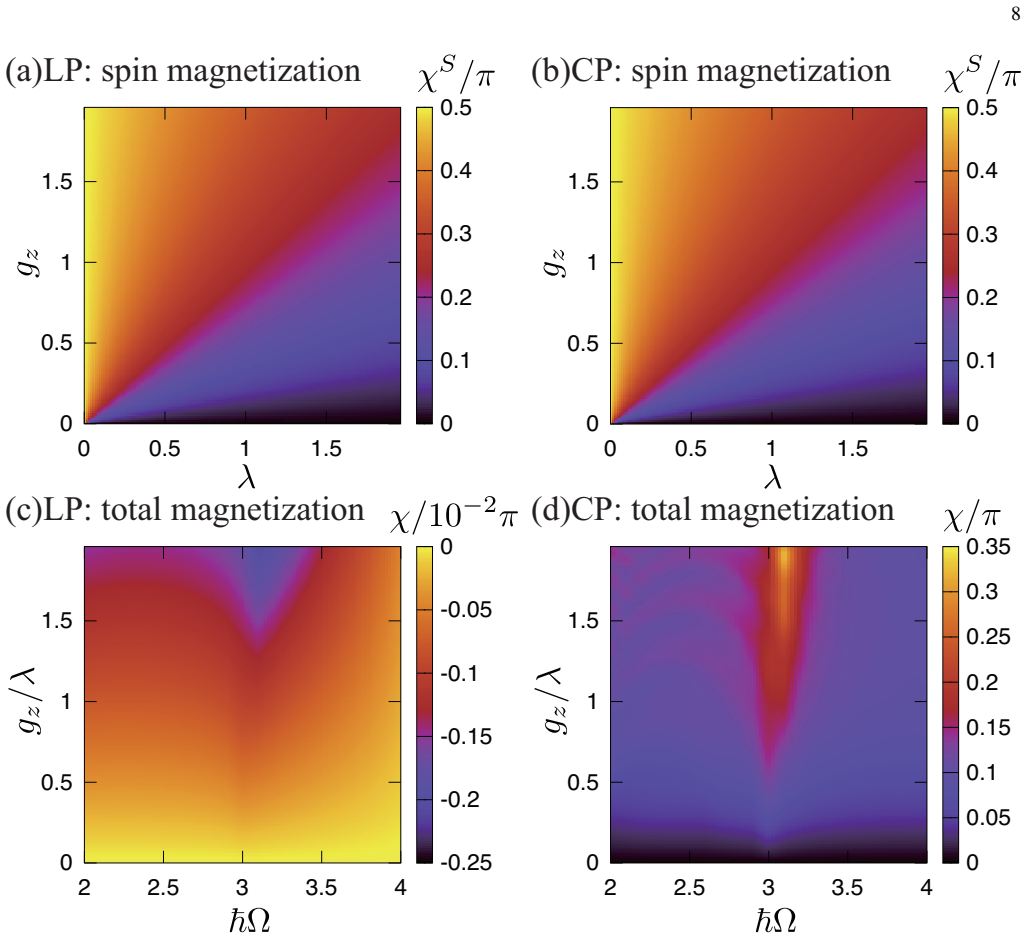


read the original abstract
Ferroaxial ordering, a spontaneous rotational distortion of the atomic arrangement, brings about a cross-product-type spin-orbit coupling (SOC) manifested as an electric toroidal dipole. We propose the light-induced nonlinear Edelstein effect (NLEE) -- a second-order optical response in which a static magnetization is induced by a time-dependent electric field -- as a promising probe of ferroaxial ordering. First, we elucidate the relationship between the NLEE tensor and the electric toroidal dipole. By decomposing the polarization modes of light, we find that both the linearly polarized and circularly polarized light couple to the electric toroidal dipole via distinct mechanisms. We then demonstrate the NLEE using a minimal model that incorporates ferroaxial ordering. Our analysis reveals that effective coupling between orbital magnetization and SOC induces spin magnetization. In particular, the spin magnetization is tilted owing to the electric toroidal dipole; the tilt angle reflects the ratio between the ferroaxial-origin SOC and the relativistic SOC.
Editorial analysis
A structured set of objections, weighed in public.
Referee Report
Summary. The manuscript proposes the light-induced nonlinear Edelstein effect (NLEE) as a probe of ferroaxial ordering. It relates the NLEE tensor to the electric toroidal dipole from ferroaxial order, decomposes the coupling for linearly and circularly polarized light, and uses a minimal model to show that orbital magnetization couples to SOC to produce a tilted spin magnetization whose tilt angle encodes the ratio of ferroaxial-origin SOC to relativistic SOC.
Significance. If the central result holds, the work offers a concrete second-order optical signature for detecting and quantifying ferroaxial order, a phase of growing interest in materials with spontaneous rotational distortions. The polarization-mode decomposition provides mechanistic insight, and the minimal-model demonstration of the tilt angle is a clear, falsifiable prediction that could guide experiments.
major comments (2)
- [Minimal model demonstration] Minimal-model section: the derivation of the tilt angle as the direct ratio of ferroaxial-origin SOC to relativistic SOC assumes that the effective orbital-to-spin conversion is not renormalized by omitted interband transitions or lattice relaxation; no estimate or bound on such corrections is given, which is load-bearing for the claim that the angle is an observable ratio in real materials.
- [Relationship between NLEE tensor and electric toroidal dipole] NLEE tensor relation to electric toroidal dipole: the decomposition into linear and circular polarization channels is presented, but without explicit tensor components or numerical evaluation of the response functions it is not possible to confirm that the two mechanisms remain distinct and non-canceling once higher-order terms are restored.
minor comments (2)
- Notation for the electric toroidal dipole and the SOC terms should be introduced with explicit definitions before the minimal-model Hamiltonian is written.
- Figure captions for any polarization-decomposition plots should state the exact light frequencies and material parameters used.
Simulated Author's Rebuttal
We thank the referee for the constructive report and positive assessment of the significance of our work. We address each major comment below and describe the revisions we will implement.
read point-by-point responses
-
Referee: Minimal-model section: the derivation of the tilt angle as the direct ratio of ferroaxial-origin SOC to relativistic SOC assumes that the effective orbital-to-spin conversion is not renormalized by omitted interband transitions or lattice relaxation; no estimate or bound on such corrections is given, which is load-bearing for the claim that the angle is an observable ratio in real materials.
Authors: We agree that the minimal model isolates the leading-order mechanism and does not quantify possible renormalizations from interband transitions or lattice relaxation. In the revised manuscript we will add a dedicated paragraph that states this assumption explicitly and supplies order-of-magnitude bounds on the corrections, using typical bandwidths, SOC strengths, and relaxation scales reported for known ferroaxial candidates. This will make the range of validity of the predicted tilt angle clearer while preserving the model’s falsifiable character. revision: yes
-
Referee: NLEE tensor relation to electric toroidal dipole: the decomposition into linear and circular polarization channels is presented, but without explicit tensor components or numerical evaluation of the response functions it is not possible to confirm that the two mechanisms remain distinct and non-canceling once higher-order terms are restored.
Authors: We accept that the current presentation would benefit from greater explicitness. In the revision we will insert the full tensor decomposition of the NLEE response expressed in terms of the electric toroidal dipole, separating the linear- and circular-polarization channels. We will also report numerical evaluations of the relevant response functions within the minimal model, confirming that the two channels remain distinct and do not cancel at the order considered. revision: yes
Circularity Check
Derivation from minimal model Hamiltonian is self-contained forward calculation
full rationale
The paper starts from a minimal Hamiltonian incorporating ferroaxial ordering (electric toroidal dipole) as an explicit input, then computes the NLEE tensor via polarization decomposition and derives the induced spin magnetization tilt as an output ratio of ferroaxial-origin SOC to relativistic SOC. This is a standard model-to-observable calculation with no reduction of the final tilt angle or NLEE response to a fitted parameter defined by the same equations, no self-citation load-bearing uniqueness claims, and no ansatz or renaming that collapses the result to its inputs by construction. The central claim remains an independent prediction from the stated model assumptions.
Axiom & Free-Parameter Ledger
axioms (1)
- domain assumption Standard assumptions of spin-orbit coupling and magnetization response in non-centrosymmetric or symmetry-broken crystals.
Lean theorems connected to this paper
-
IndisputableMonolith/Cost/FunctionalEquation.leanwashburn_uniqueness_aczel unclear?
unclearRelation between the paper passage and the cited Recognition theorem.
tan χ ≡ δM⊥/δM∥ = gz/λ (Eq. 22); minimal model ĥ(k) = ĥhop + ĥCEF + λ l·s + gz (l×s)z (Eq. 12)
-
IndisputableMonolith/Foundation/AlexanderDuality.leanalexander_duality_circle_linking unclear?
unclearRelation between the paper passage and the cited Recognition theorem.
ET dipole G = l × s (Eq. 1); ferroaxial ordering preserves SI and TR
What do these tags mean?
- matches
- The paper's claim is directly supported by a theorem in the formal canon.
- supports
- The theorem supports part of the paper's argument, but the paper may add assumptions or extra steps.
- extends
- The paper goes beyond the formal theorem; the theorem is a base layer rather than the whole result.
- uses
- The paper appears to rely on the theorem as machinery.
- contradicts
- The paper's claim conflicts with a theorem or certificate in the canon.
- unclear
- Pith found a possible connection, but the passage is too broad, indirect, or ambiguous to say the theorem truly supports the claim.
Reference graph
Works this paper leans on
-
[1]
1), which gives the absorption condition for the NLEE
1 (red arrow in Fig. 1), which gives the absorption condition for the NLEE. B. Results Figure 2 shows the frequency dependence of the symmetry- allowed NLEE components evaluated by Eq. (9). In the nor- mal state ( gz = 0, point group D6h), the allowed components are ηx;yz = −ηy;zx (LPL) and ξx;x = ξy;y, ξz;z (CPL). In the ferroaxial state ( gz /nequal0, C...
-
[2]
Dynamics of the density operator The dynamics of the density operator ρ(t) obeys the von Neumann equation: iℏ∂tρ(t) = [H(t), ρ(t)], (A11) where ∂t = ∂/∂t, [ A, B] = AB −BA, and H(t) = H0 + V(t). The density operator ρ(t) is expressed by the tensor product labeled by the crystal momentum k, that is, ρ(t) = ∏ k ⊗ρk(t), and the matrix representation of ρk(t)...
-
[3]
Derivation of NLEE tensor The second-order induced magnetization per unit cell is de- fined by δMβ µ(ω) = µB 1 N ∑ kab βµ kbaρ(2) kab(ω) (A20) for µ= x, y, z. µB is Bohr magneton. βrepresents the spin β= S or orbital β= L. Using Eq. (A19) with symmetrization for electric fields, we obtain the NLEE tensor δMµ(ω) = ∑ νλ ∫ dω1dω2 (2π)2 ˜ζµ;νλ(ω; ω1, ω2)Eν(ω1)E...
-
[4]
N. Nagaosa, J. Sinova, S. Onoda, A. H. MacDonald, and N. P . Ong, Anomalous Hall e ffect, Rev. Mod. Phys. 82, 1539 (2010)
work page 2010
-
[5]
D. Xiao, M.-C. Chang, and Q. Niu, Berry phase e ffects on elec- tronic properties, Rev. Mod. Phys. 82, 1959 (2010)
work page 1959
-
[6]
S. Nakatsuji, N. Kiyohara, and T. Higo, Large anomalous Hall effect in a non-collinear antiferromagnet at room temperature , Nature 527, 212 (2015)
work page 2015
-
[7]
S. Hayami and H. Kusunose, Unified description of electronic orderings and cross correlations by complete multipole rep re- sentation, J. Phys. Soc. Jpn. 93, 072001 (2024)
work page 2024
-
[8]
C. Ederer and N. A. Spaldin, Towards a microscopic theory of toroidal moments in bulk periodic crystals, Phys. Rev. B 76, 214404 (2007)
work page 2007
-
[9]
N. A. Spaldin, M. Fiebig, and M. Mostovoy, The toroidal mo- ment in condensed-matter physics and its relation to the magne- toelectric effect*, J. Phys.: Condens. Matter 20, 434203 (2008)
work page 2008
-
[10]
Y . V . Kopaev, Toroidal ordering in crystals, Phys.-Usp.52, 1111 (2009)
work page 2009
-
[11]
W. Jin, E. Drueke, S. Li, A. Admasu, R. Owen, M. Day, K. Sun, S.-W. Cheong, and L. Zhao, Observation of a ferro-rotationa l order coupled with second-order nonlinear optical fields, N at. Phys. 16, 42 (2020)
work page 2020
-
[12]
T. Hayashida, Y . Uemura, K. Kimura, S. Matsuoka, M. Hag- ihala, S. Hirose, H. Morioka, T. Hasegawa, and T. Kimura, Phase transition and domain formation in ferroaxial crysta ls, Phys. Rev. Mater. 5, 124409 (2021)
work page 2021
-
[13]
T. Hayashida, Y . Uemura, K. Kimura, S. Matsuoka, D. Morikawa, S. Hirose, K. Tsuda, T. Hasegawa, and T. Kimura, Visualization of ferroaxial domains in an order- disorder type ferroaxial crystal, Nat Commun 11, 4582 (2020)
work page 2020
-
[14]
H. Y okota, T. Hayashida, D. Kitahara, and T. Kimura, Three- dimensional imaging of ferroaxial domains using circularl y po- larized second harmonic generation microscopy, npj Quantu m Mater. 7, 1 (2022)
work page 2022
-
[15]
X. Fang, C. De, F.-T. Huang, X. Xu, K. Du, K. Wang, B. Li, and S.-W. Cheong, Ferrorotational selectivity in ilmenite s, J. Am. Chem. Soc. 145, 28022 (2023)
work page 2023
- [16]
-
[17]
A. Inda and S. Hayami, Emergent cross-product-type spin-or bit coupling under ferroaxial ordering, Phys. Rev. B 111, L041104 (2025)
work page 2025
-
[18]
A. Roy, M. H. D. Guimar˜ aes, and J. Sławi´ nska, Unconventional spin Hall e ffects in nonmagnetic solids, Phys. Rev. Mater. 6, 045004 (2022)
work page 2022
-
[19]
J. Nasu and S. Hayami, Antisymmetric thermopolarization by electric toroidicity, Phys. Rev. B 105, 245125 (2022)
work page 2022
-
[20]
A. Inda and S. Hayami, Nonlinear transverse magnetic suscep - tibility under electric toroidal dipole ordering, J. Phys. Soc. Jpn. 92, 043701 (2023)
work page 2023
-
[21]
A. Kirikoshi and S. Hayami, Rotational response induced by electric toroidal dipole, J. Phys. Soc. Jpn. 92, 123703 (2023)
work page 2023
-
[22]
M. Battiato, G. Barbalinardo, and P . M. Oppeneer, Quantum theory of the inverse Faraday e ffect, Phys. Rev. B 89, 014413 (2014)
work page 2014
-
[23]
M. Berritta, R. Mondal, K. Carva, and P . M. Oppeneer, Ab initio theory of coherent laser-induced magnetization in metals, Phys. Rev. Lett. 117, 137203 (2016)
work page 2016
-
[24]
H. Xu, J. Zhou, H. Wang, and J. Li, Light-induced static magne- tization: Nonlinear Edelstein e ffect, Phys. Rev. B 103, 205417 (2021)
work page 2021
-
[25]
B. M. Fregoso, Bulk photospin e ffect: Calculation of electric spin susceptibility to second order in an electric field, Phy s. Rev. B 106, 195108 (2022)
work page 2022
-
[26]
V . M. Edelstein, Spin polarization of conduction electrons in- duced by electric current in two-dimensional asymmetric el ec- tron systems, Solid State Communications 73, 233 (1990)
work page 1990
-
[27]
C. Xiao, H. Liu, W. Wu, H. Wang, Q. Niu, and S. A. Yang, Intrinsic nonlinear electric spin generation in centrosym metric magnets, Phys. Rev. Lett. 129, 086602 (2022)
work page 2022
-
[28]
C. Xiao, W. Wu, H. Wang, Y .-X. Huang, X. Feng, H. Liu, G.- Y . Guo, Q. Niu, and S. A. Yang, Time-reversal-even nonlinear current induced spin polarization, Phys. Rev. Lett. 130, 166302 (2023)
work page 2023
-
[29]
R. Guo, Y .-X. Huang, X. Yang, Y . Liu, C. Xiao, and Z. Y uan, Extrinsic contribution to nonlinear current induced spin p olar- ization, Phys. Rev. B 109, 235413 (2024)
work page 2024
- [30]
-
[31]
I. Baek, S. Han, S. Cheon, and H.-W. Lee, Nonlinear orbital and spin Edelstein effect in centrosymmetric metals, npj Spintronics 2, 1 (2024)
work page 2024
-
[32]
J. ¯Oik´ e and R. Peters, Impact of electron correlations on the nonlinear Edelstein e ffect, Phys. Rev. B 110, 165111 (2024). 13 (a) 10 -6 10 -5 10 -4 10 -3 10 -2 10 -4 10 -3 10 -2 10 -1 10 0 (b) 10 -4 10 -3 10 -2 10 -1 10 0 10 1 10 -4 10 -3 10 -2 10 -1 10 0 FIG. 4. Scattering rate dependence of the NLEE tensor in Eq. ( 9) at ℏΩ = 4. For the other model p...
work page 2024
-
[33]
J. ¯Oik´ e, K. Shinada, and R. Peters, Nonlinear magnetoelectri c effect under magnetic octupole order: Application to a d-wave altermagnet and a pyrochlore lattice with all-in/all-out magnetic order, Phys. Rev. B 110, 184407 (2024)
work page 2024
-
[34]
B. S. Mendoza, N. Arzate-Plata, N. Tancogne-Dejean, and B. M. Fregoso, Nonlinear photomagnetization in insulators , Phys. Rev. B 110, 224412 (2024)
work page 2024
-
[35]
R. D. Johnson, S. Nair, L. C. Chapon, A. Bombardi, C. V ec- chini, D. Prabhakaran, A. T. Boothroyd, and P . G. Radaelli, Cu3Nb2O8: A multiferroic with chiral coupling to the crystal structure, Phys. Rev. Lett. 107, 137205 (2011)
work page 2011
-
[36]
R. D. Johnson, L. C. Chapon, D. D. Khalyavin, P . Manuel, P . G. Radaelli, and C. Martin, Giant improper ferroelectricity in the ferroaxial magnet CaMn 7O12, Phys. Rev. Lett. 108, 067201 (2012)
work page 2012
- [37]
- [38]
-
[39]
H. F. Yang, K. Y . He, J. Koo, S. W. Shen, S. H. Zhang, G. Liu, Y . Z. Liu, C. Chen, A. J. Liang, K. Huang, M. X. Wang, J. J. Gao, X. Luo, L. X. Yang, J. P . Liu, Y . P . Sun, S. C. Yan, B. H. Yan, Y . L. Chen, X. Xi, and Z. K. Liu, Visualization of chiral electronic structure and anomalous optical response in a ma - terial with chiral charge density wave...
work page 2022
-
[40]
Jin, V oltage enables ferro-rotational domain switching, Nat
W. Jin, V oltage enables ferro-rotational domain switching, Nat. Nanotechnol. 18, 840 (2023). 14
work page 2023
-
[41]
G. Liu, T. Qiu, K. He, Y . Liu, D. Lin, Z. Ma, Z. Huang, W. Tang, J. Xu, K. Watanabe, T. Taniguchi, L. Gao, J. Wen, J.-M. Liu, B. Yan, and X. Xi, Electrical switching of ferro-rotational order in nanometre-thick 1T-TaS2 crystals, Nat. Nanotechnol.18, 854 (2023)
work page 2023
-
[42]
T. Hayashida, K. Kimura, and T. Kimura, Electric field–induc ed magnetochiral dichroism in a ferroaxial crystal, Proceedi ngs of the National Academy of Sciences 120, e2303251120 (2023)
work page 2023
- [43]
-
[44]
H. Watanabe and Y . Yanase, Chiral photocurrent in parity- violating magnet and enhanced response in topological anti fer- romagnet, Phys. Rev. X 11, 011001 (2021)
work page 2021
-
[45]
M. Yatsushiro, H. Kusunose, and S. Hayami, Multipole classi - fication in 122 magnetic point groups for unified understandi ng of multiferroic responses and transport phenomena, Phys. R ev. B 104, 054412 (2021)
work page 2021
-
[46]
S. Tsirkin and I. Souza, On the separation of Hall and Ohmic nonlinear responses, SciPost Physics Core 5, 039 (2022)
work page 2022
-
[47]
S. Kanda and S. Hayami, Nonlinear frequency-asymmetric op- tical response in chiral systems, Phys. Rev. B 111, 035130 (2025)
work page 2025
-
[48]
M. Oestreich, M. Bender, J. H¨ ubner, D. H¨ agele, W. W. R¨ uhle, T. Hartmann, P . J. Klar, W. Heimbrodt, M. Lampalzer, K. V olz, and W. Stolz, Spin injection, spin transport and spin cohere nce, Semicond. Sci. Technol. 17, 285 (2002)
work page 2002
-
[49]
I. ˇZuti´ c, J. Fabian, and S. Das Sarma, Spintronics: Fundamen- tals and applications, Rev. Mod. Phys. 76, 323 (2004)
work page 2004
- [50]
-
[51]
H. Kusunose, R. Oiwa, and S. Hayami, Symmetry-adapted modeling for molecules and crystals, Phys. Rev. B 107, 195118 (2023)
work page 2023
-
[52]
R. Oiwa and H. Kusunose, Systematic analysis method for non- linear response tensors, J. Phys. Soc. Jpn. 91, 014701 (2022)
work page 2022
-
[53]
SOC is not essential in orbital magnetization in general. Fo r instance, as an e ffect of polarization along the x axis, we add the following hopping term to the Hamiltonian: ˆh′ hop(k) = t′sin (kzc)My. When t′/nequal0, we obtain ξL x;x /nequal0, that is, orbital magnetization is driven even without SOC
-
[54]
A. Agui, S. Matsumoto, H. Sakurai, N. Tsuji, S. Homma, Y . Sakurai, and M. Itou, Microscopic magnetization process in Tb43Co57 film by magnetic compton scattering, Appl. Phys. Ex- press 4, 083002 (2011)
work page 2011
-
[55]
M. Itou, A. Koizumi, and Y . Sakurai, Spin and orbital mag- netization loops obtained using magnetic Compton scatteri ng, Applied Physics Letters 102, 082403 (2013)
work page 2013
- [56]
-
[57]
T. Thonhauser, D. Ceresoli, D. V anderbilt, and R. Resta, Or- bital magnetization in periodic insulators, Phys. Rev. Let t. 95, 137205 (2005)
work page 2005
-
[58]
D. Xiao, J. Shi, and Q. Niu, Berry phase correction to electro n density of states in solids, Phys. Rev. Lett. 95, 137204 (2005)
work page 2005
-
[59]
D. Ceresoli, T. Thonhauser, D. V anderbilt, and R. Resta, Or- bital magnetization in crystalline solids: Multi-band ins ulators, Chern insulators, and metals, Phys. Rev. B 74, 024408 (2006)
work page 2006
-
[60]
J. Shi, G. Vignale, D. Xiao, and Q. Niu, Quantum theory of orbital magnetization and its generalization to interacti ng sys- tems, Phys. Rev. Lett. 99, 197202 (2007)
work page 2007
-
[61]
I. Souza and D. V anderbilt, Dichroic f -sum rule and the orbital magnetization of crystals, Phys. Rev. B 77, 054438 (2008)
work page 2008
-
[62]
Thonhauser, Theory of orbital magnetization in solids, I nt
T. Thonhauser, Theory of orbital magnetization in solids, I nt. J. Mod. Phys. B 25, 1429 (2011)
work page 2011
-
[63]
J. L. Cheng, N. V ermeulen, and J. E. Sipe, Third-order nonlin - earity of graphene: E ffects of phenomenological relaxation and finite temperature, Phys. Rev. B 91, 235320 (2015)
work page 2015
-
[64]
D. J. Passos, G. B. V entura, J. M. V . P . Lopes, J. M. B. L. dos Santos, and N. M. R. Peres, Nonlinear optical responses of crys- talline systems: Results from a velocity gauge analysis, Ph ys. Rev. B 97, 235446 (2018)
work page 2018
-
[65]
K. Das, S. Lahiri, R. B. Atencia, D. Culcer, and A. Agarwal, In - trinsic nonlinear conductivities induced by the quantum me tric, Phys. Rev. B 108, L201405 (2023)
work page 2023
-
[66]
S. I. Marmo and V . D. Ovsiannikov, Electric field induced mag- netization and inverse Cotton-Mouton e ffect in atomic gases, Physics Letters A 202, 201 (1995)
work page 1995
-
[67]
A. M. Kalashnikova, A. V . Kimel, R. V . Pisarev, V . N. Gridnev, A. Kirilyuk, and Th. Rasing, Impulsive generation of cohere nt magnons by linearly polarized light in the easy-plane antif erro- magnet FeBO3, Phys. Rev. Lett. 99, 167205 (2007)
work page 2007
-
[68]
A. M. Kalashnikova, A. V . Kimel, R. V . Pisarev, V . N. Grid- nev, P . A. Usachev, A. Kirilyuk, and Th. Rasing, Impulsive ex - citation of coherent magnons and phonons by subpicosecond laser pulses in the weak ferromagnet FeBO 3, Phys. Rev. B 78, 104301 (2008)
work page 2008
-
[69]
A. Ben-Amar Baranga, R. Battesti, M. Fouch´ e, C. Rizzo, and G. L. J. A. Rikken, Observation of the inverse Cotton-Mouton effect, EPL 94, 44005 (2011)
work page 2011
-
[70]
J. P . van der Ziel, P . S. Pershan, and L. D. Malmstrom, Optically-induced magnetization resulting from the inver se Faraday effect, Phys. Rev. Lett. 15, 190 (1965)
work page 1965
-
[71]
P . S. Pershan, J. P . van der Ziel, and L. D. Malmstrom, Theoret- ical discussion of the inverse Faraday e ffect, Raman scattering, and related phenomena, Phys. Rev. 143, 574 (1966)
work page 1966
-
[72]
T. Tamaki and K. Tsushima, Optically induced magnetization in ruby, J. Phys. Soc. Jpn. 45, 122 (1978)
work page 1978
-
[73]
A. V . Kimel, A. Kirilyuk, P . A. Usachev, R. V . Pisarev, A. M. Balbashov, and T. Rasing, Ultrafast non-thermal control of magnetization by instantaneous photomagnetic pulses, Nat ure 435, 655 (2005)
work page 2005
-
[74]
A. Kirilyuk, A. V . Kimel, and T. Rasing, Ultrafast optical ma - nipulation of magnetic order, Rev. Mod. Phys. 82, 2731 (2010)
work page 2010
discussion (0)
Sign in with ORCID, Apple, or X to comment. Anyone can read and Pith papers without signing in.