Emergent Zeeman-Resilient Superconductivity Beyond the Spin-Paramagnetic Limit in Ultrathin NiBi3
Pith reviewed 2026-05-18 16:40 UTC · model grok-4.3
The pith
Ultrathin NiBi3 films develop superconducting states resilient to magnetic fields beyond the spin-paramagnetic limit.
A machine-rendered reading of the paper's core claim, the machinery that carries it, and where it could break.
Core claim
Ultrathin NiBi3 films develop a highly field-resilient superconducting state, with in-plane critical fields surpassing the spin-paramagnetic limit even above 0.9Tc. This enhancement is activated by dimensional confinement and depends sensitively on film thickness and morphology. Standard mechanisms, including strong spin-orbit coupling and multiband superconductivity, fail to quantitatively explain the observed robustness. These findings uncover an unconventional pathway for Zeeman-resistant superconductivity in low-dimensional materials beyond known Ising and Rashba scenarios, and further support earlier theoretical predictions of triplet pairing in low-dimensional NiBi3.
What carries the argument
Dimensional confinement activating Zeeman-resilient superconductivity in ultrathin films.
Load-bearing premise
The assumption that the in-plane critical fields truly exceed a correctly calculated spin-paramagnetic limit for NiBi3 without measurement artifacts from thickness or morphology variations.
What would settle it
Demonstrating that the critical field returns to the standard spin-paramagnetic limit when the film thickness is increased or the morphology is smoothed to reduce confinement effects.
Figures
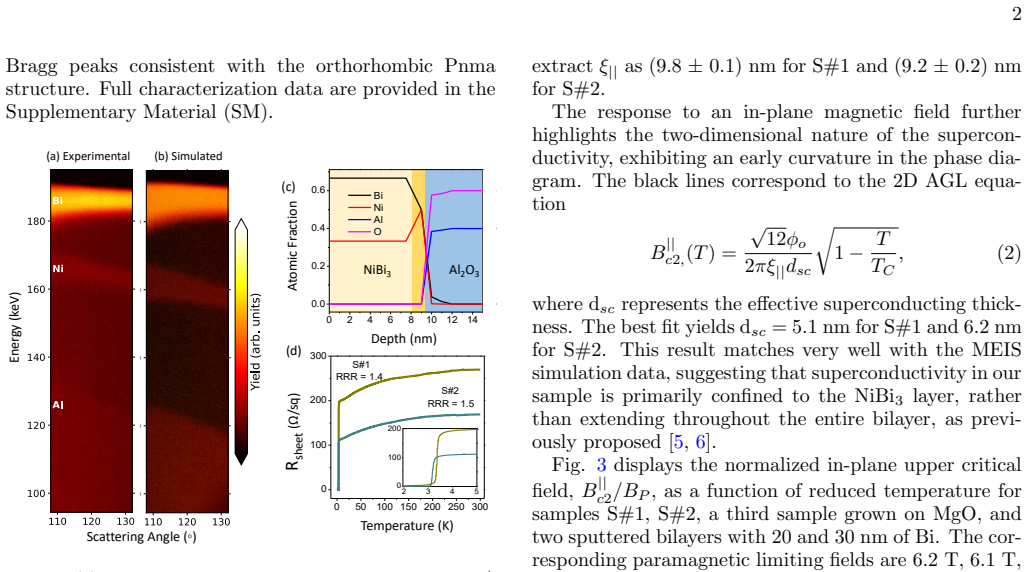


read the original abstract
The spin-paramagnetic limit sets a fundamental magnetic-field bound for conventional superconductors. Here we show that ultrathin NiBi$_3$ films develop a highly field-resilient superconducting state, with in-plane critical fields surpassing the spin-paramagnetic limit even above 0.9T$_C$. This enhancement is activated by dimensional confinement and depends sensitively on film thickness and morphology. Standard mechanisms, including strong spin-orbit coupling and multiband superconductivity, fail to quantitatively explain the observed robustness. These findings uncover an unconventional pathway for Zeeman-resistant superconductivity in low-dimensional materials beyond known Ising and Rashba scenarios, and further support earlier theoretical predictions of triplet pairing in low-dimensional NiBi$_3$.
Editorial analysis
A structured set of objections, weighed in public.
Referee Report
Summary. The manuscript reports experimental observations of in-plane upper critical fields in ultrathin NiBi3 films that exceed the conventional spin-paramagnetic (Pauli) limit at reduced temperatures above 0.9 Tc. The enhancement is attributed to dimensional confinement, with strong dependence on film thickness and morphology; the authors state that standard mechanisms including strong spin-orbit coupling and multiband superconductivity fail to account quantitatively for the data, and suggest an unconventional pathway possibly involving triplet pairing as predicted by earlier theory.
Significance. If the central experimental claim is substantiated by a material-specific recalculation of the Pauli limit and exclusion of morphology-induced artifacts, the result would be significant for the field of low-dimensional superconductivity. It would demonstrate a route to Zeeman resilience beyond established Ising or Rashba scenarios and provide support for theoretical predictions of unconventional pairing in confined NiBi3, with potential implications for designing field-tolerant superconducting devices.
major comments (2)
- [Abstract and Results] The central claim requires that measured in-plane Bc2(T) genuinely exceeds the spin-paramagnetic limit Bp(T) computed for this specific ultrathin NiBi3 system. The abstract states that standard mechanisms fail quantitatively, yet the manuscript does not appear to provide an explicit, thickness-dependent recalculation of Bp(T) from measured normal-state quantities such as susceptibility or specific-heat jump; using the bulk BCS value Bp(0) = 1.86 Tc without film-specific adjustments for effective g-factor or density of states leaves the excess unverified.
- [Experimental Methods and Discussion] Thickness or grain-size variations across the film can produce local regions with higher local Tc or reduced orbital depairing, potentially inflating the globally measured Bc2. The manuscript must demonstrate that transport or magnetization data reflect uniform resilience rather than an average over inhomogeneous morphology; without such controls or spatially resolved measurements, the dependence on morphology risks being an artifact.
minor comments (2)
- [Figures] Error bars, fitting details, and exclusion criteria for the critical-field data should be explicitly shown in all relevant figures to allow quantitative assessment of the claimed excess above 0.9 Tc.
- [Theory section] Notation for the spin-paramagnetic limit (Bp vs. Bp0) and any temperature-dependent expressions should be defined consistently in the text and equations.
Simulated Author's Rebuttal
We are grateful to the referee for the careful reading and constructive comments on our manuscript. The feedback highlights key points that strengthen the presentation of our results. We address each major comment below and have revised the manuscript accordingly.
read point-by-point responses
-
Referee: [Abstract and Results] The central claim requires that measured in-plane Bc2(T) genuinely exceeds the spin-paramagnetic limit Bp(T) computed for this specific ultrathin NiBi3 system. The abstract states that standard mechanisms fail quantitatively, yet the manuscript does not appear to provide an explicit, thickness-dependent recalculation of Bp(T) from measured normal-state quantities such as susceptibility or specific-heat jump; using the bulk BCS value Bp(0) = 1.86 Tc without film-specific adjustments for effective g-factor or density of states leaves the excess unverified.
Authors: We thank the referee for this important observation. We agree that an explicit, thickness-dependent recalculation of the Pauli limit using film-specific normal-state data would provide stronger quantitative support for the central claim. In the revised manuscript, we have added this analysis to the Results section and Supplementary Information. Using our measured susceptibility and specific-heat jump values for the ultrathin films, we recalculate Bp(T) with adjustments for the effective g-factor and density of states. The updated figures and discussion confirm that the in-plane Bc2(T) exceeds the recalculated Bp(T) above 0.9 Tc, consistent with the abstract statement that standard mechanisms do not fully account for the data. revision: yes
-
Referee: [Experimental Methods and Discussion] Thickness or grain-size variations across the film can produce local regions with higher local Tc or reduced orbital depairing, potentially inflating the globally measured Bc2. The manuscript must demonstrate that transport or magnetization data reflect uniform resilience rather than an average over inhomogeneous morphology; without such controls or spatially resolved measurements, the dependence on morphology risks being an artifact.
Authors: We appreciate the referee raising this potential concern about morphological inhomogeneities. Our films were extensively characterized by AFM and XRD, and the transport data exhibit sharp transitions with consistent critical temperatures across samples. The systematic dependence of the critical field on thickness and morphology follows the expected trend from dimensional confinement rather than random local variations. In the revised manuscript, we have expanded the Experimental Methods and Discussion sections with additional magnetization data and analysis to further support uniformity. While spatially resolved superconducting probes are not part of this study, the reproducibility across multiple films and the alignment with theoretical predictions indicate that the observed Zeeman resilience is intrinsic to the confined system. revision: partial
Circularity Check
Experimental measurements compared to standard Pauli limit; no derivation reduces to inputs by construction
full rationale
The manuscript is an experimental report of in-plane critical fields in ultrathin NiBi3 films exceeding the conventional spin-paramagnetic limit. The central result rests on direct transport/magnetization data versus the established BCS expression for Bp(T) and on thickness/morphology dependence; no first-principles derivation, fitted-parameter prediction, or self-referential equation chain is present. Prior theoretical predictions of triplet pairing are cited only as supporting context and do not carry the load-bearing claim. The analysis is therefore self-contained against external benchmarks.
Axiom & Free-Parameter Ledger
axioms (1)
- domain assumption The spin-paramagnetic limit sets a fundamental magnetic-field bound for conventional superconductors.
Lean theorems connected to this paper
-
IndisputableMonolith/Cost/FunctionalEquation.leanwashburn_uniqueness_aczel unclear?
unclearRelation between the paper passage and the cited Recognition theorem.
We report a violation of the spin-paramagnetic limit in the in-plane upper critical field (B||c2) ... none of these mechanisms fully capture the observed behavior.
-
IndisputableMonolith/Foundation/DimensionForcing.leanalexander_duality_circle_linking unclear?
unclearRelation between the paper passage and the cited Recognition theorem.
The temperature-dependent upper critical fields ... 2D AGL equation B||c2(T) = √12 ϕ0 / (2π ξ|| dsc) √(1-T/TC)
What do these tags mean?
- matches
- The paper's claim is directly supported by a theorem in the formal canon.
- supports
- The theorem supports part of the paper's argument, but the paper may add assumptions or extra steps.
- extends
- The paper goes beyond the formal theorem; the theorem is a base layer rather than the whole result.
- uses
- The paper appears to rely on the theorem as machinery.
- contradicts
- The paper's claim conflicts with a theorem or certificate in the canon.
- unclear
- Pith found a possible connection, but the passage is too broad, indirect, or ambiguous to say the theorem truly supports the claim.
Reference graph
Works this paper leans on
-
[1]
M. Sato and Y. Ando, Topological superconductors: a re- view, Reports on Progress in Physics80, 076501 (2017)
work page 2017
-
[2]
J. Linder and J. W. Robinson, Superconducting spintron- ics, Nature Physics11, 307 (2015)
work page 2015
-
[3]
X.-X. Gong, H.-X. Zhou, P.-C. Xu, D. Yue, K. Zhu, X.- F. Jin, H. Tian, G.-J. Zhao, and T.-Y. Chen, Possible p-wave superconductivity in epitaxial bi/ni bilayers, Chi- nese Physics Letters32, 067402 (2015)
work page 2015
-
[4]
J. Wang, X. Gong, G. Yang, Z. Lyu, Y. Pang, G. Liu, Z. Ji, J. Fan, X. Jing, C. Yang,et al., Anomalous mag- netic moments as evidence of chiral superconductivity in a bi/ni bilayer, Physical Review B96, 054519 (2017)
work page 2017
-
[5]
P. Chauhan, F. Mahmood, D. Yue, P.-C. Xu, X. Jin, and N. Armitage, Nodeless bulk superconductivity in the time-reversal symmetry breaking bi/ni bilayer system, Physical review letters122, 017002 (2019)
work page 2019
-
[6]
X. Gong, M. Kargarian, A. Stern, D. Yue, H. Zhou, X. Jin, V. M. Galitski, V. M. Yakovenko, and J. Xia, Time-reversal symmetry-breaking superconductivity in epitaxial bismuth/nickel bilayers, Science advances3, e1602579 (2017)
work page 2017
-
[7]
R. Romero III, Z. Tagay, J. Liang, J. Y. Yan, D. Yue, and N. Armitage, Terahertz range polarization rotation in the candidate time-reversal symmetry breaking super- conductor bini, arXiv preprint arXiv:2508.08026 (2025)
-
[8]
Chao, Superconductivity in a bi/ni bilayer, Physical Review B99, 064504 (2019)
S.-P. Chao, Superconductivity in a bi/ni bilayer, Physical Review B99, 064504 (2019)
work page 2019
-
[9]
M. Vaughan, N. Satchell, M. Ali, C. J. Kinane, G. B. Stenning, S. Langridge, and G. Burnell, Origin of super- conductivity at nickel-bismuth interfaces, Physical Re- view Research2, 013270 (2020)
work page 2020
-
[10]
B. Silva, R. Luccas, N. Nemes, J. Hanko, M. Oso- rio, P. Kulkarni, F. Mompean, M. Garc´ ıa-Hern´ andez, M. Ramos, S. Vieira,et al., Superconductivity and mag- netism on flux-grown single crystals of nibi 3, Physical Review B—Condensed Matter and Materials Physics88, 184508 (2013)
work page 2013
-
[11]
G. Sant’ana, D. M¨ ockli, A. d. C. Viegas, P. Pureur, and M. A. Tumelero, Ni/bi bilayers: The effect of thickness on the superconducting properties, Journal of Applied Physics135(2024)
work page 2024
-
[12]
L. Liu, Y. Xing, I. Merino, H. Micklitz, D. Franceschini, E. Baggio-Saitovitch, D. Bell, and I. Sol´ orzano, Super- conductivity in bi/ni bilayer system: Clear role of su- perconducting phases found at bi/ni interface, Physical Review Materials2, 014601 (2018)
work page 2018
-
[13]
G. Zhao, X. Gong, P. Xu, B. Li, Z. Huang, X. Jin, X.-D. Zhu, and T. Chen, Singlet superconductivity in a single-crystal nibi3 superconductor, Superconductor Sci- ence and Technology31, 125005 (2018)
work page 2018
- [14]
-
[15]
J. Wang, C. Farhang, D. Yue, X. Jin, X. Zhu, and J. Xia, Absence of spontaneous time-reversal symmetry break- ing and ferromagnetism in superconducting ni bi 3 single crystal, Physical Review B107, 024415 (2023)
work page 2023
-
[16]
X. Zhu, H. Lei, C. Petrovic, and Y. Zhang, Surface- induced magnetic fluctuations in a single-crystal nibi 3 superconductor, Physical Review B—Condensed Matter and Materials Physics86, 024527 (2012)
work page 2012
-
[17]
C. Adriano, K. Lee, Y. Kushnirenko, B. Schrunk, K. R. Pakuszewski, L.-L. Wang, S. L. Bud’ko, P. C. Canfield, and A. Kaminski, Bulk and surface electronic structure of nibi 3, Physical Review B107, 165107 (2023)
work page 2023
-
[18]
T. Herrmannsd¨ orfer, R. Skrotzki, J. Wosnitza, D. K¨ ohler, R. Boldt, and M. Ruck, Structure-induced coexistence of ferromagnetic and superconducting states of single-phase bi 3 ni seen via magnetization and resistance measure- ments, Physical Review B—Condensed Matter and Ma- terials Physics83, 140501 (2011)
work page 2011
-
[19]
H. Trombini, F. F. Selau, C. W. Basso, P. Grande, M. Vos, and J. Morais, Structural Characterization of Nanometric Pt Films by Electron- and Ion-Based Tech- niques (2023)
work page 2023
-
[20]
G. G. Marmitt, I. Alencar, H. Trombini, F. F. Selau, B. Konrad, and P. L. Grande, PowerMEIS 3: A versatile tool for simulating ion and electron scattering, Computer 6 Physics Communications313, 109639 (2025)
work page 2025
-
[21]
M. Tinkham, Effect of fluxoid quantization on transi- tions of superconducting films, Physical Review129, 2413 (1963)
work page 1963
-
[22]
N. Werthamer, E. Helfand, and P. Hohenberg, Tempera- ture and purity dependence of the superconducting crit- ical field, h c 2. iii. electron spin and spin-orbit effects, Physical Review147, 295 (1966)
work page 1966
-
[23]
Maki, The magnetic properties of superconducting al- loys
K. Maki, The magnetic properties of superconducting al- loys. ii, Physics Physique Fizika1, 127 (1964)
work page 1964
-
[24]
W. M. van Weerdenburg, A. Kamlapure, E. H. Fyhn, X. Huang, N. P. van Mullekom, M. Steinbrecher, P. Krogstrup, J. Linder, and A. A. Khajetoorians, Ex- treme enhancement of superconductivity in epitaxial alu- minum near the monolayer limit, Science Advances9, eadf5500 (2023)
work page 2023
-
[25]
R. A. Klemm, A. Luther, and M. Beasley, Theory of the upper critical field in layered superconductors, Physical Review B12, 877 (1975)
work page 1975
-
[26]
J. Lu, O. Zheliuk, I. Leermakers, N. F. Yuan, U. Zeitler, K. T. Law, and J. Ye, Evidence for two-dimensional ising superconductivity in gated mos2, Science350, 1353 (2015)
work page 2015
- [27]
-
[28]
L. P. Gor’kov and E. I. Rashba, Superconducting 2d sys- tem with lifted spin degeneracy: mixed singlet-triplet state, Physical Review Letters87, 037004 (2001)
work page 2001
-
[29]
Y. Liu, Z. Wang, X. Zhang, C. Liu, Y. Liu, Z. Zhou, J. Wang, Q. Wang, Y. Liu, C. Xi,et al., Interface-induced zeeman-protected superconductivity in ultrathin crys- talline lead films, Physical Review X8, 021002 (2018)
work page 2018
-
[30]
S. Yoshizawa, T. Kobayashi, Y. Nakata, K. Yaji, K. Yokota, F. Komori, S. Shin, K. Sakamoto, and T. Uchihashi, Atomic-layer rashba-type superconductor protected by dynamic spin-momentum locking, Nature communications12, 1462 (2021)
work page 2021
-
[31]
H. Hayashi and K. Ando, Two-dimensional rashba super- conductivity in ni/bi bilayers evidenced by nonreciprocal transport, Applied Physics Reviews11(2024)
work page 2024
-
[32]
R. Cai, D. Yue, W. Qiao, L. Guo, Z. Chen, X. Xie, X. Jin, and W. Han, Nonreciprocal transport of superconductiv- ity in a bi/ni bilayer, Physical Review B108, 064501 (2023)
work page 2023
-
[33]
Y. Liu, Y. Xu, J. Sun, C. Liu, Y. Liu, C. Wang, Z. Zhang, K. Gu, Y. Tang, C. Ding,et al., Type-ii ising super- conductivity and anomalous metallic state in macro-size ambient-stable ultrathin crystalline films, Nano Letters 20, 5728 (2020)
work page 2020
-
[34]
Y. Xing, K. Zhao, P. Shan, F. Zheng, Y. Zhang, H. Fu, Y. Liu, M. Tian, C. Xi, H. Liu,et al., Ising superconduc- tivity and quantum phase transition in macro-size mono- layer nbse2, Nano letters17, 6802 (2017)
work page 2017
-
[35]
P. Fulde and R. A. Ferrell, Superconductivity in a strong spin-exchange field, Physical Review135, A550 (1964)
work page 1964
-
[36]
A. Larkin and Y. N. Ovchinnikov, Nonuniform state of superconductors, Soviet Physics-JETP20, 762 (1965)
work page 1965
-
[37]
Y. Yanase and M. Sigrist, Antiferromagnetic order and π-triplet pairing in the fulde–ferrell–larkin–ovchinnikov state, Journal of the Physical Society of Japan78, 114715 (2009)
work page 2009
-
[38]
P. Wan, O. Zheliuk, N. F. Yuan, X. Peng, L. Zhang, M. Liang, U. Zeitler, S. Wiedmann, N. E. Hussey, T. T. Palstra,et al., Orbital fulde–ferrell–larkin–ovchinnikov state in an ising superconductor, Nature619, 46 (2023)
work page 2023
-
[39]
N. F. Yuan, Orbital fulde-ferrell-larkin-ovchinnikov state in an ising superconductor, Physical Review Research5, 043122 (2023)
work page 2023
-
[40]
S. Ran, C. Eckberg, Q.-P. Ding, Y. Furukawa, T. Metz, S. R. Saha, I.-L. Liu, M. Zic, H. Kim, J. Paglione,et al., Nearly ferromagnetic spin-triplet superconductivity, Sci- ence365, 684 (2019)
work page 2019
-
[41]
E. Slooten, T. Naka, A. Gasparini, Y. Huang, and A. de Visser, Enhancement of superconductivity near the ferromagnetic quantum critical point in ucoge, Physical review letters103, 097003 (2009)
work page 2009
-
[42]
G. Sant’ana, J. P. P. Pacheco, D. Mockli, F. M. da Rosa, S. G. Magalh˜ aes, P. Pureur, and M. A. Tumelero, Linear magnetoresistance and anomalous hall effect in the su- perconductor nibi {3}, arXiv preprint arXiv:2505.11285 (2025)
-
[43]
V. Mineev, Magnetic field dependence of pairing interac- tion in ferromagnetic superconductors with triplet pair- ing, Physical Review B—Condensed Matter and Materi- als Physics83, 064515 (2011)
work page 2011
-
[44]
Y. Fujimori, S.-i. Kan, B. Shinozaki, and T. Kawaguti, Superconducting and normal state properties of nibi 3, Journal of the Physical Society of Japan69, 3017 (2000)
work page 2000
-
[45]
A. M. Clogston, Upper limit for the critical field in hard superconductors, Physical Review Letters9, 266 (1962). SUPPLEMENT AR Y MA TERIALS I. SAMPLES F ABRICA TION AND STRUCTURAL CHARACTERIZA TION Bi(10 nm)/Ni(1 nm) bilayers were deposited at 300 K via molecular beam epitaxy (MBE) into MgO(001) and Al2O3(001) substrates under a base pressure of 2×10 −10...
work page 1962
discussion (0)
Sign in with ORCID, Apple, or X to comment. Anyone can read and Pith papers without signing in.