Ultrafast optically induced tunneling in narrow metallic gaps from the time dependent density functional perspective
Pith reviewed 2026-05-18 16:28 UTC · model grok-4.3
The pith
TDDFT calculations retrieve experimental currents for optically induced tunneling in narrow metallic gaps without parameters.
A machine-rendered reading of the paper's core claim, the machinery that carries it, and where it could break.
Core claim
Using time-dependent density functional theory, the authors demonstrate that short optical pulses trigger electron tunneling in narrow metallic gaps through photon-assisted mechanisms with one-photon, two-photon, and higher-order absorption at weak fields, transitioning to optical field emission at strong fields. The approach accounts for the tunneling barrier, applied bias, and field strength, with single-electron calculations and an analytical strong-field theory model providing supporting insights. The parameter-free TDDFT results retrieve and explain recent experimental observations of optically induced transport under dc bias.
What carries the argument
Time-dependent density functional theory applied to the metallic gap geometry, which computes the time-dependent electron density and resulting tunneling currents under optical fields to identify photon-assisted orders.
If this is right
- At weak optical fields, tunneling currents show signatures of one-photon or two-photon absorption processes.
- An applied dc bias shifts the effective barrier and increases the overall optically induced transport.
- Stronger optical fields drive a transition to optical field emission that bypasses photon-order dependence.
- The analytical strong-field model reproduces key TDDFT trends and isolates the role of the tunneling barrier.
Where Pith is reading between the lines
- The same framework could be used to predict how gap width or metal choice alters the intensity threshold for the tunneling-to-field-emission crossover.
- Extension to structured electrodes might allow design of light-gated nanoscale switches that operate at optical frequencies without material-specific fitting.
- Discrepancies at very high fields could highlight where current TDDFT functionals miss multi-electron or relativistic corrections in the gap.
Load-bearing premise
The time-dependent density functional theory accurately captures the work function, dielectric response, and geometry of the metallic gaps so that no empirical scaling or fitting is needed to match currents.
What would settle it
A clear mismatch between the TDDFT-predicted dependence of tunneling current on optical field strength or photon order and the measured currents in narrow gaps under single-cycle pulses plus dc bias.
Figures




read the original abstract
In this work, using the time-dependent density functional theory, we address the electron tunneling triggered by short (single-cycle and several-cycle) optical pulses in narrow metallic gaps under conditions relevant for actual experiments. We identify photon-assisted tunneling with one-photon, two-photon, and higher-order photon absorption, and we discuss the effect of the tunneling barrier, applied bias, and strength of the optical field on transition from photon-assisted tunneling (weak optical fields) to the optical field emission at strong optical fields. The numerical single-electron calculations and an analytical strong-field theory model are used to gain deeper insights into the results of the time-dependent density functional theory calculations. Additionally, our parameter-free calculations allow us to retrieve and explain recent experimental results on optically induced transport in narrow metallic gaps under an applied dc bias.
Editorial analysis
A structured set of objections, weighed in public.
Referee Report
Summary. The manuscript applies time-dependent density functional theory (TDDFT) to model ultrafast electron tunneling through narrow metallic gaps driven by single-cycle and few-cycle optical pulses. It distinguishes photon-assisted tunneling (one-photon, two-photon, and higher-order processes) from optical field emission, examines the roles of barrier height, applied dc bias, and optical-field strength in the transition between regimes, and supplements the TDDFT results with single-electron numerical calculations and an analytical strong-field theory model. The central claim is that these calculations are parameter-free and directly retrieve and explain recent experimental measurements of optically induced transport under bias.
Significance. If the parameter-free claim holds, the work would be significant for establishing a first-principles route to quantitative prediction of ultrafast tunneling currents in nano-gaps without empirical scaling. The combination of TDDFT numerics, single-electron analysis, and analytical modeling provides multiple cross-checks on the identified regimes. The direct retrieval of experimental data is a notable strength that distinguishes the manuscript from purely phenomenological treatments.
major comments (1)
- [§4] §4 (comparison with experiment): the manuscript states that the TDDFT currents are obtained with first-principles inputs for geometry, work function, and dielectric response and match measured values without adjustment. However, the precise numerical values adopted for gap separation and the exchange-correlation functional are not tabulated alongside the experimental parameters; this information is load-bearing for the parameter-free assertion and should be added explicitly.
minor comments (3)
- [Figure 2] Figure 2: the color scale for the time-dependent current density is not labeled with units, making quantitative comparison to the analytical model difficult.
- [§3.2] The transition criterion between photon-assisted tunneling and field emission is described qualitatively in the text but lacks an explicit threshold (e.g., in terms of Keldysh parameter or field strength) that could be used to demarcate the regimes in the figures.
- [§3.3] A few typographical inconsistencies appear in the notation for the vector potential (A(t) vs. A_0 sin(ωt)) between the analytical model and the TDDFT implementation.
Simulated Author's Rebuttal
We thank the referee for the careful reading of our manuscript and the positive recommendation for minor revision. The single major comment is constructive and we address it directly below.
read point-by-point responses
-
Referee: [§4] §4 (comparison with experiment): the manuscript states that the TDDFT currents are obtained with first-principles inputs for geometry, work function, and dielectric response and match measured values without adjustment. However, the precise numerical values adopted for gap separation and the exchange-correlation functional are not tabulated alongside the experimental parameters; this information is load-bearing for the parameter-free assertion and should be added explicitly.
Authors: We agree with the referee that the parameter-free character of the comparison would be more transparent if the exact numerical inputs were tabulated. In the revised manuscript we will add a new table (or expanded paragraph) in §4 that lists, side-by-side with the experimental parameters, the precise values used in the TDDFT runs: the gap separation (taken from the experimental geometry), the exchange-correlation functional (PBE), the work-function value obtained from the same DFT calculation, and the dielectric-response model. These quantities are not adjusted to fit the measured currents; they are either taken directly from the experimental setup or computed ab initio. The added table will make the absence of empirical scaling explicit and will strengthen the central claim of the paper. revision: yes
Circularity Check
No significant circularity: parameter-free TDDFT derivation remains independent of fitted inputs
full rationale
The paper's derivation chain relies on time-dependent density functional theory (TDDFT) computations for electron tunneling in metallic gaps, supplemented by single-electron numerical calculations and an analytical strong-field model. The central claim states that these are 'parameter-free calculations' that 'retrieve and explain recent experimental results' using first-principles inputs for geometry, bias, and optical field. No quoted equations or steps reduce a prediction to a fitted parameter by construction, nor do self-citations bear the load of uniqueness or ansatz smuggling. The agreement with experiment is presented as an external benchmark rather than a tautological output. This qualifies as a self-contained first-principles result with no circular reduction.
Axiom & Free-Parameter Ledger
axioms (2)
- domain assumption Time-dependent density functional theory provides an accurate description of electron tunneling dynamics in metallic nanostructures under optical driving.
- domain assumption The strong-field analytical model correctly captures the transition from photon-assisted to field-emission tunneling.
Lean theorems connected to this paper
-
IndisputableMonolith/Cost/FunctionalEquation.leanwashburn_uniqueness_aczel unclear?
unclearRelation between the paper passage and the cited Recognition theorem.
our parameter-free calculations allow us to retrieve and explain recent experimental results on optically induced transport in narrow metallic gaps under an applied dc bias
-
IndisputableMonolith/Foundation/RealityFromDistinction.leanreality_from_one_distinction unclear?
unclearRelation between the paper passage and the cited Recognition theorem.
TDDFT ... ALDA ... stabilized jellium model ... Wigner-Seitz radius r_s = 3.02 a0
What do these tags mean?
- matches
- The paper's claim is directly supported by a theorem in the formal canon.
- supports
- The theorem supports part of the paper's argument, but the paper may add assumptions or extra steps.
- extends
- The paper goes beyond the formal theorem; the theorem is a base layer rather than the whole result.
- uses
- The paper appears to rely on the theorem as machinery.
- contradicts
- The paper's claim conflicts with a theorem or certificate in the canon.
- unclear
- Pith found a possible connection, but the passage is too broad, indirect, or ambiguous to say the theorem truly supports the claim.
Reference graph
Works this paper leans on
-
[1]
V/nm × 0.05 1ℏ𝜔𝜔 2ℏ𝜔𝜔 3ℏ𝜔𝜔 4ℏ𝜔𝜔 1ℏ𝜔𝜔 2ℏ𝜔𝜔 3ℏ𝜔𝜔 4ℏ𝜔𝜔 5ℏ𝜔𝜔 3ℏ𝜔𝜔 5ℏ𝜔𝜔 6ℏ𝜔𝜔 12ℏ𝜔𝜔 c) d) e) 1.7 V/nm 2.0 V/nm 2.2 V/nm 2.5 V/nm 4ℏ𝜔𝜔0.7 V/nm 1.0 V/nm 1.2 V/nm 1.4 V/nm 1.7 V/nm 0 energy distribution (arb.u.) x (Å) 0 10 20 30 40 7ℏ𝜔𝜔 x (Å) -10 -5 0 5 10 potential 𝓔𝓔𝑭𝑭 -300 0 300-20 0 20 x (Å) t (fs) electron energy, ℰ (eV) electron energy, ℰ (eV) electron energ...
-
[2]
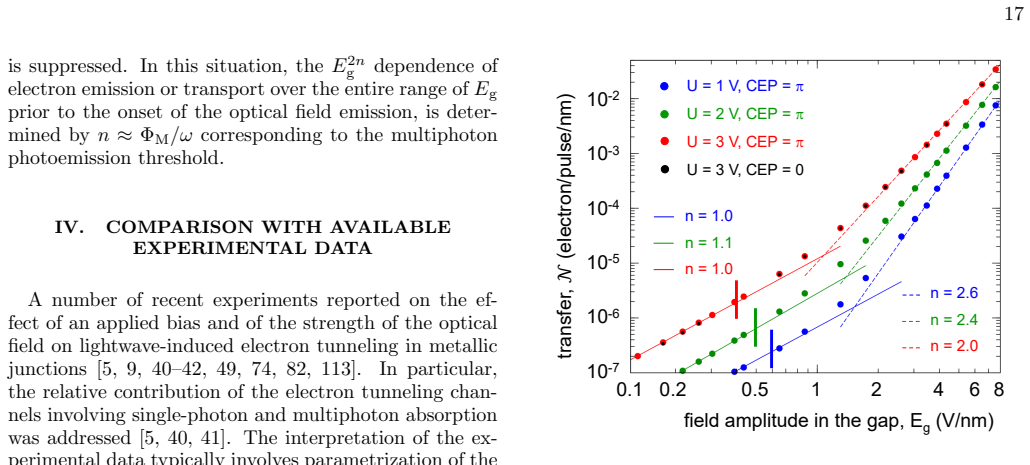
is used here, while the results in Figure 6a are obtained withω= 0.95 eV. The difference in photon energies ex- plains the difference between the effective photon orders nobtained in the two sets of results. In line with experimental findings [5], for an applied bias ofU= 3 V we find that:
-
[3]
The optically assisted electron tunneling withℓ= 1 photon absorption at lowE g evolves into a multi- photon regime with effective photon ordern= 2 as Eg increases
-
[4]
No higher nonlinearityn >2 is observed over a wide range of optical field strengths in the gap up to the onset of the optical field emission regime that we calculate here atE g ≈12 V/nm (not shown). According to the SFT, TDDFT and model WPP calcula- tions performed in section III (see Figure 8), the second finding implies that while severalℓ-channels (pho...
-
[5]
S. Yoshida, H. Hirori, T. Tachizaki, K. Yoshioka, Y. Arashida, Z.-H. Wang, Y. Sanari, O. Takeuchi, Y. Kanemitsu, and H. Shigekawa, ACS Photonics6, 1356 (2019)
work page 2019
-
[6]
Y. Arashida, H. Mogi, M. Ishikawa, I. Igarashi, A. Hatanaka, N. Umeda, J. Peng, S. Yoshida, O. Takeuchi, and H. Shigekawa, ACS Photonics9, 3156 (2022)
work page 2022
-
[7]
S. Liu, A. Hammud, I. Hamada, M. Wolf, M. M¨ uller, and T. Kumagai, Science Advances8, eabq5682 (2022)
work page 2022
-
[8]
M. Garg, A. Martin-Jimenez, M. Pisarra, Y. Luo, F. Mart´ ın, and K. Kern, Nature Photonics16, 196 (2022)
work page 2022
-
[9]
Y. Luo, F. Neubrech, A. Martin-Jimenez, N. Liu, K. Kern, and M. Garg, Nature Communications15, 1316 (2024)
work page 2024
-
[10]
Y. Luo, S. Sheng, A. Schirato, A. Martin-Jimenez, G. Della Valle, G. Cerullo, K. Kern, and M. Garg, Na- ture Communications16, 4999 (2025)
work page 2025
-
[11]
S. Maier, R. Spachtholz, K. Gl¨ ockl, C. M. Bustamante, S. Lingl, M. Maczejka, J. Sch¨ on, F. J. Giessibl, F. P. Bonaf´ e, M. A. Huber, A. Rubio, J. Repp, and R. Huber, Attosecond charge transfer in atomic-resolution scan- ning tunnelling microscopy (2025), arXiv:2507.10206 [physics.optics]
- [12]
-
[13]
M¨ uller, Progress in Surface Science99, 100727 (2024)
M. M¨ uller, Progress in Surface Science99, 100727 (2024)
work page 2024
-
[14]
J. Vogelsang, A. Mikkelsen, C. Ropers, J. H. Gaida, M. Garg, K. Kern, J. Miao, M. Schultze, and M. Os- siander, Europhysics Letters149, 36001 (2025)
work page 2025
-
[15]
Z. Zhao, V. Kravtsov, Z. Wang, Z. Zhou, L. Dou, D. Huang, Z. Wang, X. Cheng, M. B. Raschke, and T. Jiang, eLight5, 1 (2025)
work page 2025
-
[16]
T. L. Cocker, V. Jelic, M. Gupta, S. J. Molesky, J. A. J. Burgess, G. De Los Reyes, L. V. Titova, Y. Y. Tsui, M. R. Freeman, and F. A. Hegmann, Nature Photonics 7, 620 (2013)
work page 2013
-
[17]
K. Yoshioka, I. Katayama, Y. Minami, M. Kitajima, S. Yoshida, H. Shigekawa, and J. Takeda, Nature Pho- tonics10, 762 (2016)
work page 2016
-
[18]
T. L. Cocker, D. Peller, P. Yu, J. Repp, and R. Huber, Nature539, 263 (2016)
work page 2016
-
[19]
C. Roelcke, L. Z. Kastner, M. Graml, A. Biereder, J. Wilhelm, J. Repp, R. Huber, and Y. A. Gerasimenko, Nature Photonics18, 595 (2024)
work page 2024
- [20]
- [21]
-
[22]
W. Schattke and M. A. Van Hove,Solid-state photoemis- sion and related methods: theory and experiment(John Wiley & Sons, 2003)
work page 2003
-
[23]
M. D¸ abrowski, Y. Dai, and H. Petek, Chemical Reviews 120, 6247 (2020)
work page 2020
- [24]
-
[25]
C. Lemell, X.-M. Tong, F. Krausz, and J. Burgd¨ orfer, Phys. Rev. Lett.90, 076403 (2003)
work page 2003
- [26]
-
[27]
R. Bormann, M. Gulde, A. Weismann, S. V. Yalunin, and C. Ropers, Phys. Rev. Lett.105, 147601 (2010)
work page 2010
-
[28]
M. Kr¨ uger, M. Schenk, P. Hommelhoff, G. Wachter, C. Lemell, and J. Burgd¨ orfer, New Journal of Physics 14, 085019 (2012)
work page 2012
-
[29]
D. J. Park, B. Piglosiewicz, S. Schmidt, H. Kollmann, M. Mascheck, and C. Lienau, Phys. Rev. Lett.109, 244803 (2012)
work page 2012
- [30]
- [31]
-
[32]
M. Kr¨ uger, C. Lemell, G. Wachter, J. Burgd¨ orfer, and P. Hommelhoff, Journal of Physics B: Atomic, Molecular and Optical Physics51, 172001 (2018)
work page 2018
-
[33]
P. D. Keathley, W. P. Putnam, P. Vasireddy, R. G. Hobbs, Y. Yang, K. K. Berggren, and F. X. K¨ artner, Nature Physics15, 1128 (2019)
work page 2019
-
[34]
M. F. Ciappina, J. A. P´ erez-Hern´ andez, A. S. Lands- man, W. A. Okell, S. Zherebtsov, B. F¨ org, J. Sch¨ otz, L. Seiffert, T. Fennel, T. Shaaran, T. Zimmermann, A. Chac´ on, R. Guichard, A. Za¨ ır, J. W. G. Tisch, J. P. Marangos, T. Witting, A. Braun, S. A. Maier, L. Roso, M. Kr¨ uger, P. Hommelhoff, M. F. Kling, F. Krausz, and M. Lewenstein, Reports o...
work page 2017
-
[35]
P. Dienstbier, L. Seiffert, T. Paschen, A. Liehl, A. Leit- enstorfer, T. Fennel, and P. Hommelhoff, Nature616, 702 (2023)
work page 2023
-
[36]
C. Heide, P. D. Keathley, and M. F. Kling, Nature Re- views Physics 10.1038/s42254-024-00764-7 (2024)
- [37]
-
[38]
M. H. Pedersen and M. B¨ uttiker, Phys. Rev. B58, 12993 (1998)
work page 1998
-
[39]
P. K. Tien and J. P. Gordon, Phys. Rev.129, 647 (1963)
work page 1963
-
[40]
J. R. Tucker and M. J. Feldman, Reviews of Modern Physics57, 1055 (1985)
work page 1985
- [41]
- [42]
-
[43]
H. Yanagisawa, C. Hafner, P. Don´ a, M. Kl¨ ockner, D. Leuenberger, T. Greber, M. Hengsberger, and J. Os- terwalder, Phys. Rev. Lett.103, 257603 (2009)
work page 2009
-
[44]
B. Schr¨ oder, O. Bunjes, L. Wimmer, K. Kaiser, G. A. Traeger, T. Kotzott, C. Ropers, and M. Wenderoth, New Journal of Physics22, 033047 (2020)
work page 2020
-
[45]
C. Lin, F. Krecinic, H. Yoshino, A. Hammud, A. Pan, M. Wolf, M. M¨ uller, and T. Kumagai, ACS Photonics 10, 3637 (2023)
work page 2023
-
[46]
N. Mart´ ın Saban´ es, F. Krecinic, T. Kumagai, F. Schulz, M. Wolf, and M. M¨ uller, ACS Nano16, 14479 (2022)
work page 2022
-
[47]
G. Tagliabue, A. S. Jermyn, R. Sundararaman, A. J. Welch, J. S. DuChene, R. Pala, A. R. Davoyan, P. Narang, and H. A. Atwater, Nature Communications 9, 3394 (2018)
work page 2018
- [48]
-
[49]
A. Schirato, M. Maiuri, G. Cerullo, and G. D. Valle, Nanophotonics12, 1 (2023)
work page 2023
- [50]
- [51]
-
[52]
A. Stefancu, N. J. Halas, P. Nordlander, and E. Cortes, Nature Physics20, 1065 (2024)
work page 2024
- [53]
-
[54]
Clocking and controlling attosecond currents in a scanning tunnelling microscope
D. Davidovich, B. Ma, A. Goldner, S. Cohen, Z. Chen, and M. Kr¨ uger, Clocking and controlling attosecond currents in a scanning tunnelling microscope (2025), arXiv:2507.10252 [quant-ph]
work page internal anchor Pith review Pith/arXiv arXiv 2025
-
[55]
M. F¨ orster, T. Paschen, M. Kr¨ uger, C. Lemell, G. Wachter, F. Libisch, T. Madlener, J. Burgd¨ orfer, and P. Hommelhoff, Phys. Rev. Lett.117, 217601 (2016)
work page 2016
-
[56]
T. Paschen, M. F¨ orster, M. Kr¨ uger, C. Lemell, G. Wachter, F. Libisch, T. Madlener, J. Burgd¨ orfer, and P. Hommelhoff, Journal of Modern Optics64, 1054 (2017)
work page 2017
-
[57]
P. Dienstbier, T. Paschen, and P. Hommelhoff, Nanophotonics10, 3717 (2021)
work page 2021
-
[58]
A. Li, Y. Pan, P. Dienstbier, and P. Hommelhoff, Phys. Rev. Lett.126, 137403 (2021)
work page 2021
-
[59]
H. Y. Kim, M. Garg, S. Mandal, L. Seiffert, T. Fennel, and E. Goulielmakis, Nature613, 662 (2023)
work page 2023
-
[60]
H. R. Reiss, Foundations of the strong-field approxima- tion, inProgress in Ultrafast Intense Laser Science III (Springer Berlin Heidelberg, Berlin, Heidelberg, 2008) pp. 1–31
work page 2008
-
[61]
D. B. Miloˇ sevi´ c, G. G. Paulus, D. Bauer, and W. Becker, Journal of Physics B: Atomic, Molecular and Optical Physics39, R203 (2006)
work page 2006
-
[62]
S. V. Yalunin, M. Gulde, and C. Ropers, Phys. Rev. B 84, 195426 (2011)
work page 2011
- [63]
- [64]
-
[65]
S. Kim, T. Schmude, G. Burkard, and A. S. Moskalenko, New Journal of Physics23, 083006 (2021)
work page 2021
- [66]
-
[67]
M. Turchetti, M. R. Bionta, Y. Yang, F. Ritzkowsky, D. R. Candido, M. E. Flatt´ e, K. K. Berggren, and P. D. Keathley, J. Opt. Soc. Am. B38, 1009 (2021)
work page 2021
-
[68]
A. Thon, M. Merschdorf, W. Pfeiffer, T. Klamroth, P. Saalfrank, and D. Diesing, Applied Physics A78, 189 (2004)
work page 2004
-
[69]
G. Wachter, C. Lemell, J. Burgd¨ orfer, M. Schenk, M. Kr¨ uger, and P. Hommelhoff, Phys. Rev. B86, 035402 (2012)
work page 2012
-
[70]
L. Shi, I. Babushkin, A. Husakou, O. Melchert, B. Frank, J. Yi, G. Wetzel, A. Demircan, C. Lienau, H. Giessen, M. Ivanov, U. Morgner, and M. Kovacev, Laser & Photonics Reviews15, 2000475 (2021)
work page 2021
-
[71]
F. Ritzkowsky, M. Yeung, E. Bebeti, T. Gebert, T. Mat- suyama, M. Budden, R. E. Mainz, H. Cankaya, K. K. Berggren, G. M. Rossi, P. D. Keathley, and F. X. K¨ artner, Nature Communications15, 10179 (2024)
work page 2024
- [72]
-
[73]
A. G. Borisov, B. Ma, M. Zapata-Herrera, A. Babaze, 26 M. Kr¨ uger, and J. Aizpurua, ACS Photonics12, 2137 (2025)
work page 2025
- [74]
-
[75]
Z. Hu, Y. Kwok, G. Chen, and S. Mukamel, Nano Let- ters21, 6569 (2021)
work page 2021
-
[76]
L. Bhan, C. Covington, and K. Varga, Phys. Rev. B 105, 085416 (2022)
work page 2022
-
[77]
L. Chen, Y. Zhang, G. Chen, and I. Franco, Nature Communications9, 2070 (2018)
work page 2070
-
[78]
D. Diesing, M. Merschdorf, A. Thon, and W. Pfeiffer, Applied Physics B: Lasers and Optics78, 443 (2004)
work page 2004
- [79]
- [80]
discussion (0)
Sign in with ORCID, Apple, or X to comment. Anyone can read and Pith papers without signing in.