REVIEW 3 major objections 4 minor 97 references
Simplified scheme for continuous-variable entanglement distillation: multicopy distillation of Gaussian entanglement without heralding Gaussian measurements
T0 review · 3 major / 4 minor · reviewed 2026-08-15 · deepseek-v4-flash
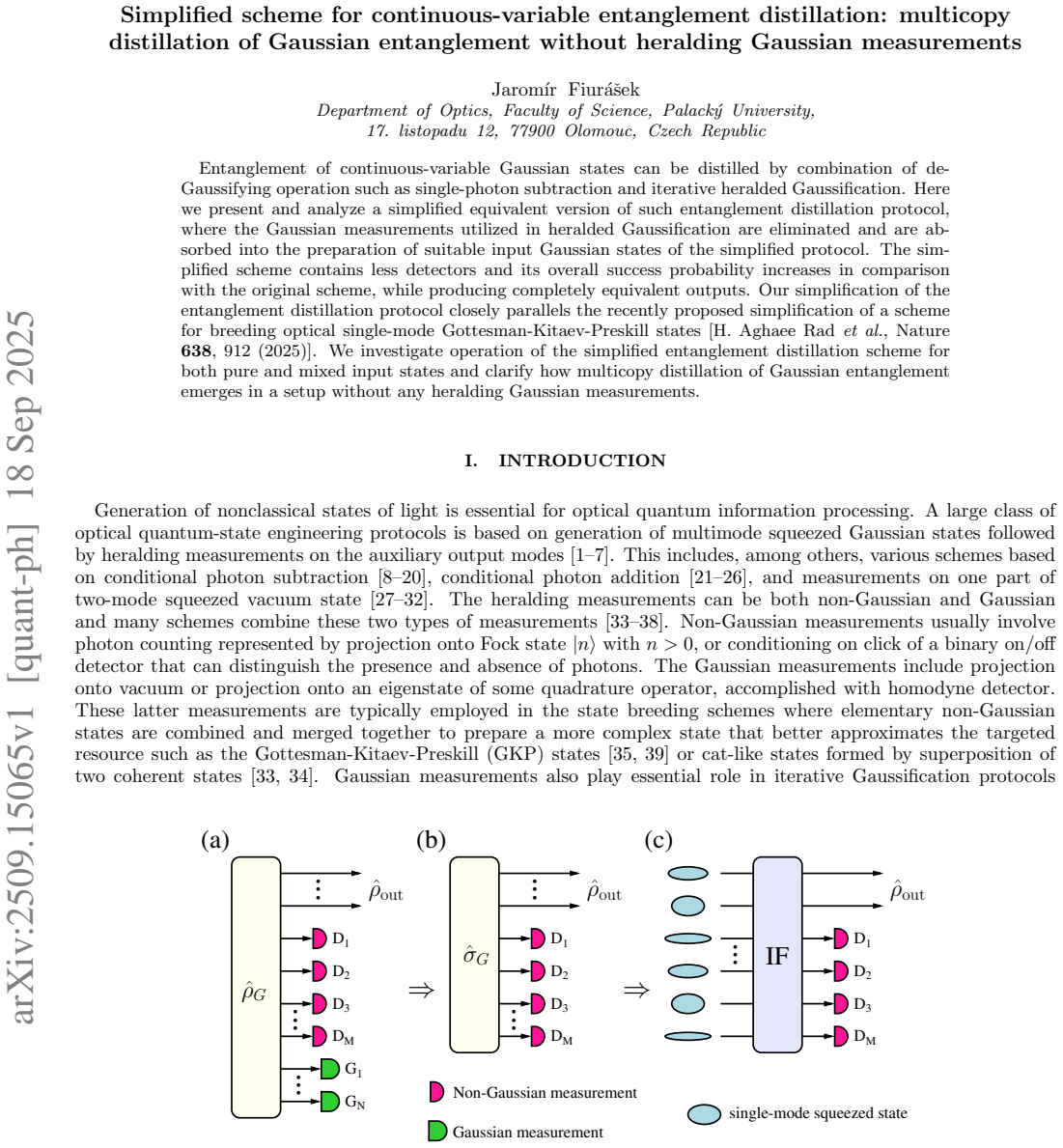
Pith's one-line read Gaussian vacuum projections in continuous-variable entanglement distillation can be absorbed into the preparation of input squeezed states, leaving only single-photon heralding with identical outputs, fewer detectors, and higher success…
desk verdict The simplification rests on a beam-splitter identity that appears false as printed, so the main claim is unproven; still worth refereeing because the error looks fixable. read the letter →
The pith
A machine-rendered reading of the paper's core claim, the machinery that carries it, and where it could break.
The reading
What carries the argument
The argument runs on three operations. First, a passive beam-splitter reordering identity (Eq. 7), $\hat{U}_{A_1A_2}\hat{V}_{A_1C_1}\hat{V}_{A_2C_2}\hat{U}^{\dagger}_{C_1C_2} = \hat{U}^{\dagger}_{C_1C_2}\hat{V}_{A_1C_1}\hat{V}_{A_2C_2}\hat{U}_{A_1A_2}$, with $\hat{U}$ a balanced (50:50) beam splitter and $\hat{V}$ the unbalanced beam splitter used for photon subtraction, lets the Gaussian measurements move past the photon-subtraction splitters. Second, because two identical zero-displacement Gaussian states are left unchanged by balanced beam-splitter coupling (Eq. 9), the inner interferometers of the multicopy circuit can be removed. Third, the projection onto vacuum is reinterpreted as a conditional zero-photon subtraction, i.e. a noiseless attenuation of each mode, which converts the auxiliary input into $\hat{\sigma}\propto (1-T)^{(\hat{n}_A+\hat{n}_B)/2}\hat{\rho}(1-T)^{(\hat{n}_A+\hat{n}_B)/2}$. In the $M$-copy version these steps turn the whole protocol into two $M$-mode interferometers whose first input is $\hat{\rho}$, whose remaining inputs are $\hat{\sigma}$, and whose auxiliary outputs are all projected onto $|1\rangle$.
What would settle it
Evaluate both sides of Eq. (7) exactly on a set of Fock states using the stated transmittance $T$ for the unbalanced beam splitters; if the operator identity fails for any $T$, the simplified circuit does not reproduce the original output. A direct experiment could run the original and simplified two-copy circuits at fixed $\lambda$ and $T$ and compare the squeezing variances and success probabilities of the heralded outputs.
Extended reading notes
Core claim
The central discovery is a circuit equivalence: every Gaussian measurement in the heralded Gaussification stage can be removed. The original round combines local single-photon subtractions with balanced beam-splitter interference and projections of auxiliary modes onto vacuum; the simplified version absorbs those vacuum projections into a different input Gaussian state $\hat{\sigma}$, obtained by two-mode noiseless attenuation of the original state, and keeps only projections onto the single-photon state $|1\rangle$. For pure two-mode squeezed vacuum inputs with squeezing parameter $\lambda$ and photon-subtraction transmittance $T$, the two-copy output is proportional to $\sum_{n=0}^{\infty}(n^2+3n+4)(T\lambda)^n |n,n\rangle$, and for $M$ copies the output is proportional to $(1+\mu \hat{a}^{\dagger}\hat{b}^{\dagger}/M)^M e^{\mu\hat{a}^{\dagger}\hat{b}^{\dagger}}|\mathrm{vac}\rangle$ with $\mu=T\lambda$. In the large-$M$ limit this becomes a Gaussian two-mode squeezed vacuum with squeezing parameter $2T\lambda$, so multicopy distillation converges to a Gaussian entangled state with no heralding Gaussian measurement. The same structure persists for mixed states distributed through lossy channels, where $\hat{\sigma}$ is a pumped-down squeezed thermal state and the local-operations-and-classical-communication structure of the distillation protocol is unchanged.
Load-bearing premise
The simplification stands or falls on the beam-splitter reordering identity of Eq. (7), which is stated without proof, together with the requirement that all Gaussian and non-Gaussian measurements happen in parallel so that their order can be swapped.
Editorial extensions
If this is right
- For $M$ pure copies the output approaches a Gaussian two-mode squeezed vacuum with squeezing parameter $2T\lambda$ as $M\to\infty$, so Gaussian entanglement can be distilled without any Gaussian measurement.
- The success probability is higher by a factor $1/P_\sigma$ for every additional copy, giving an exponential improvement $P_\sigma^{1-M}$ over the original multicopy scheme.
- The auxiliary Gaussian states $\hat{\sigma}$ have weaker squeezing than the original states and can be generated deterministically from the same source, so the simplification does not demand a new non-Gaussian resource.
- For mixed inputs distributed over lossy channels the distilled squeezing obeys a bound set by the loss, and the local-operations-and-classical-communication structure of the protocol is preserved, so the simplification is not limited to ideal pure-state operation.
Reading between the lines
- The same absorption trick should transfer to single-mode Gaussification and squeezing-distillation protocols, which share the parallel Gaussian-postselection structure; the paper demonstrates the two-mode case and cites the analogous single-mode logical-qubit breeding case.
- Because the multicopy output factorizes as one factor per heralded pair of modes, the protocol is a bipartite analogue of Gaussian boson sampling; quantifying how photon-number-resolving detector inefficiency degrades the distilled squeezing is a natural next step.
- A global optimization of all $M$ input squeezing parameters, rather than the single parameter $\kappa$ scanned here, could trade success probability against distilled squeezing in ways the one-round analysis does not capture.
Signed reviews
Editorial analysis
A structured set of objections, weighed in public.
Referee Report
Summary. The paper proposes a simplified continuous-variable entanglement distillation scheme in which the heralding Gaussian measurements (vacuum projections) of the original iterative Gaussification protocol are eliminated and absorbed into the preparation of modified Gaussian input states. The authors claim that the simplified circuit produces exactly the same output as the original protocol while requiring fewer detectors and having a higher success probability. They analyze the two-copy case for pure and mixed inputs, compare with generalized photon subtraction, and present a multicopy generalization in which the output converges to a two-mode squeezed vacuum with squeezing parameter 2Tλ. The material closely follows the recent simplification of GKP state breeding by Aghaee Rad et al.
Significance. If the claimed equivalence is correct, the result is significant: it would show that multicopy distillation of Gaussian entanglement can be achieved without any heralding Gaussian measurements, using only single-photon projections, and it would provide a bipartite analogue of the recent GKP breeding simplification. The paper also gives explicit formulas for the distilled squeezing variance, entanglement, and fidelity, and treats mixed states with loss, which are valuable for potential experiments. The multicopy output formula Eq. (49) and the interpretation as bipartite Gaussian boson sampling are attractive. However, the central equivalence is not established by the arguments in the manuscript: the key reordering identity is false as stated, and the two-copy derivation contains an algebraic error. The manuscript would require a substantially corrected proof before its main claim is reliable.
major comments (3)
- [§III, Eq. (7)] The beam-splitter reordering identity Eq. (7) is false as written. With the paper's definitions (3) and (8), U_{A1A2}=exp[π/4(a1†a2−a1a2†)] and V_{AjCj}=exp[θ(aj†cj−ajcj†)], θ=arccos√T, the two sides of Eq. (7) do not agree for generic T. A direct evaluation on |1,0,0,0⟩ at T=0.8 gives different coefficients in the C2 mode on the two sides. Since this identity is the sole justification for the reordering step from Fig. 2(b) to Fig. 2(c), the subsequent absorption of the Gaussian vacuum projections into the prepared state σ is unsupported. This is a load-bearing point for the claimed equivalence.
- [§IV, Eqs. (18)-(19)] The assertion that Eq. (18)/(19) reproduces Eq. (13) is incorrect. Inserting ν=(1−T)λ into Eq. (19), the generated state has Fock-space coefficients proportional to 2λ²µⁿ + n(n−1)µⁿ⁻² (up to a common prefactor), whereas Eq. (13) has coefficients proportional to (n²+3n+4)µⁿ. These are not proportional for general λ and T, so the simplified two-copy output as written is not equal to the original output. This error directly contradicts the claim that the two schemes produce 'completely equivalent outputs'.
- [§VII] The multicopy simplification in Sec. VII is said to proceed 'in the same way' as the two-copy case, so it inherits the problems with Eq. (7). The reordering of the whole beam-splitter arrays relies on the same false identity, and therefore the proof of equivalence between Fig. 8(a) and Fig. 8(b) is not established. The output formula Eq. (49) may be correct—a direct M=2 calculation from the simplified circuit in Fig. 8(b) yields Eq. (49) and matches Eq. (13)—but the manuscript needs a correct derivation of this equivalence rather than the flawed commutation argument.
minor comments (4)
- [General] There are numerous typos and small language errors, including 'suqeezed' (Sec. II), 'previouss' (Sec. IV), 'multicoppy' (Sec. VI), 'Gausisan' (Sec. VII), 'auxliary' (Introduction), and 'muticopy' (Sec. VIII).
- [§IV, Eq. (17)] The reasoning leading to Eq. (17) is unclear: the stated projection (|0,2>−|2,0>)/√2 has zero overlap with a two-mode squeezed vacuum state, so the conclusion that the ancilla modes are projected onto ν²|0,0>+|2,2> does not follow from the preceding sentence. This passage should be rewritten with a clear derivation.
- [§IV, Eq. (24)] The two roots for κ² should be discussed more explicitly: the text notes that κ² can be negative, but it would help to state which root is physically admissible and how the constraint |κ|<1/(1−T) is enforced in the optimization.
- [Fig. 2 caption] The caption states that 'both ρ and σ in panels (a)-(e) denote Gaussian states', while panel (f) refers to ρ^(i) as a non-Gaussian state; the notation should be clarified to avoid confusion about what is input to each stage.
Circularity Check
No circularity: the simplified distillation scheme is derived from linear-optics reordering and noiseless attenuation, not from the target output.
full rationale
The derivation chain is self-contained and not circular. The core equivalence between Fig. 2(a) and Fig. 2(e) is built from the passive beam-splitter reordering identity (Eq. 7), the invariance of identical Gaussian states under balanced couplings (Eq. 9), and the noiseless-attenuation map (Eq. 10); none of these assume the final output states (13) or (49). The pure-state output (13) and the multicopy output (49) are computed from the circuits, and the simplified-circuit output (18)-(19) is then asserted to equal (13), which is an algebraic check rather than a redefinition. The only free knob, kappa, is an optimization parameter over the ancilla squeezing, not a fit to data, so there is no fitted-input-called-prediction issue. Self-citations appear (e.g., Refs. [46,76,77,81]), but the load-bearing Gaussification convergence theorem is attributed to the independent Eisert-Browne-Scheel-Plenio result [41], and the noiseless attenuation maps are stated explicitly; none of the self-citations is invoked as the sole justification of a central claim. The skeptical observation that Eq. (7) may be false as written, and that the equality of Eqs. (18)-(19) with Eq. (13) is unshown algebra, is a correctness risk, not circularity, because a false intermediate identity does not make the derivation equivalent to its inputs.
Assumptions & free parameters
free parameters (1)
- κ =
optimized, not fitted; e.g., positive root of Eq. (24)
assumptions (5)
- standard math Beam-splitter unitaries obey the reordering identity of Eq. (7).
- domain assumption The two copies of the input Gaussian state are identical and have zero coherent displacement, so balanced beam-splitter coupling leaves their product state unchanged (Eq. 9).
- domain assumption No feedforward is used, so the Gaussian and non-Gaussian measurements can be reordered in parallel.
- domain assumption Detectors are perfect photon-number-resolving detectors that project onto |1>.
- domain assumption Known convergence results for iterative Gaussification (Eisert et al., Ref. [41]) are accepted.
Cite this review
Pith. "Pith review of Simplified scheme for continuous-variable entanglement distillation: multicopy distillation of Gaussian entanglement without heralding Gaussian measurements." pith.science (2026). https://pith.science/paper/T6V5XVA7
@misc{pith2026250915065,
  author       = {Pith},
  title        = {Pith review of: Simplified scheme for continuous-variable entanglement distillation: multicopy distillation of Gaussian entanglement without heralding Gaussian measurements},
  year         = {2026},
  howpublished = {\url{https://pith.science/paper/T6V5XVA7}},
  note         = {Machine review of arXiv:2509.15065}
}
read the original abstract
Entanglement of continuous-variable Gaussian states can be distilled by combination of de-Gaussifying operation such as single-photon subtraction and iterative heralded Gaussification. Here we present and analyze a simplified equivalent version of such entanglement distillation protocol, where the Gaussian measurements utilized in heralded Gaussification are eliminated and are absorbed into the preparation of suitable input Gaussian states of the simplified protocol. The simplified scheme contains less detectors and its overall success probability increases in comparison with the original scheme, while producing completely equivalent outputs. Our simplification of the entanglement distillation protocol closely parallels the recently proposed simplification of a scheme for breeding optical single-mode Gottesman-Kitaev-Preskill states [H. Aghaee Rad et al., Nature 638, 912 (2025)]. We investigate operation of the simplified entanglement distillation scheme for both pure and mixed input states and clarify how multicopy distillation of Gaussian entanglement emerges in a setup without any heralding Gaussian measurements.
Figures


Figures from the paper (5 more)


Reference graph
Works this paper leans on
-
[49]
A. Franzen, B. Hage, J. DiGuglielmo, J. Fiur´ aˇ sek, and R. Schnabel, Experimental Demonstration of Continuous Variable Purification of Squeezed States, Phys. Rev. Lett.97, 150505 (2006)
work page 2006
-
[1]
+ν MX j=1 ˆc† j ˆd† j |vac⟩.(45) Recall thatµ=Tλ. Subsequently, modes C j (Dj) are mutually coupled at two identicalM-port interferometers described by a real coupling matrixV, ˆc† j→ X k Vjkˆc† k, ˆd† j→ X l Vjl ˆd† l.(46) It holds thatV TV=IwhereIstands for the identity matrix. Moreover,V 1k = 1√ M for allj. This latter condition is equivalent to the...
2025
-
[2]
Walschaers, Non-Gaussian Quantum States and Where to Find Them, PRX Quantum2, 030204 (2021)
M. Walschaers, Non-Gaussian Quantum States and Where to Find Them, PRX Quantum2, 030204 (2021)
2021
-
[3]
A. I. Lvovsky, P. Grangier, A. Ourjoumtsev, V. Parigi, M. Sasaki, and R. Tualle-Brouri, Production and applications of non-Gaussian quantum states of light, arXiv:2006.16985, (2020)
arXiv 2020
-
[4]
Biagi, S
N. Biagi, S. Francesconi, A. Zavatta, and M. Bellini, Photon-by-photon quantum light state engineering, Prog. Quant. Electron.84, 100414 (2022)
2022
-
[5]
D. Su, C. R. Myers, and K. Kumar Sabapathy, Conversion of Gaussian states to non-Gaussian states using photon-number- resolving detectors, Phys. Rev. A100, 052301 (2019)
2019
-
[6]
A. Aralov, ´E. Gillet, V. Nguyen, A. Cosentino, M. Walschaers, and M. Frigerio, Photon catalysis for general multimode multi-photon quantum state preparation, arXiv:2507.19397v2
-
[7]
M. V. Larsen, J. E. Bourassa, S. Kocsis, J. F. Tasker, R. S. Chadwick, C. Gonz´ alez-Arciniegas, J. Hastrup, C. E. Lopetegui- Gonz´ alez, F. M. Miatto, A. Motamedi, R. Noro, G. Roeland, R. Baby, H. Chen, P. Contu, I. Di Luch, C. Drago, M. Giesbrecht, T. Grainge, I. Krasnokutska, M. Menotti, B. Morrison, C. Puviraj, K. Rezaei Shad, B. Hussain, J. McMahon, ...
2025
Show all 97 references
-
[8]
Dakna, T
M. Dakna, T. Anhut, T. Opatrn´ y, L. Kn¨ oll, and D.-G. Welsch, Generating Schr¨ odinger-cat-like states by means of condi- tional measurements on a beam splitter, Phys. Rev. A55, 3184 (1997)
1997
-
[9]
Hanamura, K
F. Hanamura, K. Takase, H. Nagayoshi, R. Ide, W. Asavanant, K. Fukui, P. Marek, R. Filip, and A. Furusawa, Beyond Stellar Rank: Control Parameters for Scalable Optical Non-Gaussian State Generation, arXiv:2509.06255
-
[10]
Ourjoumtsev, R
A. Ourjoumtsev, R. Tualle-Brouri, J. Laurat, and P. Grangier, Generating optical Schr¨ odinger kittens for quantum infor- mation processing, Science312, 83 (2006)
2006
-
[11]
Wenger, R
J. Wenger, R. Tualle-Brouri, and P. Grangier, Non-Gaussian Statistics from Individual Pulses of Squeezed Light, Phys. Rev. Lett.92, 153601 (2004)
2004
-
[12]
Wakui, H
K. Wakui, H. Takahashi, A. Furusawa, and M. Sasaki, Photon subtracted squeezed states generated with periodically poled KTiOPO4, Opt. Express15, 3568 (2007)
2007
-
[13]
J. S. Neergaard-Nielsen, B. M. Nielsen, C. Hettich, K. Molmer, and E. S. Polzik, Generation of a superposition of odd photon number states for quantum information networks, Phys. Rev. Lett.97, 083604 (2006)
2006
-
[14]
Takahashi, K
H. Takahashi, K. Wakui, S. Suzuki, M. Takeoka, K. Hayasaka, A. Furusawa, and M. Sasaki, Generation of Large-Amplitude Coherent-State Superposition via Ancilla-Assisted Photon Subtraction, Phys. Rev. Lett.101, 233605 (2008)
2008
-
[15]
Ourjoumtsev, A
A. Ourjoumtsev, A. Dantan, R. Tualle-Brouri, and P. Grangier, Increasing Entanglement between Gaussian States by Coherent Photon Subtraction, Phys. Rev. Lett.98, 030502 (2007). 15
2007
-
[16]
J. S. Neergaard-Nielsen, M. Takeuchi, K. Wakui, H. Takahashi, K. Hayasaka, M. Takeoka, and M. Sasaki, Optical continuous-variable qubit, Phys. Rev. Lett.105, 053602 (2010)
2010
-
[17]
listopadu 12, 77900 Olomouc, Czech Republic Entanglement of continuous-variable Gaussian states can be distilled by combination of de- Gaussifying operation such as single-photon subtraction and iterative heralded Gaussification. Here we present and analyze a simplified equiva...
2025 arXiv
-
[18]
Ourjoumtsev, F
A. Ourjoumtsev, F. Ferreyrol, R. Tualle-Brouri, and P. Grangier, Preparation of non-local superpositions of quasi-classical light states, Nat. Phys.5, 189 (2009)
2009
-
[19]
Huang, H
K. Huang, H. Le Jeannic, J. Ruaudel, V. B. Verma, M. D. Shaw, F. Marsili, S. W. Nam, E Wu, H. Zeng, Y.-C. Jeong, R. Filip, O. Morin, and J. Laurat, Optical synthesis of large-amplitude squeezed coherent-state superpositions with minimal resources, Phys. Rev. Lett.115, 023602 (2015)
2015
-
[20]
Asavanant, K
W. Asavanant, K. Nakashima, Y. Shiozawa, J.-I. Yoshikawa, and A. Furusawa, Generation of highly pure Schr¨ odinger’s cat states and real-time quadrature measurements via optical filtering, Opt. Express25, 32227 (2017)
2017
-
[21]
M. Endo, R. He, T. Sonoyama, K. Takahashi, T. Kashiwazaki, T. Umeki, S. Takasu, K. Hattori, D. Fukuda, K. Fukui, K. Takase, W. Asavanant, P. Marek, R. Filip, and A. Furusawa, Non-Gaussian quantum state generation by multi-photon subtraction at the telecommunication wavelength,...
2023
-
[22]
M. Endo, T. Nomura, T. Sonoyama, K. Takahashi, S. Takasu, D. Fukuda, T. Kashiwazaki, A. Inoue, T. Umeki, R. Nehra, P. Marek, R. Filip, K. Takase, W. Asavanant, and A. Furusawa, High-Rate Four Photon Subtraction from Squeezed Vacuum: Preparing Cat State for Optical Quantum Comp...
2025 arXiv
-
[23]
Zavatta, S
A. Zavatta, S. Viciani, and M. Bellini, Quantum-to-Classical Transition with Single-Photon-Added Coherent States of Light, Science306, 660 (2004)
2004
-
[24]
Barbieri, N
M. Barbieri, N. Spagnolo, M. G. Genoni, F. Ferreyrol, R. Blandino, M. G. A. Paris, P. Grangier, and R. Tualle-Brouri, Non-gaussianity of quantum states: An experimental test on single-photon-added coherent states, Phys. Rev. A82, 063833 (2010)
2010
-
[25]
Kumar, E
R. Kumar, E. Barrios, C. Kupchak, and A. I. Lvovsky, Experimental Characterization of Bosonic Creation and Annihilation Operators, Phys. Rev. Lett.110, 130403 (2013)
2013
-
[26]
Jeong, A
H. Jeong, A. Zavatta, M. Kang, S.-W. Lee, L. S. Costanzo, S. Grandi, T. C. Ralph and M. Bellini, Generation of hybrid entanglement of light, Nature Photonics8, 564 (2014)
2014
-
[27]
Fadrn´ y, M
J. Fadrn´ y, M. Neset, M. Bielak, M. Jeˇ zek, J. B´ ılek, and J. Fiur´ aˇ sek, Experimental preparation of multiphoton-added coherent states of light, npj Quantum Inf.10, 89 (2024)
2024
-
[28]
Chen, H.-Y
Y.-R. Chen, H.-Y. Hsieh, J. Ning, H.-C. Wu, H. L. Chen, Z.-H. Shi, P. Yang, O. Steuernagel, C.-M. Wu, and R.-K. Lee, Generation of heralded optical cat states by photon addition, Phys. Rev. A110, 023703 (2024)
2024
-
[29]
A. I. Lvovsky, H. Hansen, T. Aichele, O. Benson, J. Mlynek, and S. Schiller, Quantum State Reconstruction of the Single-Photon Fock State, Phys. Rev. Lett.87, 050402 (2001)
2001
-
[30]
Yukawa, K
M. Yukawa, K. Miyata, T. Mizuta, H. Yonezawa, P. Marek, R. Filip, and A. Furusawa, Generating superposition of up-to three photons for continuous variable quantum information processing, Opt. Express21, 5529 (2013)
2013
-
[31]
Cooper, L
M. Cooper, L. J. Wright, C. S¨ oller, and B. J. Smith, Experimental generation of multi-photon fock states, Opt. Express 21, 5309 (2013)
2013
-
[32]
Bouillard, G
M. Bouillard, G. Boucher, J. F. Ortas, B. Kanseri, and R. Tualle-Brouri, High production rate of single-photon and two-photon Fock states for quantum state engineering, Opt. Express27, 3113 (2019)
2019
-
[33]
Kawasaki, K
A. Kawasaki, K. Takase, T. Nomura, S. Miki, H. Terai, M. Yabuno, F. China, W. Asavanant, M. Endo, J.-I. Yoshikawa, and A. Furusawa, Generation of highly pure single-photon state at telecommunication wavelength, Opt. Express30, 24831 (2022)
2022
-
[34]
M. G. A. Paris, M. Cola and R. Bonifacio, Quantum-state engineering assisted by entanglement, Phys. Rev. A67, 042104 (2003)
2003
-
[35]
Etesse, M
J. Etesse, M. Bouillard, B. Kanseri, and R. Tualle-Brouri, Experimental Generation of Squeezed Cat States with an Operation Allowing Iterative Growth, Phys. Rev. Lett.114, 193602 (2015)
2015
-
[36]
D. V. Sychev, A. E. Ulanov, A. A. Pushkina, M. W. Richards, I. A. Fedorov and A. I. Lvovsky, Enlargement of optical Schr¨ odinger’s cat states, Nat. Photonics11, 379 (2017)
2017
-
[37]
Konno, W
S. Konno, W. Asavanant, F. Hanamura, H. Nagayoshi, K. Fukui, A. Sakaguchi, R. Ide, F. China, M. Yabuno, S. Miki, H. Terai, K. Takase, M. Endo, P. Marek, R. Filip, P. van Loock, and A. Furusawa, Logical states for fault-tolerant quantum computation with propagating light, Scien...
2024
-
[38]
Cotte, H
V. Cotte, H. Simon, B. Pointard, and R. Tualle-Brouri, Experimental generation of coherent-state superpositions with a quantum memory, Phys. Rev. Res.4, 043170 (2022)
2022
-
[39]
Simon, L
H. Simon, L. Caron, R. Journet, V. Cotte, and R. Tualle-Brouri, Experimental Demonstration of a Versatile and Scalable Scheme for Iterative Generation of Non-Gaussian States of Light, Phys. Rev. Lett.133, 173603 (2024)
2024
-
[40]
Ourjoumtsev, H
A. Ourjoumtsev, H. Jeong, R. Tualle-Brouri and P. Grangier, Generation of optical ‘Schr¨ odinger cats’ from photon number states, Nature448, 784 (2007)
2007
-
[41]
Encoding a qubit in an oscillator
H. M. Vasconcelos, L. Sanz, and S. Glancy, All-optical generation of states for “Encoding a qubit in an oscillator”, Opt. Lett. 35(19), 3261 (2010)
2010
-
[42]
D. E. Browne, J. Eisert, S. Scheel, and M. B. Plenio, Driving non-Gaussian to Gaussian states with linear optics, Phys. Rev. A67, 062320 (2003)
2003
-
[43]
Eisert, D
J. Eisert, D. Browne, S. Scheel, and M. B. Plenio, Distillation of continuous-variable entanglement with optical means, Ann. Phys.311, 431 (2004)
2004
-
[44]
E. T. Campbell and J. Eisert, Gaussification and Entanglement Distillation of Continuous-Variable Systems: A Unifying Picture, Phys. Rev. Lett.108, 020501 (2012). 16
2012
-
[45]
Dost´ al, M
M. Dost´ al, M. Jeˇ zek, J. Fiur´ aˇ sek, and J. B´ ılek, Experimental investigation of heralded Gaussification of phase-randomized coherent states of light, Opt. Express32, 45582-45599 (2024)
2024
-
[46]
B. Hage, A. Samblowski, J. DiGuglielmo, A. Franzen, J. Fiur´ aˇ sek, and R. Schnabel, Preparation of distilled and purified continuous-variable entangled states, Nat. Phys.4, 915 (2008)
2008
-
[47]
B. Hage, A. Samblowski, J. DiGuglielmo, J. Fiur´ aˇ sek, and R. Schnabel, Iterative Entanglement Distillation: Approaching the Elimination of Decoherence, Phys. Rev. Lett.105, 230502 (2010)
2010
-
[48]
Fiur´ aˇ sek, Distillation and purification of symmetric entangled Gaussian states, Phys
J. Fiur´ aˇ sek, Distillation and purification of symmetric entangled Gaussian states, Phys. Rev. A82, 042331 (2010)
2010
-
[50]
Grebien, J
S. Grebien, J. G¨ ottsch, B. Hage, J. Fiur´ aˇ sek, and R. Schnabel, Multistep Two-Copy Distillation of Squeezed States via Two-Photon Subtraction, Phys. Rev. Lett.129, 273604 (2022)
2022
-
[51]
Aghaee Rad, T
H. Aghaee Rad, T. Ainsworth, R. N. Alexander, B. Altieri, M. F. Askarani, R. Baby, L. Banchi, B. Q. Baragiola, J. E. Bourassa, R. S. Chadwick, I. Charania, H. Chen, M. J. Collins, P. Contu, N. D’Arcy, G. Dauphinais, R. De Prins, D. Deschenes, I. Di Luch, S. Duque, P. Edke, S. ...
2025
-
[52]
A. P. Lund, A. Laing, S. Rahimi-Keshari, T. Rudolph, J. L. O’Brien, and T. C. Ralph, Boson Sampling from a Gaussian State, Phys. Rev. Lett.113, 100502 (2014)
2014
-
[53]
C. S. Hamilton, R. Kruse, L. Sansoni, S. Barkhofen, C. Silberhorn, and I. Jex, Gaussian Boson Sampling, Phys. Rev. Lett. 119, 170501 (2017)
2017
-
[54]
Paesani, Y
S. Paesani, Y. Ding, R. Santagati, L. Chakhmakhchyan, Ca. Vigliar, K. Rottwitt, L. K. Oxenløwe, J. Wang, M. G. Thompson, and A. Laing, Generation and sampling of quantum states of light in a silicon chip, Nature Physics15, 925 (2019)
2019
-
[55]
Zhong, H
H.-S. Zhong, H. Wang, Y.-H. Deng, M.-C. Chen, L.-C. Peng, Y.-H. Luo, J. Qin, D. Wu, X. Ding, Y. Hu, P. Hu, X.-Y. Yang, W.-J. Zhang, H. Li, Y. Li, X. Jiang, L. Gan , G. Yang, L. You, Z. Wang, L. Li , N.-L. Liu, C.-Y. Lu, and J.-W. Pan, Quantum computational advantage using phot...
2020
-
[56]
Zhong, Y.-H
H.-S. Zhong, Y.-H. Deng, J. Qin, H. Wang, M.-C. Chen, L.-C. Peng, Y.-H. Luo, D. Wu, S.-Q. Gong, H. Su, Y. Hu, P. Hu, X.-Y. Yang, W.-J. Zhang, H. Li, Y. Li, X. Jiang, L. Gan, G. Yang, L. You, Z, Wang, L. Li, N.-L. Liu, J. J. Renema, C.-Y. Lu, and J.-W. Pan, Phase-Programmable G...
2021
-
[57]
Thekkadath, S
G.S. Thekkadath, S. Sempere-Llagostera, B.A. Bell, R.B. Patel, M.S. Kim, and I.A. Walmsley, Experimental Demonstration of Gaussian Boson Sampling with Displacement, PRX Quantum3, 020336 (2022)
2022
-
[58]
Takase, K
K. Takase, K. Fukui, A. Kawasaki, W. Asavanant, M. Endo, J.-i. Yoshikawa, P. van Loock, and A. Furusawa, Gottesman- Kitaev-Preskill qubit synthesizer for propagating light, npj Quantum Inf.9, 98 (2023)
2023
-
[59]
S. L. Braunstein, Squeezing as an irreducible resource, Phys. Rev. A71, 055801 (2005)
2005
-
[60]
Opatrn´ y, G
T. Opatrn´ y, G. Kurizki, and D.-G. Welsch, Improvement on teleportation of continuous variables by photon subtraction via conditional measurement, Phys. Rev. A61, 032302 (2000)
2000
-
[61]
Takahashi, J
H. Takahashi, J. S. Neergaard-Nielsen, M. Takeuchi, M. Takeoka, K. Hayasaka, A. Furusawa, and M. Sasaki, Entanglement distillation from Gaussian input states, Nat. Photonics4, 178–181 (2010)
2010
-
[62]
Kurochkin, A
Y. Kurochkin, A. S. Prasad, and A. I. Lvovsky, Distillation of The Two-Mode Squeezed State, Phys. Rev. Lett.112, 070402 (2014)
2014
-
[63]
Dirmeier, J
T. Dirmeier, J. Tiedau, I. Khan, et al., Distillation of squeezing using an engineered pulsed parametric down-conversion source, Opt. Express28, 30784 (2020)
2020
-
[64]
Eisert, S
J. Eisert, S. Scheel, and M. B. Plenio, Distilling Gaussian States with Gaussian Operations Is Impossible, Phys. Rev. Lett. 89, 137903 (2002)
2002
-
[65]
Fiur´ aˇ sek, Gaussian Transformations and Distillation of Entangled Gaussian States, Phys
J. Fiur´ aˇ sek, Gaussian Transformations and Distillation of Entangled Gaussian States, Phys. Rev. Lett.89, 137904 (2002)
2002
-
[66]
Giedke and J
G. Giedke and J. I. Cirac, Characterization of Gaussian operations and distillation of Gaussian states, Phys. Rev. A66, 032316 (2002)
2002
-
[67]
Kitagawa, M
A. Kitagawa, M. Takeoka1 M. Sasaki, and A. Chefles, Entanglement evaluation of non-Gaussian states generated by photon subtraction from squeezed states, Phys. Rev. A 73, 042310 (2006)
2006
-
[68]
Dell’Anno, D
F. Dell’Anno, D. Buono, G. Nocerino, A. Porzio, S. Solimeno, S. De Siena, and F. Illuminati, Tunable non-Gaussian resources for continuous-variable quantum technologies, Phys. Rev. A88, 043818 (2013)
2013
-
[69]
S. L. Zhang and P. van Loock, Distillation of mixed-state continuous-variable entanglement by photon subtraction, Phys. Rev. A82, 062316 (2010)
2010
-
[70]
Navarrete-Benlloch, R
C. Navarrete-Benlloch, R. Garc´ ıa-Patr´ on, J. H. Shapiro, and N. J. Cerf, Enhancing quantum entanglement by photon addition and subtraction, Phys. Rev. A86, 012328 (2012)
2012
-
[71]
Wang, L.-L
S. Wang, L.-L. Hou, X.-F. Chen, and X.-F. Xu, Continuous-variable quantum teleportation with non-Gaussian entangled states generated via multiple-photon subtraction and addition Phys. Rev. A91, 063832 (2015). 17
2015
-
[72]
Olivares, M
S. Olivares, M. G. A. Paris, and R. Bonifacio, Teleportation improvement by inconclusive photon subtraction, Phys. Rev. A67, 032314 (2003)
2003
-
[73]
Yang and F.-L
Y. Yang and F.-L. Li, Entanglement properties of non-Gaussian resources generated via photon subtraction and addition and continuous-variable quantum-teleportation improvement, Phys. Rev. A80, 022315 (2009)
2009
-
[74]
T. J. Bartley, P. J. D. Crowley, A. Datta, J. Nunn, L. Zhang, and I. Walmsley, Strategies for enhancing quantum entan- glement by local photon subtraction, Phys. Rev. A87, 022313 (2013)
2013
-
[75]
N. Wang, M. Wang, and X. Su, Continuous-variable entanglement swapping with photon subtraction, Phys. Rev. A110, 012416 (2024)
2024
-
[76]
Nha and H
H. Nha and H. J. Carmichael, Proposed Test of Quantum Nonlocality for Continuous Variables, Phys. Rev. Lett.93, 020401 (2004)
2004
-
[77]
Garc´ ıa-Patr´ on, J
R. Garc´ ıa-Patr´ on, J. Fiur´ aˇ sek, N. J. Cerf, J. Wenger, R. Tualle-Brouri, and Ph. Grangier, Proposal for a Loophole-Free Bell Test Using Homodyne Detection, Phys. Rev. Lett.93, 130409 (2004)
2004
-
[78]
Fiur´ aˇ sek, S
J. Fiur´ aˇ sek, S. Grebien, and R. Schnabel, Extended analysis of distillation and purification of squeezed states of light, Phys. Rev. A111, 043704 (2025)
2025
-
[79]
Miˇ cuda, I
M. Miˇ cuda, I. Straka, M. Mikov´ a, M. Duˇ sek, N. J. Cerf, J. Fiur´ aˇ sek, and M. Jeˇ zek, Noiseless Loss Suppression in Quantum Optical Communication, Phys. Rev. Lett.109, 180503 (2012)
2012
-
[80]
C. M. Nunn, J. D. Franson, and T. B. Pittman, Heralding on the detection of zero photons, Phys. Rev. A104, 033717 (2021)
2021
-
[81]
Eisert, M
J. Eisert, M. B. Plenio, D. E. Browne, S. Scheel, and A. Feito, On the experimental feasibility of continuous-variable optical entanglement distillation, Optics and Spectroscopy103, 173 (2007)
2007
-
[82]
T. C. Ralph and A. P. Lund, in Quantum Communication Measurement and Computing edited by A. Lvovsky (AIP, New York, 2009), pp. 155–160
2009
-
[83]
Fiur´ aˇ sek, Engineering quantum operations on traveling light beams by multiple photon addition and subtraction, Phys
J. Fiur´ aˇ sek, Engineering quantum operations on traveling light beams by multiple photon addition and subtraction, Phys. Rev. A80, 053822 (2009)
2009
-
[84]
Zavatta, J
A. Zavatta, J. Fiur´ aˇ sek, and M. Bellini, A high-fidelity noiseless amplifier for quantum light states, Nat. Photonics5, 52 (2011)
2011
-
[85]
Neset, J
M. Neset, J. Fadrn´ y, M. Bielak, J. Fiur´ aˇ sek, M. Jeˇ zek, and J. B´ ılek, Experimental noiseless quantum amplification of coherent states of light by two-photon addition and subtraction, Phys. Rev. A112, 023710 (2025)
2025
-
[86]
A. E. Ulanov, I. A. Fedorov, A. A. Pushkina, Y. V. Kurochkin, T. C. Ralph and A. I. Lvovsky, Undoing the effect of loss on quantum entanglement, Nat. Photonics9, 764 (2015)
2015
-
[87]
K. P. Seshadreesan, H. Krovi, and S. Guha, Continuous-variable entanglement distillation over a pure loss channel with multiple quantum scissors, Phys. Rev. A100, 022315 (2019)
2019
-
[88]
J. J. Guanzon, M. S. Winnel, A. P. Lund, and T. C. Ralph, Noiseless linear amplification and loss-tolerant quantum relay using coherent-state superpositions, Phys. Rev. A108, 032411 (2023)
2023
-
[89]
Takase, J.-I
K. Takase, J.-I. Yoshikawa, W. Asavanant, M. Endo, and A. Furusawa, Generation of optical Schr¨ odinger cat states by generalized photon subtraction, Phys. Rev. A103, 013710 (2021)
2021
-
[90]
Tomoda, A
H. Tomoda, A. Machinaga, K. Takase, J. Harada, T. Kashiwazaki, T.i Umeki, S. Miki, F. China, M. Yabuno, H. Terai, D. Okuno, and S. Takeda, Boosting the generation rate of squeezed single-photon states by generalized photon subtraction, Phys. Rev. A110, 033717 (2024)
2024
-
[91]
Takase, F
K. Takase, F. Hanamura, H. Nagayoshi, J. E. Bourassa, R. N. Alexander, A. Kawasaki, W. Asavanant, M. Endo, and A. Furusawa, Generation of flying logical qubits using generalized photon subtraction with adaptive Gaussian operations, Phys. Rev. A110, 012436 (2024)
2024
-
[92]
A Vourdas, Analytic representations in quantum mechanics, J. Phys. A: Math. Gen.39, R65 (2006)
2006
-
[93]
Motamedi, Y
A. Motamedi, Y. Yao, K. Nielsen, U. Chabaud, J. E. Bourassa, R. N. Alexander, and F. Miatto, The stellar decomposition of Gaussian quantum states, arXiv:2504.10455
-
[94]
A. J. Pizzimenti and D. Soh, Optical Gottesman-Kitaev-Preskill qubit generation via approximate squeezed coherent state superposition breeding, Phys. Rev. A110, 062619 (2024)
2024
-
[95]
D. J. Weigand and B. M. Terhal, Generating grid states from Schr¨ odinger-cat states without postselection, Phys. Rev. A 97, 022341, (2018)
2018
-
[96]
A. J. Pizzimenti and D. Soh, Optical Gottesman-Kitaev-Preskill qubit generation via approximate squeezed coherent state superposition breeding, arXiv:2409.06902
-
[97]
Crescimanna, S
V. Crescimanna, S. Yu, K. Heshami, and R. B. Patel, Adaptive Non-Gaussian Quantum State Engineering, arXiv:2502.14967
Reviewed August 15, 2026 · model on record in the stance chip above.
Discussion (0). Continue with ORCID to comment.