Code Less to Code More: Streamlining Language Server Protocol and Type System Development for Language Families
Pith reviewed 2026-05-18 15:35 UTC · model grok-4.3
The pith
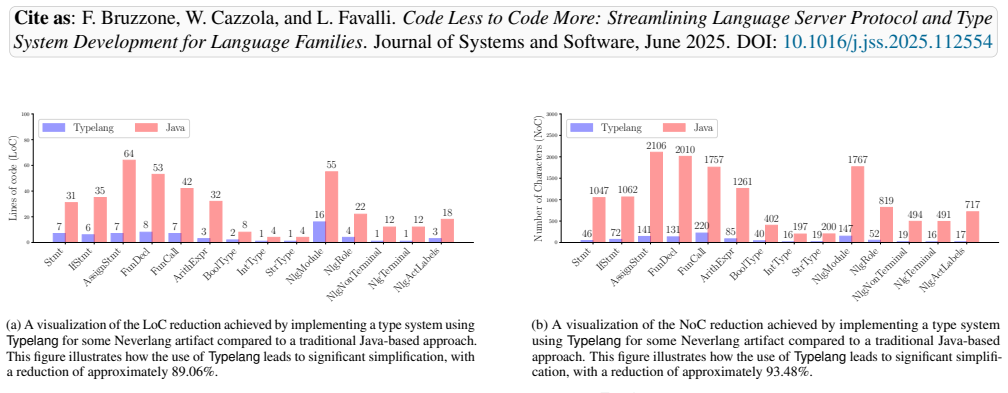
Typelang and automated generation cut type system code by over 93 percent for language families
A machine-rendered reading of the paper's core claim, the machinery that carries it, and where it could break.
Core claim
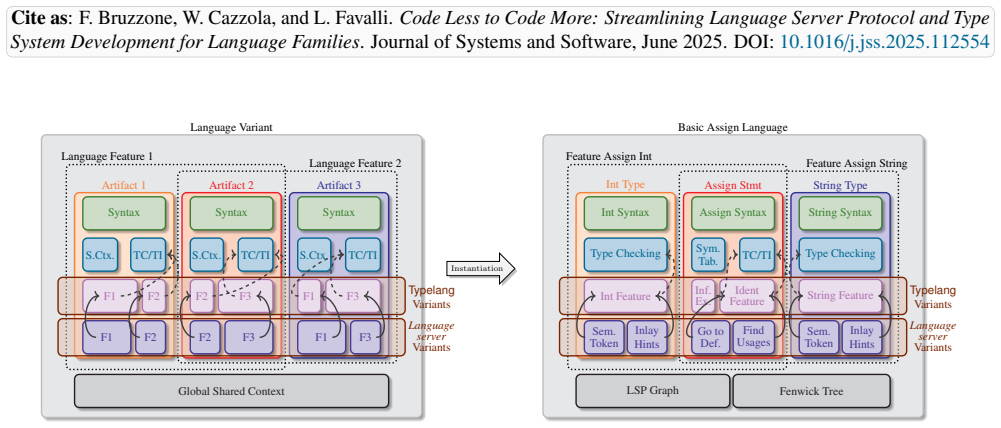
The paper claims that integrating Typelang into language artifacts within a modular workbench, managed by variant-oriented programming and a coordination layer, allows generation of language servers per artifact and full automation of LSP plugins for editors. This first reduces the problem to one language server per type system, and with reuse of artifacts across languages further reduces it to a small number of unique type systems, demonstrated by a 93.48% reduction in the characters required for type system code and 100% automation of plugin generation.
What carries the argument
Typelang, a family of domain-specific languages designed for modular, composable, and reusable type system implementations, together with a variant-oriented programming paradigm for handling interdependent language variants.
If this is right
- Language servers are produced automatically from each modular language artifact.
- LSP plugins for different editors are generated without manual coding, achieving 100% automation.
- Reuse of language artifacts across related languages reduces the number of unique type systems needed from T to N where N is much smaller than T.
- The total effort to provide editing support for language families drops substantially due to the character reduction and automation.
Where Pith is reading between the lines
- This method could be applied to other language implementation concerns like parsing or runtime semantics to achieve similar reuse benefits.
- Large libraries of reusable language components might emerge if the reuse across families proves effective in practice.
- Empirical studies on real-world language families would help quantify the reuse factor N/T in typical scenarios.
Load-bearing premise
Language artifacts from the modular workbench can be reused across different languages to reduce the count of unique type systems to far fewer than the number of languages.
What would settle it
A direct comparison of total code characters and development time for type systems and LSP plugins when building support for a set of related languages with full reuse versus without any reuse.
Figures






read the original abstract
Developing editing support for $L$ languages in $E$ editors is complex and time-consuming. Some languages do not provide dedicated editors, while others offer a single native editor. The $\textit{language server protocol}$ (LSP) reduces the language-editor combinations $L \times E$ to $L + E$, where a single language server communicates with editors via LSP plugins. However, overlapping implementations of linguistic components remain an issue. Existing language workbenches struggle with modularity, reusability, and leveraging type systems for language server generation. In this work, we propose: (i) Typelang, a family of domain-specific languages for modular, composable, and reusable type system implementation, (ii) a modular language server generation process, producing servers for languages built in a modular workbench, (iii) the variant-oriented programming paradigm and a cross-artifact coordination layer to manage interdependent software variants, and (iv) an LSP plugin generator, reducing $E$ to $1$ by automating plugin creation for multiple editors. To simplify editing support for language families, each language artifact integrates its own Typelang variant, used to generate language servers. This reduces combinations to $T \times 1$, where $T = L$ represents the number of type systems. Further reuse of language artifacts across languages lowers this to $N \times 1$, where $N << T$, representing unique type systems. We implement Typelang in Neverlang, generating language servers for each artifact and LSP plugins for three editors. Empirical evaluation shows a 93.48% reduction in characters needed for type system implementation and 100% automation of LSP plugin generation, significantly lowering effort for editing support in language families, especially when artifacts are reused.
Editorial analysis
A structured set of objections, weighed in public.
Referee Report
Summary. The paper introduces Typelang, a family of DSLs for modular and composable type system definitions, a modular language server generation process, the variant-oriented programming paradigm with a cross-artifact coordination layer, and an automated LSP plugin generator. It claims these reduce editing support effort for language families from L × E combinations to T × 1 and further to N × 1 (N ≪ T) via artifact reuse, with an empirical evaluation in Neverlang showing a 93.48% reduction in type system implementation characters and 100% automation of LSP plugin generation for three editors.
Significance. If the reuse claims are substantiated, the work addresses a practical pain point in language engineering by enabling shared type system components across language variants and automating LSP plugin creation, potentially lowering barriers for families of related languages. The implementation in an existing workbench (Neverlang) and support for multiple editors are practical strengths that could influence language workbench design.
major comments (2)
- [§5] §5 (Empirical Evaluation): The reported 93.48% reduction in characters for type system implementation and 100% LSP automation lack any description of baselines, measurement methodology, controls, specific languages evaluated, or the fraction of components actually reused across artifacts. Without these details it is impossible to determine whether the results support the central claim that reuse reduces the problem from T to N ≪ T rather than providing only per-language modularization benefits.
- [§3.3] §3.3 (Cross-Artifact Coordination Layer): The description of how the coordination layer resolves inter-variant dependencies is not accompanied by concrete metrics, examples, or case studies showing successful sharing of type system components across multiple languages in a family; this mechanism is load-bearing for the N × 1 reduction but remains unevidenced in the reported outcomes.
minor comments (2)
- [Introduction] The notation L × E, T × 1, and N × 1 would benefit from an accompanying diagram in the introduction to clarify the claimed reductions in editor-language combinations.
- [Abstract] Ensure all quantitative claims in the abstract are cross-referenced to the corresponding tables or figures in the evaluation section for traceability.
Simulated Author's Rebuttal
We thank the referee for the constructive feedback. The comments highlight opportunities to strengthen the substantiation of our empirical claims and the cross-artifact coordination mechanism. We address each point below and will revise the manuscript to incorporate additional details and evidence.
read point-by-point responses
-
Referee: [§5] §5 (Empirical Evaluation): The reported 93.48% reduction in characters for type system implementation and 100% LSP automation lack any description of baselines, measurement methodology, controls, specific languages evaluated, or the fraction of components actually reused across artifacts. Without these details it is impossible to determine whether the results support the central claim that reuse reduces the problem from T to N ≪ T rather than providing only per-language modularization benefits.
Authors: We agree that §5 would be strengthened by explicit descriptions of the evaluation methodology. In the revised version we will add: the specific Neverlang language variants used as subjects, the baseline (non-modular) implementations against which character counts were compared, the precise measurement procedure for source characters and reuse fraction, and quantitative data on how many type-system components were actually shared across variants. These additions will clarify that the observed 93.48 % reduction is attributable to cross-variant reuse rather than intra-language modularity alone, thereby supporting the claimed reduction from T × 1 to N × 1 with N ≪ T. revision: yes
-
Referee: [§3.3] §3.3 (Cross-Artifact Coordination Layer): The description of how the coordination layer resolves inter-variant dependencies is not accompanied by concrete metrics, examples, or case studies showing successful sharing of type system components across multiple languages in a family; this mechanism is load-bearing for the N × 1 reduction but remains unevidenced in the reported outcomes.
Authors: We acknowledge that §3.3 currently provides only a high-level description. We will revise the section to include concrete examples of inter-variant type dependencies, a small case study illustrating how the coordination layer resolves them when components are reused across family members, and quantitative metrics (e.g., number of shared components and resolved dependency edges) drawn from the Neverlang implementation. These additions will supply the missing evidence that the coordination layer enables the N × 1 reduction. revision: yes
Circularity Check
No significant circularity in derivation chain
full rationale
The paper describes Typelang as a family of DSLs for modular type systems, a modular LSP generation process, variant-oriented programming, and an LSP plugin generator, all implemented in Neverlang. The combination reductions (L×E to L+E, then T×1, then N×1) are high-level conceptual descriptions of the intended benefits of modularity and reuse rather than any mathematical derivation or equation that reduces to its own inputs by construction. The central claims rest on reported empirical outcomes (93.48% character reduction and 100% automation) from their implementation and evaluation, which are independent measurements. No self-definitional constructs, fitted inputs presented as predictions, or load-bearing self-citation chains appear. The derivation is self-contained against external benchmarks of code size and automation effort.
Axiom & Free-Parameter Ledger
axioms (1)
- domain assumption Existing language workbenches struggle with modularity, reusability, and leveraging type systems for language server generation.
invented entities (2)
-
Typelang
no independent evidence
-
variant-oriented programming paradigm
no independent evidence
Reference graph
Works this paper leans on
-
[1]
Compilers: Prin- ciples, Techniques, and Tools
Aho, A.V ., Sethi, R., Ullman, J.D., 1986. Compilers: Prin- ciples, Techniques, and Tools. Addison Wesley, Reading, Massachusetts
work page 1986
-
[2]
Error Recovery in Recursive Descent Parsers and Run-Time Storage Organization
Ammann, U., 1978. Error Recovery in Recursive Descent Parsers and Run-Time Storage Organization. Technical Report D-INFK. ETH Zürich, Department of Computer Science. Zürich, Switzerland
work page 1978
-
[3]
Apel, S., Leich, T., Saake, G., 2008. Aspectual Feature Modules. IEEE Transactions on Software Engineering 34, 162–180
work page 2008
-
[4]
Strategies for Product-Line Verifica- tion: Case Studies and Experiments, in: Chang, B.H., Pohl, K
Apel, S., von Thein, A., Wendler, P., Größlinger, A., Beyer, F., 2013. Strategies for Product-Line Verifica- tion: Case Studies and Experiments, in: Chang, B.H., Pohl, K. (Eds.), Proceedings of the 35th International Conference on Software Engineering (ICSE’13), IEEE, San Francisco, CA, USA. pp. 482–491
work page 2013
-
[5]
Barros, D., Peldszus, S., Assunção, W.K.G., Berger, T.,
-
[6]
Editing Support for Software Languages: Imple- mentation Practices in Language Server Protocols, in: Wimmer, M. (Ed.), Proceedings of the 25th International Conference on Model Driven Engineering Langauges and Systems (MoDELS’22), ACM, Montréal, Canada. pp. 232–243
-
[7]
Framing Software Reuse: Lessons from the Real World
Bassett, P., 1996. Framing Software Reuse: Lessons from the Real World. Prentice Hall
work page 1996
-
[8]
Modular Language Implementation in Rascal— Experience Report
Basten, B., van den Bos, J., Hills, M., Klint, P., Lankamp, A., Lisser, B., van der Ploeg, A., van der Storm, T., Vinju, J., 2015. Modular Language Implementation in Rascal— Experience Report. Science of Computer Programming 114, 7–19
work page 2015
-
[9]
Batory, D., Lofaso, B., Smaragdakis, Y ., 1998. JTS: Tools for Implementing Domain-Specific Languages, in: Pro- ceedings of the 5th International Conference on Software Reuse (ICSR’98), IEEE Computer Society, Victoria, BC, Canada. pp. 143–153
work page 1998
-
[10]
Batory, D., Sarvela, J.N., Rauschmayer, A., 2004. Scaling Step-Wise Refinement. IEEE Transactions on Software Engineering 30, 355–371
work page 2004
-
[11]
Reuse Frequency as Metric for Component Assessment
Bay, T.G., Pauls, K., 2004. Reuse Frequency as Metric for Component Assessment. Technical Report 464. ETH, Department of Computer Science. Zürich, Switzerland
work page 2004
-
[12]
Béguet, R., Amiard, R., 2023. Application of SMT in a Meta-Compiler: A Logic DSL for Specifying Type Systems, in: Graham-Lengrand, S., Preiner, M. (Eds.), Proceedings of the 21st International Workshop on Satisfi- ability Modulo Theories (SMT’23), CEUR, Haifa, Israel. pp. 46–61
work page 2023
-
[13]
Computational Geometry: Algorithms and Applications
de Berg, M., Cheong, O., van Kreveld, M., Overmars, M., 2008. Computational Geometry: Algorithms and Applications. 3rd ed., Springer
work page 2008
-
[14]
On the Granularity of Linguistic Reuse
Bertolotti, F., Cazzola, W., Favalli, L., 2023a. On the Granularity of Linguistic Reuse. Journal of Systems and Software 202. doi:10.1016/j.jss.2023.111704. 27 Cite as: F. Bruzzone, W. Cazzola, and L. Favalli.Code Less to Code More: Streamlining Language Server Protocol and Type System Development for Language Families. Journal of Systems and Software, Ju...
-
[15]
Journal of Systems and Software 205
Bertolotti, F., Cazzola, W., Favalli, L., 2023b.SP LL SP: Software Product Lines Extraction Driven by Language Server Protocol. Journal of Systems and Software 205. doi:10.1016/j.jss.2023.111809
-
[16]
A DSL for Writing Type Systems for Xtext Languages, in: Probst, C.W., Wimmer, C
Bettini, L., 2011. A DSL for Writing Type Systems for Xtext Languages, in: Probst, C.W., Wimmer, C. (Eds.), Proceedings of the 9th International Conference on Prin- ciples and Practice of Programming in Java (PPPJ’11), ACM, Kongens Lyngby, Denmark. pp. 31–40
work page 2011
-
[17]
Implementing Domain-Specific Lan- guages with Xtext and Xtend
Bettini, L., 2013a. Implementing Domain-Specific Lan- guages with Xtext and Xtend. PACKT Publishing Ltd
-
[18]
Bettini, L., 2013b. Implementing Java-like Languages in Xtext with Xsemantics, in: Proceedings of the 28th An- nual ACM Symposium on Applied Computing (SAC’13), ACM, Coimbra, Portugal. pp. 1559–1564
-
[19]
Implementing Type Systems for the IDE with Xsemantics
Bettini, L., 2016. Implementing Type Systems for the IDE with Xsemantics. Journal of Logical and Algebraic Methods in Programming 85, 655–680
work page 2016
-
[20]
Type Errors for the IDE with Xtext and Xsemantics
Bettini, L., 2019. Type Errors for the IDE with Xtext and Xsemantics. Journal Open Computer Science 9, 52–79
work page 2019
-
[21]
Imple- menting a Typed Javascript and Its IDE: A CASE-Study with Xsemantics
Bettini, L., von Pilgrim, J., Reiser, M.O., 2016. Imple- menting a Typed Javascript and Its IDE: A CASE-Study with Xsemantics. Journal on Advances in Software 9, 283–303
work page 2016
-
[22]
Bezerra, C.I.M., Andrade, R.M.C., Monteiro, J.M., 2015. Measures for Quality Evaluation of Feature Models, in: Proceedings of the 9th International Conference on Soft- ware and Software Reuse (ICSR’15), Springer, Miami, FL, USA. pp. 282–297
work page 2015
-
[23]
Object-Oriented Anal- ysis and Design with Applications
Booch, G., Maksimchuk, R., Engle, M., Young, B., Conallen, J., Houston, K., 2007. Object-Oriented Anal- ysis and Design with Applications. Third ed., Addison- Wesley
work page 2007
-
[24]
A Unified Frame- work for Coupling Measurement in Object-Oriented Sys- tems
Briand, L.C., Daly, J.W., Wüst, J., 1999. A Unified Frame- work for Coupling Measurement in Object-Oriented Sys- tems. IEEE Transactions on Software Engineering 25, 91–121
work page 1999
-
[25]
Bünder, H., 2019. Decoupling Language and Editor: The Impact of the Language Server Protocol on Tex- tual Domain-Specific Languages, in: Hammoudi, S., Fer- reira Pires, L., Seliç, B. (Eds.), Proceedings of the 7th International Conference on Model-Driven Engineering and Software Development (MODELW ARD’19), SciTe Press, Prague, Czech Republic. pp. 129–140
work page 2019
-
[26]
Bünder, H., Kuchen, H., 2019. Towards Multi-editor Sup- port for Domain-Specific Languages Utilizing the Lan- guage Server Protocol, in: Hammoudi, S., Pires, L.F., Seli´c, B. (Eds.), Proceedings of the 7th International Conference on Model-Driven Engineering and Software Development (MODELSWARD’19), Springer, Prague, Czech Republic. pp. 225–245
work page 2019
-
[27]
Butting, A., Eikermann, R., Kautz, O., Rumpe, B., Wort- mann, A., 2018a. Controlled and Extensible Variability of Concrete and Abstract Syntax with Independent Lan- guage Features, in: Proceedings of the 12th International Workshop on Variability Modelling of Software Intensive Systems (V AMOS’18), ACM, Madrid, Spain. pp. 75–82
-
[28]
Modeling Language Variability with Reusable Language Components, in: Berger, T., Borba, P
Butting, A., Eikermann, R., Kautz, O., Rumpe, B., Wort- mann, A., 2018b. Modeling Language Variability with Reusable Language Components, in: Berger, T., Borba, P. (Eds.), Proceedings of the 22nd International Systems and Software Product Line Conference (SPLC’18), ACM, Gothenburg, Sweden. pp. 65–75
-
[29]
Structural Subtyping and the Notion of Power Type, in: Ferrante, J., Peter, M
Cardelli, L., 1988. Structural Subtyping and the Notion of Power Type, in: Ferrante, J., Peter, M. (Eds.), Pro- ceedings of the 15th ACM Symposium on Principles of Programming Languages (POPL’88), ACM, San Diego, CA, USA. pp. 70–79
work page 1988
-
[30]
Cardozo, N., Günther, S., D’Hondt, T., Mens, K., 2011. Feature-Oriented Programming and Context-Oriented Programming: Comparing Paradigm Characteristics by Example Implementations, in: Hartmann, H., Breivold, H.P. (Eds.), Proceedings of the 6th International Con- ference on Software Engineering Advances (ICSEA’11), IARIA, Barcelona, Spain. pp. 130–135
work page 2011
-
[31]
Cazzola, W., 2012. Domain-Specific Languages in Few Steps: The Neverlang Approach, in: Gschwind, T., De Paoli, F., Gruhn, V ., Book, M. (Eds.), Proceedings of the 11th International Conference on Software Com- position (SC’12), Springer, Prague, Czech Republic. pp. 162–177
work page 2012
-
[32]
Towards a Recipe for Language Decomposition: Quality Assessment of Lan- guage Product Lines
Cazzola, W., Favalli, L., 2022. Towards a Recipe for Language Decomposition: Quality Assessment of Lan- guage Product Lines. Empirical Software Engineering 27. doi:10.1007/s10664-021-10074-6
-
[33]
Software Modernization Powered by Dynamic Language Product Lines
Cazzola, W., Favalli, L., 2024. Software Modernization Powered by Dynamic Language Product Lines. Journal of Systems and Software 218. doi: 10.1016/j.jss.2024. 112188
-
[34]
Gradually Learn- ing Programming Supported by a Growable Program- ming Language
Cazzola, W., Olivares, D.M., 2016. Gradually Learn- ing Programming Supported by a Growable Program- ming Language. IEEE Transactions on Emerging Top- ics in Computing 4, 404–415. doi: 10.1109/TETC.2015. 2446192. special Issue on Emerging Trends in Education
-
[35]
Cazzola, W., Poletti, D., 2010. DSL Evolution through Composition, in: Proceedings of the 7 th ECOOP Work- shop on Reflection, AOP and Meta-Data for Software Evolution (RAM-SE’10), ACM, Maribor, Slovenia
work page 2010
-
[37]
Type Sys- tems as Macros, in: Gordon, A.D
Chang, S., Knauth, A., Greenman, B., 2017. Type Sys- tems as Macros, in: Gordon, A.D. (Ed.), Proceedings of the 44th Symposium on Principles of Programming Languages (PoPL’17), ACM, Paris, France. pp. 694–705
work page 2017
-
[38]
Software Product Lines: Practices and Patterns
Clements, P., Northrop, L., 2001. Software Product Lines: Practices and Patterns. Addison-Wesley
work page 2001
-
[39]
Inheritance Is Not Subtyping, in: Allen, F.E
Cook, W.R., Hill, W., Canning, P.S., 1990. Inheritance Is Not Subtyping, in: Allen, F.E. (Ed.), Proceedings of the 17th ACM SIGPLAN-SIGACT Symposium on Prin- ciples of Programming Languages (POPL’90), ACM, San Francisco, CA, USA. pp. 125–135
work page 1990
-
[40]
Cooper, K.D., Torczon, L., 2022. Engineering a Compiler. Morgan Kaufmann
work page 2022
-
[41]
Crane, M.L., Dingel, J., 2005. UML vs. Classical vs. Rhapsody Statecharts: Not All Models Are Created Equal, in: Briand, L., Williams, C. (Eds.), Proceedings of the 8th International Conference on Model Driven Engineering Languages and Systems (MoDELS’05), Springer, Mon- tego Bay, Jamaica. pp. 97–112
work page 2005
-
[42]
Staged Configuration Using Feature Models, in: Weiss, D., van Ommering, R
Czarnecki, K., Helsen, S., Eisenecker, U., 2004. Staged Configuration Using Feature Models, in: Weiss, D., van Ommering, R. (Eds.), Proceedings of the 3rd Interna- tional Conference on Software Product-Line (SPLC’04), Springer, Boston, MA, USA. pp. 266–283
work page 2004
-
[43]
Delta- Oriented Multi Software Product Lines, in: Heymans, P., Rubin, J
Damiani, F., Schaefer, I., Winkelmann, T., 2014. Delta- Oriented Multi Software Product Lines, in: Heymans, P., Rubin, J. (Eds.), Proceedings of 18th International Software Product Line Conference (SPLC’14), ACM, Florence, Italy. pp. 232–236
work page 2014
-
[44]
A Formal Model for Multi Software Product Lines
Damini, F., Lienhardt, M., Paolini, L., 2019. A Formal Model for Multi Software Product Lines. Science of Computer Programming 172, 203–231
work page 2019
-
[45]
Product Derivation in Software Product Families: A Case Study
Deelstra, S., Sinnema, M., Bosch, J., 2005. Product Derivation in Software Product Families: A Case Study. Journal of Systems and Software 74, 173–194
work page 2005
-
[46]
Degueule, T., Combemale, B., Blouin, A., Barais, O., Jézéquel, J.M., 2015. Melange: a Meta-Language for Modular and Reusable Development of DSLs, in: Di Rus- cio, D., Völter, M. (Eds.), Proceedings of the 8th Inter- national Conference on Software Language Engineering (SLE’15), ACM, Pittsburgh, PA, USA. pp. 25–36
work page 2015
-
[47]
Del Sole, A., 2023. Visual Studio Distilled. Third ed., Apress
work page 2023
-
[48]
The JastAdd System — Modular Extensible Compiler Construction
Ekman, T., Hedin, G., 2007. The JastAdd System — Modular Extensible Compiler Construction. Science of Computer Programming 69, 14–26
work page 2007
-
[49]
El-Sharkawy, S., Kröher, C., Schmid, K., 2011. Support- ing Heterogeneous Compositional Multi Software Prod- uct Lines, in: Santana de Almeida, E., Kishi, T. (Eds.), Proceedings of the 15th International Software Product Line Conference (SPLC’11), IEEE, Münich, Germany. pp. 1–4
work page 2011
-
[50]
The State of the Art in Language Workbenches, in: Erwig, M., Paige, R.F., Van Wyk, E
Erdweg, S., van der Storm, T., Völter, M., Boersma, M., Bosman, R., Cook, W.R., Gerrtsen, A., Hulshout, A., Kelly, S., Loh, A., Konat, G.D.P., Molina, P.J., Palatnik, M., Pohjonen, R., Schindler, E., Schindler, K., Solmi, R., Vergu, V .A., Visser, E., 2013. The State of the Art in Language Workbenches, in: Erwig, M., Paige, R.F., Van Wyk, E. (Eds.), Proce...
work page 2013
-
[51]
Favalli, L., Kühn, T., Cazzola, W., 2020. Neverlang and FeatureIDE Just Married: Integrated Language Product Line Development Environment, in: Collet, P., Nadi, S. (Eds.), Proceedings of the 24th International Software Product Line Conference (SPLC’20), ACM, Montréal, Canada. pp. 285–295
work page 2020
-
[52]
A New Data Structure for Cumula- tive Frequency Tables
Fenwick, P.M., 1994. A New Data Structure for Cumula- tive Frequency Tables. Software: Practice and Experience 24, 327–336
work page 1994
-
[53]
Fowler, M., 2005. Inversion of Control. Martin Fowler’s Blog. URL: https://martinfowler.com/ bliki/InversionOfControl.html
work page 2005
-
[54]
Software Reuse: Metrics and Models
Frakes, W., Terry, C., 1996. Software Reuse: Metrics and Models. ACM Computing Surveys 28, 415–435
work page 1996
-
[55]
Design Patterns: Elements of Reusable Object-Oriented Software
Gamma, E., Helm, R., Johnson, R., Vlissides, J., 1995. Design Patterns: Elements of Reusable Object-Oriented Software. Professional Computing Series, Addison- Wesley, Reading, Ma, USA
work page 1995
-
[56]
Practical LR Error Recovery, in: Johnson, S.C
Graham, S.L., Haley, C.B., Joy, W.N., 1979. Practical LR Error Recovery, in: Johnson, S.C. (Ed.), Proceedings of the 1979 Sigplan Symposium on Compiler Construction (CC’79), ACM, Denver, CO, USA. pp. 168–175
work page 1979
-
[57]
TextMate: Power Editing for the Mac
Gray, II, E.J., 2007. TextMate: Power Editing for the Mac. Pragmatic Bookshelf
work page 2007
-
[58]
Implementing Product-Line Features with Component Reuse, in: Frakes, W.B
Griss, M.L., 2000. Implementing Product-Line Features with Component Reuse, in: Frakes, W.B. (Ed.), Proceed- ings of the 6th International Conference on Software Reuse (ICSR’00), Springer, Vienna, Austria. pp. 137– 151
work page 2000
-
[60]
Gunasinghe, N., Marcus, N., 2022. Language Server Pro- tocol and Implementation: Supporting Language-Smart Editing and Programming Tools. Apress
work page 2022
-
[61]
Hartmann, H., Trew, T., 2008. Using Feature Diagrams with Context Variability to Model Multiple Product Lines for Software Supply Chains, in: Geppert, B. (Ed.), Pro- ceedings of the 12th International Software Product Line Conference (SPLC’08), IEEE, Limerick, Ireland. pp. 12– 21
work page 2008
-
[62]
Adding Standardized Variabil- ity to Domain Specific Languages, in: Pohl, K., Geppert, B
Haugen, Ø., Møller-Pedersen, B., Oldevik, J., Olsen, G.K., Svendsen, A., 2008. Adding Standardized Variabil- ity to Domain Specific Languages, in: Pohl, K., Geppert, B. (Eds.), Proceedings of the 12th International Software Product Line Conference (SPLC’08), IEEE, Limerick, Ireland. pp. 139–148
work page 2008
-
[63]
Model-Based Language Engineering with EMFText, in: Lämmel, R., Visser, J., Saraiva, J
Heidenreich, F., Johannes, J., Karol, S., Seifert, M., Wende, C., 2011. Model-Based Language Engineering with EMFText, in: Lämmel, R., Visser, J., Saraiva, J. (Eds.), Proceedings of the International Summer School on Generative and Transformational Techniques in Soft- ware Engineering (GTTSE’11), Springer, Braga, Portugal. pp. 322–345
work page 2011
-
[64]
The Principal Type-Scheme of an Ob- ject in Combinatory Logic
Hindley, R., 1969. The Principal Type-Scheme of an Ob- ject in Combinatory Logic. Transactions of the America Mathematical Society 146, 29–60
work page 1969
-
[65]
A Systematic Review and an Expert Survey on Capabilities Supporting Multi-Product Lines
Holl, G., Grünbacher, P., Rabiser, R., 2012. A Systematic Review and an Expert Survey on Capabilities Supporting Multi-Product Lines. Information and Software Technol- ogy 54, 828–852
work page 2012
-
[66]
Configuration in Industrial Product Families: The ConIPF Methodology
Hotz, L., Wolter, K., Krebs, T., Deelstra, S., Sinnema, M., Nijhuis, G.J., MacGregor, J., 2006. Configuration in Industrial Product Families: The ConIPF Methodology. IOS Press
work page 2006
-
[67]
Hu, H., Shinde, S., Adrian, S., Chua, Z.L., Saxena, P., Liang, Z., 2016. Data-Oriented Programming: On the Ex- pressiveness of Non-control Data Attacks, in: Shmatikov, V ., Erlingsson, U. (Eds.), Proceedings of the 2016 IEEE Symposium on Security and Privacy (SP’16), IEEE, San Josè, CA, USA. pp. 969–986
work page 2016
-
[68]
Modular Domain Specific Languages and Tools, in: Devanbu, P., Poulin, J
Hudak, P., 1998. Modular Domain Specific Languages and Tools, in: Devanbu, P., Poulin, J. (Eds.), Proceedings of the 5th International Conference on Software Reuse (ICSR’98), IEEE, Victoria, BC, Canada. pp. 134–142
work page 1998
-
[69]
Why Functional Programming Matters
Hughes, J., 1989. Why Functional Programming Matters. The Computer Journal 32, 98–107
work page 1989
-
[70]
Hürsch, W., Videira Lopes, C., 1995. Separation of Con- cerns. Technical Report NU-CCS-95-03. Northeastern University, Boston
work page 1995
-
[71]
A Langium-Based Approach to BigER
Jordan, T., Zib, S., 2024. A Langium-Based Approach to BigER. Bachelor’s thesis. Technische Universität Wien. Wien, Austria
work page 2024
-
[72]
Feature-Oriented Domain Analysis (FODA) Feasibility Study
Kang, K.C., Cohen, S.G., Hess, J.A., Novak, W.E., Pe- terson, A.S., 1990. Feature-Oriented Domain Analysis (FODA) Feasibility Study. Technical Report CMU/SEI- 90-TR-21. Carnegie Mellon University. Pittsburgh, Penn- sylvania, USA
work page 1990
-
[73]
The Road to Feature Modularity?, in: Schäfer, I., John, I., Schmid, K
Kästner, C., Apel, S., Ostermann, K., 2006. The Road to Feature Modularity?, in: Schäfer, I., John, I., Schmid, K. (Eds.), Proceedings of the 3rd Workshop on Feature-Oriented Software Development (FOSD’11), ACM, Münich, Germany
work page 2006
-
[74]
Kats, L.C.L., Visser, E., 2010. The Spoofax Language Workbench: Rules for Declarative Specification of Lan- guages and IDEs, in: Rinard, M., Sullivan, K.J., Stein- berg, D.H. (Eds.), Proceedings of the ACM International Conference on Object Oriented Programming Systems Languages and Applications (OOPSLA’10), ACM, Reno, Nevada, USA. pp. 444–463
work page 2010
-
[75]
Kats, L.C.L., Visser, E., Wachsmuth, G., 2010. Pure and Declarative Syntax Definition: Paradise Lost and Regained, in: Proceedings of ACM Conference on New Ideas in Programming and Reflections on Software (On- ward! 2010), ACM, Reno-Tahoe, Nevada, USA
work page 2010
-
[76]
An Overview of AspectJ, in: Knud- sen, J.L
Kiczales, G., Hilsdale, E., Hugunin, J., Kersten, M., Palm, J., Griswold, B., 2001. An Overview of AspectJ, in: Knud- sen, J.L. (Ed.), Proceedings of the 15th European Con- ference on Object-Oriented Programming (ECOOP’01), Springer-Verlag, Budapest, Hungary. pp. 327–353
work page 2001
-
[77]
Aspect- Oriented Programming, in: Ak¸ sit, M., Matsuoka, S
Kiczales, G., Lamping, J., Mendhekar, A., Maeda, C., Videira Lopes, C., Loingtier, J.M., Irwin, J., 1997. Aspect- Oriented Programming, in: Ak¸ sit, M., Matsuoka, S. (Eds.), 11th European Conference on Object Oriented Programming (ECOOP’97), Springer-Verlag, Helsinki, Finland. pp. 220–242
work page 1997
-
[78]
EASY Meta-Programming with Rascal, in: Fernandes, J.M., Lämmel, R., Visser, J., Saraiva, J
Klint, P., van der Storm, T., Vinju, J., 2009. EASY Meta-Programming with Rascal, in: Fernandes, J.M., Lämmel, R., Visser, J., Saraiva, J. (Eds.), Proceedings of the International Summer School on Generative and Transformational Techniques in Software Engineering III (GTTSE’09), Springer, Braga, Portugal. pp. 222–289
work page 2009
-
[79]
The Art of Computer Programming: Fundamental Algorithms
Knuth, D.E., 1997. The Art of Computer Programming: Fundamental Algorithms. third ed., Addison Wesley
work page 1997
-
[80]
Domain Specific Languages: A Systematic Mapping Study
Kosar, T., Bohra, S., Mernik, M., 2016. Domain Specific Languages: A Systematic Mapping Study. Information and Software Technology 71, 77–91
work page 2016
-
[82]
Krahn, H., Rumpe, B., Völkel, S., 2007. Efficient Ed- itor Generation for Compositional DSLs in Eclipse, in: Tolvanen, J.P., Gray, J., Rossi, M., Sprinkle, J. (Eds.), Proceedings of the 7th OOPSLA Workshop on Domain- Specific Modeling (DSM’07), Montréal, Canada
work page 2007
-
[83]
MontiCore: A Framework for Compositional Development of Domain Specific Languages
Krahn, H., Rumpe, B., Völkel, S., 2010. MontiCore: A Framework for Compositional Development of Domain Specific Languages. International Journal on Software Tools for Technology Transfer 12, 353–372
work page 2010
discussion (0)
Sign in with ORCID, Apple, or X to comment. Anyone can read and Pith papers without signing in.