Dispersion Relations in Two- and Three-Dimensional Quantum Systems
Pith reviewed 2026-05-18 15:14 UTC · model grok-4.3
The pith
A tensor-network approach using infinite projected entangled-pair states computes dispersion relations in two- and three-dimensional quantum lattice models.
A machine-rendered reading of the paper's core claim, the machinery that carries it, and where it could break.
Core claim
Imaginary-time evolution within the iPEPS ansatz yields dispersion relations for the transverse-field Ising model on two- and three-dimensional lattices that agree with series-expansion results wherever the latter exist, thereby providing the first such spectra for three-dimensional quantum lattice models.
What carries the argument
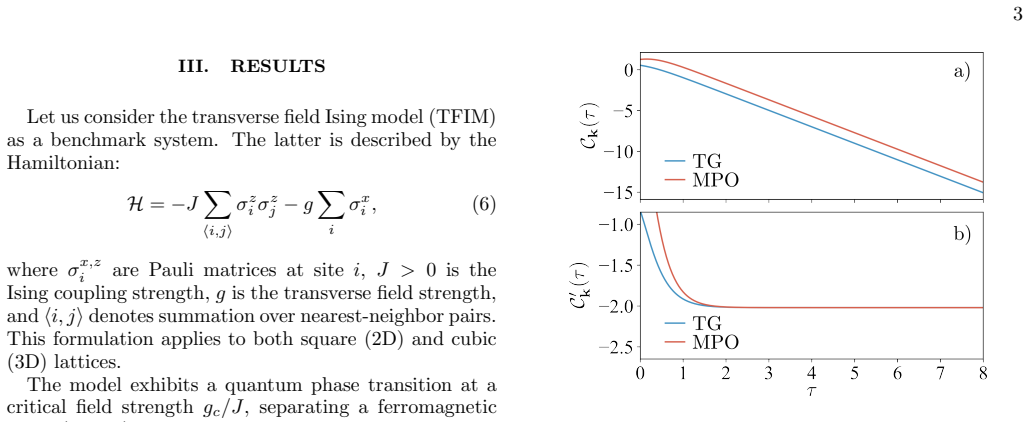
Imaginary-time evolution of iPEPS states to extract momentum-resolved excitation spectra by analyzing the decay of correlations in imaginary time.
If this is right
- Dispersion relations become computable in both paramagnetic and ferromagnetic regimes of the model.
- Results match independent series-expansion data in regimes where such expansions are reliable.
- Only modest bond dimensions and computational effort are required to maintain accuracy across a broad range of parameters.
- The same procedure applies to other two- and three-dimensional lattice models that admit an iPEPS description.
Where Pith is reading between the lines
- The technique could be applied to models with longer-range interactions or different symmetries to map out previously unknown phase diagrams in three dimensions.
- Momentum-resolved spectra obtained this way could serve as input for designing photonic or quantum-information devices that rely on precise band structures.
- Extending the evolution to finite temperature or to real-time dynamics would test whether the same framework yields dynamical structure factors in three dimensions.
Load-bearing premise
The iPEPS representation with modest bond dimensions remains accurate enough to capture the dispersion relations in three dimensions without large truncation errors over wide parameter ranges.
What would settle it
Direct numerical comparison of the iPEPS-derived dispersion curves against exact diagonalization or higher-bond-dimension results on small three-dimensional clusters at the same parameter values.
Figures


read the original abstract
Extracting momentum-resolved excitation spectra in strongly correlated quantum systems remains a major challenge, especially beyond one spatial dimension. We present an efficient tensor-network approach to compute dispersion relations via imaginary-time evolution within the infinite projected entangled-pair states (iPEPS) framework. Benchmarking on the transverse-field Ising model, the method successfully captures dispersion relations in both paramagnetic and ferromagnetic phases for two- and three-dimensional lattices, achieving strong agreement with series expansion methods, where these are applicable. Crucially, this work presents the first demonstration of dispersion relation calculations for three-dimensional quantum lattice models - a long-standing computational challenge that opens entirely new research frontiers. The method demonstrates remarkable efficiency, requiring only modest computational resources while maintaining high accuracy across wide parameter ranges. Its broad applicability makes it a powerful tool for quantum simulation, photonic material design, and quantum information platforms requiring precise momentum-resolved spectra.
Editorial analysis
A structured set of objections, weighed in public.
Referee Report
Summary. The manuscript introduces a tensor-network method using infinite projected entangled-pair states (iPEPS) and imaginary-time evolution to extract momentum-resolved dispersion relations in 2D and 3D quantum lattice models. Benchmarking is performed on the transverse-field Ising model in both paramagnetic and ferromagnetic phases, with reported strong agreement to series-expansion results where available; the work claims to provide the first such calculations for three-dimensional systems.
Significance. If the accuracy and convergence claims hold under systematic checks, the result would be significant as the first demonstration of dispersion-relation extraction for 3D quantum lattice models via tensor networks, addressing a long-standing computational challenge and enabling new studies in quantum simulation and photonic materials. The reported efficiency with modest resources strengthens the potential impact if truncation errors are shown to be controlled.
major comments (1)
- [Abstract and 3D results] Abstract and 3D results section: the central claim that the iPEPS method with modest bond dimensions accurately captures dispersion relations in 3D rests on 'strong agreement' with series expansions, yet no error bars, bond-dimension scaling plots, or truncation-error estimates are provided; this is load-bearing because the stricter entanglement area law in 3D makes long-range correlations (which enter the excitation energies) vulnerable to systematic truncation precisely in regimes where series data are unavailable.
minor comments (2)
- [Methods] The methods section would benefit from an explicit statement of the bond-dimension values employed for the 2D and 3D benchmarks and the convergence criterion used in the imaginary-time evolution.
- [Figures] Figure captions should specify the momentum grid resolution and any fitting procedure used to extract the dispersion curves from the imaginary-time data.
Simulated Author's Rebuttal
We thank the referee for their careful reading of the manuscript and for identifying this important point about the presentation of the 3D results. We address the concern directly below and outline the revisions we will make to strengthen the supporting evidence.
read point-by-point responses
-
Referee: [Abstract and 3D results] Abstract and 3D results section: the central claim that the iPEPS method with modest bond dimensions accurately captures dispersion relations in 3D rests on 'strong agreement' with series expansions, yet no error bars, bond-dimension scaling plots, or truncation-error estimates are provided; this is load-bearing because the stricter entanglement area law in 3D makes long-range correlations (which enter the excitation energies) vulnerable to systematic truncation precisely in regimes where series data are unavailable.
Authors: We agree that additional quantitative checks would strengthen the central claim for the 3D calculations. The current manuscript shows direct comparisons to series-expansion data in the regimes where those benchmarks exist and reports good visual agreement for both paramagnetic and ferromagnetic phases. However, we acknowledge that explicit bond-dimension scaling plots, error bars on the extracted dispersion points, and truncation-error estimates derived from the iPEPS singular-value spectrum are not included. In the revised manuscript we will add these elements: (i) a figure showing the dispersion relation for several bond dimensions D in the 3D transverse-field Ising model, (ii) a quantitative assessment of the change in excitation energies with D, and (iii) a brief discussion of how the area-law truncation affects long-range correlations and the resulting dispersion. For parameter regions without series-expansion data we will explicitly note that the accuracy is inferred from the controlled convergence observed in the benchmarked regimes and from the 2D results, rather than claiming direct validation. revision: yes
Circularity Check
No significant circularity; derivation relies on independent benchmarks
full rationale
The paper introduces an iPEPS-based imaginary-time evolution method to extract momentum-resolved spectra. It validates the approach by direct comparison to series-expansion results on the transverse-field Ising model in both 2D and 3D, explicitly noting agreement “where these are applicable.” The central claim of a first 3D demonstration therefore rests on numerical output cross-checked against an external, non-self-referential technique rather than on any fitted parameter, self-definition, or load-bearing self-citation. No equation or step reduces the reported dispersion relations to the input ansatz by construction.
Axiom & Free-Parameter Ledger
free parameters (1)
- bond dimension
axioms (1)
- domain assumption The infinite projected entangled-pair states ansatz can faithfully represent ground states and low-lying excitations of the transverse-field Ising model in 2D and 3D lattices.
Lean theorems connected to this paper
-
Foundation/AlexanderDuality.leanalexander_duality_circle_linking echoes?
echoesECHOES: this paper passage has the same mathematical shape or conceptual pattern as the Recognition theorem, but is not a direct formal dependency.
first demonstration of dispersion relation calculations for three-dimensional quantum lattice models
What do these tags mean?
- matches
- The paper's claim is directly supported by a theorem in the formal canon.
- supports
- The theorem supports part of the paper's argument, but the paper may add assumptions or extra steps.
- extends
- The paper goes beyond the formal theorem; the theorem is a base layer rather than the whole result.
- uses
- The paper appears to rely on the theorem as machinery.
- contradicts
- The paper's claim conflicts with a theorem or certificate in the canon.
- unclear
- Pith found a possible connection, but the passage is too broad, indirect, or ambiguous to say the theorem truly supports the claim.
Reference graph
Works this paper leans on
-
[1]
Paramagnetic Phase (g= 1) The dispersion relation in the paramagnetic phase for 2D square (SQ) lattice is given by: ∆k = 2−2J(c 1x +c 1y) +J 2 1−2c 1xc1y − 1 2(c2x +c 2y) + 1 4 J 3 [c1x +c 1y −6(c 2xc1y +c 1xc2y)−(c 3x +c 3y)] + 1 32 J 4 70−16c 1xc1y −60c 2xc2y −24(c 2x +c 2y) −40(c 3xc1y +c 1xc3y)−5(c 4x +c 4y) +· · ·. (A1) For the 3D case, the dispersio...
-
[2]
F erromagnetic Phase (J= 1) The dispersion relation in the ferromagnetic phase in 2D for SQ lattice is: ∆k = 8− 1 4 g2(1 +c 1x +c 1y) + 1 768 g4 19 + 12(c1x +c 1y) − 1 884736 g6 4745 + 4176c1xc1y + 4710(c1x +c 1y) + 504(c2x +c 2y) + 276(c2xc1y +c 1xc2y) + 46(c3x +c 3y) +· · ·.(A3) The ferromagnetic dispersion relation in 3D for SC lat- tice is given by: ∆...
-
[3]
F. J. Dyson, General theory of spin-wave interactions, Phys. Rev.102, 1217 (1956)
work page 1956
-
[4]
T. Holstein and H. Primakoff, Field dependence of the intrinsic domain magnetization of a ferromagnet, Phys. Rev.58, 1098 (1940)
work page 1940
-
[5]
J. Bardeen, L. N. Cooper, and J. R. Schrieffer, Theory of superconductivity, Phys. Rev.108, 1175 (1957)
work page 1957
-
[6]
A. Damascelli, Z. Hussain, and Z.-X. Shen, Angle- resolved photoemission studies of the cuprate supercon- ductors, Rev. Mod. Phys.75, 473 (2003)
work page 2003
-
[7]
J. A. Sobota, Y. He, and Z.-X. Shen, Angle-resolved photoemission studies of quantum materials, Rev. Mod. Phys.93, 025006 (2021)
work page 2021
-
[8]
M. Mourigal, M. Enderle, A. Kl¨ opperpieper, J.-S. Caux, A. Stunault, and H. M. Rønnow, Fractional spinon ex- citations in the quantum Heisenberg antiferromagnetic chain, Nat. Phys.9, 435 (2013)
work page 2013
-
[9]
D. M. Mittleman, Perspective: Terahertz science and technology, Journal of Applied Physics122, 230901 (2017)
work page 2017
-
[10]
M. C. Hoffmann and J. A. F¨ ul¨ op, Intense ultrashort ter- ahertz pulses: generation and applications, Journal of Physics D: Applied Physics44, 083001 (2011)
work page 2011
-
[11]
J. R. Maze, P. L. Stanwix, J. S. Hodges, S. Hong, J. M. Taylor, P. Cappellaro, L. Jiang, M. V. G. Dutt, E. Togan, A. S. Zibrov, A. Yacoby, R. L. Walsworth, and M. D. Lukin, Nanoscale magnetic sensing with an individual electronic spin in diamond, Nature455, 644 (2008)
work page 2008
- [12]
-
[13]
C. Gross and I. Bloch, Quantum simulations with ultra- cold atoms in optical lattices, Science357, 995 (2017)
work page 2017
-
[14]
I. ˇZuti´ c, J. Fabian, and S. Das Sarma, Spintronics: Fun- damentals and applications, Rev. Mod. Phys.76, 323 (2004)
work page 2004
-
[15]
Fert, Nobel lecture: Origin, development, and future of spintronics, Rev
A. Fert, Nobel lecture: Origin, development, and future of spintronics, Rev. Mod. Phys.80, 1517 (2008)
work page 2008
-
[16]
C. L. Degen, F. Reinhard, and P. Cappellaro, Quantum sensing, Rev. Mod. Phys.89, 035002 (2017)
work page 2017
-
[17]
A. Avella and F. Mancini,Strongly Correlated Systems: Numerical Methods, Springer Series in Solid-State Sci- ences (Springer Berlin Heidelberg, 2013)
work page 2013
-
[18]
Dagotto, Correlated electrons in high-temperature su- perconductors, Rev
E. Dagotto, Correlated electrons in high-temperature su- perconductors, Rev. Mod. Phys.66, 763 (1994)
work page 1994
-
[19]
M. Troyer and U.-J. Wiese, Computational complex- ity and fundamental limitations to fermionic quantum Monte Carlo simulations, Phys. Rev. Lett.94, 170201 (2005)
work page 2005
- [20]
-
[21]
M. P. Gelfand, R. R. P. Singh, and D. A. Huse, Per- turbation expansions for quantum many-body systems, 7 Journal of Statistical Physics59, 1093 (1990)
work page 1990
-
[22]
U. Schollw¨ ock, The density-matrix renormalization group in the age of matrix product states, Annals of Physics 326, 96 (2011), january 2011 Special Issue
work page 2011
-
[23]
S. R. White, Density matrix formulation for quantum renormalization groups, Phys. Rev. Lett.69, 2863 (1992)
work page 1992
- [24]
-
[25]
R. Or´ us, A practical introduction to tensor networks: Matrix product states and projected entangled pair states, Annals of Physics349, 117 (2014)
work page 2014
-
[26]
B. Bruognolo, J.-W. Li, J. von Delft, and A. Weichsel- baum, A beginner’s guide to non-abelian iPEPS for cor- related fermions, SciPost Phys. Lect. Notes , 25 (2021)
work page 2021
-
[27]
P. C. G. Vlaar and P. Corboz, Simulation of three- dimensional quantum systems with projected entangled- pair states, Phys. Rev. B103, 205137 (2021)
work page 2021
-
[28]
I. V. Lukin and A. G. Sotnikov, Single-layer tensor net- work approach for three-dimensional quantum systems, Phys. Rev. B110, 064422 (2024)
work page 2024
-
[29]
L. Vanderstraeten, J. Haegeman, and F. Verstraete, Sim- ulating excitation spectra with projected entangled-pair states, Phys. Rev. B99, 165121 (2019)
work page 2019
-
[30]
W.-L. Tu, L. Vanderstraeten, N. Schuch, H.-Y. Lee, N. Kawashima, and J.-Y. Chen, Generating function for projected entangled-pair states, PRX Quantum5, 010335 (2024)
work page 2024
-
[31]
B. Ponsioen and P. Corboz, Excitations with projected entangled pair states using the corner transfer matrix method, Phys. Rev. B101, 195109 (2020)
work page 2020
-
[32]
J. D. Arias Espinoza and P. Corboz, Spectral functions with infinite projected entangled-pair states, Phys. Rev. B110, 094314 (2024)
work page 2024
-
[33]
B. Ponsioen, F. F. Assaad, and P. Corboz, Automatic differentiation applied to excitations with projected en- tangled pair states, SciPost Phys.12, 006 (2022)
work page 2022
-
[34]
I. V. Lukin, A. G. Sotnikov, J. M. Leamer, A. B. Mag- ann, and D. I. Bondar, Spectral gaps of two- and three- dimensional many-body quantum systems in the thermo- dynamic limit, Phys. Rev. Res.6, 023128 (2024)
work page 2024
-
[35]
F. Verstraete, V. Murg, and J. Cirac, Matrix prod- uct states, projected entangled pair states, and vari- ational renormalization group methods for quantum spin systems, Advances in Physics57, 143 (2008), https://doi.org/10.1080/14789940801912366
-
[36]
J. I. Cirac, D. P´ erez-Garc´ ıa, N. Schuch, and F. Ver- straete, Matrix product states and projected entangled pair states: Concepts, symmetries, theorems, Rev. Mod. Phys.93, 045003 (2021)
work page 2021
-
[37]
S.-J. Ran, W. Li, B. Xi, Z. Zhang, and G. Su, Optimized decimation of tensor networks with super- orthogonalization for two-dimensional quantum lattice models, Phys. Rev. B86, 134429 (2012)
work page 2012
-
[38]
H. N. Phien, I. P. McCulloch, and G. Vidal, Fast conver- gence of imaginary time evolution tensor network algo- rithms by recycling the environment, Phys. Rev. B91, 115137 (2015)
work page 2015
-
[39]
H. C. Jiang, Z. Y. Weng, and T. Xiang, Accurate de- termination of tensor network state of quantum lattice models in two dimensions, Phys. Rev. Lett.101, 090603 (2008)
work page 2008
-
[40]
S. S. Jahromi and R. Or´ us, Universal tensor-network al- gorithm for any infinite lattice, Phys. Rev. B99, 195105 (2019)
work page 2019
-
[41]
J. Tindall and M. Fishman, Gauging tensor networks with belief propagation, SciPost Phys.15, 222 (2023)
work page 2023
-
[42]
H. W. J. Bl¨ ote and Y. Deng, Cluster Monte Carlo sim- ulation of the transverse Ising model, Phys. Rev. E66, 066110 (2002)
work page 2002
-
[43]
A. Garc´ ıa-S´ aez and J. I. Latorre, Renormalization group contraction of tensor networks in three dimensions, Phys. Rev. B87, 085130 (2013)
work page 2013
discussion (0)
Sign in with ORCID, Apple, or X to comment. Anyone can read and Pith papers without signing in.