Vacuum-Signal Detection and the Principle-Level Feasibility of Arbitrarily Long-Distance Repeaterless Quantum Communication
Pith reviewed 2026-05-18 15:45 UTC · model grok-4.3
The pith
Controlled operations on multiple signal copies allow filtering of vacuum-induced errors, keeping quantum communication secure at any distance.
A machine-rendered reading of the paper's core claim, the machinery that carries it, and where it could break.
Core claim
The central claim is that the vacuum-signal detection (VSD) paradigm, through controlled operations combined with multi-copy analysis, identifies and filters vacuum-induced detection events without disturbing the encoded messages. This stabilizes the non-vacuum signal ratio of accepted signals at a high value independent of channel attenuation. As a result, the fundamental quantum bit error rate of practical repeaterless quantum communication stays within secure bounds at any communication distance, establishing the principle-level feasibility of arbitrarily long-distance repeaterless quantum communication.
What carries the argument
The vacuum-signal detection (VSD) paradigm that employs controlled operations and multi-copy analysis to filter vacuum-induced detection events.
If this is right
- Practical repeaterless quantum communication becomes feasible over arbitrarily long distances.
- The quantum bit error rate remains suppressed within secure bounds regardless of distance.
- The non-vacuum signal ratio is stabilized at a high value irrespective of channel attenuation.
- This framework may apply to other loss-sensitive quantum information tasks.
Where Pith is reading between the lines
- Similar multi-copy filtering techniques could be explored for improving other quantum protocols that suffer from loss and dark counts.
- If the required controlled operations can be implemented with low overhead, this could influence the design of future quantum networks.
- The approach highlights the potential of using multiple copies to extract information about noise without destroying the quantum state.
- Experimental tests could involve sending multi-copy quantum states through lossy channels and verifying the filtering efficiency.
Load-bearing premise
That controlled operations applied to multi-copy signals can accurately identify and filter vacuum-induced detection events without introducing new errors or disturbing the quantum information in the non-vacuum signals, even under realistic loss and detector conditions.
What would settle it
A demonstration that applying the controlled operations either disturbs the encoded quantum messages or fails to reduce the error rate below the secure threshold in high-loss regimes would falsify the claim.
Figures


read the original abstract
Practical repeaterless quantum communication (PRQC) is constrained by the divergence of quantum bit error rate (QBER) arising from the interplay between channel loss and single-photon detector (SPD) dark counts. As the channel transmission rate decays with distance, vacuum-signal-induced dark counts inevitably dominate detection events beyond a finite range, driving QBER toward 50\% and rendering PRQC infeasible. Here, a theoretical framework termed vacuum-signal detection (VSD) is established to address this limitation at the level of principle. By employing controlled operations together with multi-copy analysis, the VSD paradigm enables vacuum-induced detection events to be identified and filtered without disturbing the encoded messages. Consequently, the non-vacuum signal ratio (NVSR) of the accepted signals can be stabilized at a high value irrespective of channel attenuation, thereby suppressing the fundamental QBER of PRQC within the secure bounds at any communication distance. As a result, PRQC can, in principle, remain feasible over arbitrarily long distances. By providing a rigorous theoretical resolution of the fundamental QBER-induced distance limitation, this work clarifies the principle-level scalability of PRQC. Furthermore, the vacuum-filtering framework developed here and its introduction of multi-copy analysis may also be of interest in a broader class of loss-sensitive or detection-based quantum tasks.
Editorial analysis
A structured set of objections, weighed in public.
Referee Report
Summary. The manuscript proposes a theoretical framework called the vacuum-signal detection (VSD) paradigm for practical repeaterless quantum communication (PRQC). It claims that by using controlled operations together with multi-copy analysis, vacuum-induced detection events from dark counts can be identified and filtered without disturbing the encoded quantum messages. This allows the non-vacuum signal ratio (NVSR) to be stabilized at a high value independent of channel attenuation, keeping the quantum bit error rate (QBER) within secure bounds at any distance, thus making PRQC feasible over arbitrarily long distances.
Significance. If the proposed filtering mechanism can be rigorously shown to work without introducing additional errors, this would address a fundamental limitation in long-distance quantum communication without repeaters. The work provides a principle-level resolution to the QBER divergence due to loss and dark counts. The introduction of multi-copy analysis may be of interest for other detection-based quantum protocols. However, the significance is currently limited by the absence of explicit derivations and error models in the presentation.
major comments (2)
- [Abstract] The central claim that controlled operations on multi-copy signals enable identification and filtering of vacuum-induced events 'without disturbing the encoded messages' lacks an explicit operator, Kraus map, or error model. No derivation is given showing that the post-selection is trace-preserving on the accepted subspace or that the logical qubit remains invariant under arbitrary attenuation (see abstract and framework description).
- [Framework Description] The stabilization of NVSR 'irrespective of channel attenuation' and the consequent suppression of QBER to secure bounds at arbitrary distance rests on the unshown assumption that the controlled gates act differently on vacuum vs. single-photon subspaces without introducing phase or bit-flip errors that grow with copy number or loss. An explicit construction or proof of this filtering map is required to substantiate the principle-level feasibility result.
minor comments (2)
- [Abstract] The acronym PRQC is used before its expansion; consider spelling out 'practical repeaterless quantum communication' on first use.
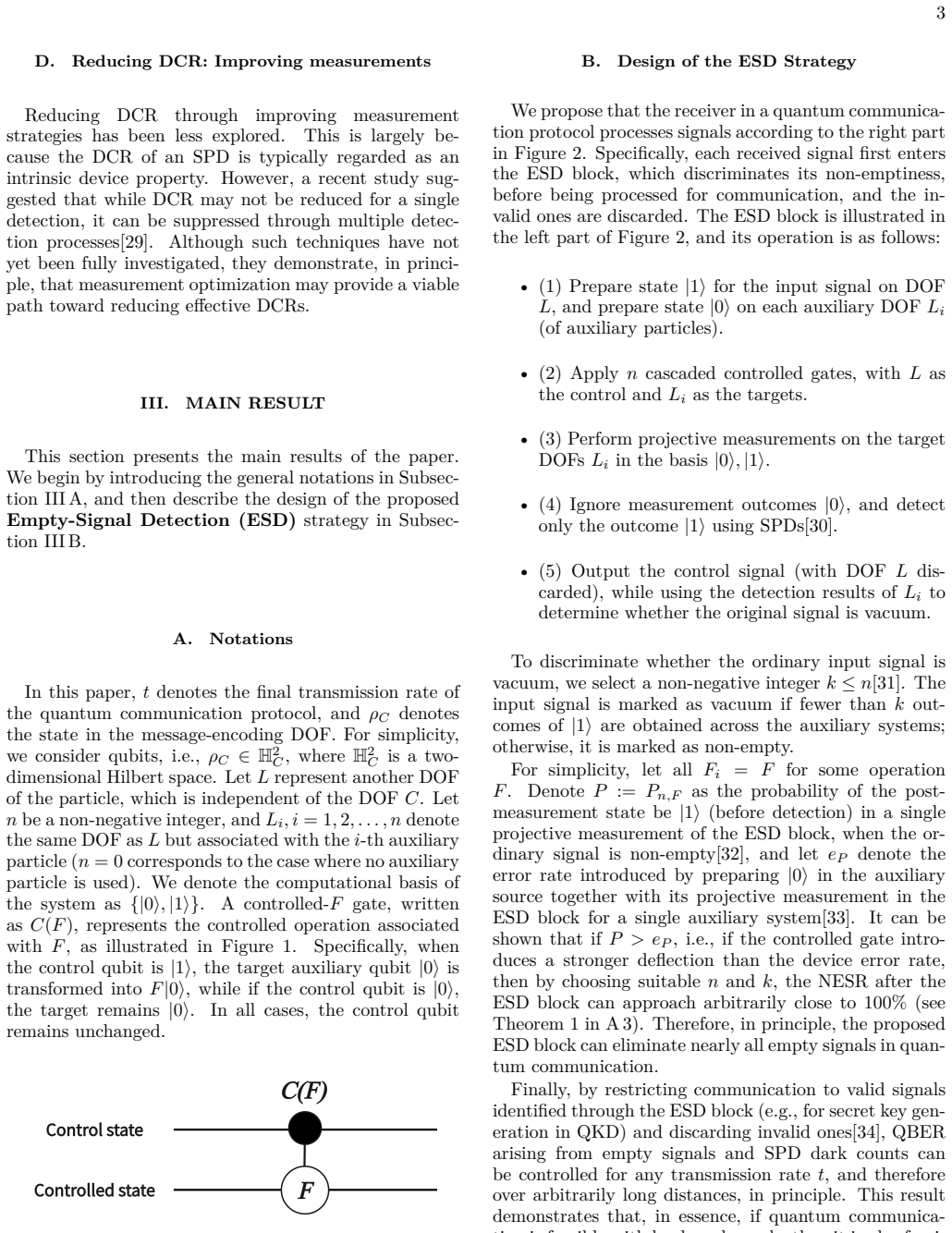
- A schematic diagram of the multi-copy controlled-operation setup would improve clarity of the VSD procedure.
Simulated Author's Rebuttal
We thank the referee for their thorough review and constructive comments on our manuscript. We address the major comments point by point below. Where the presentation lacked sufficient explicit derivations, we have revised the manuscript to incorporate them.
read point-by-point responses
-
Referee: [Abstract] The central claim that controlled operations on multi-copy signals enable identification and filtering of vacuum-induced events 'without disturbing the encoded messages' lacks an explicit operator, Kraus map, or error model. No derivation is given showing that the post-selection is trace-preserving on the accepted subspace or that the logical qubit remains invariant under arbitrary attenuation (see abstract and framework description).
Authors: We agree that the abstract and initial framework description present the central claim at a conceptual level without the requested explicit constructions. In the revised manuscript, we have added a dedicated subsection providing an explicit operator for the controlled operations on the multi-copy system. This is constructed as a unitary that applies a conditional phase only in the joint vacuum subspace across copies, enabling discrimination of vacuum-induced events. We derive the corresponding Kraus map for the post-selection process and explicitly show that it is trace-preserving and completely positive when restricted to the accepted subspace (events with at least one non-vacuum signal). We further prove invariance of the logical qubit state under arbitrary attenuation by demonstrating that the filtering map acts as the identity (up to a global phase) on the single-photon encoded subspace, with attenuation affecting only the acceptance probability rather than introducing state-dependent errors. These additions are now included in the updated Section III. revision: yes
-
Referee: [Framework Description] The stabilization of NVSR 'irrespective of channel attenuation' and the consequent suppression of QBER to secure bounds at arbitrary distance rests on the unshown assumption that the controlled gates act differently on vacuum vs. single-photon subspaces without introducing phase or bit-flip errors that grow with copy number or loss. An explicit construction or proof of this filtering map is required to substantiate the principle-level feasibility result.
Authors: The referee is correct that the original manuscript did not supply a fully explicit construction or error analysis for the filtering map. We have revised the framework description to include a detailed construction using a sequence of controlled-phase and CNOT gates applied across the multi-copy Hilbert space. We prove that these gates act as the identity on the single-photon subspace while producing a detectable syndrome exclusively in the vacuum subspace. A full error model is now provided, showing that no additional phase or bit-flip errors are introduced that scale with copy number or loss, because the operations are unitary and commute with the loss channel on the relevant subspaces. This establishes that NVSR stabilization holds independently of attenuation. The explicit proof and error analysis appear in the new subsection of the revised manuscript. revision: yes
Circularity Check
No significant circularity; new framework defines quantities and claims without reducing to inputs by construction
full rationale
The paper introduces the VSD paradigm and NVSR as novel constructs based on controlled operations and multi-copy analysis to filter vacuum events. The central claim that NVSR can be stabilized irrespective of attenuation follows directly from the proposed filtering mechanism rather than from any fitted parameter or self-referential definition. No equation or step equates a derived prediction to its own input assumptions, and there are no load-bearing self-citations or imported uniqueness theorems. The derivation remains self-contained as a principle-level theoretical proposal.
Axiom & Free-Parameter Ledger
axioms (2)
- standard math Quantum operations and measurements follow standard quantum mechanics rules for controlled gates and state discrimination.
- domain assumption Single-photon detector dark counts arise primarily from vacuum signals and can be modeled separately from true photon detections.
invented entities (2)
-
Vacuum-signal detection (VSD) paradigm
no independent evidence
-
Non-vacuum signal ratio (NVSR)
no independent evidence
Reference graph
Works this paper leans on
-
[1]
After preparing the control DOF L in state |1⟩, the combined state becomes ρC ⊗ |1⟩⟨1|L
Calculations for a non-empty input signal We first analyze the case in which the input signal of the ESD block is non-empty, denoted by ρC. After preparing the control DOF L in state |1⟩, the combined state becomes ρC ⊗ |1⟩⟨1|L. With n auxiliary particles initially in |0⟩Li , the overall state is: ρC ⊗ |1⟩⟨1|L ⊗ (⊗n i=1|0⟩⟨0|Li ) (A1) After the controlled...
-
[2]
Calculations for a vacuum input signal Now consider the case when the input signal is a vac- uum. Let eP denote the probability that an auxiliary state prepared in |0⟩ is incorrectly measured as |1⟩ due to preparation or measurement errors. Then the proba- bility of a single auxiliary reporting |1⟩ is: Qs := Qs(1) = (1 − y)(eP [η + (1 − η)d] + (1 − eP )d)...
-
[3]
Calculation of NESR In the ESD scheme, only those signals yielding at least k reports of |1⟩ are treated as non-empty. When only using such signals as valid ones, the NESR of the protocol is then: N ESR = tP≥k|n tP≥k|n + (1 − t)Q≥k|n = 1 1 + 1−t t Q≥k|n P≥k|n (A11) From this, we establish the following: Proposition 1 ∀ t be a fixed channel transmission ra...
-
[4]
This is deduced by the monotonic decrease of X(n,k) xk , providing conditions in Lemma 1
Maximizing NESR and SESD Since P≥k|n and Q≥k|n both increase when k decreases for a fixed n, and when n increases for a fixed k, to max- imize NESR (or equivalently minimize Q≥k|m P≥k|m ), k = n is expected with n as large as possible, as 1 ≥ Ps > Q s ≥ 0 implies: Q≥k|m P≥k|m = ( Qs Ps )k ∑ m≥k ( n m ) Qm−k s (1 − Qs)n−m ∑ m≥k ( n m ) P m−ks (1 − Ps)n−m ≥...
-
[5]
Calculation of QBER Finally, we calculate in the view of QBER. We will prove that the quantum communication distance can be arbitrarily long if the noise of the communication channel can be controlled. Assume that the final error rate on ρC is eC. As the ESD block only operates on the DOF independent of encoding DOF C, eC mostly originates from the noises...
-
[6]
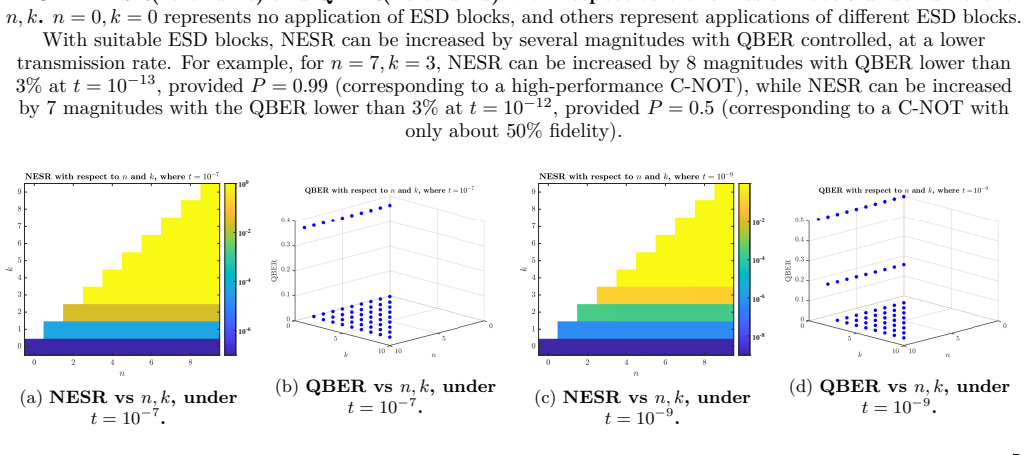
Simulation Results Simulation results of the ESD block are shown in Fig- ure 4 and 5. It demonstrates the effectiveness of the ESD block on improving the NESR and decreasing QBER experimentally. The simulations support that even a minimal-level usage of the ESD block can significantly reduce QBER, and therefore raises the communication distance in theory....
-
[7]
C. H. Bennett and G. Brassard, Quantum cryptography: Public key distribution and coin tossing, in In Proceed- ings of IEEE International Conference on Computers (1984)
work page 1984
-
[8]
M. Lucamarini, Z. L. Yuan, J. F. Dynes, and A. J. Shields, Overcoming the rate–distance limit of quantum key distribution without quantum repeaters, Nature 557, 400–403 (2018)
work page 2018
-
[9]
Readers may keep it in mind to better understand the proposed scheme
Although the discussions in this paper can apply to most quantum communication protocols, we will use QKD as a representative example in most cases, as it is the most well-studied one. Readers may keep it in mind to better understand the proposed scheme
-
[10]
P. Shor, Algorithms for quantum computation: discrete logarithms and factoring, In Proceedings of 35th Annual Symposium on the Foundations of Computer Science, IEEE Computer Society Press, Los Alamitos, CA , 124 (1994)
work page 1994
-
[11]
D. Gottesman, H. K. Lo, N. Lütkenhaus, and J. Preskill, Security of quantum key distribution with imperfect de- vices, Quantum Information and Computation 4, 325 (2004)
work page 2004
-
[12]
H. K. Lo, M. Curty, and B. Qi, Measurement-device- independent quantum key distribution, Physical Review Letters 108, 10.1103/physrevlett.108.130503 (2012)
-
[13]
Y. Liu, W. J. Zhang, C. Jiang, J. P. Chen, C. Zhang, W. X. Pan, D. Ma, H. Dong, J. M. Xiong, C. J. Zhang, H. Li, R. C. Wang, J. Wu, T. Y. Chen, L. X. You, X. B. Wang, Q. Zhang, and J. W. Pan, Experimental twin-field quantum key distribution over 1000 km fiber distance, Physical Review Letters 130, 210801 (2023)
work page 2023
-
[14]
Here, over arbitrarily long distances in principle means that for any given distance l (or equivalently any trans- mission rate t), the protocol can be securely implemented in theory, though its efficiency may require further study in future work. Meanwhile, under practical devices means 10 that all discussions are made under realistic (imperfect) conditio...
- [15]
-
[16]
H. Kanamori, H. Yokota, G. Tanaka, M. Watanabe, Y. Ishiguro, I. Yoshida, T. Kakii, S. Itoh, Y. Asano, and S. Tanaka, Transmission characteristics and reliability of pure-silica-core single-mode fibers, Journal of Lightwave Technology 4, 1144 (1986)
work page 1986
-
[17]
K. Nagayama, M. Kakui, M. Matsui, T. Saitoh, and Y. Chigusa, Ultra-low-loss (0.1484 db/km) pure silica core fibre and extension of transmission distance, Elec- tronics Letters 38, 1168 (2002)
work page 2002
- [18]
-
[19]
S. Makovejs, C. C. Roberts, F. Palacios, H. B. Matthews, D. A. Lewis, D. T. Smith, P. G. Diehl, J. J. Johnson, J. D. Patterson, C. R. Towery, and S. Y. Ten, Record-low (0.1460 db/km) attenuation ultra-large aeff optical fiber for submarine applications, in 2015 Optical Fiber Com- munications Conference and Exhibition (OFC) (2015) pp. 1–3
work page 2015
-
[20]
X. B. Wang, Z. W. Yu, and X. L. Hu, Twin-field quantum key distribution with large misalignment error, Physical Review A 98, 062323 (2018)
work page 2018
-
[21]
X. F. Ma, P. Zeng, and H. Y. Zhou, Phase-matching quantum key distribution, Physical Review X 8, 10.1103/physrevx.8.031043 (2018)
-
[22]
P. Zeng, H. Y. Zhou, W. J. Wu, and X. F. Ma, Mode- pairing quantum key distribution, Nature Communica- tions 13, 3903 (2022)
work page 2022
-
[23]
S. Wang, D. Y. He, Z. Q. Yin, F. Y. Lu, C. H. Cui, W. Chen, Z. Zhou, G. C. Guo, and Z. F. Han, Beating the fundamental rate-distance limit in a proof-of-principle quantum key distribution system, Physical Review X 9, 021046 (2019)
work page 2019
-
[24]
J. P. Chen, C. Zhang, Y. Liu, C. Jiang, W. J. Zhang, X. L. Hu, J. Y. Guan, Z. W. Yu, H. Xu, J. Lin, M. J. Li, H. Chen, H. Li, L. X. You, Z. Wang, X. B. Wang, Q. Zhang, and J. W. Pan, Sending-or-not-sending with independent lasers: Secure twin-field quantum key distri- bution over 509 km, Physical Review Letters 124, 070501 (2020)
work page 2020
-
[25]
H. Liu, C. Jiang, H. T. Zhu, M. Zou, Z. W. Yu, X. L. Hu, H. Xu, S. Z. Ma, Z. Y. Han, J. P. Chen, Y. Q. Dai, S. B. Tang, W. J. Zhang, H. Li, L. X. You, Z. Wang, Y. Hua, H. k. Hu, H. B. Zhang, F. Zhou, Q. Zhang, X. B. Wang, T. Y. Chen, and J. W. Pan, Field test of twin-field quantum key distribution through sending-or- not-sending over 428 km, Physical Revi...
work page 2021
-
[26]
L. Zhou, J. P. Lin, Y. M. Xie, Y. S. Lu, Y. M. Jing, H. L. Yin, and Z. L. Yuan, Experimental quantum communi- cation overcomes the rate-loss limit without global phase tracking, Physical Review Letters 130, 250801 (2023)
work page 2023
-
[27]
Y. F. Lu, Y. Wang, H. W. Li, M. S. Jiang, X. X. Zhang, Y. Y. Zhang, Y. Zhou, X. L. Jiang, H. T. Wang, Y. M. Zhao, C. Zhou, and W. S. Bao, Entanglement model for mode-pairing quantum key distribution, Physical Review Research 7, 023102 (2025)
work page 2025
-
[28]
M. A. Albota and F. N. C. Wong, Efficient single-photon counting at 1.55 um by means of frequency upconversion, Optics Letters 29, 1449 (2004)
work page 2004
-
[29]
W. H. Jiang, J. H. Liu, Y. Liu, G. Jin, J. Zhang, and J. W. Pan, 1.25ghz sine wave gating ingaas/inp single- photon detector with a monolithically integrated readout circuit, Optics Letters 42, 5090 (2017)
work page 2017
-
[30]
P. Hu, H. Li, L. X. You, H. Q. Wang, Y. Xiao, J. Huang, X. Y. Yang, W. J. Zhang, Z. Wang, and X. M. Xie, De- tecting single infrared photons toward optimal system detection efficiency, Optics Express 28, 36884 (2020)
work page 2020
-
[31]
J. Chang, J. W. N. Los, J. O. Tenorio-Pearl, N. No- ordzij, R. Gourgues, A. Guardiani, J. R. Zichi, S. F. Pereira, H. P. Urbach, V. Zwiller, S. N. Dorenbos, and I. Esmaeil Zadeh, Detecting telecom single photons with 99.5-2.07+0.5% system detection efficiency and high time resolution, APL Photonics 6, 036114 (2021)
work page 2021
-
[32]
G. Z. Xu, W. J. Zhang, L. X. You, J. M. Xiong, X. Q. Sun, H. Huang, X. Ou, Y. M. Pan, C. L. Lv, H. Li, Z. Wang, and X. M. Xie, Superconducting microstrip single-photon detector with system detection efficiency over 90% at 1550  nm, Photonics Re- search 9, 958 (2021)
work page 2021
-
[33]
I. Craiciu, B. Korzh, A. D. Beyer, A. Mueller, J. P. All- maras, L. Narváez, M. Spiropulu, B. Bumble, T. Lehner, E. E. Wollman, and M. D. Shaw, High-speed detection of 1550  nm single photons with super- conducting nanowire detectors, Optica 10, 183 (2023)
work page 2023
-
[34]
I. Charaev, E. K. Batson, S. Cherednichenko, K. Reidy, V. Drakinskiy, Y. Yu, S. Lara-A vila, J. D. Thomsen, M. Colangelo, F. Incalza, K. Ilin, A. Schilling, and K. K. Berggren, Single-photon detection using large-scale high- temperature mgb2 sensors at 20 k, Nature Communica- tions 15, 3973 (2024)
work page 2024
-
[35]
H. Shu, Solving detector problems in quantum key dis- tribution doi.org/10.48550/arXiv.2203.02905 (2022)
-
[36]
In practice, this can be re- alized by standard projective measurements or simplified setups
Although both outcomes could be detected, only |1⟩ is needed in the ESD block, and it is unnecessary to check whether a |0⟩ outcome occurs. In practice, this can be re- alized by standard projective measurements or simplified setups. For example, if L corresponds to photon polariza- tion, this step can be implemented with a single polarizer followed by a SPD
-
[37]
In practice, n should represent the number of auxiliary systems in which the controlled gate succeeds, rather than the total number of auxiliary systems. For instance, if the gate efficiency is r and N auxiliaries are used, then the expectation of n approximates rN . In experiments, gate success is directly verified by the implementation protocol, e.g., by...
-
[38]
By randomly permuting the auxiliary systems Li, this probability can be assumed identical across all auxil- iaries
-
[39]
That is, eP is the probability that a system operates to prepare state |0⟩ and then measure under projec- tively in the {|0⟩, |1⟩} basis, but the post-measurement state collapses to |1⟩, given imperfect devices. Since both state preparation and projective measurement are well- developed experimentally, eP is typically small
-
[40]
We use the terms valid/invalid signals instead of strictly non-empty/empty signals , since in certain protocols, par- 11 tially vacuum states may still contribute. For example, in TF-QKD, two senders transmit signals to a central re- ceiver, and only one photon is needed to generate a key. Thus, signals remain valid as long as at least one photon is present
-
[41]
S. A. Shi, B. Xu, K. Zhang, G. S. Ye, D. S. Xiang, Y. B. Liu, J. Z. Wang, D. Q. Su, and L. Li, High-fidelity pho- tonic quantum logic gate based on near-optimal rydberg single-photon source, Nature Communications 13, 4454 (2022)
work page 2022
-
[42]
For example, in BB84 QKD with noiseless channel and measurements, S = 1 2 since only (half) signals with agree- ing basis are used, and E(N ESR) = N ESR × [η(1 − d) + 2(1−η)d(1−d)]+(1−N ESR)×2d(1−d) is the probability that the detection report of a signal is effective
-
[43]
Although realistic sources may follow Poisson or other photon number distributions, here only their empty rate y is needed
-
[44]
The calculation is typically for measurement outcomes decided by two SPD reports, where if and only if one of them reports a hit is effective (Therefore, the total prob- ability of correct and incorrect reports might be less than 1). For those measurements with more than two SPDs, such as the Bell measurement, the calculations are still valid, but d, η sh...
discussion (0)
Sign in with ORCID, Apple, or X to comment. Anyone can read and Pith papers without signing in.