REVIEW 4 major objections 4 minor 34 references
ArchesClimate: Probabilistic Decadal Ensemble Generation With Flow Matching
T0 review · 4 major / 4 minor · reviewed 2026-08-15 · deepseek-v4-flash
Pith's one-line read ArchesClimate, a flow-matching emulator, produces stable 10-year climate states whose members are interchangeable with IPSL-CM6A-LR ensemble members for several key variables.
desk verdict A serious and unusually transparent attempt at a coupled ocean–atmosphere decadal emulator, but the 'interchangeable' claim only holds for a subset of variables at seasonal/annual scales, and the paper's own spectra show an unresolved decadal-variance deficit. read the letter →
The pith
A machine-rendered reading of the paper's core claim, the machinery that carries it, and where it could break.
The reading
What carries the argument
The load-bearing mechanism is flow matching applied to residuals. A deterministic model forecasts the mean next monthly state, and a generative model learns a vector field that transports standard Gaussian noise to the distribution of the standardized difference between the true next state and that deterministic mean. At inference the generative model is integrated over several flow-matching steps and its output is added back onto the deterministic forecast; this composite state becomes the input for the next month, which is what makes the generation autoregressive. External forcings enter every transformer block through conditional layer normalization, and the ocean and atmosphere fields are handled together in one model rather than by separate emulators.
What would settle it
Generate a 10-year ArchesClimate ensemble from the same 1969 initialization and compare the deep-ocean heat-content variable (thetaot2000) against IPSL-DCPP: if its ensemble variance stays near half the target and its rank histogram stays strongly u-shaped across all three test decades, even after the proposed loss changes, then the interchangeability claim is limited to surface and atmospheric variables rather than the full coupled state.
Extended reading notes
Core claim
The central claim is that a probabilistic emulator trained only on output states can stand in for a coupled climate model when the question is internal variability at monthly-to-decadal scales. Starting from two months of IPSL-DCPP state, ArchesClimate predicts the next month, feeds its own prediction back in, and stays stable and physically plausible for ten years. The paper reports that for several key variables, a generated member placed inside a ten-member IPSL-DCPP ensemble shows a flat rank histogram, meaning it could have come from the climate model itself, and that CRPS is close to or below the spread among the model's own members. The authors also report that the emulator responds to changing greenhouse-gas and solar forcings over a 50-year rollout, while acknowledging that its variance is consistently lower than IPSL-DCPP for every variable tested.
Load-bearing premise
The load-bearing premise is that the variation that makes an ensemble useful can be regenerated from freshly sampled Gaussian noise alone, even though the model never receives the specific initial-condition perturbations or nudging that produced each target member.
Editorial extensions
If this is right
- A trained ArchesClimate can generate a 10-member, 10-year ensemble at a fraction of the compute of running IPSL-CM6A-LR, which would make large-ensemble studies of internal variability much cheaper.
- For variables with flat rank histograms, generated members can be substituted into an IPSL-DCPP ensemble without shifting its statistical behavior, so the emulator can augment existing decadal prediction ensembles.
- Because CRPS for ArchesClimate is comparable to or lower than IPSL-DCPP for most tested variables, the model can act as a probabilistic forecast system at monthly-to-decadal lead times.
- The 50-year forcing experiment shows the emulator tracks a changing external-forcing trend better than repeated fixed forcings, so it is not merely replaying the seasonal cycle.
Reading between the lines
- The paper's interpolated train/test split leaves open whether the emulator has learned forced dynamics or memorized seen decades; a decisive extension would be to condition on SSP scenarios outside the training period and check whether the 50-year trend response still tracks a full climate model.
- The consistently lower variance suggests a structural test: initialize the flow-matching noise from a distribution matched to the observed spread of IPSL-DCPP anomalies rather than unit Gaussian; if variance still lags, the missing spread comes from information the white-noise residual cannot carry, such as ocean initial-condition memory.
- A frequency-weighted spectral loss, rather than the uniform 0.2 scaling used in the paper, might recover the missing variance in sea-level pressure and ocean variables without the CRPS penalty the authors report.
- Adding a slowly varying ocean memory term, such as a running decadal mean of ocean heat content, is a natural next condition that could restore variance and improve Arctic persistence without changing the architecture.
Signed reviews
Editorial analysis
A structured set of objections, weighed in public.
Referee Report
Summary. The paper presents ArchesClimate, a flow-matching based emulator of the IPSL-CM6A-LR climate model, trained on decadal hindcast outputs from the DCPP project. The model autoregressively generates monthly states from the two preceding months and is designed to produce probabilistic ensemble members at monthly-to-decadal timescales. The authors evaluate the model using CRPS, ensemble variance, rank histograms, temporal power spectra, Pearson correlation of decadal trends, and seasonal spatial anomaly maps, and they compare several training and variance-enhancement strategies. The central claims are that ArchesClimate generates stable, physically consistent 10-year sequences and that for several climate variables its ensemble members are interchangeable with IPSL-DCPP members.
Significance. If the central claims were fully established, ArchesClimate would be a valuable contribution: it is a relatively low-cost, open-source method for generating probabilistic ensemble members from a coupled climate model, and it extends the ArchesWeatherGen approach to a coupled ocean-atmosphere setting with external forcings. The paper is commendable for its transparent experimental design, the comparison of multiple training schemes, the inclusion of CRPS and rank-histogram diagnostics, the availability of code, and the explicit discussion of limitations in Appendices B and C. However, the headline claims of 'interchangeable' and 'physically consistent' are not yet supported by the evidence presented: the variance of generated ensembles is consistently lower than that of IPSL-DCPP, the temporal power spectra show deficits at periods beyond the annual cycle, and the physical-consistency assessment is qualitative. The significance is therefore conditional on strengthening these evaluations.
major comments (4)
- [Section 3.6 / Section 3.7 / Table 2] The interchangeability claim rests on rank histograms computed from raw pixel values, which are dominated by the seasonal cycle and the spatial mean. The paper's own Temporal Power Spectra (Section 3.7, Figure 6) show that ArchesClimate is underpowered at all periods beyond the monthly, seasonal, and annual peaks for every variable examined, and Table 2 shows that ArchesClimate variance is roughly half of IPSL-DCPP for all variables (e.g., psl 30529 vs 109017 Pa^2, ta 0.68 vs 1.58 K^2, tos 0.26 vs 0.51 K^2). A flat rank histogram on raw fields does not demonstrate that the generated ensembles reproduce decadal internal variability. The authors should either delimit the interchangeability claim to sub-annual-to-annual timescales or provide complementary diagnostics (e.g., rank histograms on anomalies, spectral variance ratios, or low-frequency variance scores) that directly assess decadal-scale calibration.
- [Section 3.10] The variance shortfall, which is acknowledged in the manuscript, is shown to be unresolved by the proposed remedies: noise scaling by 1.1, per-variable noise scaling, and the alternative spectral/gradient loss. The alternative loss improves variance for tos and ta but increases CRPS, and the authors state that balancing this tradeoff is left for future work. Since an under-dispersed ensemble undermines the core purpose of probabilistic decadal ensemble generation, the paper should provide a more definitive treatment, such as a calibrated variance-inflation procedure evaluated with proper scoring rules, or a demonstration that the deficit is confined to variables or timescales not central to the intended application.
- [Appendix C / Section 2.3] The test set includes time periods that overlap the training distribution (ensembles initialized in 1969, 1979, and 2010–2015, with other ensembles overlapping those decades), and the paper's own alternative non-overlapping split shows degraded skill, particularly for tos and ta toward the end of the decade. This means the headline interchangeability result may partly reflect interpolation within the training distribution rather than a general emulation capability. The manuscript should either adopt the stricter split for the central claims or explicitly state that the claims are limited to interpolation within the observed period, and quantify the degradation in the abstract and conclusions.
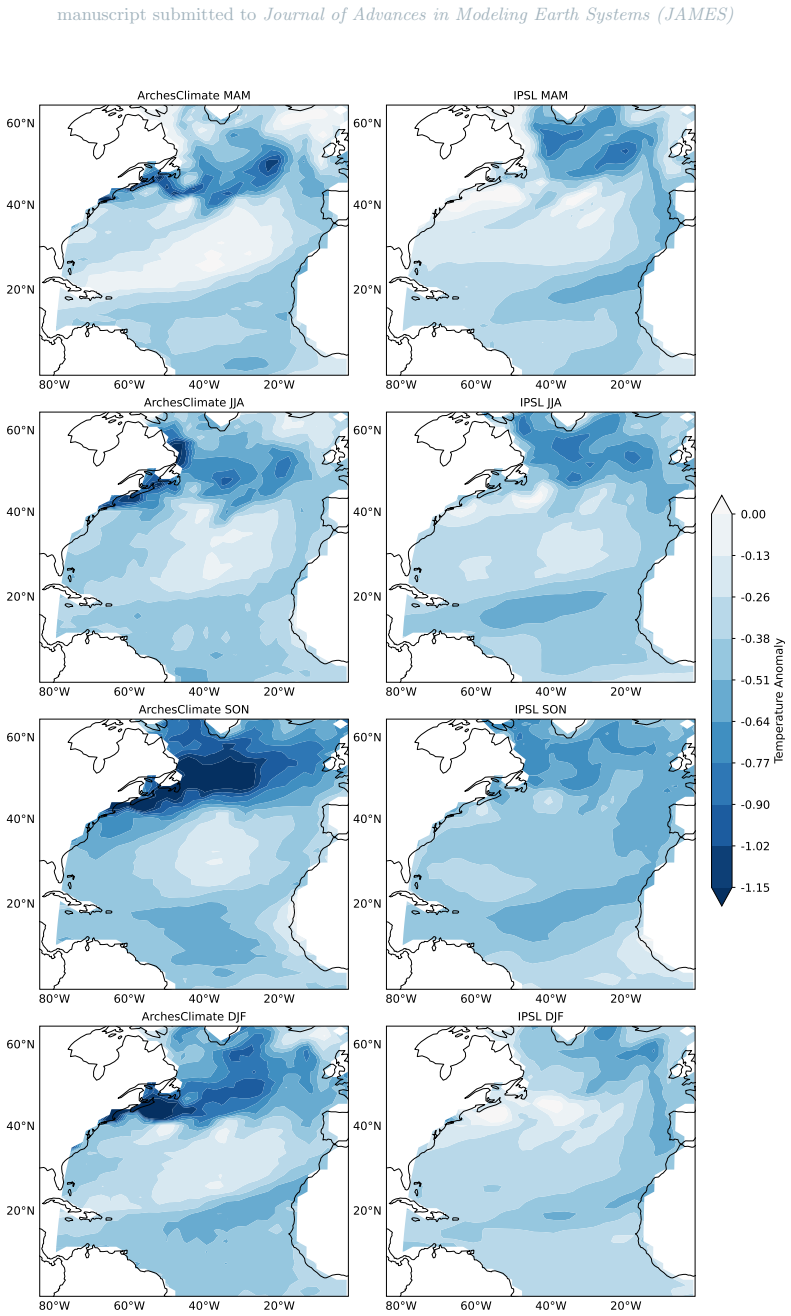
- [Section 3.3 / Discussion] The abstract's claim that the generations are 'physically consistent' is supported only by qualitative visual inspection of Figure 4; no quantitative conservation, dynamical-consistency, or process-level tests are reported. The Discussion itself states that adherence to conservation properties (mass, energy, hydrostatic constraints) remains future work. The claim should be softened to 'statistically plausible' or supported by a quantitative physical-consistency check before it is made in the abstract.
minor comments (4)
- [Section 2.3, Eqs. (2)-(3)] The notation in Equations (2) and (3) appears garbled, with mismatched parentheses and an ambiguous role for σ. Please rewrite these equations carefully and define all symbols, including the FM timestep discretization (ψ_m) used in Equation (4).
- [Section 2.1] The text states that the dataset contains 'approximately 70,000 simulated months.' Given 10 members initialized every year from 1960 to 2015, each with 120 months, the total is 56 × 10 × 120 = 67,200 months before excluding validation and test sets; please clarify how the 70,000 figure is obtained.
- [Figure 1 caption / Figure B1] There is a typo 'ISPL-DCPP' in the Figure 1 caption, which should be 'IPSL-DCPP.' Additionally, Appendix B text refers to 'repeated forcings' while Figure B1's legend says 'constant forcings'; please align the terminology.
- [Section 3.5] The sentence 'The variance is consistently higher in IPSL-DCPP across all periods' is clearer than the later claim that CRPS being lower for ArchesClimate implies better performance; the paper correctly notes the ambiguity, but the discussion would benefit from a more explicit statement that lower CRPS than the baseline is not necessarily the goal when the aim is to replicate the target distribution.
Circularity Check
No significant circularity: ArchesClimate's derivation chain is self-contained; the evaluation limitations noted in the paper are not reductions of the predictions to the model's inputs.
full rationale
ArchesClimate is an empirical emulator, not a first-principles derivation, and its central claim is an empirical evaluation against IPSL-DCPP. The residual-flow training in Eqs. (1)-(3) defines the target as the residual distribution of IPSL-DCPP and reconstructs the next state as f_theta(X_t) + sigma * g_theta(...), which is the intended emulation objective rather than a circular reduction: the model is trained to map Gaussian noise to the residual distribution and is then evaluated on its ability to reproduce that distribution. The backbone citation to ArchesWeatherGen is a method inheritance and is not load-bearing as a proof of ArchesClimate's skill; the present paper's architecture and losses are specified directly, and the evaluation is performed against IPSL-DCPP data, not against ArchesWeatherGen's results. The temporal overlap between training and test sets acknowledged in Appendix C is a real generalization and evaluation limitation, and the AC per-variable noise scaling in Section 3.10 is tuned on variance differences rather than being an independent prediction; however, neither of these makes the central claim equivalent to the model's inputs by construction. The under-variance shown in Table 2 and the qualitative nature of the physical-consistency claim are correctness and validation concerns, not circularity. No step in the claimed derivation chain reduces to its own input by definition, and no load-bearing argument rests solely on a self-citation. Therefore the circularity score is 0.
Assumptions & free parameters
free parameters (4)
- Flow-matching inference steps M =
not reported
- Noise scaling factor =
1.1
- Loss weights for gradient and spectral terms =
0.2 each
- Per-variable variance scaling =
variable-dependent
assumptions (5)
- domain assumption IPSL-DCPP 10-member ensembles are exchangeable samples of the same predictive distribution.
- domain assumption Initialization noise in decadal hindcasts fades quickly, so omitting initial conditions is acceptable.
- domain assumption The selected variable subset and monthly-mean time step are sufficient to represent decadal coupled variability.
- standard math Flow matching defines a valid probability path from Gaussian noise to the residual distribution.
- ad hoc to paper Temporal overlap between training and test periods does not inflate reported skill.
Cite this review
Pith. "Pith review of ArchesClimate: Probabilistic Decadal Ensemble Generation With Flow Matching." pith.science (2026). https://pith.science/paper/CJQO3OSJ
@misc{pith2026250915942,
  author       = {Pith},
  title        = {Pith review of: ArchesClimate: Probabilistic Decadal Ensemble Generation With Flow Matching},
  year         = {2026},
  howpublished = {\url{https://pith.science/paper/CJQO3OSJ}},
  note         = {Machine review of arXiv:2509.15942}
}
read the original abstract
Internal variability is a dominant contributor to the uncertainty of predictions at the interannual to decadal timescale. A typical approach to separating the internal variability from forced climate responses is to generate large ensembles of simulations under different initial conditions. Due to the complexity of Earth System Models, generating these large ensembles is computationally expensive. In this work, we present ArchesClimate, a deep learning-based climate model emulator designed to reduce the cost of exploring internal variability at timescales ranging from monthly to decadal. ArchesClimate is trained on decadal hindcasts of the IPSL-CM6A-LR climate model. We train a flow matching model following ArchesWeatherGen, which we adapt to predict near-term climate. Once trained, the model generates states at a one-month lead time from the states of the two preceding months, and can be used to auto-regressively emulate climate model simulations. We show that for up to 10 years, these generations are stable and physically consistent. We also show that for several important climate variables, ArchesClimate generates simulations that are interchangeable with the IPSL model. This work suggests that climate model emulators could reduce the cost of generating large ensembles with climate models.
Figures


Figures from the paper (6 more)



Reference graph
Works this paper leans on
-
[1]
biPanguWeather3DHighResolution2022 APACrefauthors Bi, K. , Xie, L. , Zhang, H. , Chen, X. , Gu, X. \ Tian, Q. APACrefauthors \ 2022 11 . Pangu- Weather : A 3D High-Resolution Model for Fast and Accurate Global Weather Forecast Pangu- Weather : A 3D High-Resolution Model for Fast and Accurate Global Weather Forecast \ ( \ arXiv:2211.02556). arXiv
arXiv 2022
-
[2]
boerDecadalClimatePrediction2016 APACrefauthors Boer, G J. , Smith, D M. , Cassou, C. , Doblas-Reyes , F. , Danabasoglu, G. , Kirtman, B. Eade, R. APACrefauthors \ 2016 10 . The Decadal Climate Prediction Project ( DCPP ) Contribution to CMIP6 The Decadal Climate Prediction Project ( DCPP ) contribution to CMIP6 . Geoscientific Model Development 9 10 3751...
-
[3]
boucherPresentationEvaluationIPSLCM6ALR2020 APACrefauthors Boucher, O. , Servonnat, J. , Albright, A L. , Aumont, O. , Balkanski, Y. , Bastrikov, V. Vuichard, N. APACrefauthors \ 2020 . Presentation and Evaluation of the IPSL-CM6A-LR Climate Model Presentation and Evaluation of the IPSL-CM6A-LR Climate Model . Journal of Advances in Modeling Earth Systems...
-
[4]
brenowitzClimateBottleGenerative2025 APACrefauthors Brenowitz, N D. , Ge, T. , Subramaniam, A. , Gupta, A. , Hall, D M. , Mardani, M. Pritchard, M S. APACrefauthors \ 2025 05 . Climate in a Bottle : Towards a Generative Foundation Model for the Kilometer-Scale Global Atmosphere Climate in a Bottle : Towards a Generative Foundation Model for the Kilometer-...
-
[5]
chenAdaSpeechAdaptiveText2021 APACrefauthors Chen, M. , Tan, X. , Li, B. , Liu, Y. , Qin, T. , Zhao, S. \ Liu, T Y. APACrefauthors \ 2021 03 . AdaSpeech : Adaptive Text to Speech for Custom Voice AdaSpeech : Adaptive Text to Speech for Custom Voice \ ( \ arXiv:2103.00993). arXiv . APACrefDOI doi:10.48550/arXiv.2103.00993 APACrefDOI
-
[6]
couaironArchesWeatherArchesWeatherGenDeterministic2024 APACrefauthors Couairon, G. , Singh, R. , Charantonis, A. , Lessig, C. \ Monteleoni, C. APACrefauthors \ 2024 12 . ArchesWeather & ArchesWeatherGen : A Deterministic and Generative Model for Efficient ML Weather Forecasting ArchesWeather & ArchesWeatherGen : A deterministic and generative model for ef...
-
[7]
deserEffectsMacroVs2024 APACrefauthors Deser, C. , Kim, W M. , Wills, R C J. , Simpson, I R. , Yeager, S. , Danabasoglu, G. Rosenbloom, N. APACrefauthors \ 2024 12 . Effects of Macro vs. Micro Initialization and Ocean Initial-Condition Memory on the Evolution of Ensemble Spread in the CESM2 Large Ensemble Effects of macro vs. micro initialization and ocea...
work page 2024
-
[8]
dheeshjithSamudraAIGlobal2025 APACrefauthors Dheeshjith, S. , Subel, A. , Adcroft, A. , Busecke, J. , Fernandez-Granda , C. , Gupta, S. \ Zanna, L. APACrefauthors \ 2025 03 . Samudra: An AI Global Ocean Emulator for Climate Samudra: An AI Global Ocean Emulator for Climate \ ( \ arXiv:2412.03795). arXiv . APACrefDOI doi:10.48550/arXiv.2412.03795 APACrefDOI
Show all 34 references
-
[9]
, Smith, D
eadeSeasonaltodecadalClimatePredictions2014 APACrefauthors Eade, R. , Smith, D. , Scaife, A. , Wallace, E. , Dunstone, N. , Hermanson, L. \ Robinson, N. APACrefauthors \ 2014 . Do Seasonal-to-Decadal Climate Predictions Underestimate the Predictability of the Real World? Do se...
2014 doi
-
[10]
, Kulal, S
esserScalingRectifiedFlow2024a APACrefauthors Esser, P. , Kulal, S. , Blattmann, A. , Entezari, R. , M \"u ller, J. , Saini, H. Rombach, R. APACrefauthors \ 2024 03 . Scaling Rectified Flow Transformers for High-Resolution Image Synthesis Scaling Rectified Flow Transformers fo...
-
[11]
, Mignot, J
estella-perezAdvancesReconstructingAMOC2020 APACrefauthors Estella-Perez , V. , Mignot, J. , Guilyardi, E. , Swingedouw, D. \ Reverdin, G. APACrefauthors \ 2020 08 . Advances in Reconstructing the AMOC Using Sea Surface Observations of Salinity Advances in reconstructing the A...
2020 doi
-
[12]
, Beyerle, U
fischerStorylinesUnprecedentedHeatwaves2023 APACrefauthors Fischer, E M. , Beyerle, U. , Bloin-Wibe , L. , Gessner, C. , Humphrey, V. , Lehner, F. Knutti, R. APACrefauthors \ 2023 08 . Storylines for Unprecedented Heatwaves Based on Ensemble Boosting Storylines for unprecedent...
2023 doi
-
[13]
, Derksen, C
fyfeLargeNeartermProjected2017 APACrefauthors Fyfe, J C. , Derksen, C. , Mudryk, L. , Flato, G M. , Santer, B D. , Swart, N C. Jiao, Y. APACrefauthors \ 2017 04 . Large Near-Term Projected Snowpack Loss over the Western United States Large near-term projected snowpack loss ove...
2017 doi
-
[14]
, Lyu, P
guoORCAGlobalOcean2024 APACrefauthors Guo, Z. , Lyu, P. , Ling, F. , Luo, J J. , Boers, N. , Ouyang, W. \ Bai, L. APACrefauthors \ 2024 05 . ORCA : A Global Ocean Emulator for Multi-year to Decadal Predictions ORCA : A Global Ocean Emulator for Multi-year to Decadal Prediction...
-
[15]
APACrefauthors \ 2001 03
hamillInterpretationRankHistograms2001 APACrefauthors Hamill, T M. APACrefauthors \ 2001 03 . Interpretation of Rank Histograms for Verifying Ensemble Forecasts Interpretation of Rank Histograms for Verifying Ensemble Forecasts
2001
-
[16]
, Aich, M
hessFastScaleadaptiveUncertaintyaware2025 APACrefauthors Hess, P. , Aich, M. , Pan, B. \ Boers, N. APACrefauthors \ 2025 03 . Fast, Scale-Adaptive and Uncertainty-Aware Downscaling of Earth System Model Fields with Generative Machine Learning Fast, scale-adaptive and uncertain...
2025 doi
-
[17]
, Jain, A
hoDenoisingDiffusionProbabilistic2020 APACrefauthors Ho, J. , Jain, A. \ Abbeel, P. APACrefauthors \ 2020 12 . Denoising Diffusion Probabilistic Models Denoising Diffusion Probabilistic Models \ ( \ arXiv:2006.11239). arXiv
2020 arXiv
-
[18]
, Kalchbrenner, N
hoAxialAttentionMultidimensional2019 APACrefauthors Ho, J. , Kalchbrenner, N. , Weissenborn, D. \ Salimans, T. APACrefauthors \ 2019 12 . Axial Attention in Multidimensional Transformers Axial Attention in Multidimensional Transformers \ ( \ arXiv:1912.12180). arXiv . APACrefD...
-
[19]
, Scaife, A A
jainImportanceInternalVariability2023 APACrefauthors Jain, S. , Scaife, A A. , Shepherd, T G. , Deser, C. , Dunstone, N. , Schmidt, G A. Turkington, T. APACrefauthors \ 2023 06 . Importance of Internal Variability for Climate Model Assessment Importance of internal variability...
2023 doi
-
[20]
, Chen, R T Q
lipmanFlowMatchingGenerative2023 APACrefauthors Lipman, Y. , Chen, R T Q. , Ben-Hamu , H. , Nickel, M. \ Le, M. APACrefauthors \ 2023 02 . Flow Matching for Generative Modeling Flow Matching for Generative Modeling \ ( \ arXiv:2210.02747). arXiv
2023 arXiv
-
[21]
, Lin, Y
liuSwinTransformerHierarchical2021 APACrefauthors Liu, Z. , Lin, Y. , Cao, Y. , Hu, H. , Wei, Y. , Zhang, Z. Guo, B. APACrefauthors \ 2021 08 . Swin Transformer : Hierarchical Vision Transformer Using Shifted Windows Swin Transformer : Hierarchical Vision Transformer using Shi...
2021 arXiv
-
[22]
, Balkanski, Y
lurtonImplementationCMIP6Forcing2020a APACrefauthors Lurton, T. , Balkanski, Y. , Bastrikov, V. , Bekki, S. , Bopp, L. , Braconnot, P. Boucher, O. APACrefauthors \ 2020 . Implementation of the CMIP6 Forcing Data in the IPSL-CM6A-LR Model Implementation of the CMIP6 Forcing Dat...
2020 doi
-
[23]
, Milinski, S
maherLargeEnsembleClimate2021 APACrefauthors Maher, N. , Milinski, S. \ Ludwig, R. APACrefauthors \ 2021 04 . Large Ensemble Climate Model Simulations: Introduction, Overview, and Future Prospects for Utilising Multiple Types of Large Ensemble Large ensemble climate model simu...
2021 doi
-
[24]
\ Nicholls, Z R J
meinshausenUoMAIMssp370121GHGConcentrations2018 APACrefauthors Meinshausen, M. \ Nicholls, Z R J. APACrefauthors \ 2018 . UoM-AIM-ssp370-1-2-1 GHG Concentrations. Earth System Grid Federation . Doi: https://doi.org/10.22033/ESGF/input4MIPs.9861 . UoM-AIM-ssp370-1-2-1 GHG conce...
2018 doi
-
[25]
, Garc \'i a-Serrano , J
mignotDecadalPredictionSkill2016 APACrefauthors Mignot, J. , Garc \'i a-Serrano , J. , Swingedouw, D. , Germe, A. , Nguyen, S. , Ortega, P. Ray, S. APACrefauthors \ 2016 08 . Decadal Prediction Skill in the Ocean with Surface Nudging in the IPSL-CM5A-LR Climate Model Decadal p...
2016 doi
-
[26]
, Hoyer, S
raspWeatherBench2Benchmark2024 APACrefauthors Rasp, S. , Hoyer, S. , Merose, A. , Langmore, I. , Battaglia, P. , Russel, T. Sha, F. APACrefauthors \ 2024 01 . WeatherBench 2: A Benchmark for the next Generation of Data-Driven Global Weather Models WeatherBench 2: A benchmark f...
-
[27]
o the, U. , B \
schmittConsistencyModelsScalable2024 APACrefauthors Schmitt, M. , Pratz, V. , K \"o the, U. , B \"u rkner, P C. \ Radev, S T. APACrefauthors \ 2024 11 . Consistency Models for Scalable and Fast Simulation-Based Inference Consistency Models for Scalable and Fast Simulation-Base...
-
[28]
, Mignot, J
servonnatReconstructingSubsurfaceOcean2015 APACrefauthors Servonnat, J. , Mignot, J. , Guilyardi, E. , Swingedouw, D. , S \'e f \'e rian, R. \ Labetoulle, S. APACrefauthors \ 2015 01 . Reconstructing the Subsurface Ocean Decadal Variability Using Surface Nudging in a Perfect M...
2015 doi
-
[29]
, Schreck, J S
shaImprovingAIWeather2025 APACrefauthors Sha, Y. , Schreck, J S. , Chapman, W. \ II, D J G. APACrefauthors \ 2025 01 . Improving AI Weather Prediction Models Using Global Mass and Energy Conservation Schemes Improving AI weather prediction models using global mass and energy c...
-
[30]
, Eade, R
smithRobustSkillDecadal2019 APACrefauthors Smith, D M. , Eade, R. , Scaife, A A. , Caron, L P. , Danabasoglu, G. , DelSole, T M. Yang, X. APACrefauthors \ 2019 05 . Robust Skill of Decadal Climate Predictions Robust skill of decadal climate predictions . npj Climate and Atmosp...
2019 doi
-
[31]
, Shazeer, N
vaswaniAttentionAllYou2017 APACrefauthors Vaswani, A. , Shazeer, N. , Parmar, N. , Uszkoreit, J. , Jones, L. , Gomez, A N. Polosukhin, I. APACrefauthors \ 2017 . Attention Is All You Need Attention is All you Need . Advances in Neural Information Processing Systems Advances in...
2017
-
[32]
APACrefauthors \ 2019 10
wangThreeoceanInteractionsClimate2019 APACrefauthors Wang, C. APACrefauthors \ 2019 10 . Three-Ocean Interactions and Climate Variability: A Review and Perspective Three-ocean interactions and climate variability: A review and perspective . Climate Dynamics 53 7 5119--5136 . A...
2019 doi
-
[33]
, Henn, B
watt-meyerACE2AccuratelyLearning2024 APACrefauthors Watt-Meyer , O. , Henn, B. , McGibbon, J. , Clark, S K. , Kwa, A. , Perkins, W A. Bretherton, C S. APACrefauthors \ 2024 11 . ACE2 : Accurately Learning Subseasonal to Decadal Atmospheric Variability and Forced Responses ACE2...
-
[34]
, B \"u ttner, A
whiteProjectedNeuralDifferential2024 APACrefauthors White, A. , B \"u ttner, A. , Gelbrecht, M. , Duruisseaux, V. , Kilbertus, N. , Hellmann, F. \ Boers, N. APACrefauthors \ 2024 10 . Projected Neural Differential Equations for Learning Constrained Dynamics Projected Neural Di...
Reviewed August 15, 2026 · model on record in the stance chip above.
Discussion (0). Continue with ORCID to comment.