Multimode Gaussian steady state engineering in optomechanical systems with a squeezed reservoir
Pith reviewed 2026-05-18 15:11 UTC · model grok-4.3
The pith
A single squeezed optical reservoir combined with optomechanical mediation can stabilize targeted Gaussian quantum states in multiple mechanical modes.
A machine-rendered reading of the paper's core claim, the machinery that carries it, and where it could break.
Core claim
The interplay between the coherent phonon-phonon interactions mediated by the auxiliary optical modes and the dissipation provided by the squeezed bath enables the steady-state preparation of targeted quantum states of the mechanical modes, closely approximating an ideal theoretical model when uncontrolled noise sources are negligible. The protocol performance is analyzed for the generation of mechanical cluster states defined on rectangular graphs.
What carries the argument
Effective phonon-phonon interaction Hamiltonian mediated by auxiliary optical modes, paired with dissipation from a single squeezed reservoir.
Load-bearing premise
Uncontrolled noise sources remain negligible so the open-system dynamics reproduce the ideal target model.
What would settle it
Measure the steady-state covariance matrix of the mechanical modes and check whether its entries match the exact values predicted for the target state under the protocol.
Figures




read the original abstract
We investigate a theoretical protocol for the dissipative stabilization of mechanical quantum states in a multimode optomechanical system composed of multiple optical and mechanical modes. The scheme employs a single squeezed reservoir that drives one of the optical modes, while the remaining optical modes mediate an effective phonon-phonon interaction Hamiltonian. The interplay between these coherent interactions and the dissipation provided by the squeezed bath enables the steady-state preparation of targeted quantum states of the mechanical modes. In the absence of significant uncontrolled noise sources, the resulting dynamics closely approximate the model introduced in [Phys. Rev. Lett. 126, 020402 (2021)]. We analyze the performance of this protocol in generating mechanical cluster states defined on rectangular graphs.
Editorial analysis
A structured set of objections, weighed in public.
Referee Report
Summary. The manuscript proposes a theoretical protocol for dissipative engineering of multimode Gaussian steady states in an optomechanical system consisting of multiple optical and mechanical modes. A single squeezed reservoir drives one optical mode while the remaining optical modes mediate an effective phonon-phonon interaction Hamiltonian; the interplay of these coherent interactions and the engineered dissipation is claimed to stabilize the mechanical modes into targeted states, specifically mechanical cluster states on rectangular graphs, that closely approximate the ideal closed-system model of Phys. Rev. Lett. 126, 020402 (2021) provided uncontrolled noise remains negligible.
Significance. If the approximation to the 2021 PRL model holds with quantifiable robustness, the scheme would constitute a practical simplification for preparing continuous-variable cluster states, requiring only a single squeezed bath rather than multiple independent reservoirs. This could reduce experimental overhead in optomechanical platforms for Gaussian quantum information processing, provided the noise-tolerance analysis is supplied.
major comments (2)
- [Results / Performance analysis (cluster-state fidelity subsection)] The central claim that the steady-state dynamics 'closely approximate' the target model of Phys. Rev. Lett. 126, 020402 (2021) is load-bearing for the cluster-state preparation result, yet no explicit bound is derived on the ratio of uncontrolled noise rates (thermal phonons, optical losses, imperfect squeezing) to the engineered squeezed-dissipation rate. Cluster-state fidelity on rectangular graphs degrades rapidly under additional Lindblad channels; without a quantitative fidelity-versus-noise plot or perturbative bound in the results section, the regime of validity remains unverified.
- [Model derivation / Effective Hamiltonian section] The derivation of the effective phonon-phonon interaction Hamiltonian mediated by the auxiliary optical modes is presented as parameter-free in the ideal limit, but the manuscript does not show how residual optical losses or finite cavity decay rates modify the effective Lindblad operators. A concrete check (e.g., comparison of the steady-state covariance matrix with and without these terms) is needed to confirm the approximation remains faithful.
minor comments (2)
- [Introduction / Figure 1] Notation for the rectangular-graph cluster states should be clarified with an explicit adjacency-matrix definition or figure label to avoid ambiguity when comparing to the 2021 PRL reference.
- [Abstract and Conclusions] The abstract states the protocol works 'in the absence of significant uncontrolled noise sources'; this phrasing is repeated in the main text but should be replaced by a precise statement of the parameter regime (e.g., 'when thermal occupancy n_th < 0.1 and optical loss rate κ_loss / γ_squeezed < 0.05').
Simulated Author's Rebuttal
We thank the referee for the constructive and detailed report. The comments correctly identify areas where additional quantitative support would strengthen the presentation of our approximation to the ideal model. We address each point below and have incorporated revisions to the manuscript.
read point-by-point responses
-
Referee: [Results / Performance analysis (cluster-state fidelity subsection)] The central claim that the steady-state dynamics 'closely approximate' the target model of Phys. Rev. Lett. 126, 020402 (2021) is load-bearing for the cluster-state preparation result, yet no explicit bound is derived on the ratio of uncontrolled noise rates (thermal phonons, optical losses, imperfect squeezing) to the engineered squeezed-dissipation rate. Cluster-state fidelity on rectangular graphs degrades rapidly under additional Lindblad channels; without a quantitative fidelity-versus-noise plot or perturbative bound in the results section, the regime of validity remains unverified.
Authors: We agree that an explicit quantitative characterization of the noise tolerance is necessary to substantiate the regime of validity. In the revised manuscript we have added a new subsection in the results that derives a perturbative bound on the deviation of the steady-state covariance matrix from the ideal target when additional Lindblad terms are present at small but finite strength. We also include a figure plotting the rectangular-graph cluster-state fidelity versus the ratio of uncontrolled noise rates to the engineered squeezed-dissipation rate, confirming that fidelities above 0.9 are maintained for ratios below approximately 0.1 under the parameter regimes considered. revision: yes
-
Referee: [Model derivation / Effective Hamiltonian section] The derivation of the effective phonon-phonon interaction Hamiltonian mediated by the auxiliary optical modes is presented as parameter-free in the ideal limit, but the manuscript does not show how residual optical losses or finite cavity decay rates modify the effective Lindblad operators. A concrete check (e.g., comparison of the steady-state covariance matrix with and without these terms) is needed to confirm the approximation remains faithful.
Authors: We concur that the effects of residual optical losses and finite cavity decay should be quantified to validate the effective model. The revised manuscript now includes an extended derivation that retains these terms explicitly and presents a direct numerical comparison of the steady-state covariance matrices obtained with and without them. For cavity decay rates and optical losses kept below 5% of the relevant optomechanical coupling strengths, the element-wise deviation remains below 4%, supporting the fidelity of the approximation in the regime of interest. revision: yes
Circularity Check
No circularity: derivation approximates independent external model
full rationale
The paper derives an effective optomechanical Hamiltonian and Lindblad dynamics from a squeezed reservoir coupled to one optical mode, with auxiliary modes mediating phonon-phonon interactions. The central claim is that these dynamics approximate the target model of Phys. Rev. Lett. 126, 020402 (2021) when uncontrolled noise is negligible. This reference is external (different authors) and provides an independent benchmark rather than a self-citation or fitted input. No equations reduce a prediction to a parameter fit by construction, no ansatz is smuggled via self-citation, and no uniqueness theorem is imported from the authors' prior work. The derivation chain remains self-contained, with the approximation serving as a performance claim rather than a definitional tautology.
Axiom & Free-Parameter Ledger
axioms (1)
- domain assumption The multimode optomechanical system is accurately described by standard cavity-optomechanics Hamiltonians plus a squeezed reservoir acting on one optical mode.
Lean theorems connected to this paper
-
IndisputableMonolith/Cost/FunctionalEquation.leanwashburn_uniqueness_aczel unclear?
unclearRelation between the paper passage and the cited Recognition theorem.
The interplay between these coherent interactions and the dissipation provided by the squeezed bath enables the steady-state preparation of targeted quantum states of the mechanical modes. In the absence of significant uncontrolled noise sources, the resulting dynamics closely approximate the model introduced in [Phys. Rev. Lett. 126, 020402 (2021)].
-
IndisputableMonolith/Foundation/DimensionForcing.leanalexander_duality_circle_linking unclear?
unclearRelation between the paper passage and the cited Recognition theorem.
We analyze the performance of this protocol in generating mechanical cluster states defined on rectangular graphs.
What do these tags mean?
- matches
- The paper's claim is directly supported by a theorem in the formal canon.
- supports
- The theorem supports part of the paper's argument, but the paper may add assumptions or extra steps.
- extends
- The paper goes beyond the formal theorem; the theorem is a base layer rather than the whole result.
- uses
- The paper appears to rely on the theorem as machinery.
- contradicts
- The paper's claim conflicts with a theorem or certificate in the canon.
- unclear
- Pith found a possible connection, but the passage is too broad, indirect, or ambiguous to say the theorem truly supports the claim.
Reference graph
Works this paper leans on
-
[1]
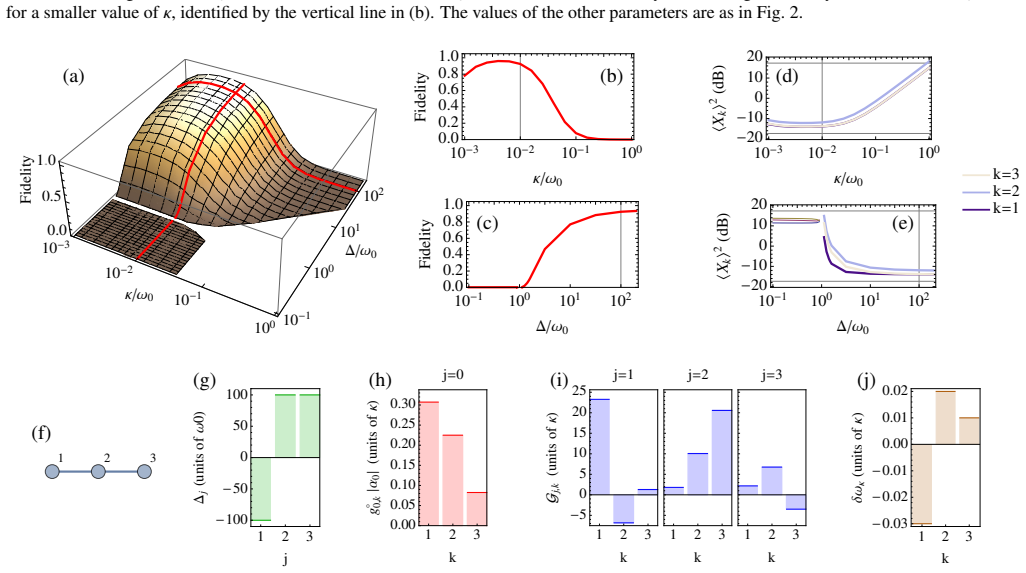
Fidelity The fidelity measures how close two states are. The fidelity between the steady state of our system and the target state, can be expressed in terms of the covariance matrices as [64] F= 2N q E(b) st +E (b) target ,(D1) where the target covariance matrixE (b) target is evaluated as fol- lows. The elements ofE (b) target are n E(b) target o k,k′ = ...
-
[2]
V is the variance of the nullifiers
Variance of the nullifiers The other quantity that we study in Sec. V is the variance of the nullifiers. An ideal Gaussian cluster states with adjacency matrixA is defined as the eigenstate at zero eigenvalue of the nullifiers, that are the linear combination of quadrature operators [52, 53] Xk =−i bkeiθk −b † ke−iθ j − NX k′=1 Akk′ bk′ eiθk′ +b † k′ e−iθ...
-
[3]
S. Barzanjeh, A. Xuereb, S. Gr ¨oblacher, M. Paternostro, C. A. Regal, and E. M. Weig, Optomechanics for quantum technolo- gies, Nat. Phys.18, 15 (2022)
work page 2022
- [4]
-
[5]
M. Aspelmeyer, T. J. Kippenberg, and F. Marquardt, Cavity op- tomechanics, Rev. Mod. Phys.86, 1391 (2014)
work page 2014
-
[6]
W. H. P. Nielsen, Y . Tsaturyan, C. B. Møller, E. S. Polzik, and A. Schliesser, Multimode optomechanical system in the quan- tum regime, Proc. Natl. Acad. Sci.114, 62 (2017)
work page 2017
-
[7]
M. J. Weaver, F. Buters, F. Luna, H. Eerkens, K. Heeck, S. de Man, and D. Bouwmeester, Coherent optomechanical state transfer between disparate mechanical resonators, Nat Commun 16 8, 824 (2017)
work page 2017
-
[8]
E. Gil-Santos, M. Labousse, C. Baker, A. Goetschy, W. Hease, C. Gomez, A. Lema ˆıtre, G. Leo, C. Ciuti, and I. Favero, Light-Mediated Cascaded Locking of Multiple Nano- Optomechanical Oscillators, Phys. Rev. Lett.118, 063605 (2017)
work page 2017
- [9]
-
[10]
P. Piergentili, L. Catalini, M. Bawaj, S. Zippilli, N. Malossi, Riccardo Natali, D. Vitali, and G. D. Giuseppe, Two-membrane cavity optomechanics, New J. Phys.20, 083024 (2018)
work page 2018
-
[11]
I. Moaddel Haghighi, N. Malossi, R. Natali, G. Di Giuseppe, and D. Vitali, Sensitivity-Bandwidth Limit in a Multimode Op- toelectromechanical Transducer, Phys. Rev. Applied9, 034031 (2018)
work page 2018
-
[12]
M. F. Colombano, G. Arregui, N. E. Capuj, A. Pitanti, J. Maire, A. Griol, B. Garrido, A. Martinez, C. M. Sotomayor-Torres, and D. Navarro-Urrios, Synchronization of Optomechanical Nanobeams by Mechanical Interaction, Phys. Rev. Lett.123, 017402 (2019)
work page 2019
-
[13]
J. P. Mathew, J. del Pino, and E. Verhagen, Synthetic gauge fields for phonon transport in a nano-optomechanical system, Nat. Nanotechnol.15, 198 (2020)
work page 2020
-
[14]
P. Piergentili, W. Li, R. Natali, N. Malossi, D. Vitali, and G. D. Giuseppe, Two-membrane cavity optomechanics: Non-linear dynamics, New J. Phys.23, 073013 (2021)
work page 2021
-
[15]
N. Fiaschi, B. Hensen, A. Wallucks, R. Benevides, J. Li, T. P. M. Alegre, and S. Gr ¨oblacher, Optomechanical quantum teleportation, Nat. Photon.15, 817 (2021)
work page 2021
-
[16]
L. Mercier de L ´epinay, C. F. Ockeloen-Korppi, M. J. Woolley, and M. A. Sillanp¨a¨a, Quantum mechanics–free subsystem with mechanical oscillators, Science372, 625 (2021)
work page 2021
-
[17]
L. Mercad ´e, K. Pelka, R. Burgwal, A. Xuereb, A. Mart´ınez, and E. Verhagen, Floquet Phonon Lasing in Multimode Optome- chanical Systems, Phys. Rev. Lett.127, 073601 (2021)
work page 2021
-
[18]
J. del Pino, J. J. Slim, and E. Verhagen, Non-Hermitian chiral phononics through optomechanically induced squeezing, Na- ture606, 82 (2022)
work page 2022
-
[19]
M. H. J. de Jong, J. Li, C. G ¨artner, R. A. Norte, and S. Gr¨oblacher, Coherent mechanical noise cancellation and co- operativity competition in optomechanical arrays, Optica9, 170 (2022)
work page 2022
- [20]
-
[21]
A. Youssefi, S. Kono, A. Bancora, M. Chegnizadeh, J. Pan, T. V ovk, and T. J. Kippenberg, Topological lattices realized in superconducting circuit optomechanics, Nature612, 666 (2022)
work page 2022
-
[22]
H. Ren, T. Shah, H. Pfeifer, C. Brendel, V . Peano, F. Marquardt, and O. Painter, Topological phonon transport in an optomechan- ical system, Nat Commun13, 3476 (2022)
work page 2022
-
[23]
L. Mercad ´e, R. Ortiz, A. Grau, A. Griol, D. Navarro-Urrios, and A. Mart´ınez, Engineering Multiple GHz Mechanical Modes in Optomechanical Crystal Cavities, Phys. Rev. Appl.19, 014043 (2023)
work page 2023
-
[24]
C. C. Wanjura, J. J. Slim, J. del Pino, M. Brunelli, E. Verhagen, and A. Nunnenkamp, Quadrature nonreciprocity in bosonic net- works without breaking time-reversal symmetry, Nat. Phys.19, 1429 (2023)
work page 2023
- [25]
-
[26]
M. Chegnizadeh, M. Scigliuzzo, A. Youssefi, S. Kono, E. Gu- zovskii, and T. J. Kippenberg, Quantum collective motion of macroscopic mechanical oscillators, Science386, 1383 (2024)
work page 2024
-
[27]
J. Vijayan, J. Piotrowski, C. Gonzalez-Ballestero, K. Weber, O. Romero-Isart, and L. Novotny, Cavity-mediated long-range interactions in levitated optomechanics, Nat. Phys.20, 859 (2024)
work page 2024
-
[28]
D. Alonso-Tom ´as, C. M. Arab ´ı, C. Mili ´an, N. E. Capuj, A. Mart ´ınez, and D. Navarro-Urrios, Self-modulated multi- mode silicon cavity optomechanics (2025), arXiv:2501.16914
-
[29]
B. A. Moores, L. R. Sletten, J. J. Viennot, and K. W. Lehn- ert, Cavity Quantum Acoustic Device in the Multimode Strong Coupling Regime, Phys. Rev. Lett.120, 227701 (2018)
work page 2018
- [30]
-
[31]
U. von L ¨upke, I. C. Rodrigues, Y . Yang, M. Fadel, and Y . Chu, Engineering multimode interactions in circuit quantum acous- todynamics, Nat. Phys.20, 564 (2024)
work page 2024
-
[32]
C. F. Ockeloen-Korppi, E. Damsk ¨agg, J.-M. Pirkkalainen, M. Asjad, A. A. Clerk, F. Massel, M. J. Woolley, and M. A. Sillanp¨a¨a, Stabilized entanglement of massive mechanical os- cillators, Nature556, 478 (2018)
work page 2018
-
[33]
R. Riedinger, A. Wallucks, I. Marinkovi ´c, C. L ¨oschnauer, M. Aspelmeyer, S. Hong, and S. Gr ¨oblacher, Remote quantum entanglement between two micromechanical oscillators, Nature 556, 473 (2018)
work page 2018
- [34]
-
[35]
G. Andersson, S. W. Jolin, M. Scigliuzzo, R. Borgani, M. O. Thol´en, J. Rivera Hern´andez, V . Shumeiko, D. B. Haviland, and P. Delsing, Squeezing and Multimode Entanglement of Surface Acoustic Wave Phonons, PRX Quantum3, 010312 (2022)
work page 2022
-
[36]
E. A. Wollack, A. Y . Cleland, R. G. Gruenke, Z. Wang, P. Arrangoiz-Arriola, and A. H. Safavi-Naeini, Quantum state preparation and tomography of entangled mechanical res- onators, Nature604, 463 (2022)
work page 2022
-
[37]
K. Stannigel, P. Rabl, A. S. Sørensen, P. Zoller, and M. D. Lukin, Optomechanical Transducers for Long-Distance Quan- tum Communication, Phys. Rev. Lett.105, 220501 (2010)
work page 2010
-
[38]
S. J. M. Habraken, K. Stannigel, M. D. Lukin, P. Zoller, and P. Rabl, Continuous mode cooling and phonon routers for phononic quantum networks, New J. Phys.14, 115004 (2012)
work page 2012
- [39]
- [40]
-
[41]
M. S. Ebrahimi, S. Zippilli, and D. Vitali, Feedback-enabled microwave quantum illumination, Quantum Sci. Technol.7, 035003 (2022)
work page 2022
-
[42]
Y . Xia, A. R. Agrawal, C. M. Pluchar, A. J. Brady, Z. Liu, Q. Zhuang, D. J. Wilson, and Z. Zhang, Entanglement- enhanced optomechanical sensing, Nat. Photon.17, 470 (2023)
work page 2023
-
[43]
K. Stannigel, P. Komar, S. J. M. Habraken, S. D. Bennett, M. D. 17 Lukin, P. Zoller, and P. Rabl, Optomechanical Quantum Infor- mation Processing with Photons and Phonons, Phys. Rev. Lett. 109, 013603 (2012)
work page 2012
-
[44]
M. Schmidt, M. Ludwig, and F. Marquardt, Optomechanical circuits for nanomechanical continuous variable quantum state processing, New J. Phys.14, 125005 (2012)
work page 2012
-
[45]
M. Ludwig and F. Marquardt, Quantum Many-Body Dynam- ics in Optomechanical Arrays, Phys. Rev. Lett.111, 073603 (2013)
work page 2013
-
[46]
M. Schmidt, V . Peano, and F. Marquardt, Optomechanical Dirac physics, New J. Phys.17, 023025 (2015)
work page 2015
-
[47]
M. Schmidt, S. Kessler, V . Peano, O. Painter, and F. Marquardt, Optomechanical creation of magnetic fields for photons on a lattice, Optica, OPTICA2, 635 (2015)
work page 2015
- [48]
- [49]
-
[50]
C. T. Hann, C.-L. Zou, Y . Zhang, Y . Chu, R. J. Schoelkopf, S. M. Girvin, and L. Jiang, Hardware-Efficient Quantum Ran- dom Access Memory with Hybrid Quantum Acoustic Systems, Phys. Rev. Lett.123, 250501 (2019)
work page 2019
-
[51]
C. Chamberland, K. Noh, P. Arrangoiz-Arriola, E. T. Camp- bell, C. T. Hann, J. Iverson, H. Putterman, T. C. Bohdanowicz, S. T. Flammia, A. Keller, G. Refael, J. Preskill, L. Jiang, A. H. Safavi-Naeini, O. Painter, and F. G. Brand˜ao, Building a Fault- Tolerant Quantum Computer Using Concatenated Cat Codes, PRX Quantum3, 010329 (2022)
work page 2022
- [52]
-
[53]
S. Zippilli and D. Vitali, Dissipative Engineering of Gaus- sian Entangled States in Harmonic Lattices with a Single-Site Squeezed Reservoir, Phys. Rev. Lett.126, 020402 (2021)
work page 2021
-
[54]
J. Zhang and S. L. Braunstein, Continuous-variable Gaussian analog of cluster states, Phys. Rev. A73, 032318 (2006)
work page 2006
-
[55]
S. Zippilli and D. Vitali, Possibility to generate any Gaussian cluster state by a multi-mode squeezing transformation, Phys. Rev. A102, 052424 (2020)
work page 2020
-
[56]
J. B. Clark, F. Lecocq, R. W. Simmonds, J. Aumentado, and J. D. Teufel, Sideband cooling beyond the quantum backaction limit with squeezed light, Nature541, 191 (2017)
work page 2017
-
[57]
M. J. Yap, J. Cripe, G. L. Mansell, T. G. McRae, R. L. Ward, B. J. J. Slagmolen, P. Heu, D. Follman, G. D. Cole, T. Corbitt, and D. E. McClelland, Broadband reduction of quantum radia- tion pressure noise via squeezed light injection, Nat. Photonics 14, 19 (2020)
work page 2020
- [58]
-
[59]
W. P. Bowen and G. J. Milburn,Quantum Optomechanics(Tay- lor & Francis, 2015)
work page 2015
-
[60]
C. Biancofiore, M. Karuza, M. Galassi, R. Natali, P. Tombesi, G. Di Giuseppe, and D. Vitali, Quantum dynamics of a high- finesse optical cavity coupled with a thin semi-transparent membrane, Phys. Rev. A84, 033814 (2011)
work page 2011
- [61]
-
[62]
M. Eichenfield, J. Chan, A. H. Safavi-Naeini, K. J. Vahala, and O. Painter, Modeling dispersive coupling and losses of localized optical and mechanical modes in optomechanical crystals, Opt. Express, OE17, 20078 (2009)
work page 2009
-
[63]
M. Wu, A. C. Hryciw, C. Healey, D. P. Lake, H. Jayakumar, M. R. Freeman, J. P. Davis, and P. E. Barclay, Dissipative and Dispersive Optomechanics in a Nanocavity Torque Sensor, Phys. Rev. X4, 021052 (2014)
work page 2014
-
[64]
O. Shevchuk, G. A. Steele, and Ya. M. Blanter, Strong and tun- able couplings in flux-mediated optomechanics, Phys. Rev. B 96, 014508 (2017)
work page 2017
-
[65]
I. C. Rodrigues, D. Bothner, and G. A. Steele, Coupling mi- crowave photons to a mechanical resonator using quantum in- terference, Nat Commun10, 5359 (2019)
work page 2019
-
[66]
G. Spedalieri, C. Weedbrook, and S. Pirandola, A limit formula for the quantum fidelity, J. Phys. A: Math. Theor.46, 025304 (2013)
work page 2013
-
[67]
N. C. Menicucci, Fault-Tolerant Measurement-Based Quantum Computing with Continuous-Variable Cluster States, Phys. Rev. Lett.112, 120504 (2014)
work page 2014
- [68]
-
[69]
B. W. Walshe, L. J. Mensen, B. Q. Baragiola, and N. C. Menicucci, Robust fault tolerance for continuous-variable clus- ter states with excess antisqueezing, Phys. Rev. A100, 010301 (2019)
work page 2019
-
[70]
G. S. MacCabe, H. Ren, J. Luo, J. D. Cohen, H. Zhou, A. Sipahigil, M. Mirhosseini, and O. Painter, Nano-acoustic resonator with ultralong phonon lifetime, Science370, 840 (2020)
work page 2020
discussion (0)
Sign in with ORCID, Apple, or X to comment. Anyone can read and Pith papers without signing in.